Take the bus from Sakurai’s south exit to Tanzan Shrine and follow the Ashiraku route to the thirteen-storey pagoda, worship hall and East Hall. Compare Hasedera as a half-day alternative, with its 399 steps, special Kannon viewing, autumn 2026 events and return transport.
- Region & Focus
- KansaiShrines and temples
- Reading Scope
- 32 min read · 17 chapters · 6 Q&As
- Official Verification
- 20 official sources checkedUpdated 27 October 2026
- Key Topics
- ItinerariesRail travelSeasons
Chapter Route Map (tap any stop)
- Choose the setting: a pagoda in woodland or covered steps and a Kannon hall
- At Sakurai, find the south exit and a bus marked Tanzan Shrine
- Choose the return bus before deciding how much more to see
- Tanzan admission is now ¥700: distinguish last admission from closing
- Use the Ashiraku route and leave the 140 front steps optional
- At the thirteen-storey pagoda, study the roofs, then turn towards the former lecture hall
- Inside the worship hall, look at the vermilion stage, turning corridors and slope
- Finish with the East Hall and Love Path; budget separately for the rear mountain
- Read Tanzan’s name and kemari festival through the shrine’s tradition
- Tanzan’s 2026 foliage festival and illuminations: arrange the night descent first
- Give lunch on the Tanzan day a complete gap before the downhill bus
- Choose Hasedera instead: walk from Kintetsu Hasedera Station into Hase temple town
- The 399 covered steps form three sections: rest before you are exhausted
- Hasedera’s main hall and eleven-headed Kannon: admission and special viewing are separate
- Hasedera’s autumn 2026 special viewing needs an extra ¥1,000 and reception time
- For wheelchairs, pushchairs or rain, change the main route to what is accessible
- Give the day to one site and assess any spare time after returning to Sakurai
- Quick Q&A
Tanzan Shrine suits half a day among a thirteen-storey pagoda, vermilion halls and woodland. Hasedera offers a different half-day built around its covered stairway, main hall and Hase temple town. Both are in Sakurai, but access differs: Tanzan needs a bus from Sakurai Station, while Hasedera is a walk from Kintetsu Hasedera Station. For a first visit, choose one for an unhurried visit and a proper meal before returning. For special autumn openings, match visiting hours with downhill transport first. Prices and events below use official information dated 27 October 2026.
Choose the setting: a pagoda in woodland or covered steps and a Kannon hall
Choose Tanzan Shrine for a wooden pagoda, vermilion buildings along a slope and views where architecture and trees partly conceal each other. The main sights share one hillside. Linger around the thirteen-storey pagoda and worship hall, adding the East Hall if energy allows. Bus times frame the day, so it suits an early start with the afternoon return settled first. After several city temples elsewhere in Kansai, the mountain setting offers a clear change.
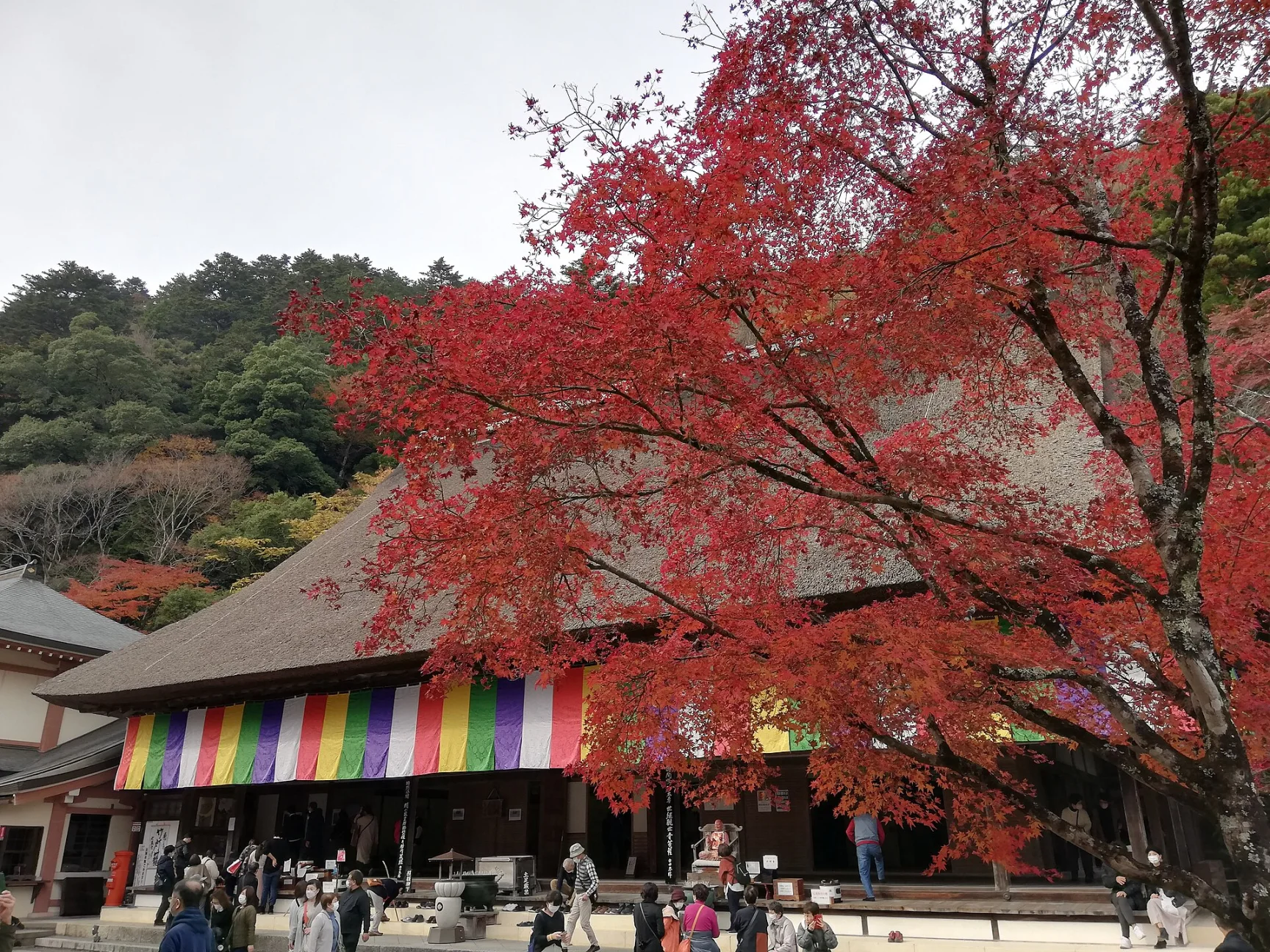
Choose Hasedera for roofed steps, a large wooden Kannon statue and the main hall’s viewing stage. The covered stairway makes the ascent part of worship, while the temple town suits lunch and a walk before leaving. There is still a walk from the railway station: train arrival is not temple entry. If steps are a concern, read the temple’s internal transport conditions before deciding whether everyone will ascend to the main hall.
Allow three to four hours for either, including access, worship, rest and a simple meal. With only half a day, give it all to one site. With a full day, explore Tanzan more closely or add Hasedera’s special viewing or temple treasures exhibition. For Nara Park, hotels and the Great Buddha route, read Nara in one day or with an overnight stay and put it on a different travel day.
| Site | Access | Main walking | What to stay for |
|---|---|---|---|
| Tanzan Shrine | Nara Kotsu bus from Sakurai Station south exit | Slopes and stone steps; optional trails behind the shrine | Pagoda, shrine halls, woodland and festivals |
| Hasedera | About 15 minutes’ walk from Kintetsu Hasedera Station | 399 covered steps and the walk back to the station | Main hall, Kannon and the temple town |
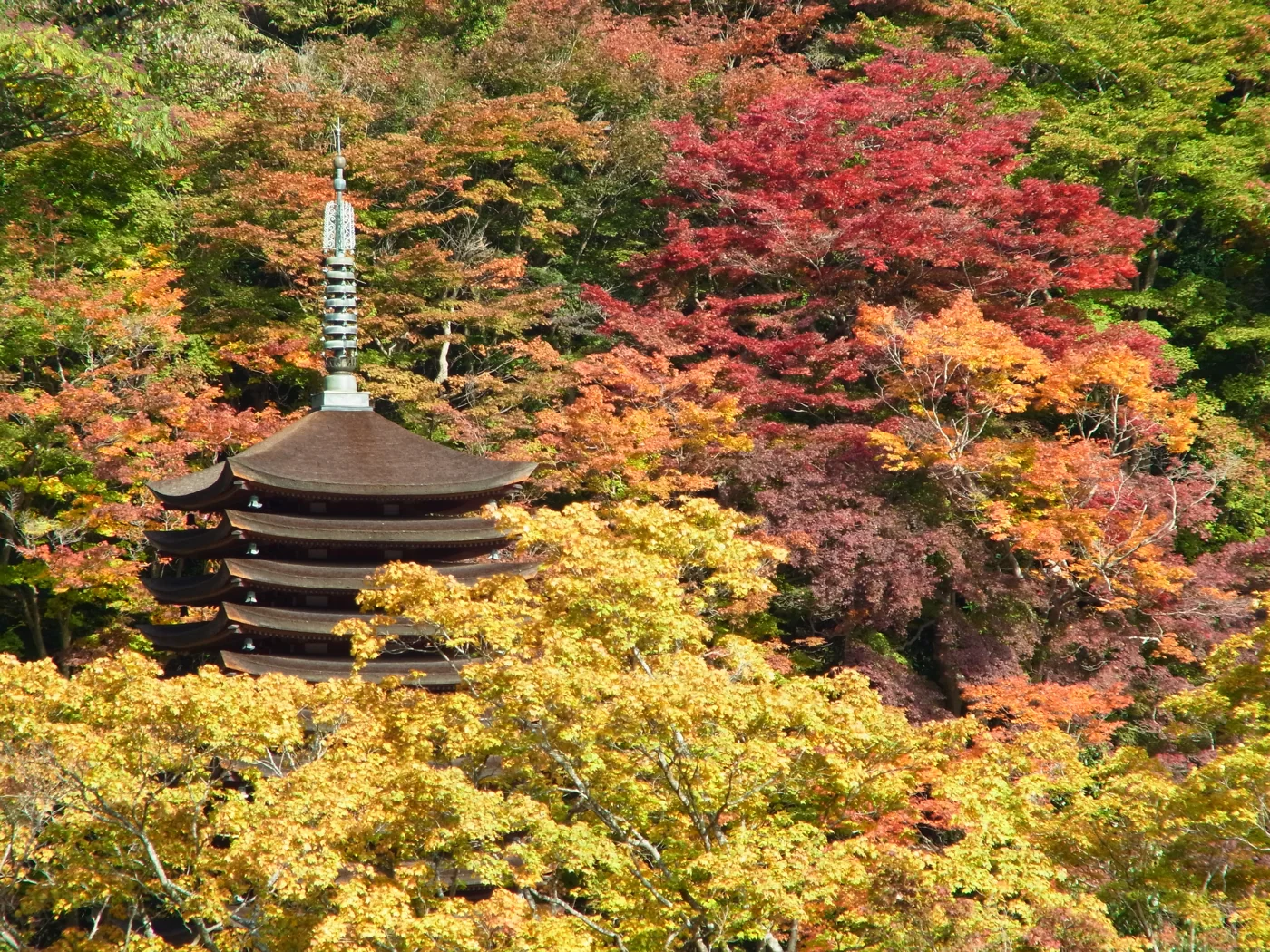
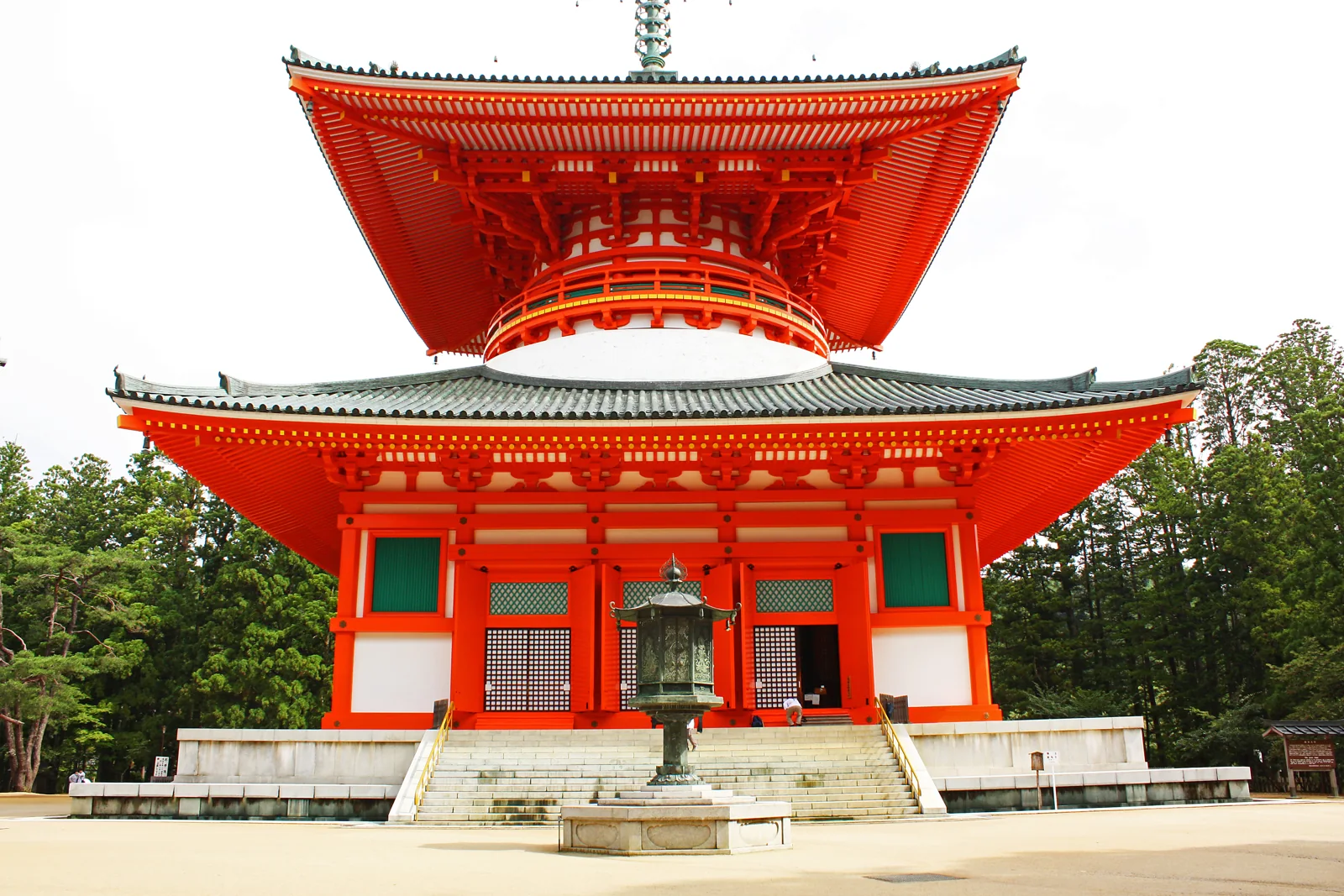
Take the bus from Sakurai’s south exit to Tanzan Shrine and follow the Ashiraku route to the thirteen-storey pagoda, worship hall and East Hall. Compare Hasedera as a half-day alternative, with its 399 steps, special Kannon viewing, autumn 2026 events and return transport.
At Sakurai, find the south exit and a bus marked Tanzan Shrine
For Tanzan Shrine, change at JR or Kintetsu Sakurai Station and take Nara Kotsu from the south exit. Use the Japanese stop name Sakurai-eki Minamiguchi (桜井駅南口) on your phone and the sign. JR and Kintetsu gates lead out differently, so allow time on a first visit to reach the south exit, find the stop and confirm the bus destination. Search from your accommodation to the station’s south exit first, then check the uphill leg separately.
Nara Kotsu’s current autumn page lists about 25 minutes from Sakurai Station south exit to Tanzan Shrine, with an adult one-way fare of ¥570. Tonomine is an intermediate stop separate from the Tanzan Shrine terminus, with a ¥500 fare. Pay for the stop actually used. In autumn congestion, the operator may terminate buses at Tonomine; follow that day’s walking directions to the shrine. Check the destination before boarding and locate the Sakurai-bound boarding point after alighting. Similar mountain place names are no reason to get off early.
Leave large luggage at your original accommodation and carry water, an outer layer, rainwear and daily essentials. There is still a walk from the bus to the entrance and stone steps within the grounds. A suitcase adds difficulty to both bus travel and worship. From Osaka or Kyoto, calculate rail to Sakurai, waiting and the final uphill ride separately. Use the morning bus to set breakfast and departure time.
Choose the return bus before deciding how much more to see
As of the checking date, Nara Kotsu’s normal timetable is marked revised 1 April 2025 and lists 17:52 as the final Tanzan Shrine departure to Sakurai Station south exit. Read the weekday and weekend/public holiday columns separately. This identifies the day’s transport limit. Plan an earlier service to leave room for a missed bus, a longer visit or congestion. Nara Kotsu’s official website provides date-specific routes and temporary service information.
For example, start with 09:45 uphill from Sakurai Station south exit and 13:17 downhill from Tanzan Shrine. Using the roughly 25-minute ride estimate, this leaves roughly three hours on the mountain for the main halls and a rest. For a slower lunch, choose 14:28 downhill and shorten the East Hall or another branch according to actual queues. Allow separately for waiting and congestion, dropping later additions if traffic delays you.
Other usual daytime descents include 15:32 and 16:37, with the last at 17:52. For a morning start, choose 13:17 or 14:28 first and keep later departures as fallbacks. Choosing 10:50 uphill instead of 09:45 removes about an hour of visiting time. Drop the rear mountain trail first, then the East Hall, rather than cutting meals or jogging to the bus. Sakurai’s tourism association explicitly says the revised 2025 timetable continues unchanged in 2026.
Save both the intended downhill departure and the next service, including stop name, direction, operating days and revision date in screenshots. Check the stop again on arrival. If signs announce a diversion or suspension, adjust the visit first. For a dinner reservation, work backwards from Sakurai to your accommodation. Do not make the bus wait the final deadline with no remaining room to adjust.
Make a decision on leaving the worship hall. Only add the East Hall or a rest if the main visit is complete and there is time before your chosen bus. Adding a rear mountain trail requires a fresh deduction for the out-and-back path and return to the stop. Visiting every corner is not needed to make the mountain worthwhile. Time at a building you enjoy is usually fuller than rushing to collect the final two map pins.
| Leg | Available departures | Use in this example |
|---|---|---|
| Sakurai south exit → Tanzan Shrine | 09:45, 10:50 | Choose one morning ascent |
| Tanzan Shrine → Sakurai south exit | 13:17, 14:28 | Planned descent for the main half-day route |
| Tanzan Shrine → Sakurai south exit | 15:32, 16:37 | Later services for a longer visit |
| Tanzan Shrine → Sakurai south exit | 17:52 | Normal last bus; separate from the 20:30 illumination finish |
Tanzan admission is now ¥700: distinguish last admission from closing
The Tanzan Shrine admission guide now lists ¥700 for general adult admission, ¥300 for primary school children and free entry for preschool children. These prices took effect on 1 April 2026. Normal admission runs 08:30–16:00, with visits ending at 16:30. At 16:00, new entry closes. For an afternoon arrival, check how much time remains before buying a ticket for the full grounds.
The official disability concession is ¥350 for the eligible visitor and the same amount for one accompanying person, with the required proof shown on entry. Discounts cannot be combined. Start group budgets at ordinary individual prices, adjusting after establishing eligibility. Group rates, study-visit rates and older offers are not the price for everyone. Two adults and one primary school child pay ¥1,700 for normal admission, a fixed item for the day’s budget.
For a daytime visit, leave a full morning for the halls and keep the post-lunch route optional. Near last admission, prioritise the pagoda and worship hall, leaving the East Hall and rear mountain trails until later. The same approach suits long autumn photography stops: waiting for light reduces later walking time rather than creating extra hours.
Use the Ashiraku route and leave the 140 front steps optional
The shrine’s recommended visiting route starts at the front reception, then follows the Ashiraku route towards Haraedo Shrine and the west entrance, continuing to the Soja main hall, Soja worship hall and Akaiya well house. The official grounds map marks this cross-slope path, the 140 front stone steps and the upper halls separately. For a first visit, ascend gradually in this order and choose an exit later rather than taking the whole family straight up the long front stairway.
The smaller buildings along this side allow a pause to identify roofs and locations. The Soja main hall is a relocated former main shrine building; the Soja worship hall has curved karahafu gables at front and rear. Akaiya preserves a well associated with the site’s temple history. Continuing from here to the Shinbyo worship hall and pagoda helps explain why a shrine contains a pagoda, a former lecture hall and a well rather than treating them as unrelated photograph stops.
The Ashiraku route is still on a hillside, with changes in level along paths and at building entrances. For fewer steps, use the map to choose a manageable section and ask entrance staff for directions. The buildings page also says the front stairs may close outside peak cherry blossom and autumn foliage periods. Follow the open entrances for the season rather than entering closed steps or returning downhill to reproduce a photograph.
At the thirteen-storey pagoda, study the roofs, then turn towards the former lecture hall
Fujiwara no Kamatari’s son Jōe founded the pagoda in memory of his father. The shrine dates its origin to 678; the surviving wooden structure was rebuilt in 1532. The official buildings guide describes it as the only surviving wooden thirteen-storey pagoda and an Important Cultural Property. Studying the progressively smaller roofs reveals the outline better than simply counting thirteen levels. For a full view, step back without blocking the path and include the trees with the tower.
Facing the pagoda is the Shinbyo worship hall, formerly Myorakuji’s lecture hall. Their relationship preserves the earlier temple layout. The shrine’s history links memorial rites for Kamatari, reburial of his remains and Myorakuji’s foundation, followed by a sanctuary housing his sacred image. Look at the pagoda, then turn towards the former lecture hall to see Buddhist memorial practice and Kamatari worship meet within the same grounds.
Slow down here rather than assigning every building a fixed number of minutes. Cloudy weather reveals roof lines; sunshine brings light through leaves. Both offer detail. If autumn crowds gather at the pagoda, visit nearby Gonden and Hie Shrine first, then return without changing the planned return time. This group and the worship hall already explain Tanzan’s most distinctive architectural relationships.
Inside the worship hall, look at the vermilion stage, turning corridors and slope
From the pagoda, the official route’s middle section continues through the west treasure store and tower gate to the worship hall. Built in 1520, it has a vermilion stage structure, cypress-bark roofing and open corridors turning around both sides of the main sanctuary. From a place where you can pause, see how columns divide the woodland beyond the slope into frames, then how the turning corridors follow the terrain. In autumn, the space between architecture and leaf colour becomes the focus.
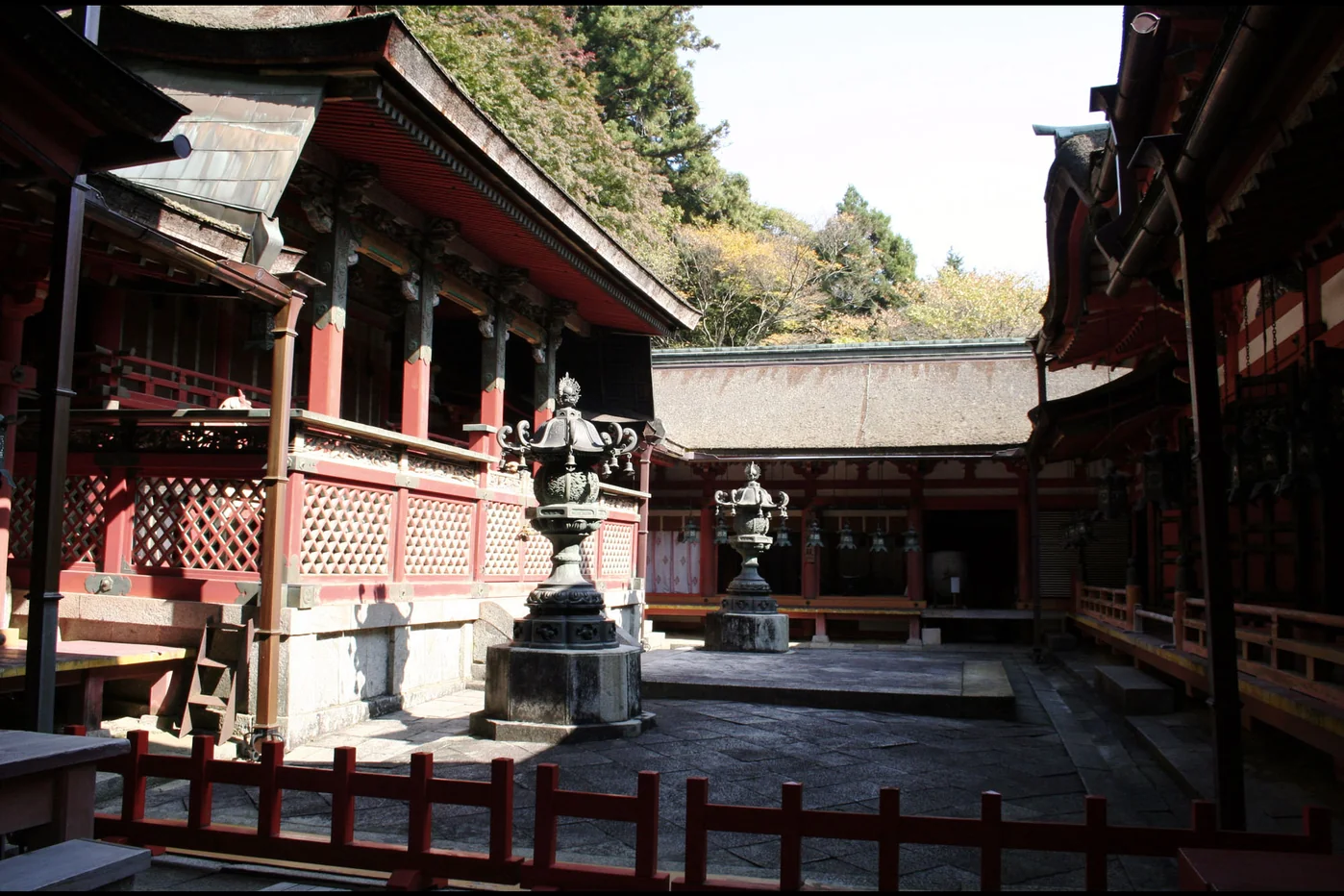
The main sanctuary enshrines Fujiwara no Kamatari. Its current building dates to 1850, unlike the worship hall. Both are Important Cultural Properties. Notice how the sanctuary’s vermilion and painted decoration relate to the worship hall’s more open stage. Worship first, then move aside to observe without blocking people wanting a quiet prayer. Follow posted photography restrictions indoors and in exhibition areas; do not extend a phone into prohibited spaces.
The east and west treasure stores use azekura log construction. Official information says some historic treasures are deposited with museums. For a special treasures exhibition, read the current notice rather than assuming the building name means every collection is on permanent display inside. Architecture-focused companions can use this stretch for the gate, roofs and corridors. Those interested in calligraphy, painting or historical documents can choose one subject from the current displays.
Finish with the East Hall and Love Path; budget separately for the rear mountain
Continue from the worship hall towards the east treasure store and Kannon Hall, then the East Hall and Love Path, for the second part of the walk. The East Hall, also called the Love Shrine, enshrines Kagami no Okimi, Jōe and Fujiwara no Fuhito. It is a relocated former main sanctuary and an Important Cultural Property. Follow the local form of worship if making a wish. For architecture alone, compare its relocation with the Soja main hall: former sanctuary buildings now serve different functions in different places.
Tanzan and Mount Goharetsu behind the main sanctuary are extra trails. From the trail entrance, the buildings page gives Tanzan as 290 metres, about ten minutes’ walk, and Mount Goharetsu as 510 metres, about 20 minutes. These are one-way figures; add the return, stops and slower walking on wet surfaces. The admission guide separately ends access for worship at Mount Goharetsu and Santen Inari at 15:00, with mountain closure at 16:00. General shrine-building visiting hours do not apply.
If descents trouble your knees, shoes are unsuitable, arrival is late or you want to sit down, finish after the East Hall. With a strong interest in Kamatari, good weather and enough time, choose one rear mountain destination rather than making both branches compulsory. Before returning to the exit, use the toilet and sort outer layers, then walk to the bus stop. Do not leave the final hall only moments before departure.
Read Tanzan’s name and kemari festival through the shrine’s tradition
According to the shrine’s history, Prince Naka no Oe and Nakatomi no Kamatari conferred on this mountain, a tradition behind the name Tanzan. Their first meeting is linked to a kemari ball game at Hokoji in Asuka. Reading this as historical memory preserved by the shrine shifts the focus from maple trees alone to why the pagoda, sacred image and Kamatari rites gather here. This account is enough for another layer of understanding beyond photographs.
The annual events list gives the autumn Kemari Festival at 11:00 on 3 November and the main annual festival at 10:30 on 17 November. Kemari preserves through ritual the traditional account of the two men’s meeting; the annual festival relates to Kamatari’s death anniversary. If travelling for a ceremony, include viewing, movement and crowds in the mountain time and make one event the day’s centre. Ordinary visitors who encounter a ceremony should observe from the designated paths and keep ritual and staff routes clear.
On festival days, both building visits and transport may take longer. Reach your main target first, then decide whether to wait for the ceremony rather than walking many branches in the morning and finding viewing areas full in the afternoon. If companions are uninterested, agree a named entrance or rest point to reunite. Work the meeting time backwards from the return bus rather than splitting up at a trail junction.
Tanzan’s 2026 foliage festival and illuminations: arrange the night descent first
Tanzan Shrine’s 2026 autumn foliage festival is announced for 1 October–6 December. Illuminations run separately from 14 November to 6 December, from after sunset until 20:30. These are different date ranges: an October visit does not include November evening leaves. Colour develops over time. Check current official foliage photographs and weather when choosing a date, retaining daytime architecture as the main visit so chasing one particular colour does not leave the day empty.
The normal last bus at 17:52 cannot cover an illumination finish at 20:30. To see the full evening scene, arrange a working accommodation transfer, confirmed taxi or your own car before staying. With normal buses only, focus on daytime. A last-minute mountain taxi still needs an operator willing to accept the journey and time to reach you. A prearranged descent supports the evening plan. If extra buses are announced, adjust for the specified date and direction.
With a car, choose the parking location and shrine entrance together; mountain-road visibility changes at dusk. For children or older relatives, complete lunch and rest before going up or staying on rather than walking from morning to night. Follow the event’s open areas. Daytime rear mountain trails do not become evening walks. If tired, descend on the original bus and leave evening views for a prepared visit, preserving a complete daytime experience.
Give lunch on the Tanzan day a complete gap before the downhill bus
The buildings page lists Katarai-no-Mori at 11:00–14:00, extended to 15:00 on weekends and public holidays, with irregular closing days and separate reservations for groups. For lunch on the mountain, finish the pagoda and main halls in the morning, then eat. For an afternoon visit, a meal in Sakurai first is easier. With irregular dining closures, carry suitable snacks and water and use permitted rest areas rather than eating in worship or circulation spaces.
Include queuing and the walk to the stop in mountain lunch time. If there is no complete meal gap left, descend and eat near the station rather than missing the chosen bus to sit down hurriedly. For relatives with fixed meal or medication times, reserve this break first, then choose the East Hall and rear mountain additions. This makes continuing more predictable and avoids searching for food when everyone is most tired.
For one adult travelling between Sakurai and Tanzan with ordinary admission, buses at ¥570 × 2 plus ¥700 total ¥1,840 in fixed costs. List meals, travel from the starting city to Sakurai, shrine items and any taxi separately. Two adults and a primary school child have a fixed ¥1,700 admission total; calculate the bus portion using Nara Kotsu’s child fares. Set known costs first to leave money for a meal or shrine item you want.
Choose Hasedera instead: walk from Kintetsu Hasedera Station into Hase temple town
Hasedera’s rail gateway is Hasedera Station on the Kintetsu Osaka Line. The temple’s access guide gives about 15 minutes on foot. This is Hase in Sakurai, Nara Prefecture, distinct from the temple with the same name in Kamakura. Check the address Hase 731-1. From Osaka or Kyoto, search Kintetsu changes from your accommodation to Hasedera Station rather than detouring through Nara Park and back to Sakurai. Plan the station walk and covered stairway separately: reaching the station is only the start below the temple.
Walk through the streets towards the temple town and temple, remembering that the return is on foot too. Leave shopping until after descending rather than breaking up morning admission with snack queues. After a late breakfast, go to the temple first, finish the main hall, then find lunch along the street. If you need food first, eat below before climbing the covered stairs. Choose the order by admission time, special-viewing reception and the group’s appetite.
Temple parking for a standard car costs ¥500, separately from admission. Follow official vehicle directions to the actual car park rather than treating a narrow pedestrian route through town as a driving shortcut. The 2026 1,300th-anniversary event notices warn of busy roads and parking on event days. Rail reduces that uncertainty. Store large luggage first here too. An appealing temple town does not make a suitcase suitable for the station round trip and hillside steps.
The 399 covered steps form three sections: rest before you are exhausted
The Hasedera covered stairway guide divides the 399 steps into lower, middle and upper sections, becoming steeper towards the top. Roofs and hanging lamps create a continuous depth of view. As you walk, notice stair turns, beams, columns and light. For photographs, stand securely and let others pass first. The roof shelters part of the route, but the station walk and grounds still include outdoor stretches. In rain, wear grippy shoes and stow a dripping umbrella before continuing.
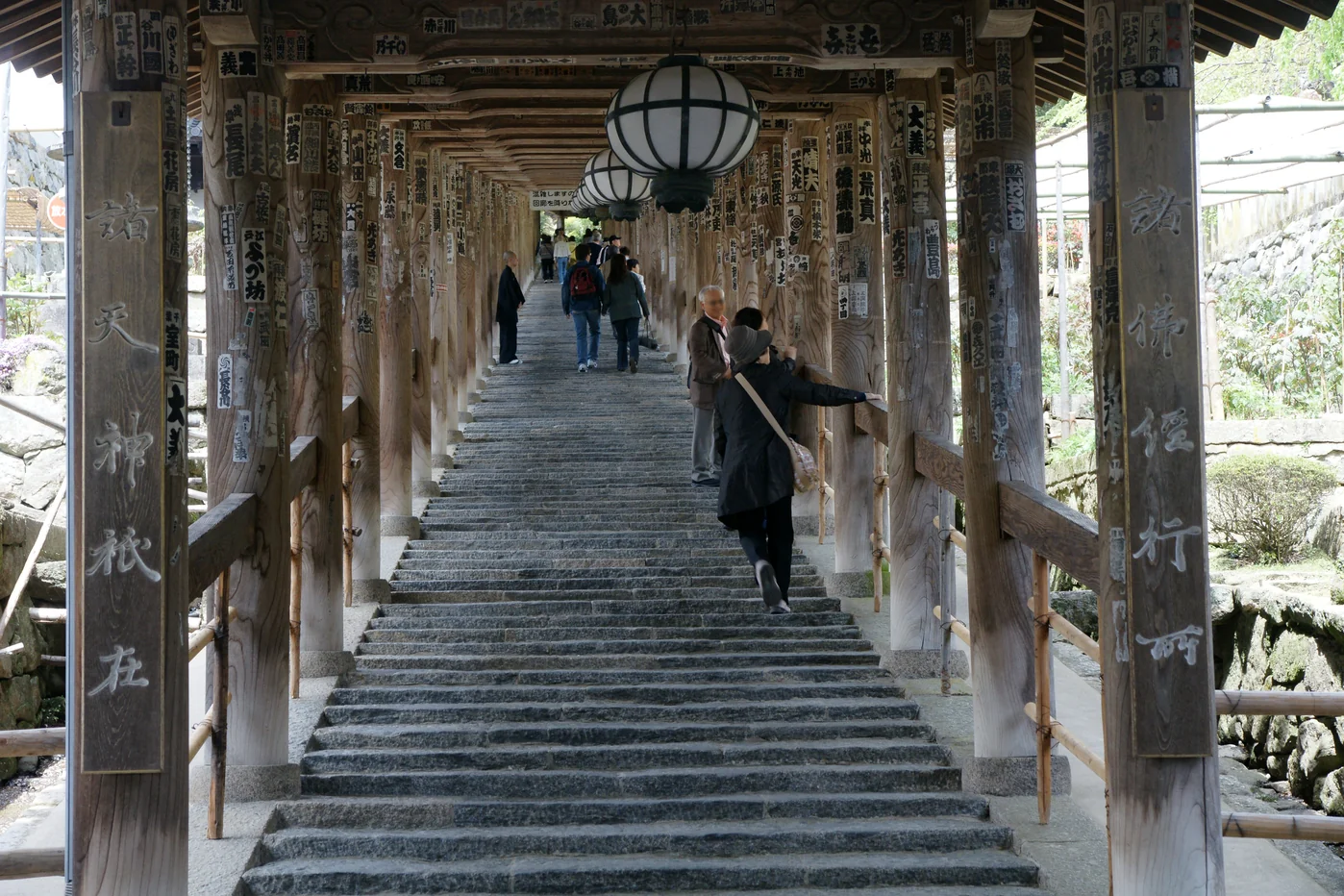
The official grounds map uses different colours for routes via Kaisando and the inner sanctuary, and marks rests, toilets and the west approach. Illustrative routes of about 30 or 40 minutes help explain direction. Add a fuller stay for queues, worship, exhibitions and photographs. On a first visit, follow Niomon Gate, the covered stairway and main hall, then choose one return route according to energy. Do not treat all dotted lines as one compulsory walk.
If walking speeds differ, wait in a broad space clear of the route. Do not let children sprint uphill and leave adults chasing. Stop while you still have energy rather than seeking room on the steepest upper section. There is another walk back to Hasedera Station after descending, so preserve strength, especially with sensitive knees. Dropping the pagoda or other branches after the main hall still leaves enough for a half-day.
Hasedera’s main hall and eleven-headed Kannon: admission and special viewing are separate
Ordinary individual admission to Hasedera is ¥500 for adults and junior/senior high school pupils, and ¥250 for primary school pupils. Opening hours are 08:30–17:00 from April to September; 09:00–17:00 in October, November and March; and 09:00–16:30 from December to February. These are normal admission hours. The special viewing of the principal image has its own reception times, so do not join its queue just before general closing. If that is the aim, enter and ascend in the morning, then eat lunch below.
The main hall’s projecting stage extends from the hillside. A stone-floored worship space lies between the inner sanctuary and worship hall in what the temple calls the twin-hall style. It was designated a National Treasure in 2004. Notice how the slope supports the structure and how interior worship connects with outward views. The stage reveals different levels of the grounds. Stand securely towards the inside rather than leaning a phone or body beyond the railing for distant roofs.
The principal eleven-headed Kannon is 10.18 metres tall. The surviving image was made in 1538, holds a staff in the right hand and a water vessel in the left, and stands on a large rock pedestal. These details introduce Hasedera’s form of Kannon. The temple prohibits photographing Buddhist images and monks. Give attention to the statue and rituals there; use official treasures information for a closer look at home. Paid special viewing brings visitors nearer the image’s feet. Choose it according to your interest.
| Item | General adult charge | Time conditions |
|---|---|---|
| Ordinary admission | ¥500 | October–November, 09:00–17:00 |
| Autumn special viewing of the principal image | Additional ¥1,000 | 10 October–6 December 2026, 09:30–16:00 |
| Admission plus special viewing | ¥1,500 total | Allow time for reception and the ascent first |
| Standard car parking | Additional ¥500 | Use the official vehicle entrance |
Hasedera’s autumn 2026 special viewing needs an extra ¥1,000 and reception time
The 2026 autumn foliage festival notice gives 10 October–6 December for autumn special viewing of the principal image, from 09:30 to 16:00, at an extra ¥1,000. Admission is separate, and no group discount applies. General adult admission with this viewing totals ¥1,500. If closeness to the principal Kannon is the aim, make the cost and queue part of the main plan, with lunch and shopping afterwards.
During the same period, the Kinshu Kiku Kairo chrysanthemum display occupies Arashi-no-Saka from 09:00 to 16:30, with no extra charge after entry. Pots of chrysanthemums line the steps. Flower enthusiasts can add it after the main hall; those wanting the covered stairway and worship alone can use ordinary admission. Autumn choices include chrysanthemums, buildings and Kannon worship as well as the state of the leaves. Give more time to one interest.
The 1,300th-anniversary programme also lists events such as the five-storey pagoda restoration completion service on 7 November. Read the specific notice before leaving, as events can affect roads and parking. For a quieter main hall visit, avoid major ceremony periods. The temple’s official autumn short film shows foliage and the stage in 2018 and helps explain the space. Use the 2026 notices for this year’s activities; the two serve different purposes.
The temple’s autumn 2018 short film shows foliage in the grounds, the main hall stage and walking spaces.
For wheelchairs, pushchairs or rain, change the main route to what is accessible
Tanzan Shrine offers priority parking at the west entrance for visitors with limited mobility and older visitors. The shrine office has a nursing room and wheelchairs to borrow. Taking a transfer to the appropriate entrance reduces access effort. If a companion cannot manage steps, ask reception to mark accessible routes and choose a few main sights. A borrowed wheelchair still requires help on slopes; do not include the front stairs, indoor level changes and rear mountain in one route.
Hasedera’s homepage says visitors who have difficulty reaching or leaving the main hall can request internal transport at the car park or admission reception. Demand can mean a wait, and temple events may prevent the service. This assists movement inside the temple; station-to-temple travel is separate. Explain wheelchair carriage, specific boarding assistance or a larger travelling party to the temple before leaving. If transport cannot meet the need, keep the temple town and reachable areas or use an already planned city half-day.
In light rain with normal transport, remove branches at both sites: keep Tanzan’s pagoda and main halls, or Hasedera’s covered stairway and main hall. In strong wind, heavy rain, road disruption or unsteady footing, cancel the mountain day and stay near your accommodation, visit Naramachi and city museums or rest. Hasedera prohibits tripods, monopods, ladders and drone operation. Handheld photography avoids extra luggage and stair effort for one angle.
Give the day to one site and assess any spare time after returning to Sakurai
For Tanzan, change in Sakurai in the morning, then follow the Ashiraku route to the pagoda and worship hall. Eat or rest at midday, add only the East Hall in the afternoon and return on the chosen bus. If time remains in Sakurai, eat around the station or return to your accommodation. Let the half-day’s walking end comfortably rather than adding a distant temple at short notice.
For Hasedera, arrive at the station before noon, walk through town and ascend the covered stairway to the main hall. Complete special-viewing reception first if wanted, then have lunch and browse below. After a post-lunch arrival, shorten shopping and branches to preserve the main hall and return walk. Both plans can finish in the afternoon for dinner in Osaka or Kyoto. Calculate rail to your actual accommodation and book dinner for a time you can reach.
To visit both in one day, you need every connection: the Tanzan downhill bus, Sakurai to Kintetsu Hasedera Station, both station walks and the covered stairway visit. Keep the second site optional and recalculate before leaving Tanzan in the morning. For evening leaves, a ceremony, children needing naps or difficulty with steps, choose one directly. Shoryakuji lies in another transport direction and belongs on a different day. A reliable return lets you spend longer at the pagoda or main hall without worrying.
A few useful answers
Should I visit Tanzan Shrine and Hasedera on the same day?
For a first visit, choose one. Tanzan depends on buses to and from Sakurai. Hasedera adds rail, station walks and 399 covered steps. For ceremonies, evening leaves or small children, give each half a day to a full day.
Is Tanzan Shrine admission still ¥600 in 2026?
From 1 April 2026, general adult admission is ¥700, primary school admission ¥300 and preschool admission free. Normal last admission is 16:00, with visits ending at 16:30.
How much is the bus from Sakurai Station to Tanzan Shrine?
Nara Kotsu’s current autumn page gives about 25 minutes from the south exit, at ¥570 one way per adult. Tonomine costs ¥500. Congestion may cause buses to terminate at Tonomine; follow that day’s directions to the shrine.
Can I catch the normal last bus after the full 2026 Tanzan illuminations?
Illuminations run after sunset until 20:30 from 14 November to 6 December. The normal final downhill bus is 17:52. Arrange a transfer, reserved vehicle or your own car before staying until the end.
How many steps does Hasedera have, and can I get transport to the main hall?
The covered stairway has 399 steps in three increasingly steep sections. Visitors who struggle with the ascent or descent can request internal transport at the car park or admission reception. Demand means waiting, and temple events may suspend it. Arrange the station-to-temple leg separately.
Does Hasedera’s autumn 2026 special viewing include ordinary admission?
They are separate. General adult admission is ¥500, and the principal-image special viewing from 10 October to 6 December costs another ¥1,000, totalling ¥1,500. Special viewing runs 09:30–16:00.
Official information and references
Sources used in this guide.
- Tanzan Shrine | 2026 admission, reception and assistance facilities
- Tanzan Shrine | Kamatari and the history of Tanzan
- Tanzan Shrine | grounds map
- Tanzan Shrine | pagoda, halls, trails and dining
- Tanzan Shrine | Ashiraku route and visiting order
- Hasedera | internal transport and photography rules
- Hasedera | admission, seasonal hours and parking
- Hasedera | the three sections of its 399 covered steps
- Hasedera | grounds map and return routes
- Hasedera | National Treasure main hall and twin-hall structure
- Hasedera | date and attributes of the eleven-headed Kannon
- Hasedera | 2026 foliage festival and principal-image special viewing
- Hasedera | 2026 1,300th-anniversary events
- Nara Kotsu | autumn Tanzan access and current fares
- Sakurai City Tourism Association | timetable retained for 2026
- Nara Kotsu | Tanzan Shrine to Sakurai south exit timetable
- Nara Kotsu | Sakurai south exit to Tanzan timetable
- Tanzan Shrine | 2026 foliage festival and illuminations
- Hasedera | Kintetsu access and walking route
- Tanzan Shrine | Kemari Festival and annual festival