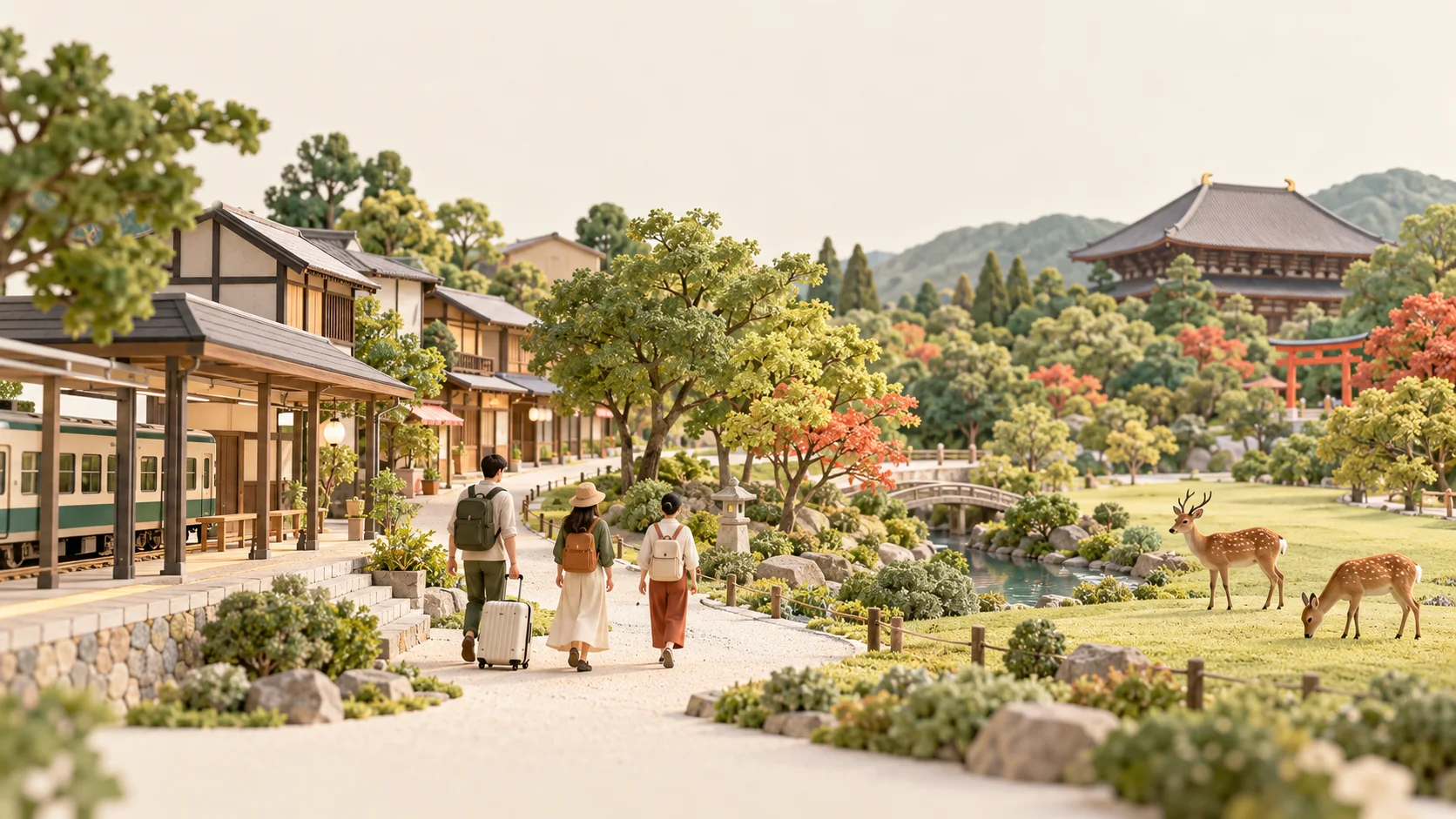
Start your Nara plans with three distinctions: its two railway stations, the walking distances around the park, and the separate day needed for Mount Yoshino. A first visit can combine the Great Buddha Hall, Kasuga Taisha and lunch; an overnight stay leaves room for Naramachi, an early walk, laundry and rest. Using official information checked on 21 October 2026, this guide separates current charges, historical blossom observations and itinerary suggestions. Start with the station comparison, a day around the park, hotel locations and sleeping arrangements, or planning Yoshino as its own day.
A day trip or an overnight stay?
A full day works if your priorities are the Great Buddha, a stretch of wooded shrine approach and the deer. Give the morning to one main temple and the afternoon to a shrine and breaks, rather than treating every paid hall as essential. With only half a day, choose either Todaiji and the park or Kasuga Taisha and Naramachi. That avoids crossing between opposite ends of the park around lunchtime.
The benefit of two days and one night is freedom from an evening return to Osaka or Kyoto. Drop off your bags, visit the temples and shrines, rest in your room, then explore the traditional townhouses the next day. If you already have consecutive nights booked as part of your Osaka accommodation and three-day plan, a day trip saves a hotel change. An early park walk, a hot-spring bath or the space of a four-person room can make the extra night in Nara worthwhile.
Include check-in and check-out in those two days. Deal with large bags on arrival and confirm whether the hotel will store them after check-out, including the same-day collection deadline. Pulling a suitcase over gravel and slopes makes sightseeing harder. With children, a midday departure on day two leaves room for lunch and bathroom stops. If that day is for Yoshino, finish your main city visits the day before instead of trying to fit two complete itineraries into one day.
Kintetsu Nara and JR Nara are different arrival bases
Kintetsu Nara works well for a walking day linking the park, the area around Kofukuji and the shopping streets. JR Nara suits arrivals on the JR Nara or Yamatoji lines. They are separate stations, not parts of one interchange concourse. Use the full station name when choosing a hotel, and compare the Kintetsu Nara station layout with the JR Nara platforms and station information. A booking page saying “near Nara Station” does not tell you which one.
For a first day trip, work backward from your accommodation the previous night. From Namba, if you are taking Kintetsu, use Kintetsu Nara as your arrival and return point. From JR Kyoto Station or the Tennoji area, compare that day’s JR trains and the bus connection on arrival. An extra transfer is only helpful if it actually saves time; being nominally closer to the park is not enough.
A hotel beside JR does not commit you to walking all the way to the park each day. A bus out and a leisurely return through Naramachi can work well. Near Kintetsu, check that the hotel entrance is on the side that suits your walks. Your choice affects dinner, moving luggage and the ease of returning to rest. Neither station minimises travel for every possible itinerary.
| Base | Needs to compare first | Trade-off to allow for |
|---|---|---|
| Around Kintetsu Nara | Kintetsu arrivals, shopping streets and walking to the park | Underground exits involve level changes; the nearest stairs may not suit luggage |
| East or west of JR Nara | JR arrivals, city onsen hotels and laundry | Use a bus to the main temples and shrines; east and west hotel exits are not interchangeable |
| South of the park / toward Naramachi | Early and evening walks, townhouses and family rooms | Plan the station return and luggage; being beside a pond does not guarantee deer |
From Osaka or Kyoto: separate the basic fare and limited express supplement
From Osaka-Namba, Kintetsu Nara is a straightforward city destination. The official Namba–Nara fare table currently lists an adult one-way basic fare of ¥680. The separate ¥520 figure is the limited express supplement, not an ordinary train ticket. Distinguish rapid express and similar services from trains requiring a limited express ticket. A reserved seat alone does not necessarily include the basic fare.
From Kyoto, compare Kintetsu to Kintetsu Nara with the JR Nara Line to JR Nara. Some Kintetsu services require a change at Yamato-Saidaiji; on JR, the train type and stopping pattern also matter. Check the official Kintetsu station timetables and JR’s route information for your actual date. An advertised shortest train journey is not the total time from your hotel door to the temple entrance.
If you already have a regional rail pass, check its exact product, dates and operator before buying another ticket for Nara. Our guide to choosing Japanese transport passes separates the basic fare, limited express seating and city buses. Calculate the park day and Yoshino day independently. Being in the same prefecture does not make every journey eligible for one urban day pass.
On arrival, find the lift, luggage storage and actual hotel entrance
Kintetsu Nara is underground. Its official plan distinguishes the east and west ticket gates from the exits at street level. With a pushchair, wheelchair or large suitcase, follow the station lift route to the street before continuing to your hotel or bus. The nearest numbered exit on your phone may involve stairs. Japanese 1F means ground level; there is still a vertical journey from the underground platforms.
For hotels beside JR, remember the east or west exit. Daiwa Roynet below is on the west side; Onyado Nono is on the east. Choose the correct hotel before leaving the station, navigate with its official name and address, and save the final approach. Getting off the train, passing through the gates, finding the lift and crossing the road all need time beyond a hotel’s advertised walking minutes.
Ask the hotel where you will stay whether it accepts bags before check-in and when you must collect them after check-out. Station lockers need a check of dimensions, availability and the route for collection. Lockers being provided does not ensure an available one on arrival. If you arrive late, sort out your bags and dinner first and shorten the park walk; that is more useful than rushing to a ticket office that has already closed.
Getting around the park: regular buses and Gurutto Bus are separate services
For Todaiji, take the city loop bus from JR or Kintetsu Nara to “東大寺大仏殿・春日大社前” and continue on foot using the temple’s access directions. The roughly 20-minute walk from Kintetsu is a general reference, without children’s stops, photographs or time among the deer. For Kasuga Taisha, distinguish “春日大社本殿” from “春日大社表参道”: they give you different walks to the main worship area.
The operator’s current Gurutto Bus fares and operating days list ¥250 per adult ride and ¥130 for children. It generally runs on weekends and Japanese national holidays, with separate announcements for some weekdays. It is not a free daily shuttle throughout the year, and the ¥100 quoted on older tourism pages is outdated. For a weekday visit, establish your regular bus options before building the day around this sightseeing service.
Boarding doors and payment timing vary by regular route. Follow Nara Kotsu’s boarding instructions and the vehicle signs: some buses use the front door and payment on boarding, while others use rear boarding, a numbered ticket and payment when you get off. Check the destination before boarding. On your return, another stop with the same name may not be the one you need. If you require a low-floor vehicle, confirm the boarding point, vehicle type and available space together.
Family fares follow the operator’s own rules. Under Nara Kotsu’s regular fare categories, junior-high-school students in the Japanese system and older passengers pay the adult fare; elementary-school students pay half, rounded up to the next ¥10. On ordinary routes, each passenger aged 6 or older can accompany one child aged 1 to under 6 free; additional children in that age group pay the child fare. Children under 1 travel free. The age bands on a Kintetsu pass do not replace these bus rules.
When the ¥600 bus pass or ¥1900 Kintetsu pass makes sense
The Nara Park & Nishinokyo World Heritage 1-Day Pass covers regular buses within a designated area for ¥600 per adult or ¥300 per child. Sales points include the information offices at JR and Kintetsu Nara. It does not include the railway from Osaka or Kyoto or admission to all temples and shrines. For only one or two bus trips, compare individual fares; there is little benefit in adding unnecessary detours just to break even.
The KINTETSU RAIL PASS 1day costs ¥1900 per adult and ¥950 for children aged 6–11. It is valid on your selected day within specified Kintetsu and Nara Kotsu areas. The purchase and use conditions specify foreign visitors to Japan, carrying a passport, and an internet-capable device for digital tickets. Passes purchased online or through a travel agent cannot be refunded at a Kintetsu station ticket office. Check eligibility for you and each companion, and that your device can use the digital ticket, before paying.
For Gurutto Bus on a weekend when it operates, two adult rides cost ¥500, below the ¥600 bus pass; three cost ¥750, above it. An ordinary Namba return is ¥1360, or ¥1860 with two Gurutto rides: ¥40 less than the ¥1900 Kintetsu pass. With three rides, the ordinary train plus the ¥600 bus pass costs ¥1960. These are same-day comparisons within valid areas. They exclude limited express supplements, JR and other operators, and do not work if the bus is not running.
| Option | Current adult cost | Suitable use | Exclusions or checks |
|---|---|---|---|
| Pay per ride | Gurutto: ¥250 each | One or two rides on an operating day | Check ordinary route fares separately; this service may not run on weekdays |
| Nara Park & Nishinokyo World Heritage 1-Day Pass | ¥600 | Several bus rides within the city validity area | Intercity rail, temple and shrine admission, Yoshino transport |
| KINTETSU RAIL PASS 1day | ¥1900 | Eligible travellers using Kintetsu and designated buses on one day | Limited express ticket extra; validity does not extend to Yoshino |
| Ordinary Namba return + bus day pass | ¥1360 + ¥600 = ¥1960 | An adult example for comparison with the Kintetsu pass | Applies to this starting station and ticket combination, not everyone’s journey |
A one-day route: Great Buddha, lunch and Kasuga, with an optional extra
A workable order is station arrival and luggage storage, Todaiji’s Nandaimon gate and Great Buddha Hall, lunch, a break around Kasugano, then Kasuga Taisha. Finish by bus or via the shopping streets to the station. This puts your most important indoor visit first and lets you adjust the afternoon walking to your energy. It is a suggested itinerary, not a guided tour requiring every stop to be completed.
Check the time after the hall. If everyone has energy and the weather is settled, add Nigatsudo. If children are tired or you want Kasuga’s special visit that afternoon, protect time for lunch and the forest approach instead. Adding the summit of Wakakusa, every paid hall and all the Naramachi shops would no longer be a relaxed half-day outing. Rest and connections belong in the itinerary from the start.
Before heading to Kasuga Taisha in the afternoon, check whether the special visit is available. If a ceremony suspends it, use the general worship area and approach rather than waiting for an unconfirmed reopening. Leave food and souvenir shopping toward the station area or Naramachi. Keeping the final extra optional protects your time to collect bags and eat dinner.
Todaiji tickets: the Great Buddha Hall and other halls charge separately
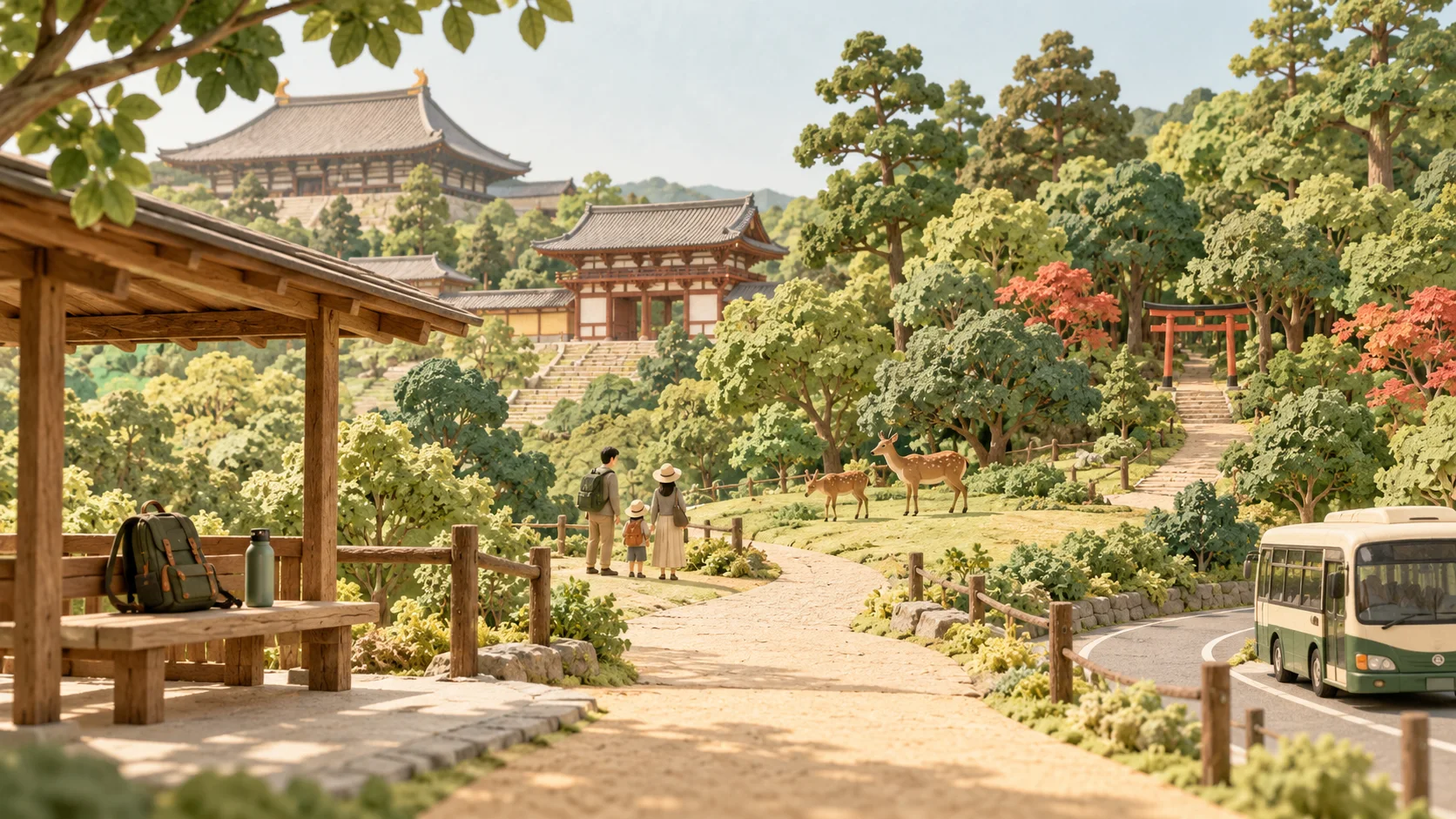
Todaiji’s official opening hours and admission information list separate charges for Daibutsuden, Hokkedo, Kaidando and the museum, with cash-only payment. Ordinary individual admission to the Great Buddha Hall, using Japanese school-stage categories, is ¥800 for junior-high-school students and older visitors, or ¥400 for elementary-school students. Group student rates and tickets to other halls are different products. No advance reservation is required for an ordinary visit: the temple’s ticketing FAQ directs you to the ticket office on the day.
Daibutsuden opens 7:30–17:30 from April through October and 8:00–17:00 from November through March. Hokkedo and Kaidando open 8:30–16:00. If visiting several halls, watch the earliest closing time; Daibutsuden remaining open does not keep every other hall open. Festivals and exceptional circumstances can change the schedule. Putting your main hall in the first half of the day makes adjustments easier.
If you also want the museum, the Daibutsuden–museum combined ticket costs ¥1200 for junior-high-school students and older visitors, or ¥600 for elementary-school students, and is sold at either ticket office. The museum opens at 9:30. From April through October it closes at 17:30 with last admission at 17:00; in winter it closes at 17:00 with last admission at 16:30. Decide whether you will see the exhibition before buying the combination, and allow viewing time before closing rather than treating last admission as the start of an unhurried visit.
Choosing extras: the Buddha, Nandaimon, Nigatsudo and Wakakusa
The temple’s introduction to Daibutsuden and the Vairocana Buddha explains that the present hall is an Edo-period reconstruction and the statue is 14.98 metres tall. The original Nara-period building has not survived intact. Take in the statue and space from the front, then look at details along the worship route. A simple “world’s largest” description misses the history of rebuilding and repair.
The guardian statues at Nandaimon fit naturally before or after the hall, without retracing your steps simply to collect another landmark. Nigatsudo lies uphill and is associated with Shunie; treat it as an elevated walk if you have the energy. The temple’s accessibility guidance explicitly notes unavoidable steps for someone remaining seated in a wheelchair on the way up. Stay with the lower route if stairs are unsuitable.
Mount Wakakusa is a separate uphill option, not a walk automatically completed by passing through Daibutsuden. The prefecture’s mountain entry information gives an ordinary season from the third Saturday in March to the second Sunday in December, 9:00–17:00. Individual admission is ¥150 for junior-high-school students and older visitors, or ¥80 from age 3 through elementary school. Check management notices for the year and weather. After rain, with a late afternoon arrival or with children who need a nap, leaving the summit for another visit is sensible.
Kasuga Taisha: free general worship and the ¥700 special visit
General worship at the main shrine’s worship place is free. The special visit to the main sanctuary brings you closer to the central gate and the corridor’s hanging lanterns, currently for ¥700, normally 9:00–16:00. General opening is 6:30–17:30 from March through October and 7:00–17:00 from November through February. That does not mean every paid facility and amulet counter opens at the same time.
The special visit has scheduled restrictions, including the mornings of the 1st, 11th and 21st of each month and certain ceremonial dates. Full-day restrictions also include around 8–13 March, 20 December–7 January and Coming of Age Day, among others. These are examples that affect ordinary planning; match your date against the complete official list. A ceremony preventing corridor access does not necessarily close the entire shrine.
For the wooded approach and general worship, the free areas are enough to build a visit. Consider the special visit if the lanterns and architecture interest you. The treasure museum and Manyo botanical garden are separate facilities, not automatically included in the ¥700 ticket. Choose the admission that matches what you actually want to see rather than buying one just to walk an approach.
Drivers should also check the shrine parking rules: an ordinary passenger car costs ¥1500. Parking opens 7:30–17:00 from March through October and 7:30–16:30 from November through February. Those hours differ from general worship, so an early visit does not guarantee parking is open. During ceremonies or heavy crowds, access may be restricted to prayer visitors, buses or other specified vehicles. Keep another legal parking option or public transport available.
Lanterns, amulets and goshuin without a shopping checklist
Distinguish the Mantoro recreation at Fujinami-no-ya from the actual lantern ceremony. The shrine describes a tradition of lighting all lanterns at Setsubun and on 14 and 15 August, with details in its August events calendar. Seeing lanterns on an ordinary day does not guarantee they all light up that evening. For an overnight stay built around the lighting, confirm that year’s opening arrangements, weather and return transport.
The shrine’s published amulets and deer-shaped fortunes include Shiroshika-mamori, with an offering of ¥1000 and a meaning of good fortune; Kazoku-mamori, ¥800, for family health and peace; and shika-mikuji and shiroshika-mikuji at ¥600 each. These are meanings attached to prayers, not guarantees of health or a trouble-free journey. Choose what matters to you rather than feeling obliged to obtain every item.
Ofuda, omamori and goshuin service starts at 9:00 and continues until closing, rather than beginning at the early-morning opening of the grounds. Confirm the counter and queue on the day. Photographing a seal or amulet should not obstruct the line or use someone else’s worship as a backdrop. Near closing, complete your worship first and then decide whether to wait, keeping enough time for the station.
Deer and shika senbei: adults manage the distance; children can simply watch
Nara Park’s deer are wild animals. The prefecture’s contact and feeding precautions warn of charging, biting, kicking and antler strikes. Avoid casual touching and do not let children approach alone. Mothers protecting fawns in spring and males in the autumn rut need particular care. A deer lowering its head does not promise a tame animal that will accept head pats or hugs.
If you feed them, use only the shika senbei deer crackers permitted by the park, never bread, your own snacks, vegetables or leftovers. The official guidance describes the crackers as deer treats, with part of the proceeds supporting protection. They are not picnic food for visitors. Ask the stall selling them about the number per pack and the day’s price. An old price online is not a permanent guarantee across every sales point.
With young children or anyone afraid of animals, it is fine to skip feeding and watch from the path at a distance. Move away from the deer before lunch, taking out a paper bag or unfolding a map: the prefecture warns they swallow plastic bags, maps and litter. Close bags and take rubbish away. Avoid chasing deer or repeatedly holding food in front of them to stage a photo with a child.
Pushchairs, wheelchairs and toilets: choose an achievable route first
The front steps are not the only way into Daibutsuden. The official wheelchair worship route uses the west ramp, on your left as you face the building. Wheelchair and pushchair approaches are also indicated from the parking area in front and the western taxi drop-off. These arrangements cover specified stretches; they do not make the whole hillside, Nigatsudo or Nara Park step-free.
The Todaiji family and facilities FAQ identifies a nappy-changing table in the museum’s multifunction toilet on basement level 1. There is no permanent nursing room: ask the security office, which can provide a room only if one is vacant. Wheelchair loans are limited and cannot be reserved; ask at the Daibutsuden entrance ticket office or the security post in front. Bring essential care supplies rather than depending on an assumed facility.
Nara Kotsu’s pushchair and wheelchair-space instructions allow an unfolded pushchair on low-floor or one-step vehicles displaying the relevant symbol, with wheels locked, a securing strap and an adult holding it steady. Vehicle type and available space still govern use, so ask the driver for help. If the slope, turning width or space for several wheelchairs is uncertain, shorten the route or consult the operator first rather than improvising a carry up stairs.
Food in Nara: time for kamameshi, and a separate dinner location
For kamameshi rice on a park day, check Shizuka Park branch’s opening information. It opens at 11:00, with last orders at 15:00 on weekdays or 16:00 on weekends and Japanese national holidays. Tuesday is the usual closure, except holidays, with additional irregular closures. It is not a dinner stop for an evening walk back to the station. Before joining the line at Noboriojicho, agree how much time the family can spend eating so lunch does not displace Kasuga’s special visiting hours.
Under Shizuka’s own reservation instructions, the Park branch currently takes no dine-in reservations; takeaway collection can be arranged by phone. The Omiya branch has a separate dine-in reservation system. A booking there is not a table at the Park branch. For takeaway, confirm collection time, portions and dietary needs, then eat somewhere suitable away from the deer. Keep hot rice pots off children’s laps and avoid combining eating on the move with feeding animals.
For dinner toward Naramachi, Hiraso Nara’s main building and hanare offer options including persimmon-leaf sushi. Sales, dining and last-order hours differ between the two buildings. Monday is the usual closure and seasonal changes are possible. Choose a restaurant along your route back to the room, with a low-wait alternative. For allergies or religious dietary requirements, check ingredients and preparation directly; a local-food label is not assurance of suitability.
A rainy day in Nara: replace an outdoor stretch with a nearby interior
In light rain, shorten the approaches and consider Todaiji Museum before or after the Great Buddha Hall. Check opening and last admission before choosing a combined ticket. Rain does not require you to buy admission to every hall if the Buddha was your only priority. The official museum video here introduces the space; check current temple information for exhibitions and opening times, rather than treating an old video as a guarantee that a particular work will be displayed that day.
Once you are near Naramachi, Naramachi Nigiwai-no-Ie offers a townhouse-culture stop. Admission is free, 9:00–17:00; Wednesday is closed unless a holiday, with a separate year-end and New Year closure. Its own opening calendar also flags possible exceptional closures. It is in Nakanoshinyacho, not an indoor playground beside the station. Free admission does not make it a place for children to run around for hours.
A traditional townhouse may require removing shoes and have narrow passages or level changes. Ask which areas a pushchair or wheelchair can reach. During heavy rain, strong wind or official transport-disruption notices, reduce cross-park journeys and rest near the station or at the hotel. Completing every rainy-day alternative could add slippery walking. Dry socks, somewhere for the umbrella and a lunch plan are often more useful than a third indoor venue.
Two days and one night: temples first, townhouses and a slower half-day next
If you arrive in the morning, store bags, see Nandaimon and Daibutsuden, then choose Kasuga Taisha or Nigatsudo according to energy. Check in toward evening, do laundry or bathe, and eat in an area where you have confirmed opening hours. Arriving after midday calls for one main temple or shrine, with the other the next morning. There is no need to compress the entire daytime route into the hours before closing.
Day two can finish with Naramachi, the area around Sarusawa Pond and lunch. After check-out, collect bags within the hotel’s storage deadline and return to Osaka or Kyoto. If the family prefers deer and shade, substitute a short park walk. For Kasuga’s amulet counters, remember the 9:00 start. The benefit of two days is being able to switch mornings and afternoons, not having to double the sights.
If continuing to Kyoto’s neighbourhoods and places to stay, decide your departure direction from Nara before placing lunch. Yoshino blossom viewing is another full travel day. Staying in Nara the night before can work, but check-out, storage, the Great Buddha, a Yoshino ascent and descent and a long return are too much to promise in one day. For an unhurried visit to both places, add a night or reduce the city extras.
Where to stay in Nara: three bases and four specific hotels
Write down three requirements before choosing a hotel: sleeping arrangements, bathroom layout and your return route. Kintetsu’s station area suits shopping streets and walking toward the park; JR suits train arrivals, laundry and urban hotels with large shared baths. The park’s southern edge connects Naramachi and early walks. Even a nearby property needs a check of its entrance, luggage access and the ground-level route, rather than choosing by straight-line distance alone.
The following four properties are starting points with rooms you can check on official websites, not a ranking based on personal stays or a live availability quote for a date. Three adults each wanting a bed need something different from two adults and a child sharing. Two rooms called Twin may provide just two beds or add a pullout bed. Read the full room name and enter every traveller’s age to see which arrangement is actually bookable.
“Nara Park accommodation” does not promise deer outside the room, permission to feed them there or a temple-pagoda view. For quiet, a view, a cot or accessibility, discuss the exact room and your needs with the property. Separating room equipment from rate-plan conditions lets you compare Kansai hotels on the same terms and rule out places where sleeping or access will not work.
Beside Kintetsu: IROHA’s third guest sleeps on a sofa bed
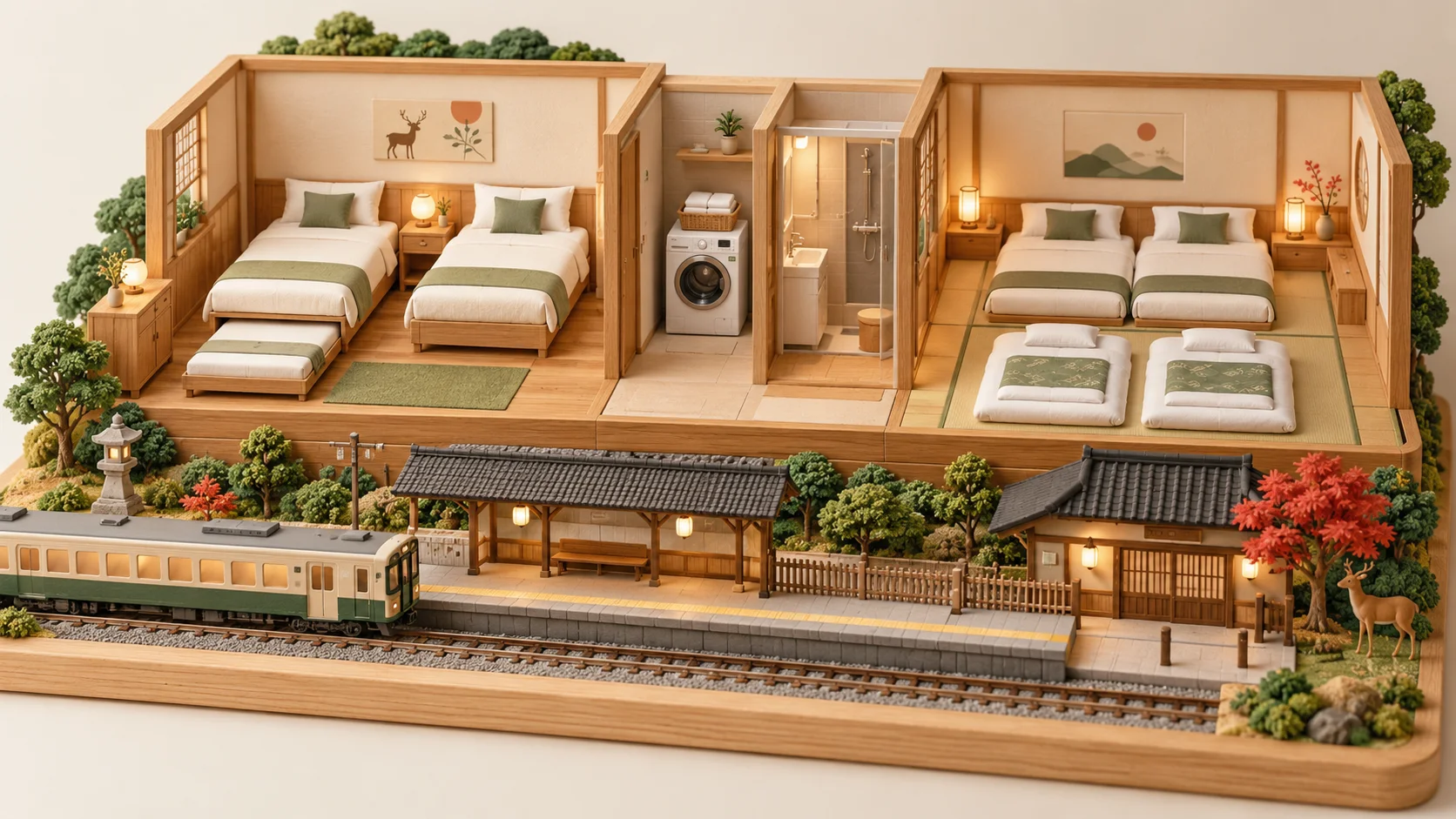
Iroha Grand Hotel Kintetsu Nara Ekimae gives an official walking time of about 2 minutes from Kintetsu Nara, convenient for handling bags before the shopping streets and park. Moderate Twin is 22.80 m² for 1–2 guests, with 110 cm-wide beds and a combined bathroom and toilet. Superior Twin and Superior TATAMI Twin are 28.53 m², with a sofa bed for the third guest and separate bath, toilet and washbasin areas. Choose the bathroom layout by the room category.
Families can compare low beds on tatami with conventional beds, but low height alone does not guarantee against falls. Cots are loan items requiring reservation. The property lists paid shared coin laundry, luggage storage, and a wheelchair-accessible toilet and nappy-changing table at ground level. Bags after check-out must be collected the same day. If you will be back late from Yoshino, confirm the deadline and return route rather than assuming storage until the day after.
For accessibility, Universal Double is 27.60 m² with one 140 cm-wide double bed, a specially equipped combined bathroom and toilet, sliding bathroom door and lower furniture and switches. It is a different arrangement from a twin with separate bath, toilet and washbasin areas. Vehicles cannot drive into the front entrance, so taxis and parking need a separate location. Discuss drop-off, the entrance and bedside space as well as the Universal room name.
JR west exit: Daiwa Roynet’s Superior Twins have different bed counts
Daiwa Roynet Hotel Nara’s access page places it about 3 minutes on foot from JR Nara’s west exit. The Nara property’s detailed bed table lists Standard Twin at 16.41 m² with two 95 cm-wide beds and an integrated bathroom. Superior Twin is 26.36 m² with two beds, 110 and 140 cm wide. Its advertised three-person occupancy still means two beds, not three independent ones.
For three adults each needing a sleeping place, compare Superior Twin with “トランドル” in its official name: 26.41 m², two 110 cm-wide beds and a 97 × 188 cm pullout, with separate bath and toilet. Tell the third guest about the shorter bed before booking. Connecting rooms involve particular adjoining rooms and a two-room arrangement. A three-person listing for one room does not make two separately booked rooms connect automatically.
The shared laundry rooms on the 5th and 8th floors operate 24 hours with automatically dispensed detergent; these are not in-room washing machines. Universal Twin is 26.41 m², with one electrically adjustable bed among its two beds and an integrated bathroom. It does not share the regular Superior’s separate bathroom layout. Confirm the transfer side and bathroom equipment before deciding whether those needs outweigh station proximity.
JR east exit: Onyado Nono’s city onsen and room sizes
Onyado Nono Nara’s arrival information gives about 1 minute on foot from JR Nara’s east exit. “Yoshino Sakura no Yu” is the hotel bath’s name; the property is not on Mount Yoshino. It is a candidate for a station-side stay with an evening communal onsen. If you expect a standalone hot-spring ryokan with dinner and breakfast, check the actual plan: the name Onyado does not include dinner by itself.
The current room page lists Standard Twin at 19.40 m², two 100 × 195 cm beds and two occupants. Compact Twin is 15.90 m² with two 90 × 190 cm beds. Shared room-equipment specifications include a shower booth; if an in-room bathtub is essential, confirm the exact category. Deluxe Twin mentions two beds and futon bedding, but the occupancy shown remains two. Ask the hotel for a bookable plan before treating it as a three-adult room.
The gender-separated natural hot-spring baths are on Japanese 1F, at ground level, open 15:00 until 10:00 the next day. The sauna has a separate overnight closure. Tattoo and other restrictions apply; a cover sticker is not a guaranteed solution. In the shared laundry area, washers are free with automatic detergent and drying is ¥100 per 20 minutes. This is communal equipment, rather than free washing and drying inside every room.
South of the park: MIROKU’s beds, sofa bed and futons for four
MIROKU Nara is in Takabatakecho near Araike, useful for linking the park’s south side with Naramachi. Its official detailed room page lists Superior with Japanese-style at 32 m² for up to four people: two low beds, a sofa bed and provision for futon bedding on tatami. Four guests does not mean four identical conventional single beds. Check the third and fourth guests’ arrangements against the plan you book.
Moderate Loft includes upper-level sleeping places. Avoid assigning those casually to anyone who must avoid ladders, needs to care for a small child at night or has difficulty getting up. Some room areas differ between the website’s homepage and detailed pages, including Loft figures. Ask the property about the actual area, stairs and full bedding setup for your room before comparing it with a conventional low-bed room.
The detailed page says all rooms have separate bath and toilet. The facilities page lists shared laundry from ¥500, accepting only ¥100 coins, and bag storage before and after a stay. The address and access page says free parking ended on 8 January 2024, so older parking offers should stay out of your driving budget. The room page also warns that Kofukuji’s five-storey pagoda is concealed by repair coverings. An old photo or room name is not a guarantee of a complete pagoda view.
| Hotel and exact category | Published bedding / area | Bathroom and practical trade-offs |
|---|---|---|
| IROHA Superior Twin | 28.53 m²; twin beds + sofa bed for guest three | Separate bathtub, toilet and washbasin; not three conventional beds |
| Daiwa Superior Twin | 26.36 m²; two beds, 110 and 140 cm wide; occupancy listed as three | Separate bath and toilet; still only two beds for three guests |
| Daiwa Superior Twin (トランドル) | 26.41 m²; two 110 cm beds + 97 × 188 cm pullout | Separate bath and toilet; third bed is shorter |
| Onyado Nono Standard Twin | 19.40 m²; two 100 × 195 cm beds; listed for two | In-room facilities and communal baths serve different needs; not presented as a triple |
| MIROKU Superior with Japanese-style | 32 m²; two low beds, sofa bed and futons on tatami; up to four | Separate bath and toilet; confirm bedding setup for your actual party |
Children, laundry, access and cancellation: confirm them together
Enter all guests and children’s real ages, then compare the same room category, meals and cancellation terms. Capacity for two adults does not automatically allow two additional children free. Bed-sharing does not necessarily include extra pillows, bedding, breakfast or a cot. List what each guest needs to sleep, and ask the hotel to clarify adult beds and extra-person charges if only a total occupancy is shown.
The four hotels’ published laundry arrangements are the shared facilities described above. If you need grab bars, transfers or wheelchair turning space, confirm actual bedside and bathroom dimensions with the hotel. The questions for a first ryokan stay also apply here: a communal bath, an in-room bathroom and a private open-air bath are separate conditions. A natural onsen at the hotel does not put a hot-spring tub in every room.
Read the final confirmation screen for the deadline, governing time zone, scope of free cancellation and no-show charge, and keep the confirmation email. Another property in the chain or another platform’s policy is not a substitute. Compare totals with the same adults, children, breakfast, third bed, taxes and early-arrival or late-departure charges. If a cheap rate makes you book a second room, it may no longer be the saving you expected.
A Nara day-trip budget: known tickets first, meals and hotels afterwards
For one adult taking an ordinary Kintetsu return from Namba, two Gurutto rides on valid routes that day, the Great Buddha Hall and Kasuga’s special visit, transport is ¥1360 + ¥500 = ¥1860. Admission is ¥800 + ¥700 = ¥1500, giving ¥3360 altogether. This is a reproducible example without meals, amulets, accommodation, limited express or your hotel-to-Namba journey. Substitute your own fare for a different starting station. Our itemised Japan travel budget uses the same approach for the whole trip.
Allow separately for lunch and dinner and adjust against the chosen restaurants’ menus on the day. For three adults sharing one night, compare the total for the same date and one three-person room including tax and beds, then divide by three. Do not multiply a per-person result from a two-person search by three. Third-bed charges, breakfast and non-refundable plans can change choices that initially look close.
For an onsen stay, distinguish the tax. Nara City’s bathing-tax rules set ¥150 per person per night for taxable hot-spring bathing associated with an overnight stay, with exemptions including children under 12. This is not a universal additional accommodation tax on every ordinary hotel. The property may already have accounted for it in the displayed rate. Check the breakdown rather than adding ¥150 again regardless of the type of stay.
| Item | Calculation / amount | Conditions |
|---|---|---|
| Ordinary Kintetsu return | ¥680 × 2 = ¥1360 | Osaka-Namba–Kintetsu Nara; not a limited express total |
| Two Gurutto rides | ¥250 × 2 = ¥500 | Operating day and valid route required |
| Great Buddha Hall + Kasuga special visit | ¥800 + ¥700 = ¥1500 | Ordinary adult individual admissions, both open |
| Example subtotal | ¥1360 + ¥500 + ¥1500 = ¥3360 | No meals, amulets, hotel or other journey legs |
| Kintetsu 1day comparison | ¥1900 + ¥1500 = ¥3400 | Eligibility, valid day and area apply; not necessarily the cheapest choice |
Nara cherry blossoms and other seasons: use the year and variety
The Nara tourism association’s cherry blossom guide gives a broad city viewing season from late March to late April. Himuro Shrine’s weeping cherries tend to be earlier, while the park’s Somei Yoshino and double-flowered yaezakura do not finish together. Its 22 April 2026 record had Nara Park’s Somei Yoshino between falling petals and the end, with yaezakura still shown in full bloom. That is an observation for that date, not a 2027 forecast.
Kasugano and the area around Ukimido can join your normal city walk without a new cross-city excursion. When checking blossom reports, look first at the year and update date, then the variety and location. “Nara cherry blossom season” is not one day when the whole prefecture blooms together. With fixed dates, use current observations to choose a worthwhile stretch instead of repeatedly changing hotels to chase an old photograph.
Adjust other seasons to the itinerary: limit midday sun in summer and visit the halls that close earlier first in winter. For major spring or autumn events, check buses and accommodation ahead. If staying for Mantoro or the Wakakusa mountain-burning event, use that year’s formal announcement; an annual-events introduction does not guarantee weather. Our Japan seasons and blossom-report guide helps separate seasonal expectations from cancellable reservations.
Give Yoshino a separate day; it is not beside Nara Park
Mount Yoshino and Nara city are different travel days. The Yoshinoyama tourism association’s access guide distinguishes the Kyoto approach via Kashiharajingu-mae from the Osaka approach from Osaka-Abenobashi. From Kintetsu Nara, check that day’s connections toward Kashiharajingu-mae and the Yoshino Line. JR Nara is not on a direct railway up the mountain.
Decide your starting accommodation and where you will return that night before choosing how far to climb. Two nights in Nara can leave the middle day for Yoshino; one night means trimming the second city day. Blossom crowds, changes of train and hillside walking all take time. Keep lunch and descent comfortably ahead of the last service, adding transfers, waits and walks outside stations to the fastest train time.
The Yoshino visitor bureau’s blossom and luggage information warns that Yoshino Station has limited lockers and no other baggage-storage service in front of the station. Leave large bags at your accommodation and carry a day bag. If you are going after check-out, secure an actual storage option first. A mountain trip is an awkward place to drag a suitcase while searching for an empty locker.
Yoshino ropeway, buses and driving have different operating arrangements
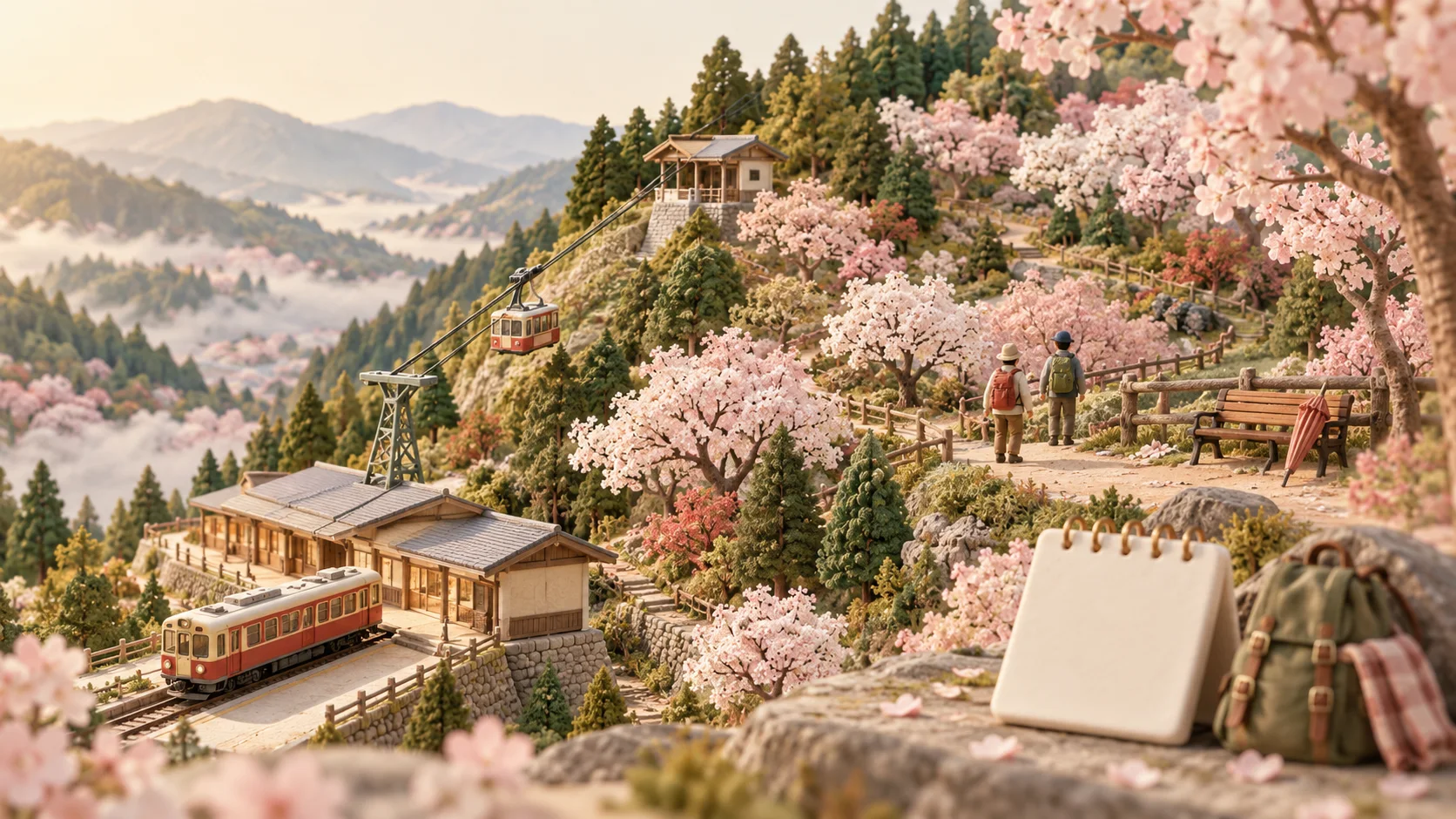
The Yoshino Omine Ropeway information lists Senbonguchi–Yoshinoyama at ¥500 adult one-way or ¥250 from age 4 through elementary school. Ordinary-season returns are ¥900/¥450; return tickets are not sold during the cherry blossom period. The operator requires cash on both ropeway and buses, rather than the city’s IC-card arrangements. The ropeway reaches the mountain entrance area, not Kami-senbon or Oku-senbon directly.
At the time checked, the operator’s service notice gives ordinary ropeway operation on Friday, Saturday, Sunday and Monday, with replacement buses Tuesday through Thursday. The Oku-senbon route bus generally operates on weekends. A separate autumn-leaf arrangement runs daily from 23 October through 30 November 2026. This is a dated notice: check again for winter or the following spring instead of extending the autumn calendar to the whole year.
Spring’s temporary buses are another service. The Yoshino Town record of 2026 blossom transport lists daily operation 20 March–19 April, then selected weekends and holidays 25 April–6 May, alongside vehicle restrictions and cancellation of some shuttles. These dates are past, not a 2027 timetable. Even an identified parking lot may be full or unreachable under road restrictions. Check the relevant year’s announcement before deciding whether to take the train.
Reading Yoshino blossom forecasts: Shimo, Naka, Kami and Oku-senbon
Altitude and different areas mean Yoshino cannot be reduced to one full-bloom date. The visitor bureau’s saved 2026 observations give Shimo-senbon 1 April, Naka-senbon 2 April, Kami-senbon 4 April and Oku-senbon near Saigyoan 9 April. By 14 April, the report recorded leaves after flowering and ended the year’s updates. Those dates explain 2026’s sequence, not an annual repeat on fixed dates.
For a first visit, choose Shimo or Naka according to your walking capacity and keep lunch, toilets and the return within a manageable area. Kami and Oku add elevation changes; there is no need to keep climbing just to tick all four names. With children, pushchairs or a need for step-free access, published general walking times are not a personal guarantee. Ask transport and site staff which areas you can reach.
Near departure, choose an area using the latest blossom report, then confirm its bus and your descent. If the blossoms you wanted have finished, reconsider city yaezakura, temples and hillside walks. Without a recent observation, a guess is not evidence of “full bloom now.” Forecasts help planning, but what you see depends on that year’s climate, the variety and the location.
| Area | Visitor bureau’s 2026 full-bloom date | Use when planning |
|---|---|---|
| Shimo-senbon | 1 April | Check current blossom reports near the mountain entrance |
| Naka-senbon | 2 April | Confirm temporary buses and lunch; do not only chase the summit |
| Kami-senbon | 4 April | Allow extra ascent and descent time |
| Oku-senbon / near Saigyoan | 9 April | Check access separately; this is not the ropeway terminus |
Protect luggage collection and dinner before adding the last stop
For your city return, choose Kintetsu or JR Nara and keep their train services separate. Before leaving Kasuga Taisha, check the bus direction. If shopping on the walk back, agree on a final stopping time. Waiting for lighting or night views needs that year’s opening information and transport for the evening. Without a confirmed workable return, “there should still be a bus” is not much of a plan.
With children on a day trip, make the first decision after Daibutsuden: add slopes only with energy to spare. After lunch, choose the shrine or the station. Shopping streets can be the last evening extra. This order makes what you have already done worthwhile even if you shorten the day. If companions have different priorities, agree a clear meeting place and time rather than splitting up suddenly among deer or at a bus door.
For an overnight stay, returning to the room for rest is part of the itinerary. For a separate Yoshino day, settle your descent pace before going up. Nara’s temples, shrines, park, townhouses and mountain each call for a different rhythm. Two or three priorities placed in days you can actually complete are closer to the trip you want than linking every place name in the prefecture into one route.
A few useful answers
For a first Nara day trip, should I start at Kintetsu or JR Nara?
Use your accommodation the night before and railway route. Kintetsu suits walking to the park and shopping streets; JR suits arrivals on the Nara or Yamatoji lines, with city buses onward to temples and shrines. They are different stations: confirm the full name and exit when booking a hotel.
Must I reserve Todaiji tickets or buy them online?
Ordinary worship visits need no advance reservation. The temple directs you to buy on the day with cash. Great Buddha Hall ordinary individual admission, using Japanese school-stage categories, is ¥800 for junior-high-school students and older visitors, or ¥400 for elementary-school students. Other paid halls and the museum are separate.
Does everyone need a ¥700 ticket at Kasuga Taisha?
General worship at the main shrine’s worship place is free. ¥700 is for the special visit to the main sanctuary, normally 9:00–16:00, subject to scheduled ceremonial restrictions. The treasure museum and botanical garden have separate fees; this is not an all-inclusive ticket.
Is Nara Park’s Gurutto Bus still ¥100?
The operator currently lists ¥250 per adult ride and ¥130 for children. It generally runs on weekends and Japanese national holidays, with separate notices for some weekdays. Check your date’s timetable instead of using an old ¥100 price or assuming daily operation.
Is the ¥600 bus day pass always cheaper?
No. Two adult Gurutto rides at ¥250 total ¥500, while three total ¥750. Check that the service runs, that your journeys are valid and how many rides you will actually take before comparing them with the ¥600 designated-area day pass.
Can children feed the Nara deer on their own?
That is not advisable. The prefecture warns that wild deer may charge, bite or kick: do not let children approach alone. Watching from a distance is fine. If feeding, use only the permitted shika senbei, never bread, snacks or other food.
Can a wheelchair enter Daibutsuden or go up to Nigatsudo?
Use the temple’s official west-ramp approach for Daibutsuden. The upper route to Nigatsudo still has steps that cannot be avoided while remaining seated in a wheelchair, and lower paths have level changes. Access to Daibutsuden does not establish step-free access to the whole grounds.
Does a Twin room for three adults always have three beds?
No. Daiwa’s regular Superior Twin lists three-person occupancy but only two beds; the category with トランドル in its name adds a pullout. IROHA Superior Twin uses a sofa bed for the third guest. Enter the real party size and check the complete category name.
Are there station-side Nara hotels with laundry and an onsen?
Compare Daiwa Roynet by JR’s west exit with Onyado Nono by its east exit; their beds and facilities differ. Nono has gender-separated natural hot-spring communal baths, shared washers and paid drying. That does not mean every room has an onsen bath or washing machine.
How can I change my Nara itinerary for rain?
Shorten outdoor stretches and use Todaiji Museum within its opening hours, or visit Naramachi Nigiwai-no-Ie. The latter is free, 9:00–17:00, with Wednesday and year-end/New Year closure rules; check its exceptional-closure calendar too. In heavy rain or strong wind, reduce journeys across the park.
Can I book 2027 using Yoshino’s 2026 full-bloom dates?
No. Shimo, Naka, Kami and Oku-senbon had different full-bloom dates in 2026; those are historical observations. Use the following year’s current reports, transport and cancellation conditions. The same date and area are not guaranteed to be in full bloom again.
Can I combine Nara city and Mount Yoshino in one day?
For a first trip, avoid putting both complete itineraries into one day. Yoshino involves railway transfers, ropeway or buses and hillside walking, so deserves a separate day. Nara’s city bus pass and Kintetsu 1day area do not automatically cover Yoshino.
Check with the source
Schedules, availability and rules can change. These official sources are the place to confirm details before you book.
- Todaiji | Hall opening hours, cash admission and museum combination tickets
- Todaiji | Rail, bus and walking access
- Todaiji | Booking, cash, wheelchair and family-facility FAQ
- Todaiji | Daibutsuden and the Vairocana Buddha
- Todaiji | Nandaimon and the guardian statues
- Todaiji | Nigatsudo history
- Todaiji | Grounds map and accessible routes
- Kasuga Taisha | General and special visits, ceremonial restrictions and access
- Kasuga Taisha | Mantoro recreation at Fujinami-no-ya
- Kasuga Taisha | August events and Chugen Mantoro
- Kasuga Taisha | Amulet and deer-fortune meanings and offerings
- Nara Prefecture | Precautions around Nara Park’s wild deer
- Nara Prefecture | Wakakusa’s ordinary opening season and fees
- Nara Kotsu | Nara Park & Nishinokyo 1-Day Pass
- Nara Kotsu | Current Gurutto Bus fares and operating days
- Nara Kotsu | Adult, child and accompanied-infant fare categories
- Nara Kotsu | Boarding and payment by route type
- Nara Kotsu | Stroller, wheelchair and riding FAQ
- Kintetsu | KINTETSU RAIL PASS 1day prices and validity
- Kintetsu | Foreign-visitor eligibility, digital tickets, passports and refunds
- Kintetsu | Osaka-Namba–Kintetsu Nara basic fares and limited express supplements
- Kintetsu | Station timetable search
- Kintetsu | Nara east/west gates and lift plan
- JR West | Nara Station layout and platforms
- IROHA Grand Hotel Kintetsu Nara Ekimae | Rooms, facilities and FAQ
- Daiwa Roynet Nara | Twin-room beds and bathrooms
- Daiwa Roynet Nara | Access from JR’s west exit
- Daiwa Roynet Nara | Shared laundry and facilities
- Onyado Nono Nara | Rooms, areas and occupancy
- Onyado Nono Nara | Arrival from JR east exit and Kintetsu
- Onyado Nono Nara | Bath opening times and restrictions
- Onyado Nono Nara | Shared washing, drying and bag storage
- MIROKU Nara | Detailed bedding, rooms and cleaning
- MIROKU Nara | Shared laundry and facilities
- MIROKU Nara | Address and end of free parking
- Shizuka Park branch | Opening and closure information
- Shizuka | Park-branch takeaway versus Omiya dine-in reservations
- Hiraso | Nara main building, hanare and branch hours
- Naramachi Nigiwai-no-Ie | Calendar and official channel link
- Nara City | Nigiwai-no-Ie free admission, hours and location
- Nara tourism association | 2026 city blossom records and variety differences
- Yoshino visitor bureau | 2026 area blossom records and luggage information
- Yoshinoyama tourism association | Rail, slopes, ropeway and bus access
- Yoshino Omine Ropeway | Current ordinary and autumn service notice
- Yoshino Omine Ropeway | Fares, ages and cherry blossom-period restrictions
- Yoshino Town | Historical 2026 blossom transport and traffic restrictions
- Nara City | Bathing-tax rates and exemptions