Travel from Naha to Itoman for Himeyuri Peace Museum, the Cornerstone of Peace and the prefectural museum. Compare driving with buses 89 and 82, with an extension to Haebaru Cave No. 20.
- Region & Focus
- Okinawa Main Island
- Reading Scope
- 30 min read · 14 chapters · 6 Q&As
- Official Verification
- 19 official sources checkedUpdated 27 October 2026
- Key Topics
- ItinerariesOkinawa
Chapter Route Map (tap any stop)
- Choose a full day, half day or bus itinerary
- Why visit these two places together?
- Himeyuri Peace Museum: from school life to the battlefield
- How to order the monument and museum visits
- Okinawa Prefectural Peace Memorial Museum: the battle through residents’ eyes
- The Cornerstone of Peace: names on stones by the coast
- Look at the park map before choosing your walk
- Peace Hall and the prefectural museum are separate places
- Without a car: connect bus 89 with bus 82
- Driving: separate indoor exhibitions from outdoor memorial spaces
- Whether to add the Former Japanese Navy Underground Headquarters
- A half-day extension: Haebaru Cave No. 20 and Cultural Centre
- Follow the historical sequence between sites
- With older relatives or children: equipment and breaks
- Quick Q&A
South of Naha, Himeyuri Monument and Okinawa Peace Memorial Park in Itoman fit into one day. The first follows students and teachers from two girls’ schools through mobilisation, the battlefield and survivors’ post-war lives. The second broadens the view to the Battle of Okinawa and the names of those who died. Both have museums. Allow time to read and rest rather than stopping only for monument photographs. Drivers can visit Himeyuri first, then the park at Mabuni. Without a car, take bus 89 from Naha to Itoman Bus Terminal, then bus 82 to connect the two sites. Bus 82 runs infrequently, so check the return before choosing a departure time. With only half a day, focus on one museum and its adjoining memorial space to allow time for reading.
Choose a full day, half day or bus itinerary
Allow longer inside if you want to watch testimony films in full. By bus, fix your return service on route 82 first, then work backwards to see how long each museum allows. Himeyuri closes at 17:25 and the prefectural museum at 17:00. If starting in the afternoon, prioritise the latter’s 16:30 last entry to the permanent exhibition.
| Travel conditions | Suggested plan |
|---|---|
| Full day by car | Himeyuri Peace Museum and Monument in the morning; after lunch, Peace Memorial Park, the prefectural museum and the Cornerstone of Peace. |
| From Naha without a car | Bus 89 to Itoman, then 82 to Himeyuri; take 82 onwards to Heiwa Kinen-do Iriguchi. Put both the inter-museum and return services in the timetable first. |
| Half day | Choose Himeyuri museum and monument, or the prefectural museum and Cornerstone of Peace within the park, saving one journey between areas. |
| With children | Start with school life and individual stories. Agree that children can leave the exhibition room when they need a break, using the outdoor park between visits. |
| Limited mobility | The prefectural museum lends wheelchairs. The Former Japanese Navy Underground Headquarters has a long entrance staircase; contact it in advance to arrange entry via the exit ramp. |
Travel from Naha to Itoman for Himeyuri Peace Museum, the Cornerstone of Peace and the prefectural museum. Compare driving with buses 89 and 82, with an extension to Haebaru Cave No. 20.
Why visit these two places together?
Ground fighting reached Okinawa in 1945 and engulfed its residents. Himeyuri Peace Museum records that 240 students and teachers from the Women’s Division of Okinawa Normal School and Okinawa First Girls’ High School were mobilised to the Okinawa Army Hospital. Of these, 136 died in the Battle of Okinawa. After the war, the group became known as the Himeyuri Student Corps.
The museum begins with school life before the war, then covers work in hospital caves, retreat south, experiences after disbandment and survivors’ post-war lives. Read this before approaching the monument and its names gain individual lives and stories. The museum explains that the monument names 227 students and teachers from the two schools who died in the battle: the 136 corps members and 91 other students and teachers. These two figures cover different groups.
Peace Memorial Park is in Mabuni, Itoman. Its prefectural museum presents the battle from residents’ perspectives. The Cornerstone of Peace records names of people who died in the Battle of Okinawa and related circumstances, regardless of nationality or civilian or military status. Understanding the effects on residents indoors before seeing the stones outside gives the visit a clearer sequence.
Himeyuri Peace Museum: from school life to the battlefield
The museum is at 671-1 Ihara, Itoman, next to Himeyuri Monument. The visitor information lists opening hours of 09:00–17:25, last admission 17:00. It opens year-round, with possible temporary closure as typhoons approach or in similar circumstances. Individual tickets cost ¥450 for adults, ¥250 for senior high school students and ¥150 for primary and junior high school pupils. Online tickets use group prices. Groups of 10 or more must book ahead; group admission prices apply from 20 people.
The exhibition does not begin in a cave. The first room introduces life at the two schools, showing the students’ everyday lives before war. It then moves into the Army Hospital, where students helped care for wounded soldiers and carried food and water. As fighting worsened, they retreated south with the hospital to Itoman. The museum records a disbandment order on the night of 18 June 1945. Many died on the southern battlefield after leaving the caves.
Follow the rooms in order without rushing to read every panel. With limited time, school life, battlefield experiences, filmed testimony and the memorial space connect people, events and remembrance. With more time, continue to the post-war material in room five. It explores how survivors began sharing their experiences and established the museum after many years.
The permanent exhibition guide lists testimony films, photographs, names, a model of Ihara Third Surgical Cave and post-war displays. Photography, filming and sound recording are prohibited in exhibition rooms. Put your phone away and leave time to listen, rather than discovering at the exit that you missed the films. In-person talks by former student corps members ended in March 2015; recorded testimony remains available.
The museum lists Japanese and English panels, and Japanese audio with Japanese and English subtitles for films. Large testimony books in room four include translated editions. Move through the testimony books, earlier images and panels at your own pace. Wheelchairs can be used inside; three loan wheelchairs and an accessible toilet are available. Ask reception about borrowing one.
On-site payment includes Visa, MasterCard and JCB, plus Suica and compatible transport IC cards, Edy and other listed methods. Online tickets use the group rates of ¥400 for adults, ¥200 for senior high school students and ¥110 for primary and junior high school pupils. The purchase link is in the visitor information. Only the price uses the group rate; one or two visitors do not need to form a group of 20. Choose each family member’s actual school-age category, and still allow time for presenting advance tickets and waiting to enter.
The museum’s introduction released in 2019 presents its building, exhibitions and the students’ history as a preview of a visit.
How to order the monument and museum visits
Himeyuri Monument is a memorial and serves a different role from the adjacent museum. You can pause quietly at the monument before reading the full background indoors, or visit the exhibition first and return afterwards. The monument remains accessible when the museum is closed, but visiting only the monument misses the personal stories and testimony inside.
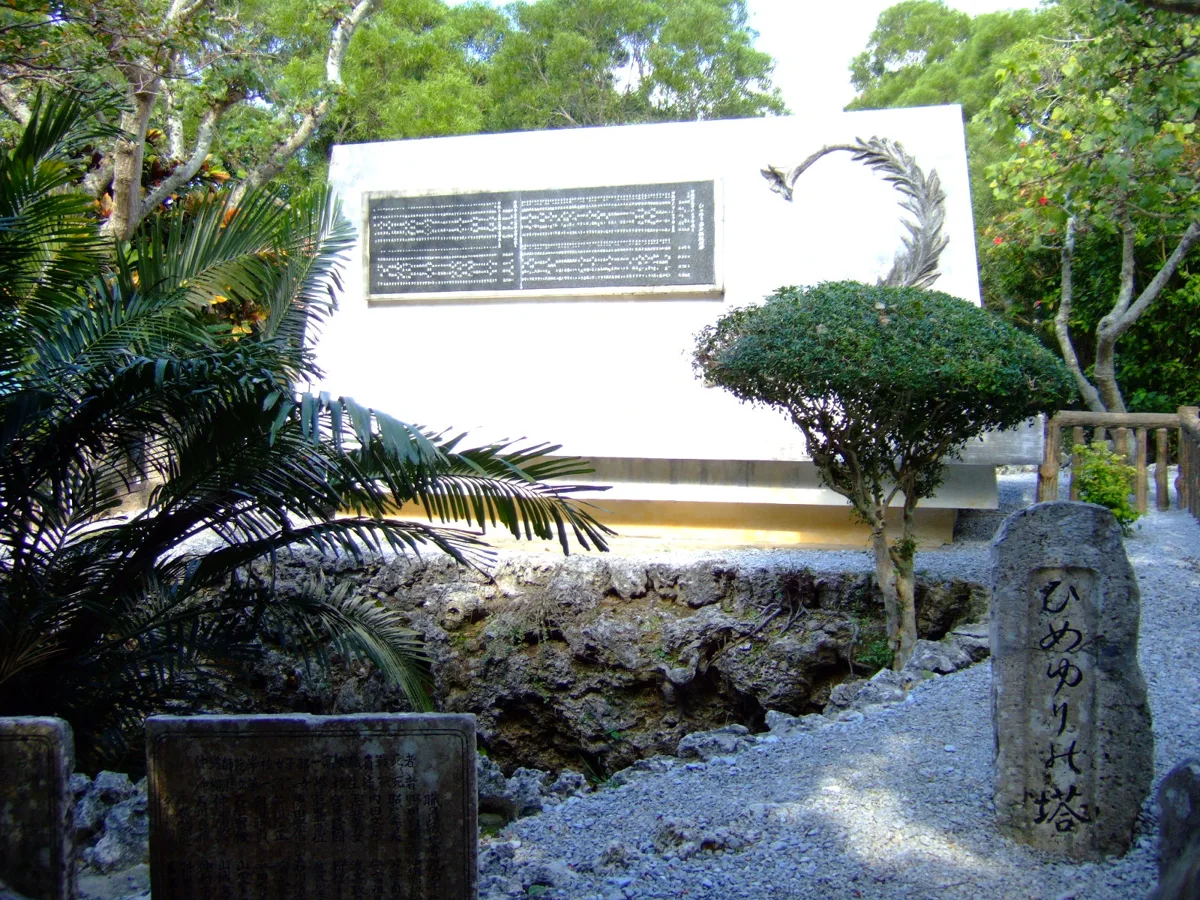
Bereaved families, school groups and other travellers share this space. Lower your voice near the monument and leave room for incense, flowers and silent remembrance. Avoid obstructing worshippers when taking photographs. Leave some unstructured time here rather than filling every minute.
Okinawa Prefectural Peace Memorial Museum: the battle through residents’ eyes
The museum estimates about 10 minutes by car from Himeyuri to Peace Memorial Park, or about 15 minutes on bus 82 to Heiwa Kinen-do Iriguchi. Follow park signs on foot to the prefectural museum. Its address is 614-1 Mabuni, Itoman. For navigation, select Okinawa Prefectural Peace Memorial Museum, signed 沖縄県平和祈念資料館, rather than the similarly named Okinawa Peace Hall, 沖縄平和祈念堂. Both are within the park but are separate facilities.
The park’s museum introduction describes five permanent-exhibition themes from residents’ perspectives: before the battle, the fighting, the battlefield, testimony and post-war life. The second-floor permanent galleries use photographs, objects and testimony. Follow the route to establish a chronology, then read selected testimony more closely. The ground floor also has a children’s exhibition room and information library. If companions read at different speeds, arrange to meet downstairs.
The museum opens 09:00–17:00, with last entry to the permanent exhibition at 16:30. It closes from 29 December to 3 January. Individual permanent-exhibition admission costs ¥300 for adults and ¥150 for minors and students; preschool children enter free. The adult category excludes students. Groups of 20 or more have separate rates. Free loan equipment and admission exemptions are also listed in the museum’s visitor information.
Photographs, testimony and battlefield material may be distressing for some children and adults. Agree that anyone can take a break outside and resume later. Families can start in the ground-floor children’s exhibition and judge how long to spend upstairs from the children’s response. Let each person read at their own pace instead of requiring everyone to see the same material.
The park car park is free. The museum lists 352 ordinary-car spaces and 53 bus spaces. It identifies the annual Okinawa Memorial Service for All War Dead on 23 June and the NAHA Marathon on the first Sunday in December as regular traffic-restriction events. Park and road access on these days affects parking. The permanent exhibition is free on Okinawa Memorial Day. Even if coming specifically for the exhibition, account for the memorial ceremony’s transport arrangements rather than using an ordinary arrival time simply because entry is free.
The Cornerstone of Peace: names on stones by the coast
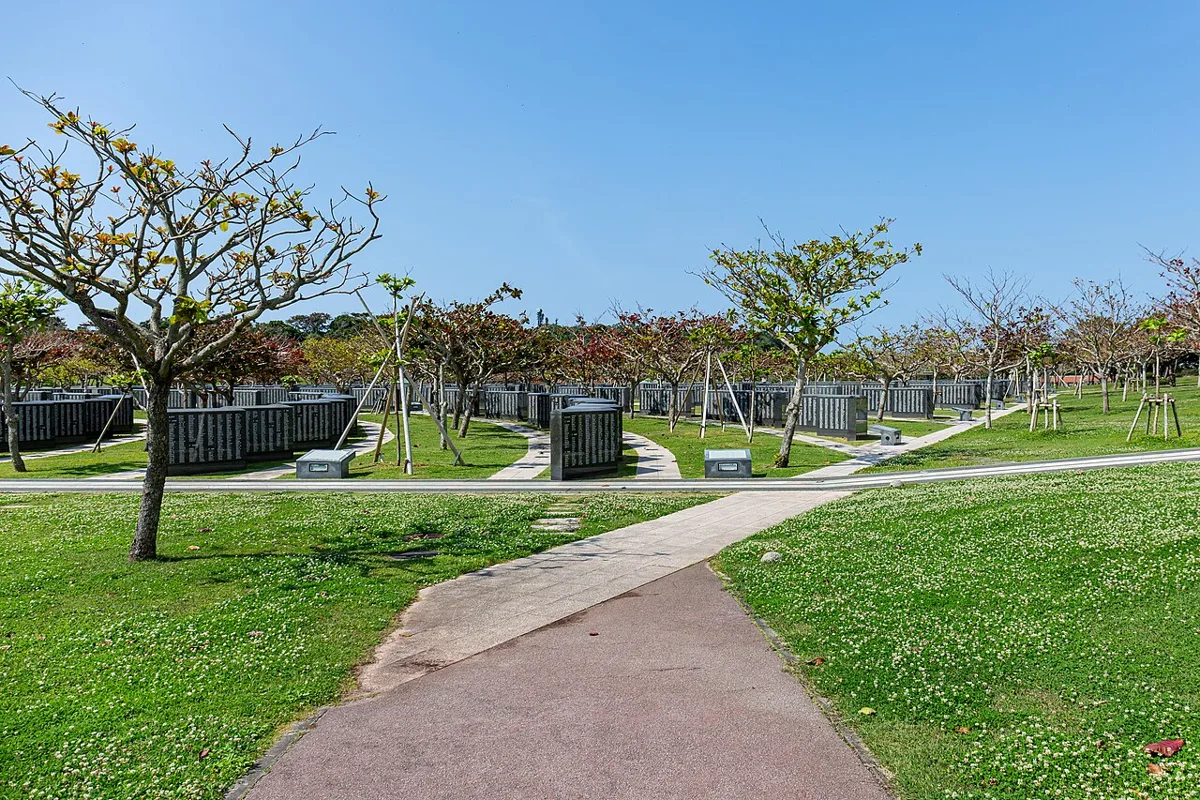
The Cornerstone of Peace was established within the park on 23 June 1995. The park management explanation says it commemorates those who died in the Battle of Okinawa and related circumstances, regardless of nationality or civilian or military status. Paths run between rows of inscribed stones, and Peace Plaza faces the coast. Its central Flame of Peace combines flames from Aka Island, Hiroshima and Nagasaki.
After reading residents’ testimony in the prefectural museum, walk among the stones. The history extends beyond overall figures: each name represents a person. The grounds are extensive and outdoor walking is affected by sun and rain. Bring water and sun protection in summer. In rain, shorten the outdoor stop, visit the indoor exhibition first and walk to the stones when it eases. Use park paths; do not climb stones or enter closed areas.
Okinawa Memorial Day falls on 23 June, when the park is a major place of remembrance. Allow time for transport and site access, using that year’s organiser announcements. Ordinary parking and visiting routines do not apply directly to ceremony day.
Look at the park map before choosing your walk
The official park map page provides park maps and a Cornerstone of Peace layout, with separate area-division and park-map downloads alongside the Japanese complete park map and stone layout. Use the area-division map to identify facilities, then the full park and stone maps to plan paths. For a particular name, the stone layout is more useful than the park map alone. Keep full names when saving or printing maps: the park, museum and Peace Hall sound similar, and complete names make meeting points clearer.
The park and museum use different addresses. Park management lists 444 Mabuni; the prefectural museum lists 614-1 Mabuni. Drivers heading directly to the museum should select its name and address. Use the official park map for paths, stones and other facilities. For a particular inscription, use an indoor or online search system first, then compare its location with the Cornerstone layout to reduce backtracking.
Peace Hall and the prefectural museum are separate places
Heiwa Kinen-do Iriguchi is a bus stop name. Okinawa Peace Hall is a separate facility, while the prefectural Peace Memorial Museum is the historical exhibition in this itinerary. After getting off, consult the park map and choose the museum, Cornerstone of Peace or an outdoor rest first. In a group, specify the museum entrance or bus stop as the meeting point so people do not head to different buildings with similar names.
Without a car: connect bus 89 with bus 82
From Naha, take bus 89 to Itoman Bus Terminal and change to 82 for Himeyuri-no-to-mae or Heiwa Kinen-do Iriguchi. Himeyuri’s access information warns that boarding 89 inside Naha Bus Terminal takes a longer route via Kainan. You can instead board across the road at Asahibashi / Naha Bus Terminal. From the monorail’s Akamine Station, board 89 at Akamine-ekimae and change at Itoman.
For both museums, first find that day’s 82 from Himeyuri towards Peace Memorial Park, then the park-to-Itoman return. If you miss the middle service, staying longer at Himeyuri or connecting by taxi is easier to adjust than waiting by the road and compressing both visits. Check direction as well as departure time for route 82 here. Match the destination with the direction shown at the stop before boarding.
The prefectural museum visitor information, dated 1 January 2026 for these details, lists bus 89 from Naha Bus Terminal to Itoman at ¥670 one way and bus 82 from Itoman to Heiwa Kinen-do Iriguchi at ¥540 one way. It gives intervals of about 10–20 minutes for 89 and about an hour for 82. These cover the two legs to the park. Fares for boarding or leaving at Himeyuri depend on the actual section used. Check the bus operator for payment methods and your travel day’s services.
Do not simply return to the same stop pole. Himeyuri explains that Itoman-bound buses 82 and 107 board in front of Himeyuri Soba, while 108 boards in front of Deigo Plus. Bus 107 can take you to Hakugindo-mae, where you change at the same alighting stop to Naha-bound 89. Identify the boarding point for your actual route beforehand, especially in rain or fading light, to avoid an improvised road crossing.
For Peace Memorial Park alone, take 82 directly from Itoman to Heiwa Kinen-do Iriguchi. The museum gives about five minutes’ walk from there. Combining both museums adds another wait, so bus travellers should not estimate the day from time on board alone.
Driving: separate indoor exhibitions from outdoor memorial spaces
Leave your accommodation in the morning and navigate to Himeyuri Peace Museum. Visit the museum and monument before lunch. The museum has no dedicated car park and directs visitors to nearby souvenir-shop parking. Some navigation systems may lead to a farm road behind the museum, so follow road signs for Himeyuri-no-to as you approach. Continue to the prefectural museum in the afternoon, then the Cornerstone of Peace. The museum estimates about 10 minutes’ drive between the sites. From Chatan or Onna, add the journeys to and from Itoman; those 10 minutes are not the day’s only driving.
Keep last entry in mind: 16:30 for the prefectural permanent exhibition and 17:00 for Himeyuri. If reaching the south only in the afternoon, choose a museum where you have time to read, then assess whether another outdoor memorial fits. Include parking, walking and meeting up after navigating to the park.
Have lunch between the sites or return to central Itoman afterwards. Reading time varies, so leave a gap after your estimated museum departure. For a reserved restaurant, work backwards to avoid leaving halfway through testimony. Companions who need a break can meet in a suitable public space within the park before walking to the Cornerstone together.
Whether to add the Former Japanese Navy Underground Headquarters
The Former Japanese Navy Underground Headquarters is in Tomigusuku, separate from the two Itoman sites. You can add it while travelling south from Naha or on the return, depending on transport. It was the Japanese navy’s Okinawa command facility, distinct from the Army Hospital caves where Himeyuri students worked. Separate the names and locations before combining the histories.
The site lists opening hours of 09:00–17:00, with ticket sales ending at 16:30. Its FAQ estimates 30–40 minutes for the museum and tunnels. Current individual tickets cost ¥600 for senior high school age and above and ¥300 for primary and junior high school pupils; preschool children enter free. An announcement dated 10 October 2026 raises these prices to ¥800 and ¥400 respectively from 1 January 2027. Budget according to the date you enter if travelling across New Year. Free parking is available for ordinary cars.
The entrance descends 105 steps, with a ramp near the exit. The site says visitors with limited mobility can contact it ahead to arrange wheelchair entry through the exit. There is no lift inside. Call before travel if a companion cannot manage stairs; ask entrance staff about pushchair storage. If the two Itoman museums already take most of the day, put the headquarters into a separate half day rather than cutting reading time to fill a list of sights.
A half-day extension: Haebaru Cave No. 20 and Cultural Centre
To connect the Himeyuri students’ route from school to hospital and then south, make a separate visit to Haebaru Cultural Centre and Cave No. 20 of the Okinawa Army Hospital Haebaru cave complex. Haebaru is north of Itoman. This is a different site from Ihara Third Surgical Cave beneath Himeyuri Monument. In March 1945 the students first went to the Army Hospital in Haebaru. After its retreat south in May, hospital personnel dispersed into caves around Ihara in Itoman. Visiting in that sequence helps explain why both place names appear.
The Haebaru town introduction says Cave No. 20 originally housed internal medicine, then became the Second Surgical Department. It is a manually excavated horizontal tunnel about 70 metres long. A central junction with other caves served as an operating area, and nearby passages held two-tier beds. Staff lead today’s visits, allowing comparison of the real space with the Cultural Centre’s reconstructed hospital-cave exhibit. This is a historical site with a different visiting format from panel- and film-based museums.
The town’s visit information requires reservations for individuals and groups. Visits for up to 16 people use 30-minute slots; at most eight enter the cave at once, with staff arranging larger parties. Helmets and torches are lent free and must be used by every visitor. The cave closes on Wednesdays and from 29 December to 3 January. Non-resident tickets cost ¥300 for general admission, ¥200 for senior high school students and ¥100 for primary and junior high school pupils. After submitting a form, wait for the Cultural Centre to confirm availability before putting it in the itinerary.
Slots for up to 16 people start at 09:00, 09:45, 10:30 and 11:15 in the morning, then 13:00, 13:45, 14:30, 15:15 and 16:00. Each lasts about 30 minutes. Individuals can apply through the form; within three days of a visit, enquire by phone. Reservations generally open a year ahead. Groups of 17 or more must apply at least a month in advance. Call the Cultural Centre on 098-889-7399 with party size and preferred date and time. For a larger party, also ask about splitting groups and walking to the meeting point.
Haebaru Cultural Centre is at 257 Kyan, Haebaru. It opens 09:00–18:00, closes Wednesdays and 29 December–3 January, and has free parking. Cave No. 20 is about 10 minutes’ walk away; centre and cave admission are separate. From Naha, take Okinawa Bus 40 or 309 on the Ozato Line, get off at Fukushi Centre Iriguchi and walk about five minutes towards Ozato in Nanjo to the centre. Plan transport and the exhibition around the fixed cave reservation rather than expecting immediate entry on arrival.
Individual Cultural Centre tickets for non-residents cost ¥300 for general admission, ¥200 for junior and senior high school students and ¥150 for primary school pupils. One general ticket at each venue totals ¥600 for a non-resident adult; the primary-school total is ¥250. Keep the venues’ different school-age bands separate. Centre groups of 17 or more also need to apply, with group prices from 20. If extending from Itoman, arrange reservations and admission for both centre and cave so exhibition time is not overlooked.
Beyond the Battle of Okinawa, the Cultural Centre covers post-war camps, local shops and everyday objects, along with emigration and ways of life. The hospital-cave reconstruction has beds and an operating table, with excavated local objects also displayed. After the real Cave No. 20, the reconstruction helps compare how medical work fitted into confined space. Companions who do not enter the cave can see these exhibits. Meet at the centre entrance or reception, keeping the meeting point distinct from the hillside cave entrance.
With only half a day, choose the centre and Cave No. 20. With another full day available, separate them from Himeyuri. A spare 30 minutes cannot cover the cave, centre and both Itoman museums. If companions are unsuited to cave entry, discuss the actual route with staff and arrange to meet around the centre exhibition.
Follow the historical sequence between sites
Himeyuri’s two schools were originally in Asato, Naha. During the war, students and teachers were sent to Haebaru. Museum records state that 222 students and 18 teachers went to the Okinawa Army Hospital on the night of 23 March 1945. Students helped patients eat, use the toilet and dress wounds, and went outside to carry food and water and handle the dead. Starting with school life presents them as students before they appear under their collective wartime name.
On 25 May, the Army Hospital received orders to retreat. Students helped move patients and injured companions south. In Ihara, Itoman, hospital personnel dispersed into six caves, short of equipment, medicine and space. The corps received its disbandment order on the night of 18 June, after which some hid in scrub, among rocks and near the coast. The museum records that, of the 136 corps students and teachers who died, 117 died or went missing after the order. Compare the exhibition with the museum’s historical account to follow these stages.
The natural cave at Himeyuri Monument is Ihara Third Surgical Cave, used by Army Hospital personnel and residents. The museum says an attack there early on 19 June killed more than 80 people. The first monument was established in 1946; the present white monument dates from 1957, with the original stone preserved in front. The monument, cave and museum therefore make this both a battlefield site and a place of post-war remembrance.
The prefectural museum in Peace Memorial Park broadens the view. Room two uses a relief map, images and objects to show the fighting and harm to residents. Room three covers residents hiding in caves and fleeing above ground, including killings by Japanese soldiers, collective deaths under coercion and casualties from US attacks. Room four contains residents’ testimony. Room five continues into post-war camps, 27 years of US rule, land struggles and the reversion movement. This gives post-war lives a place in the story rather than ending abruptly in 1945.
To find a particular name at the Cornerstone, use the prefectural museum’s search guidance. There are two search terminals in the park and one in the museum, plus an online system. Names continue to be added, so totals change. Searching with a name and place of origin is more effective than checking every stone in the rows.
With older relatives or children: equipment and breaks
Himeyuri has three attendant-propelled wheelchairs and an accessible toilet. The prefectural museum has five wheelchairs, two pushchairs and multilingual audio guides including Chinese, all available free at its information counter. Museum wheelchairs are for indoor use only. For a wheelchair on Cornerstone paths or elsewhere in the park, contact the Okinawa Peace Memorial Foundation first on 098-997-2765. Plan indoor exhibitions and outdoor movement separately so loan arrangements connect.
Agree a break signal and meeting point before watching testimony with children. Eating and drinking are prohibited in Himeyuri exhibition rooms; drinks must be in sealed containers to be brought inside the museum. Drink water and eat snacks at suitable outdoor rest areas. The prefectural museum’s ground-floor children’s room offers a starting point before the upstairs permanent exhibition. Judge time in testimony areas by children’s responses. Adults can take turns accompanying them so others can keep reading.
School groups can cause admission waits at Himeyuri even with online tickets. Both museums have group prices from 20 people, but Himeyuri requires reservations from 10. If family and friends total 10, arrange its group booking ahead. The prefectural museum requires electronic applications for permanent-exhibition groups of 20 or more at least four days before the visit.
Individual general adult tickets for both main museums total ¥750. With Himeyuri’s ¥400 online group-rate ticket, the total is ¥700. This is the exhibition budget; add transport and meals separately. Student categories differ: Himeyuri separates senior high from primary and junior high, while the prefectural museum includes students in its ¥150 category. Choose each ticket separately.
A few useful answers
Can I visit both museums in one day without hiring a car?
Buses 89 and 82 connect them, but visiting time depends on that day’s timetable. Fix the park-to-Itoman return first, then work backwards through the inter-museum service and departure from Naha. If suitable services are too far apart, choose one museum or connect by taxi rather than judging only by map distance.
Does Himeyuri Monument need a ticket?
The museum lists the monument separately from its paid exhibition. The monument remains accessible when the museum is closed. Admission is required for the museum’s permanent exhibition. Combining them reveals the history of the students and teachers commemorated.
Do the Cornerstone of Peace and museum use one ticket?
The Cornerstone is an outdoor memorial in the park. The museum’s second-floor permanent galleries charge admission separately. Walk to the stones after the exhibition; these are not one ticketed gallery.
Is a rainy-day visit suitable?
Both museums have indoor exhibitions, so use them during heavier rain. Bring rainwear for the outdoor Cornerstone. If wind and rain affect transport, check temporary museum closures and bus notices before changing the order. Himeyuri explicitly lists possible closure as typhoons approach.
Should I combine this with Churaumi Aquarium?
Churaumi is in the north of the main island; Himeyuri and Peace Memorial Park are in the south. Both museums have substantial exhibitions and testimony, so adding the aquarium across the island reduces visiting time. From northern accommodation, use the day you move to Naha, allowing for luggage and car return. From Naha, give the south its own day.
How do I choose if I only have time for one museum?
Choose Himeyuri for individual people, school life and student testimony. Choose the prefectural museum and Cornerstone for residents’ perspectives on the battle followed by names inscribed beside the coast. Select the perspective that fits your time and companions’ needs.
Official information and references
Sources used in this guide.
- Himeyuri Peace Museum | Wartime history
- Himeyuri Peace Museum | Opening times, prices, access and facilities
- Himeyuri | Permanent exhibition guide
- Peace Memorial Park | Museum introduction
- Okinawa Prefectural Peace Memorial Museum | Visitor information
- Park management | Cornerstone of Peace
- Peace Memorial Park | Official maps
- Former Japanese Navy Underground Headquarters | Facilities, hours and current admission
- Former Japanese Navy Underground Headquarters | FAQ
- Haebaru Town introduction
- Haebaru Town | Cave visit information
- Haebaru Cultural Centre
- Prefectural museum | Searching the Cornerstone inscriptions
- Himeyuri Museum | Himeyuri Monument
- Prefectural Peace Memorial Museum | Exhibition rooms
- Okinawa Peace Memorial Park | Access
- Former Japanese Navy Underground Headquarters | Fare announcement
- Ryukyu Bus Kotsu | Route 89 Itoman Line fares, revised 1 April 2026
- Ryukyu Bus Kotsu | Route 82 Gyokusendo–Itoman Line fares