Plan Churaumi using autumn 2026 official information: tickets and same-day re-entry, Kuroshio feeding and surface viewing, revised November backstage tours, partial Wednesday opening, P7 parking and buses from Naha and Onna.
- Region & Focus
- Okinawa Main Island
- Reading Scope
- 40 min read · 18 chapters · 3 Q&As
- Official Verification
- 28 official sources checkedUpdated 7 November 2026
- Key Topics
- ItinerariesBookingTravel budget
Chapter Route Map (tap any stop)
- Allow a full day in northern Okinawa and arrange both journeys first
- Buy tickets by school stage: family totals and annual passes
- Tickets, same-day re-entry and free facilities
- Opening hours and partial Wednesdays: arrangements since July 2026
- Driving: navigate to P7 and add the walk after parking
- Without a hire car: choose the operator and stop before entry time
- Bus timetable examples from Naha and Onna
- From third-floor coral reefs to first-floor deep sea: follow the changing depth
- The Kuroshio Sea: allow separate time for the front, underside and feeding
- Free surface viewing and paid backstage tours: separate access arrangements
- Revised backstage tour from November: meeting time and participation rules
- Dolphin theatre and feeding: a free show and a separate paid activity
- Combine sea turtles, manatees and a rest near the exit
- Lunch beside a tank, at the fourth-floor restaurant or outside
- Pushchairs, nursing and wheelchairs: use facilities when you need them
- Park vehicles, plants and play areas: use the remaining time
- A driving-day example: aquarium first, then one outdoor choice
- A car-free day and shorter rainy-day options
- Quick Q&A
Set aside a full day in northern Okinawa for Churaumi. Choose your outward and return journeys first, then fit the aquarium, lunch and one nearby facility between them. Standard adult admission is ¥2,180. Kuroshio Sea feeding, surface viewing and dolphin programmes have separate times. Since July 2026, the park has operated partial Wednesday opening; backstage tours also change in November. Consider both when choosing your date.
Allow a full day in northern Okinawa and arrange both journeys first
Okinawa Churaumi Aquarium is inside Ocean Expo Park in Motobu. Driving from Naha Airport via the expressway takes about two hours. Airport buses take roughly 2½–3 hours depending on route, stops and traffic. The 08:15 express from Kencho Kitaguchi in central Naha is timetabled to reach the aquarium stop in 1 hour 41 minutes. A same-day return from Naha therefore uses roughly half the day on road transport alone. Make the aquarium and neighbouring park facilities your main activities. From accommodation in Nago or Motobu, you can leave the morning or afternoon for your hotel and spend less of the day travelling.
The aquarium's FAQ gives an average indoor visit of 1½–2 hours, excluding the dolphin theatre, lagoon, sea turtle and manatee facilities. For a slower Kuroshio Sea visit, a feeding explanation, young children's meals or nursing, extend the aquarium portion to 2½–3 hours, plus lunch and outdoor stops. Allowing 4–6 hours across the park leaves more room for breaks.
After fixing your return transport, choose one programme to anchor the visit. Morning arrivals can target 09:30 ray feeding; afternoon visitors can choose 15:00 Kuroshio feeding. For dolphins, build around the 13:00 or 15:00 show. The two 15:00 programmes take place in different locations, so choose one.
Plan Churaumi using autumn 2026 official information: tickets and same-day re-entry, Kuroshio feeding and surface viewing, revised November backstage tours, partial Wednesday opening, P7 parking and buses from Naha and Onna.
Buy tickets by school stage: family totals and annual passes
Standard tax-inclusive admission is ¥2,180 for adults, ¥1,440 for senior secondary students and ¥710 for primary and junior secondary pupils. Preschool children under six enter free. School stages follow Japan's April school-year system, and identity or student documents may be requested. The admission difference between senior and junior secondary students is ¥730. For teenagers, keep proof of age and school status on the ticket buyer's phone or in a day bag.
Two adults, one primary-school child and one three-year-old pay ¥2,180 × 2 + ¥710 = ¥5,070 for standard tickets. Replacing the primary-school child with a senior secondary student gives ¥5,800; two primary or junior secondary pupils give ¥5,780. For a child whose sixth birthday is close to starting school, provide the ticket desk with the birthday and school stage rather than applying hotel bed-sharing or bus child-fare categories.
Annual passes cost ¥4,360 for adults, ¥2,880 for senior secondary students and ¥1,420 for primary and junior secondary pupils, equal to two standard admissions. Buy an ordinary ticket for one visit. Two visits on different dates cost the same with a pass or two ordinary tickets; the pass gives a clear saving from the third visit. Ordinary tickets allow same-day re-entry, so use the original ticket to see the same tank again after lunch.
Groups of 20 or more entering together and paying in one transaction pay ¥1,730 per adult, ¥1,140 per senior secondary student and ¥560 per primary or junior secondary pupil. Preschool children do not count towards the group size. Group tickets are currently sold on site for the same day; schools and designated groups have separate advance entry applications. Families combining numbers must also meet the shared-entry and single-payment conditions.
Tickets, same-day re-entry and free facilities
For ordinary admission, follow the aquarium's linked web ticket system from the official ticket page. After choosing a category, read its usable dates, redemption method and cancellation terms before paying. Families adding a backstage tour need a separate activity reservation. Save admission and activity confirmations separately for the entrance and tour meeting point, instead of searching through the same screenshot on site.
Same-day re-entry is allowed by showing your admission ticket at the entrance. If you visit the aquarium, go out for lunch or dolphins and then return for Kuroshio feeding, keep the original ticket until the day ends. If your group splits up, everyone returning needs access to their own ticket. Keep paper tickets safe; for electronic tickets, the purchaser should check how to display them separately.
Basic visits to the dolphin theatre, Dolphin Lagoon, Sea Turtle Pool, Manatee Pool and Churaumi Plaza are free via park paths. Indoor Kuroshio Sea, coral reef and deep-sea displays require aquarium admission. Animal feeding, backstage tours and some dining seats cost extra. If you only want a dolphin show, use the park facilities directly; to see whale sharks, buy aquarium admission.
Holders of disability documents listed or recognised by the aquarium, plus one companion, receive free admission regardless of disability grade. The official overseas list includes Taiwan's Republic of China disability handbook. Present the document at the ticket counter; for other countries, use the items on the official list. Calculate this admission concession separately from paid activities, food and transport.
Opening hours and partial Wednesdays: arrangements since July 2026
According to the aquarium opening notice, normal hours are 08:30–18:30, last admission 17:30. The August 2026 late-opening programme until 21:00 has ended; use normal hours for October. Last admission is only the entrance deadline. Enter early enough for the amount you want to see. The sea turtle, manatee and dolphin facilities normally open 08:30–17:30, while Churaumi Plaza remains open until 18:30.
From 1 July 2026 to 31 March 2027, Ocean Expo Park is trialling partial opening each Wednesday. If Wednesday is a national holiday, this shifts to the next weekday. The aquarium, Dolphin Lagoon, Sea Turtle Pool, Manatee Pool, Churaumi Plaza and main northern food outlets remain among the open areas. Concentrate your visit around the aquarium on these days.
Facilities closed on partial-opening days include Churashima Botanical Garden/Tropical Dream Center, the Oceanic Culture Museum, Native Okinawan Village, Omoro Botanical Garden and play equipment such as Chibikko Toride. P1 South Gate and P8 in front of the Tropical Dream Center are also closed. Park vehicles run only the aquarium shuttle route. Choose another opening day for climbing nets, plant houses or planetarium programmes.
General park areas currently open 08:00–18:00. On operating days, the Oceanic Culture Museum and Tropical Dream Center normally open 08:30–17:30, with last admission 30 minutes before closing. Towards evening, finish indoor visits before resting or shopping on the way out. The aquarium has announced no planned closures through 31 March 2027. Temporary closures for typhoons, equipment or animal management are announced separately.
Driving: navigate to P7 and add the walk after parking
For Okinawa Churaumi Aquarium, set your final navigation destination to P7 North Gate multi-storey car park. The aquarium FAQ identifies P7 and P6 in front of North Gate as convenient for entry. Parking in the park is free. Near the park, follow signs for aquarium parking and staff directions, distinguishing the driving route from the walking route.
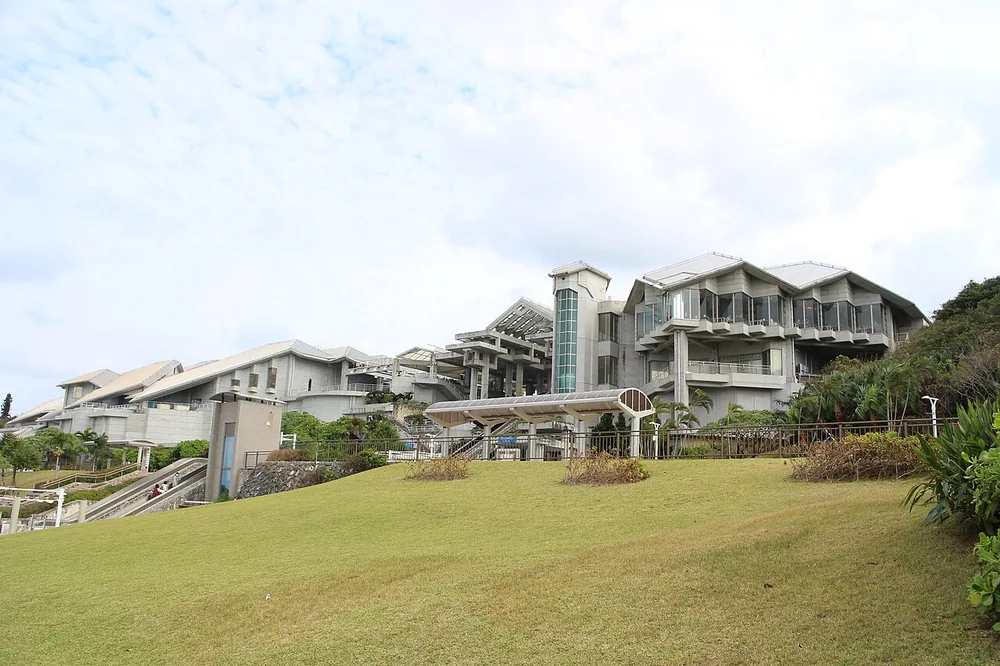
Parking at P3 or P5 Central Gate brings you into the park near the general information centre, then north to the aquarium. This suits a visit to the central park first. For the aquarium alone, pushchairs or older companions, prioritise the northern entrance to reduce walking. P7's first floor has pushchair and wheelchair loans. Include these in your drop-off plan so that the family does not reach the aquarium entrance and have to turn back.
The two-hour drive starts with road travel; add parking, toilets, ticket collection and the walk to the third-floor entrance. The revised 10:00 backstage tour from November meets at 09:55, so allow entry and park walking beforehand. Arriving at the car park at 09:50 does not get you to that meeting on time. Note your floor and parking zone, retrace the route to collect the car and include changing nappies and folding the pushchair before departure.
Driving north immediately after a flight also requires immigration, baggage collection and car-hire procedures. Churaumi works better as a full day after a night's stay. On departure day, if returning a car in Naha, treat refuelling, car return and the terminal shuttle as separate stages and shorten the park visit. If already staying in Nago or Motobu, use the morning opening rather than delaying to match a day trip from Naha.
Without a hire car: choose the operator and stop before entry time
Compare Yanbaru Express and Okinawa Airport Shuttle for travel north from Naha. Their boarding points, stops and boarding systems are separate. Yanbaru Express does not take reservations; wait at your chosen stop. Electronic tickets are a payment method, without reserving a seat on a departure. Standing is prohibited on expressway sections; if full, wait for a later bus. For a fixed-time aquarium activity, keep at least one earlier outbound service as an option.
Yanbaru Express's official FAQ identifies Royal View Hotel Churaumi (Churaumi Aquarium) as the nearest stop. Arriving from Naha, walk back from the stop and enter through North Gate. Kinen Koen-mae (Central Gate) serves the central side instead. Save the operator, full boarding and alighting stop names and direction together. Identify the return stop when you arrive.
Northbound Airport Shuttle uses Okinawa Churaumi Aquarium (Kinen Koen-mae), followed by about ten minutes' walk to the aquarium entrance. Express services skip Onna's main coastal stops. If staying in Onna, choose a stopping service; from Naha, compare the express for a shorter journey. Add hotel-to-stop walking, road crossings and waiting to the published journey time.
On 29 October 2026, Airport Shuttle announced that new bookings on its own website remain suspended, with no restart date. During the suspension, you can book through its partner WILLER website; select Okinawa and your travel date when searching. Cancel WILLER bookings directly with WILLER. If you have not reserved a seat, you can board at the stop on the day subject to availability and pay the driver. For disability or surrendered-driving-licence discounts, contact the operator through its enquiry form. Families can use the official booking channel to arrange outward and return services, while still allowing time to reach the stop early.
Bus timetable examples from Naha and Onna
Airport Shuttle's current timetable applies from 15 October 2026 to 31 January 2027. Express #3 leaves Naha's Kencho Kitaguchi at 08:15 and reaches Kinen Koen-mae at 09:56. Return express #16 leaves the aquarium stop at 15:30, reaching Asahibashi Station/Naha Bus Terminal-mae at 17:18. This gives about 5½ hours in the park for the aquarium, lunch and one nearby visit.
For more time, stopping service #18 leaves the aquarium at 16:00 and reaches Asahibashi at 18:48. Service #20 leaves at 17:00 and reaches Asahibashi at 19:48; it does not serve the airport. The 15:30 express cannot follow both the 15:00 dolphin show and Kuroshio feeding. Decide on arrival which you want. Services #17 and #22 are marked suspended in this period's timetable; remove them from your plan.
For Onna's west coast, use #5 as an example: board at Tiger Beach-mae at 10:20 or Sun Marina Beach-mae at 10:23, reaching Kinen Koen-mae at 12:02. Return #18 leaves at 16:00, arriving at Sun Marina at 17:39 and Tiger Beach at 17:42. For a longer visit, earlier #1 leaves Tiger Beach at 08:06 and reaches the aquarium stop at 09:38. Adjust these examples to your accommodation using the same timetable.
Stopping services #5 and #18 have a toilet break at Nabee Beach-mae. Service #1 and all express services do not. Take children to the toilet before joining the boarding queue. Free lap travel is limited to one young child per adult. Children aged one to five occupying a seat pay a child fare; ages six through primary school year six pay half the adult fare, and junior secondary pupils pay adult fares. Yanbaru Express allows child fares for both primary and junior secondary pupils, with ID required for the latter. Calculate each operator's child category separately if mixing them for your return trip.
From third-floor coral reefs to first-floor deep sea: follow the changing depth
The main paid entrance is on the third floor, with the route descending through coral reefs, the Kuroshio and the deep sea. The coral reef area includes Life in the Inoh intertidal displays, the Coral Sea, Sea of Tropical Fish and smaller individual tanks. Let children find a familiar fish before comparing habitats nearby, rather than hurrying them onwards from the entrance.
The Coral Sea uses natural light. The Sea of Tropical Fish shows reef fish in a larger environment, while small tanks suit close study of shape, pattern and camouflage. Allow roughly 30 minutes and extend by interest. If targeting 09:30 ray feeding, enter early, make a shorter first pass through the coral section and return later that day.
The second floor leads to Churaumi Theater, shark research displays and the main Kuroshio tank. First-floor deep-sea displays include deep-sea life, bioluminescence-related exhibits, Aqua Lab and the Ryukyu Arc waterside area. Leave a quiet stretch for these after the big tank. Visitors who like smaller creatures may stay longer here.
Children afraid of darkness can rest in a brighter area before one adult accompanies them through a short section. Those uninterested in deep-sea displays can follow the route to the exit. To understand life at different depths, compare light, water temperature and habitat using the explanations on site, rather than deciding time solely by animal size. With different interests, agree a meeting point towards the exit and let everyone explore a section.
The Kuroshio Sea: allow separate time for the front, underside and feeding
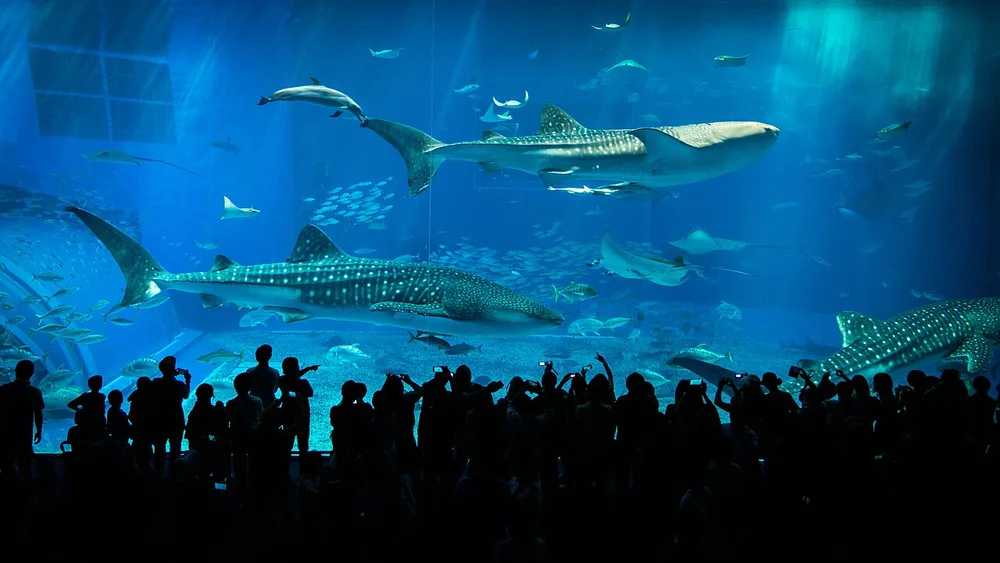
The Kuroshio Sea holds 7,500 cubic metres of water, ten metres deep, 35 metres wide and 27 metres from front to back. It houses open-water swimmers including whale sharks and manta rays. First watch the direction of passing fish from the front, then use Aqua Room to see bodies and undersides overhead. This reveals the tank's space better than taking selfies along the glass. Front-facing viewing seats make a shared rest point for companions.
Give the Kuroshio Sea at least 30 minutes for fish to approach, a change of angle and a short rest. For photographs, stop in one place and leave a route for pushchairs and wheelchairs. For shorter children, wait to one side until the front row moves, rather than lifting them onto railings or pushing into a crowd. Finish one viewpoint before moving; the family need not chase every large fish.
Current feeding explanations show manta rays eating at 09:30 and Kuroshio tank animals at 15:00 and 17:00. The outdoor dolphin show also runs at 15:00. Stay indoors if whale sharks and the big tank are your priority; choose another feeding slot if dolphins matter more. Animal health can change programmes. Confirm that day's schedule at entry before deciding whether to leave around lunch.
Before travelling, watch the aquarium's official 360° Kuroshio Sea Underwater video. Its angles explain the fish and tank's scale. On site, move between ordinary viewing areas, Aqua Room and any open surface-viewing area. Afterwards, ask children to choose a body shape they most want to observe, giving them a specific small task on arrival.
Observe the fish and main tank's scale in the official underwater 360° footage, then compare the front-facing and Aqua Room views on site.
Free surface viewing and paid backstage tours: separate access arrangements
Kuroshio Exploration surface viewing currently opens 09:00–10:45 and 17:30–18:15, without reservations, after aquarium admission. Take the dedicated lift from the first-floor whale shark and ray area to the fourth-floor tank surface. The exterior fourth floor is separate from this dedicated entrance; follow signs inside. For a morning visit, reach the first floor in time and see other sections afterwards.
Surface viewing closes from 10:45–17:30 for animal health management. For a 15:30 bus to Naha, choose the morning slot. If arriving at noon, focus on the Kuroshio front view, Aqua Room and other displays. The evening slot ends at 18:15; bus users should compare it with their own return service first.
Paid backstage tours take visitors into work areas with a guide and need separate activity and aquarium tickets. The revised programme starts on 1 November 2026. Book the product for your attendance date. Independent surface viewing lets you control your stay; backstage tours require fixed meeting times and walking conditions. Choose according to whether you want Japanese explanations of the work.
Revised backstage tour from November: meeting time and participation rules
The revised Kuroshio Sea backstage tour from 1 November 2026 costs ¥2,000 per person, plus aquarium admission. Tours run at 10:00, 11:00 and 13:00 for 30 minutes, with one group of up to five per session and one booking per group per day. They include the tank surface, feed preparation area and the keepers' observation room, with the actual route fitted around work operations.
Bookings open 30 days before attendance at 10:00 Japan time. For example, 1 December opens on 1 November at 10:00. Meet five minutes before the start in front of the Life in the Inoh tank. Arrival ten or more minutes late is treated as cancellation with a 100% fee, without extension or a different slot. Traffic north, parking and entrance queues affect meeting time. For morning tours, compare the previous night's location and transport together.
Participants must walk independently for 30 minutes and wear non-slip shoes enclosing toes and heels. Wheelchairs, pushchairs and baby carriers are not permitted on the tour. The official recommendation is primary-school age and above; primary-school children and younger require a parent. Explanations are in Japanese only, requiring everyday Japanese comprehension. With younger children, one adult can tour while another takes them around normal displays, then meet afterwards.
Register every participant's name and age when booking. Each is checked on the day; unregistered people cannot join at the last minute. Leave large bags in entrance lockers. Work areas are hot and humid, with fish and seawater smells and machinery noise. Follow instructions to disinfect hands and shoe soles. Report crustacean allergies in advance. Discuss these conditions with companions before choosing who joins.
Dolphin theatre and feeding: a free show and a separate paid activity
Okichan Theater is about five minutes' walk from the aquarium exit. Normal showtimes are 10:30, 11:30, 13:00, 15:00 and 17:00, free to watch. Allow two hours inside the aquarium, then choose a nearby showtime to reduce repeated entry and exit. Front rows and lagoon edges can receive seawater spray. Secure phones, cameras and children's spare clothes beforehand.
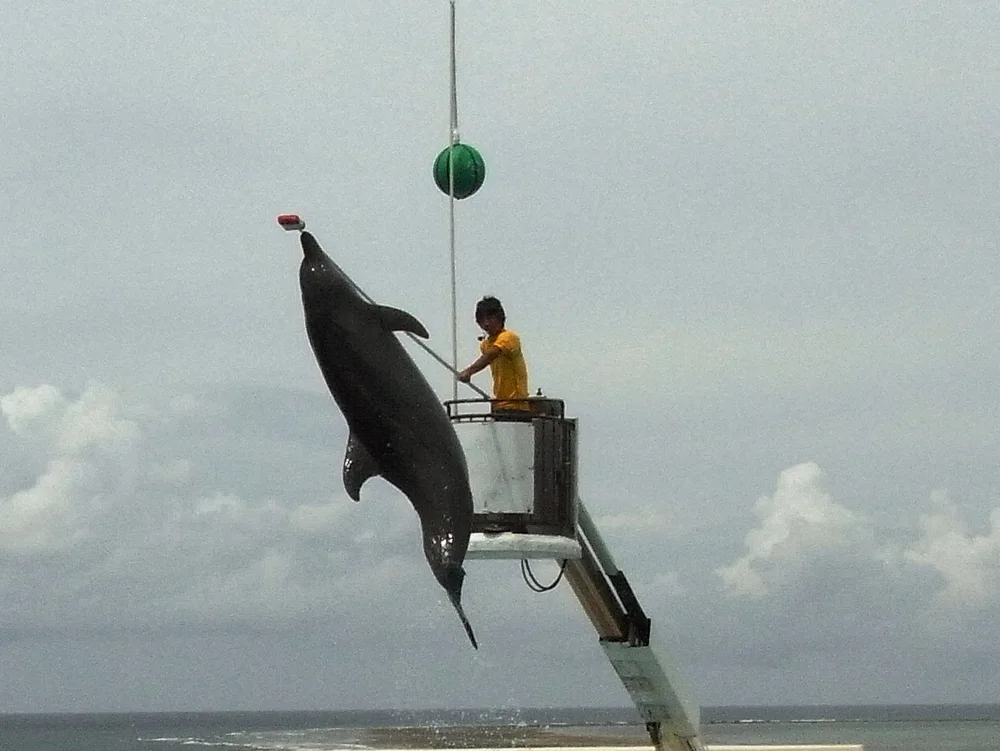
Since July 2026, the Dolphin Lagoon feeding experience costs ¥1,000 per set of food. Current sessions are 10:00, 13:30 and 15:30. Smartphone QR queue tickets open at reception beside the lagoon 30 minutes beforehand until sold out. Former 11:00 and 12:00 sessions are suspended. After obtaining a queue ticket, arrive at the start and pay by credit card or PayPay only. Preschool children need a parent.
If combining the 13:00 show and 13:30 feeding, reception times overlap. Adults can split the tasks, or choose just one activity. To watch dolphins swim, visit the lagoon without adding feeding. Pay extra if the feeding experience interests you. Programmes may be cancelled for animal health or weather; use that time for sea turtles, manatees or indoor tanks instead.
The aquarium has announced suspension of theatre dolphin shows from 4–9 January 2027 for repairs. Remove the theatre programme on those six days when planning winter holidays or an early-year trip, keeping the aquarium and other open facilities. Aquarium operations and theatre repairs have separate notices, so check each activity you intend to see before buying tickets.
Combine sea turtles, manatees and a rest near the exit
At the Sea Turtle Pool, watch swimming and nesting sand from above, then descend one level for underwater side views. Basic admission is free, about five minutes from the aquarium exit. Let children first see shells at the surface, then paddling below. Linking the two heights creates one observation rather than a single photograph at the pool edge.
The Manatee Pool is also free, showing West Indian manatees underwater. Current mother-and-calf care arrangements use lower-level viewing. Manatees are sensitive to light and sound; stay quiet and turn off flash. For a short family rest, sit first in Churaumi Plaza beside the exit, then decide whether to continue to the manatees.
Secure lens caps, hats, toys and food beside the turtle pools. Throwing objects into the pools is prohibited to prevent animals swallowing them. Adults should accompany young children, keeping hands and bodies inside the railings. Choose just one facility if children are tired, leaving energy for the car park or bus stop. Nearby facilities normally close at 17:30, an hour before the aquarium. In the afternoon, see them first and return indoors afterwards.
Lunch beside a tank, at the fourth-floor restaurant or outside
Inside the aquarium, first-floor Ocean Blue café lets you eat while watching the Kuroshio Sea. Ordinary tables have no seating charge. Nine tank-side seating areas cost ¥1,000 for 50 minutes, allocated on a first-come, first-served basis on the day, without reservations. Each person must order at least one item; food and drinks are extra. Only drinks and desserts are served 08:30–10:00, so plan a full meal after 10:00.
The café normally opens until 18:00, with food last orders at 17:00 and the drinks bar until 17:30. To combine 15:00 feeding with 50 minutes in the café, finish eating first and move to the general viewing area. Queuing and waiting for tank-side seats must not consume your booked return bus time. Stay flexible for a preferred tank-side seat; if children are hungry, choose somewhere easier to sit.
Fourth-floor Inoh restaurant is accessible from outside the paid exhibition area. Its lunch buffet runs 11:00–16:00, last orders 15:30, with 50-minute dining. Ages 13 and over pay ¥2,600, ages 7–12 ¥1,400 and ages 3–6 ¥500. Two adults with seven- and three-year-old children pay ¥7,100. Small families queue on site; telephone reservations start at ten people. Reservations are not accepted from 26 December 2026 to 3 January 2027.
After leaving for dolphins, choose light meals at Okichan Parlor near the theatre and lagoon, or More Mare in Churaumi Plaza at the exit. Bring food only to outdoor eating spaces allowed by the park. Eating, drinking and bringing meals into the aquarium are prohibited, although sealable bottles and flasks are allowed for hydration for health reasons. For food allergies, read each restaurant's official allergen chart before choosing food and location.
Pushchairs, nursing and wheelchairs: use facilities when you need them
Free pushchair loans are available on P7's first floor and at places including the general information centre. Numbers are limited, first come, first served, without reservations. Aquarium ramps accommodate pushchairs. If children also need one while waiting for buses or before arrival, bringing your usual pushchair connects the whole day more easily. In crowded tank areas, park clear of passageways while adults take turns accompanying children.
Nursing rooms at the third-floor entrance and in front of second-floor Churaumi Theater have sofas and hot water for formula; bring your own formula. Changing tables are in toilets including those at the third-floor entrance, fourth floor and first floor. If a feed is due on arrival, use the third-floor facilities before following the route down. The Blue Manta shop sells only size L nappies, for roughly 9–14 kg. Bring other sizes and familiar supplies from your accommodation.
Wheelchairs can be borrowed on P7's first floor. The aquarium's FAQ states that the aquarium itself does not lend them. Indoor ramps and lifts are available, but the park has level changes. Include the route from exit back to entrance or parking. Ask at park information or speak to staff if help with longer distances is needed. The paid backstage tour's independent walking requirement applies separately.
Personal souvenir photography is allowed without disturbing others. Selfie sticks, monopods and tripods are prohibited indoors. The Manatee Pool also requires quiet viewing without flash. If a child is lost, contact nearby staff. Point out entrance and exit directions on arrival, and agree precise meeting places when adults split up, avoiding repeated searches around the big tank.
Park vehicles, plants and play areas: use the remaining time
Park sightseeing vehicles cost ¥300 per ride or ¥500 for a day ticket from primary-school age, with under-sixes free. Buy from the driver. Current operation is 10:00–17:00, accepting cash and listed transport IC cards. Buy a single for one ride or compare the day ticket for two or more. If leaving the aquarium after 17:00, allow your own walk back to the car or bus stop.
Normal opening days have circuit and shuttle routes at roughly 20–30-minute intervals. Partial Wednesdays have only the aquarium shuttle. For a fixed bus departure, compare waiting with walking and leave a buffer before reaching the stop. Tell the driver about wheelchair or pushchair assistance before boarding, and follow instructions for the actual vehicle.
With another half-day and an interest in maritime culture, make the Oceanic Culture Museum and Planetarium another main activity. For tropical plants and greenhouses, choose Churashima Botanical Garden/Tropical Dream Center. Both require separate admission and close on partial Wednesdays, so consider them when first choosing dates.
For outdoor climbing nets, consider Chibikko Toride between P7 and the aquarium. It closes for safety in rain or when the nets are wet, and also on partial Wednesdays. Keep it flexible after the aquarium. Shorten shopping if children are absorbed; rest instead if the nets are unavailable, without letting journeys between distant buildings squeeze the return trip.
A driving-day example: aquarium first, then one outdoor choice
For a family staying in Naha without a backstage booking, leave around 07:00, reach parking after 09:00, use toilets and enter around 10:00. See coral reefs, Kuroshio and the deep sea, with lunch at noon. Accommodation location and roads change departure time. Add rest and entry time to the live driving estimate.
After lunch, see the 13:00 dolphin show and choose either sea turtles or manatees. If 15:00 Kuroshio feeding is your priority, retain the original ticket and return inside. To leave between 14:00 and 15:00, head to parking after the 13:00 dolphins, keeping time for a journey break and hotel dinner. If young children need sleep, leaving straight after lunch still gives you the main indoor displays.
From Onna or Nago, enter as early as 08:30, see rays at 09:30 and surface viewing around 10:00, then fill in coral and deep-sea sections. Spend the afternoon at the hotel or add one park facility. For the revised 10:00 backstage tour, put the 09:55 meeting first, assigning feeding, surface viewing or dolphins to other slots rather than trying to finish everything that morning.
For an afternoon outside the park, choose a short Bise walk or Nakijin Castle Ruins. Bise offers village shade and an easy turn-back when tired. Nakijin suits visitors happy with stone steps who want walls and sea views. If your morning already includes a backstage tour and you want 15:00 feeding after lunch, move the outdoor extension to another day and leave time to retrace the route to your car.
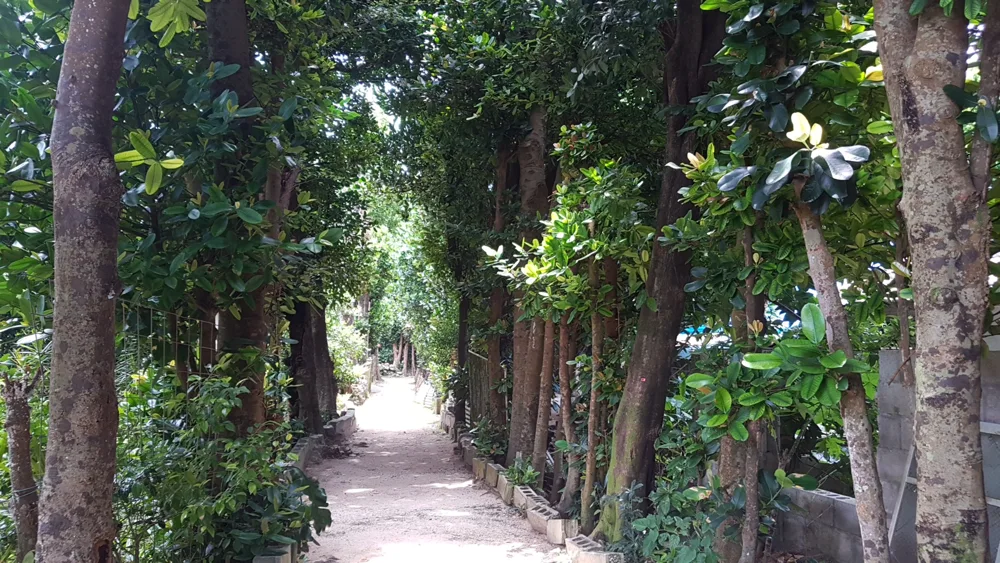
For the Bise Fukugi Tree Road, keep your P7 space, walk from the aquarium towards Emerald Beach and leave via Bise Gate on the park map, reaching the tree-road entrance at the village's southern side. Allow 60–90 minutes including the park return, walking just 15–20 minutes into the village before turning back. You need not reach Cape Bise. The tourist association describes about one kilometre from the tree road to the cape, with the return still to add. Retracing the route to P7 avoids driving into the village to seek another space. Fukugi trees originally sheltered homes from wind. Stay on roads for photographs, let residents and vehicles pass, and leave doorways and gardens to residents.
For Nakijin Castle Ruins, the operator's FAQ gives about ten minutes by car from the aquarium, plus parking, tickets and walking on arrival. Car Park 1 has been closed for construction since 1 September 2026. Follow the current parking notice to Car Parks 2, 3 or 4. Car Park 2 is near the Gusuku Exchange Center; 3 and 4 are further out. After parking, walk to the ticket office inside the centre, then to Heiro-mon gate. Follow on-site signs for parking areas along the route and large-bus-only areas. Open the official parking map from the homepage notice and save it with your navigation before leaving to recognise usable entrances.
Since 1 September 2025, ordinary Nakijin Castle Ruins admission is ¥1,000 for adults, ¥500 for junior and senior secondary students, and free for primary-school children and younger. The History and Culture Center is separately free. Castle hours are normally 08:00–18:00 in January–April and September–December, last entry 17:30, extending to 19:00 in May–August, last entry 18:30. The official estimate is about 30 minutes in the ruins and 15 minutes in the centre. Allow 60–90 minutes including parking, tickets and returning to the car. Continuous stone steps make wheelchairs and pushchairs difficult. Families wanting to avoid carrying can visit only the History and Culture Center, which has a lift. It opens 09:00–17:00, last admission 16:30, closing Mondays, or the next day when Monday is a national holiday or Okinawa Memorial Day. It also closes from 29 December to 3 January.
A car-free day and shorter rainy-day options
With the 08:15 Kencho Kitaguchi express reaching the stop at 09:56, arrive at the entrance around 10:10. See indoor displays in the morning, eat around noon, then choose 13:00 dolphins or sea turtles and manatees. For a 15:30 return, start towards the stop before 15:00, allowing toilets, tickets and folding the pushchair. For 15:00 feeding, choose a later bus with room to adjust.
This route stays around Central Gate and the aquarium. If a full outbound bus delays you, remove restaurant queues, paid seats and extra park facilities first, keeping the aquarium and return journey. Save southbound times, stop direction and your accommodation address in advance, so that poor signal or a low phone battery does not leave you unsure where to go.
In ordinary rain, spend longer indoors. Extend to sea turtles or manatees according to wind, rain and the outdoor walks between buildings. In strong winds, typhoon warnings or operator suspensions, stay at your accommodation to arrange meals and booked activities. Park and bus operators publish separate operating updates. Check that facilities are open and you can return before leaving. Road restrictions and bus changes also apply for the 8 November cycling race; replan that day using the operator's special notice.
For two adults, a seven-year-old and a three-year-old, standard admission totals ¥5,070. Add Inoh lunch at ¥7,100 for ¥12,170. Day tickets for park vehicles add ¥1,500 for three paying passengers, giving ¥13,670. List animal feeding, souvenirs and Naha return transport separately. If the same family visits only free outdoor facilities, remove admission and recalculate actual food and transport to see where the day's spending goes.
Without a car, add Bise using the same 09:56 Kinen Koen-mae arrival and 15:30 return from the original stop, replacing dolphins, turtles or manatees after 13:00 with a walk. After lunch, head towards Emerald Beach, leave through Bise Gate, walk a short section from the tree road's southern entrance, then retrace your route into the park and follow paths to Kinen Koen-mae at Central Gate. Identify Bise Gate and Central Gate on the official park map beforehand; they are on different sides. Budget 13:00–14:30 for walking, start back towards the stop by 14:30 and reach the waiting area at 15:00. Shorten the tree-road section if lunch runs late or children walk slowly. These services use Airport Shuttle's 15 October 2026–31 January 2027 timetable. Replan 8 November using the race-day transport notice above.
This Bise extension connects entirely on foot, returning to the stop identified in the morning. For 15:00 Kuroshio feeding, stay in the park after lunch, re-enter with your original ticket and take one of the later returns listed in this guide. With the short Bise option and 15:30 bus, make the walk your final activity after leaving the aquarium. Decide at lunch to avoid rushing from the village to the paid entrance and back to the bus stop.
A few useful answers
Do I need an aquarium ticket just to see dolphins?
Basic visits to the dolphin theatre, lagoon, sea turtle and manatee facilities are free. Whale sharks and the Kuroshio Sea are inside the paid aquarium. Feeding and similar experiences cost extra.
Can I leave Churaumi for lunch and return?
Same-day re-entry is allowed. Show the original admission ticket at the entrance and observe the last admission time.
Is the aquarium open on Wednesdays?
During the partial-opening trial from 1 July 2026 to 31 March 2027, the aquarium remains open. The Tropical Dream Center, Oceanic Culture Museum, Native Okinawan Village and some play facilities close. A holiday Wednesday shifts the arrangement to the next weekday.
Official information and references
Sources used in this guide.
- Frequently asked questions
- Standard tax-inclusive admission
- Aquarium opening notice
- Partial Wednesday opening trial
- Yanbaru Express
- Official FAQ
- Airport Shuttle: website booking suspension and the WILLER alternative (29 October 2026)
- Airport Shuttle timetable: 15 October 2026–31 January 2027
- Coral reef area
- Deep-sea area
- The Kuroshio Sea
- Current feeding explanations
- Kuroshio Exploration surface viewing
- Revised Kuroshio Sea backstage tour from 1 November 2026
- Normal showtimes
- Feeding experience
- Same-day seating on a first-come, first-served basis
- Lunch buffet
- Free pushchair loans
- Selfie sticks, monopods and tripods prohibited
- Park sightseeing vehicles
- Operator's special notice
- Airport Shuttle: child fares, free lap travel and toilet-break FAQs
- Motobu Tourism Association: Bise Fukugi Tree Road
- Nakijin Castle Ruins: ordinary tickets, seasonal hours, ticket office and accessibility FAQs
- Nakijin Castle Ruins: Car Park 1 closure and alternative parking map
- Ocean Expo Park: maps and brochures
- Okinawa Convention & Visitors Bureau: walking in Bise and residents' upkeep