Explore Shikinaen as a royal retreat and reception garden. Read the residence, Rokkakudo, stone bridges and Ikutokusen from the pond paths, and plan a car-free half-day around seasonal last admission, Wednesday closures and Shikinaen-mae bus stop.
- Region & Focus
- Naha
- Reading Scope
- 28 min read · 12 chapters · 4 Q&As
- Official Verification
- 6 official sources checkedUpdated 22 November 2026
- Key Topics
- ItinerariesSeasonsNeighbourhoods
Chapter Route Map (tap any stop)
- Give Shikinaen a morning with time to walk slowly
- How the 1799 retreat connects with royal diplomacy
- Locate the pond, residence and Rokkakudo first
- The residence: see the roof across the water, then approach its details
- Rokkakudo and stone bridges: close and distant views of one pond
- Ikutokusen: connect water and inscriptions with the reception history
- The main gate, curved stone path and boat landing
- Check admission, Wednesday closures and seasonal hours together
- Arriving without a car: target Shikinaen-mae, then choose bus or taxi
- Morning at Shikinaen, afternoon in Naha
- Adding Shuri: separate the visits and the journey between
- Rain, older relatives and young children: shorten paths rather than every stop
- Quick Q&A
Allow half a day for Shikinaen. Follow the pond to study the royal residence, Rokkakudo and stone bridges, then read the investiture envoy’s inscriptions at Ikutokusen spring. Choose an opening day and connect your accommodation with Shikinaen-mae bus stop. Last admission is 17:00 from October to March; arrive earlier for a detailed visit. If Shuri already fills your day, give this royal retreat a separate morning.
Give Shikinaen a morning with time to walk slowly
If Shuri Castle is already in your Naha itinerary, garden, architecture and history enthusiasts should give Shikinaen a separate morning. Shuri Castle connects with the kingdom’s residence and government; Shikinaen was a royal retreat that received Chinese investiture envoys. Here, the focus is the pond, its banks, buildings and your position while walking. Understand the relationship between the residence and Rokkakudo from one point, then change angle along the shore. This offers more than photographing a list of names.
Allow about one and a half to two hours inside, with accommodation journeys, waiting and lunch before or after to form a half-day. This allocation suits reading explanations and stopping to look. A quick look at Rokkakudo can take less, but a dedicated cross-city trip merits unhurried time for the pond, residence and Ikutokusen. If companions look slowly, eat in the city afterwards instead of adding Shuri.
With only one cultural half-day, decide what you most want to see. Choose Shuri for castle gates, fortifications and its neighbourhood. Choose Shikinaen for garden composition, royal hospitality and water scenery. For detailed visits to both, separate half-days make walking and transfers easier. Adding Shikinaen to a route already linking Shuri Castle, Tamaudun and Kinjocho’s stone-paved road adds another cross-city journey.
Shikinaen is at 421-7 Maaji, Naha. Save this address and Shikinaen-mae bus stop to match the entrance with transport. Accommodation along the monorail can still be a base, but the final garden journey needs a city bus or taxi. If the garden is the day’s priority, settle arrival and return before choosing lunch.
Explore Shikinaen as a royal retreat and reception garden. Read the residence, Rokkakudo, stone bridges and Ikutokusen from the pond paths, and plan a car-free half-day around seasonal last admission, Wednesday closures and Shikinaen-mae bus stop.
How the 1799 retreat connects with royal diplomacy
The Agency for Cultural Affairs explanation dates the garden to 1799. It served royal recreation and entertained investiture envoys sent by the Chinese emperor. Keep both uses in mind: private royal relaxation and formal reception. They give the pond and buildings a concrete context.
Investiture envoys were representatives of the Chinese emperor, rather than travellers in general. Their identity explains the garden’s Chinese-related architecture and inscriptions and distinguishes it from a park focused on flowers and trees. Treat Rokkakudo, stone bridges and Ikutokusen as different clues in the same history of hospitality.
The Agency connects the garden layout with Japanese influence, and the bridges to pond islands and Rokkakudo with Chinese influence, while stressing the overall Ryukyuan composition and design. Look first at the pond and banks together, then individual roofs and bridges. This follows the official explanation more closely than assigning each object one national label. Designs from different sources meet in a place used by Ryukyuan royalty.
The Agency’s World Heritage page includes Shikinaen in the Gusuku Sites and Related Properties of the Kingdom of Ryukyu, inscribed in 2000. Other components include Shuri Castle Site, Tamaudun and Sonohyan-utaki Ishimon. You need not collect them all in one trip. Distinguish garden, royal castle, tomb and place of prayer, then choose what you want to understand.
Shikinaen was damaged in the Battle of Okinawa. Naha’s tourism association records long-term reconstruction beginning in 1975; the Agency explains that conservation repairs drew on investigation of remains. Read today’s buildings and garden through both the royal-period layout and post-war restoration that made it visible again. Alongside roofs and walls, read restoration information on site.
Locate the pond, residence and Rokkakudo first
Naha describes Shikinaen as a strolling garden, where scenery changes as you move around the pond. First locate the water, royal residence and Rokkakudo, then choose an open path. With the overall relationship established, each bridge or spring has a position within the garden rather than being another marker on your phone.
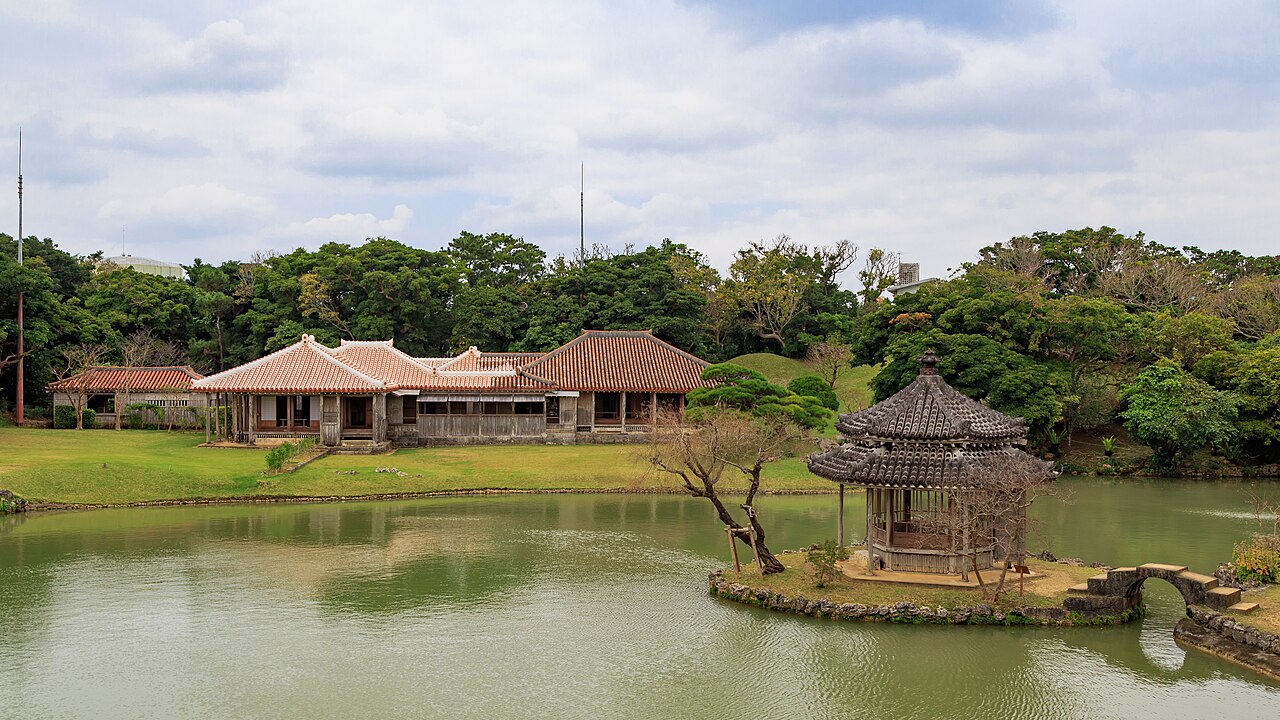
At the first pond view, stop without blocking others. Look at the residence’s long red-tiled roofs, Rokkakudo’s more compact grey roofline and the water between them. Their different volumes are easy to recognise in one view. Follow an open bank and notice buildings hidden by trees, roofs reappearing and stonework defining the pond edge.
Use the residence as a reference. Remember whether it appears left or right of Rokkakudo, then walk to the next stopping place and see whether they overlap. This helps garden newcomers and gives children a difference to find. With a reference point, shrubs, islands and bridges become positions you can describe, and photographs are easier to orient later.
Let the view determine stops rather than a photo count. Where residence and pavilion are visible together, study the whole. Where only Rokkakudo appears, examine roof, columns and island. Nearby trees shift against distant buildings as you move along the bank. These changes are central to a strolling garden and cannot be replaced by repeated photographs from one spot.
Divide the visit into a pond route and optional branches. Focus the main route on residence, water, Rokkakudo and bridges, then add springs, inscriptions and entrance details if time and energy allow. This is a suggested way to choose; follow open paths and signs on site. For more architecture and less walking, stop longer along the main route instead of constantly seeking another camera position.
A Shikinaen video uploaded by JUNICHI217 in 2014, recording the garden after February rain.
The residence: see the roof across the water, then approach its details
The royal residence rewards a distant view first. The accompanying 2016 photograph shows its red roofs across the pond, with grass and water in front and Rokkakudo on a nearer island. Identify this depth in the image, then notice along the bank when the residence becomes central and when it sits behind the pavilion. This shows how buildings form part of the scenery.
Near the building, slow down for horizontal eaves, roof junctions and the distance between timber facades and garden. From afar, red tiles unite the building; close up, different roofs and rows of columns become clear. Moving from far to near makes the residence a focus without requiring a vocabulary of architectural terms.
Where that day’s open route approaches the residence, follow signs for entrances, footwear and accessible areas. Read explanations before studying the space. If some companions prefer architecture and others pond photography, agree a clearly identifiable path meeting point rather than searching while moving. Allow interested visitors time instead of breaking every stop short to complete a circuit.
Receiving investiture envoys is the garden’s historical context. Read on-site explanations for individual room functions. Seeing how the building faces the garden and appears from the pond already makes the royal retreat tangible. Before leaving, look back over the water and place the columns and roofs you studied into the wider scene.
Rokkakudo and stone bridges: close and distant views of one pond
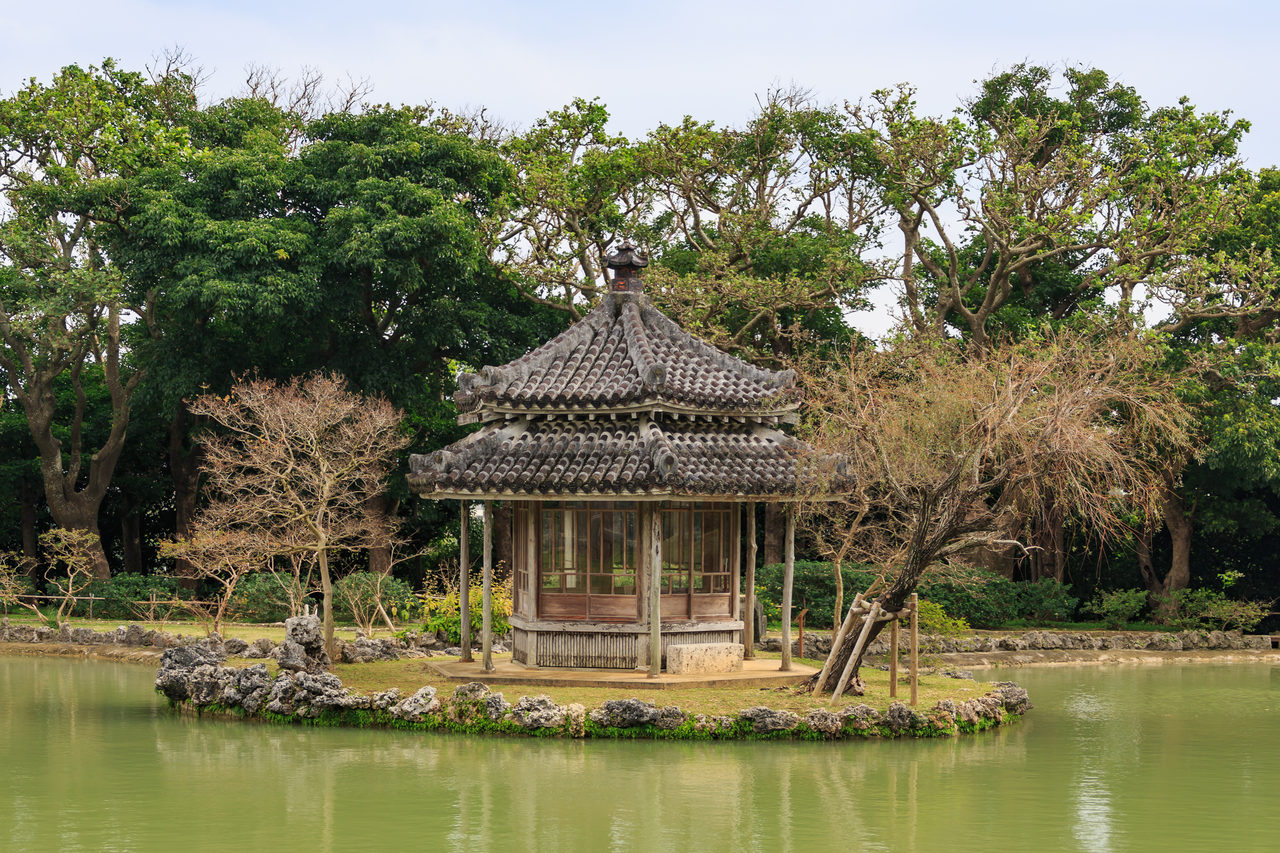
Rokkakudo stands on a pond island. The Agency identifies it and the island bridges as designs showing Chinese influence. The main photograph, taken on 7 January 2016, shows its two-tier grey roof and island bank close up. Another photograph places it in the wider pond before the residence. Compare them: recognise the outline nearby, then read distances between pavilion, bank, residence and bridge from afar.
Across the pond, the pavilion can appear isolated. From another angle, bridge and bank connections enter the view and link it to the path system. This makes a short extra walk worthwhile. One photograph from the nearest point can miss the island’s relationship with other buildings; after a wide view, approaching reveals tile, timber and stone textures.
Treat the bridge as part of the composition first. Find its arch and connections with water and island from the bank, then decide whether to cross along an open route. Stop for photographs on wider paths and let people crossing pass first. Children can count pavilion sides and roof tiers, then find the bridge in the photograph. Visible shapes offer a simple way into the garden.
In rain, the choice is direct. Naha’s tourism association specifically warns about footing on stone-paved paths and bridges. If surfaces are wet or a companion feels unsteady, view from a firmer bank and omit close-up photography. You can still read the garden from the shore without standing on the same stone as a reference photograph.
Even in sunshine, an empty bridge need not be the goal. Look briefly at its structure, then change to a position clear of passing visitors rather than waiting at the entrance for everyone to leave. Impressions build from different positions. Giving up one camera spot still leaves water, trees and roofs to enjoy.
Ikutokusen: connect water and inscriptions with the reception history
Visit Ikutokusen after understanding the main pond. The Agency explains that it supplies the pond and has two stone inscriptions written by chief investiture envoy Zhao Wenkai. Find the spring’s relationship with the pond, then read the inscriptions’ explanation to connect the water scenery with a named person. The 1799 garden and reception history become visible clues.
There is no need to rush to photograph every character. Read the name and explanation, understand why inscriptions stand here, then study their placement around the spring. A simple explanation to companions—this feeds the pond and preserves the envoy’s words—can be clearer than reciting dates. Interested readers can stay with the original text while others wait without blocking passage.
The tourism association also notes the natural monument Shimachisujinori algae at Ikutokusen. Shift attention from inscriptions to water and habitat, using on-site explanations to identify it. Stay on permitted paths for viewing and photography. Keep hands and equipment out of the water and leave stones in place. This is where cultural history meets a spring environment; reading offers more than rushing for a vivid organism close-up.
Even with limited time, keep Ikutokusen alongside the main pond. Rokkakudo offers a recognisable outline, the residence shows the retreat’s scale, and spring and inscriptions add water supply and reception history. Give each a different approach: read by the spring and change viewing angle along the pond, rather than merely photograph and leave at every stop.
The main gate, curved stone path and boat landing
Study the main gate near the entrance on arrival or departure. Naha’s tourism association explains that the tiled gate served guests and royalty, with its form tied to status. With this background, look beyond roof colour to who passed through and how the entrance expressed the order of a reception place.
The association also describes an S-shaped stone path and its cultural meaning through a legend of majimun spirits that can travel only straight. Tell children the story, then ask how bends alter the view. Read legend and shape together rather than treating the path simply as a shortcut to the pond. Follow the site route and watch for other visitors at bends.
The official introduction also mentions unusual rocks modelled on China’s Taihu stones and a boat landing used during pleasure boating. Knowing names and functions helps you recognise signs instead of treating all stones as the same bank decoration. Compare rock shapes with their surroundings. The landing connects pond water with garden activities and the retreat’s purpose.
These details need not become compulsory stops. Architecture enthusiasts can study the gate, garden-stone enthusiasts the rocks, and families the bends. Deepen the main visit according to interest rather than rushing to find every name before leaving.
Check admission, Wednesday closures and seasonal hours together
The Naha visitor guide lists individual admission at ¥400 for adults and ¥200 for junior secondary pupils and younger. Preschool children accompanied by a guardian enter free. Two adults and one primary pupil pay ¥400 + ¥400 + ¥200 = ¥1,000. With a guardian-accompanied preschool child instead, the total is ¥800. Calculate the actual party and list transport and meals separately.
Group rates apply only to 20 or more: ¥320 per adult and ¥160 for junior secondary pupils and younger. Ordinary families use individual prices. The city also lists free admission for eligible holders of physical disability, rehabilitation or mental disability health and welfare handbooks, with one carer, on presentation. Ask the management office to check the document type you hold and count the carer separately.
The city lists half-price admission for residents aged 65 or above. Both residence and age are conditions. Overseas visitors should budget adult admission for older relatives; Naha residents can prepare the city’s required residence and age evidence. Ask about this separately from handbook exemptions so each document matches the relevant concession.
The garden opens at 09:00 daily when operating. From April to September it closes at 18:00, with last entry at 17:30. From October to March it closes at 17:30, with last entry at 17:00. Work backwards from closing to allow the visit rather than aiming for last admission. For the suggested one and a half to two hours, around 15:00 is easier in the winter half-year; entering at 17:00 leaves a brief visit.
Regular closure is Wednesday, moving to the next day when Wednesday is a holiday or 23 June, Okinawa Memorial Day. On a multi-day Naha trip, place Shikinaen on an opening day before flexible shopping and meals. Tamaudun is also a Naha cultural property but opens year-round; keep the two rules separate. Read city opening information before departure and move the garden to another day after a temporary closure.
Admission cost is simple; cross-city transport, waiting and companions’ walking capacity shape the half-day. Set aside a possible taxi return budget. This can be more useful than rushing the paths to save one fare.
| Item | Details |
|---|---|
| Individual admission | Adults ¥400; junior secondary pupils and younger ¥200; guardian-accompanied preschool children free |
| Group admission | 20 or more; adults ¥320, junior secondary pupils and younger ¥160 |
| April–September | 09:00–18:00; last admission 17:30 |
| October–March | 09:00–17:30; last admission 17:00 |
| Regular closure | Wednesday; moves to the following day when it is a holiday or 23 June, Okinawa Memorial Day |
Arriving without a car: target Shikinaen-mae, then choose bus or taxi
Use Shikinaen-mae as the destination stop and save 421-7 Maaji, Naha as a separate location. The tourism association’s access page lists this stop. Check the whole journey from your accommodation and the walk from stop to entrance. A route only to Shuri Station does not yet reach the garden.
For city buses, enter your actual boarding stop and Shikinaen-mae, using the visit date. Check both directions with the relevant weekday, weekend or holiday schedule. Save direction, waiting location and intended return, then compare the stop sign on arrival. Where same-named stops lie on opposite sides, use destination direction and stop sequence rather than boarding merely because the name is familiar.
The association’s 2022 feature notes that the return stop is across the road from the arrival stop. Identify both signs and a crossing before entering the garden. Include walking and traffic-light time between entrance and stop. Waiting there early is easier than searching for the return stop as departure approaches.
To avoid transfers, or with young children and older relatives, take a taxi directly from accommodation. Show the Japanese name and full address. Decide whether the return is to your hotel, lunch or Shuri. For a fixed arrival, include calling the taxi, road travel and walking after alighting.
Mix bus and taxi if useful. Take the bus with good morning energy and a suitable service, then return directly when tired. For a fixed morning target, take a taxi out and choose a suitable bus back. Match transport to the half-day rather than adding transfers to keep one mode all day.
Drivers can use the free parking listed by the tourism association. Navigate to Shikinaen and its parking signs, then walk in. Count returning to the car, exiting and onward travel separately. If otherwise staying in central Naha, compare one taxi trip with a full-day rental before hiring a car for the garden.
Morning at Shikinaen, afternoon in Naha
For a garden-focused day, leave after breakfast, arrive near the 09:00 opening, study pond, residence, pavilion and spring, then return for lunch. Leaving around 11:00 is an example based on two hours inside; add transport for the actual city arrival. Avoid a lunch booking immediately after exit to keep time for final inscriptions or a rest.
Move from large relationships to details: establish the pond scene, change angle along the bank, approach open building areas, then read spring and inscriptions. Photographers can stay longer at the water; history enthusiasts can shift time to Ikutokusen and explanations. If tired later, omit remaining branches and follow open paths to the exit.
Choose lunch and shopping according to your accommodation direction. For Makishi Market and Tsuboya, use the city sections of the Naha food and Shuri walking guide in the afternoon. After much morning walking, return to rest after eating. Completing the garden half-day leaves room for a different pace rather than another cultural property requiring extensive walking and reading.
An afternoon visit also works, with lunch before crossing town. From October to March, use arrival around 15:00 as a reference and leave before closure. If lunch runs too late, move the garden to another morning. This preserves actual viewing time instead of rushing to reach ticket cut-off and immediately finding the exit.
Visitors staying on the west coast with a return to Chatan or Onna still have another cross-area journey. Choose lunch for an easy connection, omit city shopping or visit while based in Naha. The Okinawa main-island accommodation and transport guide compares bases and trip lengths to place the garden on a convenient day.
Adding Shuri: separate the visits and the journey between
Shikinaen and Shuri both connect with Ryukyuan royalty, but divide the itinerary into garden, transfer and Shuri. Morning garden and afternoon Shuri make a full cultural day. For detailed Tamaudun and stone-road visits too, give Shuri another day. After the garden, one main afternoon attraction is more relaxed.
The tourism association has described a historical walking route from Shikinaen to Shuri Castle, explicitly noting hills and recommending winter and sufficient stamina. Ancient-route enthusiasts who treat walking itself as the activity can plan it separately. General first-time visitors connecting the two should compare vehicle transport first and save energy for the sites. Remove the cross-area walk after rain or with a pushchair.
With a fixed Shuri visit time, work backwards through midday transport, lunch and the entrance walk to set a garden departure. A late start after breakfast calls for shorter garden branches or another day. A fixed booking should not compress the whole pond route into a few minutes.
Tamaudun is the Second Sho dynasty’s royal mausoleum, changing the subject from retreat to burial. Naha lists 09:00–18:00, last admission 17:30, open year-round. Record its entry and closure rules separately, especially when Shikinaen closes earlier in winter. The combination suits royal-history interests but each site and the transfer need time.
For only Shikinaen and Tamaudun, two adults’ ordinary admissions total ¥400 + ¥400 + ¥300 + ¥300 = ¥1,400. Adding one primary pupil adds ¥200 and ¥150, making ¥1,750 for three. Keep this in the cultural-admission budget, with fares and lunch separate, to compare one combined day against two visits.
For first-time visitors without a full cultural day in mind, return to Naha after Shikinaen and save Shuri for another fresh morning. A complete residence and pond visit followed by a seated city meal already forms a clear half-day. Let companions’ interest in royal history decide a second site.
Rain, older relatives and young children: shorten paths rather than every stop
In rain, change stone paths and bridges first. Wear shoes suited to wet ground, stop securely for photographs and keep hands free for support and balance. If rain prevents reading or wet stones become difficult, keep the main pond views and follow usable paths to the exit. Save distant branches for suitable weather instead of hurrying everyone along.
Ask older companions whether buildings, pond scenery or inscriptions interest them most and put that first. Those with limited walking capacity can stop more often at main views while others read nearby signs. Choose a visible meeting place where stopping is permitted and does not block passage. For wheelchairs or pushchairs, call Shikinaen management on 098-855-5936 before departure, explaining equipment and intended route so staff can advise on entrances and access.
With young children, look for shapes: Rokkakudo’s roof, the residence’s red tiles, a bridge arch or pond-edge stones. Stay longer where a child is interested rather than teaching every spring, inscription and gate. Adults should accompany children near water and on bridges. Agree who photographs and who watches children so both adults are not focused on phones.
As nap or meal time approaches, remove unvisited branches and return by the chosen transport. A clear departure helps children and older relatives: know the return stop side and direction, or the taxi pickup address. Save these in one note so leaving the garden leads directly to the next part.
A few useful answers
When is Shikinaen open to visitors?
Shikinaen is open from 9am to 6pm from April to September, with last entry at 5.30pm. From October to March, it is open from 9am to 5.30pm, with last entry at 5pm. The garden closes on Wednesdays, or on Thursday if Wednesday falls on a public holiday or Okinawa Memorial Day (23 June).
What does it cost to visit Shikinaen with children?
Adults pay 400 yen and children up to the end of lower secondary school pay 200 yen. Children below school age enter free with a parent or guardian. Two adults and one primary school pupil pay 1,000 yen in total.
How can I get to Shikinaen without hiring a car?
Take a local bus to Shikinaen-mae. The bus back leaves from the opposite side of the road. If you take a taxi straight from your accommodation, give the driver the name of the garden, Shikinaen, and the address, 421-7 Maji, Naha.
How long should I allow for Shikinaen, and where should I start?
Allow an hour and a half to two hours in the garden. Start at the pond for a view of the Udun and the Rokkakudo pavilion on the island, then walk along the bank to see the stone bridge and stop at Ikutokusen Spring to read about the two inscribed stone tablets.
Official information and references
Sources used in this guide.
- Naha City: scenic places, historic sites and World Heritage — Shikinaen
- Naha City Tourism Association: Shikinaen
- Naha City Tourism Association: visiting Shikinaen
- Agency for Cultural Affairs: Shikinaen layout, Ikutokusen and restoration
- Agency for Cultural Affairs: Gusuku Sites and Related Properties of the Kingdom of Ryukyu
- JUNICHI217: Shikinaen Garden (uploaded in 2014)