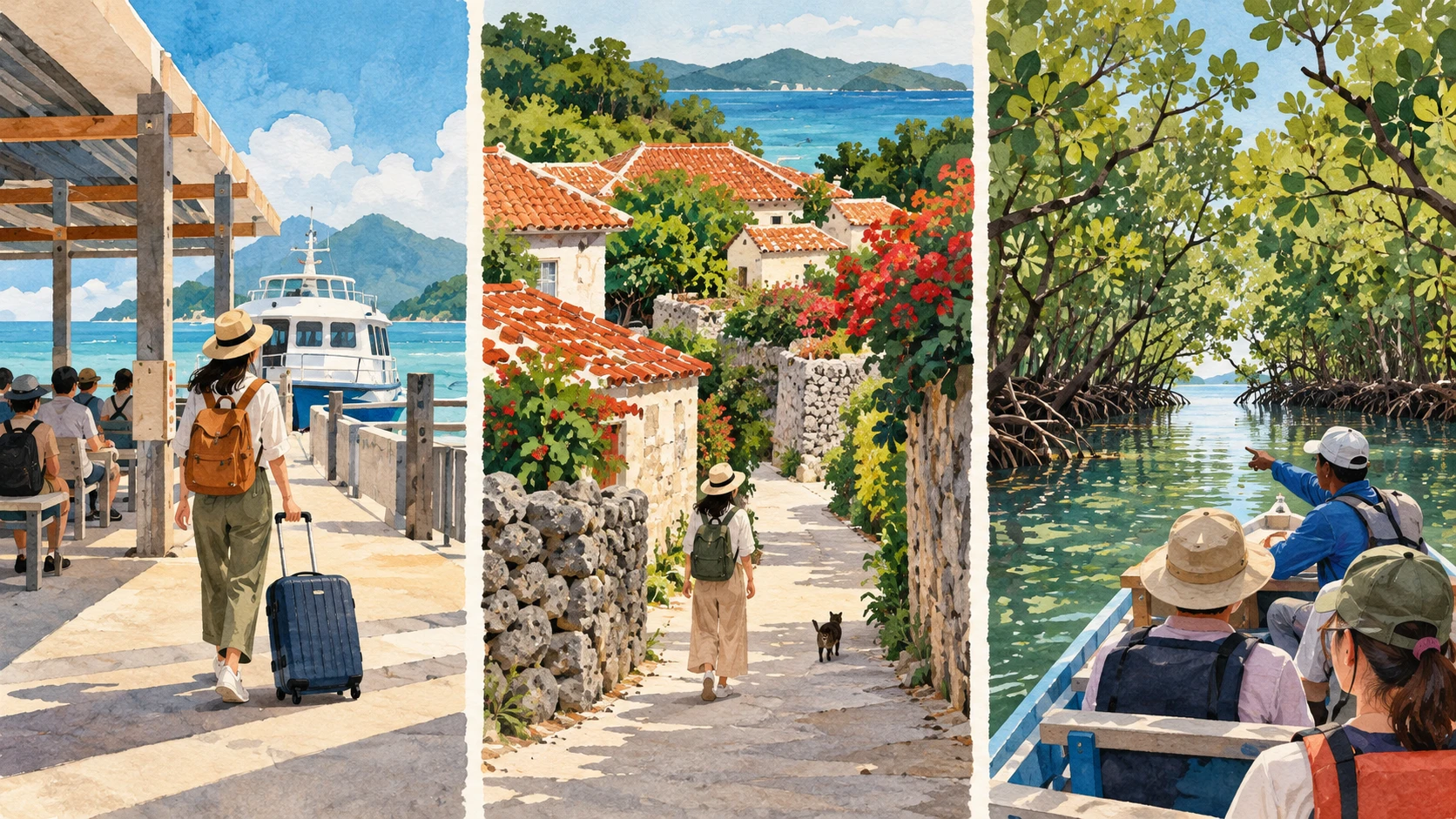
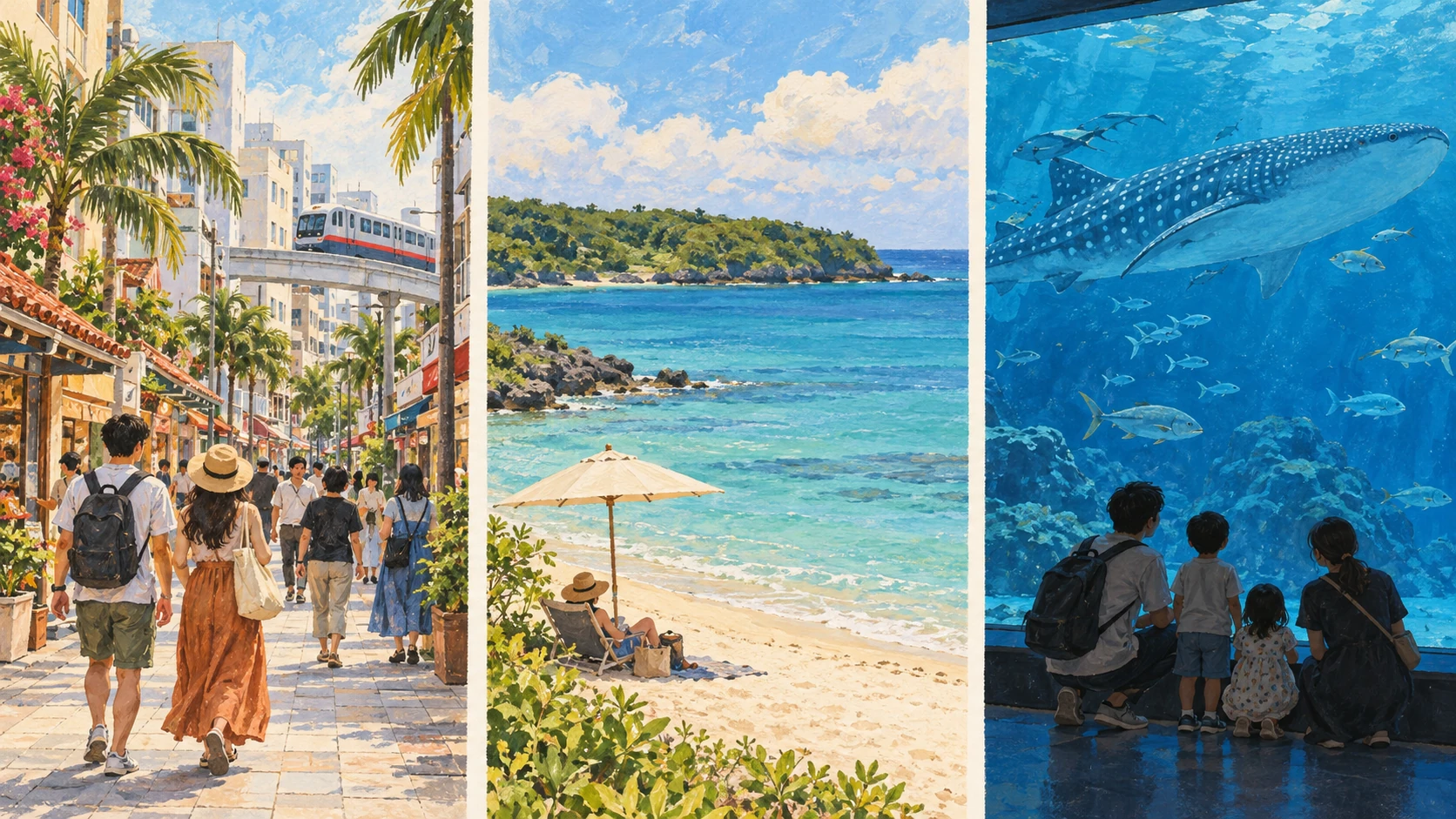
Choose where to spend each night on Okinawa’s main island before deciding whether to hire a car and how far north to go. This guide starts with named rooms and transportation conditions in Naha, Chatan and Onna, then connects Shuri Castle reservations, Kokusai Street food, a Churaumi day and alternative coastal outings into a workable route.
Choose an Okinawa base before deciding how far north to travel
For a first trip to Okinawa’s main island, choosing between life in Naha, Chatan and Onna makes planning easier than putting every attraction on a map. Start with Naha if you want Kokusai Street, dinner within walking distance of your room and mainly public transportation. Consider Chatan for evening waterfront walks and restaurants. Make Onna the focus when you genuinely want time to use a beachfront hotel’s facilities. Each can support a trip in its own right; changing hotels every night is unnecessary.
For five days and four nights, compare two nights in Naha with two on the west coast, but let arrival and departure times determine the order. After a late flight, stay in Naha first. Before an early departure, a final night in Naha usually makes transportation easier to manage. For three days and two nights, one base and one longer outing are more realistic. Families should protect naps and meals before adding Churaumi, rather than completing a list by leaving at dawn and returning late every day.
This guide uses official information available on October 22, 2026, focusing on accommodation, transportation, Shuri Castle, Kokusai Street and northern Okinawa. Shuri Castle’s Seiden is scheduled to open to the public on November 23, with different rules before and after that date. Ishigaki and Yaeyama require another flight and separate ferry planning; see the Ishigaki accommodation and Yaeyama island guide. A main-island hire-car route cannot simply become a same-day trip across those islands.
| Main priority | More suitable base | Tradeoff to accept |
|---|---|---|
| City streets, food and Shuri Castle; less daily driving | Naha | Set aside a full day for the north; beach-resort time is not the daily focus |
| Waterfront walks, restaurants and northern buses | Mihama, Chatan | Arrange airport and Shuri Castle transportation separately |
| Sea-view room, pool and hotel time | Onna | Confirm dinner and transfers first; daily Naha returns are inconvenient |
Three, four or five days: subtract the time actually spent travelling
For three days and two nights based entirely in Naha, keep the first day to arrival, luggage storage and dinner near Kokusai Street. On day two, choose Shuri Castle and the city or a full Churaumi day; finish according to your flight on day three. To include both, first establish whether arrival and departure days really offer usable half-days. An afternoon arrival is not a full sightseeing day. If your Shuri reservation falls around noon, avoid adding a long northern journey on either side.
With four days and three nights, one option is a night in Naha followed by two in Onna: collect the car and travel along the west coast on day two, visit Churaumi on day three, and return the car before departure on day four. Do not copy this order for an early flight. Another option with less luggage moving is to stay throughout in Chatan, setting aside one Naha day, one northern day and time by the waterfront. These are planning suggestions, not packages guaranteed to connect with every flight.
Five days and four nights allow Naha, the coast and the north to stay separate: a Kokusai Street and market day, a Shuri day, an afternoon move to the west coast, and a Churaumi day, alongside arrival and departure transportation. Seven days can mean a longer stay in one place, weather alternatives and genuine rest. Two extra days do not require more distant islands. Mark one essential activity each day and make the other stops optional.
Staying in Naha: a monorail station and Kokusai Street offer different conveniences
Choose a Naha hotel by the stations you will use each day. Asahibashi is close to Naha Bus Terminal, making the area worth comparing if your booked northern bus leaves from the terminal. Kencho-mae serves the southern end of Kokusai Street and Palette Kumoji, a useful combination for department-store shopping, the main street and the monorail. Miebashi works for city dining and travel toward Tomari Port, but check the actual pier for your sailing. Makishi, at the other end of Kokusai Street, suits a stay focused on shopping and eating along the main street. These are differences between station areas, not a promise that every hotel is equally close. With luggage, check the actual exit, road crossings and route from your room to the platform. Northern bus operators also use different stops: not every departure from Naha leaves from inside the terminal.
HOTEL COLLECTIVE, on Kokusai Street, provides a concrete example. Its official Superior Twin page lists 30 m², occupancy of one to three adults and beds measuring 120 × 203 cm. That maximum does not establish that there are three identical beds. Confirm the third person’s bedding in the booking. If separate beds matter, asking about bed numbers is more useful than comparing floor area alone.
The official FAQ lists guest parking at 1,800 yen per vehicle per night, including tax, and no airport shuttle. If your first two days are in the city, collecting a car only when leaving Naha can reduce idle car-hire and parking costs. Compare the city branch’s opening hours and different-location return conditions first. Sea views, lounge access and children’s breakfast cannot be assumed from the hotel’s category; check your room and the official service details individually.
For cooking and laundry during a longer stay, compare the main building of Condominio Makishi, within walking distance of Makishi Station. Its standard twin room is 27 m² with two fixed beds measuring 97 × 195 cm, a kitchen, washing machine and gas dryer. Three adults use a sofa bed; four adults also need the supplied futon set, so this is not a room with four fixed beds. Elementary-school children pay the adult rate. Preschool children sharing existing bedding stay free, but extra bedding costs more. Washing and drying are free; renting dishes and a rice cooker costs ¥1,000 for the whole stay, not per night. Not every item for cooking is included in the room rate. Availability, the actual total and cancellation terms depend on the plan you book.
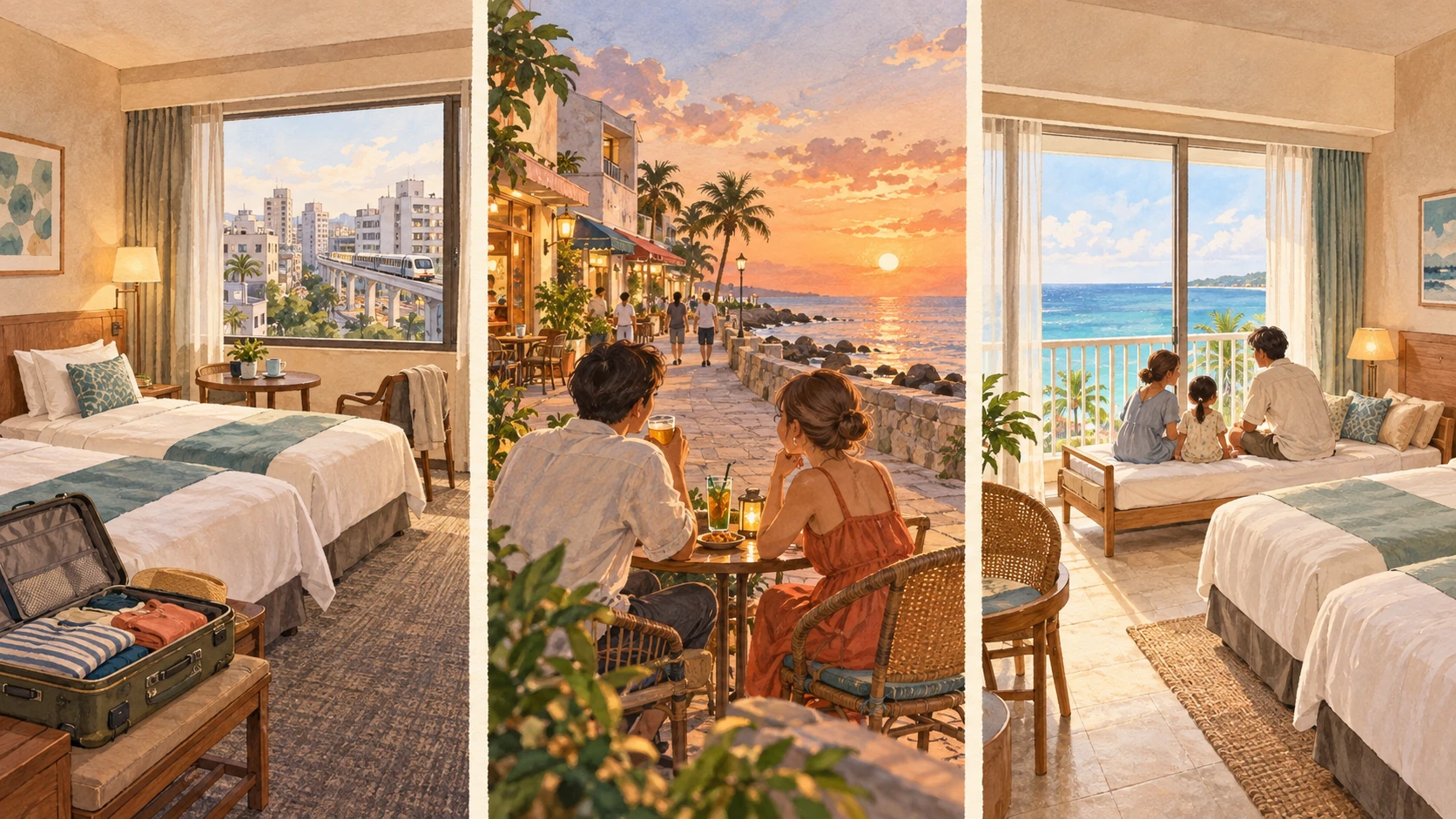
Staying in Chatan: distinguish sea views, bed width and bed sharing
Mihama in Chatan suits dinner nearby, a waterfront walk and an easy return to your hotel. If you spend every day far away, transportation consumes much of that location’s value; if you want an evening without driving to restaurants, it becomes more appealing. Check the hotel and bus stop separately, including the walk with luggage. Mihama is not on Naha’s monorail, and a city transit pass is not an airport or northern transfer ticket.
Among Vessel Hotel Campana Okinawa’s main-building rooms, the Standard Twin is 26 m² with two 120-cm-wide beds; the Ocean View Twin is 30 m² with the same two bed widths. Both accommodate one to two adults, excluding children sharing existing beds, and neither has an additional extra bed. Two adults with two children must decide whether those two beds work for them. Allowing children on a booking does not make it a four-bed room.
The hotel’s bed-sharing policy for children aged 18 and under applies when they share a room with parents or grandparents without a separate bed. A child needing their own bed must be booked as an adult. One adult and one child in a Twin are charged as two adults. Breakfast for bed-sharing children is free at ages zero to five and charged separately from six; free accommodation does not make breakfast free. The annex Family Room can accommodate five, but its stated view is of the street, not the sea. Decide whether bedding or the view matters more.
Staying in Onna: put hotel time into the itinerary
A beachfront stay in Onna makes sense when you genuinely leave a morning or afternoon for the hotel. Arriving only at night and leaving early may not deliver the vacation you expected from a sea-view supplement. Before comparing room prices, check beach and pool seasons, weather cancellations, children’s height or age restrictions and restaurant reservations. The coast is long: hotels sharing an Onna address are not necessarily within walking distance of one another.
Hotel Monterey Okinawa Spa & Resort’s Standard room is 36 m² on floors six to eleven, with standard beds measuring 120 × 203 cm. For three or more guests, the configuration uses two standard beds plus extra beds measuring 100 × 203 cm. The listed basic rates for two, three or four occupants are per-person reference prices that vary by season. They are not an available minimum price for the whole room, and photographs alone do not establish the bed arrangement.
The room page explicitly allows preschool children not requiring bedding or meals to share a bed, limited to one child per bed. However, that same page contains both an 80%-of-adult rate and an adult-rate statement for elementary-school children. Enter each child’s age and your party size in the actual plan and obtain a clear quote before paying. The accommodation overview separately lists breakfast at 4,500 yen for junior-high age and above, 2,500 for elementary-school children and free for preschoolers, including tax and service. Do not add breakfast twice if the room plan includes it, and check other facilities against the plan too.
Check the rules for each pool, even within the same hotel. Monterey’s Sunset Garden outdoor pools list a swimming season of 20 March–3 November 2026, with free use for hotel guests. Within that season, 1 October–3 November swimming hours are 9:00–18:00, subject to changes on site. Children in elementary school or younger (described by the hotel as age 12 and under), or children 130 cm or shorter, must have a parent swimming with them in the main and wave pools. However, preschool children (described by the hotel as age 6 and under) cannot use the main pool, even with a parent. Children who are not toilet-trained must wear a swim nappy with a swimsuit over it. Other pools have their own conditions.
The indoor Blue Reef is a separate facility. A day pass for hotel guests costs ¥1,500 for high-school students and older guests, ¥750 for elementary- and junior-high-school students, and is free for preschool children. The pool currently lists 9:00–19:00 hours; the later closing times for the baths and gym do not apply to swimming. Children in elementary school or younger, or children 130 cm or shorter, must have a parent swimming with them. Free outdoor-pool use for hotel guests does not mean the indoor pool is free. If your accommodation plan includes a pass, check the booking rather than adding the cost twice. Recheck the winter operating notices; this 2026 information does not guarantee a 2027 pool season.
Compare the total accommodation cost and each booking’s cancellation deadline
Add accommodation, breakfast, parking, airport journeys and daily transportation when comparing the three bases. COLLECTIVE’s guest parking is 1,800 yen nightly; Monterey’s is 500 yen nightly, capped at 1,500 yen. Those are each hotel’s own official terms, not evidence that other Okinawa hotels charge the same or nothing. Compare booking-screen totals only after matching guest numbers, breakfast and bed arrangements.
For the one-to-seven-room band in COLLECTIVE’s accommodation terms, cancellation three or two days before arrival costs 30% of the basic accommodation charge; the preceding day, arrival day and no-show cost 100%. Particular dates can have separate conditions, and the band is calculated using cumulative reserved room-nights. This is an example of reading a contract, not a universal rule that fees begin only three days before. Monterey’s room page already lists cancellation fees as far as fourteen days ahead, so the Naha hotel’s rules cannot be applied to it.
Even with a cancellable plan, record Japan local time, the cancellation channel and the acceptance deadline. Flight-and-hotel packages, booking platforms and direct hotel reservations can have different contracts. A cancelled flight or approaching typhoon does not automatically produce refunds from every supplier. Use the distinction between fixed and adjustable travel costs to secure the bookings that shape the trip, then decide whether a lower rate justifies an earlier cancellation deadline.
Before hiring a car, check where the licence was issued, not the article’s language
Eligibility to drive a hire car in Okinawa depends on each driver’s valid documents. According to JAF’s explanation of foreign licences, licences issued in Taiwan, Switzerland, Germany, France, Belgium and Monaco can use the original domestic licence plus an approved Japanese translation; have your passport ready at collection too. The translation must come from an organization recognized under Japanese law. Your own translation or an ordinary online translation is not equivalent to a valid document.
Travellers with licences from other jurisdictions should establish whether they hold an International Driving Permit recognized by Japan and issued in the format of the 1949 Geneva Convention, or a valid Japanese licence. Not every document labeled “international licence” qualifies. Toyota Rent a Lease Okinawa’s document guidance distinguishes these routes too. Reading the Traditional Chinese, English or German edition does not change the eligibility of your licence; website language must not be treated as nationality.
The National Police Agency’s 2026 foreign-licence guidance limits the driving period for international permits and recognized foreign licences to the shorter of one year after entry and the document’s validity. An international permit itself is valid for one year from issue. People registered as residents in Japan have additional rules under which a short departure and re-entry do not restart the period. Before booking, check issuing jurisdiction, vehicle category and document dates. Each potential driver should present original documents and be registered when collecting the car.
Car collection and return times are not flight arrival and departure times
After landing at Naha Airport, you still need immigration, baggage collection, the shuttle meeting point, the ride to the branch, document checks and the vehicle inspection. Entering touchdown time as your car-hire departure makes the first day unnecessarily tight. Toyota Okinawa’s official FAQ says the Naha Airport, Naha Airport Seaside and Naha Airport Business branches provide airport shuttles; other main-island branches require you to reach them yourself. Booking the same brand does not make every branch a shuttle branch.
The operator also states that vehicles cannot be delivered or abandoned for return directly at Naha Airport. Return to the designated branch and then take the shuttle to the terminal. Work backward from the airline’s check-in deadline, adding refuelling, inspection, shuttle waiting and road congestion. A fixed rule of “return the car one hour before departure” does not fit every flight and branch. Do not discover in the final hour that return and collection locations differ.
At collection, photograph the exterior and existing scratches, and check fuel, wipers, lights, navigation language, child-seat attachment and the accident contact number. Contact the branch if your inbound flight is delayed. Toyota Okinawa currently says car hire proceeds during business hours, while arrival after closing may mean collection the following day. After a late flight, a city stay followed by collection next morning is often easier to adjust than hinging your hotel arrival on the last shuttle.
Deductible cover, NOC and ETC are three separate questions
“Insurance included” on a rental screen does not mean an accident leaves no out-of-pocket cost. Toyota’s important information separates basic insurance, deductible cover and the non-operation charge, or NOC. Its general example charges 20,000 yen if the vehicle can be driven back to the scheduled branch and 50,000 if it cannot be returned. These are that company’s rules, not uniform Okinawa fees. The additional Double Protection Package has its own scope and exceptions.
At minimum, ask about vehicle and property-damage deductibles, whether NOC is waived, treatment of tyres and towing, and actions that invalidate protection. Toyota lists circumstances such as failing to report to police, an unregistered driver, drunk driving, driving without a valid licence or extending use without permission as potentially outside coverage. After a collision, first ensure personal safety and contact police and the rental company. “Only a small scratch” is not permission to leave without reporting.
An ETC onboard unit and an ETC card are different items. Ask whether the card is rented separately, how tolls are settled and whether it must be removed before return. A unit does not mean a valid card is inserted. Toyota’s ETC card-rental service says some branches do not offer it and cards are limited in number; it is not automatically included with every rental. Without ETC, check your route and accepted toll-booth payments rather than entering an ETC-only lane at the last moment.
Family driving and road rules: a suitable car must fit the luggage too
JAF’s traffic rules require driving on the left, seat belts for every occupant, no drunk driving and appropriate child seats for children under six. Give the branch each child’s age, height and weight and confirm seat models and quantities. Holding a child on an adult’s lap is not a substitute. From age six onward, still check whether the belt fits correctly instead of relying only on a birthday.
Count all child seats, pushchairs and luggage when choosing the vehicle. A seven-seater filled with passengers may not have space for seven large suitcases; an equivalent-class substitution can alter the storage layout too. With older relatives or small children, easy access and comfortable seating usually matter more than styling or a model name. Check the space at collection, rather than discovering in the north that bags must be piled beside passengers.
Follow posted speed limits, stop lines and road signs. At “止まれ,” come to a complete stop and check, rather than importing habits from home. When turning right, pay particular attention to oncoming traffic and pedestrians. A navigation instruction does not authorize crossing a prohibited line. Some Naha roads have time-specific bus-lane restrictions: read the signs instead of applying one schedule to the entire island. Increase following distance and slow down in rain; even an excellent view is no reason to stop on a bridge or roadside shoulder for photographs.
Naha without a car: calculate monorail-pass value before buying
The Yui Rail monorail plus walking works for the airport, central Naha and Shuri, but does not reach Chatan, Onna or Churaumi. The official one-day pass costs 1,000 yen for adults and 500 for children and lasts 24 hours from purchase. The two-day pass costs 1,800 and 900 yen respectively and lasts 48 hours from purchase. These passes do not all expire at midnight, nor can you buy one in advance and freely choose a future activation day.
List the journeys you will actually make and compare their single fares before purchasing. If arrival night involves only the airport-to-hotel trip and the following day is mainly Kokusai Street, a day pass may not pay off. Buying in the afternoon can be useful if you also need the monorail next morning. Facility discounts depend on validity periods and current operations; a benefit once listed online is not necessarily available now.
Weather affects both walking and connections. The final stretch from station to hotel in rain, lifts with a pushchair and restaurant queues can change a tidy plan on paper. Leave hot or rainy afternoon periods for meals and indoor rest, and tackle Shuri’s slopes during a half-day when everyone has more energy. For a first independent visit, see transportation and reservation priorities after arriving in Japan, including mobile connectivity and backup payment methods.
Naha to Churaumi: identify the bus operator and your arrival stop
The Yanbaru Express Bus FAQ explicitly says the Airport Line does not accept reservations: go to the stop and queue. Buying an electronic ticket does not reserve a seat on a particular departure. Standing is prohibited on the highway, so you may be unable to board a full bus. The official airport stop is number 1 on the domestic terminal’s level 1 (1F); Kencho Kitaguchi is a city option. Neither should be confused with a platform inside Naha Bus Terminal.
The same FAQ names “Royal View Hotel Churaumi (Churaumi Aquarium)” as the nearest stop. Arriving from Naha, walk back a little and enter through the North Gate. Another company may use “Kinen Koen-mae”; do not wait for one operator while holding another’s ticket. Read both the northbound and Naha-bound pages of the timetable. Secure the return plan before deciding lunch and aquarium time, and avoid making the last bus your only option.
Children’s rules are not interchangeable either. Yanbaru currently allows elementary-school children and junior-high students presenting identification to use child fares; preschool children occupying a seat also need a child ticket. Other northern buses may count junior-high students as adults. On November 8, 2026, a cycling event causes partial suspensions and stop changes. For that date, read the operator’s current diversion notice instead of relying on an ordinary-day screenshot.
Chatan to Churaumi: a reserved bus exists, with one daily round trip
Staying in Mihama does not necessarily require a hire car for an aquarium day. The official Chatan Adventure Highway Bus page lists a trial service from April 1, 2026, to March 31, 2027, with one round trip daily. The current schedule leaves Chatan Gateway at 9:15 and reaches Kinen Koen-mae at 11:12; the return leaves the aquarium at 16:55 and reaches Gateway at 18:54. Road delays are possible: these are published times, not guaranteed arrivals.
Its system is the opposite of Yanbaru’s: buy online beforehand, with sales opening one month before travel. A visible empty seat does not allow cash boarding. The operator requires the live ticket display on a phone and accepts neither screenshots nor printouts. Once the ticket has been displayed as used, changes and cancellation are no longer possible. Complete the purchase and check both directions, the meeting point and phone battery before treating this as your confirmed northern day.
Guests of specified Mihama hotels, including Campana, can qualify for a guest discount during their stay, including check-in and check-out dates, subject to the official list and purchase conditions. Staying elsewhere in Chatan or simply eating breakfast at a listed hotel does not establish eligibility. One daily round trip also means a missed return is not followed by another bus from the same company thirty minutes later. If your family does not want the fixed 16:55 return, compare driving or a tour with clearly specified transfers.
Shuri Castle in 2026: plan separately before and after the Seiden opens
Shuri Castle is not entirely off-limits simply because reconstruction continues, but in October 2026 its Seiden interior cannot be described as already fully open. The official Seiden completion project website announces general public opening from noon on November 23, 2026, with advance reservations for the interior. That date divides the planning rules. Earlier visits can focus on the gates, fortifications, restoration displays and Shuri streets currently open; do not build a plan around an interior experience you have not confirmed.
From November 23, 2026, interior visits use a specified date and time slot. The official explanation says there is no additional interior-viewing fee, but admission to the paid area changes. A ticket to that area does not establish a place inside the Seiden. If a time slot is sold out, open areas and the exterior may still be visited subject to the day’s controls; reaching the ticket counter does not guarantee interior entry. Same-day purchase is possible only when places remain, and must be completed no later than fifteen minutes before the time slot begins.
The Naha City Tourism Association’s Shuri Castle tour information gives the date-specific admission charges in the table below. Use the prices for your actual visit. Temporary closures and opening-time adjustments may surround the reopening, so normal weekday hours cannot simply be applied to late November. Confirm the open areas, reservation date and entry time before booking a nonrefundable restaurant that day.
| Visit date | Adult | High-school student | Elementary/junior-high student |
|---|---|---|---|
| Through November 21, 2026 | 400 yen | 300 yen | 160 yen |
| From November 23, 2026 | 1,000 yen | 760 yen | 370 yen |
A Shuri half-day: allow for slopes, sunshine and rest
Entering the castle, understanding Ryukyu history and having a meal can form a complete Shuri half-day. Take Yui Rail to Shuri Station; the Naha City Tourism Association’s access guide gives an approximately 15-minute walk to Shureimon. That is not the time to reach the Seiden or finish your visit. To shorten the final walk, check that day’s buses from Shuri-ekimae to Shurijo-mae. From Shurijo-mae, Shureimon is about a one-minute walk. Shurijo-koen-iriguchi is a different stop, with a roughly five-minute walk to Shureimon. Allow extra time for waiting, riding and breaks. Getting close to Shureimon does not make the entire castle grounds level. Shureimon, Sonohyan-utaki’s stone gate and the fortifications have different meanings. Reading the explanations slowly often reveals more about the city than photographing the Seiden exterior alone.
With a Seiden reservation, work backward from that time slot. Without one, do not sacrifice an entire day waiting for an uncertain vacancy. The tourism association’s “Shurijo Monogatari” guided tour requires its own booking and explicitly excludes a tour inside the Seiden; admission is paid separately. Joining it does not automatically obtain an interior place. If you want interpretation, compare services whose scope is clearly stated rather than confusing a neighbourhood tour with an admission ticket.
Shuri’s paths and gates involve changes in level, and afternoon sun or wet paving affects pace. For pushchairs, wheelchairs or travellers needing frequent rests, check current accessible routes and usable entrances; temporary construction barriers may alter the way through. Include water, toilets and lunch midway, then return to central Naha in the afternoon. A “half-day” label is no reason to rush every stop.
If you are driving to Shurijo Castle, start by checking the Suimuikan (首里杜館) underground car park. Okinawa Prefecture's August 2025 facility document lists parking areas on basement levels B1 and B2 and identifies buses and ordinary passenger cars as users of the facility; follow the on-site allocation and directions. The castle's official temporary notice checked on 22 October 2026 listed parking hours of 8:30–19:30. Read the latest notice again before setting off, and separately confirm last-entry times for the Seiden interior and other park facilities. Set your navigation to the Suimuikan car park, then follow entrance signs and staff directions on arrival. Plan backward to allow time for entering the car park, walking the slopes after getting out of the car, and the visit itself. If renting a high-roof vehicle or fitting a roof rack, check the vehicle's actual height against the car park's current height limit. Confirm parking charges, the permitted length of stay, and any construction-related directions before entering. If you cannot confirm that entry is possible, use the monorail and bus approach described above instead, allowing transfer and walking time before your Seiden reservation.
Kokusai Street: divide the main road into market, side streets and dinner
To avoid retracing the whole route, start at Kencho-mae Station, enter Kokusai Street and turn through Ichiba Hondori to First Makishi Public Market. After eating, rejoin Kokusai Street and finish toward Makishi Station, or reverse the route to suit your hotel. The tourism association’s station descriptions identify Kencho-mae and Makishi as entrances at opposite ends; the market’s access page estimates a nine-minute walk from Makishi and ten from Miebashi. Those are individual walking estimates, excluding browsing, queues and shopping. For an afternoon break, leave early via Miebashi instead of walking the entire street.
Sunday’s Transit Mall can be a highlight but changes vehicle access. HOTEL COLLECTIVE currently posts separate hotel directions during the Sunday pedestrian period, noon to 18:00. If collecting luggage by car then, read the hotel’s current traffic notice rather than navigating straight onto the main street as on a weekday. Events, weather or special arrangements can change implementation, and a pedestrian zone is not permission to ignore vehicles at every hour.
For dinner, distinguish a flexible simple meal from a full meal requiring reservations. A fixed restaurant booking needs a buffer after Shuri or the north; a day with uncertain transportation may suit something more flexible near the hotel. Child seats, smoking rules, vegetarian choices and allergen handling affect the meal more directly than search rankings. A famous restaurant queue need not cost the whole family its rest.
For a short detour in light rain, enter the covered Heiwa-dori shopping arcade from Kokusai Street, visit one or two shops that are open, then return to Kokusai Street through the same entrance. This guide suggests 30–45 minutes as an optional shopping allowance, not an official walking time. There are still outdoor sections beyond the roof; do not press deeper into Tsuboya’s lanes just to finish a route in strong wind and rain. A Naha City notice says Tsuboya Pottery Museum is closed for construction from 1 September 2026 to 31 March 2027, so it cannot serve as an indoor backup during that period. 1 April 2027 is the planned reopening date; check again before travelling.
First Makishi Public Market: separate ingredient prices, cooking charges and last orders
First Makishi Public Market’s official information lists facility hours of 8:00–22:00, while individual businesses differ. Last orders for taking ingredients from level 1 upstairs for cooking are at 19:45, and for dining on level 2 at 20:00; only some ingredients qualify for the carry-up service. A building closing at 22:00 does not mean you can select a fish for cooking at 21:00. Lunch is generally easier to plan than an arrival close to last orders.
The market’s carry-up service guidance is clear: pay the ingredient seller for the ingredients and the dining establishment for cooking. Charges differ with preparation. Ask about the fish’s weight, total ingredient cost, number of dishes, cooking fee and waiting time before buying. Applying one widely repeated online cooking charge to every table without checking can produce a surprise.
The market normally closes on the fourth Sunday each month except December, with additional New Year, Lunar New Year and traditional Obon closures; individual shops may take their own days off. A Sunday Transit Mall visit needs a specific check against that fourth Sunday. The market has no dedicated parking, so drivers must find a legal alternative. Walks from Makishi or Miebashi also need allowance for rain and pushchair pace.
Learn Okinawan food names before deciding what to eat
The “soba” in Okinawa soba can mislead first-time visitors. The Ministry of Agriculture’s regional-food description explains that the noodles use wheat flour and alkaline water, often in pork-bone and bonito broth; this is not the buckwheat noodle dish many people picture. Pork-belly slices, bone-in ribs and cartilage ribs are different toppings too. Choose a texture and portion you want before asking only which restaurant is most famous.
Spread meals between noodles, the market and local home-style cooking instead of repeating one set meal daily. Bitter-melon stir-fry, stewed pork, Okinawa soba, sea grapes and taco rice suit different appetites. Read the day’s menu; a dish’s name does not guarantee a vegetarian or mild version. Seasonings and broth may contain meat, fish or alcohol. Dietary requirements need questions about ingredients and preparation.
Jimami tofu is another name that requires care: it uses peanuts, unlike ordinary soybean tofu. Travellers with peanut allergies should read Urasoe City’s ingredient warning and confirm with the restaurant. Showing a photograph and preparing Japanese wording for the allergen are more precise than simply saying “no tofu.” Identify small side dishes before sharing with children rather than assuming they all use the same ingredients.
For a specific city breakfast or quick meal, consider Pork Tamago Onigiri’s Makishi Market shop, at 2-8-35 Matsuo, Naha. Its website currently lists 7:00–20:00, open year-round. These are Makishi-branch details, not the airport or Chatan branches. The menu includes the basic pork-and-egg onigiri, bitter-melon tempura and thick-fried island tofu with abura-miso, making it an option before or after the market walk. Check actual menu availability and temporary notices; queues are not a fixed duration. If seafood cooked at the market is also planned for lunch, leave room at breakfast.
Onna lunches and snacks work well on the hotel-moving day
On the move from Naha to Onna, Onna no Eki Nakayukui Market can provide a rest and food stop. This local-produce market has agricultural products, processed foods and vendors, allowing everyone to choose a small snack while you establish whether dinner still needs a reservation. It is not Manzamo’s entrance or the only possible stop en route to Churaumi. When time is short, choose one stop.
Check market hours, individual stalls, that day’s supply and special shortened hours separately, beginning with the official hours notice. Seasonal fruit on shaved ice is not necessarily available in the same selection year-round. Fruit taken back to the hotel also needs storage and consideration of return-home quarantine rules. This is a snack stop for a day already following the west coast, not a reason for a separate Naha-to-north detour.
Dinner near your accommodation needs earlier attention. Resort restaurants may use fixed sittings or reservations, while outside dining may require driving. Anyone drinking alcohol should arrange a walkable restaurant, shuttle or taxi. A quiet-looking road does not create an exception for a short drive after drinking. Where travellers have different dietary needs, establish what the hotel can accommodate before buying a dinner-inclusive plan.
For lunch in Onna, compare Nakamura Soba at 1669-1 Serakaki. Its website currently lists 10:30–16:00, closed Thursdays and also January 1–5. It belongs in a lunch plan, not dinner after hotel check-in. Asa soba incorporates seaweed into the noodles and fish cake, while Nakamura soba has finely cut pork-belly pieces; choose the flavour you want. Combine it with Manzamo or hotel time on the same west-coast day, checking temporary notices before departure. Another bowl of noodles need not disrupt the whole return from Churaumi.
A northern Churaumi day: give the aquarium enough time
Churaumi Aquarium is within Ocean Expo Park on the Motobu Peninsula, not a short urban trip from Naha. JNTO’s access information estimates about two and a half hours by bus or two by car from Naha, warning that congestion can make it longer. Use those as a sense of scale, not a substitute for your date’s timetable or navigation. Morning departure, afternoon visiting and an evening return already make a full day.
The aquarium’s official FAQ gives an average of roughly one and a half to two hours inside, excluding the dolphin theatre, sea turtles, manatees and other surroundings. This guide suggests allowing about three hours for the building and breaks before adding park activities according to interest. The large tank deserves more than a photograph from the front: divide time among coral, deep-sea and smaller displays. If a child becomes absorbed in one area, drop a later extra stop.
From Onna or Chatan, compare a same-day return. From Naha, if Kouri is also essential, consider a northern overnight or delete other stops. Churaumi, Manzamo and Kouri followed by a fixed Kokusai Street dinner leave much of the day to roads and car parks. In poor weather, an indoor aquarium does not make the journey safe automatically. Check park and bus operations before leaving.
Churaumi tickets and the park: admission does not guarantee every facility
Churaumi’s official opening-hours page currently lists 8:30–18:30, last admission at 17:30, and no planned closure days through March 31, 2027, except temporary closures such as those caused by typhoons. Do not reuse older fixed December closure arrangements. Check notices for your date and allow time for parking, walking and buying tickets. Last admission is not a sensible target arrival time.
Official standard admission, including tax, is 2,180 yen for adults, 1,440 for high-school students and 710 for elementary- and junior-high-school students; preschool children under six enter free. School grades follow Japan’s April school-year entry standard, and identification such as a student card may be checked. Hotel bed-sharing rules do not determine attraction tickets. Check ticket validity, exchange requirements and cancellation conditions. The official FAQ allows re-entry that day on presentation of the admission ticket, so retain it before leaving for lunch.
The Japan National Tourism Organization’s park guide lists the aquarium, Tropical Dream Center and Oceanic Culture Museum as paid facilities; ordinary viewing of the surrounding dolphin show, dolphins, Sea Turtle Pool and Manatee Pool is free. Free viewing does not include every experience. The version of the aquarium’s official feeding-experience page read on 22 October 2026 lists dolphin feeding at ¥1,000 per set, payable only by credit card or PayPay, and turtle feeding at ¥500 per set, payable only in cash. These are prices for feeding sets, not per-person admission or a group ticket with unlimited participants. Check the day’s notices for availability and sellouts.
Start with the official surrounding-area programme page, choose an afternoon dolphin-feeding session operating on your travel date, then work backwards: visit the aquarium interior in the morning, eat lunch early and walk to the dolphin reception. When reception opens 30 minutes before that session, scan the on-site QR code to obtain a numbered ticket, then show it and pay at the session’s start time. The official walk from the aquarium exit to the experience is about five minutes; queues, children’s breaks and meals take additional time. “No reservation required” does not mean you can skip the day’s numbered ticket. Afterwards, make just one short stop at either the turtles or the manatees, leaving enough time for your return. This is an editorial itinerary example, not a guarantee of fixed daily sessions. If you arrive late or places run out, drop the feeding rather than cutting your indoor visit to chase a slot. Animal conditions, maintenance and weather may change or cancel activities; an open aquarium does not guarantee that everything around it is operating. Check each restaurant’s hours separately.
Churaumi entrances, parking and buses: navigate to your actual arrival point
The official FAQ’s parking advice recommends the North Gate multistorey parking P7 and P6 in front of the North Gate. All nine park parking areas are free, and P7’s entrance has aquarium-parking signs. Navigate to a suitable parking area and follow the day’s walking route: entering the park does not mean reaching the aquarium door. Full lots or restrictions may create a longer walk. With pushchairs or reduced mobility, check ramps and lifts first.
Yanbaru Express passengers should use its Royal View Hotel Churaumi stop and North Gate directions. Those on the Adventure Highway Bus from Chatan use Kinen Koen-mae in both directions. Both stops relate to the aquarium but are not interchangeable. Identify the return stop and waiting position on arrival, before entering the park, rather than searching with tired children in the evening.
If you want more park time after lunch, establish the walk back to the stop and allow for toilets, stored belongings and souvenir shopping. Without a car, do not assume you can simply call a taxi to Kouri after visiting the aquarium. The taxi, onward return and cost all need to be workable. If those connections are unconfirmed before departure, keep the park surroundings as the day’s activity area.
Kouri is an alternative day: distinguish the bridge, coast and island roads
The Nakijin Village Tourism Association describes Kouri Bridge as linking Yagaji and Kouri islands over 1,960 metres. The viewpoint at its southern end on the Yagaji side has free parking, allowing you to park before walking to see the sea. The bridge itself has no attraction-ticket opening slot, but weather and traffic controls still apply. Its roadway is transportation space, not a viewpoint where you can stop a car for photographs.
Kouri suits seeing a bay, taking a short bridge-side walk or eating lunch on the island. If the aquarium is the trip’s priority, Kouri can move to another day instead of becoming an obligatory afternoon addition. Viewpoints, private parking and shops have their own charges and hours. A free bridge crossing does not make everything free. Avoid turning in residential entrances or farm roads and disturbing residents while searching for parking.
Kouri is not absolutely impossible without driving: Yanbaru Express operates an official three-island route to Kourijima no Eki Sorahashi. However, check every transfer, both directions and usable time there. The Naha Airport Line is not a direct Kouri service. Some three-island departures are suspended on November 8, 2026, making an old itinerary particularly unsuitable. Without a reasonable return connection, choose a shorter coastal day or an option with complete transfers.
Manzamo: a short west-coast stop whose path must be finished by sunset
Manzamo works on an Onna hotel day or the move between Naha and the west coast, entering through the visitor facility. The designated operator’s website lists 100 yen per person, the same for adults and children, with preschool children free. This is the viewing-area charge, not car hire, food or every shop’s purchases. Do not carry forward an impression of a free walk from many years ago.
The site lists inquiry-service hours of 8:00–20:00 from March to October and 8:00–19:00 from November to February, while specifically saying Manzamo viewing ends at sunset. The latter is the important limit for visitors. Staff still serving in a building or shop does not mean the viewing path remains open after dark. Arrive with enough daylight and follow on-site management in wind and rain. Do not cross a barrier for a sunset photograph.
Without a car, check an Onna-bound bus and the final walk; a stop called “Onna” is not necessarily at the ticket entrance. A hotel shuttle also needs clarification about which leg it covers: airport, hotel or attraction. If a workable return is missing, do not force the plan around an imagined supply of taxis. Manzamo, Kouri and Churaumi offer a short path, island scenery and indoor exhibits respectively. Choosing the experience you most want leaves more breathing room than collecting all three in one day.
A five-day, four-night example linking Naha and the west coast
Use this five-day framework flexibly around flights. Day one: arrive in Naha, store luggage or check in, and eat near Kokusai Street. Day two: a Shuri half-day, then return to the city for the market or a neighbourhood walk. Day three: collect the car and move along the west coast, choosing Onna no Eki or Manzamo before checking in at Onna. Day four: make Churaumi the main outing, then rest at the hotel. Day five: work backward from the flight to car return and airport transportation. No particular flight is assumed to arrive on time.
For an early departure on day five, move the last night back to Naha or stay in Naha throughout with one northern bus day. If the children prefer the pool, day four can stay at the hotel and the aquarium can wait for another trip. If Shuri culture is the priority, extend day two and omit the north. A complete trip gives enough time to what matters to you; it does not require every famous place name on the list.
A five-day car-free version can stay entirely in Naha, with two city days and one northern bus day, leaving the rest for arrival and departure. Alternatively, base yourself in Chatan and use a prebooked northern return bus. Do not demand no car, a new hotel daily, large luggage and distant attractions every day at once. Before booking accommodation, draw each morning’s starting point and the return to that night’s room. This exposes the days that need fewer stops or another night.
Children, rain and winter: keep uncertain experiences replaceable
Families most often underestimate the walking after parking, finding toilets and waiting for food. Give a morning or afternoon one main place, then swap coast, shopping and hotel rest according to the children’s condition. Room bed-sharing rules and attraction child tickets are separate systems. The same six-year-old can fall into different categories across transportation, hotels and attractions. Enter age or school grade for each product rather than applying one table throughout.
Rain can justify swapping an outdoor coastal day with an indoor visit, but typhoons and strong winds can also close indoor attractions and stop transportation. Check weather and operation notices, roads or buses, attractions, then hotels and restaurants. A purchased ticket alone is not a reason to depart. If already in a resort area, ask the hotel what meals and indoor activities are available that day before handling other bookings, avoiding repeated family journeys on the roads.
Winter still offers sea views and city walks, but sea conditions, wind and pool operations are not summer conditions. In the Monterey example above, the published 2026 outdoor swimming season ends on 3 November. Being able to stroll in the gardens outside that season does not mean swimming is allowed. Indoor Blue Reef has its own pass charges and pool hours, so check current operations and whether your plan includes access before judging the room’s value. See travel dates and weather across Japan’s seasons for broader comparisons; actual marine activities in Okinawa remain subject to the operator’s judgement that day.
Build a budget for your party, including tickets and rest
Fix accommodation and longer-distance transportation first, then add attractions, food, parking and car-hire extras. Two adult Yui Rail 24-hour passes total 2,000 yen; three nights of Monterey guest parking total 1,500 yen under the current cap. Whether both belong in your budget depends on the days you have a car. A full-trip car-hire quote plus monorail day passes every day can create a total with no corresponding itinerary.
For family rooms, compare the whole booking. Whether two beds hold everyone, extra-bed charges, children’s breakfast and cancellation conditions matter more than “from” prices per person. Campana charges separately for bed-sharing children’s breakfast from age six; Monterey’s preschool bed-sharing allowance is limited to one child per bed. Write children’s ages beside the budget so a different hotel or website language does not hide a fee.
Finally, retain a flexible amount for changed transportation or an extended stay, based on flight flexibility and the group’s needs. Fewer hotel moves, fewer car-hire days or less cross-area dining can save money. Skipping a necessary child seat, overlooking valid driving documents or sacrificing return time should not. After booking, put each cost back into the daily plan so you know which days involve transportation costs and which genuinely leave time to travel.
Final checks: match every ticket to its date and traveller
Start with the Shuri Castle opening and reservation rules for your actual date. Then check whether your northern bus requires reservations, whether the correct direction is purchased and where you board. Confirm room type, children’s ages, breakfast, parking and cancellation deadlines next. Keep this information available offline, including booking references and operator contacts. Dynamic transport tickets still need to be opened as the operator requires; a screenshot is not a substitute.
For a hire car, recheck each driver’s original licence, valid Japanese translation or applicable international permit, passport, reserved child seats and collection and return branches. On departure morning, read current operation notices, especially around the Seiden opening, northern sporting events and coastal weather. An old screenshot saying “normal service today” is not a guarantee for a new travel date. Both the notice’s date and the route it covers matter.
If a leg still works only because you “should make it,” remove a secondary stop or change the hotel order. Naha, Chatan and Onna each reward time spent there; two different rhythms can make a rich main-island trip. Give every base enough time for meals, rest and returning to the room, and the route becomes one you can actually enjoy.
A few useful answers
For a first Okinawa main-island trip, should I stay in Naha or Onna?
Start with Naha for city streets, food and a trip without a hire car. Choose Onna when you want time for a sea-view room, pool and hotel activities. For five days and four nights, compare two nights in Naha with two on the west coast; before an early flight, prioritize a final night back in Naha.
Can I reach Churaumi Aquarium without hiring a car?
Yes. From Naha, compare the Yanbaru Express Airport Line, which does not reserve seats or allow standing on a full bus. Chatan has a separate Adventure Highway Bus requiring advance online purchase. Stops, child fares and reservation systems differ; confirm the return first.
Does Okinawa car hire always require a Taiwanese licence and Japanese translation?
That route applies only to licences from the relevant issuing jurisdictions. Taiwan, Switzerland, Germany, France, Belgium and Monaco have a domestic-licence-plus-approved-Japanese-translation route. Other jurisdictions require separate checking for a Japan-recognized 1949 Geneva Convention permit or Japanese licence. Article language does not determine eligibility.
When does Shuri Castle’s Seiden open in 2026?
The official completion-project website announces general opening from noon on November 23, 2026. The interior requires advance reservations for a specified date and time. Before then, it cannot be described as already open inside. Check temporary closures and new admission charges for your actual date around the reopening.
Does paid-area admission guarantee entry inside the Seiden?
No. An interior place requires the relevant reservation. No additional interior fee does not mean no reservation. Same-day purchase is possible only if places remain, no later than fifteen minutes before the slot begins. Check paid-area admission and interior eligibility separately.
Does Campana’s free stay for children aged 18 and under include a bed and breakfast?
No. It applies to room sharing with parents or grandparents without another bed. A separate bed requires an adult booking. Bed-sharing breakfast is free at ages zero to five and charged separately from six. One adult and one child using a Twin are charged as two adults.
Can Churaumi, Kouri and Manzamo all fit in one day?
That depends on the base and transportation. For a first trip, give Churaumi a full northern day, put Manzamo on an Onna moving day and keep Kouri for another day or as an alternative. Avoid a long return followed by a fixed dinner.
Does a Yui Rail one-day pass expire at midnight?
No. It currently costs 1,000 yen for adults and 500 for children and is valid for 24 hours from purchase; the two-day pass lasts 48 hours. Calculate your actual journeys, since passes do not always beat single fares.
Can the Makishi market cook seafood until it closes at 22:00?
No. Building hours differ from restaurant last orders. The carry-up cooking service stops taking orders at 19:45, and dining on level 2 at 20:00. Businesses and eligible ingredients differ; ingredient costs and cooking charges are paid separately.
Does Churaumi Aquarium always have a fixed December closure?
The official site currently states there are no planned closure days through March 31, 2027, except temporary closures such as typhoon closures. Do not reuse an older year’s fixed closure date. Surrounding Ocean Expo Park facilities and programmes have separate current notices.
Check with the source
Schedules, availability and rules can change. These official sources are the place to confirm details before you book.
- HOTEL COLLECTIVE: Superior Twin room
- HOTEL COLLECTIVE: services and parking FAQ
- HOTEL COLLECTIVE: accommodation terms
- Vessel Hotel Campana Okinawa: rooms
- Vessel Hotel Campana Okinawa: bed sharing and breakfast
- Hotel Monterey Okinawa: Standard room and conditions
- Hotel Monterey Okinawa: accommodation overview
- JAF: foreign licences and approved Japanese translations
- JAF: Japanese traffic rules
- Toyota Rent a Lease Okinawa: collection, return, documents and child-seat FAQ
- Toyota Rent a Car: insurance, deductibles and NOC
- Toyota Rent a Car: ETC card rental
- Yui Rail: 24- and 48-hour passes
- Yanbaru Express Bus: boarding, stops and child-fare FAQ
- Yanbaru Express Bus: timetables in both directions
- Yanbaru Express Bus: three-island route
- Yanbaru Express Bus: diversions and suspensions on November 8, 2026
- Chatan Gateway: northern return bus, reservations and hotel-guest conditions
- Shuri Castle Seiden completion project: opening date and reservation FAQ
- Shurijo Castle Park: Seiden reservation entry
- Naha City Tourism Association: Shuri tour scope and date-specific admission
- First Makishi Public Market: facility hours and closure days
- First Makishi Public Market: carry-up service payments
- Ministry of Agriculture: Okinawa soba ingredients and food culture
- Urasoe City: peanut-tofu ingredient warning
- Onna no Eki Nakayukui Market: official information
- JNTO: Churaumi Aquarium access
- Churaumi Aquarium: current opening hours
- Churaumi Aquarium: access and parking
- Nakijin Village Tourism Association: Kouri Bridge
- Manzamo designated operator: viewing fee and sunset limit
- National Police Agency: 2026 foreign-licence and validity guidance
- Churaumi Aquarium: standard admission and school-grade categories
- Churaumi Aquarium: visit duration, parking and re-entry FAQ
- Onna no Eki: opening-hours notice
- HOTEL COLLECTIVE: current Kokusai Street vehicle-access notice
- Naha City Tourism Association: Kencho-mae and Makishi geography
- First Makishi Public Market: walking access
- Pork Tamago Onigiri: Makishi shop address, hours and menu
- Nakamura Soba: Onna restaurant hours and menu
- Yui Rail: Asahibashi Station and Naha Bus Terminal
- Yui Rail: Kencho-mae Station and the Kokusai Street entrance
- Yui Rail: Miebashi Station and the Tomari Port area
- Yui Rail: Makishi Station and Kokusai Street
- Condominio Makishi main building: kitchens, rooms and equipment rental
- Hotel Monterey Okinawa: Sunset Garden swimming season and children’s restrictions
- Hotel Monterey Okinawa: Blue Reef indoor-pool hours and charges
- Naha City Tourism Association: Shuri Station and bus stops to Shureimon
- Okinawa Convention & Visitors Bureau: covered Heiwa-dori shopping arcade
- Naha City: Tsuboya Pottery Museum construction closure
- JNTO: free viewing and paid facilities around Churaumi
- Churaumi Aquarium: dolphin and turtle feeding, numbered tickets and payment
- Okinawa Prefecture: Suimuikan underground car park levels and vehicle information (August 2025)
- Shurijo Castle Park: parking and temporary opening notices (check current information)