How to buy Narita Express (N'EX) tickets for Shinjuku, Shibuya, Tokyo Station or Yokohama: standard single fares, the ¥5,200 14-day return ticket, Terminal 3 access, and what to do if you miss your train.
- Region & Focus
- TokyoTransport and passes
- Reading Scope
- 19 min read · 10 chapters · 6 Q&As
- Official Verification
- 29 official sources checkedUpdated 22 November 2026
- Key Topics
- Rail travelAirport transfersBooking
Chapter Route Map (tap any stop)
- Match your N'EX station to your hotel location
- Single fares vs the ¥5,200 return ticket
- The 14-day rule, travel direction and JR transfers
- Booking online, airport collection and seat reservations
- Walking from Narita's three terminals to the two JR stations
- Flight delays, missed trains and sold-out seats
- Choosing seats with children, wheelchairs or large luggage
- Navigating Tokyo, Shinagawa and Shinjuku stations
- Red-eye flights, service disruptions and airport bus alternatives
- Can I use the JR TOKYO Wide Pass on the N'EX?
- Quick Q&A
The Narita Express (N'EX) runs direct from Narita Airport to Tokyo, Shinagawa, Shibuya, Shinjuku and Yokohama, reaching Tokyo Station from Terminal 1 in as little as 53 minutes. An adult Ordinary Car reserved seat single costs ¥3,140 to Tokyo Station and ¥3,330 to Shinjuku. Travellers holding a non-Japanese passport who are entering and leaving via Narita within 14 days can buy the ¥5,200 N'EX TOKYO Round Trip Ticket. Before purchasing, check your hotel's nearest station exit for the arrival leg and your departure terminal for the return: those two details dictate which train and which station you need.
Match your N'EX station to your hotel location
If you are staying near Shinjuku's South Exit, Shibuya or Shinagawa with heavy luggage, a direct N'EX saves you changing trains. Check your booking confirmation for the hotel's street address and nearest exit before looking at timetables. Properties labelled "Shinjuku" on booking sites are often closer to Tochomae or Shinjuku-sanchome. Mapping the walk from the actual station exit to the hotel entrance — and comparing it with airport bus drop-off points — gives a far truer picture than a listing claiming "minutes from Shinjuku Station".
Inbound N'EX services split into two main branches: Shinjuku and Ofuna. Both call at Tokyo Station, after which the Shinjuku branch continues to Shibuya and Shinjuku, while the Ofuna branch serves Musashi-Kosugi, Yokohama and Totsuka. Shinagawa sits on both branches, though some trains pass straight through without stopping. Certain services also call at Narita, Sakura, Yotsukaido or Chiba. Expand the full list of stops on the timetable and make sure your chosen train actually shows an arrival time at Shinagawa if that is your stop.
Where a timetable marks a service as bound for both Ofuna and Shinjuku (shown on Japanese boards with the combined code for Ofuna/Shinjuku), two coupled train sets travel together from Narita Airport to Tokyo Station before splitting for their separate destinations. If you are heading to Shibuya, board the exact carriage number printed on your seat ticket at the airport so you do not end up in the Yokohama-bound half. If your family's seats end up in different carriages, ask staff at the ticket counter before going through the barriers to check availability and move you into the same section.
Staying around Tokyo Station means checking first whether your hotel lies on the west Marunouchi side or the east Yaesu side. From the N'EX underground Sobu platforms, emerging on the wrong side adds a long trek right across the station complex. If you are connecting immediately to the Tokaido Shinkansen for Nagoya or Kyoto and your N'EX calls at Shinagawa, check Shinagawa as an interchange option too. For the Tohoku Shinkansen towards Sendai, change at Tokyo Station.
Yokohama Station and Shin-Yokohama Station are two separate stations. Stay near Yokohama Station and you can take a direct N'EX; if you need the Shinkansen from Shin-Yokohama, you will need a local transfer from Yokohama, or you can change onto the Tokaido Shinkansen at Tokyo or Shinagawa instead. Hotels in Minatomirai or Sakuragicho also require a short onward hop beyond Yokohama Station. On the return journey from Yokohama, look for JR Platform 10 and check the departure boards on the day for your train number and time.
If your hotel is in Ueno, check whether you can walk straight there from Keisei-Ueno Station, or change to JR at Nippori using the Keisei Skyliner. Keisei advertises a fastest time of 36 minutes from Airport Terminal 2 Station to Nippori, while JR quotes 53 minutes from Narita Airport Station (Terminal 1) to Tokyo Station — two different terminal-to-city pairs. To compare door-to-door times fairly, measure from the same terminal and arrival time right through to your hotel lobby, including transfers and waits.
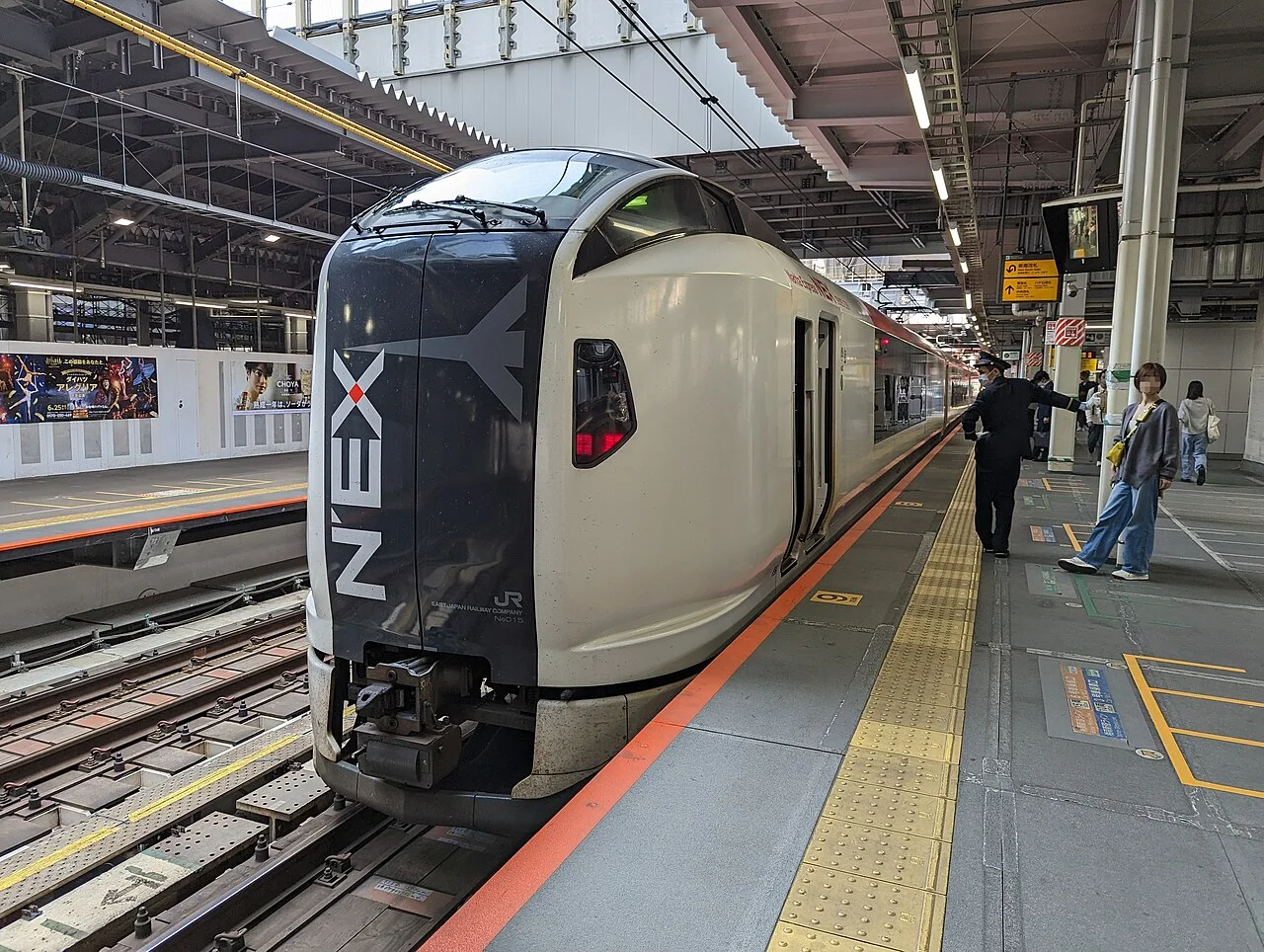
How to buy Narita Express (N'EX) tickets for Shinjuku, Shibuya, Tokyo Station or Yokohama: standard single fares, the ¥5,200 14-day return ticket, Terminal 3 access, and what to do if you miss your train.
Single fares vs the ¥5,200 return ticket
The table below lists JR East's published adult Ordinary Car reserved-seat fares from either Narita Airport Station (Terminal 1) or Airport Terminal 2 Station. Single fares include both the basic fare and the limited express surcharge. Compared with buying two singles to and from the same station, the ¥5,200 return ticket saves ¥1,080 from Tokyo Station, ¥1,460 from Shinagawa, Shibuya or Shinjuku, and ¥3,760 from Yokohama. Weigh those savings against Keisei or coach fares if you only plan to take the N'EX in one direction.
If you take the N'EX straight to Shinjuku on day one, then stay in Ueno at the end of your trip and fly out via the Skyliner, buy a ¥3,330 N'EX single outbound and a separate Keisei ticket back. Conversely, if you start in Shinjuku and finish with a few nights in Yokohama, using the N'EX both ways makes the return ticket worthwhile: two separate singles would cost ¥3,330 plus ¥4,480 (¥7,810 total), or ¥2,610 more than the ¥5,200 return ticket. Moving hotels between areas does not forfeit the discount, because the return ticket lets you use different city stations outbound and inbound.
Flying into Narita and out of Haneda? Buy a single N'EX ticket to your first hotel stop. The same applies if you are transferring directly between airports: take the N'EX to Shinagawa and switch to a Keikyu train for Haneda. Because the N'EX return ticket only covers journeys back to Narita, there is no reason to force an airport-to-airport itinerary into a return pass.
If you want a Green Car (first-class) seat, compare the actual total prices directly. JR East lists a single Green Car fare to Tokyo Station at ¥3,910, compared with ¥3,140 for an Ordinary Car. If you already hold a ¥5,200 return ticket and upgrade to a Green Car, you must pay the limited express reserved-seat and Green Car surcharges on top — the return ticket only covers the basic fare for that leg. Booking online as an express-only reservation avoids paying the basic fare twice for the same stretch.
| City station | Single | Two singles (same station) | N'EX TOKYO Round Trip Ticket |
|---|---|---|---|
| Tokyo | ¥3,140 | ¥6,280 | ¥5,200 |
| Shinagawa, Shibuya, Shinjuku | ¥3,330 | ¥6,660 | ¥5,200 |
| Yokohama | ¥4,480 | ¥8,960 | ¥5,200 |
| Ofuna | ¥4,810 | ¥9,620 | ¥5,200 |
The 14-day rule, travel direction and JR transfers
The N'EX TOKYO Round Trip Ticket is available exclusively to holders of non-Japanese passports, and staff will check passports on collection. It costs ¥5,200 for adults and ¥2,600 for children aged 6 to 11. You must use it in sequence: first from Narita Airport into central Tokyo, and then back to Narita from inside the designated zone. You cannot use the outbound portion to travel from the city out to Narita for a flight if your trip begins in Tokyo.
The 14-day validity includes your chosen start date. Activate it on 20 December, for example, and the final valid day is 2 January; flying back on 3 January means buying a separate return ticket. If you plan to board right after landing, set the start date to your arrival date in Japan. Travellers on overnight flights should make sure the activation date matches the day they land in Japan rather than their departure date.
After riding the N'EX into the city, you can stay inside JR East's ticket barriers and transfer onto other JR trains to any station within the designated Tokyo train zone at no extra charge. The same works in reverse on your way back: enter at any JR station inside the coverage zone and change to the N'EX within the barriers. For a hotel in Ikebukuro, for instance, ride the N'EX to Shinjuku, stay inside the JR barriers to board the Yamanote Line to Ikebukuro, and tap out only at your final stop — reversing the route on departure. Check JR's official coverage map against your hotel route, as switching to Tokyo Metro or private railways incurs a separate fare.
If you step outside the JR ticket barriers at Tokyo Station to meet someone, buy food or use a coin locker, that leg of your return ticket ends immediately. Re-entering the barriers requires paying a separate fare to your next stop. If you need to meet a companion partway, arrange to meet on a specific platform sign or transfer concourse inside the paid area, or have friends coming from outside meet you beyond the barriers at your final station so nobody has to exit and re-enter needlessly.
Booking online, airport collection and seat reservations
Single reserved-seat tickets can be searched and bought via JR-EAST Train Reservation, or in person at a JR East Travel Service Center, a JR Ticket Office (Midori-no-Madoguchi), or reserved-seat ticket vending machines. Reserved seats normally go on sale one month before travel. At a staffed counter, simply show your travel date, departure station, destination and passenger count, ideally with your preferred train or time window ready. Since Narita has two railway stations, confirm your flight's terminal before entering the station name.
To buy the return ticket online, go to "Purchase a pass" on JR-EAST Train Reservation, choose the N'EX TOKYO Round Trip Ticket and select your start date. You can reserve Ordinary Car seats for both directions once your itinerary is fixed, or book your return seat in advance and reserve the inbound train at the airport once you clear immigration. The return leg uses a separate seat reservation, so double-check the departure station, date and airport terminal station — especially if you fly in and out of different terminals. Groups travelling together should check seat availability on a single train first to decide whether to sit together, split into pairs or wait for the following departure.
Online return tickets must be collected as paper tickets at Narita Airport Station (Terminal 1) or Airport Terminal 2 Station (serving Terminals 2 and 3). At both stations, the JR Ticket Offices and passport-reading reserved-seat vending machines operate from 06:30 to 21:45. The JR East Travel Service Centers are open 08:30 to 19:00 at Terminal 1 and 08:30 to 20:00 at Terminal 2. Buying the return ticket in person on arrival is done at the Travel Service Centers; if you land after they close with an online booking already made, head straight to the open ticket counter or a passport-reading machine.
To collect tickets at a passport-reading machine, you will need a physical biometric (IC-chip) passport along with your collection QR code, pick-up code or the credit card used to pay. At a staffed counter, bring your pick-up code or original card plus passports for inspection. JR's collection rules require all passengers named on the booking to be present, so meet outside the Travel Service Center before queuing together at the machine or counter.
The booking site's QR code is for ticket collection only. Once your paper tickets print out, check the date, departure station, train number, carriage and seat number, and keep each passenger's seat reservation ticket paired with their fare ticket. Pass through the ticket barriers one person at a time and queue at the matching carriage marker on the platform. If you are leaving Tokyo to tour other regions before flying home, collect your pre-booked return N'EX seat ticket at a JR East station before you leave the city so you can go straight to the platform on departure day.
For single journeys, JR East also sells a ticketless "Express Train e-ticket (basic fare required)". This covers only the limited express surcharge; you pay the basic fare separately using an IC card such as Suica or a paper fare ticket. Make sure your IC card has enough balance, tap the same card in and out of JR barriers, and check your online reservation on your phone for your seat number. If you choose a standard paper-ticket booking instead — or hold the return ticket — you must still collect paper tickets at the station before boarding.
Walking from Narita's three terminals to the two JR stations
Terminal 1 uses Narita Airport Station (Narita-kuko), while Terminal 2 uses Airport Terminal 2 Station (Kuko Dai-2 Biru). From the arrivals hall, follow the signs downstairs for the railway concourse, where lines split between JR and Keisei — turn towards the JR side for the N'EX. At Terminal 1's Narita Airport Station, JR Platform 1 mainly serves limited express trains and Platform 2 handles rapid services. At Airport Terminal 2 Station, inbound and outbound JR trains share a platform area, so check the displays and board a Tokyo-bound N'EX rather than following passengers heading back towards Terminal 1.
Terminal 3 passengers also board at Airport Terminal 2 Station. With wheeled luggage, you can walk directly along the airport's signposted linkway, or take the free inter-terminal shuttle bus from Terminal 3's North Exit 1 to Terminal 2 and follow the red signs down to the B1 rail ticket gates. Walking avoids waiting for a bus, whereas the shuttle saves pushing heavy bags — both bring you to the exact same JR station.
For departing flights, Narita Airport states walking times of roughly 5 minutes from each station to Terminals 1 and 2, and around 10 minutes from Airport Terminal 2 Station to Terminal 3. Heading to Terminal 3 off the train, follow signs up to the 1st floor, pick up the blue walkway markings and go up to the 2nd floor linkway. International check-in is on the 2nd floor in Terminal 3, the 4th floor in Terminal 1 and the 3rd floor in Terminal 2. Factor in walking, lifts and baggage drop when picking a return train — the arrival time on your ticket is only when the train pulls in.
When searching station names in timetable apps or booking sites, watch out for "Narita" station — that serves Narita city and sits some distance from the airport terminals. Where results show both "Narita Airport (Terminal 1)" (Narita-kuko) and "Narita Airport Terminal 2/3" (Airport Terminal 2 / Kuko Dai-2 Biru), select the one matching your terminal. Travellers heading to Terminal 3 often mistakenly book "Narita" or Terminal 1; double-check that your booking shows Terminal 2/3 (Airport Terminal 2) before paying, and note both station names alongside your flight numbers if you use different terminals outbound and inbound.
Flight delays, missed trains and sold-out seats
If you are travelling solo without an immediate onward connection, waiting until you have picked up your bags to buy an inbound ticket is hassle-free. Groups wanting to sit together can book ahead, leaving generous breathing room between landing, immigration, baggage claim and ticket collection — there is no fixed clearance time that fits every flight. If you land at Terminal 3 with minutes to spare before departure and still have to walk to Airport Terminal 2 Station to collect tickets, switching straight to the next train is easier than dashing to a counter to rebook.
On JR-EAST Train Reservation, your booking record lets you cancel either a single seat reservation or the entire pass. If your flight is delayed and you bought both the return ticket and seat bookings online without collecting paper tickets yet, you can cancel that leg's seat reservation free of charge up to 6 minutes before departure and pick a later train. Cancelling the inbound seat keeps your return booking intact. Once paper tickets have been printed, take the tickets and original payment card to an eligible JR counter for a refund.
Uncollected return tickets can be cancelled for a full refund up to 23:50 JST the day before the start date. After that deadline — while still eligible for an online refund — JR-EAST Train Reservation charges a ¥560 handling fee per person. Any full refund of an unused pass must be processed before your reserved train departs; once the train leaves, the booking becomes non-refundable. Cancelling the whole pass automatically cancels any seat bookings attached to it.
For single reserved-seat tickets bought on the same site, free cancellation runs until 21:00 JST the day before travel. After that cut-off, within the site's refund window, the handling fee is ¥320 per person for the reserved-seat ticket, plus ¥220 per person if a basic fare ticket was purchased in the same booking. If you bought only the ticketless limited express e-ticket and intended to pay the basic fare via Suica, there is no basic fare ticket to refund.
If your reserved train has already left, JR East allows you to board a later N'EX on the same day over the same route and fare zone, taking any vacant seat in an Ordinary Car. Your original seat reservation does not transfer, so you must vacate the seat if a passenger holding a reservation for it boards. If you have not bought a ticket yet and want full flexibility on the day, buy an Unreserved Seat Ticket (priced the same as an Ordinary Car reserved-seat limited express ticket): once you settle on a train, you can assign a vacant seat free of charge, or stand in the vestibule if the train is full.
If a delay means no more N'EX services are running that day, check live Keisei and airport coach timetables for services still operating and buy a separate ticket. Reaching central Tokyo is not the same as reaching your hotel — if you arrive at Keisei-Ueno late at night, check last trains for your onward city connection too. If you only make it into town the following day, rebook for the new date and keep your original confirmation email and paper tickets to explain to JR counter staff which legs went unused.
Choosing seats with children, wheelchairs or large luggage
The child N'EX return ticket for ages 6 to 11 costs ¥2,600. Children aged 5 and under travel free when seated on an adult's lap, though you must buy a child ticket if they take their own reserved seat. Standard single tickets also enforce a companion rule: one adult or child may bring up to two infants free, with a child fare payable from the third infant onwards. Before checking availability, decide who needs their own seat; two adults with two children can often take two pairs of adjacent seats in the same carriage rather than passing up a good train just because four seats in a single row are unavailable.
Every N'EX carriage has dedicated luggage racks near the doors that require no reservation, fitted with combination locks and monitored by CCTV. Because you lift your own bags off the train, keep passports and tickets in a small daypack at your seat rather than locked inside a suitcase. Take out children's snacks, wipes or charging cables before leaving the airport so you are not repacking in the doorway. Seats also have power sockets, handy for pulling up your Tokyo or Shinagawa transfer map before arrival.
If your suitcases look identical to everyone else's, wrap a bright luggage strap around the handle. If your seats are far from the rack, note which end of the carriage holds your bags and move down to retrieve them once you pass the stop before yours. On the return trip from Shibuya or Shinjuku, snap a photo of your carriage number and queue at the right marker on the platform — wheeling large cases down the platform trying to find your carriage after the train arrives blocks disembarking passengers.
JR East's standard free carry-on allowance is two items per passenger, each measuring up to 250 cm in total dimensions (length + width + height), with a maximum length of 2 metres and weight of 30 kg, provided you can handle them yourself without obstructing other passengers. Airline check-in acceptance does not override rail limits for bulky ski bags or oversized hard cases. If you are connecting to the Tokaido Shinkansen at Tokyo or Shinagawa with a bag measuring between 160 cm and 250 cm in total dimensions, you will also need to book a Shinkansen seat with an oversized baggage area.
N'EX trains are equipped for wheelchair users, including spacious accessible toilets. If you need boarding assistance, wheelchair spaces or companion seats alongside, tell JR staff your boarding, alighting and transfer stations when buying your ticket so they can coordinate support. Allow extra transfer time based on lift routes rather than escalators: changing from the N'EX to the Yamanote Line at Shinjuku, for instance, involves staff guiding you via the Saikyo / Shonan-Shinjuku platforms to the south concourse lifts to reach other lines.
Navigating Tokyo, Shinagawa and Shinjuku stations
For Narita-bound N'EX trains at Tokyo Station, follow signs for "Sobu Underground". JR maps place the Narita Express on Underground Sobu Platforms 1 to 4, completely separate from the Keiyo Line underground platforms serving Maihama. Entering from the Yaesu side, head down towards the Sobu Underground area first, then check the boards for your platform number. Arriving from the airport to catch a Shinkansen, head up and follow signs for the Tokaido or Tohoku/Joetsu/Hokuriku Shinkansen transfer gates. JR lists a standard transfer time of 15 minutes between the Sobu/Yokosuka lines and the Shinkansen — that covers walking between platforms alone, so add extra time for large suitcases, lifts or collecting Shinkansen tickets.
At Shinagawa, JR's station map puts the standard transfer time from the Sobu/Yokosuka lines to the Shinkansen at 8 minutes. If you are heading west towards Kansai and an N'EX in your window stops at Shinagawa, check both Tokyo and Shinagawa connections to see which leaves more breathing room. Kyoto-bound services typically use Tokaido/Sanyo Shinkansen outbound Platforms 23 and 24 — verify your exact platform on the departure screens. Travellers heading to Haneda Airport should follow signs for the Keikyu Line and handle that airport transfer fare separately.
At Shinjuku, the N'EX uses Platforms 5 and 6. Entering from street level, the Shin-Minami Gate, Koshu-kaido Gate and Miraina Tower Gate are marked on JR's map as step-free routes straight to Platforms 5 and 6. If you enter from the north side of the station, expect a long walk through the concourse. When transferring from the Yamanote Line, locate the connecting passageways and lifts in advance. Having your paper ticket ready in hand lets you walk straight to the platform without queuing at a ticket counter first.
If you are staying around Sakuragaoka or Shibuya Stream in Shibuya, enter JR via the south-facing Shin-Minami Gate on your return and follow signs to the Saikyo / Shonan-Shinjuku platforms where the N'EX stops. Coming from Dogenzaka, compare the walk to the Hachiko Gate against the Shin-Minami Gate. If you are changing hotels in Shibuya and using station lockers on travel day, save the exact gate names ("Shin-Minami Gate" or "Hachiko Gate") on your map so you do not end up dragging luggage around the outside of the station to the wrong locker bank.
When using different stations on arrival and departure — say, arriving at Shinjuku and departing from Tokyo — save separate station maps on your phone. Day one is about getting from the platform out towards your hotel; departure day flips the route from street entrance back to the airport-bound platform. Many hotel maps only highlight the exit closest to them, so check your entry gate and platform carriage position before setting off with bags.
Red-eye flights, service disruptions and airport bus alternatives
On an early-morning arrival, start with your arrival terminal, check the day's first N'EX departure on JR's timetable, and cross-check when ticket counters and machines open. If you clear customs before the counters open, compare already-running JR rapid trains, Keisei services and airport coaches. With heavy bags and a hotel in Shinjuku, having breakfast at the terminal and waiting for a direct N'EX can still beat changing trains at Nippori — provided you have no morning appointments and count breakfast and waiting into your arrival time.
Using JR East's December 2026 weekday timetable as an example, evening departures from Narita Airport Station (Terminal 1) towards Ofuna and Shinjuku leave at 20:44 and 21:44 — a full hour apart. If your bags only appear on the carousel at 21:30, remember that although the ticket machines stay open until 21:45, you still have to reach basement level 1, print your tickets and board before the 21:44 departure. Passengers clearing Terminal 2 or 3 should check the Airport Terminal 2 Station timetable instead.
Over the New Year holiday, temporary extra stops can also appear in journey planners. JR's winter timetable notes that between 1 and 3 January 2027, selected N'EX trains add a stop at Narita Station in Narita city. That can offer a direct ride if you booked a hotel in town, while international flyers leaving Tokyo should stay on board past Narita city until the airport terminal station printed on their ticket.
Partial suspensions and full-line closures require different workarounds. During JR's November 2026 tunnel works, for example, N'EX trains turned around at Tokyo Station — maintaining the Narita-to-Tokyo leg while suspending direct runs to Shinjuku and Ofuna. Whenever you see a similar engineering notice, check JR's timetable and live running status for your travel date. If you are already at Tokyo Station and trains are only running east of there, check alternative JR urban lines; if disruption hits the Narita end, check Keisei trains and airport coaches instead.
If your hotel is an Airport Limousine Bus stop, riding a coach straight from your terminal to the hotel lobby avoids hauling suitcases up from underground platforms. On the flip side, if the coach only stops at a distant terminal or skips your airport terminal, factor in the extra walk or taxi. Travellers with two large suitcases should check coach baggage rules and exact stops in advance to keep a reliable wet-weather, late-night or rail-disruption backup ready. Always remember that coaches are vulnerable to road traffic, so keep a rail option in mind if you are racing a check-in deadline.
For budget-minded stays near Tokyo Station, look up the AIRPORT BUS TYO-NRT. Its published adult single fare from Narita to Tokyo Station is ¥1,500 on standard departures, compared with ¥3,140 on an Ordinary Car N'EX — a ¥1,640 saving. Coaches drop off at Tokyo Station's Nihombashi Exit and depart outbound from stops 7 and 8 outside the Yaesu South Exit. If you are happy to trade a slightly longer, traffic-dependent ride for the lower fare, measure the walk to your hotel from the Nihombashi Exit, and allow plenty of buffer if you are catching a reserved long-distance Shinkansen afterwards.
Plan your return journey backwards from your airline's check-in deadline. Narita Airport advises international passengers to arrive at least 2 hours before departure, and you still face a walk from the train platform to the check-in desks — plus the inter-terminal linkway if flying from Terminal 3. If the planner offers only one train that cuts it close, take the train before it and move breakfast or duty-free shopping to after you reach the terminal. From Yokohama, Ofuna or Shinjuku, you can also check services via Tokyo Station to see if an earlier N'EX departure connects sooner.
Can I use the JR TOKYO Wide Pass on the N'EX?
The JR TOKYO Wide Pass costs ¥16,000 for adults and covers 3 consecutive days from your chosen start date, including Ordinary Car reserved seats on the Narita Express within the pass area. If you arrive and head to Shinjuku on day one, visit Nikko on day two and take another day trip on day three — journeys that already justify the pass — your inbound N'EX ride is covered at no extra cost. If you fly home on day six, just buy a single return N'EX ticket rather than paying for a N'EX return pass on top of an inbound leg already covered by your rail pass.
By contrast, if you spend your first two days in central Tokyo and only start your regional day trips on day three, activating the 3-day pass on arrival at Narita could leave your final long-distance trip uncovered. Price out both options side by side, including every regional, local and airport leg you plan to take. Because the pass runs for consecutive calendar days, anyone hoping to use it for the return trip to Narita on day five needs to count backwards to pick the right activation day.
If you already hold a broader JR East rail pass that covers the Narita line, you can reserve your N'EX seats against that pass when booking. Keep paper tickets, IC cards and rail passes organised so you tap or show the right one at each barrier. For multi-airport trips via Haneda, split-stay itineraries or a wider look at getting into town, read our Tokyo airport arrivals and rail passes guide before locking in which N'EX legs you need to buy.
A few useful answers
Can I board the N'EX by tapping my Suica card alone?
Suica covers the basic fare only; you still need a limited express ticket. If you buy JR East's ticketless Express Train e-ticket, you can tap your IC card at the ticket barriers and sit in the seat shown on your online booking.
If I buy the return ticket, can I start the return leg from a different station?
Yes. Arriving at Shinjuku from Narita and returning to Narita from Yokohama is fully permitted. You simply reserve each leg separately, making sure your return journey falls within the 14-day validity period.
Can I pick up an online N'EX return ticket in Shinjuku before my trip back?
No. Online bookings for the return ticket must be collected at Narita Airport Station (Terminal 1) or Airport Terminal 2 Station, using your passport at a JR ticket office or a passport-reading reserved-seat ticket machine.
My flight departs from Terminal 3. Which station should I book for the N'EX?
Book to Airport Terminal 2 Station (Kuko Dai-2 Biru), which serves both Terminal 2 and Terminal 3. From the station, follow the pedestrian linkway or take the free inter-terminal shuttle bus to Terminal 3.
If I miss my reserved N'EX train, do I still keep a reserved seat on the next one?
You can board a later N'EX on the same day over the same route and fare zone, and sit in any vacant Ordinary Car seat. However, if a passenger holding a reservation for that seat boards, you must give it up.
Does the N'EX return ticket cover journeys as far as Ofuna?
Yes, Ofuna is included in the return ticket coverage area. For the inbound journey, select a service shown on the timetable as stopping at Ofuna; for the return, book an Ofuna departure heading to Narita.
Official information and references
Sources used in this guide.
- JR East Narita Express route map, onboard facilities and FAQ
- JR East N'EX Ordinary and Green Car fares, reserved and unreserved seating
- JR East N'EX TOKYO Round Trip Ticket prices, collection and refunds
- JR-EAST Train Reservation enquiries, cancellations and refund rules
- JR-EAST Train Reservation pass and paper ticket collection guide
- How to use JR East ticketless Express Train e-tickets
- JR East ticket rules when missing a reserved limited express train
- Narita Airport walking times between rail stations and terminals
- Narita Airport access between Terminal 2 Station and Terminal 3
- Narita Airport international departures and check-in times
- JR East Narita Airport Station (Terminal 1) station map
- JR East Airport Terminal 2 Station station map
- JR East Tokyo Station map and standard transfer times
- JR East Shinagawa Station map and standard transfer times
- JR East Shinjuku Station map and step-free transfers
- JR East Shibuya Station map and exits
- JR East Yokohama Station map
- JR East Narita Airport Station (Terminal 1) timetable
- JR East December 2026 weekday N'EX timetable from Narita Airport Station
- JR East Narita Express winter timetable and 2027 New Year extra stops
- JR East Narita Express service status and disruption updates
- JR East Yokosuka and Sobu Rapid Line tunnel works partial suspension notice
- JR East carry-on luggage rules
- JR Central Tokaido Shinkansen oversized baggage rules
- JR East JR TOKYO Wide Pass validity dates and coverage area
- Keisei Electric Railway Skyliner route and fastest journey time
- Airport Limousine Bus routes and timetables
- Keisei Bus AIRPORT BUS TYO-NRT fares and timetable
- AIRPORT BUS TYO-NRT Tokyo Station boarding and alighting stops