Nakanoshima is a 3 km-long sandbar tucked between the Dojima and Tosabori rivers, lined with the National Museum of Art, Osaka, the Nakanoshima Museum of Art, Osaka, and Osaka City Central Public Hall. Anchored at its western tip by the 1,001-room Rihga Royal Hotel Osaka—linked underground to Keihan Nakanoshima Station—and on its northern bank by Candeo Hotels Osaka The Tower near Yodoyabashi Station with a rooftop Sky Spa, this guide covers how to choose a hotel, the Keihan Nakanoshima Line, opening details for all three museums (including the Museum of Oriental Ceramics' closure until around April 2027), and direct airport routes.
- Region & Focus
- OsakaAttractions
- Reading Scope
- 13 min read · 6 chapters · 4 Q&As
- Official Verification
- 12 official sources checkedUpdated 20 November 2026
Chapter Route Map (tap any stop)
- Nakanoshima Basics: Museum Island and the Keihan Nakanoshima Line
- Rihga Royal Hotel Osaka: The 1,001-Room Island Landmark
- Candeo Hotels Osaka The Tower: A Rooftop Sky Spa Near Yodoyabashi
- The Three Museums: Opening Hours, Admission and Closure Status
- Getting Here: Routes from Kansai and Itami Airports
- Suggested Itineraries: A Day and Night on Museum Island
- Quick Q&A
Sandwiched between the Dojima and Tosabori rivers, Nakanoshima is a slender river island stretching roughly 3 km from east to west. Lined with Osaka's first public park (opened in 1891), the National Museum of Art, Osaka, the Nakanoshima Museum of Art, Osaka, and the red-brick Central Public Hall, it has earned a reputation as the city's 'Museum Island'. Staying here follows a very different rhythm from bustling Shinsaibashi: the four stops of the Keihan Nakanoshima Line (Nakanoshima, Watanabebashi, Naniwabashi, and Oebashi) serve the entire cultural spine directly, anchored by the 1,001-room Rihga Royal Hotel Osaka—connected underground to Nakanoshima Station at the western tip—and Candeo Hotels Osaka The Tower with its rooftop Sky Spa just off Yodoyabashi Station on the northern bank. Drawing on current museum and tourism board information, this guide sets out how to pick your base, how the Keihan Nakanoshima Line links the sights, opening hours and admission fees for all three museums (including the Museum of Oriental Ceramics' renovation closure until around April 2027), and direct transfers from Kansai and Itami airports—so a quiet stay beside Osaka's museums stands out clearly from the city's busier hotel districts.
Nakanoshima Basics: Museum Island and the Keihan Nakanoshima Line
According to the Osaka Convention & Tourism Bureau, Nakanoshima is a narrow sandbar roughly 3 km from east to west and about 10.6 hectares in area, lying between the Dojima and Tosabori rivers. Since the Meiji era it has formed a leafy civic and cultural strip. Its cultural axis is neatly laid out: at the western end stand the National Museum of Art, Osaka and the Nakanoshima Museum of Art, Osaka (both around a 5-minute walk from Watanabebashi Station on the Keihan Nakanoshima Line); the middle section gathers Osaka City Central Public Hall, the Osaka Prefectural Nakanoshima Library, and the Museum of Oriental Ceramics, Osaka (right outside Exit 1 of Keihan Naniwabashi Station); and the eastern tip meets the Yodoyabashi and Kitahama business districts, all stitched together by the 1.5 km riverside promenade of Nakanoshima Park, opened in 1891.
Getting around the island revolves around the Keihan Nakanoshima Line, opened in 2008, whose four island stops—Oebashi, Watanabebashi, Naniwabashi, and Nakanoshima—make staying beside the galleries genuinely practical. A five-minute stroll from Watanabebashi brings you to the two modern art museums, Naniwabashi opens straight onto the Museum of Oriental Ceramics, and Nakanoshima Station connects underground directly into Rihga Royal Hotel Osaka. Off the island, two major interchange hubs—Yodoyabashi Station (linking the Osaka Metro Midosuji Line and Keihan Main Line) and Kitahama Station (linking the Sakaisuji Line and Keihan Main Line)—plug straight back into the wider underground network.
Before booking, it helps to be realistic about supply: hotel options on Nakanoshima itself are far scarcer than in Shinsaibashi. The 1,001-room Rihga Royal Hotel Osaka anchors the western end, Candeo Hotels Osaka The Tower on Dojimahama on the northern bank is the newest high-rise option near Yodoyabashi Station, and Conrad Osaka holds prime real estate in the island's centre—together forming the core trio. Several properties often cited in older blog posts—namely 'THE LIVELY Osaka Nakanoshima', 'Hotel Monterey Nakanoshima', and 'Candeo Kitahama'—are not actually on Nakanoshima: THE LIVELY is in Osaka Honmachi, the two Hotel Monterey properties are in Umeda and OBP Kyobashi, and Candeo has no Kitahama branch.
Hotel numbers are limited because Nakanoshima was shaped as a civic and cultural enclave rather than a shopping district. Parks, museums, historic halls, and corporate headquarters dominate the island, leaving far fewer restaurants and nightlife venues than in Umeda or Shinsaibashi. Yet that same character explains both its appeal—quiet nights, river views, and walkable museum access—and its tight inventory, with Rihga Royal and Conrad the only large hotels actually on the sandbar. Travellers who choose Nakanoshima are paying for calm after dark and unhurried gallery mornings, not convenience-store bustle on the doorstep.
That quiet brings a distinct evening bonus. Lights along the Dojima and Tosabori rivers shimmer on the water, the red-brick Central Public Hall and Hanshin head office glow elegantly after dusk, cherry trees bloom along the embankment in spring, and winter illuminations brighten Nakanoshima Park at year-end. Staying on the island turns this 1.5 km riverside promenade into your daily walk out and back—a sense of space that high-rise Umeda and neon-lit Shinsaibashi simply cannot match.
The two eastern interchange stations also sharpen intercity connections. Yodoyabashi puts you on the Midosuji Line straight to Osaka Station and Namba, while Kitahama links via the Sakaisuji Line toward Kansai Airport and via the Keihan Main Line north to Demachiyanagi in Kyoto. The four Nakanoshima Line stops tie the cultural strip together, while Yodoyabashi and Kitahama reconnect you to the underground and Kyoto rails; travellers heading down from Kyoto can ride the Keihan Main Line straight into Kitahama or Yodoyabashi without changing at sprawling Osaka Station, making a twin-city Kyoto-and-Osaka itinerary effortless.
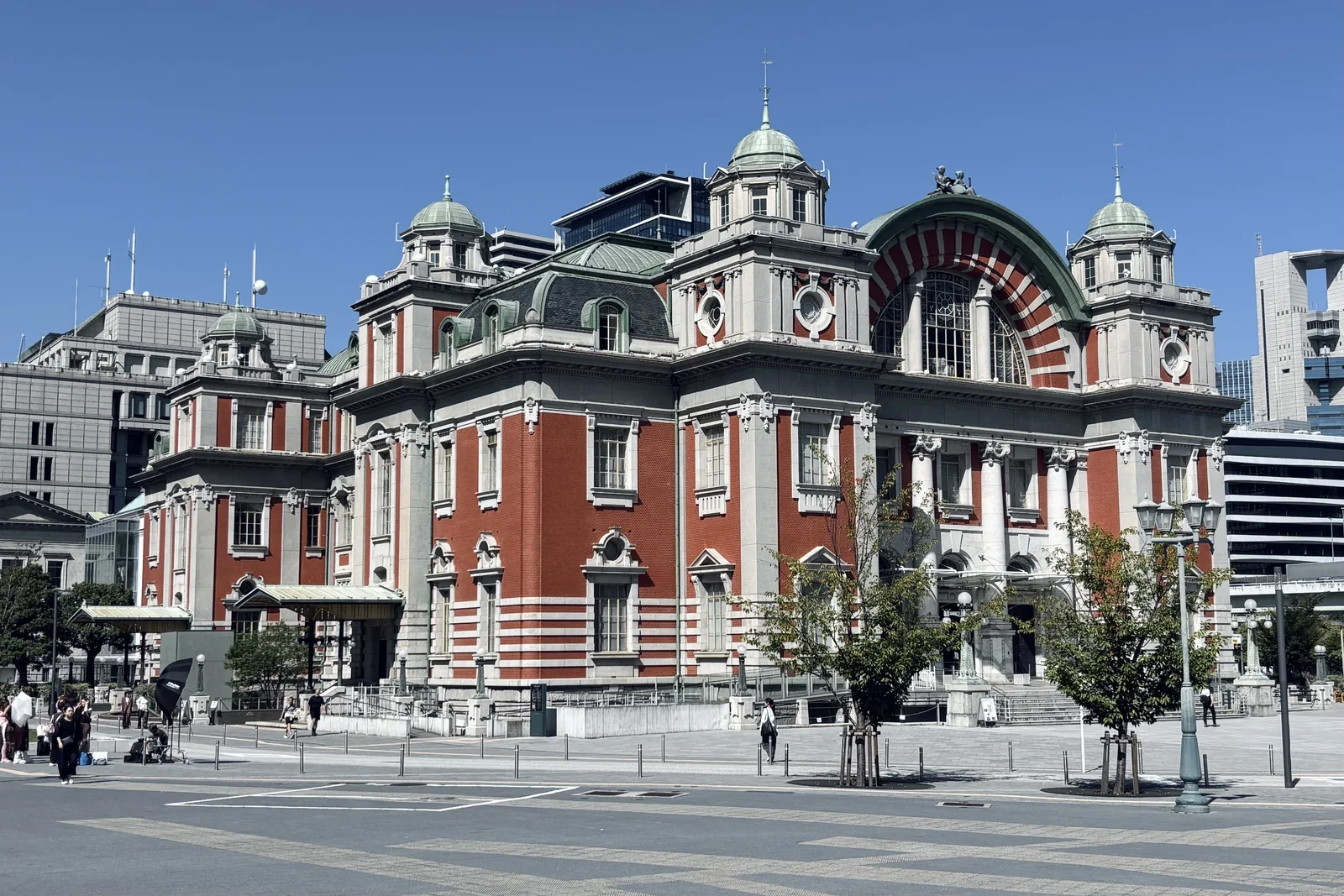
Nakanoshima is a 3 km-long sandbar tucked between the Dojima and Tosabori rivers, lined with the National Museum of Art, Osaka, the Nakanoshima Museum of Art, Osaka, and Osaka City Central Public Hall. Anchored at its western tip by the 1,001-room Rihga Royal Hotel Osaka—linked underground to Keihan Nakanoshima Station—and on its northern bank by Candeo Hotels Osaka The Tower near Yodoyabashi Station with a rooftop Sky Spa, this guide covers how to choose a hotel, the Keihan Nakanoshima Line, opening details for all three museums (including the Museum of Oriental Ceramics' closure until around April 2027), and direct airport routes.
Rihga Royal Hotel Osaka: The 1,001-Room Island Landmark
Standing at the western tip of the island (5-3-68 Nakanoshima) with 1,001 guest rooms and now part of IHG's Vignette Collection, Rihga Royal Hotel Osaka is Nakanoshima's grandest legacy landmark. Its standout advantage is transport integration: Nakanoshima Station, the terminus of the Keihan Nakanoshima Line, connects directly to the hotel via an underground passage, alongside a complimentary shuttle bus running between the hotel and the west side of JR Osaka Station (departing 07:45–22:30 every 7 to 15 minutes; roughly a 15-minute ride). From Kansai Airport, take the JR Kansai Airport Rapid Service (about 65 minutes) or the Haruka Limited Express (about 45 minutes) to JR Osaka Station for the free shuttle, or ride the airport limousine bus to Herbis Osaka (about 60 minutes) and transfer.
Room tiers span Royal Signature Suite, Royal Club, Premium, Standard, Cozy, and accessible rooms, with exact floor areas, maximum occupancy, and extra-bed rules shown live on the official booking engine. Dining is a major draw in its own right, with an impressive line-up under one roof—French fine dining at Chambord, Japanese cuisine at Nakanoshima and Nadaman, Chinese dishes at Royal Ryuho, plus teppanyaki and sushi—backed by a fitness club, indoor swimming pool, and beauty spa, so a 1,001-room stay never leaves you short of evening options.
One widespread misconception needs clearing up before you book. Many older guides claim Rihga Royal has a rooftop communal bathhouse, yet its official list of 87 on-site facilities includes no daiyokujo (public bath), hot spring, or sauna whatsoever—only the fitness club, indoor pool, and externally linked beauty spa. If an evening soak in a large communal bath is non-negotiable, this single detail should steer your hotel choice. Families travelling with children can check the official 'Family Stay' page for children's menus and family packages.
Precisely because it is the island's sole large-scale hotel in a neighbourhood with relatively few standalone restaurants, Rihga Royal operates as a self-contained culinary hub. Alongside Chambord (French), Nakanoshima and Nadaman (Japanese), and Royal Ryuho (Chinese), you will find Kobe Kitcho, Teppanyaki Naniwa, Sushi Man, and the all-day restaurant Limone—letting multi-night guests switch cuisines every evening without leaving the building.
In practical terms, breakfast hours vary by venue and are posted at each restaurant; given the 1,001-room scale, lifts and the front desk can queue at peak check-out times, so guests in a hurry should use IHG Vignette Collection member express check-out. Drivers have access to a 477-space paid car park on site, and staying guests can also board a complimentary direct shuttle bus to Universal Studios Japan (about 25 minutes), a rare theme-park perk that pairs a quiet museum base with a full day at USJ.
Further east in the centre of the island, Conrad Osaka—opened in 2017 inside Nakanoshima Festival Tower West—is the other luxury benchmark; check Hilton's official channels for current room specs, check-in times, and facilities. As for 'THE LIVELY Osaka Nakanoshima' mentioned in older trip reports, that brand now operates in Osaka Honmachi, so double-check the address before confirming a reservation.
Timing your stay around gallery opening hours works smoothly too. Both Rihga Royal and Candeo (15:00 check-in, 11:00 check-out, with priority early check-in and a complimentary one-hour late check-out for official members) let you check out right as the museums open at 10:00. Leave large suitcases with the concierge in the morning and head straight into the exhibitions; most museums on the island also offer free lockers or cloakrooms on site.
Looking across budgets and styles, mixing on-island and riverside stays is surprisingly flexible. Choose the 1,001-room Rihga Royal (under the Vignette Collection banner) for heritage scale and broad room-rate tiers, head across to Candeo The Tower on the northern bank for a contemporary high-rise communal bath, or pick value-focused business hotels around Yodoyabashi and Kitahama stations. Even with limited hotels on the sandbar itself, combining walkable riverbank stays with the island's museums opens up far more choice than first appears—simply decide your walking radius and budget first.
Candeo Hotels Osaka The Tower: A Rooftop Sky Spa Near Yodoyabashi
Located on the northern riverbank at 1-1-27 Dojimahama (with reception on the 17th floor), Candeo Hotels Osaka The Tower sits about a 6-minute walk from Exit 7 of Yodoyabashi Station on both the Osaka Metro and Keihan Railway, just across the Dojima River from Nakanoshima's museums. Standard check-in is 15:00 and check-out is 11:00, with official members eligible for priority early check-in and a complimentary one-hour late check-out; drivers can use the building's Osaka Dojimahama Tower car park, capped at ¥2,800 per night.
According to the hotel's official room specifications, the core categories are Deluxe King (24 sq m, one 1,800 mm Simmons king bed, 1–3 adults plus 1 child sharing a bed), Deluxe Twin (24 sq m, two 1,100 mm beds, 1–3 adults plus 2 children sharing beds), and Executive Twin (26 sq m). There is no dedicated four-bed room, so a family of four must book a configuration of three adults plus a bed-sharing child; note also that Deluxe King rooms have a shower cubicle without a bathtub, so pick a Twin if you want a private bath in your room.
What draws most guests here is the rooftop 'Sky Spa & Sauna'. Reserved exclusively for staying guests from 15:00 until 11:00 the next morning (the sauna pauses from 02:00 to 06:00), a high-rise open-air bath right in central Osaka is a rare find. The house rules are clear and transparent: separate gender-divided nude bathing for ages 7 and up, no children still in nappies, no swimwear allowed, tattooed guests are welcome, and the outdoor bath closes if wind speeds reach 8 metres per second or more. Airport access is equally convenient—the Kansai Airport Limousine Bus stops right outside the door at 'Dojima (Candeo Osaka The Tower)' (note that departures from Kansai Airport Terminal 1 between 08:45 and 19:30 skip Hankyu Sanbangai).
Even while the Museum of Oriental Ceramics is closed for renovation, staying near Yodoyabashi and the northern bank leaves plenty of architectural heritage within reach. A few minutes on foot brings you to Osaka City Central Public Hall, a National Important Cultural Property completed in 1918 (paid guided tours of the special restored room and main hall are available—check the hall's official website for times), and the 1904 Osaka Prefectural Nakanoshima Library with its historic facade and reading room. Paired with spring and autumn rose blooms and illuminated river views, Nakanoshima visits from winter 2026 into spring 2027 naturally centre on major special exhibitions at the two modern art museums.
For winter, the National Museum of Art, Osaka runs its special exhibition 'Where Words Overlap' from 1 December 2026 to 14 March 2027, priced at ¥1,800 for adults, ¥1,200 for university students, and ¥900 for high-school students (free for junior-high-school age and younger and under-18s), with discounted evening admission on Fridays from 17:00 to 20:00. Collection and special-exhibition tickets are priced separately: the permanent collection alone costs ¥1,000, while combined tickets can be bought at the desk as posted.
Outside the galleries, the 1.5 km Nakanoshima Park—open year-round free of charge—delivers some of Osaka's finest seasonal walks: riverside cherry blossoms in spring, cooling breezes and river cruises in summer, a second rose bloom alongside golden ginkgo trees in autumn, and glittering illuminations in winter. An early-morning loop along the water from Rihga Royal or Yodoyabashi to the Central Public Hall and back quickly becomes a highlight of staying on Museum Island.
Walking between the three museums is effortless. The National Museum of Art, Osaka and the Nakanoshima Museum of Art, Osaka sit roughly 5 minutes apart along the river (both served by Watanabashi Station), while continuing east through Nakanoshima Park reaches the Museum of Oriental Ceramics and Central Public Hall in 8 to 10 minutes. If rain sets in, hop on the Keihan Nakanoshima Line for a single stop from Watanabashi to Naniwabashi to stay dry between venues.
The Three Museums: Opening Hours, Admission and Closure Status
Tucked largely underground, the National Museum of Art, Osaka (4-2-55 Nakanoshima) is roughly a 5-minute walk from Exit 2 of Watanabashi Station. It opens 10:00–17:00 (last entry 16:30), extending until 20:00 on Fridays (last entry 19:30), and closes on Mondays (or the Tuesday following a public holiday), over the New Year break (28 December 2026 to 4 January 2027), and during exhibition changeovers. From December 2026, collection admission is ¥1,000 for adults (¥800 for Friday evenings and groups) and ¥500 for university students, with free entry for high-school students, visitors under 18, and seniors aged 65 and over.
Opened in 2022, the Nakanoshima Museum of Art, Osaka (4-3-1 Nakanoshima) is also about a 5-minute walk from Watanabashi Station. Designed around an open, walk-through passage concept, its collection spans classics by Yuzo Saeki, a nude by Modigliani, and works by Gutai Art Association founder Jiro Yoshihara. Opening hours are 10:00–17:00 (last entry 16:30), closed Mondays (or the following weekday after a public holiday); admission varies by special and permanent exhibition, so check the website or ticket counter before buying.
Just east of the Central Public Hall, the Museum of Oriental Ceramics, Osaka (1-1-26 Nakanoshima) is currently undergoing major refurbishment, with an official notice stating it will remain closed for renovation work until around April 2027. Famous for its National Treasure celadon vase with iron-brown spots, the museum stands right outside Exit 1 of Naniwabashi Station, with typical special-exhibition rates of ¥1,600 for adults and ¥800 for high-school and university students; until it reopens, focus on the neighbouring Central Public Hall exterior and Nakanoshima Park, then add it back as an easy Nakanoshima Line stop once works finish.
The Keihan Nakanoshima Line links all three sites in a straight line (Watanabashi and Naniwabashi are just one stop apart), making a full 'museum day' easy on foot or with a day pass. Anchored in the middle by the 1918 red-brick Central Public Hall and Nakanoshima Library, stepping out as galleries close at 17:00 drops you straight into dusk illuminations along the river.
Keep one transit quirk in mind when riding the Keihan Nakanoshima Line. Its four island stations operate on Keihan's own network and do not run through onto the Osaka Metro, so trips to Umeda, Namba, or Shinsaibashi require changing to the Midosuji Line at Yodoyabashi or the Sakaisuji Line at Kitahama. The 5-minute walk between Watanabashi and the two modern art museums is the line's most useful stretch, while Yodoyabashi connects smoothly to Nankai transfers for Kansai Airport (about 70 minutes) and buses for Itami Airport (30 minutes to Osaka Station). Several smaller stations along the line have compact concourses without full lift coverage, so travellers hauling heavy luggage are better off using Yodoyabashi, Kitahama, or Nakanoshima Station with its underground link to Rihga Royal.
When choosing which month to stay on Nakanoshima, prioritise major exhibition dates first and layer seasonal blooms on top: mid-May and mid-October bring peak rose blooms in the park, April lights up riverside cherry trees after dark, and December to March pairs the National Museum of Art's winter special exhibition (1 December 2026 to 14 March 2027, ¥1,800 adults) with year-end illuminations. Booking an overnight stay during marquee exhibitions yields the richest cultural return.
Winter nights on Nakanoshima are particularly rewarding. Year-end illuminations and neighbouring Christmas markets brighten the sandbar, while Aqualiner sightseeing boats depart Nakanoshima Pier for evening river cruises. Between 17:00, when the museums close, and 20:00, the island shifts gracefully from 'Museum Island' to 'Island of Light'—all within a few minutes' stroll of your hotel.
Plan meals with realistic expectations. Street-level restaurants on Nakanoshima itself are sparse—mostly confined to Rihga Royal's dining rooms and museum cafés—while riverside cafés and eateries cluster toward the eastern Yodoyabashi end. Museum cafés work best for quick exhibition-day lunches, whereas crossing the bridge into Umeda or Kitashinchi (right on the north bank of the Dojima River, one stop or a 15-minute walk away) unlocks endless dinner options, creating a neat split between quiet island mornings and lively mainland evenings.
If one season edges ahead for a Nakanoshima stay, winter actually holds the strongest hand. From December to March, the National Museum of Art's winter headline show (1 December to 14 March) overlaps with permanent and special exhibitions at the Nakanoshima Museum of Art, alongside year-end lights and Christmas markets—giving it more density than midsummer. Dipping into heated galleries rather than braving cold winds between outdoor sights also makes winter a natural match for this neighbourhood.
Getting Here: Routes from Kansai and Itami Airports
From Kansai International Airport, both flagship hotels offer straightforward transfers. For Rihga Royal Hotel Osaka, ride the JR Kansai Airport Rapid Service (about 65 minutes) or the Haruka Limited Express (about 45 minutes) to JR Osaka Station for the free shuttle, take an airport bus to Herbis Osaka (about 60 minutes) and change, catch the Nankai Rapi:t Limited Express to Namba (about 40 minutes) followed by a 15-minute taxi (around ¥1,500), or take a direct taxi (about 60 minutes, ¥18,000). For Candeo Hotels Osaka The Tower, you can pair the Nankai Airport Line (about 50 minutes) with the Osaka Metro (about 10 minutes) and a short walk (around 70 minutes total), or better yet board the Kansai Airport Limousine Bus straight to the 'Dojima' stop outside the hotel entrance—the easiest door-to-door choice with heavy bags.
If you are flying domestically into Itami Airport, Nakanoshima is actually closer than Shinsaibashi. The airport bus reaches JR Osaka Station in roughly 30 minutes for an easy shuttle or walk, while a direct taxi takes about 30 minutes for around ¥6,000—a huge advantage for business travellers and domestic connections.
Three practical transit notes are worth keeping handy. First, off-peak trains on the Keihan Nakanoshima Line run roughly every 15 to 20 minutes—less frequently than the Keihan Main Line—so head to Yodoyabashi or Kitahama if you need higher frequencies. Second, walking southwest from JR Osaka Station (Umeda) across Dojima Ohashi Bridge to Rihga Royal or the two modern art museums takes roughly 15 to 20 minutes (matching the official 'about 20 minutes southwest of Osaka Station' guide), a pleasant riverside stroll in mild weather. Third, return limousine buses to Kansai Airport depart from the opposite side of the 'Dojima' stop outside Candeo, making departure day effortless with suitcases.
On price, Nakanoshima sits in the upper-middle tier between Umeda and Shinsaibashi—Conrad and Rihga Royal anchor the luxury end, Candeo fills the upper-midscale design bracket, and business hotels across the bridges in Yodoyabashi and Kitahama cover budget stays. For the same nightly spend, Shinsaibashi buys late-night shopping and bar-hopping, whereas Nakanoshima buys river views, walkable museums, and peaceful nights—a far better fit for travellers who prefer art and riverside calm.
Suggested Itineraries: A Day and Night on Museum Island
For a packed 'museum day', enter the island from Yodoyabashi or Kitahama in the morning to admire the exterior of the Central Public Hall and stroll free-to-enter Nakanoshima Park (home to roughly 3,700 roses across 310 varieties peaking in mid-May and mid-October, plus winter illuminations). Spend the afternoon heading west through the subterranean National Museum of Art, Osaka and the striking Nakanoshima Museum of Art, Osaka, then walk back along the river at dusk to photograph the illuminated Central Public Hall—few routes in central Osaka pack this much culture per ticket.
Stretching the visit to two days and one night gives the itinerary room to breathe. Check in at Rihga Royal via its underground link from Nakanoshima Station, or at Candeo The Tower six minutes from Yodoyabashi; spend the evening soaking in Candeo's rooftop Sky Spa or dining at one of Rihga Royal's French, Japanese, Chinese, or teppanyaki restaurants. Next morning, leave your bags at reception after check-out and stroll back into the galleries unhurried.
Geographically, Nakanoshima sits right on the waterways between Umeda and Shinsaibashi, and continuing east past Kitahama and Tenmabashi links straight into the Okawa River cherry-blossom promenade, sightseeing cruises, and Osaka Castle. Nail down three pillars—staying beside the museums, using the Keihan Nakanoshima Line, and riding the direct airport buses—and Nakanoshima becomes the calmest, most rewarding night of an Osaka trip.
To gauge walking times on the ground (based on map routes), strolling along the river from Rihga Royal takes about 10 to 12 minutes to the National Museum of Art, Osaka and around 15 minutes to the Nakanoshima Museum of Art, Osaka; from Candeo The Tower via Yodoyabashi, crossing onto the island to the Central Public Hall and Museum of Oriental Ceramics takes about 8 to 10 minutes. Both bases keep the whole cultural strip well within walking distance, differing only in whether you start from the west or east end. What really merits planning ahead on Nakanoshima is dinner: if you are not eating inside Rihga Royal, simply step across the bridge into Yodoyabashi, Kitahama, or Kitashinchi for neighbourhood restaurants and cosy back-alley dining.
A few useful answers
What are the main hotel options on Nakanoshima?
The core trio consists of Rihga Royal Hotel Osaka at the western tip (5-3-68 Nakanoshima, 1,001 rooms, linked underground to Keihan Nakanoshima Station), Candeo Hotels Osaka The Tower on Dojimahama on the northern bank (6 minutes on foot from Yodoyabashi Station, with a guest-only rooftop Sky Spa), and Conrad Osaka inside Nakanoshima Festival Tower West in the middle of the island. Several properties often mentioned in older guides—'THE LIVELY Osaka Nakanoshima', 'Hotel Monterey Nakanoshima', and 'Candeo Kitahama'—are not in Nakanoshima: THE LIVELY is in Osaka Honmachi, and Hotel Monterey's Osaka branches are in Umeda and OBP Kyobashi.
Does Rihga Royal Hotel Osaka have a communal bathhouse (daiyokujo)?
No. Rihga Royal Hotel Osaka's official list of 87 facilities includes no communal bathhouse, hot spring, or sauna—only a fitness club, indoor swimming pool, and externally partnered beauty spa. If a high-rise communal bath is a priority, choose Candeo Hotels Osaka The Tower on the northern bank instead, where the rooftop Sky Spa opens to staying guests from 15:00 to 11:00 the next morning (gender-divided nude bathing for ages 7 and up).
How should I plan museum visits in Nakanoshima, and is the Museum of Oriental Ceramics open?
Both the National Museum of Art, Osaka and the Nakanoshima Museum of Art, Osaka lie about a 5-minute walk from Keihan Watanabashi Station: the former opens 10:00–17:00 (until 20:00 on Fridays), closed Mondays, with collection admission of ¥1,000 for adults (free for high-school students and younger and ages 65+); the latter opens 10:00–17:00, closed Mondays, with ticket prices varying by exhibition. The Museum of Oriental Ceramics, Osaka is closed for renovation until around April 2027, so focus on the neighbouring Central Public Hall and Nakanoshima Park in the meantime.
How do I get to Nakanoshima from Kansai or Itami Airport?
For Rihga Royal Hotel Osaka, take the JR Kansai Airport Rapid Service (about 65 minutes) or Haruka Limited Express (about 45 minutes) to JR Osaka Station and transfer to the 15-minute free shuttle bus. For Candeo The Tower, take the Nankai Airport Line (about 50 minutes) plus the Osaka Metro (about 10 minutes) for around 70 minutes total, or board the Kansai Airport Limousine Bus directly to the 'Dojima' stop outside the hotel (departures from the airport between 08:45 and 19:30 do not stop at Hankyu Sanbangai). From Itami Airport, the airport bus reaches JR Osaka Station in roughly 30 minutes for an easy onward transfer.
Official information and references
Sources used in this guide.
- Rihga Royal Hotel Osaka — Access (Keihan Nakanoshima Station Link, 15-Min JR Shuttle & Airport Routes)
- Rihga Royal Hotel Osaka — Guest Rooms (Room Categories & Official Reservations)
- Rihga Royal Hotel Osaka — Facilities List (87 Facilities, Restaurants, Fitness Club & Pool; No Communal Bath)
- Candeo Hotels Osaka The Tower — Access (6-Min Walk from Yodoyabashi Station & ¥2,800 Parking Cap)
- Candeo Hotels Osaka The Tower — Guest Rooms (24–26 sq m, Up to 3 Adults + Bed-Sharing Children; No 4-Bed Rooms)
- Candeo Hotels Osaka The Tower — Sky Spa (15:00–11:00, Guests Only & Bathing Rules)
- Kansai Airport Transportation — Kansai Airport to Dojima (Candeo Osaka The Tower) Limousine Bus Timetable
- The National Museum of Art, Osaka — Visitor Information (10:00–17:00, Fri Until 20:00 & Dec 2026 Admission)
- Nakanoshima Museum of Art, Osaka — Visitor Information (Opened 2022, 5-Min Walk from Watanabashi Station)
- The Museum of Oriental Ceramics, Osaka — Access & Closure Notice (Closed Until Around April 2027)
- OSAKA-INFO — Nakanoshima (3 km Island Overview, 2008 Nakanoshima Line & Park Rose Garden)
- OSAKA-INFO — Nakanoshima Park (Opened 1891, Rose Garden with 310 Varieties / 3,700 Bushes, May & Oct Peaks)