Stretching roughly 3 kilometers between the Dojima and Tosabori rivers, Nakanoshima is Osaka's Museum Island, home to the National Museum of Art, the Nakanoshima Museum of Art, and the Central Public Hall. Anchor your stay at the 1,001-room RIHGA Royal Hotel Osaka directly linked underground to Keihan Nakanoshima Station, or across the river at Candeo Hotels Osaka The Tower with its rooftop Sky Spa near Yodoyabashi Station. This guide covers hotel strategy, the Keihan Nakanoshima Line, museum hours and fares (including the Museum of Oriental Ceramics closure through around April 2027), and airport transit.
- Region & Focus
- OsakaAttractions
- Reading Scope
- 13 min read · 6 chapters · 4 Q&As
- Official Verification
- 12 official sources checkedUpdated November 20, 2026
Chapter Route Map (tap any stop)
- Nakanoshima Basics: Museum Island and the Keihan Nakanoshima Line
- RIHGA Royal Hotel Osaka: The 1,001-Room Island Landmark
- Candeo Hotels Osaka The Tower: Rooftop Sky Spa by Yodoyabashi Station
- The Three Museums: Hours, Fares, and Closure Status
- Getting There: Routes from Kansai (KIX) and Itami (ITM) Airports
- Sample Itinerary: One Day and One Night on Museum Island
- Quick Q&A
Wedged between the Dojima and Tosabori rivers, Nakanoshima is a narrow sandbar stretching roughly 3 kilometers from east to west. Lined with Osaka's first public park (1891), the National Museum of Art, Osaka, the Nakanoshima Museum of Art, Osaka, and the red-brick Osaka City Central Public Hall, this strip has earned its reputation as the city's "Museum Island." Staying here follows a completely different rhythm from bustling Shinsaibashi: four stations along the Keihan Nakanoshima Line (Nakanoshima, Watanabebashi, Naniwabashi, and Oebashi) serve the entire cultural corridor directly. At the western tip stands the 1,001-room RIHGA Royal Hotel Osaka with a direct underground link to Nakanoshima Station, while just off the north bank near Yodoyabashi Station rises Candeo Hotels Osaka The Tower and its rooftop Sky Spa. Drawing on current museum, hotel, and tourism board data, this guide breaks down how to pick a room, ride the Keihan Nakanoshima Line, time the three museums (including the Museum of Oriental Ceramics closure through around April 2027), and reach the island directly from Kansai and Itami airports.
Nakanoshima Basics: Museum Island and the Keihan Nakanoshima Line
Defined by the Osaka Convention & Tourism Bureau as a 3-kilometer-long, 10.6-hectare sandbar between the Dojima and Tosabori rivers, Nakanoshima has served as a green civic and cultural hub since the Meiji era. Its layout is crisp and linear: the National Museum of Art, Osaka and the Nakanoshima Museum of Art, Osaka anchor the west end (both about a 5-minute walk from Watanabebashi Station on the Keihan Nakanoshima Line); the Central Public Hall, Osaka Prefectural Nakanoshima Library, and Museum of Oriental Ceramics, Osaka cluster in the middle (right outside Exit 1 of Keihan Naniwabashi Station); and the east end meets the Yodoyabashi and Kitahama business districts. Stitching it all together along the water is Nakanoshima Park, opened in 1891 and stretching roughly 1.5 kilometers.
Transit on the island revolves around the Keihan Nakanoshima Line, opened in 2008 with four sequential stops: Oebashi, Watanabebashi, Naniwabashi, and Nakanoshima. That line makes staying next to the galleries effortless—get off at Watanabebashi for a 5-minute walk to the two modern art museums, exit at Naniwabashi for the Museum of Oriental Ceramics, or ride to Nakanoshima Station for direct underground access to RIHGA Royal Hotel Osaka. Off the island, Yodoyabashi Station (Midosuji Line and Keihan Main Line) and Kitahama Station (Sakaisuji Line and Keihan Main Line) tie straight back into the wider Osaka Metro grid.
Before choosing a hotel, accept one reality: inventory on Nakanoshima itself is far thinner than in Shinsaibashi. Three core properties define the area—the 1,001-room RIHGA Royal Hotel Osaka at the west end, newcomer Candeo Hotels Osaka The Tower just across the river in Dojimahama near Yodoyabashi Station, and Conrad Osaka in the middle of the island. Older online guides often cite "THE LIVELY Osaka Nakanoshima," "Hotel Monterey Nakanoshima," or "Candeo Kitahama," none of which sit on Nakanoshima today: THE LIVELY is in Osaka Honmachi, Hotel Monterey's two Osaka branches are in Umeda and OBP Kyobashi, and Candeo has no Kitahama hotel.
Hotels are scarce here because the island was built for culture and governance rather than retail. Parks, museums, historic halls, and corporate headquarters dominate the footprint, leaving far fewer restaurants and nightlife spots than you will find in Umeda or Shinsaibashi. Yet that exact zoning creates Nakanoshima's appeal: quiet nights, river views, and galleries on foot, paired with a tight supply of just two large on-island hotels (RIHGA Royal and Conrad). Booking Nakanoshima buys calm evenings and unhurried mornings over late-night convenience-store bustle.
That quietness pays off after dark. Floodlights along the Dojima and Tosabori rivers shimmer across the water, illuminating the red-brick Central Public Hall and the classic Hanshin Building. Cherry trees line the riverbanks in spring, and Nakanoshima Park hosts winter illuminations at year-end, ensuring the hours after museum closing never feel empty. Staying on the island turns this 1.5-kilometer riverside promenade into your daily route in and out—an atmosphere high-rise Umeda and neon Shinsaibashi cannot replicate.
Two east-end interchange stations also speed up intercity travel. Yodoyabashi puts you on the Midosuji Line straight to Osaka Station and Namba, while Kitahama connects via the Sakaisuji Line toward Kansai Airport and the Keihan Main Line north to Demachiyanagi in Kyoto. With the four Nakanoshima Line stations spanning the cultural strip and Yodoyabashi and Kitahama linking outward, travelers coming down from Kyoto on the Keihan Main Line can step off directly onto the island without navigating the maze of Osaka Station—ideal for a Kyoto-and-Osaka itinerary.
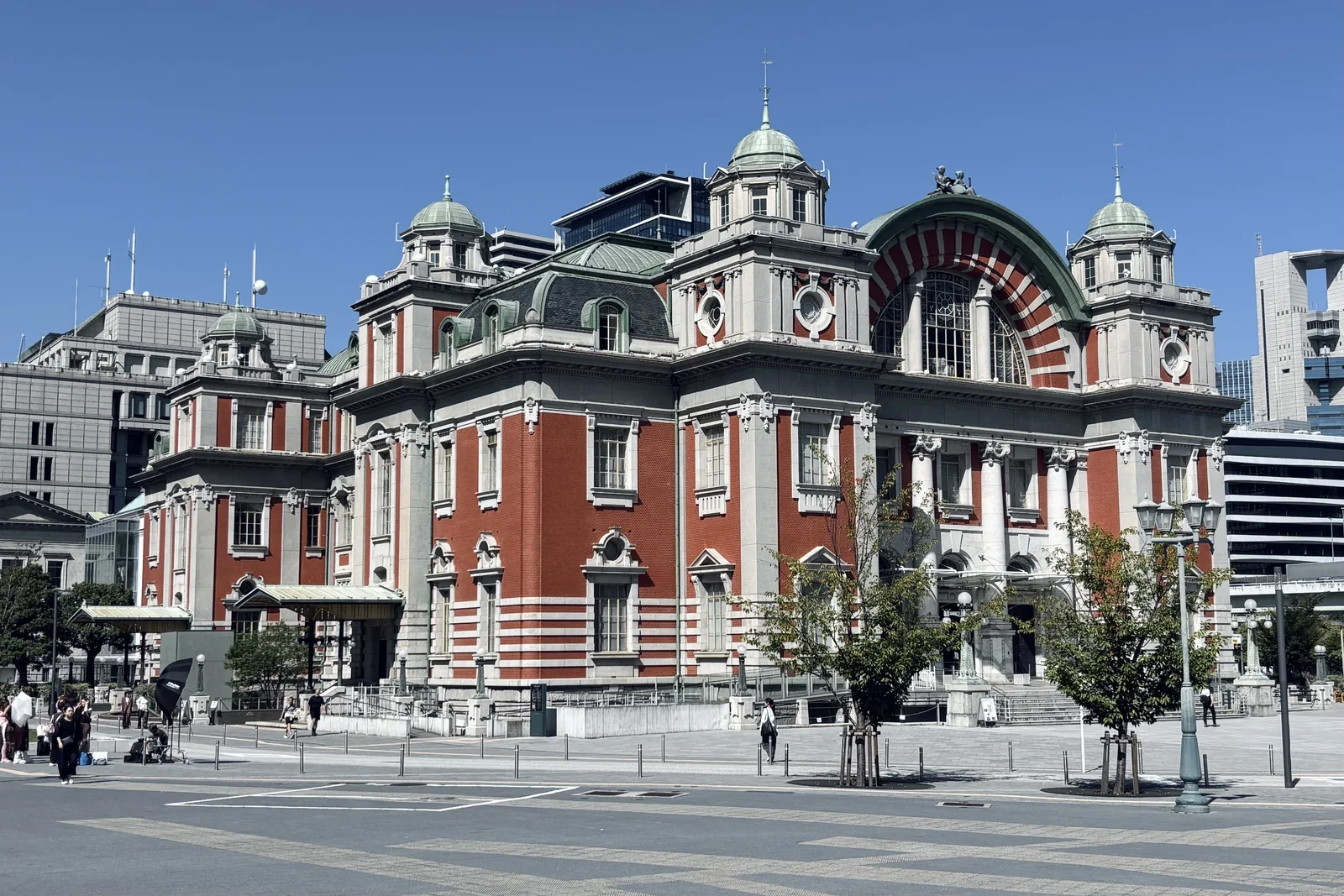
Stretching roughly 3 kilometers between the Dojima and Tosabori rivers, Nakanoshima is Osaka's Museum Island, home to the National Museum of Art, the Nakanoshima Museum of Art, and the Central Public Hall. Anchor your stay at the 1,001-room RIHGA Royal Hotel Osaka directly linked underground to Keihan Nakanoshima Station, or across the river at Candeo Hotels Osaka The Tower with its rooftop Sky Spa near Yodoyabashi Station. This guide covers hotel strategy, the Keihan Nakanoshima Line, museum hours and fares (including the Museum of Oriental Ceramics closure through around April 2027), and airport transit.
RIHGA Royal Hotel Osaka: The 1,001-Room Island Landmark
Perched at the western tip of the island (5-3-68 Nakanoshima), the 1,001-room RIHGA Royal Hotel Osaka—now part of IHG's Vignette Collection—is Nakanoshima's heavyweight classic. Its trump card is transit integration: an underground passage links directly to Nakanoshima Station at the end of the Keihan Nakanoshima Line, and a free shuttle bus runs to and from JR Osaka Station (departing the west side of Osaka Station every 7 to 15 minutes from 7:45 to 22:30; roughly a 15-minute ride). From Kansai Airport, take the JR Kansai Airport Rapid (about 65 minutes) or Limited Express Haruka (about 45 minutes) to JR Osaka Station for the shuttle, or ride the airport limousine bus to Herbis Osaka (about 60 minutes) and transfer.
Room categories span Royal Signature Suite, Royal Club, Premium, Standard, Cozy, and accessible rooms, with exact square footage, maximum occupancy, and extra-bed rules displayed live on the hotel's booking portal. On-site dining is formidable, led by French restaurant Chambord, Japanese venues Nakanoshima and Nadaman, Chinese restaurant Royal Ryuhou, teppanyaki, and sushi, backed by a fitness club, indoor pool, and beauty spa. At 1,001 rooms, you can easily spend the entire evening on property without wanting for options.
Clear up one persistent online rumor before you book: many older travel blogs claim RIHGA Royal has a rooftop public bath. In the hotel's official 87-item facilities directory, there is no public bath, hot spring, or sauna anywhere on the grounds—only the fitness club, indoor pool, and an externally affiliated beauty spa. If soaking in a communal bath at night is non-negotiable, this distinction decides your booking. Traveling families can check the hotel's dedicated "Family Stay" page for children's meals and family packages.
Because RIHGA Royal is the island's sole mega-hotel and nearby street dining is sparse, it operates like a self-contained culinary village. Alongside Chambord, Nakanoshima, Nadaman, and Royal Ryuhou, you will find Kobe Kitcho, Teppanyaki Naniwa, Sushi Man, and all-day dining at Remone—letting multi-night guests rotate through different cuisines without leaving the building.
In practice, breakfast service hours depend on each restaurant's posted schedule. With 1,001 rooms, elevators and check-out lines build quickly at peak hours, so time-pressed travelers should use IHG Vignette Collection member express check-out. Drivers have access to a 477-space paid parking garage, and overnight guests also get a complimentary direct shuttle bus to Universal Studios Japan (about 25 minutes), a rare theme-park perk from a serene museum district.
Mid-island, Conrad Osaka—opened in 2017 inside Nakanoshima Festival Tower West—is the other luxury heavyweight; verify current room specs, check-in hours, and amenities directly through Hilton's official booking site. Again, if you come across "THE LIVELY Osaka Nakanoshima" in older trip reports, check the current address before booking, as that brand now operates in Osaka Honmachi.
Check-in and check-out hours dovetail neatly with museum schedules. Both RIHGA Royal and Candeo (15:00 check-in, 11:00 check-out, with priority early check-in and 1-hour free late check-out for official members) let you drop large bags at the front desk by mid-morning and walk lightly into the galleries when they open at 10:00. Most museums on the island also provide free lockers or cloakrooms per house rules.
Zoom out across budgets and styles, and the surrounding grid offers plenty of flexibility. Choose the 1,001-room RIHGA Royal (Vignette Collection) for full-service heritage and wide rate tiers, Candeo The Tower on the north bank for modern rooms and a rooftop bath, or budget business hotels around Yodoyabashi and Kitahama stations. Once you pair mainland walking-distance stays with the island's museums, your options widen considerably—just set your walking threshold and nightly budget first.
Candeo Hotels Osaka The Tower: Rooftop Sky Spa by Yodoyabashi Station
Standing on the north bank at 1-1-27 Dojimahama with reception on the 17th floor, Candeo Hotels Osaka The Tower sits about a 6-minute walk from Exit 7 of Yodoyabashi Station (Osaka Metro and Keihan Electric Railway), separated from Nakanoshima's museums only by the Dojima River. Standard check-in is 15:00 and check-out is 11:00, with priority early check-in and a free 1-hour late check-out for official website members. Drivers can use the on-site Osaka Dojimahama Tower parking garage, capped at ¥2,800 per night.
Core guest rooms include Deluxe King (24 sqm with one 1,800mm Simmons king bed for 1 to 3 adults plus 1 co-sleeping child), Deluxe Twin (24 sqm with two 1,100mm twin beds for 1 to 3 adults plus 2 co-sleeping children), and Executive Twin (26 sqm). The hotel has no dedicated quadruple room, so families of four must book as three adults plus a co-sleeping child. Also note that Deluxe King rooms have a shower stall only without a bathtub; choose a Twin room if you want a tub.
The hotel's standout draw is its top-floor "Sky Spa & Sauna." Reserved exclusively for overnight guests, it runs from 15:00 until 11:00 the next morning (the sauna pauses from 2:00 to 6:00), offering a rare open-air bath overlooking downtown Osaka. Official bathing rules are straightforward: gender-separated nude bathing for ages 7 and up, no children still in diapers, no swimsuits, tattoos permitted, and the outdoor bath closes when wind speeds hit 8 meters per second or higher. Airport access adds another edge: the Kansai Airport Limousine Bus stops right at the front entrance at "Dojima (Candeo Hotels Osaka The Tower)," though departures from Kansai Airport Terminal 1 between 8:45 and 19:30 skip Hankyu Sanbangai.
Even while the Museum of Oriental Ceramics is closed for renovations, Yodoyabashi and the north bank keep plenty of architectural history within a few minutes' walk: the 1918 Osaka City Central Public Hall (a National Important Cultural Property offering paid guided tours of the Special Room and main hall—check its official website) and the 1904 Osaka Prefectural Nakanoshima Library's facade and reading room. Paired with spring and autumn rose blooms and riverside night lights, itineraries from winter 2026 through spring 2027 naturally anchor on blockbuster exhibitions at the two modern art museums.
At the National Museum of Art, Osaka, the winter special exhibition "Where Words Overlap" runs from December 1, 2026 to March 14, 2027. Tickets are ¥1,800 for adults, ¥1,200 for university students, and ¥900 for high school students (free for younger students and visitors under 18), with discounted evening admission on Fridays from 17:00 to 20:00. Collection and special exhibitions are ticketed separately: ¥1,000 covers the collection alone, or you can purchase a combined ticket at the counter.
Step outside the galleries and the free, 24-hour, 1.5-kilometer Nakanoshima Park delivers Osaka's easiest four-season scenery: famous riverside cherry blossoms in spring, cooling breezes and river cruises in summer, a second rose bloom alongside golden ginkgo trees in autumn, and festive illuminations in winter. An early morning walk along the river from RIHGA Royal or Yodoyabashi to the Central Public Hall and back is hard to beat.
Walking between all three museum sites is straightforward. The National Museum of Art and the Nakanoshima Museum of Art sit about 5 minutes apart along the river (both served by Watanabebashi Station), while walking east through Nakanoshima Park brings you to the Museum of Oriental Ceramics and Central Public Hall in 8 to 10 minutes. In a downpour, simply ride one stop on the Keihan Nakanoshima Line from Watanabebashi to Naniwabashi to stay dry.
The Three Museums: Hours, Fares, and Closure Status
Tucked underground, the National Museum of Art, Osaka (4-2-55 Nakanoshima) is a 5-minute walk from Watanabebashi Station Exit 2. Hours are 10:00-17:00 (last entry 16:30), extended until 20:00 on Fridays (last entry 19:30); the museum closes on Mondays (or Tuesday if Monday is a national holiday), over the Year-End/New Year break (December 28, 2026 to January 4, 2027), and during exhibition changeovers. Starting December 2026, collection admission is ¥1,000 for adults (¥800 evening and groups), ¥500 for university students, and free for high school students, visitors under 18, and seniors aged 65 and older.
Opened in 2022, the Nakanoshima Museum of Art, Osaka (4-3-1 Nakanoshima) is also about a 5-minute walk from Watanabebashi Station. Designed around an open public "passage" arcade, its collection spans works by Yuzo Saeki, Amedeo Modigliani nudes, and Gutai Art Association founder Jiro Yoshihara. It is open 10:00-17:00 (last entry 16:30) and closed Mondays (shifting to a weekday if Monday is a holiday). Admission varies by special and permanent exhibition, so confirm pricing online or at the ticket counter.
Just east of the Central Public Hall, the Museum of Oriental Ceramics, Osaka (1-1-26 Nakanoshima) is in the middle of an extended refurbishment and officially "closed for renovation work until around April 2027." Located right outside Naniwabashi Station Exit 1, the museum is renowned for its Important Cultural Property celadon vase Tobi Seiji, with regular special-exhibition tickets priced at ¥1,600 for adults and ¥800 for high school and university students. During the closure, swap in the adjacent Central Public Hall exterior and Nakanoshima Park, then put the museum back on your Nakanoshima Line stop once it reopens.
The Keihan Nakanoshima Line aligns all three venues along a single straight axis (Watanabebashi to Naniwabashi is just one stop). Whether you use a day pass or walk, you can pack a full "museum day" onto the island, punctuated mid-route by the 1918 red-brick Central Public Hall and the Prefectural Nakanoshima Library—stepping outside at 17:00 just as the riverfront lights turn on.
Keep one transit quirk in mind on the Keihan Nakanoshima Line: its four stations belong strictly to the Keihan system and do not offer through-service onto Osaka Metro. To reach Umeda, Namba, or Shinsaibashi, transfer to the Midosuji Line at Yodoyabashi or the Sakaisuji Line at Kitahama. The 5-minute walk from Watanabebashi to the two modern art museums is the line's highest-value stretch; from Yodoyabashi, connections to Nankai for Kansai Airport (about 70 minutes) and buses to Osaka Station (about 30 minutes toward Itami) flow smoothly. Several smaller stations on the line are compact and lack complete elevator access, so travelers hauling heavy suitcases should stick to Yodoyabashi, Kitahama, or Nakanoshima Station with its direct link to RIHGA Royal.
When picking dates for Nakanoshima, schedule around special exhibitions first and layer seasonal flowers on top: the rose garden peaks in mid-May and mid-October, riverside cherry blossoms are illuminated in April, and winter from December through March brings the National Museum of Art's special exhibition (December 1, 2026 to March 14, 2027, ¥1,800 general) alongside year-end park lights. Overnighting during a headline exhibition maximizes what you get out of the island.
Winter nights are especially rewarding here. Year-end illuminations and neighboring Christmas markets light up Nakanoshima Park, and the Aqua-Liner river cruise launches evening sailings from Nakanoshima Pier. Between gallery closing at 17:00 and 20:00, "Museum Island" transforms into an illuminated promenade just minutes from your hotel door.
Plan realistically around dining. Street-level restaurants on Nakanoshima itself are limited—mostly inside RIHGA Royal and museum cafes—while riverfront cafes and bistros cluster at the eastern Yodoyabashi end. Grabbing lunch at a museum cafe keeps your afternoon moving, and crossing the bridge for dinner in Umeda or Kitashinchi (right along the north bank of the Dojima River, one stop or roughly a 15-minute walk away) gives you a lively mainland dining scene alongside a quiet island bed.
If you have to pick one best season to stay on Nakanoshima, winter actually holds the advantage. From December through March, the National Museum of Art's winter exhibition (December 1 to March 14) runs alongside Nakanoshima Museum of Art's permanent and special shows, backed by year-end illuminations and Christmas markets. Cultural density outpaces midsummer, and spending cold days inside climate-controlled galleries beats battling winter winds outdoors.
Getting There: Routes from Kansai (KIX) and Itami (ITM) Airports
From Kansai International Airport (KIX), each anchor hotel has an effortless path. For RIHGA Royal Hotel Osaka, take the JR Kansai Airport Rapid (about 65 minutes) or Limited Express Haruka (about 45 minutes) to JR Osaka Station and hop on the free hotel shuttle, take the airport bus to Herbis Osaka (about 60 minutes) and transfer, or ride the Nankai Limited Express Rapi:t (about 40 minutes) to Namba followed by a taxi (about 15 minutes, roughly ¥1,500); a direct taxi from KIX takes around 60 minutes and costs roughly ¥18,000. For Candeo Hotels Osaka The Tower, you can take the Nankai Airport Line (about 50 minutes) plus Osaka Metro (about 10 minutes) and walk (around 70 minutes total), or ride the Kansai Airport Limousine Bus straight to the "Dojima" stop outside the hotel—the easiest transfer-free option with heavy bags.
Domestic flyers landing at Itami Airport (ITM) are actually closer to Nakanoshima than to Shinsaibashi. An airport bus reaches JR Osaka Station in roughly 30 minutes before you transfer or walk, while a direct taxi takes about 30 minutes for roughly ¥6,000—a major plus for business travelers and domestic-to-international connections.
Keep three practical transit details in your pocket. First, the Keihan Nakanoshima Line runs every 15 to 20 minutes during normal daytime hours, slightly less often than the Keihan Main Line—if you are in a rush, head to Yodoyabashi or Kitahama for far more frequent departures. Second, walking from JR Osaka Station (Umeda) across Dojima Ohashi Bridge to RIHGA Royal or the two modern museums takes roughly 15 to 20 minutes (matching official guidance of about a 20-minute walk southwest from Osaka Station), making a pleasant riverside walk in mild weather. Third, return limousine buses bound for KIX depart right across from Candeo's "Dojima" stop, so you can roll out with your bags on departure day and step straight aboard.
Across the board, Nakanoshima room rates sit in the upper-middle bracket between Umeda and Shinsaibashi: Conrad and RIHGA Royal command the luxury tier, Candeo fills the upscale mid-range niche, and business hotels off the island in Yodoyabashi and Kitahama cover budget stays. For the same yen, Shinsaibashi buys late-night shopping and nightlife, whereas Nakanoshima buys river views, walkable museums, and quiet sleep—an easy win for art lovers and slow-travelers.
Sample Itinerary: One Day and One Night on Museum Island
For a tight "Museum Day," enter from Yodoyabashi or Kitahama in the morning to see the Central Public Hall exterior and free Nakanoshima Park (home to 310 varieties and roughly 3,700 rose bushes peaking in mid-May and mid-October, plus year-end illuminations). Spend the afternoon heading west through the underground National Museum of Art and the bold Nakanoshima Museum of Art, then loop back along the river at dusk to catch the Central Public Hall lit up over the water—packing Osaka's highest cultural density into one compact walk.
Turning it into a two-day, one-night getaway gives the itinerary breathing room. Check into RIHGA Royal directly beneath Nakanoshima Station or Candeo The Tower a 6-minute walk from Yodoyabashi, unwind in Candeo's rooftop Sky Spa or linger over dinner at RIHGA's French, Japanese, Chinese, or teppanyaki restaurants, then check out the next morning, leave your bags at the desk, and return unhurriedly to the galleries.
Geographically, Nakanoshima sits at the aquatic crossroads between Umeda and Shinsaibashi. Walk east past Kitahama and Tenmabashi along the river, and the route links right into the Okawa cherry blossom promenade, Aqua-Liner river cruises, and Osaka Castle. Lock in three anchors—sleep beside the museums, use the Keihan Nakanoshima Line, and ride the direct airport buses—and Nakanoshima becomes the calmest, richest night of your Osaka trip.
To gauge real walking times on the ground (estimated along map routes), strolling along the river from RIHGA Royal takes roughly 10 to 12 minutes to the National Museum of Art and about 15 minutes to the Nakanoshima Museum of Art. From Candeo The Tower across the bridge from Yodoyabashi, Central Public Hall and the Museum of Oriental Ceramics lie 8 to 10 minutes away. Both bases put the entire island within easy reach; the only real difference is which end you start from. What actually takes forethought isn't distance, it's dinner—if you aren't dining inside RIHGA Royal, cross the bridge to Yodoyabashi, Kitahama, or Kitashinchi for neighborhood restaurants and izakayas.
A few useful answers
What are the hotel options in Nakanoshima?
The three anchor properties are RIHGA Royal Hotel Osaka at the west end (5-3-68 Nakanoshima, 1,001 rooms, direct underground link to Keihan Nakanoshima Station), Candeo Hotels Osaka The Tower on the north bank in Dojimahama (a 6-minute walk from Yodoyabashi Station, featuring a guest-only rooftop Sky Spa), and Conrad Osaka mid-island inside Nakanoshima Festival Tower West. Several hotels cited in older travel blogs—THE LIVELY Osaka Nakanoshima, Hotel Monterey Nakanoshima, and Candeo Kitahama—are not actually on Nakanoshima: THE LIVELY is in Osaka Honmachi, and Hotel Monterey operates in Umeda and OBP Kyobashi.
Does RIHGA Royal Hotel Osaka have a large public bath?
No. RIHGA Royal Hotel Osaka's official 87-item facilities directory includes no public bath, hot spring, or sauna—only a fitness club, indoor pool, and an externally partnered beauty spa. If an evening soak with skyline views matters to you, book Candeo Hotels Osaka The Tower on the north bank, where the rooftop Sky Spa is open exclusively to guests from 15:00 to 11:00 the next day (gender-separated nude bathing for ages 7 and older).
How should I plan the Nakanoshima museums, and is the Museum of Oriental Ceramics open?
Both the National Museum of Art, Osaka and the Nakanoshima Museum of Art, Osaka are roughly a 5-minute walk from Keihan Watanabebashi Station. The National Museum of Art is open 10:00-17:00 (until 20:00 on Fridays, closed Mondays), with general collection admission at ¥1,000 (free for high school students, visitors under 18, and seniors 65+). The Nakanoshima Museum of Art is open 10:00-17:00 (closed Mondays), with admission varying by exhibition. The Museum of Oriental Ceramics, Osaka is closed for renovation work until around April 2027, so pair the neighboring Central Public Hall and Nakanoshima Park instead while it is shut.
How do I get to Nakanoshima from Kansai Airport?
For RIHGA Royal Hotel Osaka, take the JR Kansai Airport Rapid (about 65 minutes) or Limited Express Haruka (about 45 minutes) to JR Osaka Station and transfer to the free 15-minute hotel shuttle. For Candeo Hotels Osaka The Tower, ride the Nankai Airport Line (about 50 minutes) plus Osaka Metro (about 10 minutes, around 70 minutes total), or take the Kansai Airport Limousine Bus directly to the Dojima stop outside the hotel (note that departures from the airport between 8:45 and 19:30 bypass Hankyu Sanbangai). From Itami Airport, take the airport bus about 30 minutes to JR Osaka Station and transfer.
Official information and references
Sources used in this guide.
- RIHGA Royal Hotel Osaka | Access (Keihan Nakanoshima Station Link, 15-Min JR Shuttle, Airport Routes)
- RIHGA Royal Hotel Osaka | Guest Rooms (Room Categories and Official Booking Page)
- RIHGA Royal Hotel Osaka | Facilities Directory (87 Facilities, No Public Bath, Restaurants, Fitness & Pool)
- Candeo Hotels Osaka The Tower | Access (6-Min Walk from Yodoyabashi Station, ¥2,800 Parking)
- Candeo Hotels Osaka The Tower | Guest Rooms (24-26 sqm, Max 3 Adults + Co-Sleeping, No Quad Rooms)
- Candeo Hotels Osaka The Tower | Sky Spa (15:00-11:00 Next Day, Guests Only, Bathing Rules)
- Kansai Airport Transportation | Kansai Airport - Dojima (Candeo Osaka The Tower) Limousine Bus Timetable
- The National Museum of Art, Osaka | Visitor Info (10:00-17:00, Fridays to 20:00, Fees from Dec 2026)
- Nakanoshima Museum of Art, Osaka | Visitor Info (Opened 2022, ~5-Min Walk from Watanabebashi Station)
- The Museum of Oriental Ceramics, Osaka | Access & Closure Notice (Closed Until Around April 2027)
- OSAKA-INFO | Nakanoshima (3-km Sandbar, 2008 Nakanoshima Line Opening, Park Rose Garden)
- OSAKA-INFO | Nakanoshima Park (Opened 1891, Rose Garden with 3,700 Bushes in 310 Varieties, May & Oct Peak)