The 2027 Kawazu Cherry Blossom Festival runs from 6 February to 7 March. Choose the lower river, Arakura–Kinomiya section or Mine Onsen side, visit the original tree and read bloom reports. Includes Tokyo rail tickets, day trips and overnight plans.
- Region & Focus
- Kawazu
- Reading Scope
- 30 min read · 18 chapters · 6 Q&As
- Official Verification
- 12 official sources checkedUpdated 29 October 2026
- Key Topics
- SeasonsItinerariesRail travel
Chapter Route Map (tap any stop)
- Choose your turning bridge after leaving Kawazu Station
- The 2027 dates are documented; flowering follows the trees
- A short station-side route: Yakata to Hama Bridge
- The middle section: rapeseed and tree canopies between Arakura and Kinomiya
- Mine Onsen: the blossom tunnel and Kamikawara, Hosen and Otozo trees
- The original tree in Tanaka needs time away from the river
- Read bloom reports by place, date, close-up and wide view
- Look at leaves as well as full bloom
- Handle luggage, toilets and meeting points at the station
- From Tokyo: a through limited express or an extra connection at Atami
- Use the current timetable to understand the day’s length
- A day trip: eat before deciding on another section
- Stay overnight and return to the trees in the morning
- Choose lunch with your turning point
- Two night-blossom areas: choose one you can return from
- With children or a slower pace, use bridges as stopping points
- With fixed leave, fewer flowers or rain, keep the original tree and a short river section
- Calculate the known rail costs before rooms and meals
- Quick Q&A
The 2027 Kawazu Cherry Blossom Festival is listed for 6 February–7 March. For a day trip, start with the river below Yakata Bridge and the middle section. To visit the original tree or take your time near Mine Onsen, reduce detours or stay overnight. Choose your route using close-ups and wider views from the same section on the day, and plan evening activities around that year’s announced illuminated areas.
Choose your turning bridge after leaving Kawazu Station
From Kawazu Station, the Yakata Bridge–Hama Bridge area is enough for a stretch of pink riverbank, photographs and lunch. For more views combining rapeseed and cherry trees, continue towards Arakura and Kinomiya bridges. If the original cherry tree is a priority, include time to leave the river for Tanaka. These three routes require different walking effort and stops. Choose one before booking the return, then adjust to the flowers after arrival.
For a first day trip, keep the station-side and middle river sections, turning back wherever you are comfortable. The Mine Onsen blossom tunnel, named older trees and original tree all deserve stops, but a Tokyo day trip also involves two long-distance train journeys. Looking closely at one or two places is better value than hurrying to the far end with only the return walk left.
Kawazu is on the Izukyu line on the Izu Peninsula’s east side. Atami to the north offers transfers and accommodation; Shuzenji lies in a different rail and ground-transport direction. If you have planned Atami fireworks or Shuzenji autumn leaves, see the area-by-area Izu and Atami accommodation guide. Give Kawazu blossoms their own daylight rather than crowding an existing two-day Izu plan.
| River section | What to look at | Suitable choice |
|---|---|---|
| Yakata to Hama Bridge | Rows on both banks, water and nearby branches | Afternoon arrival or shorter walk; return to the station via Yakata |
| Arakura to Kinomiya Bridge | Rapeseed, Sasahara Park and continuous crowns | Follow one bank and decide on turning at a bridge |
| Kinomiya towards Mine Onsen | Kamikawara, Hosen, Otozo and the blossom tunnel | Allow a longer day and reduce other detours |
The 2027 Kawazu Cherry Blossom Festival runs from 6 February to 7 March. Choose the lower river, Arakura–Kinomiya section or Mine Onsen side, visit the original tree and read bloom reports. Includes Tokyo rail tickets, day trips and overnight plans.
The 2027 dates are documented; flowering follows the trees
Page one of the 37th festival’s stall application document, announced by Kawazu Tourism Association on 19 October 2026, gives Saturday 6 February to Sunday 7 March 2027 as the event period. Use these dates to request leave or book cancellable accommodation. The association’s announcement and attached application are the source. The 7 February–8 March 2026 dates belong to the previous event. Kawazu Tourism Association: 37th festival stall applications and 2027 dates
The festival dates organise stalls and activities; blossoms follow that year’s tree conditions. The association gives early February to early March as the usual flowering period, with full bloom lasting about a week to ten days, and says trees at 50–60% bloom already offer worthwhile displays. With a fixed weekend, first choose an acceptable walking distance and accommodation cost, then use recent close-ups of the same section before departure to decide where to spend time.
Identify the year separately for night activities. The existing events page lists 18:00–21:00 from 7 February to 8 March 2026, below Yakata Bridge, behind Odoriko Onsen Kaikan and at selected named trees. The later night-route section uses that event to explain the differences between areas. For 2027, use the new event’s stated areas and hours rather than assuming the daytime festival dates mean all-night lighting.
A short station-side route: Yakata to Hama Bridge
The 36th official blossom map places Yakata Bridge, Hama Bridge and the Izukyu railway in the same downstream area. Find the river from the station and use Yakata Bridge as an easy landmark for returning. This section suits afternoon arrivals, companions who cannot walk far or a booked early-evening departure. You do not need to reach Mine Onsen to have seen Kawazu’s blossoms. Kawazu Cherry Blossom Festival Committee: 36th festival blossom map, 2026
First allow time to look at a whole tree. From somewhere that leaves the path clear, take in branches, water and the opposite row together. Then continue to a tree whose bloom you like for a close view. Alternating distances works better than stopping in the middle of the path every few steps for the same composition. Cross bridges fully before pausing in a wider area at the end, leaving room for people passing both ways.
Towards Hama Bridge, the river mouth and sea become easier to place. Keep the task simple: find a view of both banks, photograph that day’s flowers and return to Yakata Bridge. To avoid detours, look at water on the outward walk and nearby branches on the return. Retracing the route still offers different subjects without forcing a loop through unfamiliar lanes.
If the station-side flowers suit you, turn planned upstream time into a rest. During the festival, people gather beneath trees, at stalls and bridgeheads. Even a short map distance takes time for looking and passing others. The short route’s advantage is that you can finish whenever needed. One last view from Yakata Bridge before the station still gives the visit a complete blossom section.
The middle section: rapeseed and tree canopies between Arakura and Kinomiya
The official map marks Sasahara Park, the rapeseed path and Sakura Footbath between Arakura and Kinomiya bridges. Extending here from the station side, shift attention from individual low branches to continuous riverside crowns and the yellow flower band below. Before crossing for a photograph of both, see which bank and direction show each flower clearly that day.
Avoid repeatedly crossing the river to reproduce an old photograph. At Arakura Bridge, assess people and flowers on both sides and choose one bank forward. Near Kinomiya, decide whether to turn back or cross. This gives you at least one continuous walk and an easy meeting point. If one person photographs while another rests, agree a bridge name and time rather than simply meeting under a cherry tree ahead.
Rapeseed forms the ground layer; cherry flowers form the overhead layer. For a wide view, find somewhere showing both. For close-ups, examine petals, buds and new leaves without requiring yellow and pink in every frame. After walking further, look back along the river bend to see the same trees’ density from another angle. Sparse branches from one direction may look different from another.
Use the footbath as a landmark. To stop for a soak, check its opening on site, bring a drying towel and allow time for shoes and socks. Agree that non-participants wait at the same place rather than leaving one person chasing the group while trying to put shoes back on. Before continuing to Mine Onsen, eat or rest around here instead of waiting until everyone is tired to seek seats.
Mine Onsen: the blossom tunnel and Kamikawara, Hosen and Otozo trees
Upstream from Kinomiya Bridge, the official map marks Kamikawara, Hosen and Otozo cherry trees and the blossom tunnel behind Odoriko Onsen Kaikan. This area suits a longer daylight visit, combining rows of trees with individual named specimens. Names give clear targets so you know what you are viewing and can organise photographs by place.
Use Kamikawara and Hosen to orient yourself, then decide whether to continue behind the onsen hall. Flower symbols mark locations, not an order in which trees bloom on the same day. Photograph each chosen tree as a whole and note its name, then examine a favourite canopy. You do not need to collect every named tree before visiting the tunnel.
The tunnel effect comes from overlapping path, branches and the view ahead. Looking forward beneath the trees and back from the opposite bank gives different impressions. For slow photography, spend more time here and shorten other sections. After stopping all the way from the station, assess the time left for returning before adding the original tree. Nearby map names do not all need to become detours.
If upstream is your endpoint, return along your favourite bank. Familiar bridges, footbath and park help you navigate and judge the remaining sections towards evening. To add Mine Onsen’s geyser park or bathing facilities, transfer a full block from blossom viewing. Waiting, changing and resting need their own time beyond the walk.
The original tree in Tanaka needs time away from the river
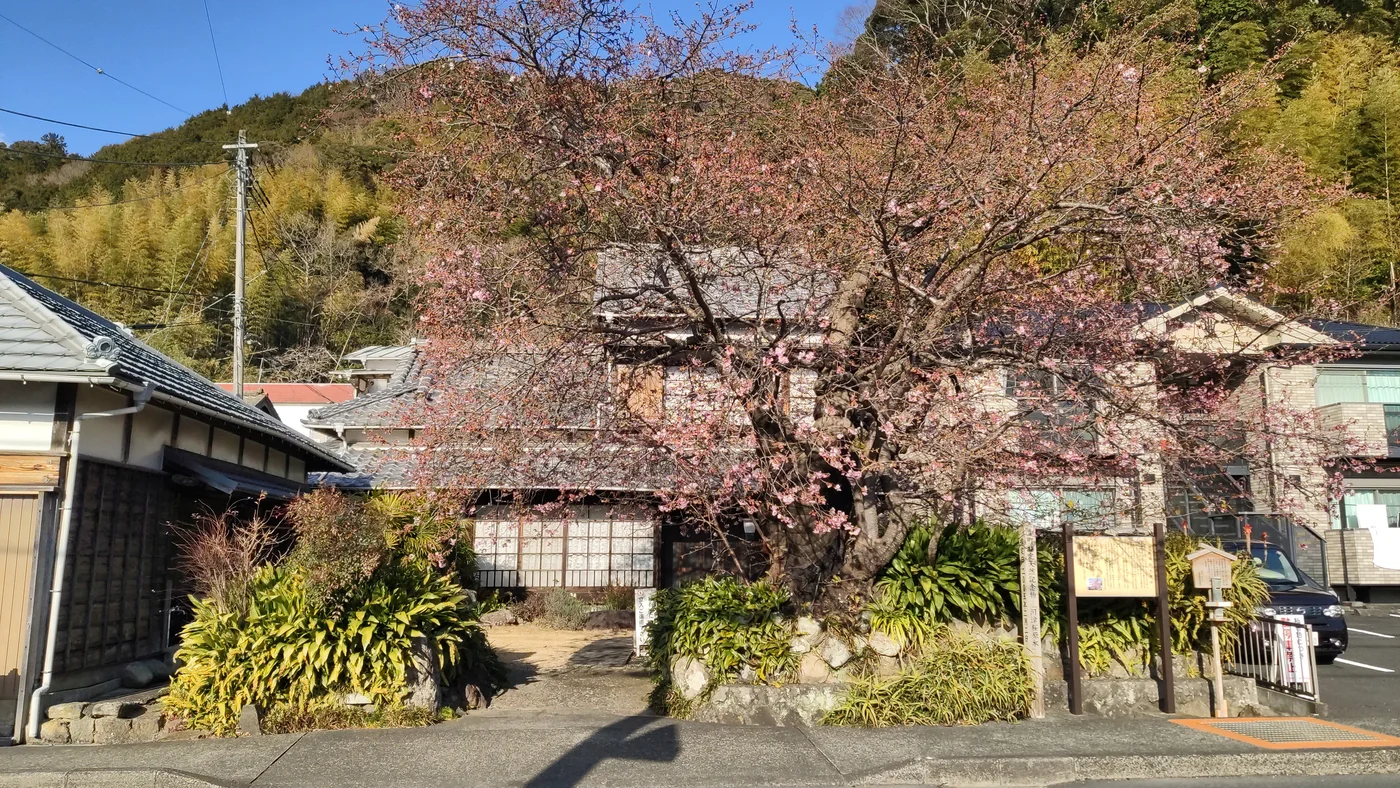
The original Kawazu cherry tree stands in the Iida family’s garden in Tanaka, Kawazu. The organiser places it about 1.2 km from Kawazu Station towards Amagi; the 2026 blossom map gives about 1.3 km. Plan a little over a kilometre each way, plus viewing, photographs and reconnection with the river. Starting at the station and cutting across from upstream are different routes. Kawazu Cherry Blossom Festival Committee: original tree and history
Read its story through two dates: discovery and flowering. Katsumi Iida found the seedling around 1955 and transplanted it to its present site. The organiser records observed flowering from 1966. Propagation and investigation followed; it was named Kawazu-zakura in 1974 and became Kawazu’s town tree in 1975. See it as a retained tree gradually propagated along the town’s river, giving it a different relationship to the planted rows.
It is in a residential garden. View from the open outer area and keep the home entrance clear. Start with the spreading canopy, then flowers within sight. Do not pull branches down or enter residential space. For group photographs, wait for the previous group to finish rather than lining everyone across the entrance for a long time.
Record this tree’s condition, but do not use one photograph to represent the whole Kawazu River. A close-up before arrival tells you about this tree. At the river, look separately at downstream and Mine Onsen conditions. Saving photographs under original tree, below Yakata Bridge, middle section and Mine Onsen makes comparison easier than one general Kawazu folder.
With half a day and a strong interest in tree history, see the original first, then a short middle or station-side section. You walk less of the avenue but understand the reason for visiting the place of origin. For long river panoramas, reverse the priority: spend daylight beside the river and add the original only if time and energy remain.
Read bloom reports by place, date, close-up and wide view
The tourism association lists about 850 trees along the Kawazu River and 8,000 across town. With that spread, first ask where a bloom photograph was taken. A full-flowered original-tree close-up, station-side river view and upstream tunnel each answer different questions. Find a search image’s location and shooting date before using it to choose a route. Kawazu Tourism Association: cultivar, usual flowering period and riverside planting
Save the organiser’s flowering-information page and the livestream linked from its official homepage. Read the publication date, then identify bridges, buildings or tree names in the image to place the section. Read any displayed livestream time as well. For a static thumbnail, find its update date rather than treating a cover outside the player as today’s trees. Kawazu Cherry Blossom Festival Committee: peak records, bloom information and visitor facilities
Close-ups show remaining buds, flower density and new leaves; wide views show continuity along the row. Ideally use both from the same day and section. Close-ups alone can turn a few good branches into an imagined uniform river; distant views alone can conceal the difference between petals and leaves. Keep one of each after arrival for a common basis of comparison.
The organiser records the 2026 peak-viewing announcement on 13 February and, on the same page, 28 February for the 35th festival. The half-month difference shows the limit of booking from one past full-bloom photograph. If dates are flexible, use recent images of the same section. With a fixed day, concentrate on the section whose flowers suit you and shorten the rest.
Look at leaves as well as full bloom
The organiser’s cultivar description says leaves unfurl after flowering and introduces Kawazu-zakura as a presumed natural cross between early-flowering Oshima and Taiwan cherry lineages. Examine a short branch: how much is tight bud, open flower or emerging leaf? This gives a clearer view of the tree’s stage than simply judging whether the whole tree is pink or green.
At 50–60% bloom, find branches still holding buds and pair them with a whole-tree photograph. With more flowers, step back for canopy and riverbank together. With clear new leaves, move closer to flowers and leaves on the same branch. Returning a few days later can record a change in their proportions.
Light affects photograph colours too. The same branch differs in front light and backlight. For comparisons across days, choose similar angles showing buds and leaves clearly rather than the strongest colour. Note the tree or bridge name when sharing with companions so you can explain which section deserves another stop.
Handle luggage, toilets and meeting points at the station
Izukyu’s Kawazu Station information lists a shop to the left after the ticket gates and coin lockers to the right. The ticket office opens 09:00–17:30. Decide on luggage storage before heading to the river. If lockers are full, use the luggage arrangement agreed with your accommodation rather than dragging a large case into the busiest branches. Izukyu: Kawazu Station facilities, services and local transport
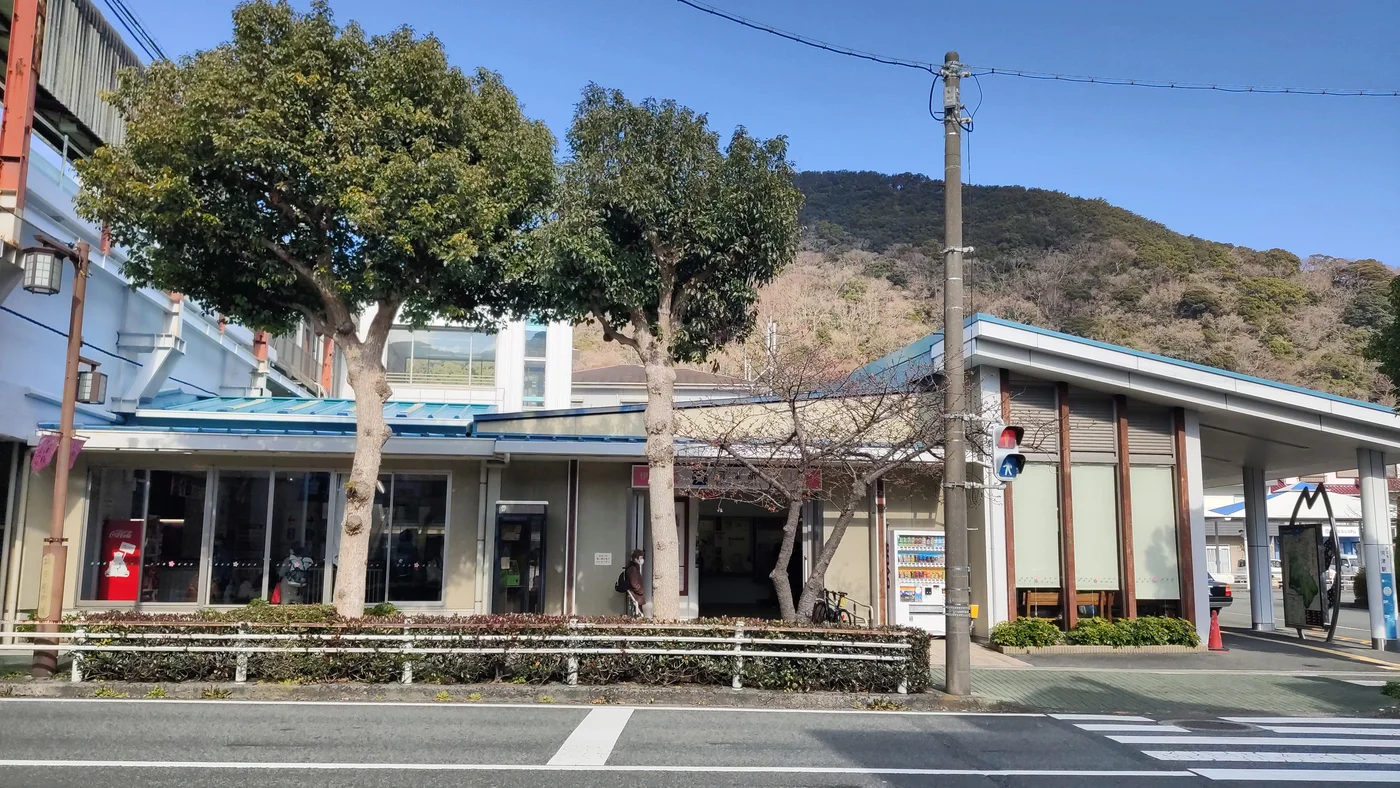
There are no steps between the station forecourt roundabout and ticket gates. Stairs and a lift connect the gates and platforms, and an accessible toilet is listed. Lift users should include vertical movement after returning in their waiting allowance. These station facilities are documented; choose riverbanks and bridges according to actual surfaces and access on arrival. A station lift does not establish a step-free river route.
With young children, use the Kawazu Sakura Tourism Exchange Hall as a midway service point. The organiser places it about ten minutes’ walk from the station, with baby-changing facilities in its multipurpose toilet. Ask the tourism association counter for breastfeeding space and staff will help arrange it. Save the location before walking, using it to divide the outing rather than searching through crowds when care is needed.
From Tokyo: a through limited express or an extra connection at Atami
The organiser gives about two hours 40 minutes from Tokyo to Kawazu on a through Odoriko. Alternatively, take Shinkansen or ordinary rail to Atami, then the Ito and Izukyu lines towards Izukyu-Shimoda. Choose according to where you start: near Tokyo Station, a through limited express may suit a one-seat journey; arriving at Atami from elsewhere, include the transfer and wait.
Set Kawazu as the destination when buying. Odoriko services operate towards both Izukyu-Shimoda and Shuzenji, so the destination, carriage and seat on your booking must match the Kawazu section. For adjacent seats, search outbound and return for the full group, choose an acceptable return first, then the morning service. If seats are separate, agree whether that is acceptable before reaching the platform.
Izukyu’s limited-express surcharge table lists ¥2,380 in advance for an ordinary reserved seat or seat-unspecified ticket from listed stations including Tokyo and Shinagawa to Kawazu, or ¥2,640 bought on board. The basic fare is additional. Both figures are surcharges, rather than the complete one-way Tokyo–Kawazu price. Izukyu: limited-express and Shinkansen surcharges
Once services are fixed, buy the basic ticket and matching limited-express ticket before departure to check the order item by item. Saphir Odoriko has different seating and pricing, and the official site states that limited-express tickets are not sold on board. For a straightforward blossom trip, establish a route using ordinary Odoriko or local trains first, then decide whether to budget extra for a sightseeing train.
Use the current timetable to understand the day’s length
This checked example is for Thursday 5 November 2026. In Izukyu’s daily southbound timetable revised on 14 March 2026, Odoriko 1 leaves Tokyo at 09:00 and departs Kawazu at 11:28. For the return, JR East’s November 2026 weekday timetable lists Odoriko 10 leaving Kawazu at 15:21 and reaching Tokyo at 17:48. The southbound table gives departure times at intermediate stations, so arrival and getting off occur slightly before 11:28.
This pair leaves about four hours in Kawazu, suitable for the station side and middle river, rather than the original tree, Mine Onsen, bathing and every stall. Meals, toilets and station waiting reduce the actual slow-walking time further. The example uses a checked autumn 2026 version. For spring 2027, select the travel date through Izukyu’s timetable page, then buy corresponding seats. Izukyu: timetables and daily and special-service versions
Staying in Ito or Izu-Kogen removes the long Tokyo return, but you still need to read each service’s direction and connections. Choose an arrival after breakfast and a return before dinner. Put saved time into Kawazu if you want upstream, rather than adding another attraction along the line. Record each transfer separately if returning via Ito or Atami instead of only noting the final arrival.
| Train | Outbound and return times | Timetable version |
|---|---|---|
| Odoriko 1, outbound | Tokyo departs 09:00; Kawazu departs 11:28 | Izukyu daily southbound table, revised 14 March 2026 |
| Odoriko 10, return | Kawazu departs 15:21; Tokyo arrives 17:48 | JR East November 2026 weekday northbound table |
A day trip: eat before deciding on another section
Practise with the roughly four-hour stay above. After arrival, handle lockers and toilets, then find the river at Yakata Bridge. If hungry, eat lunch first and return to the river. Otherwise, walk the short Yakata–Hama section before lunch. Both sequences keep the station side as a place where the walk can finish, rather than spending the first hour chasing upstream.
After eating, assess time and energy before extending towards Arakura Bridge and Sasahara Park. Stop wherever you like; Kinomiya Bridge is not a required turning point. Aim to reach the station at least half an hour before the booked train as your own waiting buffer, earlier for festival crowds or lift use. Work backwards from that target to choose when to turn rather than searching for shortcuts at the farthest point.
If station-side flowers are good, keep this short day downstream and in the middle. Original-tree enthusiasts can replace the post-lunch extension with Tanaka and add only a short river stretch on returning. Each day-trip version has a focus. Agree it with companions before departure so one person is not expecting the tunnel while another follows the road to the original tree.
Stay overnight and return to the trees in the morning
The most useful overnight plan near Kawazu is to see the same river section twice. Walk the middle or Mine Onsen side on the first afternoon, learning bridge names and the route to your accommodation. Return to the favourite section next morning for different light on flowers and water. You avoid rushing through everything on arrival and can give a better-weather interval to the outdoors.
When booking, distinguish station-side accommodation, places near the river and those needing a shuttle. Walkers should examine the actual road; shuttle users should plan around pickup points and times in the confirmation. Kawazu Station’s official information lists forecourt taxi service until 17:00. For late arrival or night transport, arrange a shuttle or booked car rather than depending on taxis waiting at the station.
For accommodation with dinner, put the meal time in first, then decide on night blossoms. Walk the return route by day if going out after dinner. To continue viewing into the evening, choose a compatible meal sitting or a room-only plan with your own dinner arrangements. The choice shapes the whole evening, beyond the price difference between dinner-and-breakfast and room-only rates.
On day two, see the original tree first, then revisit a short station-side or middle section before leaving after lunch. If leaving luggage at the accommodation, agree collection at checkout and make that the route’s endpoint before the station. After walking upstream the previous evening, you need not repeat the whole river. Quiet time with the same tree makes a practical difference from a hurried day trip.
Choose lunch with your turning point
The 2026 official blossom map marks the ground-floor ODORICO shop and the dining room and prayer room one floor above at the Tourism Exchange Hall, and Sakura Terrace Cafe on the Mine Onsen side. These locate possible eating areas. Plan lunch around shops actually open that day, then judge a queue at the door against the time you are willing to give it.
For day trips, eat before heading upstream. If companions need a seat and hot food, allow a full meal rather than relying only on stalls. For stall food, find a stable standing or seated space and finish before walking to keep the path clear.
To add bathing after lunch, remove a river section first. Before a long-distance afternoon train, eating, bathing and luggage collection are three time-consuming activities, beyond incidental rests. Overnight visitors can place one back at their accommodation. Day visitors should choose the one they most want and preserve the return walk to the station.
Kawazu Tourism Association’s introductory film about Kawazu Sakura Terrace.
Two night-blossom areas: choose one you can return from
The organiser’s 2026 events page separates illuminated tree rows below Yakata Bridge and behind Odoriko Onsen Kaikan, with named Hosen, Yakuba, Otozo, Kamikawara and Nehan trees also listed. The ends have different return conditions. For station-side stays or a train afterwards, below Yakata connects more easily to the station. Near Mine Onsen, choose the area behind the hall according to your accommodation route. Kawazu Cherry Blossom Festival Committee: 2026 events and illuminated areas
Walk the intended short night section once in daylight. Note exits from river to road, turns at bridges and accommodation signs, then use the same way back. Leave the path centre clear when photographing and put phones and cameras away before moving. After a full walking day, shorten it to one bridge and the next clear landmark instead of covering both ends again.
Treat lighting finish and train departure as separate times. Choose the dated northbound train, then subtract station entry and walking from its platform departure to determine your last river departure. Pack up then even if activities continue. If seeing the whole night scene means a very late return, an overnight stay suits the trip better than repeatedly checking connections beside the river.
Even overnight visitors should connect dinner, night walking and return to accommodation into one route. Staying nearby but crossing to the other end still adds distance. Revisiting a daytime favourite is usually easier than finding a distant named tree for the first time in darkness. Once the next event programme appears, check whether your chosen end is in its illuminated area before reserving that evening.
With children or a slower pace, use bridges as stopping points
With young children, start with the station, Yakata Bridge and Tourism Exchange Hall, extending only as the day allows. Let children watch flowers, river activity or trains on the bridge from safe stopping places. Adults wanting whole-row photographs can take turns while another waits with the children in a wider space, rather than crowding everyone beneath one tree.
Pushchair and mobility-aid users should complete station toilets and lift movements first, then choose an accessible river entrance on site. Returning on the same bank makes known slopes and surfaces easier to manage. Before crossing, inspect how the bridgehead meets the road. Accessible-toilet and parking symbols locate service points but do not provide continuous gradient data for every path. Shorten longer routes to sections companions can actually manage.
For anyone who finds standing tiring, choose photo stops where you can look and move on. Return early to an available rest point rather than making the first seat wait until after upstream. The easiest part to adjust is your turning bridge. Keep lunch and train waiting, reduce distance, and retain different early-spring views of branches, river and town streets.
With fixed leave, fewer flowers or rain, keep the original tree and a short river section
With leave already booked, make the original tree’s history, planted rows and riverside streets the fixed content, extending where flowers are better. If many station-side buds remain, inspect nearby branches, then compare a short middle section. If upstream leaves are clear, record whole trees and flowers with leaves on one branch. Change the subject of observation instead of turning the day into a rush for a full-bloom photograph.
In rain, remove the farthest extension first and choose either Yakata Bridge or the original tree as the focus. With wet paths and bridge decks and wind affecting umbrellas, take fewer photographs and put equipment away before walking. Follow closures or staff directions onto passable roads. Those with return tickets can go back to the station early; overnight visitors can save another outdoor interval for tomorrow.
Kawazu Seven Waterfalls requires a separate bus from the station; Izukyu’s station guide lists it as a bus-access attraction. If blossoms disappoint, do not append it to the river walk merely because it shares Kawazu’s name. Only make it the new main activity after checking buses, visit time and return. For an easy early-spring day, keep a short river walk and a seated lunch.
Calculate the known rail costs before rooms and meals
For one adult on ordinary Odoriko at the current advance rate, Tokyo–Kawazu return limited-express surcharges are ¥2,380 × 2, or ¥4,760, plus basic fares. Two adults’ surcharge total is ¥9,520. Put complete basic tickets, limited-express tickets and passenger numbers into the booking before comparing an Atami-transfer route to obtain the payable whole-journey total.
Within the Izukyu line, the official Odoriko reserved-seat surcharge is a flat ¥800 regardless of section, with the same price for reserved or seat-unspecified tickets and advance or on-board purchase. The advance/on-board difference from Tokyo comes from JR-line rules. Visitors already staying along Izu can compare local trains with time saved by limited express, but should not apply Tokyo’s ¥2,380 surcharge to a short Ito or Izu-Kogen journey.
Fill room and meal costs from your actual selected plans. For one extra night, compare the room, two days’ food and luggage arrangements with the benefit: night blossoms, a second look at the trees or one less rushed train.
A few useful answers
Have the 2027 Kawazu Cherry Blossom Festival dates been announced?
Page one of the 37th festival’s stall application, attached to the tourism association’s 19 October 2026 announcement, lists 6 February–7 March 2027. These are festival dates; choose blossom-viewing days using that year’s conditions by area.
How far should I walk on a first Kawazu day trip?
Start with the station-side Yakata–Hama Bridge route, then extend towards Arakura Bridge and Sasahara Park according to energy. For original-tree history, replace the middle section with Tanaka. Leave time to return to the station and wait before the booked train.
How far is the original tree from the station?
The organiser gives about 1.2 km and the 2026 map about 1.3 km, to the Iida family garden in Tanaka, Kawazu. Allow a little over a kilometre each way, plus viewing and return time.
Can I use the 2026 night-viewing times for 2027?
The organiser’s 2026 page lists 18:00–21:00 below Yakata Bridge, behind Odoriko Onsen Kaikan and at selected named trees. Use the announced hours and areas for the 2027 event, then connect them with your dated return train or accommodation.
Is ¥2,380 the full Tokyo–Kawazu Odoriko fare?
¥2,380 is the current listed advance limited-express surcharge; the basic fare is additional. Check both Tokyo–Kawazu basic and limited-express tickets when buying. Saphir Odoriko seating and prices are listed separately.
Does Kawazu Station have a lift and lockers?
Izukyu lists a lift between ticket gates and platforms, with no steps from the forecourt roundabout to the gates. Coin lockers are to the right after exiting the gates, a shop to the left, and an accessible toilet is provided. Choose the actual river route according to entrances, bridgeheads and surfaces that day.
Official information and references
Sources used in this guide.
- Kawazu Tourism Association: 37th festival stall applications and 2027 dates
- Kawazu Cherry Blossom Festival Committee: 37th stall document, 2027 dates on page 1
- Kawazu Tourism Association: cultivar, usual flowering period and riverside planting
- Kawazu Cherry Blossom Festival Committee: original tree and history
- Kawazu Cherry Blossom Festival Committee: 36th festival blossom map, 2026
- Kawazu Cherry Blossom Festival Committee: 2026 events and illuminated areas
- Kawazu Cherry Blossom Festival Committee: peak records, bloom information and visitor facilities
- Izukyu: timetables and daily and special-service versions
- Izukyu: daily southbound timetable revised on 14 March 2026
- JR East: November 2026 northbound Tokaido, Ito and Izukyu timetable
- Izukyu: limited-express and Shinkansen surcharges
- Izukyu: Kawazu Station facilities, services and local transport