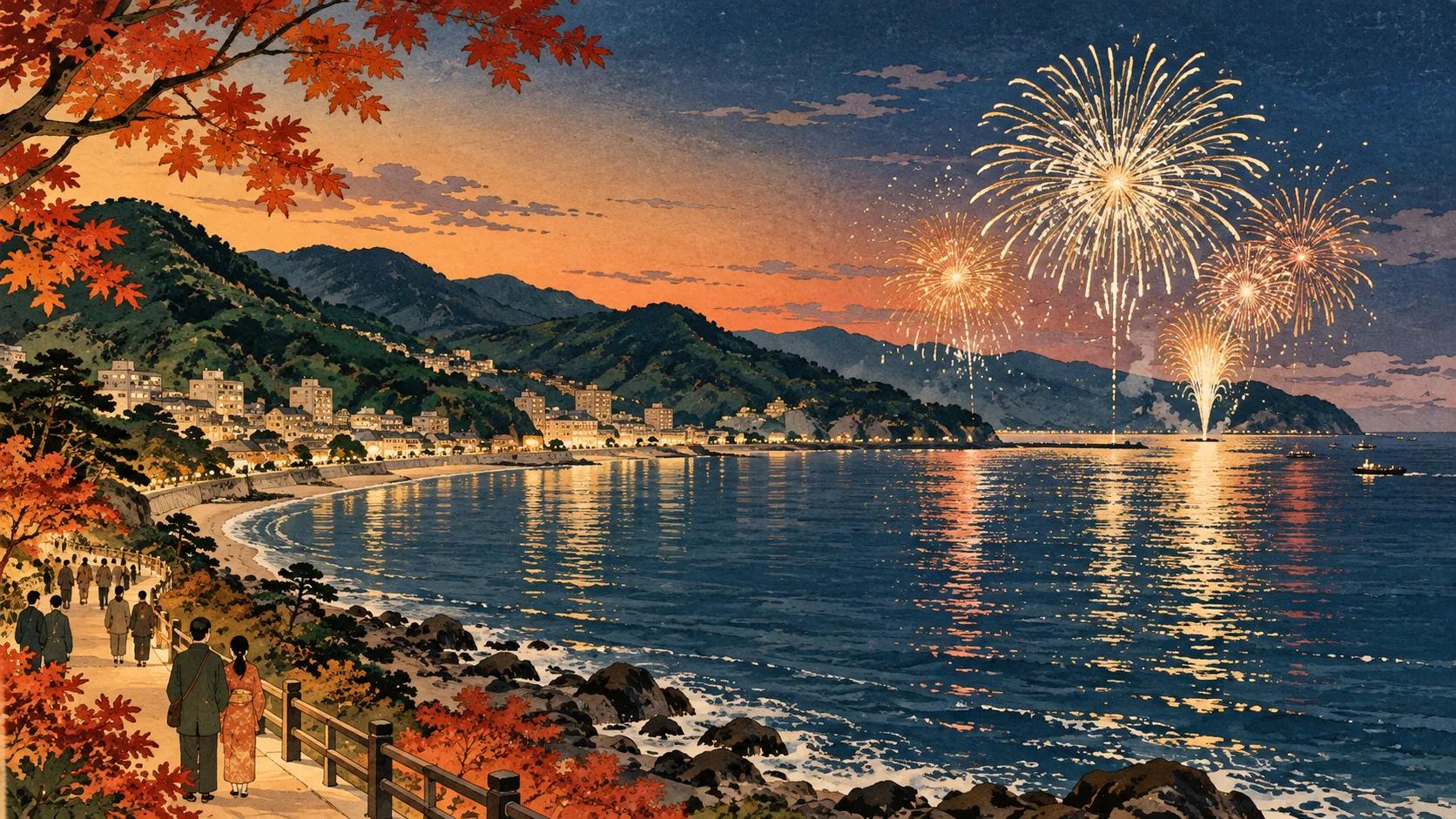
Stay in Atami for fireworks over the bay; choose Shuzenji for riverside autumn colours and Niji no Sato’s evening lights. Check the year, dinner and the journey back before choosing a room, daytime stops and transport. Two days with one night can still leave time to rest.
Two days in Izu: choose an Atami fireworks evening or Shuzenji illumination
Atami and Shuzenji both work for a short trip from Tokyo, but their evenings offer different reasons to stay. For fireworks over the sea followed by an unhurried breakfast, base yourself in Atami. For the Katsura River, autumn colours and the evening lights at Niji no Sato, stay in Shuzenji’s hot-spring district. Choose the evening you most want to keep, then book trains and a hotel. That is easier to carry out than trying to fit every “Izu attraction” into two days.
With only one night, keep one base. Consider an Atami night followed by Shuzenji only with at least two nights and companions willing to change hotels. On the moving day, reduce paid attractions and allow time for packing, connections and the ryokan’s dinner. If everyone wants something different, each person can name one priority: the shore, a hot-spring bath, autumn foliage or an art museum. Group those choices by location instead of making every day satisfy every wish.
All amounts in this guide are Japanese yen, based on official notices read on 21 October 2026. Suggested time blocks, meals and hypothetical room prices help compare choices; check actual departures, rates and event changes for your date. If you have not decided how long to spend in Japan, use the day and accommodation choices for a first Japan trip to decide how much time to give Izu before choosing a short visit or an overnight.
Atami, Shuzenji and Izu Kogen are separate places
Atami sits on the coastal side of the Izu Peninsula’s entrance. Shuzenji’s hot-spring district needs ground transport after Shuzenji Station, while Mount Omuro belongs to the Ito and Izu Kogen area. All three names appear in Izu travel searches, but they are not one walkable neighbourhood. When choosing accommodation, put the hotel address, first attraction and next day’s departure station on a map. Staying somewhere labelled “Izu” does not make all addresses equally useful.
Watching Atami fireworks and then travelling to a Shuzenji hotel adds dispersing crowds, train connections and a final bus or taxi to the same night. Returning to Tokyo after Niji no Sato’s lights creates a similar problem. If the evening event is the main purpose, prioritise a base with a clear way back to your room. Before choosing a cheaper room, compare the additional fares and how late you are willing to arrive.
Give Omuro a separate Izu Kogen day, connecting by bus from Ito or Izu Kogen. The chairlift operator’s two bus departure stations show that the mountain is outside an urban walk around Atami Bay. With two days and no car, first choose between Atami and Shuzenji. If the mountain matters more, reduce the town stops; Omuro is not a casual ten-minute detour while waiting for fireworks.
| Base | Activities to keep | Conditions to settle first |
|---|---|---|
| Atami | Bay walks, sea fireworks, an art museum or a shrine | Event date, room view, dispersing crowds and return journey |
| Shuzenji Onsen district | Katsura River, temple courtyard, maple foliage and evening lights | Opening dates, dinner and the return from Niji no Sato |
| Ito / Izu Kogen | Outdoor activities such as Mount Omuro | Bus connections, chairlift operation and maintenance dates |
Tokyo to Atami: fit the ticket around the rest of your journey
For Atami, start with the rail and transport operators collected by the tourist association. Near Tokyo or Shinagawa stations, compare shinkansen and conventional rail; from another neighbourhood, include the connection to the departure station. Compare the whole journey from your hotel door to the destination. The fastest train’s onboard time is not the complete transfer.
On a fireworks date, first decide whether to stay in Atami or return to Tokyo. For a same-night return, allow for leaving the crowd, walking, station controls, entry and finding the platform before choosing a train. Reserved-seat bookings particularly need their change conditions checked. A small morning fare saving may not cover missing an already purchased evening train. Do not promise your companions a particular departure before looking at the actual timetable.
If the trip also includes Hakone, Kyoto or other long-distance travel, list the full route before researching passes. The method for comparing Japan rail tickets journey by journey helps price the trains you will use; one shinkansen ride does not automatically justify a nationwide pass. Check a child’s school stage, whether they occupy a seat and the ticket type separately, without copying another operator’s age rules.
Getting to Shuzenji: the Mishima connection does not end at your ryokan
Shuzenji’s tourist association rail directions describe changing at Mishima to the Izu Hakone Railway: approximately 32 minutes to the terminus at Shuzenji Station, then about ten minutes by bus towards Shuzenji Onsen, or about ten minutes by taxi. These are estimates for individual vehicle journeys, without waiting, transfers, station exits or finding the hotel. Save “Shuzenji Station” and “Shuzenji Onsen” separately to avoid misreading accommodation walking distances.
Reaching Mishima from Tokyo, Kansai or elsewhere still requires checking the connection. Adding two ride times does not guarantee handing over your bags a fixed number of minutes after leaving the shinkansen. With large cases, ask whether the hotel accepts bags before check-in, then deliver them first. If arriving in the afternoon, keep the Katsura River and dinner for that day. Add Niji no Sato only according to the return arrangements that evening.
The association also links a service delivering bags from Shuzenji Station to hotels. Before using it, follow the official same-day luggage delivery directions to check your hotel’s eligibility, acceptance hours, number of pieces and handover arrangements. A service name on a page does not mean you can check bags at any time. If it does not fit, keep the hotel-first route instead of climbing slopes with all your luggage to find photo spots.
Atami local transport: remove the sightseeing loop that remains suspended
Older guides often make Yu-Yu Bus a fixed Atami day-trip loop, but Tokai Bus’s current operating page states that all departures have been temporarily suspended since 11 October 2025. The old route, single fare and some discounts remain on the page without proving a service is running. For 2026, check regular buses or taxis and look for a new notice before travelling.
Keep the day within neighbouring areas: station and centre, the bay, or one hillside attraction followed by the shore. Where there are climbs and descents, choose a suitable regular bus instead of requiring everyone to walk because the straight-line distance looks short. Izusan Shrine, MOA Museum of Art and Kinomiya Shrine are also separate walks. To visit all three, reduce waterfront time rather than deleting lunch, bus waits and rest.
Hotel shuttles and public buses are different services. Atami Korakuen’s current accommodation answers describe a shuttle between Atami Station and the hotel without a reservation requirement. Use the hotel access page for actual times; this does not establish late service after fireworks crowds disperse. Ask other properties individually rather than extending one hotel’s arrangements to all of Atami.
An Atami bus day pass needs a route-by-route calculation
Tokai Bus’s current page lists the conventional Atami One-Day Ticket at ¥950 for adults and ¥480 for children, or ¥850/¥430 digitally through EMot. It covers Tokai Bus routes within the specified map area, excluding other operators, routes outside it, regular sightseeing buses and specially contracted routes, among other exceptions. Compare the pass prices and excluded services with your three or four actual rides. Atami in the name does not make it a universal city pass.
The calculation can be simple. Suppose an adult has checked two eligible journeys at ¥300 each: ¥600 separately, or ¥250 less than the ¥850 digital pass. If another journey you genuinely need brings the total to ¥1,050, the ¥850 pass saves ¥200. These are hypothetical single-fare examples rather than actual local prices. Replace them with fares checked for your travel date, including the eligible route and product version.
Before buying digitally, read the phone, activation, display and refund requirements. Everyone needs to know how to show their ticket if a battery dies or the group separates. Without useful rides, do not make detours just to recover the pass price. While the sightseeing loop is suspended, compare the regular routes still operating. Its old ¥350 single fare is not today’s uniform price for every urban bus.
Atami fireworks 2026: remaining dates and the winter night in 2027
The Atami Marine Fireworks Festival is not only a summer event. After 21 October 2026, the current official annual timetable still lists 25 October, 8 and 23 November, and 6 and 25 December. The same 2026 programme also includes 21 February 2027. When booking winter travel, write the calendar year too: placement in a 2026 table does not turn that night into February 2026.
The usual planned time is 20:20–20:40, changing to 20:15–20:40 in July and August. The organiser says the event goes ahead in rain but also allows changes to dates and times. That is not a promise to operate in every storm or wind condition. Check the schedule before the event and current notices on the day. Read hotel cancellation terms before booking rather than leaving both checks until rain begins.
Other Atami-area fireworks take place in Izusan, Taga and Ajiro, with different locations and times. If you book by Atami Bay, confirm that you mean the “Atami Marine Fireworks Festival”; another event on the same day does not guarantee a display outside your window. Save the city’s calendar page with the main event page. Reopening the originals near departure is more reliable than reusing an old social media graphic.
The 2027 Atami fireworks programme is published, with winter dates in 2028
The official main page announced the 2027 programme on 19 October 2026, so it should no longer be called “not yet announced.” Spring dates in 2027 are 18 and 29 April, 23 May and 6 June; summer dates are 19 and 25 July and 5, 15, 18 and 24 August. Check the original 2027 Atami fireworks table, particularly before moving the August dates from 2026 directly into the following year.
Autumn dates are 20 September, 3 and 24 October and 7 November 2027. Winter lists 5 and 19 December, followed by 10 January and 13 February 2028. The two dates after New Year still belong to the 2027 programme’s winter section. Before buying a non-refundable international flight, check the calendar year and that your hotel night matches the event night, then decide whether you accept losses if the event changes.
Published dates do not establish that 2027 viewing eligibility, guest areas and ticket arrangements all follow 2026 rules. Use the dates to find an acceptable accommodation range first, then wait for that year’s arrangements. Below, the absence of general paid seats and the summer guest area are explicitly 2026 conditions. If a new product appears, follow its official description rather than treating a currently nonexistent ticket as already purchasable.
| Season | Calendar year | Planned dates |
|---|---|---|
| Spring | 2027 | 18 and 29 April; 23 May; 6 June |
| Summer | 2027 | 19 and 25 July; 5, 15, 18 and 24 August |
| Autumn | 2027 | 20 September; 3 and 24 October; 7 November |
| Winter | 2027 / 2028 | 5 and 19 December 2027; 10 January and 13 February 2028 |
Fireworks tickets and hotel guest areas: keep the 2026 conditions separate
When searching for Atami fireworks tickets, begin with the official 9 May 2026 update: no general paid viewing seats will be provided that year. Previous reserved-seat prices, resale links or claims that “everyone needs a ticket” should not be carried into 2026. The current paid-seat and hotel-guest conditions are listed separately on the same page; do not extract just one heading.
In July and August 2026, guests staying at establishments belonging to the specified hotel and ryokan association have a separate viewing space. Entry opens at 19:00 and requires the picnic mat supplied by the property. Summer, membership and actual lodging are all conditions; any hotel in Atami in any month does not confer a “VIP area.” If a property markets a fireworks plan, ask whether it means viewing from the room, access to an event area or simply staying on that night.
Free coastal viewing also does not mean sitting anywhere. Advance place-holding is prohibited in Shinsui Park’s first sector, and abandoned mats may be removed. Moon Terrace closes during the display, and the launch vicinity is restricted from noon that day. With children or older companions, choose somewhere permitted that keeps the passage open. If the front is packed, move back to a position with a manageable exit rather than making one spot determine the trip’s success.
Choose the viewing position and exit together before dark
Official directions identify the coast from Atami Sun Beach to Atami Port for viewing. Walking from Atami Station takes roughly fifteen minutes to Sun Beach or twenty to Shinsui Park’s first sector. These are normal arrival estimates; crowds and the uphill return need extra time. Read the viewing areas, closures and links to dispersal maps during daylight, then adapt to staff instructions on site.
Arrange dinner, bathrooms and a meeting place before the display. Do not spend the whole gap looking for the best camera angle. Agree on a recognisable meeting point that does not block passage, and save useful photos, the hotel address and contacts offline. Keep tripods out of pedestrian routes. With a pushchair, plan how to get out of the crowd before deciding merely whether it can stand at your viewing position.
The organiser warns of busy Atami Station gates around 21:00–22:00 after fireworks and recommends buying the return ticket or topping up an IC card beforehand. Travellers heading towards Ito and Shimoda receive separate directions to use Kinomiya Station. That does not permit arbitrary changes of operator or avoid necessary fare adjustments. Follow your destination, valid ticket and crowd controls; overnight guests should not assume an immediate short-distance taxi will be available either.
Fireworks with children or a wheelchair: reduce standing time and sound exposure
The mountains around Atami Bay reflect the fireworks’ sound. Some visitors enjoy the impact, while infants and people sensitive to noise may find it uncomfortable. On a first family visit, put distance, warmth, bathrooms and an exit available at any time ahead of photography. Returning to the room when a child tires does not make the trip a failure. There is no need to make everyone stay for the final sequence and then leave with the dispersing crowds.
The official page identifies wheelchair viewing space in Shinsui Park’s first sector, towards Sun Beach and in front of Jonathan’s. The wheelchair viewing-location description is a starting point for questions. Check the approach, companion numbers and that day’s arrangements; it does not promise a slope-free journey, full accessibility or a place. Ask the hotel about its entrance, lift and bathroom too, rather than relying on a photo containing a lift.
To reduce movement through crowds, research a room specifically stating fireworks views rather than choosing any sea-view category. Window direction, balcony use and possible obstructions that evening need confirmation for the actual room product. Indoors does not automatically mean complete sound insulation for noise-sensitive visitors. Explain your needs before booking and retain an acceptable alternative of simply enjoying the hot-spring stay without watching fireworks.
An event going ahead in rain does not cancel your hotel terms
“Rain or shine” means a rainy forecast alone does not establish cancellation. It also does not let a traveller cancel accommodation free because they prefer not to get wet. At booking, read your plan’s deadline, prepayment and cancellation charge, then consider whether you accept changing weather. Decide between a cheaper restrictive rate and a more flexible one before the rain clouds arrive.
For example, Atami Korakuen’s current Japanese FAQ gives general cancellation charges of 20% seven to six days before the stay, 30% five to three days before, 50% two days before arrival or on the preceding day, and 100% on the day or for a no-show without notice. Particular plans and agencies may differ. The hotel’s current Japanese cancellation clauses are a better reference than older online summaries, but the final check is your own booking confirmation.
In poor weather, choose an art museum according to its calendar, return to the room earlier or shorten the shore walk. Replacing every outdoor stop with another, more distant mountain does not necessarily improve the day. For refunds or train changes, contact the original seller of each transport and accommodation booking. An event cancellation, suspended transport and a personal change of mind have different procedures; no guide can promise every operator will waive fees.
Atami in one day: one hillside attraction and a stretch of bay
For a first Atami day trip, arrive in the morning and choose either MOA Museum of Art or Kinomiya Shrine, eat lunch in town and reach the shore in the afternoon. This keeps both hillside and coastline while remaining easy to shorten for weather. If browsing and meals are all you want, remove the hillside stop and leave the afternoon for the water and departure. Completing one entire attraction list is not a requirement for having visited.
On a fireworks day with a same-night return, decide dinner earlier than usual: a reserved seated meal, or eating early before walking to the venue. Check opening hours, queues and where takeaway food may be eaten separately. The hour before the show does not guarantee finding a restaurant, waiting, eating and securing a suitable viewing position. Families with children who get hungry quickly should set a seated meal first, then decide how far to walk at dusk.
Winter darkness comes earlier, so place the outdoor section in daylight and keep the evening according to the fireworks date. In summer, alternate shade, water and indoor rests. On an ordinary date, do not wait late for a display that is not taking place. Check the event day before deciding on a late Tokyo return. You may need only a seaside afternoon, rather than a complete morning-to-night sightseeing package.
An Atami overnight: keep dinner and the next breakfast in one base
For two days and one night, arrive in the afternoon, leave bags, walk along the coast or visit one nearby place, then check in and eat before returning to the same accommodation after fireworks. After breakfast, choose a shrine or museum and leave in the afternoon. This is a planning sequence rather than a timetable guarantee. If a ryokan’s dinner-and-breakfast plan has a latest dinner arrival, fit the afternoon around it; do not discover a missed prepaid meal just before leaving for the show.
The second day’s main activity can also remain blank, allowing baths, packing and an easy breakfast. To continue to Shuzenji, check the complete sequence from leaving the hotel to Mishima, the connecting train and bus. Keep only a section of the hot-spring district after arrival. With children, frequent hotel changes cost packing and waiting time as well as the difference between room rates; write that time into the comparison.
For Atami accommodation areas, the station side emphasises arrival and departure, while the bay side emphasises the shore after dinner. Both need an actual address, slopes and shuttle arrangements checked. Travellers taking bags onward should settle checkout and storage first. On a one-night trip, removing one bag-collection detour usually helps more than adding three shops you do not currently intend to visit.
Atami in rain: check MOA’s closure days before calculating the transfer
MOA Museum of Art’s current visitor information lists 9:30–16:30, with last admission 16:00, closed Thursdays and for exhibition changes; holiday Thursdays follow the official calendar. General individual admission is ¥2,000; high-school and university students pay ¥1,400, and junior-high students and younger enter free. The discounted student categories require proof. Several older discounts have ended, so a years-old discount chart should not be used as today’s price list.
From Atami Station bus stop 8, take the bus bound for MOA Museum of Art. The museum lists approximately seven minutes and a one-way fare of ¥200 for adults or ¥100 for children; check departures and traffic separately. Two general adult admissions plus buses both ways cost 2 × 2,000 + 4 × 200 = ¥4,800, excluding meals and other journeys. If an eligible transport pass already covers the ride, do not count the same fare twice, and still verify the route.
A rainy-day museum visit moves part of the activity indoors without making the whole approach rainproof. To see a particular work, check the current exhibition: an important collection piece is not necessarily on display every day of the year. If a companion merely wants a short seated rest, choose a nearby business with verified hours rather than buying an exhibition they do not want just to avoid rain.
Kinomiya Shrine: use the closest station and keep legends in their cultural context
Kinomiya Station on the JR Ito Line is the shrine’s nearest station. The shrine’s own access page gives approximately 400 metres and five minutes on foot from Kinomiya, or 1.6 kilometres and eighteen minutes from Atami Station. These are official estimates, with extra time needed for young children, older companions and luggage. If the main activity remains by the water, choose suitable arrival and departure stations instead of returning to Atami just to preserve one starting point.
The current access page lists 9:00–17:00, with prayer reception ending at 16:30. Belief in the great camphor tree, walking around it with a wish and longevity legends provide cultural context; they should not become promises of healing, a longer life or fulfilled wishes. Follow photography rules and leave worshippers’ paths clear. For amulets or goshuin, check the specific service rather than assuming grounds opening hours apply to every counter.
The shrine also has an entrance notice for wheelchair users during construction, asking visitors to use the main front torii and follow staff instructions when getting into or out of a vehicle. That makes advance access questions necessary. A station only a few minutes away does not establish convenience for every mobility aid. If climbing or transferring is difficult, ask what assistance is available before keeping this stop.
Izusan Shrine’s 837 steps do not start at the bus stop
Izusan Shrine suits visitors willing to climb stairs and give the visit its own time. Atami’s official attraction description explains that 837 is the total from Izusan-hama near Hashiriyu to the main shrine. From the municipal road containing Izusan Jinja-mae bus stop, it is about 200 steps; from National Route 135, around 600. Calling 837 the climb immediately after the bus would mislead a reader assessing the effort.
Official directions give roughly ten minutes by bus from Atami Station towards Nanao, alighting at Izusan Jinja-mae, with walking and steps afterward. The Hongusha requires another approximately one-hour mountain route from the main shrine through other shrines. That is a separate activity rather than a casual five-minute addition. Wear suitable shoes and consider weather and daylight before choosing where to turn back.
If the same day also has fireworks, a ryokan dinner or a reserved train, keep the main shrine area. A companion with knee discomfort can choose a shorter activity. Whether this shrine suits the party matters more than how impressive its staircase looks in a photograph. Do not combine worship, a mountain walk and evening crowds, then blame the visitor’s fitness when the full plan cannot be completed.
Shuzenji autumn foliage: separate the usual season from current leaf conditions
Shuzenji does not turn red everywhere at once. The tourist association’s general range is mid-November to early December for the maple grove, Niji no Sato and Shuzenji Temple, and mid-November to mid-December for the hot-spring district. Detailed descriptions also note that the temple grounds can colour later. The foliage locations and past condition reports help identify the season, without forecasting an entirely red landscape on a particular 2026 date.
When searching for Shuzenji autumn foliage now, check the latest report’s actual publication date, photographed location and year. A 2024 or 2025 image in search results is not this year’s current condition. If holiday dates are fixed, plan the hot-spring streets, temple and announced illuminations separately. Before peak colour, walking and bathing can still work. Accepting only completely red hills means accepting that natural conditions and weather cannot be guaranteed.
The association embeds an official video titled as a 2020 foliage retrospective. It shows a pedestrian bridge, a temple building and autumn colours; it cannot establish this year’s current peak. Separate daytime walking areas from a park requiring another evening ticket. To photograph a particular bridge, check where stopping is permitted rather than blocking residents’ daily passage.
Walk the Katsura River, bamboo path and temple in daylight
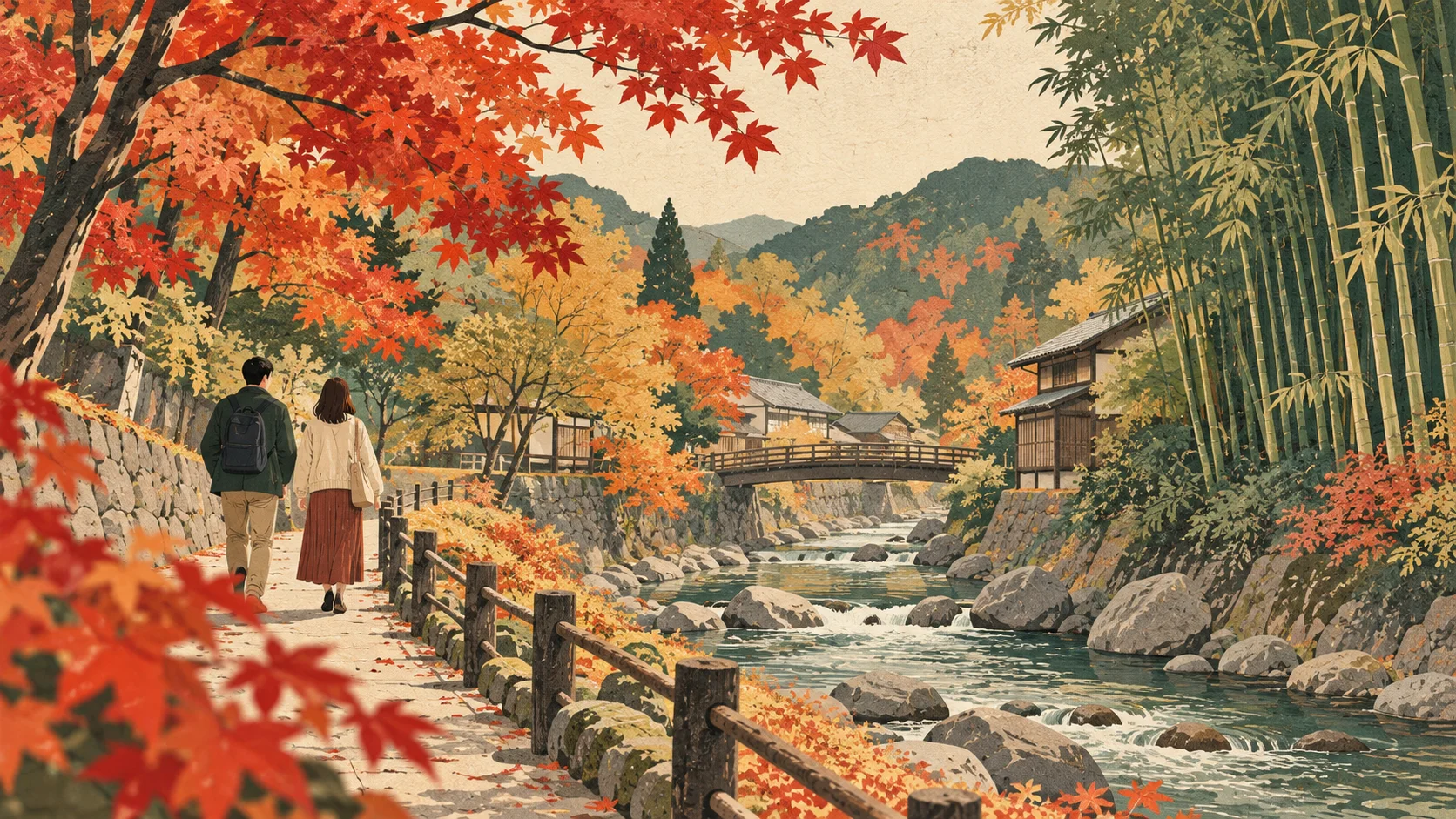
For a first Shuzenji visit, connect the temple, both sides of the Katsura, Katsurabashi and Kaedebashi bridges and the bamboo path into a walk you can shorten. These places appear in the association’s autumn walking guide. Start from your hotel or actual arrival point and adjust to the party’s energy instead of insisting on a minute-by-minute loop. In narrow spaces, let people pass and move on after taking a photograph.
Morning and afternoon walks can serve different purposes. Overnight guests can keep a short riverside section for early morning or after breakfast; later arrivals can visit the temple and bamboo grove before returning to the hotel. The maple grove and Niji no Sato need separate transport and admission arrangements. Sharing the Shuzenji name does not erase distances, and finishing the hot-spring streets does not mean visiting every foliage location.
A ryokan plan with dinner and breakfast reduces evening restaurant travel, but check the meals, latest arrival for dinner and ingredient restrictions. If you prefer eating out, find open options first rather than imagining a big city with late-night restaurants everywhere. When shopping for gifts, leave time for returning and checkout. Visiting every shop is not worth missing a booked dinner or evening transport.
Shuzenji Temple’s courtyard garden has a limited 2026 opening
The place and temple are both commonly written Shuzenji in Roman letters, but their Japanese characters differ. The 2026 autumn announcement lists the Hojo garden’s special opening from 20 to 30 November, 9:00–16:00, with a ¥200 viewing fee. The official annual courtyard-opening information concerns this special opening, rather than one year-round timetable and price for every part of the temple.
If the courtyard is a priority, your trip must take place within the opening period and the visit must happen during the day. Do not expect to return after Niji no Sato closes at 21:00 and see the garden. Arriving beyond the visiting time means a short walk around the temple instead, with the garden for another day. Two adult entries cost 2 × 200 = ¥400, still excluding Niji no Sato and other parks.
Temple activities and neighbourhood events may have different dates. Fix the paid visit requiring daylight first, then arrange lunch and bathing. Follow any local rules for photography, shoes or interiors. Foliage season does not mean permission to enter every door. If the dates do not work, choose the river and bamboo grove without describing an unopened courtyard as a guaranteed completed stop.
Niji no Sato daytime admission and night illumination are separate plans
Normal daytime admission at Niji no Sato is ¥1,220 for adults, defined as junior-high students and older, or ¥610 from age four through Japanese primary school. Typical hours are 10:00–16:00 October–February and 10:00–17:00 March–September, with last admission an hour before closing. Read the park’s daytime admission and operating information with the actual calendar rather than applying normal hours to every day or evening event.
The daytime park and evening lights give different reasons to stay. For both, first check whether separate admission, clearing the grounds and reentry rules apply, then choose dinner during the interval. This guide does not treat a day ticket as including the night. With children, staying the entire day through evening can be too long: choose one period, or visit the hot-spring district and the park on different days.
The park’s general FAQ suggests about one and a half to two hours for a visit. That does not mean every family can cover every area, ride attractions, eat and take night photographs within two hours. Pushchairs and wheelchairs may encounter difficult or prohibited sections, and rented equipment is limited. The notes on mobility aids, nursing spaces and natural terrain help you ask in advance without replacing a companion’s actual needs.
Niji no Sato illumination 2026: ordinary nights and three fireworks nights
The 2026 autumn illumination announcement gives 7 November–13 December, 17:00–21:00. Outside fireworks nights, admission is ¥2,600 for adults or ¥1,500 for children, sold only as a package combining foliage illumination and Illumi the Night. Fireworks dates are 14, 22 and 28 November, planned for 19:30. The package with foliage, illumination and fireworks costs ¥3,300/¥2,200. Check your date against the park’s current-year evening ticket announcement.
Two adults on an ordinary night pay 2 × 2,600 = ¥5,200; on a fireworks night, 2 × 3,300 = ¥6,600, a ¥1,400 difference. This compares tickets only, without transport, dinner or daytime admission. The evening notice labels adults and children, but check the actual product’s age and entry conditions before purchasing. Do not substitute daytime fees or another attraction’s child definitions.
The park also lists a night Romney Bus between the illumination and foliage areas, ¥300 for adults and free for children; visitors with a physical disability ride free with the required proof. This is internal movement, not a return shuttle to Shuzenji Station. The park also asks photographers not to occupy photo positions for long periods. Keep the sections the group can manage rather than leaving companions standing outside on a cold night while you wait for an empty scene.
After the lights, settle the last journey back to accommodation first
Niji no Sato’s official access page gives Shuzenji Station south exit bus stop 3 and roughly twenty minutes on Tokai Bus towards the park. That is an arrival estimate rather than evidence of the same departures after 21:00. Before an evening visit, check special services on that event date, the last bus and the return stop. Daytime arrival instructions cannot simply be reversed into a late-night guarantee.
For a taxi return, ask about reservations, meeting points, an estimate and waiting arrangements. If the hotel offers a specific shuttle, confirm that it serves that date and event. The association has mentioned event transport and benefits for guests, but without checking the current year’s terms, do not count a free return for everybody. Without confirmed transport, shorten the evening or use an affordable journey arranged in advance.
Dinner must fit too. If you enter at 17:00 and return after 21:00 to a ryokan with dinner included, you may miss the meal. At booking, explain the illumination plan and ask about earlier dinner, a breakfast-only plan or an outside restaurant with confirmed hours. “Dinner included” does not mean reopening a kitchen whenever you arrive. Otherwise, buying the evening ticket may mean giving up a meal already paid for.
Two days in Shuzenji: give the garden, streets and evening their own places
Arrive at Shuzenji Station around noon, leave luggage, visit the temple and walk along the Katsura in the afternoon, choose the courtyard within its opening dates, and visit Niji no Sato if dinner and transport permit. After breakfast, take another short bamboo walk and leave around midday. If companions do not want to go out at night, choose the daytime park and leave the first evening entirely for the ryokan. Both versions work; the difference is how much movement and waiting you accept for night scenery.
To combine the courtyard with evening fireworks, compare its 20–30 November opening with the 22 and 28 November fireworks dates. This is just the overlap of two announcements, without promising rooms, clear roads or perfect foliage. After choosing dates, settle accommodation and dinner time before deciding whether the fireworks-night package is needed. Buying both evening ticket types at once is unnecessary.
If only weekdays work, ordinary illumination may be enough. With poor weather, retain a short daytime district walk and time in the room. Continuing to Atami on day two means reducing activities after arrival to the shore or one museum rather than adding Omuro. A two-day Izu trip often loses time moving bags between bases, while assuming a full day of activities will still fit into each afternoon.
An Atami fireworks hotel: even Korakuen’s room categories differ
Atami Korakuen Hotel is a named example for researching sea-view accommodation. AQUA SQUARE’s official room categories list Ocean View at 40 m² for two to four guests, with a multifunction shower and no bathtub. Courtyard is 24 m² for one or two, also shower-only and without a sea view. For a sea or fireworks view from the room, do not book on hotel name alone: confirm the full category.
The hotel FAQ says Tower Wing rooms see the fireworks, while AQUA SQUARE’s Ocean View and Universal balconies do; Courtyard does not. These distinctions between the hotel’s room categories still need checking against your booking. The room-view, meal and private-bathroom answers also say the room bathwater is not hot-spring water. A “hot-spring hotel” does not make every private bathtub thermal.
For Ocean Spa Fuua, first check whether your plan includes entry. The room page lists one visit per person per night for individual reservations, from age four, excluding groups and some plans; read the operator’s further conditions. A benefit does not make all hotel facilities continuously available. Separate fireworks visibility, private bathroom, public baths and child eligibility to understand what a higher room price actually buys.
Private bathing in Shuzenji: read Katsuragawa’s rules down to the room category
Yumeguri no Yado Shuzenji Onsen Katsuragawa’s official bathing and accommodation FAQ lists seven free private baths. They are for overnight guests only, with no reservation required: use one when vacant, for a suggested thirty minutes or so. This can suit travellers wanting private space in turns, without promising a bath immediately on arrival or reserving one exclusively for the whole evening.
Room choices include Japanese rooms of ten tatami for two to four and fourteen tatami for three to five, Western doubles, twins and triples, business rooms and Japanese rooms with an open-air bath. Katsuragawa’s named room and child conditions require children in ordinary Western rooms to be at least three. Business twins also require age three or above, and there are no bed guards. The in-room open-air bathwater is not thermal. With a toddler or an interest in a private hot spring, do not book just on the words “open air.”
The hotel has no Shuzenji Station shuttle. Its FAQ suggests a bus to Miyukibashi and a two- to three-minute walk; the hotel access page lists the approaches too. General cancellation charges are 10% seven to five days before, 20% four to three days before, 50% two to one day before, 80% on the day with notice and 100% for a no-show. Plans and groups have other conditions. Compare those with prices rather than applying the Atami hotel’s cancellation table.
Family reservations: separate eligibility, beds, food and bath access
Photos of family attractions or recommended Atami hotels do not replace age and room restrictions. Ask which room accepts the child, whether they occupy a bed, how meals are charged and whether the bath you want admits that age. Katsuragawa’s age-three rule for Western and some business rooms belongs to those categories. Fuua’s age-four rule does not mean the whole Atami Korakuen hotel refuses younger children.
Atami Korakuen’s current FAQ lists ages zero to one free; ages two to three without another bed pay a facility charge. At most two bed-sharing children aged zero to three are permitted per room, subject to capacity, with possible plan and channel differences. Read the hotel’s child fees and bed-sharing conditions with your actual order. “Children free” does not waive every age, meal and bed cost, and a member rate does not promise the same price to everybody.
Give the family a manageable set of priorities: a short daytime walk, afternoon rest and only part of the evening lights or fireworks. Decide where a pushchair can stand, when to fold it, and how nappies and spare clothes fit. If a child does not want the public bath, a private shower and rest in the room can still make for a comfortable stay. Using every facility should not leave everybody without a break.
Accommodation tax, bathing tax and different bases need separate calculations
Atami’s current accommodation-tax summary lists ¥200 per person per night from 1 April 2025, exempting primary-school pupils and younger, qualifying school stays and other eligible categories. Two taxable adults for one night pay 2 × 200 = ¥400, or ¥800 for two nights. This is Atami City’s system, not automatically Shuzenji’s because both are in Izu. Charging for a child’s accommodation does not establish that this tax also applies.
The order may include or separately charge bathing tax, meals, parking and other costs. Write down the tax-inclusive room total, mandatory local payments and optional extras before calculating per person. Do not compare one platform’s small-print tax-exclusive rate with another property’s total including meals and taxes. For a prepaid reservation, still check how much remains payable on arrival.
List adults and children separately in the family budget: transport, attractions, shared beds and food may define categories differently. An accommodation-tax exemption through primary school does not mean every admission or room is free. If an order differs from a general official rule, ask the seller and hotel and keep the itemisation. Do not turn an unexplained difference into a city’s supposedly fixed extra charge.
A two-adult budget: separate hypothetical rooms from checkable costs
Suppose an Atami double costs ¥30,000 with breakfast, excluding accommodation tax, and both adults are taxable. Add the earlier ¥4,800 for general MOA admission and station buses both ways, a ¥6,000 dinner allowance and ¥3,000 lunch: 30,000 + 400 + 4,800 + 6,000 + 3,000 = ¥44,200. Room and meal amounts are your planning assumptions, not hotel quotations. Tokyo round-trip travel and other transport are still excluded.
For Shuzenji, suppose a ¥36,000 double includes two meals. Add two ordinary Niji no Sato night tickets at ¥5,200, courtyard entry ¥400, lunch ¥3,000 and local transport allowance ¥4,000: 36,000 + 5,200 + 400 + 3,000 + 4,000 = ¥48,600. The ¥4,000 is a hypothetical allowance rather than a guaranteed taxi-inclusive pass, and actual unlisted taxes must still be added. Changing to fireworks-night tickets increases this example by ¥1,400 to ¥50,000.
These examples do not establish which base is cheaper in the market, because room, meals and transport needs differ. They let you replace numbers and see what changes with one fewer paid museum, another taxi or a room without dinner. To reduce the budget, remove unimportant activities first, then adjust accommodation dates or category. Keep return transport and mandatory charges in the calculation: omitting them does not reduce actual spending.
| Choice | Assumed room and meal costs | Listed total |
|---|---|---|
| Atami + MOA | Double room with breakfast ¥30,000; dinner ¥6,000; lunch ¥3,000 | ¥44,200, including ¥400 accommodation tax and ¥4,800 for MOA and buses |
| Shuzenji + ordinary illumination evening | Room with dinner and breakfast ¥36,000; lunch ¥3,000; local transport allowance ¥4,000 | ¥48,600, including ¥5,200 evening tickets and ¥400 courtyard admission |
| Shuzenji + fireworks evening | Same assumptions as above, replacing the evening tickets with the ¥6,600 fireworks package | ¥50,000, an increase of ¥1,400 over the ordinary evening |
Give Omuro a separate Izu Kogen day; a stopped lift does not permit hiking up
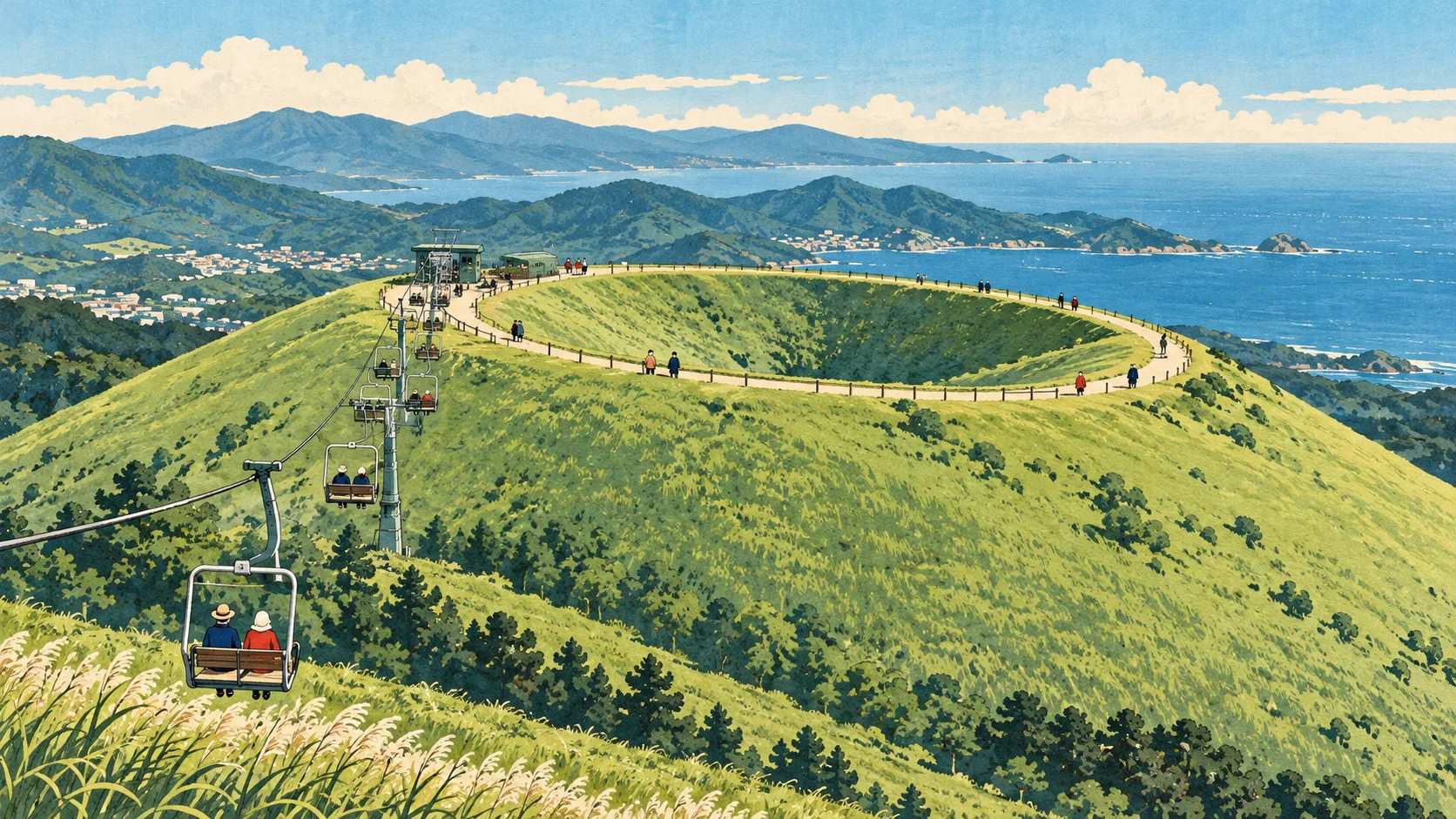
For Omuro, connect at Ito or Izu Kogen for a bus towards Shaboten Koen/Mount Omuro, alighting at the stated terminus. Check actual departures through the operator’s access directions. The summit path is approximately 1,000 metres, with an official walking estimate of twenty to thirty minutes, plus bus travel, queues and both chairlift rides. This is a substantial outdoor activity rather than a spare-time stop before Atami fireworks.
The current return chairlift fare is ¥1,000 for adults, defined as junior-high students and older, ¥500 for primary-school pupils, and free before entering primary school. March–September hours are 9:00–17:00 with last descent 17:15; October–February, 9:00–16:00 with last descent 16:15. The fares, seasonal hours and summit-path conditions expressly prohibit climbing on foot to protect the mountain. Even during operating hours, the full summit circuit can be unavailable. A suspended lift cannot be replaced by walking up yourself.
The published 2026 maintenance notice lists closure from 7 to 18 December, while wind and rain can suspend service on other days. Check Omuro’s official current information on the date, without describing one captured strong-wind situation as an entire season’s closure. The official film introduces the mountain and chairlift; for fear of heights, mobility or boarding concerns, use the operator’s riding instructions and ask whether it fits your needs. People riding in a video do not establish suitability for everyone.
Set the booking order before connecting Izu to the rest of Japan
Choose the event date you actually want, then research two acceptable accommodations and their cancellation terms. Next settle dinner and nighttime return, and only then buy dated attraction tickets and add daytime stops and trains. In Atami, ask about fireworks views or guest-area eligibility; in Shuzenji, about the return from the lights and dinner. Both need baggage and checkout arrangements. Resolving the few conditions affecting the whole trip leaves room to change your mind in the remaining time.
If Hakone comes before or afterward, compare the division of Hakone’s loop and overnight stays across days. Both being famous for hot springs does not make them one transport zone with immediate transfers. For ryokan meals, public bathing and private baths, continue with the room and meal checks for a first ryokan stay. Understanding the terms makes it easier to get useful answers when booking.
Before departure, recheck the fireworks schedule, courtyard and Niji no Sato event periods, last buses and Omuro’s operating status. Save booking addresses and cancellation contacts offline. If one part changes, use a shorter version in the same base rather than moving the whole family to another area to rescue one attraction. Adapting to weather, energy and budget is the practical result this short trip should deliver.
A few useful answers
Should I stay in Atami or Shuzenji for two days in Izu?
Choose the evening you most want: Atami for the Marine Fireworks Festival, or Shuzenji for autumn foliage, the Katsura River and Niji no Sato lights. With only one night, keep one base and check evening transport and the hotel’s dinner time first.
Have the 2027 Atami fireworks dates been announced?
Yes. The official page announced the 2027 programme on 19 October 2026; its winter dates extend to 10 January and 13 February 2028. Check the calendar year and the night you are booking. Dates and times may still change.
Do I need a general viewing ticket for Atami fireworks in 2026?
The official 9 May 2026 update states that there are no general paid viewing seats that year. In July and August, guests actually staying at specified association-member properties have a separate area accessed with the property’s picnic mat. This does not cover every hotel or every month.
Are Atami fireworks cancelled if it rains?
The organiser says they go ahead in rain, while allowing changes. Check notices near the event. Hotel cancellations and train changes follow their own booking terms; the event notice does not establish a free refund.
Can I currently take Yu-Yu Bus?
Tokai Bus’s current page says all departures have been temporarily suspended since 11 October 2025. Check regular buses or another option instead. An old loop timetable still on the page does not establish that service has resumed.
Is the hot-spring district right outside Shuzenji Station?
No. The tourist association lists about ten minutes by bus towards Shuzenji Onsen, or about ten minutes by taxi. Also allow for waiting, walking and storing bags.
When is the best time for Shuzenji autumn foliage in 2026?
The usual season starts around mid-November, but the location and that year’s weather affect it. A seasonal range does not guarantee current colours. Check the date of the latest foliage report, and do not treat the official 2020 video or old photos as this year’s conditions.
When does Shuzenji Temple’s courtyard open in 2026?
The announced special opening is 20–30 November, 9:00–16:00, with a ¥200 viewing fee. This applies to the courtyard’s special opening, not every part of the temple throughout the year.
Does Niji no Sato daytime admission include the evening illumination?
This guide treats them as separate products. The 2026 autumn evening is sold only with Illumi the Night: ¥2,600 for adults and ¥1,500 for children on ordinary nights; ¥3,300/¥2,200 on the three specified fireworks nights. Check age categories, re-entry and the actual product terms before buying.
Do I climb all 837 steps from the bus stop to Izusan Shrine?
The 837 steps run from the Izusanhama/Hashiriyu area to the main shrine. From the municipal road by the bus stop, it is about 200 steps. The roughly one-hour mountain path to Hongusha is a separate walk.
Does an Atami sea-view room always have a fireworks view and an in-room hot spring?
No. Atami Korakuen’s AQUA SQUARE Courtyard rooms have neither a sea nor a fireworks view; Ocean View rooms have a shower but no bathtub. Water in a room’s bath is not automatically hot-spring water. Check the complete room name and specifications.
Can I walk up Mount Omuro if the chairlift is closed?
No. The operator prohibits climbing on foot to protect the mountain and has announced a maintenance closure for 7–18 December 2026. Wind or rain can also stop the lift at other times, so check the day’s operating status.
Check with the source
Schedules, availability and rules can change. These official sources are the place to confirm details before you book.
- Atami Tourism Association | 2026 and 2027 Marine Fireworks Festival schedules and viewing rules
- Atami City | Marine Fireworks Festival calendar
- Atami Tourism Association | Access and transport operators
- Tokai Bus | Suspended sightseeing loop and Atami day-ticket coverage
- Kinomiya Shrine | Access and worship hours
- Kinomiya Shrine | Great camphor tree and entrance during construction
- Atami Tourism Association | Izusan Shrine steps and access
- MOA Museum of Art | Opening, admission and transport
- Atami City | Accommodation tax, exemptions and start date
- Atami Korakuen Hotel | AQUA SQUARE rooms and guest benefits
- Atami Korakuen Hotel | Current Japanese accommodation and cancellation FAQ
- Izu City Tourism Association, Shuzenji branch | Trains, buses and luggage delivery
- Izu City Tourism Association, Shuzenji branch | Maple-viewing places and past foliage reports
- Izu City Tourism Association, Shuzenji branch | Autumn 2026 and the temple courtyard opening
- Shuzenji Niji no Sato | Daytime admission, opening and mobility aids
- Shuzenji Niji no Sato | 2026 autumn evening lights and fireworks packages
- Shuzenji Niji no Sato | Bus access from Shuzenji Station
- Shuzenji Niji no Sato | Ages, visit duration and park FAQ
- Yumeguri no Yado Shuzenji Onsen Katsuragawa | Named room types and age restrictions
- Yumeguri no Yado Shuzenji Onsen Katsuragawa | Private baths, cancellation and shuttle rules
- Yumeguri no Yado Shuzenji Onsen Katsuragawa | Bus stop and walking access
- Mount Omuro chairlift | Current fares, seasonal hours and ban on climbing on foot
- Mount Omuro chairlift | Bus access from Ito and Izu Kogen
- Mount Omuro chairlift | Riding and operating-video information
- Mount Omuro chairlift | 7–18 December 2026 maintenance closure
- Mount Omuro chairlift | Today’s operating status and official video