The 2027 Kawazu Cherry Blossom Festival runs February 6–March 7. Choose the lower river by Yakata Bridge, Arakura–Kinomiya middle section or Mine Onsen side. Includes the original tree, bloom reports, Tokyo rail tickets and day-trip or overnight plans.
- Region & Focus
- Kawazu
- Reading Scope
- 30 min read · 18 chapters · 6 Q&As
- Official Verification
- 12 official sources checkedUpdated October 29, 2026
- Key Topics
- SeasonsItinerariesRail travel
Chapter Route Map (tap any stop)
- At Kawazu Station, choose your turnaround bridge
- 2027 festival dates are documented; blooms follow the trees
- Short station-side route: Yakata to Hama Bridge
- Middle section: Arakura to Kinomiya, flowers at two levels
- Mine Onsen side: tunnel and named trees
- The original tree in Tanaka needs a separate detour
- Read bloom reports by place, date, close view and panorama
- Look at leaves as well as full bloom
- Handle luggage, toilets and meeting points at the station
- From Tokyo: direct express or a transfer at Atami
- Use a dated timetable to understand the day’s length
- Day trip: eat first, then decide on the extension
- Stay overnight for a second look in the morning
- Choose lunch together with the turnaround point
- Night blossoms at two ends: choose one you can return from
- With children or a slower pace, use bridges as stopping points
- Fixed dates with fewer flowers or rain: original tree and short river
- Calculate fixed rail costs, then add rooms and meals
- Quick Q&A
The 2027 Kawazu Cherry Blossom Festival is listed for February 6–March 7. For a day trip, focus on the lower river by Yakata Bridge and the middle section. To see the original tree or take your time near Mine Onsen, reduce side trips or stay overnight. Choose your route using close and wide images of the same section on the day, and plan evening visits around that year’s announced illuminated sections.
At Kawazu Station, choose your turnaround bridge
For a stretch of pink riverbank, photographs and lunch, begin with Yakata Bridge to Hama Bridge. To see more river views combining rapeseed flowers and cherry trees, extend toward Arakura and Kinomiya bridges. If the original Kawazu tree is a priority, include time to leave the river for Tanaka. These three routes require different walking effort and pauses. Choose one before booking the return, then adjust to blooms on arrival.
For a first day trip, keep the station-side and middle river sections, turning back wherever you are comfortable. The Mine Onsen cherry tunnel, named old trees and original tree all deserve time, but a Tokyo return day also has two long train journeys. Studying one or two places is better value than hurrying to the far end with time only to return.
Kawazu is on the Izukyu line on the eastern Izu Peninsula. Atami to the north offers transfers and accommodation; Shuzenji lies along a different rail and ground-transport direction. If you have planned Atami fireworks or Shuzenji autumn leaves, read the Izu and Atami accommodation areas guide. Give Kawazu blossoms their own daylight instead of adding them to an already full two-day Izu trip.
| River section | What to observe | Suitable trade-off |
|---|---|---|
| Yakata–Hama bridges | Tree rows on both banks, water and close branches | Afternoon arrivals or shorter walks; return via Yakata Bridge |
| Arakura–Kinomiya bridges | Rapeseed flowers, Sasahara Park and continuous crowns | Follow one bank and decide at a bridge whether to return |
| Kinomiya Bridge toward Mine Onsen | Kamikawara, Hosen, Otozo and the cherry tunnel | Allow a longer day and reduce other detours |
The 2027 Kawazu Cherry Blossom Festival runs February 6–March 7. Choose the lower river by Yakata Bridge, Arakura–Kinomiya middle section or Mine Onsen side. Includes the original tree, bloom reports, Tokyo rail tickets and day-trip or overnight plans.
2027 festival dates are documented; blooms follow the trees
Page 1 of the 37th festival vendor application documents, announced by Kawazu Tourism Association on October 19, 2026, gives Saturday, February 6–Sunday, March 7, 2027. Use these dates to request leave or book cancellable accommodation. The association notice and attached application documents are the source. February 7–March 8, 2026 belongs to the previous festival.
Festival dates organize stalls and activities; flowering follows that year’s trees. The association gives early February–early March as the usual season, with full bloom lasting about a week to ten days, and says trees at 50–60% bloom already offer substantial flowers. If travel is fixed to one weekend, choose an acceptable walking distance and room price first, then use recent images of the same section to allocate time.
Identify the year of evening events separately. The existing event page lists February 7–March 8, 2026, 18:00–21:00, downstream of Yakata Bridge, behind Odoriko Onsen Hall and at selected named trees. The night route discussion below uses that edition to explain the differences. For 2027, use the new edition’s explicit sections and hours; daytime festival dates do not mean lighting all evening.
Short station-side route: Yakata to Hama Bridge
The 36th festival’s official blossom map places Yakata Bridge, Hama Bridge and the Izukyu railway together on the lower river. Find the river from the station and use Yakata Bridge as a recognizable return landmark. This suits afternoon arrivals, companions who cannot walk far or a booked early-evening departure. You need not reach Mine Onsen to have seen Kawazu blossoms.
Allow time for whole trees first. From a position that leaves the path clear, see branches, water and opposite-bank trees together, then choose a tree for a closer view. Alternating distances works better than stopping in the path every few steps for the same composition. Finish crossing a bridge before stopping at a wider bridgehead so people can pass.
Toward Hama Bridge, the river mouth and sea become easier to locate. Keep the task simple: find a view of both banks, photograph that day’s flowers and return to Yakata Bridge. Look at water outbound and close branches on the return. Retracing the route still offers different subjects without unfamiliar lanes to force a loop.
If the station-side flowers suit you, exchange the planned upstream extension for a rest. During the festival, people cluster under trees, at stalls and bridgeheads. Even a short map distance takes time with pauses and passing traffic. The short route can finish whenever needed; one last river view at Yakata Bridge before the station completes the visit.
Middle section: Arakura to Kinomiya, flowers at two levels
The official map marks Sasahara Park, Nanohana Road and Sakura Footbath between Arakura and Kinomiya bridges. Extending here shifts attention from individual hanging branches to continuous crowns and yellow flowers at ground level. Before crossing for a yellow-and-pink view, see which bank and direction show each flower clearly that day.
Avoid repeated crossings to copy an old photograph. At Arakura Bridge, judge crowds and blooms on each side and choose one bank; near Kinomiya, decide whether to return or cross. This gives a continuous walk and memorable meeting points. For a photographer and resting companion, a bridge name and time work better than the cherry tree ahead.
Rapeseed flowers form a ground layer and blossoms an overhead layer. For a wide view, find both; for close views, examine petals, buds and new leaves without requiring yellow and pink in every image. After walking, look back along the river’s curve to see the same row’s density from another angle. Sparse branches from one position may give a different impression from another.
The footbath is a useful landmark. To use it, check on-site opening, bring a drying towel and allow time to remove and replace shoes and socks. Agree on a waiting place for nonusers so one person is not chasing the group while putting shoes and socks back on. Before continuing to Mine Onsen, eat or rest nearby rather than waiting until everyone is tired to seek seats.
Mine Onsen side: tunnel and named trees
Upstream of Kinomiya Bridge, the map marks Kamikawara, Hosen and Otozo cherry trees and the Kawazu cherry tunnel behind Odoriko Onsen Hall. With a longer day, combine rows of trees with named individuals. Clear names make it easier to identify where you are and organize photographs by place.
Locate yourself with the Kamikawara and Hosen trees, then decide whether to continue behind the hall. Flower symbols mark locations, not the order in which every tree blooms on the same day. Take a whole-tree image and record its name, then choose a favorite crown for details. You need not collect every named tree before reaching the tunnel.
The tunnel effect comes from overlapping path, branches and forward view. Looking ahead under the trees differs from looking back across the river at the row. If companions want slow photography, give this area more time and shorten other sections. After a stop-filled walk from the station, check the remaining return time before adding the original tree. Nearby map names need not all become compulsory side trips.
If this is your endpoint, return along your favorite bank. Familiar bridges, footbath and park help navigation and show what remains to the station in late afternoon. To add Mine Onsen’s great geyser park or bathing, transfer a whole block from blossom time. Do not hide waiting, changing and resting inside walking minutes.
The original tree in Tanaka needs a separate detour
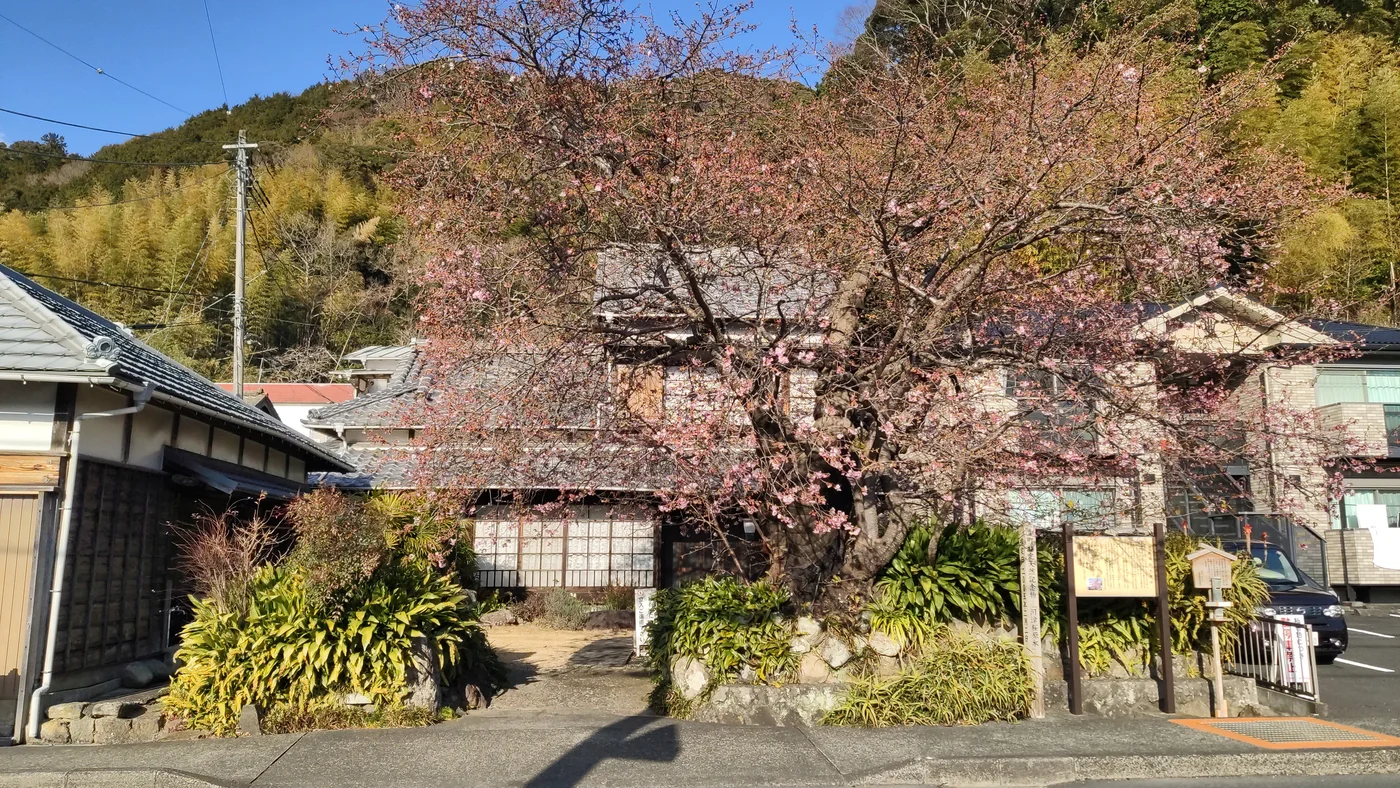
The original Kawazu cherry tree stands in the Iida family garden in Tanaka, Kawazu. The organizer’s original-tree introduction places it about 1.2 kilometers from Kawazu Station toward Amagi; the 2026 blossom map gives about 1.3 kilometers. Budget a little over a kilometer one way, plus viewing, photographs and a return to the river. Starting at the station and cutting across from upstream are different routes.
Read its story through the discovery and flowering years. Katsumi Iida found the sapling around 1955 and moved it here; the organizer records observed flowering from 1966. Propagation and study followed, the name Kawazu-zakura was adopted in 1974, and it became the town tree in 1975. Think of a retained tree gradually propagated along the town’s riverbanks, with a different relationship to the planted rows.
The tree is in a residential garden. View from the open outer positions and keep home entrances clear. Look at the spreading crown, then flowers within sight, without pulling branches down or entering residential space. For group photographs, wait for the previous group to finish rather than keeping everyone at the entrance for a long time.
The original tree’s condition is worth recording, but one image cannot represent the whole Kawazu River. Treat advance close-ups as information about that tree, then examine actual lower-river and Mine Onsen blooms on arrival. Save images separately as original tree, below Yakata Bridge, middle section and Mine Onsen side for easier comparison.
With half a day and a strong interest in tree history, see the original first, then a short middle or station-side river section. You will see fewer planted rows but understand the reason for visiting its place of origin. For long river panoramas, reverse the priorities: spend daylight by the river and add the original only if time and energy remain.
Read bloom reports by place, date, close view and panorama
The tourism association’s Kawazu cherry explanation lists about 850 trees along the river and 8,000 across town. With this distribution, ask where a bloom image was taken. A flower-filled close-up of the original, a river view near the station and the upstream tunnel answer different questions. Find the place and capture date before using a bright search-result image to choose a route.
Save the organizer’s bloom information page and the livestream link on its official home page. Read the publication date, then identify bridges, buildings or tree names to locate the section. If a livestream has a time display, read it too. For a still thumbnail, find its update date instead of treating the player cover as today’s trees.
Close views show remaining buds, open-flower density and new leaves; panoramas show continuity across a row. Ideally use both from the same day and section. Close-ups alone can make a few good branches seem typical of the whole river; distant views may hide the difference between petals and leaves. Take both on arrival for a shared comparison basis.
The organizer records February 13 as the 2026 peak-viewing announcement and, on the same page, February 28 for the 35th festival. A half-month difference shows the limits of booking from one past full-bloom photograph. With flexible dates, use recent same-section images to choose departure. With fixed dates, concentrate on the section whose flowers suit you and shorten the rest.
Look at leaves as well as full bloom
The organizer’s variety description says leaves unfold after flowering and presents Kawazu-zakura as a presumed natural cross between early-flowering Oshima and kanhizakura cherry groups. Examine a short branch: what proportion consists of tight buds, open flowers or emerging leaves? This explains the tree’s stage better than deciding only whether the whole tree looks pink or green.
At 50–60% bloom, find branches with buds and pair them with a whole-tree image. With heavier flowering, step back for crown and riverbank together. When leaves are obvious, examine flowers and leaves on the same branch. Revisiting after several days can record changes in their proportions.
Light also changes photographic color. The same flowers look different in front light and backlight. To compare dates, choose similar angles showing buds and leaves clearly rather than the most saturated image. Record a tree or bridge name when sharing photographs with companions so the worthwhile section is clear.
Handle luggage, toilets and meeting points at the station
Izukyu’s Kawazu Station information lists a shop on the left after the ticket gate and coin lockers on the right, with counter hours of 09:00–17:30. Decide on luggage storage before heading to the river. If lockers are full, use your prearranged accommodation storage rather than dragging large cases toward the densest blossoms.
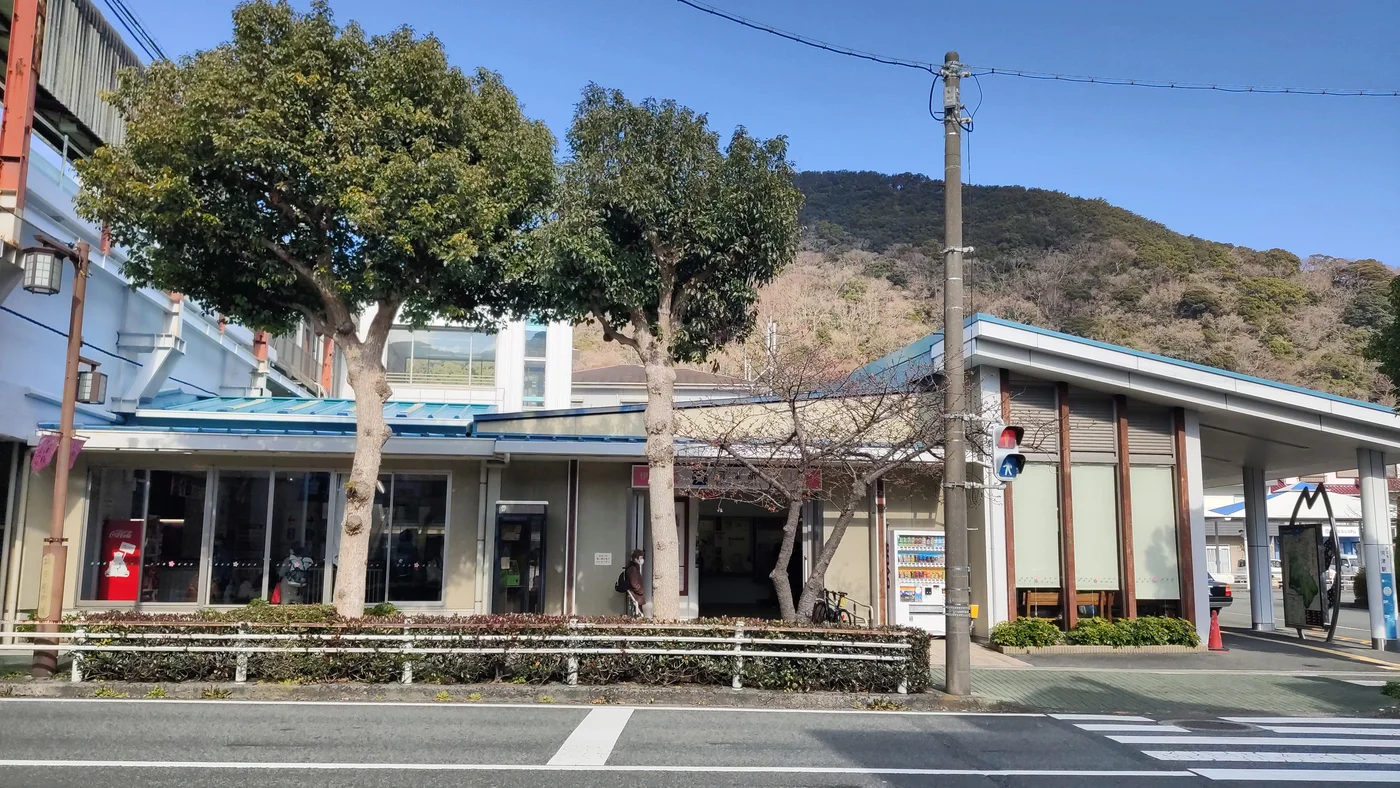
There is no level change from the station-front roundabout to the gate. Stairs and an elevator connect gate and platforms, and the station lists a wheelchair-accessible toilet. Elevator users should include vertical movement in the return waiting allowance. Station facilities are documented; choose river entrances, banks and bridges according to actual surfaces and access on arrival. A station elevator does not make the entire river route level.
With young children, use the Kawazu Cherry Blossom Tourism Exchange Center as an intermediate support point. The organizer’s visitor information places it about ten minutes from the station, with diaper-changing facilities in its multipurpose toilet. Ask the tourism association desk for nursing space, which staff will arrange. Save the location before walking so you can divide the visit around it rather than searching through crowds when a child needs care.
From Tokyo: direct express or a transfer at Atami
The organizer gives about two hours 40 minutes from Tokyo to Kawazu on a direct Odoriko. Alternatively take Shinkansen or conventional rail to Atami, then the Ito and Izukyu lines toward Izukyu-Shimoda. Start with your accommodation location: near Tokyo Station, a direct express may suit; arriving at Atami from elsewhere, list the transfer and wait together.
Use Kawazu as the ticket destination. Odoriko services operate toward both Izukyu-Shimoda and Shuzenji, so destination, car and seat must match the Kawazu section. For adjacent seats, search outbound and return for the whole group, choose an acceptable return first, then the morning service. If seats are separated, decide whether that works before reaching the platform.
Izukyu’s limited-express charge table lists an advance ordinary reserved-seat or seat-unassigned Odoriko supplement of ¥2,380 from listed origins including Tokyo and Shinagawa to Kawazu, or ¥2,640 when bought onboard. Add the basic fare. Both amounts are express supplements, not the complete Tokyo–Kawazu one-way price.
Once the train is fixed, buy the basic-fare ticket and matching limited-express ticket before departure for easier checking. Saphir Odoriko has different seating and charges, and its official site states that limited-express tickets are not sold onboard. For a straightforward blossom trip, build an ordinary Odoriko or local-train route first, then decide whether a sightseeing train deserves extra budget.
Use a dated timetable to understand the day’s length
Here is a timetable check for Thursday, November 5, 2026. Under Izukyu’s daily southbound table revised March 14, 2026, Odoriko 1 leaves Tokyo at 09:00 and Kawazu at 11:28. Under JR East’s November 2026 weekday table, return Odoriko 10 leaves Kawazu at 15:21 and reaches Tokyo at 17:48. The southbound table uses departure times at intermediate stops, so you get off slightly before 11:28.
This pair leaves about four hours in Kawazu, suitable for a short station-side and middle-section day, rather than the original tree, Mine Onsen, bathing and every stall. Lunch, toilets and return waiting reduce actual slow riverside time. This example uses a checked autumn 2026 version. For spring 2027, select your travel date through Izukyu’s timetable entry page before buying matching seats.
Staying in Ito or Izu-Kogen removes the long Tokyo legs, but still requires checking each direction and connection. Choose an arrival after breakfast and a return before dinner. Put saved time into Kawazu if you want the upper river, rather than adding another line-side attraction. If returning through Ito or Atami, list each transfer separately instead of only the final arrival.
| Train | Outbound or return times | Timetable version |
|---|---|---|
| Odoriko 1, outbound | Tokyo departs 09:00; Kawazu departs 11:28 | Izukyu daily southbound table revised 2026-03-14 |
| Odoriko 10, return | Kawazu departs 15:21; Tokyo arrives 17:48 | JR East November 2026 weekday northbound table |
Day trip: eat first, then decide on the extension
For the roughly four-hour example, handle storage and toilets after arrival, then find the river at Yakata Bridge. If hungry, eat before the river walk. Otherwise walk the short Yakata–Hama section first and return for lunch. Both orders keep the station side as an area where you can finish, rather than spending the first hour chasing upstream.
After eating, judge time and energy before extending toward Arakura Bridge and Sasahara Park. Stop at a section you like; Kinomiya Bridge need not be reached before turning back. Aim to reach the station at least half an hour before your booked train as your own waiting allowance, earlier with crowds or elevator needs. Work backward from that target instead of searching for shortcuts at the far end.
If flowers near the station are good, stay on the lower and middle river. Original-tree enthusiasts can replace the post-lunch extension with Tanaka, adding only a short river section afterward. These day trips have different themes. Agree before departure so one companion does not expect the tunnel while another heads toward the original tree.
Stay overnight for a second look in the morning
The most valuable overnight arrangement is seeing the same river section twice. Walk the middle or Mine Onsen area on the first afternoon, learning bridge names and the route to your accommodation. Return to your favorite part next morning for flowers and water in different light. You need not rush through everything on arrival, and can reserve better weather for outdoors.
Classify accommodation as station-side, near the river or requiring a shuttle. Walkers should check actual roads; shuttle users should plan around the confirmation’s boarding places and times. Kawazu Station’s official information lists station-front taxi service until 17:00. Arrange transfers or reserve a taxi for late arrival or night returns rather than making on-demand taxis a fixed condition of the evening.
For a stay with dinner, put its serving time first, then decide on night blossoms. If going out afterward, walk the return route in daylight. To remain out through evening, choose a compatible meal sitting or a room-only plan with your own meal arrangements. This changes the entire evening, beyond the price difference between half-board and room-only.
Next day, see the original tree first, then revisit a short station-side or middle section and leave after lunch. If leaving luggage at the accommodation, agree on collection at checkout and make that point the end of the walk before the station. After walking upstream the first day, you need not repeat the whole river. Quiet time with the same tree makes the overnight meaningfully different from a hurried day trip.
Choose lunch together with the turnaround point
The 2026 official blossom map marks the ODORICO shop on the Tourism Exchange Center’s first floor, a dining room and prayer room on the second, and Sakura Terrace Cafe near Mine Onsen. These locate possible meal areas. Plan lunch around businesses actually open that day, then judge the queue at the door against the time a meal will take.
Day visitors should eat before heading upstream. If companions need a hot seated meal, reserve a complete meal period rather than relying only on stalls. For stall food, finish in a stable standing or seated place before walking, keeping the path open.
To add bathing after lunch, first remove a river section. Before a long afternoon train, eating, bathing and collecting luggage are three separate activities, not all incidental rests. Overnight visitors can move one back to their accommodation. Day visitors should choose the one they most want and preserve the station walk.
Kawazu Tourism Association’s introductory film about Kawazu Sakura Terrace.
Night blossoms at two ends: choose one you can return from
The organizer’s 2026 event page separates illuminated rows below Yakata Bridge and behind Odoriko Onsen Hall, with named trees including Hosen, Yakuba, Otozo, Kamikawara and Nehan. The ends have different return conditions. For station-side accommodation or a train afterward, the lower Yakata section connects more easily to the station. Near Mine Onsen, choose the hall side according to your accommodation route.
Walk the intended short evening section once in daylight. Note exits from river to road, bridgehead turns and accommodation signs, then use the same return at night. Leave the path center free for photographs and put phones and cameras away before moving. After a full day, shorten the visit to one bridge and another clear landmark instead of walking both ends again.
Handle lighting end time separately from train departure. Choose the travel day’s northbound train, then subtract station entry and walking from platform departure to find your last river departure time. Pack up then even if activities continue. If seeing the whole night scene pushes the return very late, an overnight suits the trip better than repeatedly checking transfers beside the river.
Even overnight visitors should connect dinner, night walk and accommodation into one route. Staying nearby but crossing to the other end still adds walking. Revisiting a favorite daylight section is usually easier than finding a distant named tree for the first time in darkness. When the next edition is announced, check that your chosen end is included in its lighting area before reserving that evening.
With children or a slower pace, use bridges as stopping points
With young children, begin between the station, Yakata Bridge and Tourism Exchange Center, extending only as their condition allows. Let them watch flowers, river movement or trains from safe stopping places. Adults can alternate photographing full rows while another waits with the children in a wider space, instead of crowding the whole group under one tree.
Stroller and mobility-aid users should complete station toilets and elevator movements first, then use an accessible river entrance observed on site. Retracing one bank makes known slopes and surfaces easier to manage. Before crossing, inspect how the bridgehead meets the road. Wheelchair-toilet and parking symbols identify services, but do not supply continuous slope data for every path. Shorten long routes to sections companions can actually manage.
If long standing is difficult, choose photographic points from which you can move on promptly. Return early to available rest points rather than saving the first seat until after the upper river. The easiest adjustment is which bridge to reach. Preserve lunch and waiting time, reduce distance, and still see branches, water and town streets in early spring.
Fixed dates with fewer flowers or rain: original tree and short river
With leave already booked, keep the original tree’s history, planted rows and riverside town as fixed subjects, extending where flowers are better. If station-side branches have many buds, examine them close up and compare a short middle section. If upstream leaves are obvious, record whole trees and flowers with leaves. Adjust what you observe instead of spending the day rushing after a full-bloom image.
In rain, remove the farthest extension first and choose either Yakata’s vicinity or the original tree. With wet paths and bridges or wind affecting umbrellas, photograph less and pack equipment before moving. Follow closures and staff guidance onto open roads. With a booked return, go to the station early; with an overnight, save another outdoor section for the next day.
Kawazu Seven Waterfalls requires a separate bus from the station, also listed that way in Izukyu’s station introduction. Disappointing flowers do not make it the second half of the river walk simply because it is in Kawazu. Only if changing the day’s main activity should you research buses, visit time and return anew. For a relaxed early-spring day, keep the short river route and a seated lunch.
Calculate fixed rail costs, then add rooms and meals
For one adult taking ordinary Odoriko between Tokyo and Kawazu at current advance charges, the limited-express supplements are ¥2,380 × 2 = ¥4,760, with basic fares extra. For two adults, supplements total ¥9,520. Include complete basic tickets, express tickets and passenger count in the order before comparing an Atami-transfer route to obtain the payable total.
Izukyu lists the Odoriko reserved-seat supplement within its own line as ¥800 regardless of distance, the same for reserved or seat-unassigned tickets and advance or onboard purchase. The Tokyo advance/onboard difference comes from JR-line rules. Visitors already along Izu can compare local and express travel time, but should not apply Tokyo’s ¥2,380 supplement to a short trip from Ito or Izu-Kogen.
Fill in accommodation and meal costs from the actual plan you select. For one extra night, compare room, two days of meals and luggage arrangements against night blossoms, a second tree visit or one less hurried train journey.
A few useful answers
Have the 2027 Kawazu Cherry Blossom Festival dates been announced?
Page 1 of the 37th vendor application attached to the tourism association’s October 19, 2026 notice gives February 6–March 7, 2027. These are festival dates; choose blossom days using that year’s reports by section.
How far should a first Kawazu day trip walk?
Begin with the short station-side Yakata–Hama route, then extend toward Arakura Bridge and Sasahara Park according to energy. For original-tree history, replace the middle section with Tanaka and preserve station walking and waiting time before the return train.
How far is the original Kawazu cherry tree from the station?
The organizer gives about 1.2 kilometers and the 2026 map about 1.3 kilometers. It is in the Iida family garden in Tanaka, Kawazu. Allow a little over a kilometer one way, plus viewing and return time.
Can I use 2026 night-blossom hours for 2027?
The 2026 organizer page lists 18:00–21:00 below Yakata Bridge, behind Odoriko Onsen Hall and at selected named trees. Use the 2027 edition’s announced hours and areas for that evening, then connect them to your travel date’s train or accommodation.
Is ¥2,380 the full Odoriko fare from Tokyo to Kawazu?
¥2,380 is the currently listed advance limited-express supplement; the basic fare is extra. Check the Tokyo–Kawazu basic ticket and express ticket together. Saphir Odoriko seating and charges are separate.
Does Kawazu Station have an elevator and lockers?
Izukyu lists an elevator between gate and platforms, with no level change from the front roundabout to the gate. Coin lockers are on the right after exiting, a shop on the left, and a wheelchair-accessible toilet is provided. Choose actual river routes according to entrances, bridgeheads and the day’s surfaces.
Official information and references
Sources used in this guide.
- Kawazu Tourism Association: 37th festival vendor notice and 2027 date documents
- Kawazu Cherry Blossom Festival Committee: 37th vendor documents, 2027 dates on page 1
- Kawazu Tourism Association: variety, usual season and riverside trees
- Kawazu Cherry Blossom Festival Committee: original tree and origins
- Kawazu Cherry Blossom Festival Committee: 36th festival 2026 viewing map
- Kawazu Cherry Blossom Festival Committee: 2026 events and lighting sections
- Kawazu Cherry Blossom Festival Committee: peak records, bloom reports and visitor facilities
- Izukyu: timetable entry for daily and extra trains
- Izukyu: daily southbound timetable revised March 14, 2026
- JR East: November 2026 northbound Tokaido, Ito and Izukyu timetable
- Izukyu: limited-express and Shinkansen charges
- Izukyu: Kawazu Station facilities, services and local transport