Take the Uchiyama line from Nishitetsu Dazaifu station or Miyamae, check the 2026 weekday and weekend outbound and return timetables, the 100-yen fare and service hours, and plan a half day around the water mirror, the worship hall, the 2012 amulet office, the viewing stage and seasonal walks on the grounds.
- Region & Focus
- Fukuoka
- Reading Scope
- 25 min read · 12 chapters · 4 Q&As
- Official Verification
- 16 official sources checkedUpdated 22 November 2026
- Key Topics
- ItinerariesSeasonsKyushu
Chapter Route Map (tap any stop)
- Visit the foothill lower shrine first, and save the 100 minutes for worship and the shrine grounds
- After arriving at Dazaifu Station, look for the Uchiyama-bound stop in front of Fukuoka Bank
- 100 yen per trip, the same price for primary school children, with one IC card tap on boarding and one on alighting
- Read the timetable as four tables; the difference in afternoon timings comes down to these few minutes
- Chōzu, the water mirror and the worship hall: walking in order, unhurried
- Tamayorihime-no-Mikoto's enmusubi extends to family, friends and work too
- The 2012 amulet office: start at the round table, then look up for the cherry blossoms
- Amulets, goshuin and prayers: arrange them around two sets of service times
- Sit a while behind the amulet office, and pick the smaller shrines by interest
- Cherry blossom, green shade and autumn maple: local faith seen through trees
- Kamado Shrine alone, or linked from the Tenmangū area's Miyamae stop
- Tired, raining, or wanting to wait for the evening light: decide how to get back first
- Quick Q&A
From Dazaifu, ride one section of the Uchiyama line and arrange the water mirror, worship hall, contemporary amulet office and town viewpoint of the mountain-foot lower shrine into half a day. Choose your return bus first, then divide your time between prayer, amulets and seasonal tree scenery; the morning pairing of an 09:30 arrival and an 11:10 return leaves 100 minutes on site.
Visit the foothill lower shrine first, and save the 100 minutes for worship and the shrine grounds
If you simply want to add a shrine stroll to a Dazaifu trip, the foothill lower shrine (
First distinguish the two locations on a map. The shrine at the foot of the mountain is the lower shrine, while the summit of 829-metre Mount Hōman is the upper shrine; when you see the names Homangu or Kamado Shrine, check the marked position alongside them. The worship hall, the amulet-issuing office and the views over the city at the lower shrine can form the substance of a visit on their own. The summit upper shrine, the historic sites in the mountains and the former location of the middle shrine belong to a separate mountain path; after arranging a half-day around the lower shrine, simply follow the grounds map on a stroll, then return to Uchiyama for the bus.
If your reason for visiting is architecture, the lower shrine has two points of interest from different eras: the shrine buildings, completed in 1927 and repaired in 2013, and the amulet-issuing office, finished in 2012 and designed by Masamichi Katayama. To understand the shrine's matchmaking faith, start with the principal enshrined deity Tamayorihime-no-Mikoto, the reunion tree (Saikai-no-Ki (Reunion Tree)) and the meaning of the amulets; there is no need to turn every corner of the grounds into a checklist of photo stops. In spring you can look at the relationship between the cherry blossoms and the shrine crest, and in autumn at how the maple trees connect to local residents' votive customs; even when there are no flowers or autumn leaves in season, these aspects still make the visit worthwhile.
Take the Uchiyama line from Nishitetsu Dazaifu station or Miyamae, check the 2026 weekday and weekend outbound and return timetables, the 100-yen fare and service hours, and plan a half day around the water mirror, the worship hall, the 2012 amulet office, the viewing stage and seasonal walks on the grounds.
After arriving at Dazaifu Station, look for the Uchiyama-bound stop in front of Fukuoka Bank
Leaving Nishitetsu Dazaifu Station, head for the まほろば bus stop in front of the Fukuoka Bank Dazaifu branch and take the bus bound for Uchiyama. According to the Dazaifu Tourism Association's transport introduction of 1 October 2026, the white building and pale blue signage are how to identify the bank; alight at the terminus, Uchiyama, and the shrine is directly ahead. When checking the timetable, look for the row labelled Nishitetsu Dazaifu Station for the departure station, and for the destination look for Uchiyama(Kamado-jinja-mae) — this connects the colloquial station-front wording found in online text with the official stop name used in the table.
If you are already around Dazaifu Tenmangū, you can walk to the Miyamae stop and take an Uchiyama-bound bus; the shrine's transport page uses the Sanjo 7-Eleven as the point of orientation. Keep separate the point where you finish worshipping at Tenmangū, the time it takes to walk to Miyamae, and the wait for the bus; Miyamae is an intermediate stop and the bus continues onwards, so you cannot take the Dazaifu Station departure time as the Miyamae time. In the morning example, the bus leaves Dazaifu at 09:22, passes Miyamae at 09:24 and reaches Uchiyama at 09:30. Anyone boarding at Miyamae should be at the stop waiting before 09:24.
The shrine lists roughly 40 minutes on foot from Dazaifu Station and roughly 30 minutes on foot from Tenmangū; the tourism association lists about 2 kilometres from the station to the shrine. If you enjoy walking and have no long indoor visits planned that day, you can walk up and take the bus back, so the transport cost is only one leg. If your companions have already finished the approach and Tenmangū, taking the bus makes it easier to save your energy for the shrine grounds. Cyclists should also consider the slopes: a member of the tourism association's staff made the journey on an electric-assist bicycle in about 15 minutes and explained that there are continuous uphill sections en route, and that the roads around Tenmangū are narrow with heavy traffic. The 15 minutes is useful for gauging the scale of travel by e-assist bike; if hiring an ordinary bicycle, choose according to your own riding ability.
100 yen per trip, the same price for primary school children, with one IC card tap on boarding and one on alighting
Under the usage guide updated by Dazaifu City on 1 April 2026, the まほろば bus charges 100 yen per trip flat across all sections for everyone of primary school age and above, with payment made when alighting. An adult and a primary school child riding the same section each pay 100 yen; one adult making a return trip to Uchiyama pays 200 yen, and two adults together pay 400 yen return. Two adults with one primary school child make 600 yen for the same return trip. This calculation covers the community bus only; Nishitetsu trains, buses from Hakata and meals are listed separately, so you can see the actual additional transport cost of adding the Kamado Shrine visit.
Pre-school children travel free provided they are accompanied by a guardian, with a limit of two children per guardian. If your family exceeds this combination, first ask the operator about the applicable arrangements, following the city's usage guide. Payment can be made in cash or with a transport IC card such as nimoca; when using an IC card, you must tap once when boarding and once again when alighting. For cards that automatically apply discounted fares, such as child cards and cards for people with disabilities, the city asks that you inform the driver when alighting first. Those travelling with primary school children should remember that this line charges 100 yen, and when arranging payment state directly which child card they are using.
SUNQ Pass and Grand Pass cannot be used on the まほろば bus, and the city's current guidance also states that the general discount schemes for Nishitetsu buses do not apply. Even if you already hold a travel pass, simply prepare 100 yen or a usable IC card for this section. If you are only making the two trips between Dazaifu Station and Uchiyama, budgeting 200 yen up front is clearest; if you plan additional multi-leg journeys within the city, consult the free transfer and day-pass entry points on the city's page for the relevant rules. For a return trip back to your original station after a stroll around the shrine, plan according to two single fares.
Read the timetable as four tables; the difference in afternoon timings comes down to these few minutes
the current route page from Dazaifu City is marked 'revised from 1 April Reiwa 8'; the Uchiyama line is split into inbound (bound for Uchiyama) and outbound (departing from Uchiyama) tables, each further divided into weekdays and Saturdays, Sundays and public holidays. When checking a bus, first choose the day type, then the direction. Read the outbound table from Dazaifu all the way to Uchiyama, and the return table from Uchiyama back to Dazaifu; saving the two tables you need is more useful than screenshotting only one outbound table. In the morning you can take Dazaifu 09:22 → Uchiyama 09:30, returning on Uchiyama 11:10 → Dazaifu 11:19; these times run on both weekdays and Saturdays, Sundays and public holidays.
The afternoon timings cannot be used interchangeably. On weekdays, a bus leaves Dazaifu at 13:22 and arrives at Uchiyama at 13:30; take the 15:10 return, arriving at Dazaifu at 15:19, giving 100 minutes on site. The corresponding Saturday, Sunday and public holiday option is 13:23 → 13:31, returning 15:05 → 15:14, giving 94 minutes on site. Both work well for having lunch in Dazaifu first and then coming to worship and look at the amulet-issuing office; if a formal prayer service or waiting at the window takes up more time, shorten the stopover, or choose a later return bus before setting out.
The last bus departing Uchiyama is at 18:30 on both weekdays and Saturdays, Sundays and public holidays, arriving at Nishitetsu Dazaifu Station at 18:38; yet the latest outbound bus is Dazaifu 18:48, reaching Uchiyama at 18:55. While buses are still running towards the shrine, the return direction to Dazaifu has already finished, so in the evening you cannot judge by the outbound service alone. On the return you can alight at Dazaifu Station and connect to the train; if you are continuing to other stops in the city, read further down the same service's timetable and do not assume every bus runs all the way to Tofuro-mae — the 18:30 weekday bus terminates at Nishitetsu Gojo Station at 18:45.
There are exceptions to the operating days too. Under the city's rules, during the Obon period, in principle 13–15 August, and at year's end, 29–31 December, the Saturday, Sunday and public holiday timetable applies; on 1–3 January all services on all lines are suspended. Anyone hoping to make a New Year's hatsumōde visit will need to arrange other transport there and back first. On ordinary days, you can scan the QR code at the bus stop for real-time approach information, and allow time to walk back to the stop before the return journey.
Chōzu, the water mirror and the worship hall: walking in order, unhurried
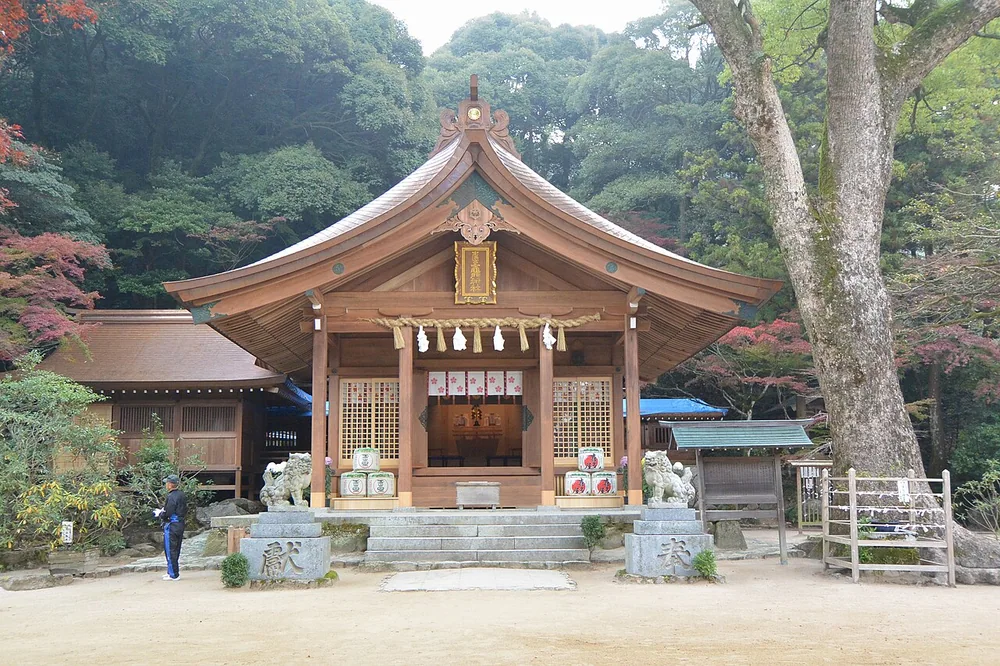
After getting off and entering the shrine precincts, you can first use the official precinct map to locate the chōzu (water for purification) and the water mirror, then head for the area before the deity. The order of the chōzu ritual as introduced by Kamado Shrine is to wash both hands first, then scoop water with both hands to rinse the mouth, and finally wash both hands once more. The water mirror comes after the chōzu: the shrine interprets the act of reflecting your own face as putting your mind in order and praying with a pure and honest heart. This is a good place to set aside a stretch of worship time without taking photographs; finish before moving on, and companions can each complete it at their own pace.
At the worship hall, the manner published by the shrine is to bow gently first, offer a monetary offering, then bow twice and clap twice, join the hands in prayer to convey thanks and wishes, bow once more, and finish with a gentle bow. Those visiting for the first time can memorise 'two bows, two claps, one bow' beforehand and concentrate on worship once at the front; holding a camera, sorting out bags and waiting for family can wait until after you have stepped back. If you are simply worshipping before the deity, completing this sequence is enough; for a formal prayer rite led by a priest, register at the amulet office instead — the arrangements are covered under the service times below.
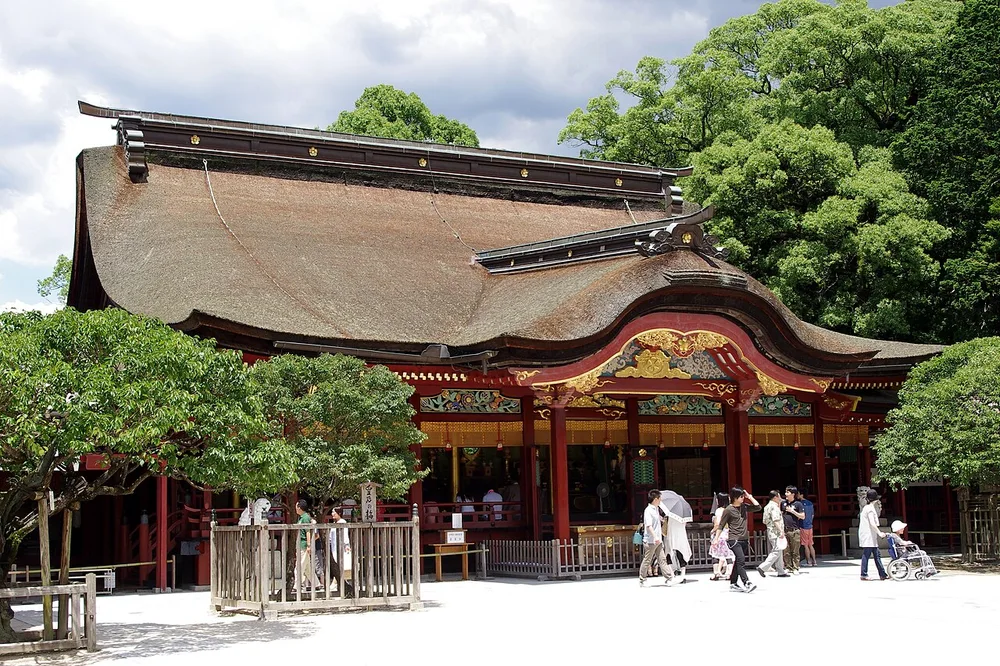
Looking at the buildings after worship, the details of the roof and timber structure readily catch the eye. The shrine records the present sanctuary as completed in 1927, in the nagare style in cypress with a copper-sheet roof, with repairs including re-roofing carried out in 2013. Those who want to compare buildings can start with the outline of the eaves and the relationship between the timber columns and the roof, then walk towards the amulet office in white and pink stone. The two are a walk apart within the precincts, yet their architectural language differs greatly: on one side, a traditional form continued in a modern-era sanctuary; on the other, contemporary interior design brought into the amulet-granting space.
The omikuji fortune slips can follow on from worship. In its precinct guide, the shrine treats the text of the fortune as a teaching for everyday life: after reading, you should take in its content and then tie it at the designated return place. Compared with looking only at the good-or-bad ranking, spending a few minutes reading your fortune in full comes closer to the shrine's own presentation. If a companion needs a translation, you can read it together somewhere that does not obstruct the walkway before completing the offering; this time also counts towards your stay at the lower sanctuary, after which you can decide whether to go to the amulet office or rest first at the stage.
Tamayorihime-no-Mikoto's enmusubi extends to family, friends and work too
The principal enshrined deity of Kamado Shrine is Tamayorihime-no-Mikoto. The shrine links the 'tama' in the name to the soul and 'yori' to mutual attraction and union in explaining its enmusubi (bond-forming) faith; the good bonds of which the shrine speaks cover romantic relationships between men and women, but also family, friends, work and nature. Those travelling with family, or preparing to change jobs, can understand worship in this broader sense. When choosing an omamori amulet, you can think first about your own wish and then look at the names and meanings; being single or a couple is only one of many reasons to visit.
'Hōyoke' (warding off directional misfortune) and 'Yakuyoke' (warding off ill fortune) connect to the position and history of Mount Homan (Mount Hōman) and Dazaifu. In its introduction, the shrine places Mount Homan in the demon-gate direction from the Dazaifu government hall, and recounts how people set out to sea climbed the mountain to pray for safe voyages and success in their undertakings; Saicho (Saichō), Kukai (Kūkai) and envoys travelling to the continent all appear in its account of the mountain's faith history. Today the formal prayer rite list covers moving house, changing jobs and new ventures, and the relationship between mountain and city, long journeys and daily life continues into these turning points of life.
The founding story should be read as the shrine's own tradition. The official account records that in 673, while the monk Shinren Shonin was practising asceticism in the mountains, the spirit of Tamayorihime appeared, and an upper sanctuary was afterwards built by order of the imperial court; the same page also separately describes ritual objects excavated beneath the great rock at the summit, including Wado Kaichin coins, the twelve imperial bronze coins (Kocho Junisen) and Nara sansai glazed pottery ware. The manifestation of the deity belongs to tradition, while the excavated objects are material clues for understanding early worship — each has its own place in the reading. Mount Homan was designated a national Historic Site in October 2013 for its historical and cultural value; learning this background at the lower sanctuary makes it clear why the official precinct introduction leads all the way up to the upper sanctuary on the mountain.
The story of the 'reunion tree' also sits within this context. Shrine tradition holds that Empress Jingu once planted a tree at the summit of Mount Homan, praying to meet loved ones again; the tree named 'Saikai' (reunion) in the precincts today, and the koi-mamori amulet, carry this wish forward. When you see the tree, the shape of its seed pods and the amulet introduction, the same story can be threaded together.
The 2012 amulet office: start at the round table, then look up for the cherry blossoms
The amulet office was designed by Masamichi Katayama (Masamichi Katayama) of Wonderwall and completed in 2012, and the shrine presents its concept as 'a standard for 100 years hence'. Here you can start with the round table at the centre: its shape is taken from a kamado cooking stove, bringing the imagery of the shrine's name indoors. White and pink stone make up the principal palette, with the walls clad in short strips of pink marble varied in length and position, which the shrine interprets as the separate wishes of those who visit. Reading the design from the concrete materials and their arrangement gives one more layer of understanding than treating the space merely as a pretty shop window for amulets.
Looking up, you can find the ceiling decoration of the shrine's cherry-blossom crest. The shrine also describes how the seasonal colours of fresh green foliage and autumn leaves are reflected into the interior; the pink stone indoors, the cherry blossoms overhead and the trees outside can be viewed together. The cherry blossom pattern remains visible outside spring — the crest keeps a seasonal plant present in an everyday space. Design lovers who linger here can shorten the later walk among the massha subsidiary shrines; if you only want to collect an omamori, once done move towards the viewing stage at the rear, where you can also see another designer's work.
The shrine's buildings are not all by one hand. The shrine credits the interior design of the amulet office to Masamichi Katayama (Masamichi Katayama), the overall design of the office building to Tsuyoshi Tanemura (Tsuyoshi Tanemura), a specialist in shrine architecture, and the stone bench and two-seater seat on the viewing stage to Jasper Morrison. Arriving here, you can use the copper-sheet roof of the worship hall seen earlier as a point of contrast, then look at the stone surfaces, round table and cherry blossom decoration of the amulet office, and finally at the outdoor seating in Aji stone (Aji stone); a short stretch holds design work at several different scales.
The amulet office also handles ofuda talismans, omamori amulets, ema plaques, goshuin seals and prayer applications. Worshipping first, then arranging collections or enquiries, separates looking at the space from getting things done. When someone is being served at the window, look at the buildings first from a position that does not get in the way; families travelling together can also agree to head to the viewing stage together once finished, letting those not choosing an amulet keep time to rest.
Besides the amulet office, the shrine office building and the Sanshūden assembly hall within the precincts were also newly built in 2012. The shrine introduces the Sanshūden as built with traditional methods combined with modern techniques, a purely Japanese-style space where parishioners, devotees and attendees of Shinto weddings wait for ceremonies. When looking at the buildings, you can understand their separate purposes from their exteriors; the Sanshūden is a waiting place for ceremonies, while this trip's rest stop is placed at the officially introduced viewing stage, making both the route and the purposes of use clear.
Amulets, goshuin and prayers: arrange them around two sets of service times
The amulet office is open from 08:30 to 18:00; registration for formal prayer rites runs from 10:00 to 16:00, at the same Ofuda and Omamori Amulet Office. Those who only want an omamori or a goshuin can plan around the amulet office hours; those applying for a formal prayer rite should place their arrival and application within 10:00 to 16:00. Arriving at the inner sanctuary at 09:30 in the morning lets you complete ordinary worship first, then ask at the window after 10:00; for an afternoon visit, complete the prayer rite first and then see the amulet office and the viewpoint, to avoid strolling to the window only after registration has closed.
For the hatsuho offering fee for formal prayer rites, the official website lists 5,000, 8,000 and 10,000 yen and above, with companies and groups from 10,000 yen. Prayer items include the achievement of good bonds, hōyoke for moving house or changing jobs, yakuyoke, household safety, safe childbirth, Shichi-Go-San and more. This fee is the hatsuho offering for the prayer ceremony; choosing an omamori is a separate matter, handled as a grant item. Deciding before you set out whether you want worship at the hall, one omamori, or an application for a prayer ceremony makes it easier to plan both budget and length of stay.
The reunion fruit on the Koi-mamori Musubi-no-Ito (koi-mamori, 'threads of connection') amulet imitates the seed pods of the reunion tree; the shrine explains that when returning it, it should be brought to the 「戀守り むすび所」 (koi-mamori musubi place) beside the reunion tree in the precincts. When giving it to someone important, you can note this origin and the return location alongside it. The 仕事結び守り (work-connection amulet) explains its prayer for work and livelihood through the idea of 'musubi' — the generating spirit of connection; the てるてる晴れ守り entrusts wishes for bright, serene days, the いちご守り (strawberry amulet) takes its meaning from ichigo ichie, 'one time, one meeting', and the Homan-sama depicts the principal enshrined deity Tamayorihime-no-Mikoto in Hakata doll form. Choose a type according to your purpose of prayer first, then look at the actual items at the window.
Ema plaques can follow on from worship too: one design carries the imagery of the kamado stove and cherry blossoms, while the paired zodiac ema were designed by Makoto Kagoshima (Mutsumi Kagoshima), a ceramic artist from Fukuoka, with two animals keeping company echoing the bond-forming theme. If you want to write down a wish, set aside a stretch of time in which you can write quietly; there is no need to collect one of every design. Goshuin seals, omamori and ema are all handled in the same place, so you can complete everything in one visit before leaving.
To enquire in advance about prayer rites or a route for visitors using mobility aids, you can telephone the shrine on 092-922-4106, with the official telephone service listed as 09:00 to 17:00. When noting things down, write one line each for the telephone service, the amulet office and prayer registration: 09:00 to 17:00, 08:30 to 18:00, 10:00 to 16:00. Use the telephone hours for enquiries, the amulet office hours for on-site collections, and the registration hours for formal prayer rites; those arriving in the evening should in particular first check which service they need.
Sit a while behind the amulet office, and pick the smaller shrines by interest
The viewing stage sits behind the amulet office, and the official introduction notes that it looks out over the Dazaifu townscape. Here you will find stools and a two-seater bench made of Aji stone and designed by Jasper Morrison, a good place to pause after praying and shift your gaze from the buildings to the town. If a companion wants more time over the amulets, agree to meet at the stage once they have finished; those more interested in the architecture can compare how the indoor stonework and the outdoor stone seating are each put to use. The rest itself can occupy part of your stay — there is no need to start calculating the next photo stop the moment you sit down.
Among the branch shrines on the grounds, start with the Saikai-no-Ki (Reunion Tree) or the Ogatama-no-Ki (tree of spirit-summoning). The former continues the story of prayers for reunion and the love amulet; the latter is read おがたま in Japanese, and the shrine explains the name as a summoning of spirits, linking it to the myth in which the deity Ame-no-Uzume-no-Mikoto danced holding tree branches and Amaterasu Omikami emerged from the heavenly rock cave. The official notes list white flowers in early April and fruit in autumn in a typical year, so you can look at the tree's shape, flowers or fruit according to the season. Plants, myth and amulets echo one another across the same grounds; taking time over one or two spots suits this half-day better than rushing through the numbers on the map.
If you are interested in the martial arts, look for the Muso Gonnosuke Shrine on the map. The shrine relates how Muso Gonnosuke, in the early Edo period, trained on Mount Hōman and founded the Shinto Muso-ryu school of staff arts, and enthusiasts still carry on that faith with practice before the gods today. The Gokoku-sha (Five Grains Shrine) shrine takes grain harvests, sprouting and people resolving to move forward as its theme, while the Shikibu Inari Shrine connects the deity Uka-no-Mitama to rice ears and everyday livelihoods. If you want to understand faith as daily life, begin with one of them and read the on-site explanations.
The Aikyo-no-Iwa (Affection Rock), the Kofuku-no-Ki (Tree of Happiness) and the 縁結びこより paper prayer ties each have their own way of praying for love, while the Susa-sha Shrine links good matches and family harmony to the myth of Susanoo-no-Mikoto and Kushinadahime. When visiting together, each person can simply choose the spots they wish to pray at. Put two places with similar appeal into the same stretch of walking, leave the remaining time for resting at the stage or waiting for the return bus, and the trip will not feel like a race between numbered stops.
The paper-strip prayers carry a local history of their own. The shrine explains that in the Edo period there was a custom called the 'sixteen visit', in which young men and women reaching the adult age of the time climbed Mount Hōman with their parents and tied their wishes, written on paper strips, to trees near the summit; men prayed for standing in the world and a livelihood, women for a good match and happiness. The 縁結びこより you see today at the Kofuku-no-Ki (Tree of Happiness) tree connects to prayers made at these turning points in life. The shrine also explains that priests perform a purification and prayer over the paper strips every morning. If you would like to write one at the lower shrine, read this history first, then set down your own wish.
Cherry blossom, green shade and autumn maple: local faith seen through trees
The cherry blossom is the sacred crest of Kamado Shrine, and it recurs across the amulet office ceiling, the votive plaques and the plants of the grounds. The shrine relates that Mount Hōman has been famous for cherry blossoms since ancient times, and the grounds hold cherry trees dedicated for marriages and other milestones in life. Visiting in spring, pray first and then leave extra time to look at how the cherry trees relate to the buildings; if a companion mainly wants to collect an amulet, meet outdoors once that is done. Beyond the blossom, the official description of the spring festivals also mentions the azaleas — the seasonal scenery and the faith activities of the spirit-binding festival connect here.
In the fresh green of early summer, focus on the amulet office and the viewing stage. The shrine's description of the amulet office notes how the green outside enters the interior; looking from the round table and the cherry-blossom decorations outwards gives a different way of seeing than autumn. The festivals page also sets out events such as the May Mineiri mountain training mountain ascent and the Saito Daigomaku fire ritual rite, showing how the mountain-ascetic faith of Mount Hōman continues today. If this visit covers the lower shrine only, complete the half day with the grounds and a rest; the mountain ascent and summit festivals in the hills have their own venues and arrangements.
In autumn the foliage typically changes colour from mid to late November, and the official listing counts some 300 deciduous trees on the grounds, including ginkgo and maple. Worth a closer look is how these trees relate to the Momiji-age custom: each spring, residents of the surrounding area in an unlucky calendar year receive a purification and dedicate maple trees to be planted on the grounds. The autumn colour you see connects to the spring dedications and the turning points in residents' lives. As you follow the approach looking at the trees, you can also compare the maple with the exteriors of the worship hall and the amulet office, rather than only hunting for the reddest tree.
If autumn colour is the goal, settle the daytime prayer visit and the return leg first, and fit the leaf-viewing stops between two buses. The Uchiyama return ends at 18:30, so plan maple-viewing for the daytime. If you mainly want to take the autumn maples slowly, arriving in the morning and returning to Dazaifu for lunch before noon usually makes it easier to keep a full stretch of time on the grounds than catching the last few outbound services in the evening.
Kamado Shrine alone, or linked from the Tenmangū area's Miyamae stop
For a morning with Kamado Shrine only, you can use Dazaifu 09:22→Uchiyama 09:30 and Uchiyama 11:10→Dazaifu 11:19 as a pair. After getting off at 09:30, walk through the grounds, the water basin and the water mirror, then to the worship hall; after praying, look at the amulet office, choose one or two branch shrines, and finish resting at the viewing stage. This is an editorial suggestion built on the official timetable, with the 100 minutes divided between everyone's walking pace and waiting at the window. If you plan to board at 11:10, be back at the stop before then — do not treat 11:10 as the time to rise from the stage.
If you have arranged a formal prayer rite, pray first after arriving at 09:30 and complete the reception formalities when they open at 10:00; afterwards, choose the amulet office or the stage according to the time left, and the branch shrines can be dropped. If there is a queue at the window or you want to stay longer, check the return timetable before changing buses. What changes then is the return leg and the content of your stay, so adjust other afternoon bookings together. Lunch can follow the 11:19 arrival back at Dazaifu: finish the bus round trip first, then decide how long to stay along the approach.
Those going to Tenmangū first should walk to Miyamae station after praying and resting, and catch the bus to Uchiyama. In the afternoon, a weekday example is Miyamae 13:24→Uchiyama 13:30, and on Saturdays, Sundays and public holidays Miyamae 13:25→Uchiyama 13:31; the returns can be 15:10→Dazaifu 15:19 and 15:05→15:14 respectively. The walk from Tenmangū to Miyamae, waiting at the stop and entering the shrine after getting off at Uchiyama all belong in the travel time. If you want to browse the main approach afterwards, alight at Dazaifu station and rework your walking route there.
If you are choosing Tenmangū and Kamado Shrine on the same day, it is best to save an in-depth visit to the Kyushu National Museum for another slot; if a special exhibition is the main purpose, keep the museum and move Kamado Shrine to another day. Both interests deserve a full visit of their own. For the Nishitetsu and Hakata bus options from Fukuoka to Dazaifu, and the routes for Tenmangū and the museum, continue with half-day and full-day plans for Dazaifu Tenmangu and the Kyushu National Museum, and pick up this Uchiyama line section once you have chosen the day's theme.
チャンネル九州塾 introduces Dazaifu Tenmangu, Kamado Shrine, plum-branch cakes and a traditional-house café, matching an itinerary that visits both shrines in one day.
Tired, raining, or wanting to wait for the evening light: decide how to get back first
When you are tired of walking, first drop the branch-shrine detours and keep the worship hall, the amulet office and the return; once you have done what you came to do, head back to the Uchiyama stop to wait. The roughly 40-minute walk between Dazaifu station and the shrine can be a deliberate outbound choice for those who enjoy walking, but after rain, fatigue or a missed bus, there is no need to turn it into an emergency return plan for the whole group. If you need a taxi, follow the contacts for the Dazaifu Taxi company or Futsukaichi Kotsu listed on the shrine's transport page, and ask first whether a car can be dispatched at that time, where pickup would be, and how long the wait would be before deciding how to leave.
The まほろば bus has a ramp for wheelchair boarding, and the city lists a capacity of 34 passengers. Wheelchair users and families with pushchairs can use this information to plan the bus section; getting around the grounds should be judged separately for each place you actually want to reach — the worship hall, the amulet office and the viewpoint. If steps and slopes are a concern, explain to the shrine before you travel what you would like to complete and what aids you use, and ask which routes are walkable. Companions can also split up for the branch shrines and reunite at the main stop, so that everyone keeps a visit that suits them.
In light rain, shorten the walk under the trees and leave more time for the amulet office; on wet stone surfaces or fallen leaves, allow extra time for the walk back to the stop. In snow, a typhoon or other service disruption, check the Nishitetsu service status and approach information linked from the city's natural disaster page, and if services are suspended move Kamado Shrine to another day. Those waiting for the evening light should treat the 18:30 last return from Uchiyama as the boundary before deciding how long to stay at the stage: pack up, walk back to the stop, catch the 18:30 bus, arrive at Dazaifu station at 18:38, and continue with your own dinner and transport back to Fukuoka.
A few useful answers
Where can I catch the bus to Kamado Shrine, and what is the fare?
Catch the Mahoroba bus to Uchiyama outside the Fukuoka Bank branch near Nishitetsu Dazaifu Station. You can also board at Miyamae near Dazaifu Tenmangu. Ride to the terminus, Uchiyama, for ¥100 each way if you’re of primary school age or older.
Which buses should I take for a morning at Kamado Shrine’s lower shrine?
On the 2026 weekday, weekend and public holiday timetables, the 09:22 from Dazaifu Station reaches Uchiyama at 09:30. The 11:10 back gets in at 11:19 and gives you 100 minutes at the lower shrine. The last bus back leaves at 18:30, with no service from 1 to 3 January.
What are the hours for amulets, goshuin and formal prayers at Kamado Shrine?
You can get amulets and goshuin stamps at the shrine counter from 08:30 to 18:00. Go to the same counter from 10:00 to 16:00 to request a formal prayer ceremony, with offerings for individuals starting at ¥5,000.
When can I see the autumn colours at Kamado Shrine?
Autumn colour usually arrives in mid to late November. The grounds have roughly 300 deciduous trees, including maples and ginkgos. Visit in the morning to stroll along the shrine paths before taking the bus back to Dazaifu for lunch.
Official information and references
Sources used in this guide.
- Kamado Shrine: grounds map and how to worship
- Kamado Shrine: access information
- Dazaifu Tourist Association: from Dazaifu station to Kamado Shrine (1 October 2026)
- Kamado Shrine: history and faith
- Kamado Shrine: Mount Hōman, the upper shrine and the lower shrine
- Kamado Shrine: prayer reception and offering fees
- Kamado Shrine: charm offerings and the 2012 amulet office
- Kamado Shrine: seasonal festivals
- Dazaifu City: timetables by route (revised 1 April 2026)
- Dazaifu City: まほろば bus usage guide (updated 1 April 2026)
- Dazaifu City: natural disaster suspensions and service status
- Uchiyama line to Kamado Shrine: weekday timetable
- Uchiyama line to Kamado Shrine: Saturday, Sunday and public holiday timetable
- Uchiyama line from Kamado Shrine: weekday timetable
- Uchiyama line from Kamado Shrine: Saturday, Sunday and public holiday timetable
- チャンネル九州塾: Dazaifu and Kamado Shrine day-trip video