Explore the buildings and Fuji pilgrimage groups of Kitaguchi Hongu Fuji Sengen Shrine, then Oshino Hakkai’s springs, inscribed stones and old houses. Distinguish three Asama shrines and A1/Fujikko bus stops, with the paid garden, family routes and a rainy-day museum.
- Region & Focus
- Lake Kawaguchiko and Mount Fuji
- Reading Scope
- 30 min read · 17 chapters · 7 Q&As
- Official Verification
- 31 official sources checkedUpdated 9 November 2026
- Key Topics
- ItinerariesRail travelTravel budget
Chapter Route Map (tap any stop)
- One shrine and Oshino: give the day to visible differences
- Locate the three Asama shrines separately on the map
- Kitaguchi Hongu: from foothill worship to the Yoshidaguchi starting point
- Pause at the worship hall: three main halls and Edo-period building work
- Fuji-ko and oshi: foothill life to explore on the station route
- Shrine to Oshino: choose an A1 that stops at Sengen Jinja-mae
- At Oshino, read pond names and stones before looking below the surface
- How springs form and become pilgrimage sites
- Waku-ike, Okama-ike and Choshi-ike: vary what you look for
- Sokonashi-ike lies inside the paid garden: choose the old house and pond together
- Kagami-ike, Shobu-ike and Deguchi-ike: extend the walk or finish
- Put lunch, rest and the return stop into the middle of the walk
- Back to Mt. Fuji Station: keep a later option, rather than targeting the last bus
- Use Fujisan Museum to keep the worship theme in rain
- With children or a wheelchair, choose ponds where you can stop comfortably
- If choosing Arakurayama, make Chureito the main subject
- Keep Kawaguchi Asama for a north-shore day: fire rites, cedars and current paths
- Quick Q&A
For shrines and springs at Mount Fuji’s foot, spend the morning at Kitaguchi Hongu Fuji Sengen Shrine in Kamiyoshida and the afternoon at Oshino Hakkai. This works better than chasing three Asama shrines in a day. The first shows how worship from the foothills developed into climbing pilgrimages. The second draws attention to pond beds, inscribed stones and purification circuits. Ordinary route buses connect them. Check whether your service stops at Sengen Jinja-mae, then plan the walk backwards from the return bus.
One shrine and Oshino: give the day to visible differences
Kitaguchi Hongu and Oshino suit visitors interested in shrine architecture, Fuji worship and water, who want time in each place. Kitaguchi Hongu is in Kamiyoshida, Fujiyoshida; Oshino Hakkai lies east in Oshino village. Use Mt. Fuji Station as the arrival and departure point to link foothill worship with a spring walk. Keep lake views, shopping and illuminated autumn leaves for another day. Every visit need not begin with a detour to Lake Kawaguchi’s north shore.
Start with 60–90 minutes for Kitaguchi Hongu and two to three hours for the Oshino ponds and garden, plus lunch, waiting and the station return. This is an allowance for slow exploration. For all eight ponds, detailed inscription reading or an old-house visit, leave extra time after lunch rather than adding only driving times on a map. If reaching Mt. Fuji Station near noon, choose the shrine and an indoor exhibition, or Oshino alone. Either gives more than one quick photograph at each.
If your main wish is Chureito Pagoda with Mount Fuji, start at Shimoyoshida Station and make Arakurayama the morning focus. If staying on Lake Kawaguchi’s north shore and interested in seven cedars and fire-quelling worship, choose Kawaguchi Asama Shrine. The three versions have different stations, slopes and waiting costs. For accommodation, the autumn-leaf festival and north-shore buses, see Lake Kawaguchi seasonal stays. Do not stack that lakeside route onto this day.
Explore the buildings and Fuji pilgrimage groups of Kitaguchi Hongu Fuji Sengen Shrine, then Oshino Hakkai’s springs, inscribed stones and old houses. Distinguish three Asama shrines and A1/Fujikko bus stops, with the paid garden, family routes and a rainy-day museum.
Locate the three Asama shrines separately on the map
Kitaguchi Hongu Fuji Sengen Shrine is written 北口本宮冨士浅間神社 and stands at 5558 Kamiyoshida. Kawaguchi Asama Shrine is at 1 Kawaguchi, Fujikawaguchiko; its name is read “Asama”. Arakura Fuji Sengen Shrine is at 2-4-1 Asama, Fujiyoshida, near Shimoyoshida Station. Save each full Japanese name and address to avoid navigation selecting another shrine called Asama Jinja.
All three relate to Fuji worship, but their main subjects differ. At Kitaguchi Hongu, the approach, halls and Yoshidaguchi starting point explain climbing worship. Kawaguchi Asama’s main hall, worship hall and seven cedars relate to fire-quelling rites after the Jogan eruption. At Arakura Fuji Sengen, worship first, then decide whether to climb to the Chureito viewing area. Treat each as a visit with its own subject rather than collecting three similarly named landmarks.
The public-transport main route uses Kitaguchi Hongu and Oshino because ordinary services travelling in the same direction can stop at both Sengen Jinja-mae and Oshino Hakkai. Kawaguchi Asama is elsewhere, not a nearby walk-on visit. Arakurayama adds travel to Shimoyoshida and climbing. Driving reduces waiting but does not remove worship, parking, walking or boarding time. It need not turn the plan into all three shrines.
| Shrine | Transport reference | What to spend time on |
|---|---|---|
| Kitaguchi Hongu Fuji Sengen Shrine | Mt. Fuji Station / Sengen Jinja-mae | Approach, three main halls, Fuji-ko and the Yoshidaguchi starting point |
| Kawaguchi Asama Shrine | Kawaguchi area on the lake’s north shore / Kawaguchi Kyoku-mae | Fire-quelling worship, nagare-zukuri main hall and seven cedars |
| Arakura Fuji Sengen Shrine | Shimoyoshida Station / Arakurayama | Worship first; add 398 steps and time for Chureito |
Kitaguchi Hongu: from foothill worship to the Yoshidaguchi starting point
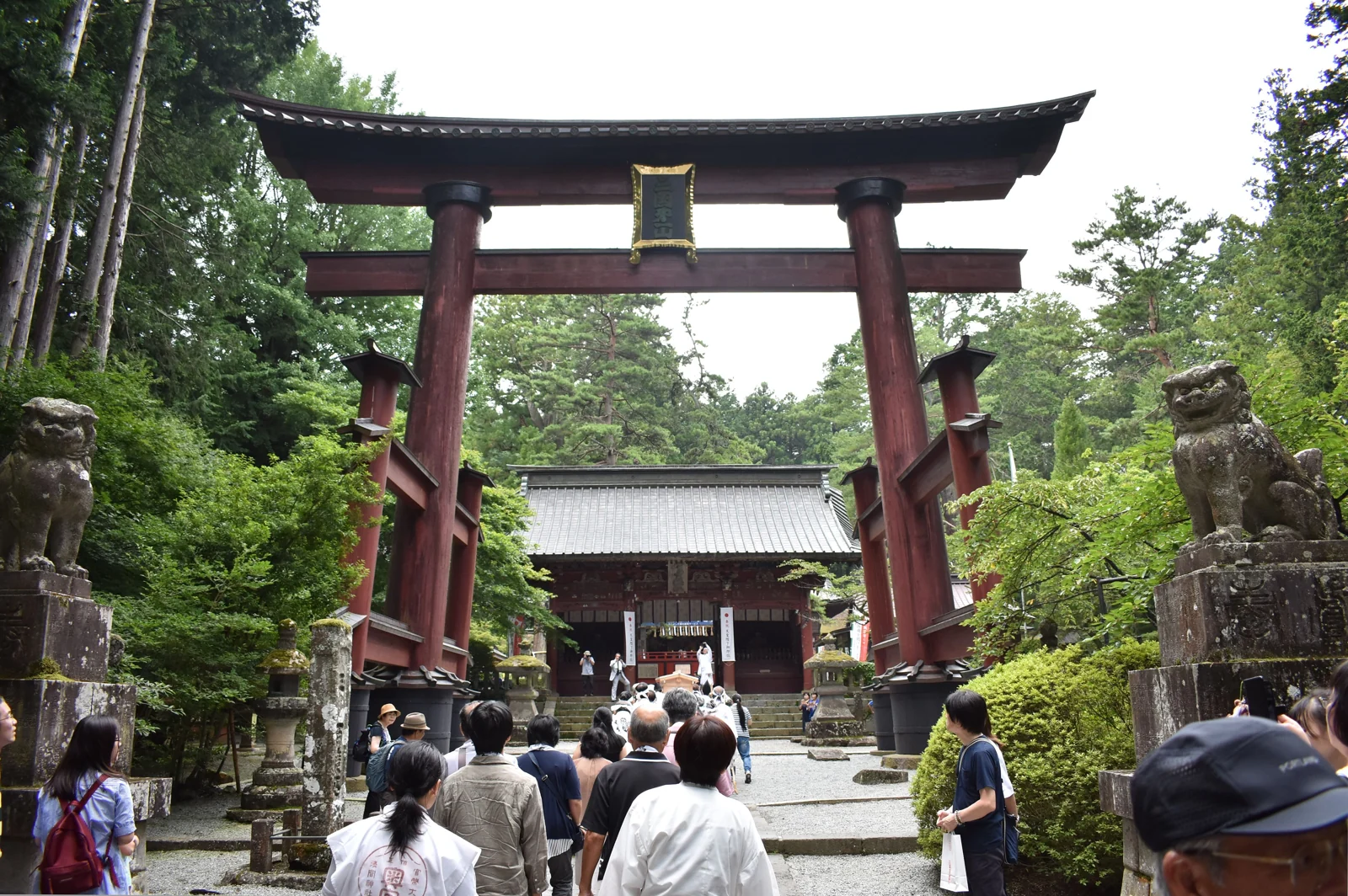
The “north entrance” in Kitaguchi Hongu refers to the Yoshidaguchi climbing route; “Hongu” identifies the main shrine at its beginning. The shrine’s own FAQ explains its foothill worship role and starting-point position, and says it has no summit inner shrine. A visit lets you understand the mountain’s sacred character from its base. You need not rush to the Fifth Station the same day to complete this part of the religious route.
The shrine worships Konohanasakuya-hime, Ninigi-no-Mikoto and Oyamatsumi. Konohanasakuya-hime connects with fire, safe childbirth and belief in Fuji’s goddess. Ninigi is her husband and Oyamatsumi her father. This family relationship gives the deities more substance than simply calling the shrine a “power spot”. Worship before the hall, then look at plaques and buildings, keeping photographs separate from the worship flow.
The shrine history describes early worship as looking towards and venerating Fuji from its foot. As Shugendo and Fuji-ko developed, climbing increasingly became prayer, known as tohai. Walking from the approach to the halls and climbing-route starting point helps explain that relationship. If today is a precinct visit, finish within the shrine. Roads into the mountain belong to a separate hike needing time and equipment.
Pause at the worship hall: three main halls and Edo-period building work
The great torii and woodland form the entrance impression, but slow down for the hall group. The official history and architecture guide dates the surviving eastern main hall to Takeda Shingen’s rebuilding in 1561, the western main hall to 1594 and the present main hall to 1615. All three are nationally designated Important Cultural Properties. They are separate buildings, not three names for one. Identify their eastern, western and present-main-hall positions.
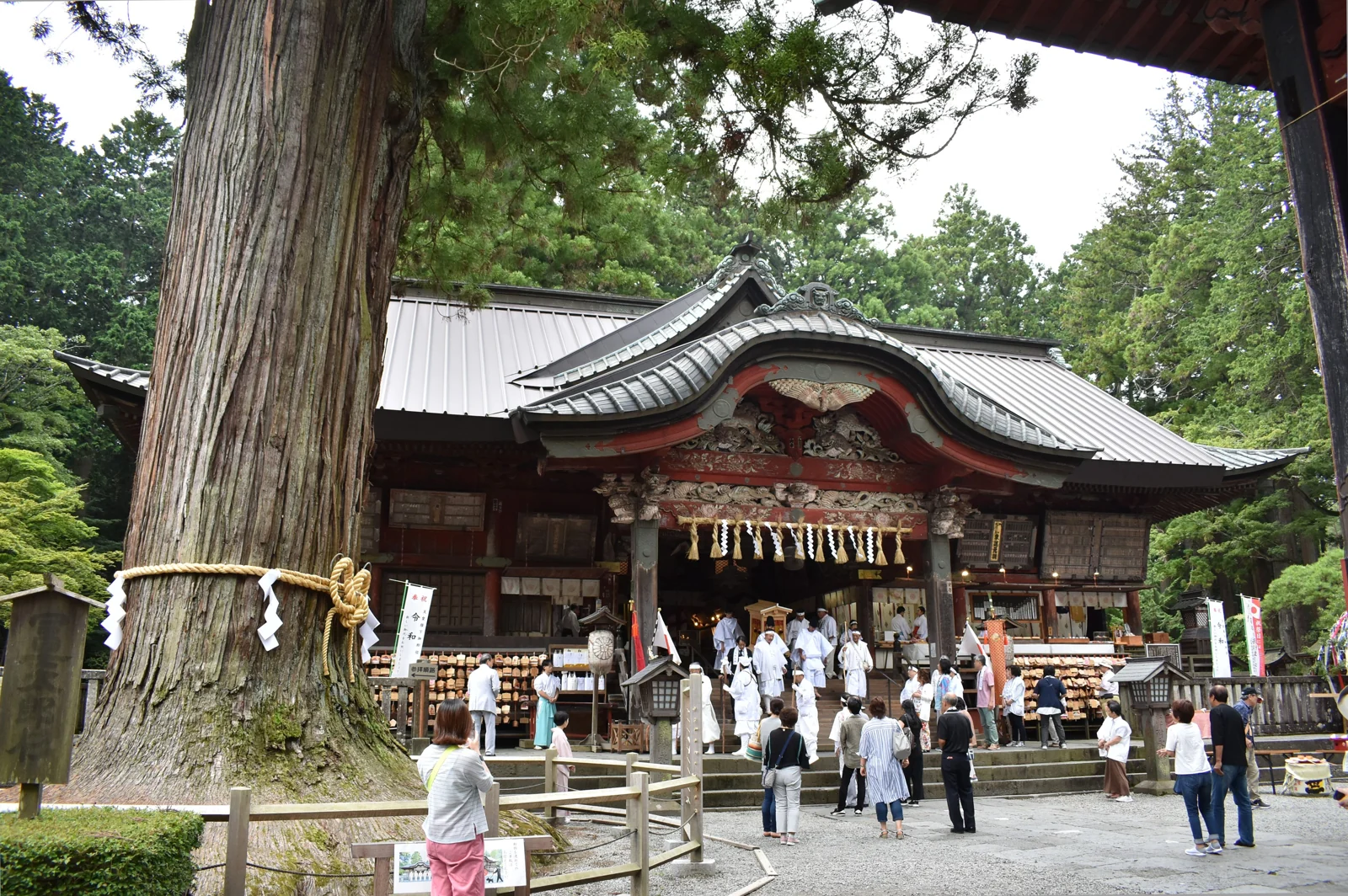
The eastern and western halls use nagare-zukuri, while the present main hall has an irimoya roof and a karahafu entrance canopy. The connected offering and worship hall joins the main hall in what the official guide calls gongen-zukuri. Without knowing the terms, compare roof projections and how the worship position connects to the hall behind, then look at carvings and eaves. Open worship areas provide plenty to see without crossing barriers for a closer look.
Edo-period work promoted by Murakami Kosei gradually shaped today’s buildings and grounds. Fuji worship here leaves traces of finance, craftsmanship and organised believers as well as a summit destination. Companions who mainly want a walk can rest by the approach and large trees while architecture enthusiasts take another look. Extra morning time is often best spent here rather than immediately at another shrine.
Production photography has a separate process. Kitaguchi Hongu asks media to submit their name, proposal and contact details, and to report at the amulet office on the day. For work photography, apply before allocating time. Ordinary worship and photographs should leave routes clear and follow signs. Give participants priority during rituals. This keeps the halls functioning as an active local religious place while visits follow the existing routes.
Fuji-ko and oshi: foothill life to explore on the station route
Fuji-ko are groups united by Fuji worship. The shrine explains that long-distance climbing once took considerable time and effort, so groups pooled money and sent representatives carrying others’ prayers. Climbing was both individual practice and a community undertaking. With this context, donations, hall construction and foothill streets become related parts of one history.
Oshi provided accommodation, religious instruction, prayers and other mediation for believers. The shrine’s Fuji-ko guide identifies the Kanadorii as the entrance and boundary of the oshi quarter, east of Mt. Fuji Station. Use it to recognise Kamiyoshida on the walk to or from the shrine. For oshi life in depth, allow exhibition time rather than treating every roadside home as a freely accessible museum.
This also preserves the theme in rain: make a short morning shrine visit, then see Fuji-ko, oshi and the Yoshida Fire Festival in the Fujisan Museum’s permanent exhibition. Outdoor observations connect with objects indoors. History enthusiasts can replace Oshino with the museum even in sunshine. With children, use two questions: who hosted climbers, and how did people climb together? This encourages more participation than reciting foundation dates.
Shrine to Oshino: choose an A1 that stops at Sengen Jinja-mae
The route map linked from Fujikyu’s current Fujiyoshida, Oshino and Lake Yamanaka touring page shows ordinary routes, Fujikko and the Oshino Hakkai express together. Arrows mean the bus passes without stopping. F1 and F2 Fujikko show arrows at Sengen Jinja-mae. A shrine photograph on the page does not mean every touring bus stops at its entrance. To reach Oshino from the shrine, choose an A1 Gotemba Line service routed via Oshino Hakkai.
As of 27 October 2026, the June 2026 route map linked by the website still carries a timetable marked revised on 7 April 2025. Outward examples include A1 from Sengen Jinja-mae at 10:14, reaching Oshino Hakkai at 10:23, and another at 11:44, arriving at 11:53. These are not regular hourly departures. At the stop, check direction and routing. Board for Oshino, rather than relying only on “Gotemba” as the destination.
Yamanashi’s official tourism information gives about 20 minutes on foot from Mt. Fuji Station to the shrine. Walk this short section in the morning to avoid waiting separately for a brief bus ride. For 60–90 minutes at the shrine and the 10:14 A1, use arrival at Mt. Fuji Station around 08:30 as the local planning assumption. If long-distance travel arrives later, use 11:44 and shorten the distant ponds or garden. For Tokyo reservations, see Fuji Five Lakes highway bus stations and tickets.
At Oshino, read pond names and stones before looking below the surface
The eight ponds are Deguchi-ike, Okama-ike, Sokonashi-ike, Choshi-ike, Waku-ike, Nigori-ike, Kagami-ike and Shobu-ike. They are spring landscapes fed by underground water associated with Fuji, and places of Fuji belief and purification pilgrimage. Oshino village’s guide explains nature and belief together. Identify each pond by name rather than counting every clear pool beside the shops among the eight.
Stones beside the ponds record names, purification order, dragon kings and waka poems, connecting each stop to the pilgrimage. A sightseeing walk can follow your arrival point, access and energy, while numbers on the stones preserve a religious order. Read one inscription fully, then compare the next. You need not repeat the same photograph at eight pools simply to collect numbers.
Depth, springs and aquatic plants offer different things to observe. At small ponds, use legal paths to see spring openings. At larger ones, look at shorelines, trees and reflections. When wind moves the surface, notice details still visible below. The village explicitly asks visitors not to throw rubbish or coins into the ponds, because depth and temperature make retrieval difficult. Keep prayers within worship practices and leave the pools unchanged.
How springs form and become pilgrimage sites
The village education board’s heritage-component guide describes the water system more precisely. Recent investigations identify underground water from Fuji and from the foothills between Mount Shakushi and Mount Ishiwari. Permeable layers in volcanic formations of different ages and deeper pressurised groundwater produce springs in different ways. Moving plants in a small pond and sand-bed springs at Choshi-ike reveal parts of this underground system.
This adds another way to look: pond area, depth and river connections differ. Okama-ike is small with deep-blue water below. Sokonashi-ike lies among trees and is listed at 1.5 m deep; large Deguchi-ike at 0.5 m. Separate depth from surface area when choosing viewpoints. Shallow shorelines, plants and flow matter too. The village’s temperature and discharge figures are compiled reference data. On site, observe current colour and movement rather than checking a number at every pond.
The connection to Kitaguchi Hongu lies in purification before climbing. The village records that Taiga-ko revived the former eight lakes as purification ponds in 1843, making them widely known among Fuji-ko across Kanto. Stones and pilgrimage order brought springs into climbing preparations. After a morning shrine visit, Oshino connects foothill worship, ascent and water purification, explaining the ponds’ cultural value.
Old houses, rivers and surrounding land use also belong to this relationship. The village links water scenery and systems with belief and rural livelihoods. A museum’s silk-farming and agricultural tools add village life beyond the tourist pools. With little time, watch one pond, read one stone and walk one village section. This already gives several layers without filling the afternoon with distant extra sights.
Waku-ike, Okama-ike and Choshi-ike: vary what you look for
Waku-ike faces the shops, with a watermill opposite, making a useful arrival landmark. Look below the surface from the open bank, then move away from the busiest photography point towards other ponds. Leave lunch and shopping for the return. With only an hour, seeing Waku-ike and nearby accessible ponds at ease still gives a complete spring walk.
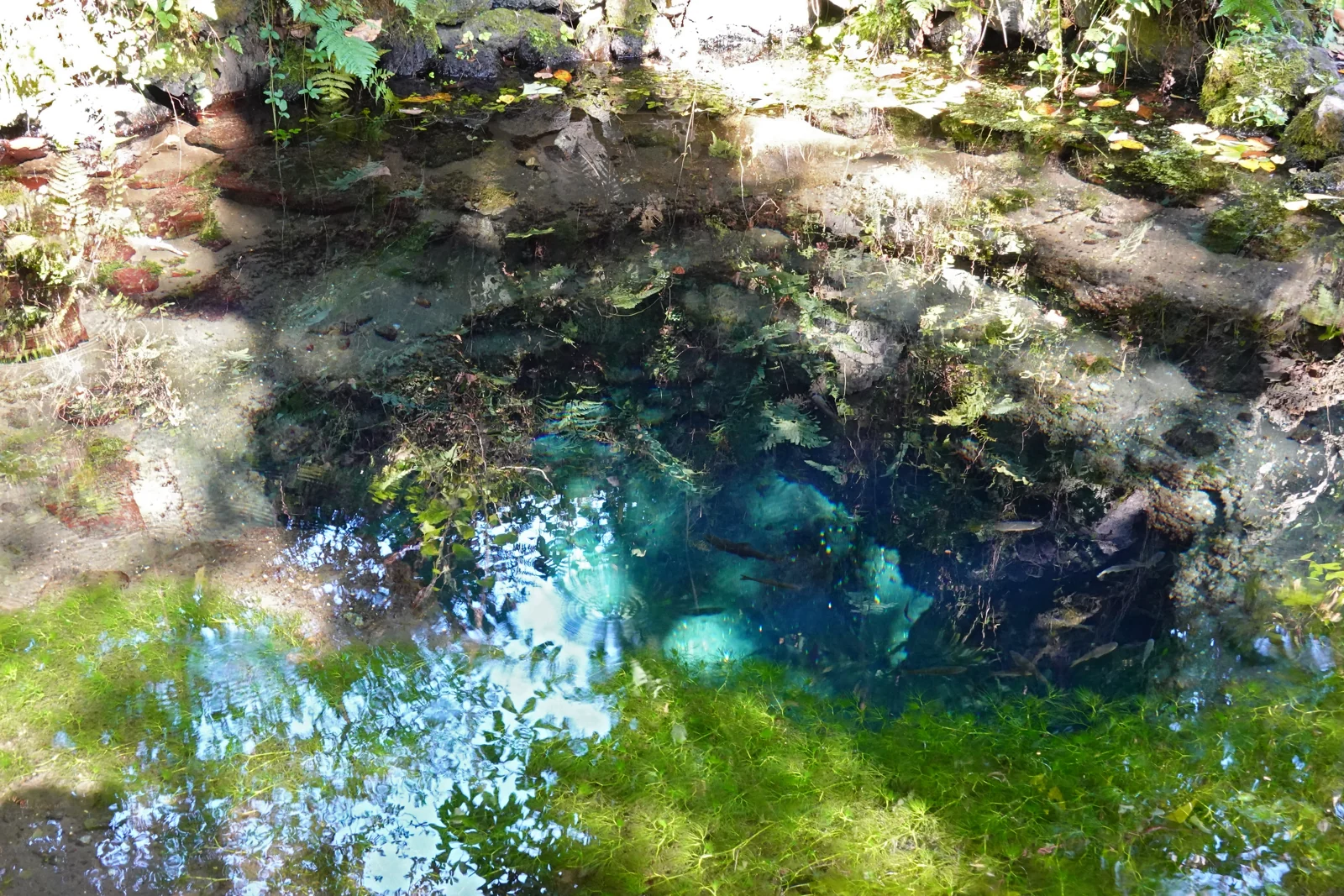
Okama-ike is the smallest of the eight. The village lists 24 square metres and a depth of 4 m. Look for deep blue beneath the small surface and moving water plants. Access involves steps. Wheelchair users can meet companions at a passable point above while others visit. The blue spring opening in photographs is only part of the pond. Leave room for people passing.
Choshi-ike sits in grass beside the Ahara River. The village highlights springs visible in its sandy bed. Moving from broad reflections to tiny upwellings helps children find something different. Nigori-ike connects to the river, and the official guide says well water now flows into it. Its name does not guarantee murky water today. Read some stones and watch some flow rather than choosing stops only by the bluest pond.
Sokonashi-ike lies inside the paid garden: choose the old house and pond together
Sokonashi-ike is within Hannoki Bayashi Museum’s grounds. Pass through the building displaying old household objects and continue into the trees to find it. Distinguish the entrance carp pond and garden water features from Sokonashi-ike itself. Stopping for photographs just inside the entrance misses the third pilgrimage site. Its wooded setting rewards a slower look at the surface and vegetation.
The museum page lists 09:00–17:00 with irregular closures, including possible closure for bad weather or family ceremonies. Admission is ¥300 from junior high school age, ¥150 for primary school pupils and ¥100 from age one through kindergarten. Match young children to their actual age and school stage rather than using one child rate for all. Sokonashi-ike follows the museum’s access hours, unlike other outdoor ponds visible early or late.
The Watanabe family house dates from the late 18th century. Displays include furniture, arms, old documents, silk-farming objects and agricultural tools. Entry combines springs, village and local life. Without interest in the house, or close to departure, spend time at outdoor ponds instead. Two adults and one primary school pupil pay ¥750, listed separately from transport. Pond paths are unpaved and outdoors. The whole garden is not a roofed heavy-rain shelter.
Kagami-ike, Shobu-ike and Deguchi-ike: extend the walk or finish
Kagami-ike’s name relates to Fuji’s reflection. The village describes the inverted mountain as visible when conditions suit. Look at the actual water and mountain before staying longer. Under cloud, continue with stones and surroundings. Shobu-ike east of Kagami-ike shifts attention to waterside plants. It suits plant enthusiasts who can manage the surface. The tourism association describes poor approach conditions that make wheelchair passage difficult.
Deguchi-ike is the largest pond and the only one clearly separated from the main cluster. There are no shops around it; woodland and Deguchi Inari Daimyojin stand behind. The village recounts climbers purifying themselves with its water and carrying water uphill, hence its other name, Shojin-ike. Allow separate time if pilgrimage interests you. For an ordinary half-day, focus on the cluster rather than making a late detour merely to reach eight.
On arrival, decide about Deguchi-ike before choosing lunch and museum order. For all eight ponds, start earlier in daylight because Sokonashi-ike depends on museum hours. If a path is muddy, companions are tired or the museum closes, save remaining ponds for another visit. This changes the walk, while the return keeps its chosen station direction. Do not first look for a bus after reaching a distant pond.
Put lunch, rest and the return stop into the middle of the walk
Shops and places to eat sit near the central pond cluster. Put lunch in the middle of the walk. Identify the return stop first, then see ponds and eat. Afterwards, choose the old house or distant Deguchi-ike according to energy. If places are full, prioritise food and rest and omit extensions. Do not treat an unseated lunch as a fixed half-hour block connecting to the only bus you can catch.
Separate long-distance travel, local buses, lunch, museum and shopping. Fujikyu’s current page lists the Fujiyoshida–Oshino–Lake Yamanaka common Free Coupon at ¥1,800 adult or ¥900 child for one day, and ¥2,200 or ¥1,100 for two days. Adults are junior high school age and above; children are primary school pupils. It covers specified touring and ordinary routes. For only a few rides, compare actual single fares first. Buying a pass need not add a loop around Lake Yamanaka.
The route map says the common pass is valid on F3 Oshino Hakkai express, but excludes the direction from Yamanakako Asahigaoka towards Gotemba. A shared map does not mean every coloured route is covered to its endpoint. Regular touring buses need no reservation; they differ from reserved Tokyo highway buses. Arrange storage at your own arrival or departure station for larger bags and keep pond walks light.
Back to Mt. Fuji Station: keep a later option, rather than targeting the last bus
Read across the Oshino Hakkai row for the return. The timetable currently linked by the official site lists A1 at 14:26, Sengen Jinja-mae 14:36, Mt. Fuji Station 14:47 and Kawaguchiko Station 15:00. F3 leaves Oshino at 15:10, reaches Mt. Fuji Station at 15:30 and Kawaguchiko at 15:40, passing Sengen Jinja-mae without stopping. F3 suits a completed shrine visit. Choose A1 if you must collect belongings near the shrine.
For longer in Oshino, keep F3 at 16:10, arriving at Mt. Fuji Station at 16:30, as a later option. The same timetable’s last F3 leaves at 17:10 and arrives at 17:30. This is the last F3 express, not the last service on every route. There is no need to wait for it. F3’s return notes mark Mt. Fuji Station and Fuji-Q Highland as alighting-only, so station-bound passengers can get off at either.
The example below assumes you are already at Mt. Fuji Station around 08:30. It reserves no connection from a Tokyo service. If arrival is delayed, use the next confirmed local connection and shorten Deguchi-ike or the garden. Autumn and winter days are short. The tourism association also notes few streetlights and advises against walking after sunset. Returning early in daylight suits the day better than staying at the ponds until the end.
| Time | Plan | Shorten or change |
|---|---|---|
| From around 08:30 | Walk from Mt. Fuji Station to Kitaguchi Hongu; official estimate about 20 minutes | If late, use 11:44 A1 and omit an Oshino extension |
| About 09:00–10:00 | Worship, halls and approach; walk to Sengen Jinja-mae stop | Stay longer for architecture and shorten Oshino |
| 10:14–10:23 | A1 from Sengen Jinja-mae to Oshino Hakkai | Not F1/F2 touring buses |
| About 10:30–14:00 | Central ponds and lunch; extend to either garden or Deguchi-ike | Leave time to find the stop and wait |
| 14:26–14:47 | A1 from Oshino Hakkai to Mt. Fuji Station | After completing the shrine, 15:10 F3 also arrives at 15:30 |
Use Fujisan Museum to keep the worship theme in rain
With cloud but dry ground, Kitaguchi Hongu’s woods and halls and Oshino’s underwater details still offer plenty to see. If rain makes outdoor stops uncomfortable, replace Oshino with Fujisan Museum. The permanent exhibition covers Fuji-ko, oshi, climbing worship and the Yoshida Fire Festival, continuing the morning shrine visit. This version stays around Kamiyoshida rather than crossing to the lake’s north shore for an indoor sight.
The visitor guide lists ¥400 for adults, ¥200 for primary, junior high and high school pupils, and free preschool entry. Hours are 09:30–17:00, with last entry at 16:30. It closes Tuesdays except public holidays, remains open daily in July and August, and closes from 28 December to 3 January. Ordinary entry differs from group guided tours needing reservations. Apply separately for group or sign-language tours. A rainy-day plan still needs to account for Tuesdays.
Wheelchairs and pushchairs can be borrowed free. Women’s and accessible toilets have changing tables, and multilingual audio guides are available. The permanent-exhibition page updated on 23 October 2026 lists roughly 12-minute VR sessions at 15 and 45 minutes past each hour, with a final 16:15 session and about 20 places. Arrive before the 16:30 last-entry deadline if you want VR. Check the actual stopping column for Fujisan Museum Park-mae and its station-bound services. The museum and shrine stops are different places.
With children or a wheelchair, choose ponds where you can stop comfortably
With young children, shorten Kitaguchi Hongu to worship and part of the approach. At Oshino, keep Waku-ike, Nigori-ike, Kagami-ike and lunch. These provide flowing water, reflections and names without making all eight the goal. At Okama-ike, a companion able to use steps should accompany children. Leave pushchairs where they do not block the way, rather than carrying them to a narrow bank for a closer spring view.
The tourism association’s accessibility FAQ lists conditions by pond: Waku-ike, Nigori-ike and Kagami-ike can be approached; Okama-ike requires steps and Shobu-ike has unsuitable wheelchair access. Choshi-ike’s entrance is narrow and unpaved, and Sokonashi-ike’s garden paths are also unpaved. Even accessible approaches do not mean a full circuit is possible. Choose bank-side stopping places first. If companions split up, agree on one meeting point.
Tourist information has three free loan wheelchairs. The official advice is to reserve first on 0555-84-4221. Deguchi-ike is separate from the main cluster, and the association recommends a vehicle for wheelchair users. Families relying on buses and loan wheelchairs should remove it from the walking route first. In heavy rain, the museum’s changing tables, loan pushchairs and indoor displays make rest and return planning easier than continuing slowly over unpaved pond paths.
If choosing Arakurayama, make Chureito the main subject
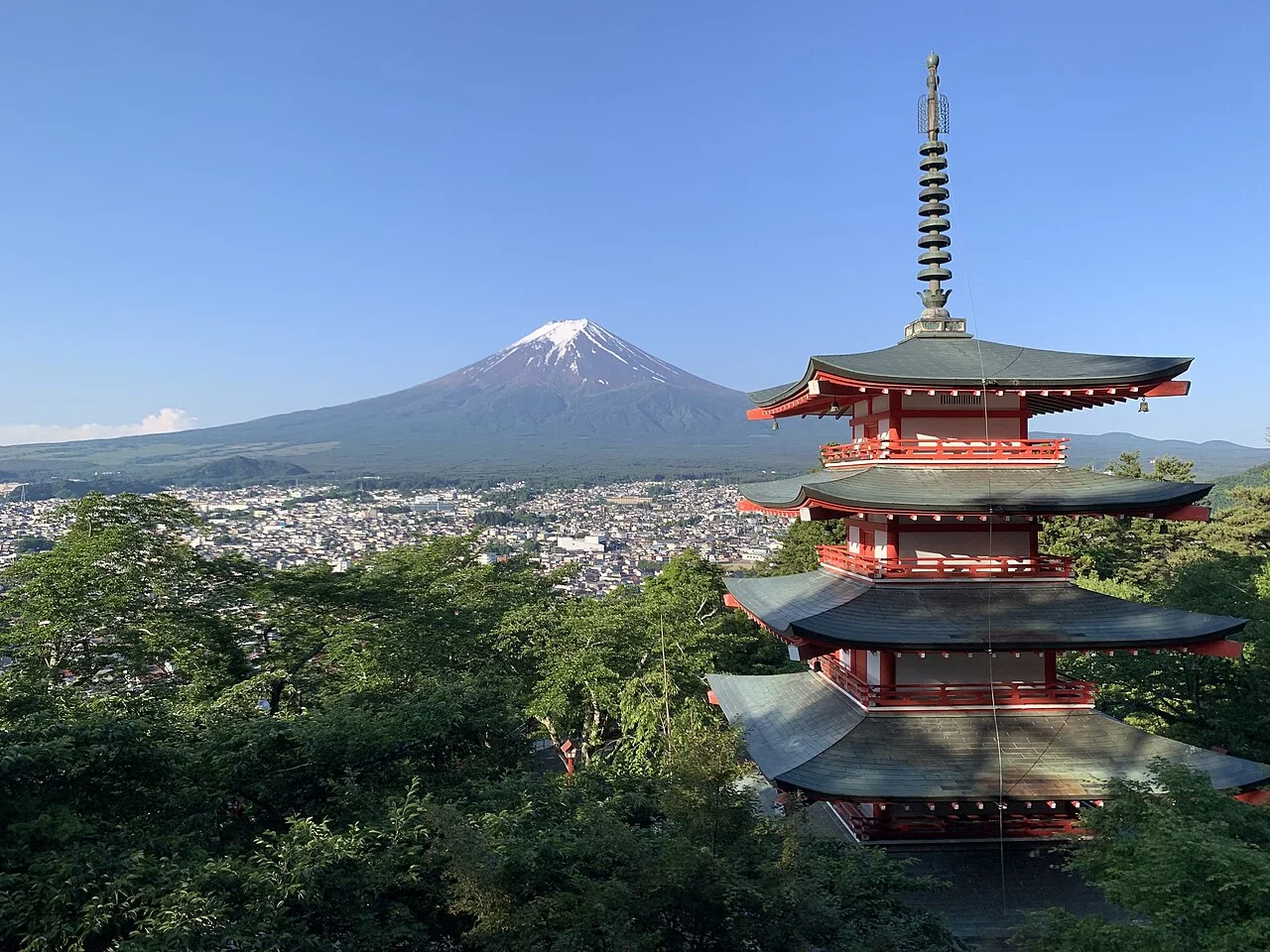
Arakura Fuji Sengen Shrine’s history records its foundation in 706 as Arakura’s local guardian shrine, worshipping Konohanasakuya-hime, Oyamatsumi and Ninigi. Chureito above it is a five-storey pagoda commemorating the war dead. The shrine’s main hall and pagoda serve different functions. Worship in the grounds first, then decide whether to continue to the viewpoint. This gives attention to the shrine and the famous composition.
The official Shimoyoshida walking route gives about 25 minutes from station to viewpoint, with 398 Sakuya-hime steps beyond the shrine grounds. This excludes photo stops, family rests and queues. With children or older people, allow the climb, descent and rest before judging afternoon energy. For worship and precinct views alone, finish at the shrine plaza and return to Shimoyoshida for food.
When substituting Arakurayama, omit Kitaguchi Hongu and decide about afternoon Oshino according to departure time. Arakurayama’s spring 2026 measures differ from north-shore events; a spring festival timetable does not apply in autumn. The city park page also warns of bear sightings nearby, especially during quiet early mornings and after dusk. Choose comfortable daylight walking hours, pass quietly through residential streets and photograph from public routes.
Keep Kawaguchi Asama for a north-shore day: fire rites, cedars and current paths
Kawaguchi Asama Shrine is in Kawaguchi on Lake Kawaguchi’s north shore. Its official history connects its foundation to the 864 Jogan eruption: in 865, imperial orders established worship of Asama Myojin to quell the fire. Its main deity is Asama Okami, Konohanasakuya-hime. The nagare-zukuri main hall, large worship hall and seven cedars fit a north-shore lake day. Remember its reading “Asama”, distinct from the common “Sengen”.
The official site allows worship visits without set visiting hours and lists shrine-office service at 09:00–16:00. Its access page uses the route bus from Kawaguchiko Station to Kawaguchi Kyoku-mae. The photography section of the official introduction requires a photography application form. Follow this shrine’s process rather than applying Kitaguchi Hongu’s media rules to another shrine.
Avoid damaged areas when extending the route. The notice dated 29 June 2026 says the 26 June earthquake damaged stone lanterns, with a falling hazard along the approach. The area around Haha no Shirataki Shrine has collapse risk, and the trail above Haha no Shirataki is impassable. Avoid hazardous lantern areas, finish the north-shore version at the shrine and lake, and leave the waterfall walk out.
Shrine and ritual scenes in Kawaguchi Asama Shrine’s official video.
A few useful answers
Can I visit all three Asama shrines in a day?
By public transport, choose one main shrine. Kitaguchi Hongu is in Kamiyoshida, Kawaguchi Asama on the lake’s north shore and Arakura Fuji Sengen near Shimoyoshida. This route pairs morning Kitaguchi Hongu with afternoon Oshino. For Chureito photographs, make Arakurayama the focus and omit Kitaguchi Hongu.
Does Fujikko stop directly outside Kitaguchi Hongu?
The current map marks F1 and F2 as passing Sengen Jinja-mae without stopping. Use a stopping A1 service via Oshino Hakkai, such as 10:14 from Sengen Jinja-mae to Oshino at 10:23. Check direction at the actual stop.
Does Oshino Hakkai have one ticket and opening time?
Outdoor ponds have no shared entrance and can be viewed freely. Sokonashi-ike is inside Hannoki Bayashi Museum, open 09:00–17:00 with irregular closures and admission charges: ¥300 from junior high school age, ¥150 for primary school pupils and ¥100 from age one through kindergarten.
Is Hannoki Bayashi Museum a heavy-rain alternative?
The house has displays, but Sokonashi-ike and garden paths are outdoors and unpaved. In heavy rain, choose Fujisan Museum. It closes Tuesdays except public holidays and 28 December–3 January, and opens daily in July and August.
Which short route suits a pushchair or wheelchair?
Start with Waku-ike, Nigori-ike and Kagami-ike. Okama-ike has steps and Shobu-ike has poor surfaces; Choshi-ike and Sokonashi-ike also have surface restrictions. Reserve a free wheelchair at tourist information on 0555-84-4221; only three are available.
Which bus returns from Oshino to Mt. Fuji Station?
The currently linked official timetable lists A1 at 14:26, arriving at 14:47; F3 at 15:10, arriving at 15:30; and F3 at 16:10, arriving at 16:30. The last F3 is 17:10, arriving at 17:30. That is the last of this express route; consult other routes separately. An earlier daylight return works better.
Can I currently hike from Kawaguchi Asama to Haha no Shirataki?
The 29 June 2026 notice lists the trail above Haha no Shirataki as impassable, collapse risk around its shrine and falling hazards from approach lanterns. Keep the north-shore alternative to shrine grounds and lakeside, avoiding damaged areas.
Official information and references
Sources used in this guide.
- Kitaguchi Hongu | Deities
- Kitaguchi Hongu | North entrance, summit shrine and other FAQ
- Kitaguchi Hongu | History and shrine architecture
- Kitaguchi Hongu | Fuji-ko and oshi
- Kitaguchi Hongu | Media applications
- Kitaguchi Hongu | Official access and address
- Kawaguchi Asama Shrine | History, access and photography
- Kawaguchi Asama Shrine | Seven cedars and official video
- Kawaguchi Asama Shrine | 2026 earthquake damage notice
- Arakura Fuji Sengen Shrine | Deities and Chureito history
- Fujiyoshida City | Arakurayama Park and bear sightings
- Fujiyoshida Tourism | Shimoyoshida–Arakurayama walk
- Oshino Village | Oshino Hakkai
- Oshino Village | Waku-ike and pilgrimage inscriptions
- Oshino Village | Deguchi-ike
- Oshino Village | Okama-ike
- Oshino Village | Sokonashi-ike
- Oshino Village | Choshi-ike
- Oshino Village | Nigori-ike
- Oshino Village | Kagami-ike
- Oshino Village | Shobu-ike
- Oshino Village | Pond viewing hours
- Oshino Tourism Association | Accessibility and walking after sunset
- Oshino Village | Protecting pond water
- Hannoki Bayashi Museum | House, prices and hours
- Fujisan Museum | Prices, facilities and closures
- Fujisan Museum | 2026 permanent exhibition and VR
- Fujikyu | Touring routes, common pass and current timetable links
- Fujikyu Bus: June 2026 Fujikko-go route map and timetable
- Yamanashi Official Tourism | Kitaguchi Hongu access and walking estimate
- Oshino Education Board | Water sources, strata, 1843 purification-pond revival and heritage