Explore Kitaguchi Hongu Fuji Sengen Shrine’s buildings and Fuji-ko pilgrimage traditions, then Oshino Hakkai’s springs, monuments and old houses. Distinguish three Asama/Sengen shrines and A1 versus Fujikko bus stops. Plan the paid garden, family short routes and a rainy-day museum.
- Region & Focus
- Lake Kawaguchiko and Mount Fuji
- Reading Scope
- 30 min read · 17 chapters · 7 Q&As
- Official Verification
- 31 official sources checkedUpdated November 9, 2026
- Key Topics
- ItinerariesRail travelTravel budget
Chapter Route Map (tap any stop)
- One shrine and Oshino: give the day to differences you can see
- Separate the three shrines on the map first
- Kitaguchi Hongu: from foothill worship to the Yoshida trailhead
- Pause at the worship hall: three main halls and Edo-period building work
- Fuji-ko and oshi: foothill life along the station route
- Shrine to Oshino: use an A1 service that stops at Sengen Jinja-mae
- At Oshino, read pond names and monuments before looking below the water
- How the springs form, and how they became pilgrimage sites
- Waku-ike, Okama-ike and Choshi-ike: vary what you look for
- Sokonashi-ike is deep inside the garden: choose the old house and admission together
- Kagami-ike, Shobu-ike and Deguchi-ike: when to extend and when to finish
- Put lunch, rest and the return stop in the middle of the pond walk
- Back to Fujisan Station: keep an alternative bus, and do not target the last one
- In rain, keep the faith theme at Fujisan Museum
- With children or wheelchairs, choose a short route around usable viewpoints
- If switching to Arakurayama, make Chureito the main visit
- Save Kawaguchi Asama for a north-shore day: eruption rites, seven cedars and current paths
- Quick Q&A
For shrines and springs at the foot of Mount Fuji, spend the morning at Kitaguchi Hongu Fuji Sengen Shrine in Kamiyoshida and the afternoon at Oshino Hakkai. This works better than chasing three Sengen shrines in one day. The shrine shows how worship from the foothills developed into pilgrimage ascents; the ponds draw attention to water below, monuments on the banks and ritual purification. Local buses connect the two. Check that your service stops at Sengen Jinja-mae, then plan the walk backward from your Oshino return bus.
One shrine and Oshino: give the day to differences you can see
Kitaguchi Hongu and Oshino suit travelers interested in shrine architecture, Fuji worship and water landscapes who want time in each place. Kitaguchi Hongu is in Kamiyoshida, Fujiyoshida; Oshino Hakkai is east in Oshino Village. Use Fujisan Station to enter and leave the area, connecting foothill worship with a spring walk. Save lake views, shopping and illuminated autumn leaves for another day instead of always detouring to Lake Kawaguchiko’s north shore.
As a planning allowance, give Kitaguchi Hongu 60–90 minutes and Oshino’s ponds and garden two to three hours, plus lunch, bus waits and the return to the station. To see all eight ponds, read monuments closely or explore an old house, add time after lunch. Adding map travel times alone is insufficient. If reaching Fujisan Station near noon, choose the shrine plus an indoor exhibition, or Oshino alone, rather than taking one photo at each.
If your priority is Chureito Pagoda with Fuji, start at Shimoyoshida Station and make Arakurayama the morning’s focus. If staying north of Kawaguchiko and interested in seven cedars and rites to calm eruptions, choose Kawaguchi Asama Shrine. These versions involve different stations, slopes and waits. For hotels, the autumn foliage festival and north-shore buses, see Kawaguchiko seasons and accommodation. You do not need to add that guide’s lakeside route to this day.
Explore Kitaguchi Hongu Fuji Sengen Shrine’s buildings and Fuji-ko pilgrimage traditions, then Oshino Hakkai’s springs, monuments and old houses. Distinguish three Asama/Sengen shrines and A1 versus Fujikko bus stops. Plan the paid garden, family short routes and a rainy-day museum.
Separate the three shrines on the map first
Kitaguchi Hongu Fuji Sengen Shrine is written “北口本宮冨士浅間神社” and is at 5558 Kamiyoshida. Kawaguchi Asama Shrine is at 1 Kawaguchi, Fujikawaguchiko, and its name is read “Asama.” Arakura Fuji Sengen Shrine is at 2-4-1 Asama, Fujiyoshida, near Shimoyoshida Station. Save each full Japanese name and address in your itinerary, so navigation does not select another shrine simply named “浅間神社.”
All three relate to Fuji worship but offer different subjects. At Kitaguchi Hongu, the approach, shrine buildings and Yoshida trailhead explain pilgrimage ascents. Kawaguchi Asama connects worship after the Jogan eruption with its main hall, worship hall and seven cedars. At Arakura Fuji Sengen, worship first, then decide about climbing to the Chureito viewpoint. Treating each as a visit with its own subject makes the choice easier than collecting three similarly named landmarks.
The main public-transport route pairs Kitaguchi Hongu and Oshino because a local service in the same direction stops at both Sengen Jinja-mae and Oshino Hakkai. Kawaguchi Asama is elsewhere, not a short walk beside Kitaguchi Hongu. Arakurayama adds travel via Shimoyoshida and a climb. Driving reduces waiting, but worship, parking, walking and entering or leaving the car still take time. There is no need to fit in all three.
| Shrine | Transport reference | What deserves time |
|---|---|---|
| Kitaguchi Hongu Fuji Sengen Shrine | Fujisan Station / Sengen Jinja-mae | Approach, three main halls, Fuji-ko and Yoshida trailhead |
| Kawaguchi Asama Shrine | Kawaguchi district north of the lake / Kawaguchi Kyoku-mae | Eruption-calming rites, nagare-zukuri main hall and seven cedars |
| Arakura Fuji Sengen Shrine | Shimoyoshida Station / Arakurayama | Worship first; add 398 steps and visiting time for Chureito |
Kitaguchi Hongu: from foothill worship to the Yoshida trailhead
“Kitaguchi,” the northern entrance in the shrine’s name, refers to the Yoshida climbing route. “Hongu” is the shrine at its starting point. The shrine’s own FAQ explains its role as a foothill place of worship and northern starting point, and says it has no summit inner shrine. A visit lets you understand Fuji’s sacred character from the foot of the mountain. You do not need to rush to the fifth station the same day to complete this religious route.
The shrine enshrines Konohanasakuya-hime, Ninigi-no-Mikoto and Oyamatsumi. Konohanasakuya-hime connects beliefs about fire, safe childbirth and Fuji’s goddess. Ninigi is her husband, and Oyamatsumi her father. This family relationship gives more concrete meaning than calling the shrine a “power spot.” Worship at the hall first, then study plaques and architecture, naturally separating photo stops from the worship route.
The shrine’s history describes early worship as looking toward and venerating Fuji from the foothills. As Shugendo and Fuji-ko developed, climbing became a form of prayer. The route from approach to shrine buildings and on to the trailhead makes this development clear on foot. If your plan is only the precincts, finish there. Roads farther into the mountain belong to a separate outing requiring equipment and time.
Pause at the worship hall: three main halls and Edo-period building work
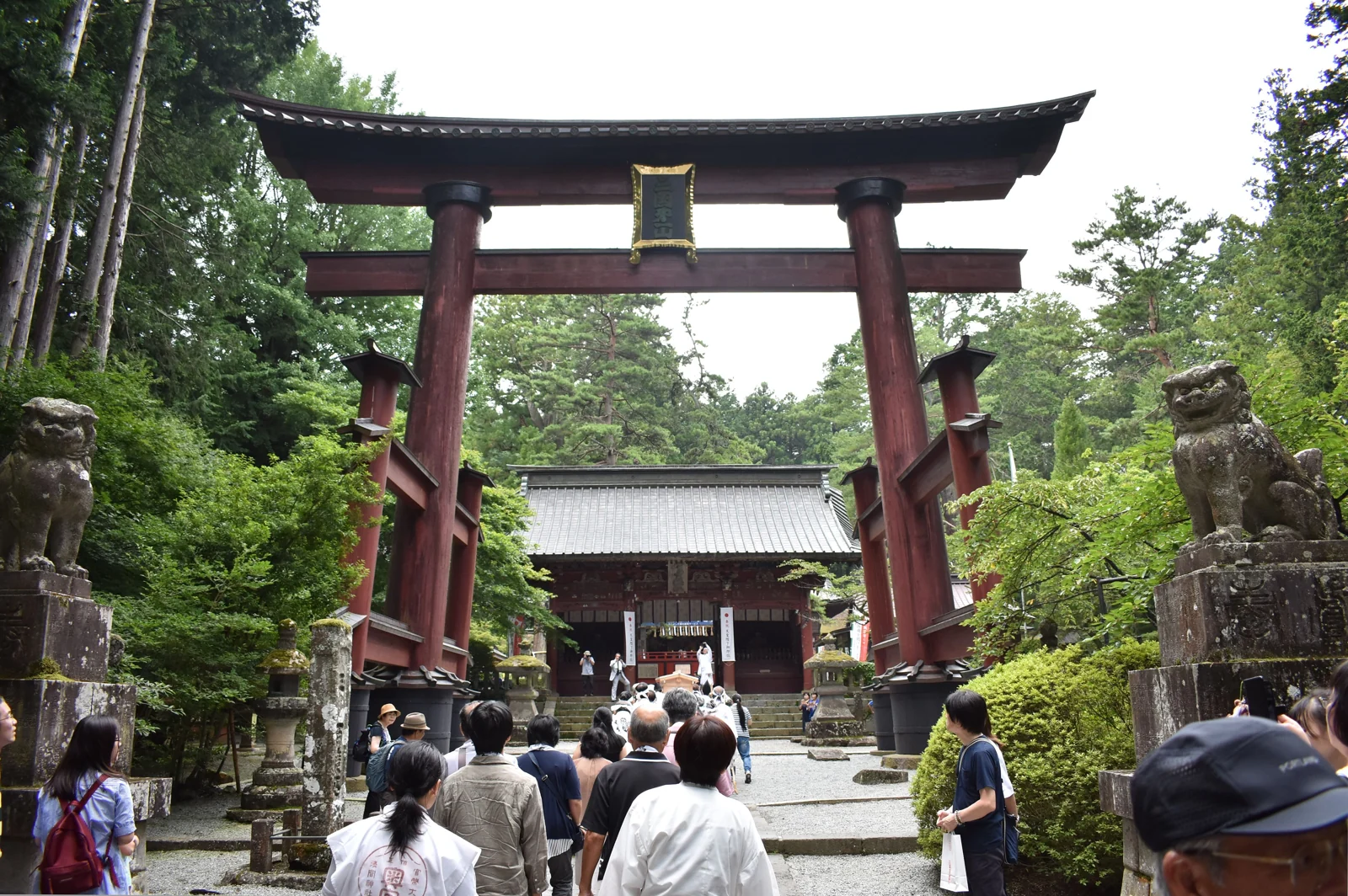
The large torii and woods shape the entrance, but slow down at the shrine complex. The official history and architecture guide dates the surviving Higashimiya main hall to Takeda Shingen’s rebuilding in 1561, the Nishimiya main hall to 1594, and the current main hall to 1615. All three are nationally designated Important Cultural Properties. These are three buildings, not three names for one. Identify the eastern, western and current main halls by location.
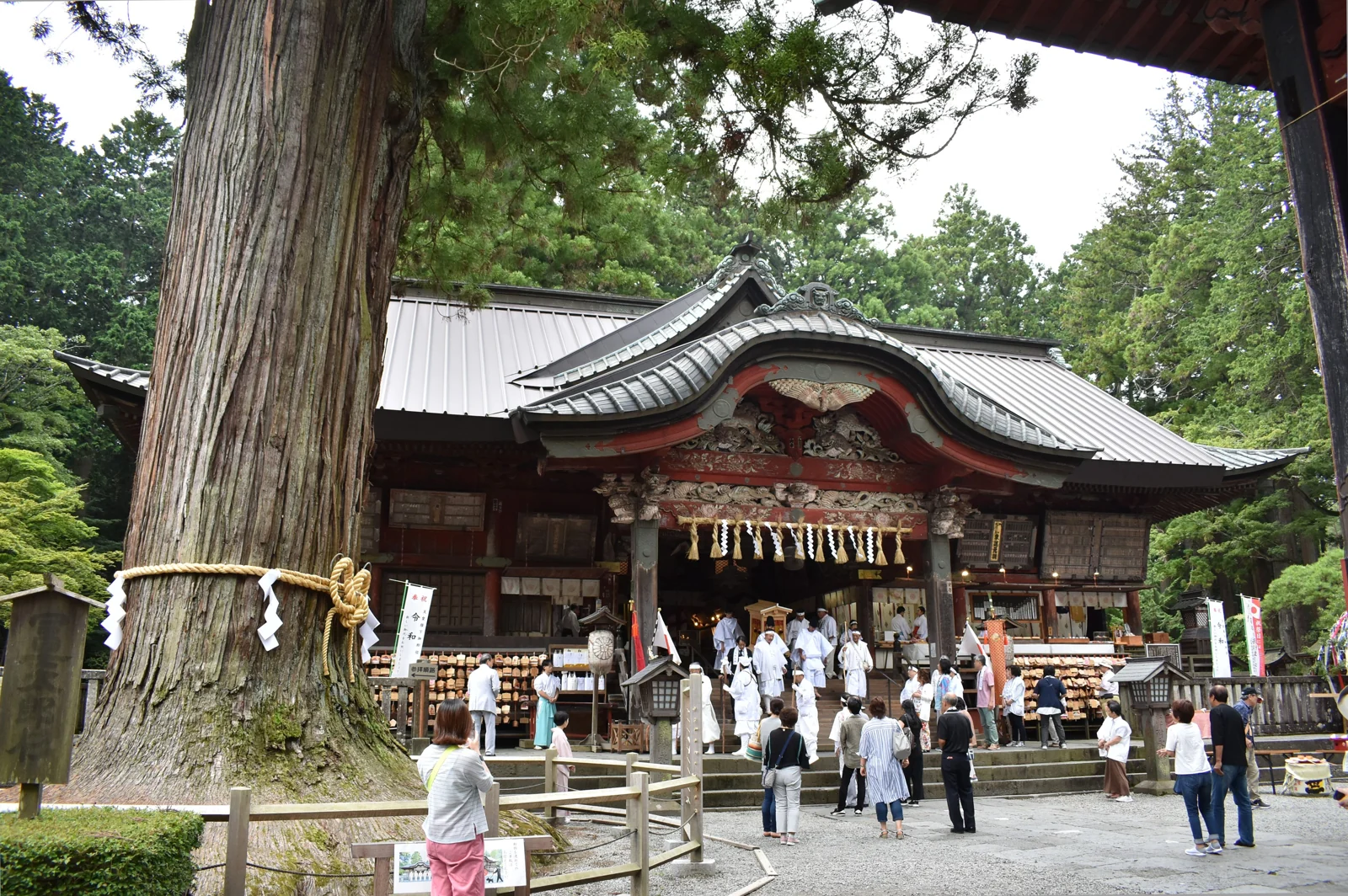
Higashimiya and Nishimiya use nagare-zukuri architecture. The current main hall has an irimoya roof and a karahafu entrance canopy. The connected offering and worship hall joins the main hall, with the official guide describing the whole arrangement as gongen-zukuri. Even without knowing these terms, compare projecting roofs and the connection between worship space and the rear main hall, then study carvings and eaves. Open worship areas provide enough to observe without crossing barriers.
Major Edo-period construction promoted by Murakami Kosei helped establish today’s buildings and precinct layout. Fuji worship left traces of funding, craft and believers’ organizations beyond a summit destination. Companions who want only a stroll can rest beside the approach and giant trees while architecture enthusiasts study the buildings again. Extra morning time is often best spent here rather than immediately moving to another shrine.
Professional filming and photography have a separate procedure. Kitaguchi Hongu requires media to submit their name, project and contact details, and report to the amulet office on the day of precinct use. For work shoots, apply before scheduling. During ordinary worship and photo stops, keep passages clear, follow signs and give way to ritual participants. This keeps the shrine usable as a living place of worship while visitors follow its existing routes.
Fuji-ko and oshi: foothill life along the station route
Fuji-ko were groups sharing faith in Mount Fuji. The shrine explains that distant climbs once required much time and effort, so communities pooled money and chose representatives to carry their prayers. Climbing was both personal practice and a community matter. This connects precinct offerings, shrine construction and the foothill town rather than leaving them as separate historic sites.
Oshi provided lodging, religious instruction, prayers and mediation in matters of faith. The shrine’s Fuji-ko explanation says the Kanadorii gate marked the entrance and boundary of the oshi town, in the area east of Fujisan Station. On the walk to or from the shrine, use it as a clue to Kamiyoshida. For deeper understanding, give time to exhibitions instead of treating every roadside home as a freely accessible museum.
This also preserves the theme in rain: make a short morning shrine visit, then use the Fujisan Museum’s permanent displays on Fuji-ko, oshi and the Yoshida Fire Festival. Outdoor observations connect with indoor objects. History enthusiasts can replace Oshino with the museum even in good weather. With children, use two questions: who welcomed the climbers, and how did people climb together? These invite more participation than memorizing founding dates.
Shrine to Oshino: use an A1 service that stops at Sengen Jinja-mae
The route map linked from Fujikyu’s current Fujiyoshida, Oshino and Yamanakako touring page combines local routes, Fujikko and the Oshino Hakkai express. An arrow means the bus passes without stopping. F1 and F2 Fujikko show arrows at Sengen Jinja-mae. A shrine photo on the introduction page does not mean every touring bus stops outside. For the shrine-to-Oshino connection, first choose an A1 Gotemba Line service via Oshino Hakkai.
As of October 27, 2026, the timetable attached to the linked June 2026 route map still bears a revision date of April 7, 2025. Outward examples include A1 from Sengen Jinja-mae at 10:14 to Oshino Hakkai at 10:23, then 11:44 to 11:53. The gap is not a fixed hourly interval. At the stop, check direction and places served. Choose via Oshino rather than boarding only because the destination says Gotemba.
Official Yamanashi tourism information gives about 20 minutes on foot from Fujisan Station to the shrine. Walk this section in the morning to avoid another wait for a short ride. For a 60–90-minute shrine visit and the 10:14 A1, use an arrival around 8:30 at Fujisan Station as the local starting assumption. If long-distance travel arrives later, take the 11:44 and shorten Oshino’s distant ponds or garden. For Tokyo reservations, see Fuji Five Lakes highway bus stations and tickets.
At Oshino, read pond names and monuments before looking below the water
The eight ponds are Deguchi-ike, Okama-ike, Sokonashi-ike, Choshi-ike, Waku-ike, Nigori-ike, Kagami-ike and Shobu-ike. They are landscapes where Fuji groundwater emerges, and places of Fuji worship and purification pilgrimage. Oshino Village’s Hakkai guide explains nature and faith together. Identifying the names is more useful than counting every clear pool beside a shop among the eight.
Monuments beside the ponds bear names, purification order, dragon-king names and waka poems, linking each stop to pilgrimage. A sightseeing walk can vary with your bus stop, access and energy. The numbers on the monuments preserve a religious sequence. Read one monument fully and compare it with the next to understand the difference, rather than repeating the same photo at eight water surfaces to collect numbers.
Depth, springs and water plants offer different ways to look. At small ponds, use open public paths to view the spring mouth. At larger ones, study banks, surrounding trees and reflections. When wind moves the surface, notice details still visible below. The village expressly asks visitors not to throw litter or coins into the ponds because depth and water temperature make removal difficult. Express wishes through worship practices and leave the water unchanged.
How the springs form, and how they became pilgrimage sites
The village board of education’s heritage component explanation describes the water system in more detail. Recent investigations identify groundwater from Fuji as well as the foothills between Mount Shakushi and Mount Ishiwari. Permeable volcanic layers of different ages and deeper pressurized groundwater produce springs in different ways. Moving water plants in a small pond and sand-bed upwelling at Choshi-ike are visible parts of the underground system.
This gives another way to compare the ponds: area, depth and connection with rivers differ. Okama-ike is small and blue in its depths. Sokonashi-ike is in woods, with an official listed depth of 1.5 m. Large Deguchi-ike has a listed depth of 0.5 m. Separate how deep you can see from how broad the surface is. Shallow banks, plants and flow deserve attention too. Water temperatures and volumes on village pages are compiled reference data. On site, observe the current color and movement instead of checking every pond against a number.
The connection with Kitaguchi Hongu is purification before climbing. The village records that Taiga-ko revived the former eight lakes as purification ponds in 1843, making them widely known among Fuji-ko groups across Kanto. Monuments and pilgrimage order brought the springs into preparations for an ascent. Visiting the shrine first connects foothill worship, climbing and water rites, showing why the eight ponds have cultural-heritage value.
Old houses, rivers and land use also belong to this relationship. The village connects water landscapes and systems with faith and rural livelihoods. Silkworm and farming displays in the museum add village life beyond sightseeing ponds. With little time, study water at one pond, read a monument and see part of the village. That already provides several layers without adding distant attractions to fill the afternoon.
Waku-ike, Okama-ike and Choshi-ike: vary what you look for
Waku-ike faces the shopping street, with a watermill building opposite, making it a useful arrival landmark. View below the water from open banks, then leave the busiest photo spots and continue to other ponds. Save lunch and shopping for the return. With only an hour, explore Waku-ike and nearby ponds you can approach without rushing for a complete impression of the springs.
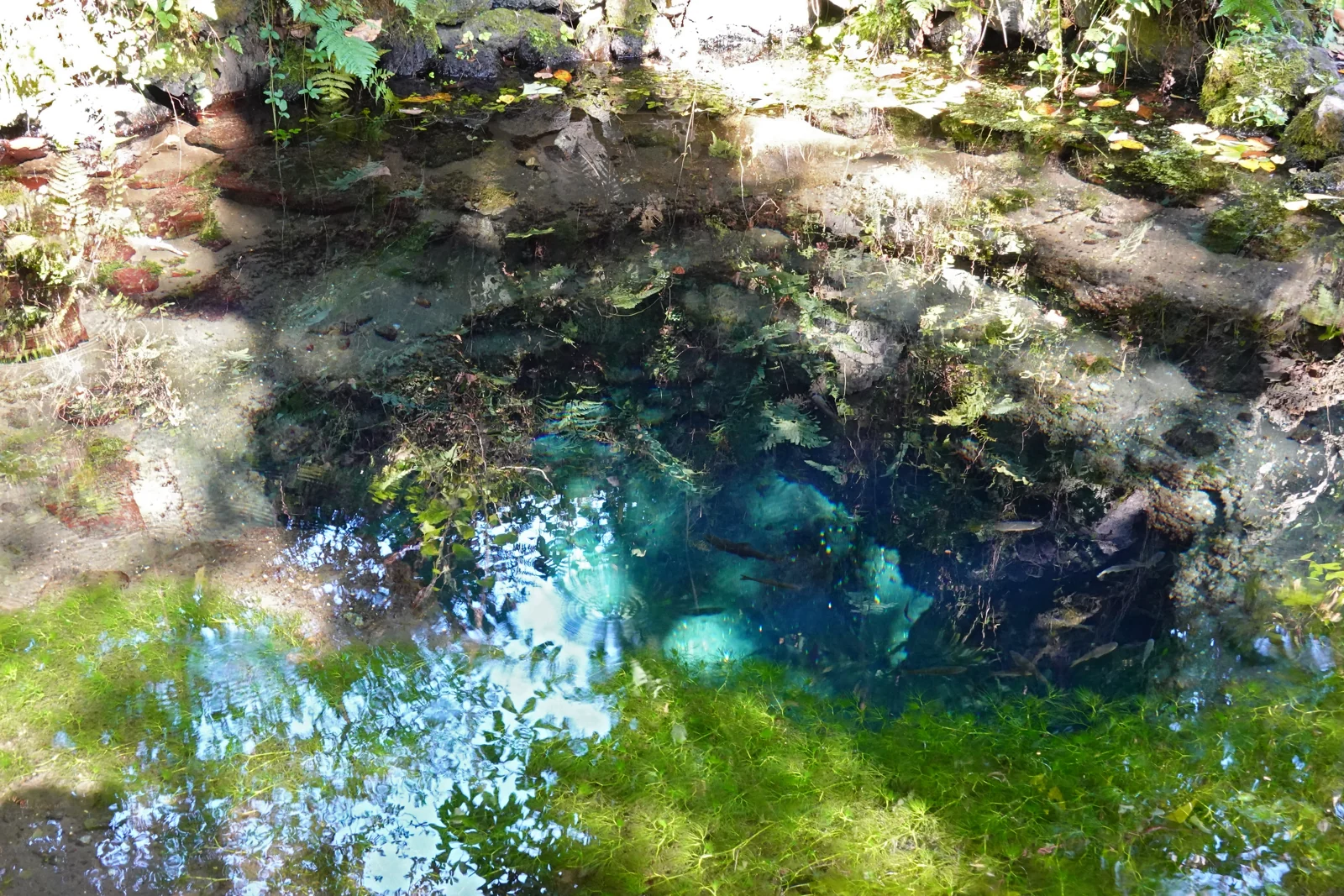
Okama-ike is the smallest of the eight. The village lists an area of 24 square meters and a depth of 4 m. Look for deep blue and swaying plants beneath its small surface. Steps lead down at the entrance. Wheelchair users can meet companions at an accessible place above while others visit. The blue spring mouth in photos is only part of the pond. Leave room for people passing during your stop.
Choshi-ike lies in grass beside the Ahara River. The village highlights visible upwelling through sand on its bottom. Shifting from broad reflections to small movements also gives children something different to find. Nigori-ike connects with the Ahara River; official information says well water now flows into it, so its “cloudy pond” name does not mean it must look cloudy today. Reading some monuments and following water movement offers more interest than choosing stops only by which pond is bluest.
Sokonashi-ike is deep inside the garden: choose the old house and admission together
Sokonashi-ike lies within Hannoki Bayashi Museum. Pass through the building displaying traditional tools, then continue into the woods farther back to reach it. Distinguish entrance carp pools and garden water features from Sokonashi-ike itself. Buying a ticket but photographing only the entrance misses the actual third pilgrimage site. Its wooded setting rewards a slower look at the surface and vegetation.
The museum page lists 9:00–17:00 hours with irregular closures, including possible closures for severe weather, weddings or funerals. Admission is ¥300 for junior high school students and older, ¥150 for elementary school students, and ¥100 for children aged one through kindergarten. Match young children to their actual age and school stage rather than one blanket child price. Sokonashi-ike follows museum opening. Other outdoor ponds’ free viewing times do not apply to it.
The Watanabe family house dates to the latter half of the 18th century. Displays include furniture, weapons, old documents, silkworm-related items and farm tools. Admission combines springs, village and residents’ lives. If the old house does not interest you or departure is near, keep time for outdoor ponds. Two adults and one elementary school child cost ¥750, separate from local transport. Pond paths are unpaved and outdoors, so the whole garden is not a roofed rainy-day attraction.
Kagami-ike, Shobu-ike and Deguchi-ike: when to extend and when to finish
Kagami-ike’s name relates to Fuji’s reflection, which the village describes as visible under suitable conditions. Look at the actual surface and mountain before deciding to wait. If clouds hide Fuji, enjoy the monument and surroundings instead. Shobu-ike lies east of Kagami-ike, shifting attention to waterside plants. It suits plant enthusiasts who can manage the path. The tourism association lists poor approach conditions, difficult for wheelchairs.
Deguchi-ike is the largest pond and the only one clearly separate from the main cluster. There are no shops around it, with wooded hills and Deguchi Inari Daimyojin behind. The village records a legend of mountain practitioners purifying themselves and taking its water up Fuji, giving it the name Shojin-ike. Allow separate time if pilgrimage is a major interest. For a general half-day walk, focus on the clustered ponds rather than rushing to the distant one at the end just to reach eight.
On arriving in Oshino, decide first whether to visit Deguchi-ike, then choose the order of lunch and museum. To cover all eight, start early in daylight because Sokonashi-ike depends on museum hours. If a path is muddy, companions are tired or the museum is closed, leave unvisited ponds for another trip. This changes your walking route, but keep the planned station-bound direction. Do not reach a distant pond before looking for a bus for the first time.
Put lunch, rest and the return stop in the middle of the pond walk
Shops and food options surround the central ponds, so lunch can sit in the middle of the walk. Identify the return stop when you arrive, then see ponds and eat. Afterward choose the old house or distant Deguchi-ike by energy. If places are full, prioritize food and rest and drop an extension. A meal before you have a seat cannot be fixed at half an hour to connect with the only bus you could catch.
Separate the budget into long-distance travel, local buses, lunch, museum and shopping. Fujikyu’s current page lists the Fujiyoshida–Oshino–Yamanakako common Free Coupon at ¥1,800 adult or ¥900 child for one day, and ¥2,200 adult or ¥1,100 child for two days. Adults are junior high school students and older; children are elementary school students. It covers specified touring and local routes. For only a few rides, compare individual section fares rather than taking an extra loop of Yamanakako because you bought the pass.
The map says the coupon can be used on the F3 Oshino Hakkai express, but travel from Yamanakako Asahigaoka toward Gotemba lies outside its coverage. Routes sharing a table are not all covered to their ends. Scheduled touring buses need no reservation; they are separate from a reserved Tokyo highway bus. With more luggage, arrange storage at your arrival or departure station and keep pond walks light.
Back to Fujisan Station: keep an alternative bus, and do not target the last one
For the return, read across the Oshino Hakkai row again. The timetable linked by the current website lists A1 at Oshino Hakkai 14:26, Sengen Jinja-mae 14:36, Fujisan Station 14:47 and Kawaguchiko Station 15:00. F3 leaves Oshino Hakkai at 15:10, reaches Fujisan at 15:30 and Kawaguchiko at 15:40, passing Sengen Jinja-mae without stopping. After a completed morning shrine visit, F3 is useful for a direct station return. For belongings near the shrine, choose an A1 that stops.
To stay longer, keep F3’s 16:10 departure and 16:30 Fujisan arrival as a later option. The final F3 in this table leaves at 17:10 and arrives at 17:30. This is the last F3 express, not the last service on every route. There is no need to wait for it. Return F3 notes make Fujisan Station and Fuji-Q Highland drop-off only, so station-bound travelers can alight at these stops.
The example below assumes you are already at Fujisan Station around 8:30. It does not reserve any connection from Tokyo. If arrival is delayed, use the next confirmed bus connection and omit Deguchi-ike or the garden. Autumn and winter days are short. The Oshino Tourism Association warns of few streetlights and advises against walking after sunset. Return to the station earlier in daylight instead of stretching pond time to the end.
| Time | Plan | How to shorten or change |
|---|---|---|
| From around 8:30 | Walk from Fujisan Station to Kitaguchi Hongu; official estimate about 20 minutes | If late, take the 11:44 A1 and omit Oshino extensions |
| About 9:00–10:00 | Worship, shrine buildings and approach; walk to Sengen Jinja-mae | Stay longer for architecture and shorten Oshino |
| 10:14–10:23 | A1 from Sengen Jinja-mae to Oshino Hakkai | Not an F1/F2 touring bus |
| About 10:30–14:00 | Central ponds and lunch; add either garden or Deguchi-ike | Leave time to find the stop and wait |
| 14:26–14:47 | A1 from Oshino Hakkai to Fujisan Station | After the shrine, the 15:10 F3 is another option, arriving 15:30 |
In rain, keep the faith theme at Fujisan Museum
With clouds but dry ground, Kitaguchi Hongu’s woods and buildings and Oshino’s underwater views still offer plenty to see. If rain makes outdoor time uncomfortable, replace Oshino with Fujisan Museum. Permanent displays cover Fuji-ko, oshi, pilgrimage ascents and the Yoshida Fire Festival, continuing the morning’s shrine visit. This version stays around Kamiyoshida instead of crossing to Kawaguchiko’s north shore for an indoor attraction.
The museum visitor guide lists ¥400 adult admission, ¥200 for elementary through high school students, and free preschool entry. Hours are 9:30–17:00, last entry 16:30. It closes Tuesdays except public holidays, opens daily in July and August, and closes December 28–January 3. Ordinary admission differs from reserved group tours. Apply through the museum if you need a group or sign-language tour. A rainy-day plan still needs to account for Tuesday closure.
Free wheelchair and stroller loans are available. Women’s and accessible toilets have diaper-changing tables, and multilingual audio guides are provided. The permanent-exhibition page updated October 23, 2026 lists a roughly 12-minute VR program at :15 and :45 each hour, last session 16:15, for around 20 people. For VR, arrive before the 16:30 last-entry deadline. Use the actual stopping column for Fujisan Museum Park-mae, then check your station-bound service. Do not confuse the museum stop with the shrine stop.
With children or wheelchairs, choose a short route around usable viewpoints
With young children, shorten Kitaguchi Hongu to worship and part of the approach. In Oshino, keep Waku-ike, Nigori-ike, Kagami-ike and lunch. These provide enough variety for water movement, reflections and names without making all eight ponds the day’s target. Children visiting Okama-ike need an adult able to manage steps. Leave strollers where they do not block passage rather than carrying them to a narrow bank beside the spring.
The Oshino Tourism Association accessibility FAQ lists conditions pond by pond. Waku-ike, Nigori-ike and Kagami-ike can be approached. Okama-ike requires steps down; Shobu-ike’s route is unsuitable for wheelchairs. Choshi-ike has a narrow unpaved entrance, and Sokonashi-ike’s garden paths are also unpaved. Even at approachable ponds, the official guide says making a full circuit is difficult. Choose banks where mobility-aid users can stop and look. If companions split up, agree on one meeting point first.
The tourist information office lends three wheelchairs free. The official advice is to reserve first at 0555-84-4221. Deguchi-ike is separate from the central cluster, and the association recommends vehicle travel for wheelchair visitors. Families relying on buses and a loan wheelchair should leave it out of the walking route. In heavy rain, the museum’s changing tables, stroller loans and indoor exhibitions make rest and the station return easier than continuing slowly over unpaved pond paths.
If switching to Arakurayama, make Chureito the main visit
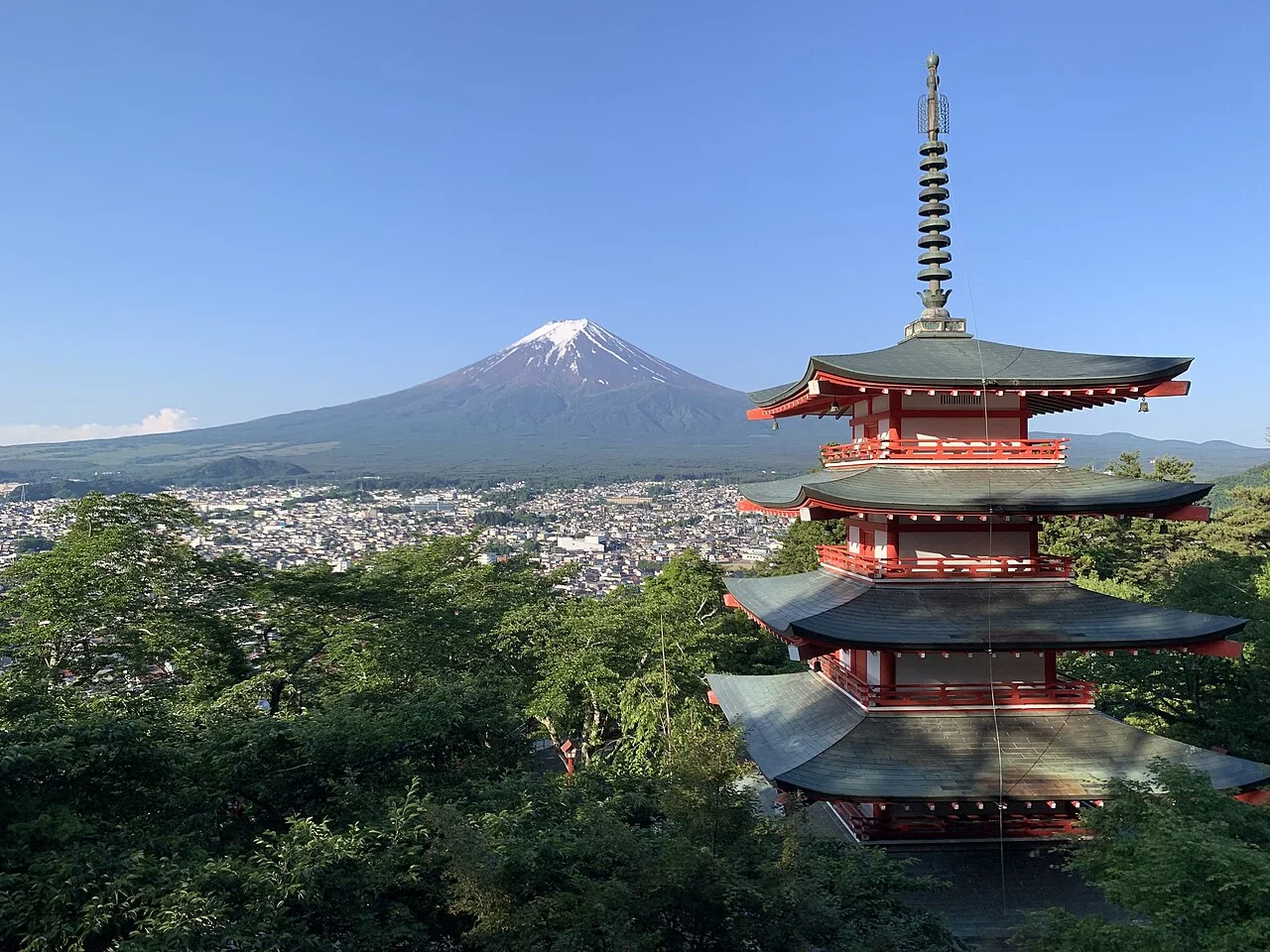
Arakura Fuji Sengen Shrine’s history dates its founding as Arakura village’s guardian shrine to 706. It enshrines Konohanasakuya-hime, Oyamatsumi and Ninigi. Chureito above it is a five-story pagoda commemorating the war dead. The main shrine and pagoda have different functions. Worship within the precincts first, then decide whether to continue to the viewpoint, giving attention to both the shrine and famous composition.
The official Shimoyoshida walking route gives about 25 minutes from station to viewpoint, with 398 Sakuya-hime steps beyond the precincts. This excludes photo stops, family rests and queues. With children or older companions, include ascent, descent and rest to know what energy remains for the afternoon. For worship and precinct scenery alone, finish at the shrine plaza and return to Shimoyoshida for lunch.
If adding Arakurayama, omit Kitaguchi Hongu and decide on afternoon Oshino by your actual departure time. Spring 2026 measures at Arakurayama differ from north-shore lake events, and spring festival schedules do not apply to autumn. The city park page also warns of nearby bear sightings, especially in quieter early mornings and after dusk. Choose a daylight period with enough time, pass quietly through residential areas and photograph only from public paths.
Save Kawaguchi Asama for a north-shore day: eruption rites, seven cedars and current paths
Kawaguchi Asama Shrine is in the Kawaguchi district north of the lake. Its official history connects its founding to the Jogan eruption of 864, followed by an imperial order in 865 to worship Asama Myojin and calm the eruption. Its principal deity is Asama Okami Konohanasakuya-hime. The nagare-zukuri main hall, large worship hall and seven cedars fit a north-shore lake day. Remember the “Asama” reading, distinct from the common “Sengen.”
The official guide lists free access for worship and shrine-office hours of 9:00–16:00. Access uses a local bus from Kawaguchiko Station to Kawaguchi Kyoku-mae. For photography, the official introduction page asks for a photography application form. Follow this shrine’s procedure rather than applying Kitaguchi Hongu’s media rules to another shrine.
Current extensions should avoid damaged areas. The June 29, 2026 notice says the June 26 earthquake damaged stone lanterns, with falling hazards along the approach. The Haha no Shirataki Shrine area has collapse hazards, and the trail above Haha no Shirataki is impassable. Avoid dangerous lantern areas during worship. Finish this north-shore alternative within the precincts and by the lake, leaving out the waterfall walk.
Shrine and ritual scenes in Kawaguchi Asama Shrine’s official video.
A few useful answers
Can I visit Kitaguchi Hongu, Kawaguchi Asama and Arakura Fuji Sengen in one day?
With public transport, choose one main shrine. Kitaguchi Hongu is in Kamiyoshida, Kawaguchi Asama north of the lake, and Arakura Fuji Sengen near Shimoyoshida. This guide pairs morning Kitaguchi Hongu with afternoon Oshino. For Chureito photos, make Arakurayama the priority and omit Kitaguchi Hongu.
Does Fujikko stop directly outside Kitaguchi Hongu?
The current map shows F1 and F2 passing Sengen Jinja-mae without stopping. Choose an A1 service via Oshino Hakkai that stops there, such as Sengen Jinja-mae 10:14 to Oshino 10:23. Check direction at the actual stop.
Does Oshino Hakkai have one ticket and shared opening hours?
The outdoor ponds have no shared entrance and can be viewed freely. Sokonashi-ike is inside Hannoki Bayashi Museum, open 9:00–17:00 with irregular closures and museum admission. Prices are ¥300 for junior high students and older, ¥150 elementary, and ¥100 from age one through kindergarten.
Is Hannoki Bayashi Museum a heavy-rain alternative?
The house has displays, but Sokonashi-ike and the garden are outdoors with unpaved paths. In heavy rain, choose Fujisan Museum. It closes Tuesdays except public holidays and December 28–January 3, but opens daily in July and August.
How should I choose a short stroller or wheelchair route in Oshino?
Start with Waku-ike, Nigori-ike and Kagami-ike. Okama-ike has steps, and Shobu-ike has poor access. Choshi-ike and Sokonashi-ike also have path restrictions. The information office has three free loan wheelchairs, available by reservation at 0555-84-4221.
Which bus returns from Oshino to Fujisan Station?
The currently linked table lists A1 from Oshino 14:26 to Fujisan Station 14:47; F3 15:10 to 15:30, and 16:10 to 16:30. The final F3 is 17:10 to 17:30. That is this express route’s last service; check other routes separately. An earlier daylight return is preferable.
Can I hike from Kawaguchi Asama Shrine to Haha no Shirataki now?
The June 29, 2026 notice lists the trail above Haha no Shirataki as impassable, collapse hazards around the waterfall shrine, and falling stone-lantern hazards on the approach. Keep this north-shore alternative to the shrine precincts and lakeside, avoiding damaged areas.
Official information and references
Sources used in this guide.
- Kitaguchi Hongu | Enshrined deities
- Kitaguchi Hongu | Northern entrance, summit shrine and other FAQ
- Kitaguchi Hongu | History and shrine architecture
- Kitaguchi Hongu | Fuji-ko and oshi
- Kitaguchi Hongu | Media applications
- Kitaguchi Hongu | Official access and address
- Kawaguchi Asama Shrine | History, access and photography
- Kawaguchi Asama Shrine | Seven cedars and official video
- Kawaguchi Asama Shrine | 2026 earthquake damage notice
- Arakura Fuji Sengen Shrine | Deities and Chureito history
- Fujiyoshida City | Arakurayama Park and bear sightings
- Fujiyoshida Tourism | Shimoyoshida–Arakurayama walking route
- Oshino Village | Oshino Hakkai
- Oshino Village | Waku-ike and pilgrimage monuments
- Oshino Village | Deguchi-ike
- Oshino Village | Okama-ike
- Oshino Village | Sokonashi-ike
- Oshino Village | Choshi-ike
- Oshino Village | Nigori-ike
- Oshino Village | Kagami-ike
- Oshino Village | Shobu-ike
- Oshino Village | Pond viewing hours
- Oshino Tourism Association | Accessibility and walks after sunset
- Oshino Village | Protecting pond water
- Hannoki Bayashi Museum | House, admission and opening
- Fujisan Museum | Fees, facilities and closures
- Fujisan Museum | 2026 permanent exhibition and VR
- Fujikyu | Touring routes, common pass and current timetables
- Fujikyu Bus: June 2026 Fujikko-go route map and timetable
- Official Yamanashi Tourism | Kitaguchi Hongu access and walking estimate
- Oshino Village Board of Education | Water-bearing layers, 1843 purification revival and cultural heritage