Decide whether you need Kawaguchiko, Fujisan Station or the fifth station, then connect your Tokyo hotel, terminal, booking platform, payment and valid ticket. Shinjuku’s booking channels changed in 2026, while Shibuya has different standard and credit-card fares. Those conditions affect amendments, refunds and family costs. A return journey that connects with the lake or your hotel is more useful than an isolated cheap one-way ticket.
Choose the right destination: Fujisan Station, Kawaguchiko or the fifth station
Before booking a coach from Tokyo towards Mount Fuji, write down the Japanese name of the stop you actually need. 河口湖駅, Kawaguchiko Station, is a useful starting point for the lake area. 富士山駅, Fujisan Station, is a railway and bus station in Fujiyoshida. 富士スバルライン五合目, the Fuji Subaru Line Fifth Station, is up the mountain. A ticket to Fujisan Station does not take you to the fifth station or include the bus uphill. For a trip built around views from the lake, choose your service around Kawaguchiko and the location of your accommodation.
Fujikyu’s Shinjuku routes towards the fifth station distinguish seasonal direct services from journeys through Kawaguchiko and other stops. A summer direct coach is not a year-round daily option. The fare for a regular Fuji Five Lakes service is also not a reliable estimate for the mountain route. Check road access, seasonal operation and whether your particular departure runs separately. This guide covers choosing and using coaches from central Tokyo to the lake area; a transport reservation is not permission to climb Mount Fuji or a summit itinerary.
If one person wants to visit the lake and another wants to reach the fifth station, work out separate arrival and return plans before deciding where to meet. Buying a cheap ticket with “Fuji” in its name and asking the driver for an extra ride is not a workable substitute. Fuji-Q Highland, Kawaguchiko, Fujisan Station and Lake Yamanaka have different stops as well. Match the destination on your ticket with the pickup point in your hotel confirmation, so that you and the hotel are not waiting at different stations.
Compare Shinjuku, Shibuya and Tokyo Station from your hotel door
Include the journey from your Tokyo hotel to the coach platform when choosing a departure point. From Shinjuku, Ikebukuro or the Chuo Line corridor, start by comparing Busta Shinjuku. If you are staying around Shibuya, Mark City is worth checking first. Near Tokyo Station or Ueno, compare the services that actually stop at your intended boarding point. This is an editorial judgment based on where you are staying, rather than a claim that one terminal is always fastest. A slightly cheaper departure may cost more in effort if the whole family must make two early train changes with luggage.
The Shinjuku route page gives about one hour and 45 minutes to Kawaguchiko as a reference; the Tokyo Station page gives about two hours. For Shibuya, check the individual departure and its intermediate stops instead of comparing only the shortest advertised journey. Train changes, finding the correct exit and floor, waiting and collecting luggage after arrival all sit outside the quoted road journey. If your Tokyo accommodation is still undecided, use the Tokyo neighborhood and transport comparison to fit this excursion into the rest of your stay.
For each option, note five times: leaving the hotel, reaching the platform, coach departure, arrival at Kawaguchiko and arrival at your accommodation. Decide what an earlier arrival actually buys you: time beside the lake, or simply a longer wait for check-in. Elevators, rest breaks and the needs of young children, older travelers or wheelchair users can change the choice. Compare that complete journey before comparing fares; the lowest number beside a departure city does not tell you how the day will feel.
Boarding at Shinjuku: reach the fourth floor, then find your departure
Coaches from Shinjuku to Kawaguchiko commonly leave from Busta Shinjuku, the highway bus terminal on the south side of Shinjuku Station. Fujikyu identifies the departure level as the fourth floor. The terminal’s official fourth-floor map distinguishes fourth-floor departures, third-floor arrivals and the second-floor pedestrian area. Reaching Shinjuku Station is not the same as reaching your coach platform. Check the exit for the train you use, then follow the highway bus signs upstairs; an ordinary street-level bus stop is not the place to wait.
Inside the terminal, match your ticket’s destination, departure time and service number with the day’s information boards before finding the platform. Even a familiar departure should not be planned around a platform number remembered from a previous visit. First-time visitors, passengers collecting tickets and travelers with large bags should allow their own margin for finding the way. That is a planning allowance, not an operator-promised check-in period. The route also requires passengers who have not bought a ticket to complete the purchase before departure. Follow the original ticketing platform’s procedures for purchase, ticket issuance or collection, and plan separately for the purchase deadline and the walk to the platform.
The floor map shows waiting areas, ticket counters and machines, elevators, accessible toilets and a nursing room. Check local notices for the condition and availability of facilities on the day. If you need an elevator, do not force an escalator shortcut copied from someone else’s directions. Agree on a meeting point and make sure the person coordinating the group has the ticket information. When someone leaves for the restroom or a drink, keep track of boarding rather than assuming another member of the party is watching the departure.
Boarding at Shibuya: Mark City’s fifth floor and early departures
Shibuya’s highway coaches use the fifth-floor terminal at Shibuya Mark City, rather than an arbitrary street-level stop beside the crossing. Keio’s Shibuya highway bus terminal introduction helps identify the building and level. The station has complicated exits and internal routes, and a department-store passage shown on an old online map may not be a useful route on your travel date. Set your navigation destination to the coach terminal itself, rather than simply to Shibuya Station.
For an early departure, work out the walk from your hotel the evening before. A shortcut through shops that worked during the day may not be open in the morning. The Avenue Exit in the official introduction has its own opening hours, so it cannot simply be used to plan an earlier departure. If you need an elevator, have a stroller or carry several suitcases, check the entrance available on the day and allow time to reach the upper floor. Historic station diagrams are not enough to establish a current accessible route; this guide therefore does not promise a permanent stairway shortcut.
Some Shibuya services travel through Futako-Tamagawa or the Gotemba area, so they do not all take the same route or the same time to Kawaguchiko. Only some continue to Fujisan Station. Check the return drop-off as well: a stop passed on the outward journey does not establish that you can board or alight at the same place in the opposite direction. If you are staying in Shibuya, avoiding a city transfer may matter more than a small difference in road time, provided arrival still works with your hotel shuttle and dinner.
Tokyo Station and Ueno: identify the correct Yaesu boarding point
Fujikyu’s Tokyo Station to Kawaguchiko route page warns that boarding points include Yaesu South Exit and the Tekko Building at Yaesu North Exit. Use the location in your own reservation. An order that says Tokyo Station does not mean you can wait in front of any highway coach there. For Ueno, choose a service that actually calls at Ueno; not every departure on the wider Tokyo Station route serves it.
If your booking uses the Tokyo Station JR Expressway Bus Terminal, JR Bus’s Tokyo Station departure and arrival guidance distinguishes departures at Yaesu South Exit from arrivals at Nihonbashi Exit. Fujikyu currently describes platform 8 at Yaesu South as planned and explicitly says it can change. Treat that number as orientation, then check the day’s boards and announcements. After returning to Tokyo, the walk back to your hotel may start from a different side of the station.
There is also a walk between Tokyo Station’s underground railway platforms and the surface coach terminal. Your train’s arrival time is not your coach-ready time when you have luggage to move. Choosing a different Yaesu boarding point means recalculating the walk, rather than changing destinations only after crossing the station. Keep the building, exit and Japanese stop name together in your itinerary. If relatives book separately, check that the tickets really depart from the same place.
Compare fares by route, payment method and destination
The fares and conditions below were checked against official information on October 21, 2026. Standard one-way fares from Shinjuku to Fuji-Q Highland or Kawaguchiko are ¥2,200 for adults and ¥1,100 for children. The Japanese route page also lists a ¥2,000 adult fare for online payment. From Tokyo Station to Kawaguchiko or Fuji-Q Highland, the listed adult fare is ¥2,300, with children from ¥1,150. Recheck the specific fare when continuing to Oshino, Lake Yamanaka or another stop; the Kawaguchiko price does not extend automatically to the end of the route.
For Shibuya, the official July 1, 2026 fare and timetable PDF lists standard fares of ¥2,300 for adults and ¥1,150 for children to Kawaguchiko, Fuji-Q Highland and Fujisan Station. The fares in parentheses are ¥2,100 and ¥1,050 respectively when paying by credit card through highwaybus.com. A search result showing ¥2,100 is therefore not automatically obsolete, but that discount is not available with every payment method. Compare the platform, payment conditions and actual boarding and destination stops together.
A family can start with standard fares for an initial budget, then recalculate using the discount actually offered at checkout. Do not cancel an existing booking merely to pursue a discount that has not been confirmed; cancellation fees can erase the saving. The table describes fares with their individual conditions, excluding trains within Tokyo, local Kawaguchiko passes, luggage storage and attraction admission. List those separately as needed, so that a one-way coach fare does not become a misleading all-inclusive day-trip price.
If Fuji-Q Highland is the main purpose of your visit, compare the Toku Q Pack coach and theme-park combination. The official description includes a return coach journey and a one-day Free Pass, with prices varying by departure point and some attractions costing extra. Refunds are unavailable after departure or partial use. For a lake visit without the park, calculate the transport you actually need. A separate hotel-and-park package should not be assumed to include the same return coach journey.
| Route and fare basis | Adult | Child | Conditions |
|---|---|---|---|
| Shinjuku–Kawaguchiko/Fuji-Q Highland, standard | ¥2,200 | ¥1,100 | Check the selected service and purchase method |
| Same Shinjuku journey, online offer | ¥2,000 | Check the child offer on the booking page | Route-listed online-payment offer; other stops may differ |
| Shibuya–Kawaguchiko and specified stops, standard | ¥2,300 | ¥1,150 | Effective July 1, 2026 |
| Same Shibuya journey, highwaybus.com credit-card offer | ¥2,100 | ¥1,050 | PDF fares in parentheses; not every payment method |
| Tokyo Station–Kawaguchiko/Fuji-Q Highland, standard | ¥2,300 | From ¥1,150 | Check different destinations and ticket types separately |
Read timetables by operating date and actual stops
When checking a Shinjuku–Kawaguchiko coach timetable, begin with the route, travel date and destination. A September 2026 table with familiar stop names does not prove that every departure remains valid from October. Enter the official booking search through the Japanese route page to avoid relying on a historic table retained in search results. Then check whether the selected service calls at Fujisan Station, continues to Lake Yamanaka or uses different intermediate stops. This guide does not reproduce a full-day timetable as a permanent promise.
Shibuya’s July 1 announcement increased the basic service from nine to 11 return journeys, while its attached table also includes a column marked for operation on specified days only. In that version, the 6:05 departure from Shibuya reaches Kawaguchiko at 8:05; the 7:55 departure is shown arriving at 10:40. Their stops differ, so one shortest journey time cannot be used for every departure. These are examples from that dated official table. Check the search results and operating notices again for your travel date and any subsequent changes.
For the return, read the departure time from the stop where you will actually board. Fujisan Station, Kawaguchiko Station and Fuji-Q Highland times occupy different positions in the table. If your order names another boarding point, check whether it can be changed rather than deciding to join one stop later. “Last bus” also needs a direction, date and route attached to it. Keeping the specific service you have booked is more useful than saving a timetable image without a year.
Shinjuku bookings from October 2026: which website handles your ticket?
The Shinjuku–Fuji Five Lakes route is jointly operated by Keio and Fujikyu. Fujikyu’s reservation-change announcement for travel from October 1, 2026 explains that online reservations and sales for Fujikyu-operated departures move to Fujiyama Connect, while highwaybus.com continues to handle its offered services. The dividing line is the date you travel, rather than the day you open a website or pay. Still check the route, travel date and actual stops for each departure.
Start with the official route page and follow the booking system to the appropriate seller. Both websites displaying timetable information does not mean either one can amend any booking. After purchasing, record the confirmation email’s sender, the website name and the order number, then check where changes and cancellation must be handled. The notice also states that this platform change does not itself change the Shinjuku route fare. A new booking site is not evidence of an automatic price increase or an additional reserved-seat charge.
If different family members arrange the outward and return legs, note the platform beside each order instead of assuming both appear in one membership account. Do not apply another website’s points or coupons to the expected discount on the platform you have chosen: the announcement says these remain independent. Understand that difference before paying. The waiting area is a poor place to discover that the website you have open cannot amend your ticket.
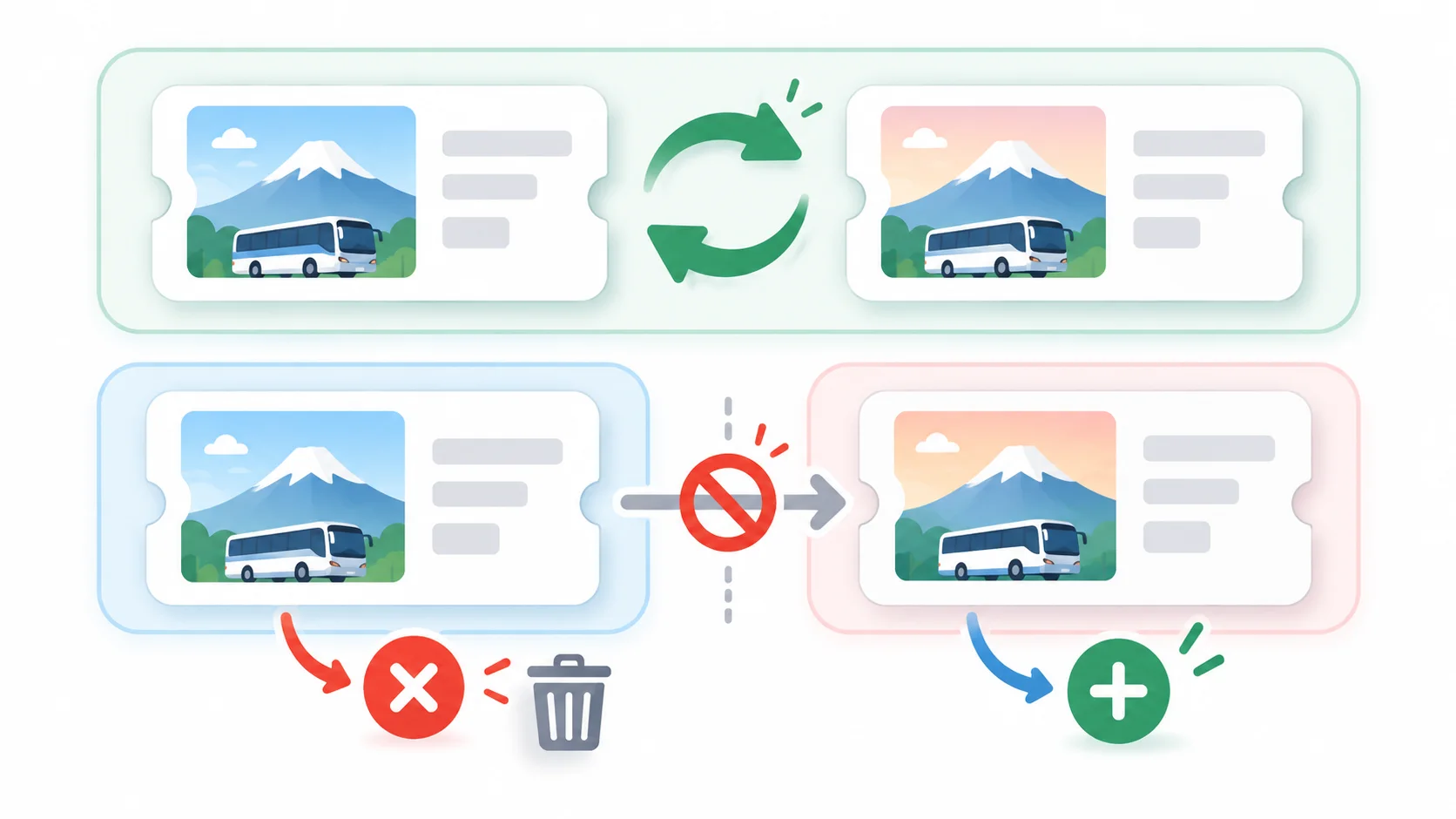
The same platform can sell Keio and Fujikyu seats
There is an important exception to a simple operator split. Question 10 of the same Japanese notice says Fujiyama Connect receives some Keio seats for sale, so it may also offer Keio-operated departures. If the original reservation was made within Fujiyama Connect, the notice permits changing a Keio departure to a Fujikyu departure there. “Keio tickets are only sold through highwaybus.com” is therefore too broad. The operator’s name alone does not establish that every change requires cancellation first.
If you have booked through highwaybus.com and want a different departure sold through Fujiyama Connect, the notice requires cancellation through the original website and a new reservation through the other one. A cancellation charge may apply; this is not a direct transfer of the existing order. If both departures can be handled on the original platform, check its change conditions, availability and any fare difference first. A special offer that cannot be amended follows its own terms, rather than an assumed right to one free change.
Before replacing a booking, establish the conditions of the desired departure and decide how to handle the original order. An unpaid search result is not a secured seat. If canceling might leave you without the old service, ask the original seller about the available procedure and costs before deciding. This guide explains that decision sequence. It has not checked inventory for a particular date or established that two websites can hold the same seats simultaneously.
SEKITORI has stopped new bookings: what remains until October 31?
As of the October 21, 2026 check for this guide, SEKITORI had stopped accepting new highway coach reservations on September 30. Fujikyu’s SEKITORI closure and migration notice directs bookings for operation from October 1 to Fujiyama Connect and schedules complete closure of the old website for October 31. Travelers arranging a new trip should not follow an older tutorial back to SEKITORI to create an order. A website still opening does not establish that it still sells new tickets.
The notice distinguishes order procedures that cease after reservations end from information retained until 23:59 on October 31: membership details, reservation history, receipt issuance, terms and inquiries. Obtain any past expense documentation within that period. A historical record is not an amendable new ticket. Membership details do not transfer, so joining the new platform requires a separate registration; the announcement also says buying without membership is possible, so a new account is not compulsory for every traveler.
SEKITORI points do not automatically migrate either. The notice sets September 30 as the usage deadline and says unused points expire from October 1. Keep those dates attached to their original year rather than presenting a closing offer as valid next year. New coach reservations, existing orders and old expense records are different tasks. Services belonging to the same Fujikyu group should not be assumed to share members or points.
One month before travel means the corresponding date, not 30 days
The Shinjuku, Shibuya and Tokyo Station route pages use the corresponding date one month before travel as their reservation starting point. That is different from counting back a fixed 30 days. For months of different lengths or a date with no equivalent in the previous month, follow the actual booking website’s notice or search results. Before a popular date opens, prepare your departure point, destination, passenger numbers and return requirements. A departure not yet appearing before sales open is not proof of permanent suspension, and an old screenshot cannot establish a service number that the current system has not offered.
Read the opening time by channel too. Fujikyu’s general FAQ gives 10:00 on the corresponding date one month before travel for reservations and purchases. Specific route pages, including Shinjuku and Shibuya, separately say telephone reservations begin at 09:00 on the first sales day. Those statements have different channels and scopes. Check the current opening notice for your route and booking website before deciding when to act. This does not establish that every Tokyo–Mount Fuji booking website opens at the same minute, and reaching the sales opening time does not guarantee a seat.
Decide roughly when you need to return before selecting the outward coach. For a weekend day trip, securing an early departure and leaving the return to chance at the station is a weak plan. Overnight visitors should first check hotel arrival, shuttle and dinner arrangements, so a later coach does not leave them outside the pickup window. The booking sequence for a first independent Japan trip can help put hard-to-replace transport and accommodation slots first.
Choose the return, child tickets and group seating together
Fujiyama Connect’s official reservation instructions describe entering the date, origin and destination, then selecting a service and plan. Choose seats if that departure offers the function, or accept the assigned seating. A return can be selected within the same process; another route may require completing the current purchase before starting again. Use the seat, payment and return options actually available for that departure rather than assuming all services have identical controls.
Enter the correct passenger numbers in one order where practical, but a shared booking is not an absolute guarantee of adjacent seats. Fujikyu’s FAQ says it will try to place passengers nearby, while a nearly full coach may leave the group separated. Its general seat-selection FAQ and Shinjuku’s route-specific preference guidance are not identical either, so check whether the actual purchase page offers a seat map. If a child, older relative or passenger needing transfer assistance must sit with a companion, confirm this before paying; a request written in a comment field is not a confirmed arrangement.
After selecting both legs, check the reversed boarding and destination stops, the dates and the inclusion of every child. If the return starts for you at Fuji-Q Highland, Kawaguchiko Station’s departure time is not your boarding time. The responsible traveler should also check passenger names, a working contact number and the email address. A mistyped address may mean you have paid but are unable to open the ticket promptly, creating a harder problem than checking the details before checkout.
Check the total before paying, then confirm the ticket and email
A reservation and a completed payment are different states. If the plan gives a payment deadline, complete it on time and check that the system has issued a valid ticket; unpaid orders may cancel automatically. Fujiyama Connect’s Japanese payment guide lists credit cards, convenience-store payment and QR payment, and warns that some overseas cards may not work. After a payment error, check the order and bank notification before acting, rather than repeatedly creating identical tickets because a screen has not redirected. Separately, the Tokyo Station/Ueno–Five Lakes route page says purchases at boarding points or on the coach require cash and do not accept Suica, PASMO or similar electronic money. That is a route-specific rule for buying there, distinct from presenting a prepaid valid online ticket or paying at another sales counter. Check the service’s boarding arrangements and seats before relying on a walk-up purchase; do not assume that tapping an IC card as you would on a city bus is a valid way to board this coach.
The platform’s payment and handling-fee instructions make further distinctions. Guest purchasers without registration cannot use convenience-store payment. That payment method carries a ¥500 handling fee, and cancellation after payment adds a separate ¥500 convenience-store cancellation fee while the original payment fee remains the customer’s cost. The page expressly says these two charges are borne by the customer even in cases such as service suspension. They belong to this platform and payment method; they are not an automatic ¥1,000 addition to every coach ticket. Check any separate fare-cancellation charge for the booked service as well.
Do not close a card or QR-payment process before it finishes. Keep the purchase confirmation email and its online-ticket link once complete. If one relative pays for everyone, make sure the people actually boarding can also access the valid tickets. A bank transaction can help with an inquiry, but does not replace the ticket needed for boarding. Match the order, payment status and issued ticket before considering this part of the journey arranged.
Prepare the valid online ticket, rather than only a payment record
Fujiyama Connect’s reservation-to-boarding guide requires presentation of the online ticket and allows a screen display or printed version; it says a screenshot cannot be used instead. Keep that rule with your own ticket. Having an image on a phone is not automatically enough to board. Before departure, check that you can open the link and have power and connectivity. If printing, retain the fields the ticket requires rather than printing only a payment receipt.
The other platform, highwaybus.com, distinguishes a mobile ticket from a self-printed WEB ticket in its official ticket-format and display instructions. It also explicitly prohibits a screenshot of the mobile ticket. For a printed return booking, print the outward and return tickets separately on single-sided sheets. Two purchases described casually as “online tickets” can therefore require different presentation. Do not apply one website’s paper or phone instructions to another seller’s ticket.
Mark the email so you can find it quickly and agree who will present each ticket. Ticket links contain order and personal information, so avoid posting them publicly for help. If a ticket will not open at the terminal, seek assistance from the original platform or the counter before departure instead of relying on a standalone card-payment screenshot. An old tutorial saying another ticket type accepted screenshots does not establish the 2026 rules of these two platforms.
Changing departures starts with the original booking platform
If you want to travel earlier or later, open the original order and check its change options before comparing another departure. Under the Shinjuku route’s October announcement, changes within one sales platform follow its procedures; an order cannot simply be moved across websites. A different fare, section of the route or non-changeable offer may require paying a difference or canceling and buying again. Avoid purchasing another service first and discovering afterwards that the old ticket cannot be refunded as expected.
For assistance, provide the order number, travel date, original service, desired replacement and passenger count. Those details are more useful than an unexplained question about changing buses. If both directions share one order, check whether a change affects only the intended leg. When the platform reports completion, verify the new date, stops and valid ticket. Keep the old notification as a record, with a clear distinction so you do not present the wrong version at boarding.
For example, if you want more time by the lake before an afternoon return, check whether the original platform can move you to a later service and whether your remaining Tokyo journey still works that evening. If only another platform has a suitable departure, compare the cancellation fee, new fare and hotel arrival time together. A later coach existing on the timetable does not make the original ticket valid on it; you are changing a specific reservation under actual conditions.
Cancellation deadlines depend on the seller and ticket channel
Start a cancellation with the original purchase website or the channel named on the ticket. Fujiyama Connect’s cancellation instructions distinguish members selecting a service after logging into My Ticket from guests finding an order with its number, phone number and booked name details. They warn that the cancellation period and fee depend on the service. Being refundable does not mean every cost comes back. Payment handling fees, fare-cancellation charges and the time taken for money to reach a bank account are different matters.
For tickets paid online through Highway Bus Net, JR Bus’s Japanese refund FAQ generally gives an online refund cutoff two hours before departure from the first stop, with some routes allowing it until ten minutes before. Counter handling after that has separate conditions, including being before departure. This rule is not Fujiyama Connect’s cancellation policy, and the time at an intermediate boarding stop is not the first-stop departure time. Convenience-store payments may also use a specified refund service; a receipt does not make every counter a refund point.
If illness or a change of plans makes a journey impossible in the morning, act then instead of waiting until the coach leaves and expecting unused travel to refund itself. Fujikyu’s route terms say a ticket may become invalid after its designated departure. Paper, convenience-store and online tickets have different handling routes. Read the plan before paying, follow the original ticket’s instructions when canceling and retain confirmation, so you can distinguish an application sent, a booking canceled and money actually returned.
Children without their own seats still need careful headcounts
Check a child’s age, primary-school status, need for a separate seat and accompanying travelers together. “Under six is free” is not enough information to complete a booking. Fujikyu’s child and young-child guidance allows one accompanied preschool child free per accompanying passenger, but a child occupying a separate seat and other specified situations require a child fare. Keio’s foreign-language FAQ also recommends a seat for a young child. Include a child needing a seat in the booking numbers, and tell the operator the actual party size even where a separate seat is not purchased.
JR Bus’s Japanese FAQ gives school-status exceptions explicitly: a 12-year-old still attending primary school is a child, while a six-year-old who has not yet entered primary school remains in its young-child category. Free travel then depends on accompaniment and seat use. It also warns that infants and young children without separate seats still count towards the vehicle’s permitted passenger capacity; boarding may be refused if that capacity is exceeded. These are operator classification examples, rather than a universal birthday-only rule shared by every platform. Ask the actual carrier if age and school status leave eligibility unclear.
For two adults with two young children, do not enter only the adults and assume the entire group is automatically accepted. Assess the children’s seats, supervision and onboard conditions before deciding how many tickets are needed. A stroller also raises folding, storage and onward-mobility questions. If adjacent seating is necessary, deal with it while choosing the service. Asking other passengers to move just before departure is not a dependable family seating plan.
Suitcases, cabin bags and power banks belong in different places
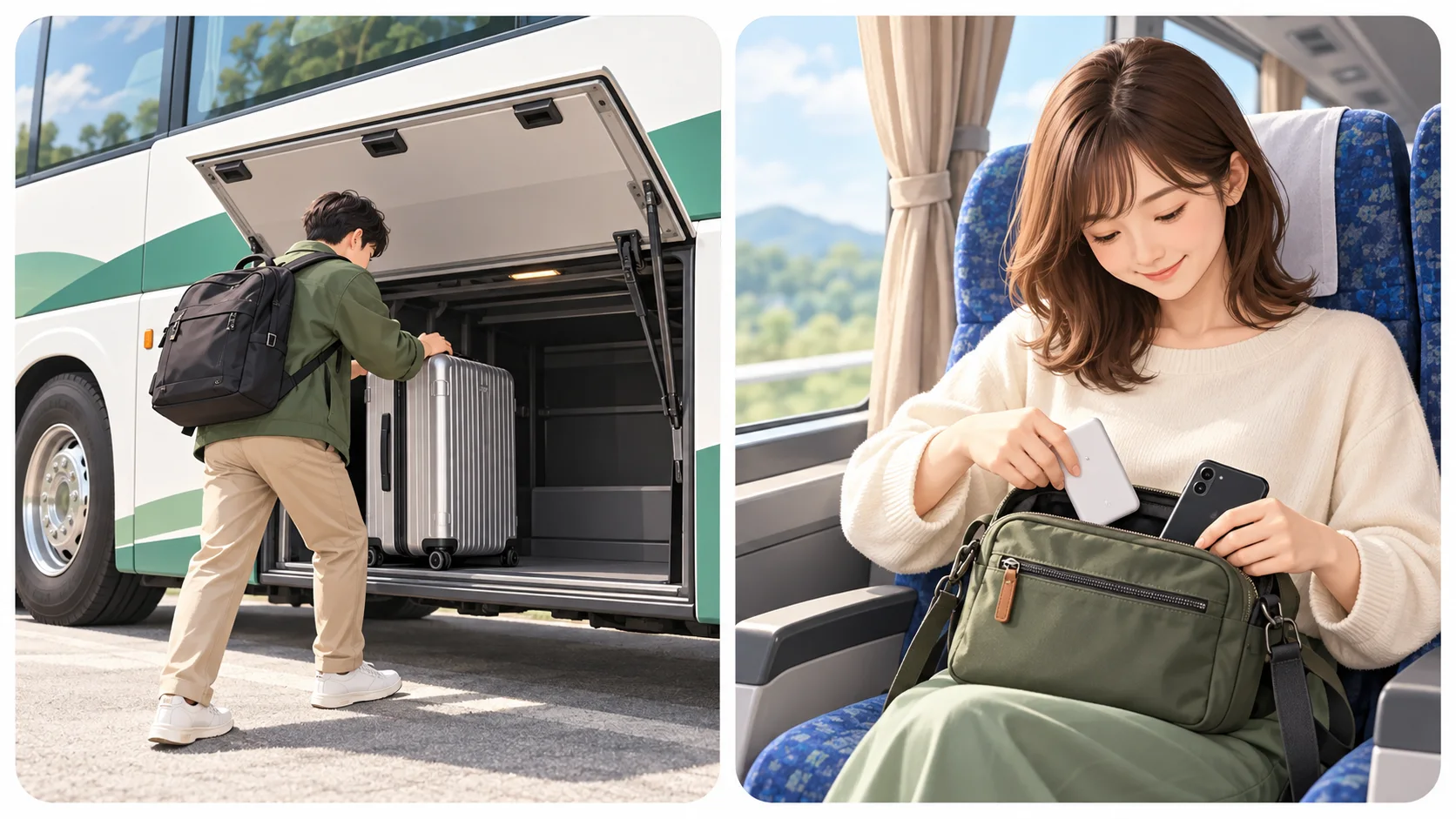
Ordinary suitcases normally use the luggage compartment below the coach, while small cabin bags must fit appropriately under the seat or on the rack without blocking the aisle. Fujikyu’s FAQ describes one small item per passenger in the designated space and larger luggage subject to capacity. Keio also says rules for large bags depend on the actual operator. Airline weight allowances, the capacity of a particular touring coach or another highway route’s size limit do not automatically apply to your departure.
Keep passports and other essential documents, wallets, medication, valuables and fragile items in a bag you can manage yourself. Fujikyu’s power-bank handling instructions specifically prohibit putting a power bank in the underfloor luggage compartment, even inside a backpack or suitcase. Take it out and keep it within reach and sight. Sort this before boarding instead of opening an entire suitcase as the driver closes the luggage doors. On arrival, retrieve your own bag and check its identifying marks before leaving.
If several people each have a large case plus shopping bags, give the operator the quantities and dimensions in advance. Where appropriate, consider forwarding larger luggage to the next accommodation and carrying only what the excursion needs; delivery time, acceptance and cost still need checking. Fitting on the coach and comfortably wheeling bags along the lake or onto a local bus are separate questions. On a day trip without a hotel to leave them at, include storage in the usable time for the visit.
Bicycles, skis and oversized items: the same destination can have different rules
Fujikyu’s Shinjuku and Shibuya route notes permit bicycles only under conditions: folding or dismantling, packing in a bicycle bag and available luggage-compartment space. Space cannot be reserved; a full compartment may mean the bicycle cannot be carried, and it cannot be taken into the passenger cabin instead. The Shinjuku page additionally prohibits bicycles on double-decker coaches. These are conditions under which carriage may be possible, rather than a guaranteed bicycle space included with a seat.
The Tokyo Station/Ueno route terms, by contrast, say bicycles are not accepted. Reaching the same Kawaguchiko destination does not transfer Shinjuku’s conditions to that service. JR Bus’s general FAQ also separates luggage standards by route and operator; choosing its most generous wording does not establish a right on every jointly operated departure. For skis, musical instruments, sports equipment or powered mobility aids, describe the real dimensions and quantities and seek an answer for the service you will use.
For a cycling-focused visit, compare local rental with bringing your own bicycle, but investigate individual rental businesses, children’s bikes and specialist models separately. This luggage explanation is not a rental guide. Check carriage feasibility before paying instead of discovering at the terminal that your bag is oversized. Saving a little on transport is poor value if an unconfirmed item prevents the whole journey from going ahead.
Wheelchairs, walking aids and strollers: confirm the whole journey before paying
Fujikyu’s wheelchair and stroller information says wheelchair-in-place accessible highway coaches are not normally used, and foldable wheelchairs and strollers can be placed in the underfloor compartment. That does not establish that every wheelchair user can board, or that selecting a seat includes assistance throughout a transfer. Check the steps at the door, whether the passenger can transfer, folded dimensions, who provides assistance and how the chair is retrieved and used at the destination.
JR Bus has accessible vehicles and advance contact arrangements on some routes, but the FAQ’s specific Tokyo–Kansai provisions do not guarantee the same for Tokyo–Kawaguchiko. Contact the actual operator with the date, section, equipment dimensions and assistance needed, then choose tickets based on its response. If the coach is unsuitable, compare rail or another transport option whose access arrangements can be established. Reliability for the person traveling deserves priority over a small difference in time or fare.
Treat station elevators, the waiting area, vehicle and onward journey after Kawaguchiko as one continuous trip. Easy boarding in Tokyo does not settle access on lakeside paths, local buses or hotel shuttles. Families with strollers likewise need a clear division of folding, carrying the child and handling bags. In rain or crowds, reducing movement between sights is often easier to manage than adding more transfers once already there.
Toilets, charging and rest stops depend on the actual departure
Equipment can differ between departures on the same route. Fujikyu’s FAQ says most coaches have a toilet, with exceptions for some jointly operated, additional or replacement vehicles. Wi-Fi, outlets and USB charging have similar qualifications. If you need charging, frequent toilet access or a particular seat layout, check the departure’s equipment rather than treating a promotional photo as every vehicle’s specification. A phone ticket also needs a power plan that does not depend entirely on charging after boarding.
The Shibuya and Tokyo Station route pages explicitly state that there is no en-route rest stop. Do not expect a guaranteed service-area shopping break. A general FAQ saying vehicles without toilets may make a toilet stop does not establish a scheduled stop for your own coach. Use the restroom and prepare drinking water and necessary items before departure; discuss special needs with the operator in advance. These preparations become more useful when congestion extends the journey beyond the published arrival time.
Keep your body and bags within your space, follow onboard eating rules and avoid strong smells or disturbing other passengers. Do not move around a moving coach or leave items in the aisle to change sides for a Mount Fuji photograph. Any view depends on your seat, the road, weather and cloud. For photography, leave time after arrival at a place where you can safely stop, rather than treating a view through the coach window as a guaranteed part of the ticket.
Fix the return before choosing your final lakeside stop
For a day trip, establish when you must be back at the long-distance boarding point before deciding whether to add one more sight. Keep the return service, stop and valid ticket, then allow time for local transport and collecting stored luggage. Local sightseeing buses and Tokyo coaches are different systems. A local bus still running does not postpone your booked coach, and another Tokyo-bound departure on the timetable does not make your ticket flexible.
In autumn, separate illuminated-event hours from both parts of the return. Kawaguchiko’s foliage festival may still be operating near your coach departure, while the last local bus from the north shore to the station can be earlier. Check both connections rather than only the festival closing time. The seasonal Kawaguchiko stay and evening-return guide explains the 2026 event and lakeside last-bus distinction. If the connection does not work, shorten the evening visit, stay overnight or confirm another transport option in advance instead of expecting a driver to wait.
Include the journey from your Tokyo arrival stop to the hotel too. A fixed Shinkansen departure, airport connection or event that evening needs its own margin. There is no single guaranteed buffer that fits everyone. Ask which next reservation would be hardest to change if the road journey took longer. Moving that commitment or allowing more independent time is easier than trying to repair the itinerary from the expressway.
Arrival at Kawaguchiko still leaves local buses and hotel shuttles
Reaching Kawaguchiko Station is not reaching Oishi Park, the north-shore autumn corridor or your lake-view room. Collect your bags and find a local bus or contact the hotel before deciding what fits into the day. Fujikyu’s local sightseeing routes and stop names help distinguish the Red Line along the north shore, Green Line towards Lake Saiko and Blue Line towards Lake Motosu. Those local fares are not automatically included in a one-way ticket from Tokyo.
Arrange transfers according to the individual hotel rather than assuming every property collects guests on demand. Fuji Lake Hotel’s station transfer guidance describes a free pickup after calling from Kawaguchiko Station. HAOSTAY Kawaguchiko’s shuttle reservation conditions instead require an arrival-shuttle booking at least two days ahead by message through the booking platform, within its own operating periods. If your coach is late, tell the hotel early and check whether the arrangement remains possible; do not wait until its pickup window has passed to request a service you never reserved.
Day visitors carrying luggage should decide on storage or short-distance movement before heading to the lake. Allow a little time to get organized after arrival instead of joining a published coach-arrival minute directly to the next local-bus departure. Wait until the whole party has its bags, and agree where you will meet for the return. That connects the ticket to the lake visit you wanted, rather than spending much of the trip repeatedly finding boarding points.
A day-trip example: work backwards from the return
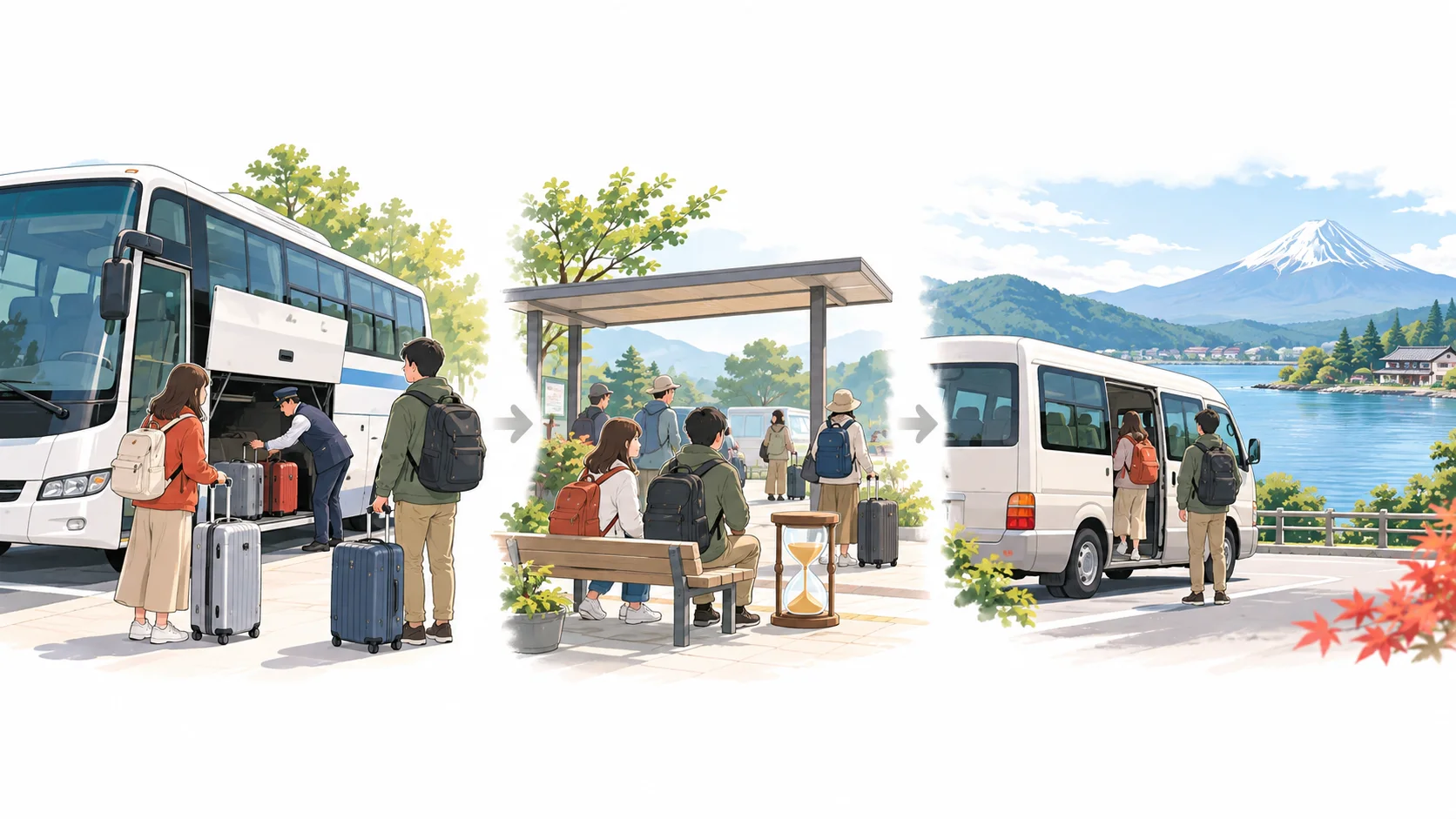
Suppose you use the Shibuya July timetable example departing at 6:05 and arriving at Kawaguchiko at 8:05, then choose the table’s 17:40 return, scheduled to reach Shibuya at 20:30. These are dated official timetable examples for explaining time allocation, rather than checked seats for your travel date or a guarantee that the same schedule will operate then. Work backwards from the return, deducting the trip to the station, collecting belongings and waiting, then decide on one main morning and afternoon priority instead of continually extending a sightseeing list.
For example, choose one north-shore walking area in the morning, eat locally at midday and add only another stop in the same direction in the afternoon. Drop that second distant stop if rain or outbound congestion has shortened the day. For Yamanashi’s houtou, the broad flat noodles cooked in a hearty pot, Kosaku Kawaguchiko’s official branch information gives opening from 11:00, first-come seating and no reservations; busy periods can bring an earlier admission cutoff. A lunch you have not yet queued for should not be treated as a guaranteed 20-minute appointment.
Keep a direct route back to the station before the fixed return, rather than making a location across the lake or on an infrequent route your final stop. If illuminated evening scenery is the priority, this early-evening return example does not suit that wish. Compare an available later departure, its night connections or an overnight stay separately. Recognizing incompatible plans preserves some unhurried time beside the water; making a day trip sound good value does not require squeezing in every popular stop.
An overnight example: fit arrival around the hotel and meals
For an overnight stay, place the long-distance arrival before the hotel’s pickup and check-in arrangements instead of choosing the latest coach and expecting staff to wait. At Shuhokaku Kogetsu on the north shore, the official station pickup window is 14:30–18:30, with a call after reaching Kawaguchiko Station. That is not on-demand transport after the evening illuminations end. Dinner and bathing are part of the stay too. Paying more for a room, arriving late and leaving on the earliest coach may leave little time to use the facilities you selected.
For an easier finish near the station, compare Fuji Lake Hotel’s Funatsu lakeside location and call-on-arrival pickup. If you prefer to direct more of the budget towards other activities, examine HAOSTAY’s actual room types and advance shuttle booking. These are accommodation examples supported by official information, rather than live lowest prices, available rooms or a ranking based on personal stays. Check mountain views, lake views, private baths and meals room by room; a hotel in Kawaguchiko does not mean every room faces Mount Fuji.
On the second day, choose the return around breakfast, checkout and the hotel’s station drop-off before deciding whether another convenient stop fits. Avoid repeatedly moving bags across two lake areas. For room, family and accessibility comparisons, read the room and shuttle differences at four Kawaguchiko properties. Establish the actual room and transfer times first, then place the coach journey where the arrangements can connect.
During congestion, deal first with connections that could expire
Road congestion is a real variable for Tokyo–Kawaguchiko coach planning. Fujikyu’s Shinjuku terms list accidents, traffic and abnormal weather as possible causes of delay and say an ordinary late arrival does not trigger a fare refund. Departing at the same time each day does not ensure the same arrival. The reference journey of about one hour and 45 minutes is not a promise to your next reservation. Before buying, give important shuttles, dinner arrangements and onward transport room to change.
If a missed connection becomes likely while on the coach, establish the situation and remaining commitments, then contact the hotel, restaurant or next ticket seller. Acting before their cutoff is more useful than presenting a congestion photograph after the arrangement has already expired. Before buying a replacement train, check the station, seats and luggage conditions; do not commit to an even tighter connection while still traveling on the road. Follow any instructions from the crew.
If you prefer not to make the return to Tokyo depend on road time, compare railway sections, transfers and fares before purchasing. That does not guarantee a railway can never be late; it changes the sort of disruption you are choosing to manage. The Japan rail-pass and individual-ticket decision guide is a starting point for that comparison. With an international flight or a difficult-to-change long-distance departure later the same day, moving the excursion to another day may be more useful than assuming a slightly earlier coach makes the connection certain.
Missing the coach or losing the ticket: limit the next loss
If you know before departure that you cannot make it, check the original order’s change options immediately or contact the seller’s stated channel. Do not keep rushing while assuming the next coach has seats. Fujikyu’s FAQ and route terms say the original ticket may no longer be changeable or refundable after its designated departure, and lateness does not make it usable on a later service. Before buying another ticket, check the date, stop and valid fare; occasional assistance from a driver is not a common entitlement across operators.
Forgetting or losing a paper ticket, or having a phone fail, does not guarantee a free replacement based on a payment photograph. Give the original platform or counter the order number, passenger name, date and purchase method so it can establish whether lookup, reissue or a new purchase is necessary. JR has a specific repurchase and later-refund procedure for lost tickets, but it should not be applied to every website or fare. Check your own ticket before the trip instead of treating another traveler’s successful recovery as a right.
If no valid ticket can be found, keep the group together somewhere the problem can be handled rather than sending half onto the coach while the rest remain at the counter. If you ultimately switch to rail, stay overnight or cancel the lake visit, recheck accommodation and the return as well, instead of adding more unconfirmed alternatives. Retain the canceled and newly purchased order records; they are easier to reconcile than reconstructing duplicate payments from memory after the holiday.
A suspended service, voluntary cancellation and ordinary delay are different
Before departure in a typhoon, heavy snow, an accident or road restrictions, check the operator’s service notices and any message about your booking. Choosing not to travel, an operator formally suspending a departure and a service still running but potentially late are different cases. Do not cancel under the ordinary process merely because a forecast is poor and assume suspension refund terms apply. Equally, a notice for one route does not establish that coaches from every Tokyo departure point have stopped.
Fujikyu’s FAQ describes a full ticket-fare refund when a service is suspended for reasons on the company’s side, but payment-channel fees may have separate terms. Fujiyama Connect’s convenience-store payment page, for example, explicitly leaves payment and cancellation handling charges with the customer even for suspension. A refundable fare does not establish compensation for restaurant tickets, hotels, connecting trains or every handling fee. Confirm the process with the original platform, retain notices and application status, then handle other reservations separately as needed.
An official service notice is not necessarily second-by-second vehicle tracking. JR Bus’s FAQ says major delay and suspension notices on its homepage are not real-time location information; check road information or contact the operator when necessary. A brief period with no new notice does not establish normal operation, and a social post from several days ago cannot establish today’s status. Check the date, route and service, then adjust the itinerary where necessary instead of repeatedly buying the same direction through different platforms.
A two-adult, one-child fare calculation with the conditions kept visible
Take two adults and one passenger confirmed eligible for the ticket’s child fare, needing a separate seat. If both directions use the specified Shibuya–Kawaguchiko section at standard fares, each direction costs ¥2,300 × 2 + ¥1,150 = ¥5,750, or ¥11,500 return. If both directions actually qualify for the PDF’s highwaybus.com credit-card offer, each costs ¥2,100 × 2 + ¥1,050 = ¥5,250, or ¥10,500 return. These are fare calculations; no date’s seats have been checked and no discount availability is guaranteed.
The two fare bases differ by ¥1,000 return, but add transport from the Tokyo hotel to the terminal, local Kawaguchiko travel, meals and activities. Do not omit a child’s required seat simply to make a comparison look cheaper. If one leg has no applicable discount, replace that leg with its actual fare. Use the itemized Japan travel-budget method to keep these expenses separate, rather than assuming a ticket saving reduces the entire trip cost by the same proportion.
Keep payment and refund fees with the channel that charges them, rather than mixing them into another platform’s discount example. If you instead use Fujiyama Connect and that order actually uses convenience-store payment, examine its payment fee. On cancellation, the original ¥500 payment fee plus the separately stated ¥500 convenience-store cancellation fee total ¥1,000; that does not establish a zero fare-cancellation charge. This example separates two stated fees, does not multiply them automatically by each passenger and does not suggest they necessarily apply to the credit-card-discount booking above.
A package comparison can also be practiced with explicit assumptions. Suppose an adult obtains the Shinjuku ¥2,000 online fare in each direction, totaling ¥4,000. Assume a separate theme-park one-day pass for that same admission date costs ¥6,000: bought separately, the total is ¥10,000. If a package for the same departure place, day and park content actually shows ¥9,200, the difference is ¥800. The ¥6,000 and ¥9,200 figures are calculation assumptions, not park or Toku Q prices established by this guide. Before buying, recalculate with matching available products on the same date and compare change and refund flexibility too.
| Fare basis | One-way calculation | One way | Return |
|---|---|---|---|
| Standard | ¥2,300 × 2 + ¥1,150 | ¥5,750 | ¥11,500 |
| highwaybus.com credit-card offer; both legs qualify | ¥2,100 × 2 + ¥1,050 | ¥5,250 | ¥10,500 |
| Difference between these two bases | ¥5,750 − ¥5,250 | ¥500 | ¥1,000 |
Keep the orders and contact details together before leaving
For the final check, put the departure building and floor, service number, travel date, valid ticket, adult and child numbers and original sales platform in one itinerary. List the outward and return separately, and confirm payment and ticket issuance separately too. This is private travel information, without a need for public uploads. Give companions the information they need, so that separating briefly or losing power on the main organizer’s phone does not leave everyone unable to access their tickets.
Complete the matters requiring advance contact: acceptance of large bags or mobility aids, seating needs, hotel pickup, dinner and the return connection. If something cannot be confirmed, change the departure or shorten the plan rather than treating a hope as a reservation. Neither a view of Mount Fuji through the window nor a calm lake comes with the ticket. A manageable arrival with people and bags gives you more freedom to choose the experience you most want once there.
On the travel day, use current-year route information and the latest details of the original order, especially operating dates, change cutoffs, boarding platforms and suspension notices. This guide breaks a Tokyo–Mount Fuji coach journey into decisions you can check for your departure neighborhood, companions and destination. Establish one workable return journey and the connection after arrival before adding more sights or accommodation. That is easier to execute than buying every available offer before knowing how the parts fit.
A few useful answers
Where do Shinjuku buses to Kawaguchiko leave from?
The usual boarding point is the fourth-floor highway bus departure level at Busta Shinjuku. Reaching the railway station still leaves the exit, upper floor and actual platform to find. Check your ticket and the day’s boards instead of relying on an old platform number.
From October 2026, can Keio departures only be bought on highwaybus.com?
No. The Shinjuku notice says Fujiyama Connect may also sell some Keio seats. A departure originally booked inside Fujiyama Connect can follow the notice’s within-platform Keio-to-Fujikyu change arrangement. Across websites, an order cannot be transferred directly; use the original seller’s process.
How do Shibuya–Kawaguchiko standard and online fares differ?
From July 1, 2026, the standard adult fare is ¥2,300 and child fare ¥1,150. The official PDF also lists highwaybus.com credit-card fares of ¥2,100 and ¥1,050. The specified section and payment conditions must qualify; every purchase method does not have the same price.
Can I still make a new reservation on SEKITORI?
As of October 21, 2026, new reservations had ended. The notice directs travel from October 1 to Fujiyama Connect. The old site retains specified membership information, history, receipts and other information until 23:59 on October 31; that is not a service for amending new orders.
Do I have to register for Fujiyama Connect?
Guest purchase is possible, but the official payment guide says guests cannot use convenience-store payment. Membership, payment method and completed ticket issuance are separate matters. Check the instructions for your selected departure.
Can I board with a screenshot after buying online?
Do not assume so. Fujiyama Connect’s reservation-to-boarding guide and highwaybus.com’s mobile-ticket rules expressly prohibit screenshots as substitutes. Follow your original ticket’s valid screen-display or printing instructions instead of using an old tutorial for another company.
Can I leave every child under six out of the passenger numbers?
No. Free travel depends on school status, accompaniment, seat use and the operator’s conditions, while even a child without a seat can count towards vehicle capacity. For a separate seat, check the relevant child fare and arrange seating together in advance.
How many kilograms of luggage can I bring?
Check the actual carrier and service; this guide does not establish a shared weight allowance across all routes. Contact the operator about large or multiple items. Keep power banks, documents and valuables in your personally managed cabin bag.
Does a late coach automatically trigger a refund?
An ordinary late arrival does not automatically refund the fare. Delay, operator suspension and voluntary cancellation need separate treatment. Even when the fare is refundable after suspension, the original payment channel’s handling fees may have different terms.
Is Kawaguchiko Station Mount Fuji’s fifth station?
No. Kawaguchiko Station, Fujisan Station and the Fuji Subaru Line Fifth Station are different destinations. A direct mountain service has seasonal and road-access conditions, and a regular lake-area ticket does not automatically include the onward fifth-station journey.
Is the ¥10,500 Shibuya return total for two adults and one child a quote?
No. It assumes both legs qualify for the specified credit-card offer and the child qualifies for a separate child-fare seat: ¥2,100 × 2 + ¥1,050 each way, totaling ¥10,500 return. Date-specific inventory was not checked. Other transport, meals, activities and possible fees are separate.
Is Toku Q Pack always better value than separate bus tickets?
It does not suit every trip. It combines return coach travel and a theme-park one-day Free Pass, with prices and conditions checked by departure point, date and content. If you are not visiting the park, calculate transport alone. A partially used package cannot be refunded, so the largest advertised saving is not enough to decide.
Check with the source
Schedules, availability and rules can change. These official sources are the place to confirm details before you book.
- Fujikyu: Shinjuku–Fuji Five Lakes route, fares and travel conditions
- Fujikyu: October 2026 Shinjuku booking changes and cross-platform Q&A
- Fujikyu: SEKITORI closure, retained records and migration
- Fujikyu: Shibuya route, fares and conditions
- Fujikyu: July 2026 Shibuya timetable and fare-change notice
- Fujikyu: July 2026 Shibuya timetable and standard/credit-card fare PDF
- Fujikyu: Tokyo Station and Ueno routes and boarding points
- Fujikyu: seasonal Shinjuku fifth-station routes and separate fares
- Fujikyu: children, bags, equipment, wheelchairs, cancellation and suspension FAQ
- Busta Shinjuku: fourth-floor departures and facilities
- Keio: Shibuya Mark City terminal location
- JR Bus Kanto: Yaesu South departures and Nihonbashi arrivals
- JR Bus Kanto: child categories, luggage, online refunds and service FAQ
- Keio: foreign-language ticket and luggage FAQ
- Fujiyama Connect: reservation instructions
- Fujiyama Connect: payment methods and convenience-store fees
- Fujiyama Connect: reservation, boarding and valid ticket display
- Fujiyama Connect: member and guest cancellation procedures
- highwaybus.com: mobile tickets and separate single-sided return printing
- Fujikyu sightseeing buses: local routes and stop names
- Fuji Lake Hotel: station access and pickup after arrival
- HAOSTAY: shuttles, check-in and luggage FAQ
- Shuhokaku Kogetsu: station pickup hours
- Kosaku Kawaguchiko: hours, first-come seating and parking
- Kosaku: possible early admission cutoff during busy periods
- Fujikyu: Toku Q inclusions, package types and partial-use refund restrictions
- Official Fujikyu Bus post: a vehicle record at Busta Shinjuku