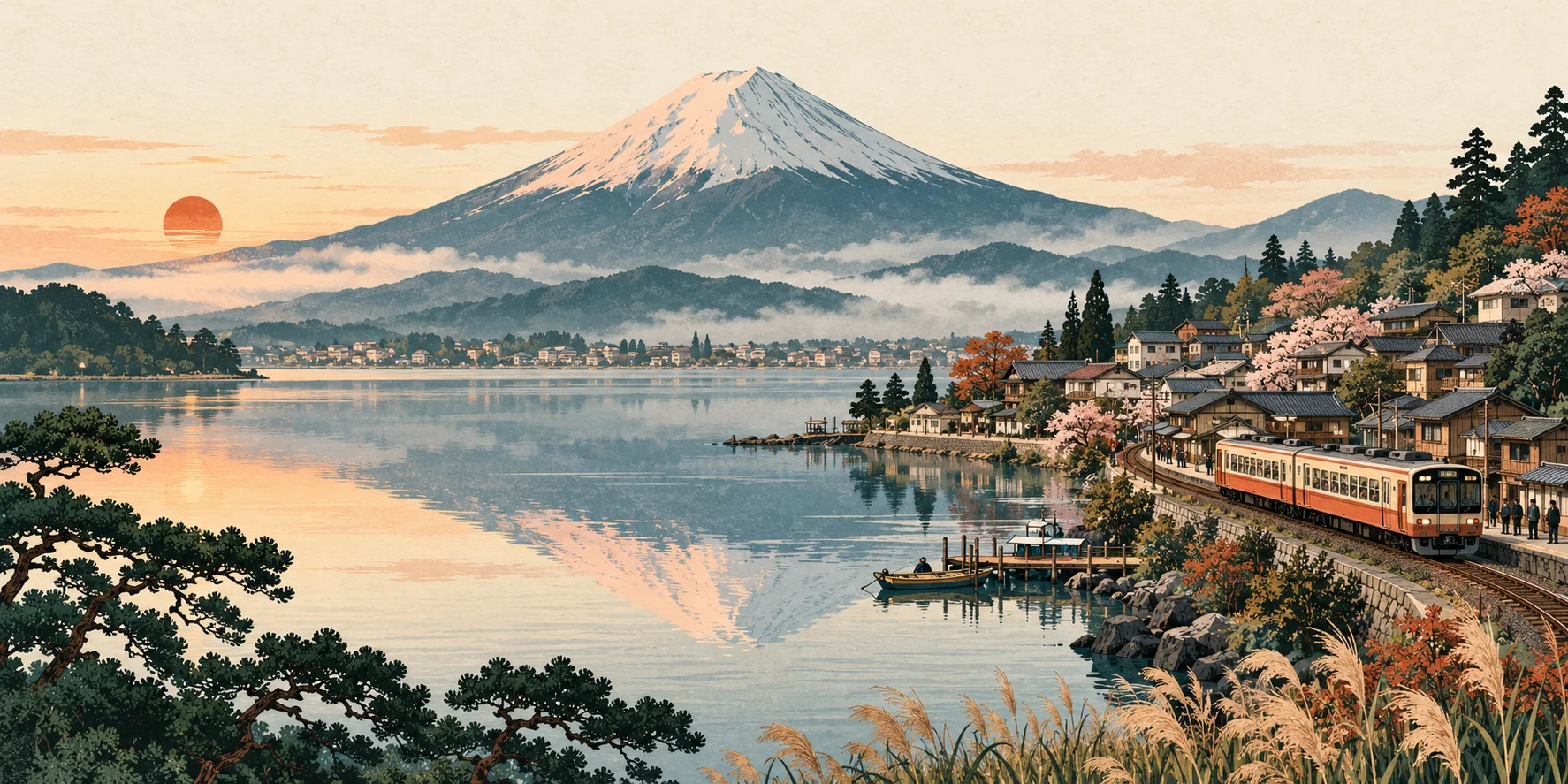
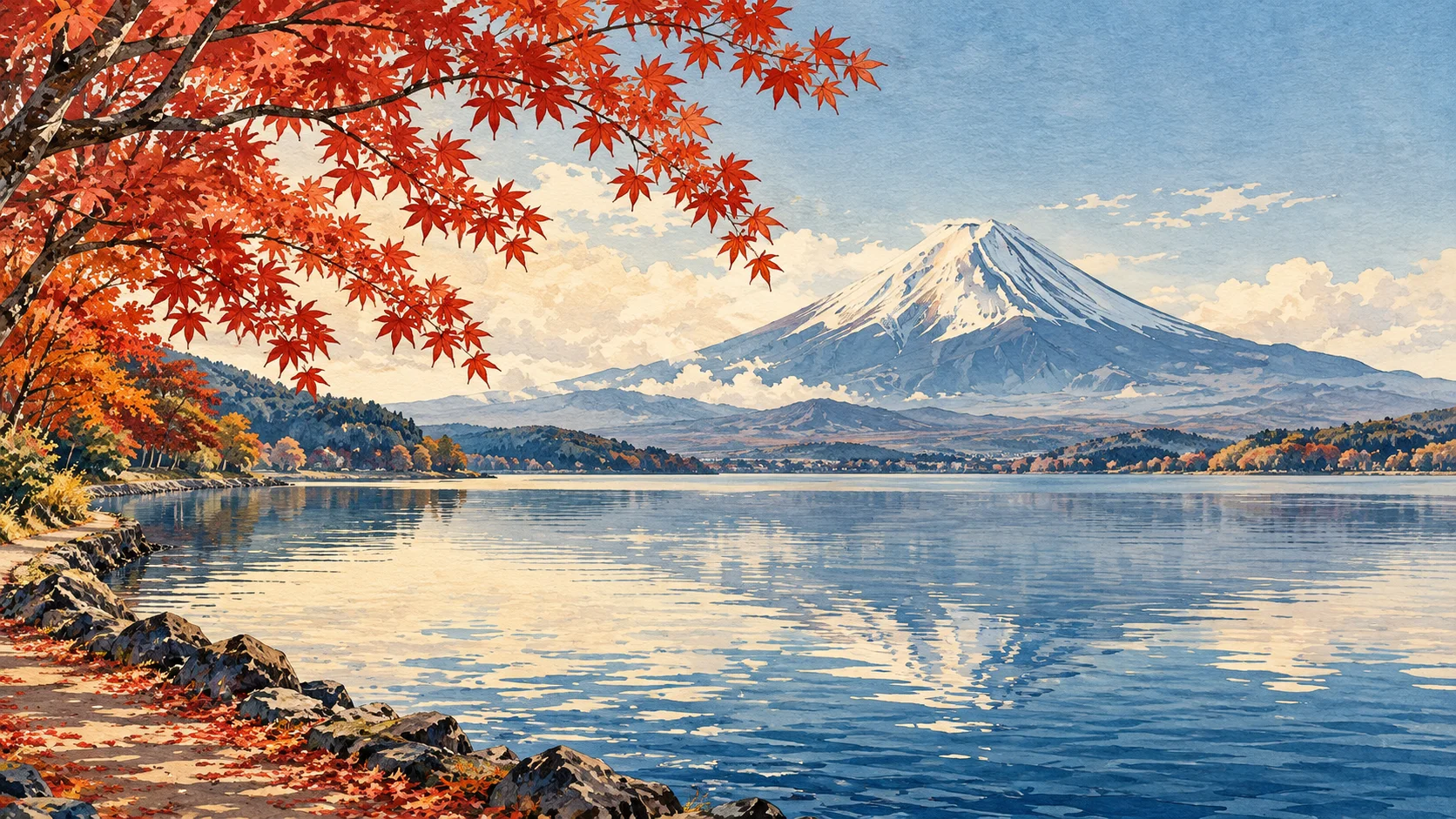
The most useful Kawaguchiko decisions often concern the trip back after the autumn lights, which room actually offers the view you want, and whether there is time beside the lake before breakfast. Distinguish the north shore, station area and other lakeside hotels first, then choose a day trip or overnight stay. That makes the foliage, cherry blossoms and bathing easier to fit into a route you can comfortably follow.
A day trip or an overnight stay? Start with the evening and the following morning
If Kawaguchiko is one opportunity to see Mount Fuji within a Tokyo trip, a day visit can focus on the north-shore scenery and one walking area. An overnight stay makes more sense when you want to see the illuminated Momiji Corridor and return to the lake early the next morning. The practical differences are the evening journey back, your hotel dinner and the next day’s first connection. An extra night cannot guarantee a clear view of Fuji. How early your companions want to get up may matter more to your choice of base than a long list of sights.
For a first visit, begin with one accommodation base and one main stretch of shoreline. The station area helps with onward travel to Tokyo; the north shore can bring lake views and the autumn festival into the same day; a hotel on the southern shore may make its garden, facilities and scheduled shuttle the focus of the stay. Fit that location into the booking sequence for a first independent Japan trip before committing to several tours, meal vouchers and attraction bundles. This leaves room to adjust the parts of the day that depend on weather and transport.
The event, room, transport and cost information in this guide was checked against official material available on 21 October 2026. Example room costs are labelled as assumptions, and past blossom reports retain their year. For spring 2027, a hotel’s announced renovation and a planned new accommodation tax also need attention. Choose the periods you most want to protect, then decide how much travel time fits around them. That gives you a clearer plan than treating every photograph of the area as another stop you must reach.
The station, north shore and southern shore create different hotel routines
Kawaguchiko Station is an important arrival and transfer point, with sightseeing buses continuing to the lake and north shore. The north shore itself has several separate stops: Kawaguchiko Museum of Art, the Itchiku Kubota museum area, the entrance to Nagasaki Park and Oishi Park are different places to get off. Put your hotel’s actual address and stop on the same map so you can judge the walk after the bus. A booking page that says only “Kawaguchiko area” does not tell you whether you can walk back after an evening outing.
Fujikyu’s sightseeing-bus routes and stop list show the Red Line leaving the station for the lakeside and north shore, ending at Kawaguchiko Natural Living Center by Oishi Park. The Green Line serves the Saiko area, while the Blue Line extends towards Narusawa, Lake Shoji and Lake Motosu. All belong to the wider Fuji Five Lakes area, but the connections still need checking individually. Putting the endpoints of all three lines into half a day would leave much of that time for waiting and changing buses.
For accommodation on the south or southwest side of the lake, pay particular attention to the hotel’s own access page. Some properties use a direct station shuttle rather than the Red Line running along the north shore. A hotel can be close to the water and still far from the autumn-festival venue you want to visit. Conversely, a simple room near the station can be useful for a late arrival, an early departure or heavy luggage even when it has no private lake view.
Check event dates, seasonal conditions and room restrictions separately
Cherry blossoms, autumn foliage and visibility of Mount Fuji are separate conditions. A festival’s dates describe the organiser’s event period; blossoms and leaf colour still change with that year’s weather. The summit will not emerge from cloud to match a room reservation. Treat a composition of flowers or leaves, lake and mountain as an opportunity when conditions cooperate, with time available for a garden, museum or meal if they do not.
For a spring visit, follow updates for the same year and the same place. Fuji View Hotel (富士ビューホテル) describes its usual cherry-blossom season as mid-April, yet its saved 2026 reports recorded full bloom on 6 April and falling petals with few flowers remaining by 12 April. The distinction is useful when choosing a general season, but it cannot guarantee dates for the following year. The hotel’s dated garden blossom reports show how actual conditions can differ from the usual window.
For autumn, put the evening event, your hotel dinner and the last bus on one timeline. If you have not chosen travel dates yet, compare the tradeoffs between Japan’s seasons, then look for a room with cancellation terms you can accept. Paying a large nonrefundable room bill far in advance for one hoped-for photography date may be a poor fit while the rest of the trip is still changing. Keep the seasonal preference and the financial commitment as two deliberate decisions.
| Item | Dates in the official information | How to use the information |
|---|---|---|
| 2026 Kawaguchiko Autumn Leaves Festival | 7–29 November 2026 | Venue: 9 a.m.–7 p.m.; illumination sunset–9 p.m.; check return transport separately |
| 2026 north-shore cherry-blossom festival | Originally 28 March–12 April; extended to 15 April | Completed 2026 event, not 2027 dates |
| Kogetsu dining-area work | 25 January–7 April 2027 | Ordinary-room capacity restricted; ask separately about 8–18 April |
| New Fujikawaguchiko accommodation tax | Planned from 1 April 2027 | Check actual stay dates and latest notices |
The 2026 autumn festival runs 7–29 November, with illumination until 9 p.m.
The official Fujikawaguchiko tourism announcement lists the 2026 Autumn Leaves Festival for 7–29 November, with illumination from sunset until 9 p.m. The year’s official leaflet separately lists venue opening hours of 9 a.m.–7 p.m. Daytime activities and evening lighting have different end times. Do not use the lighting schedule to assume every stall, meal service or other facility will stay open until 9 p.m.
The main venue centres on もみじ回廊, usually called the Momiji Corridor in English. If you want to arrive in the late afternoon, arrange dinner at a time that works with the visit. A dinner-and-breakfast hotel package has its own meal arrangements, and the property may be unable to move dinner simply because you ask after checking in. To spend longer taking photographs after the lights come on, confirm the dining schedule and journey back in advance, or choose a plan with meal arrangements that suit the outing.
Festival dates do not mean the foliage will be at its peak throughout the entire period. The official introduction uses early to mid-November as the usual peak reference. That is distinct from the 7–29 November festival period and is not a daily foliage forecast for 2026. Check that year’s updates before travelling. If a search result shows a 2025 peak report or a 10 p.m. illumination time from another year, return to the announcement labelled 2026 before using it to plan the final bus connection.
Momiji Corridor, Momiji Street and Momiji Tunnel are different places
Momiji Corridor is the festival’s main area around the Nashigawa stream. Momiji Street is a surrounding lakeside walking route, while Momiji Tunnel is a separate photography location. The similar names should not be treated as interchangeable entrances on a map. The 2026 venue map labels the corridor and street separately. Nearby stops such as 久保田一竹美術館 and 河口湖猿まわし・木の花美術館 help identify the festival area when comparing the map with the operator’s stop names.
If you want a composition with Fuji, the lake and colourful leaves, leave part of a north-shore walk for daylight, then visit the corridor later. A canopy beside the stream and an open lake view offer different angles; you do not need to wait under the busiest trees for a mountain view they may not provide. Compare the Kawaguchiko viewpoints listed by Japan’s transport ministry to distinguish the places. Use the current organiser’s announcement, rather than that geographical reference, for the event’s times.
Momiji Tunnel lies on a different stretch of shoreline in the Oishi area. Check access separately before adding it. With half a day and public transport, choose a sensible sequence involving Oishi Park, the Nagasaki Park area or the corridor rather than repeatedly changing direction for one photograph. Stay on footpaths and in permitted stopping areas, leave space for other pedestrians, and avoid standing in the road while waiting for a gap in traffic.
Plan the way back before staying for the lights
The transport panel on the official 2026 festival leaflet specifically lists the last station-bound Red Line buses: 6:32 p.m. at 久保田一竹美術館, 6:33 p.m. at 河口湖猿まわし・木の花美術館, 6:34 p.m. at the music-and-forest museum stop and 6:35 p.m. at Kawaguchiko Museum of Art. These are the departures printed on that leaflet. Check the operator’s day-of-travel notices and the sign at your actual stop before relying on them.
Illumination until 9 p.m. does not establish a 9 p.m. service on the same sightseeing-bus route. To stay later, confirm a real walking route to your accommodation when booking, arrange a taxi ahead or obtain the hotel’s agreement to a suitable pickup. A daytime station shuttle is not an on-demand service from every attraction at any hour. When travelling with young children or older relatives, consider lighting along the return route, low temperatures, toilets and where the group can wait.
If you intend to use the early-evening last departure shown on the leaflet, finish browsing and shopping with time to walk to the stop, identify the correct direction and join the queue. Congestion can change when the bus reaches the stop, and the vehicle may be crowded. Work backward from the time you must reach the station, hotel or dinner venue. Subtracting only the map’s estimated ride time leaves out the parts of the connection that tend to take longer on a busy festival day.
Oishi Park: allow time for congestion as well as the lake walk
Oishi Park is beside the Red Line’s Kawaguchiko Natural Living Center stop, making it a possible companion to a north-shore hotel and lakeside walk. It is not the same stop as Momiji Corridor. Summer lavender photographs also do not describe the park on an autumn travel date. Check current official information for a specific flower field or plant display. If your main aim is the lake and mountain, a flexible period beside the water can be enough without detouring for a photograph taken in another season.
On 13 October 2026, the local tourism organisation had already published an Oishi Park congestion and parking notice, describing busy roads and parking facilities. Large sightseeing coaches are generally asked to use temporary parking and designated boarding locations. Other visitors should allow time and must not stop along the road or use neighbouring shops’ parking without permission. The warning predates the autumn festival itself, so congestion should not be treated solely as a problem on festival weekends.
For a driving trip, include finding a space, entering the car park and leaving again, rather than only the navigation estimate from the station. For a bus trip, confirm the return direction, the next connection and the latest departure from the area that fits your plans. If Oishi Park is already very crowded, dropping one more distant photography stop and walking near your accommodation can make it easier to keep dinner and the journey back under control.
The 2026 cherry-blossom festival is past; keep its dates separate from 2027
The North Kawaguchiko Tourism Association’s announcement for the 15th Fujikawaguchiko Cherry Blossom Festival in 2026 originally gave 28 March–12 April, then extended the event by three days to 15 April. The venue was the north-shore path around 河口湖円形ホール, Kawaguchiko’s circular concert hall, with lighting described as lasting until about 9 p.m. This is a record of an event that has ended. It helps identify the location and that year’s change, but it does not establish the dates for 2027.
Start a cherry-blossom plan with one main target: a north-shore walk, a hotel garden or Arakurayama. Add a second only after looking at the accommodation and transport. Different locations, varieties and elevations can have different flowering stages; one person’s full-bloom photograph does not show the condition of the entire lake area. Keep half a day that can become an indoor visit, an earlier check-in or a different order of walks, rather than tying every connection to the flowers on one particular tree.
For spring 2027 accommodation, compare room types and cancellation deadlines first, then arrange the evening details when the organiser publishes information for that year. Hotel and transport restrictions deserve checking at the same time. Shuhokaku Kogetsu, for example, has already announced dining-area work for 2027. Even if you have not chosen your blossom-viewing date, you can check how many guests the hotel will accept on the nights you are considering.
Arakurayama is in Fujiyoshida: a cancelled festival does not close every park or event
The familiar composition of Chureito Pagoda, Mount Fuji and cherry blossoms is at Arakurayama Sengen Park in Fujiyoshida, a different location from the north-shore Kawaguchiko festival. Fujiyoshida’s official explanation says its 2026 cherry-blossom festival would not be held, against a background of visitor pressure on local life and the environment. Safety, traffic and temporary-facility measures were still arranged. Describing this as “the Kawaguchiko cherry-blossom festival was cancelled” would mix up two separate places and their announcements.
The official Fujiyoshida spring 2026 information gives 1–17 April for the special safety measures and traffic controls through 19 April. It describes possible rotating access to the viewing area and estimated peak waits of one to three hours. These are that spring’s management arrangements. They are neither an October live queue report nor the rules for the following year. Check for an announcement covering the season in which you will actually visit.
If a two-day trip already includes Kawaguchiko’s north shore and the evening autumn lights, Arakurayama can remain an option for the next day if time allows. It does not also require Lake Yamanaka, Oshino Hakkai and the fifth station. Keep quiet in residential streets, stay out of private property and respect residents while taking photographs. The Fujiyoshida city autumn video below introduces the park’s scenery; it cannot establish the current year’s leaf colour or operating conditions.
Where to look for Fuji’s reflection: check the sky and the water
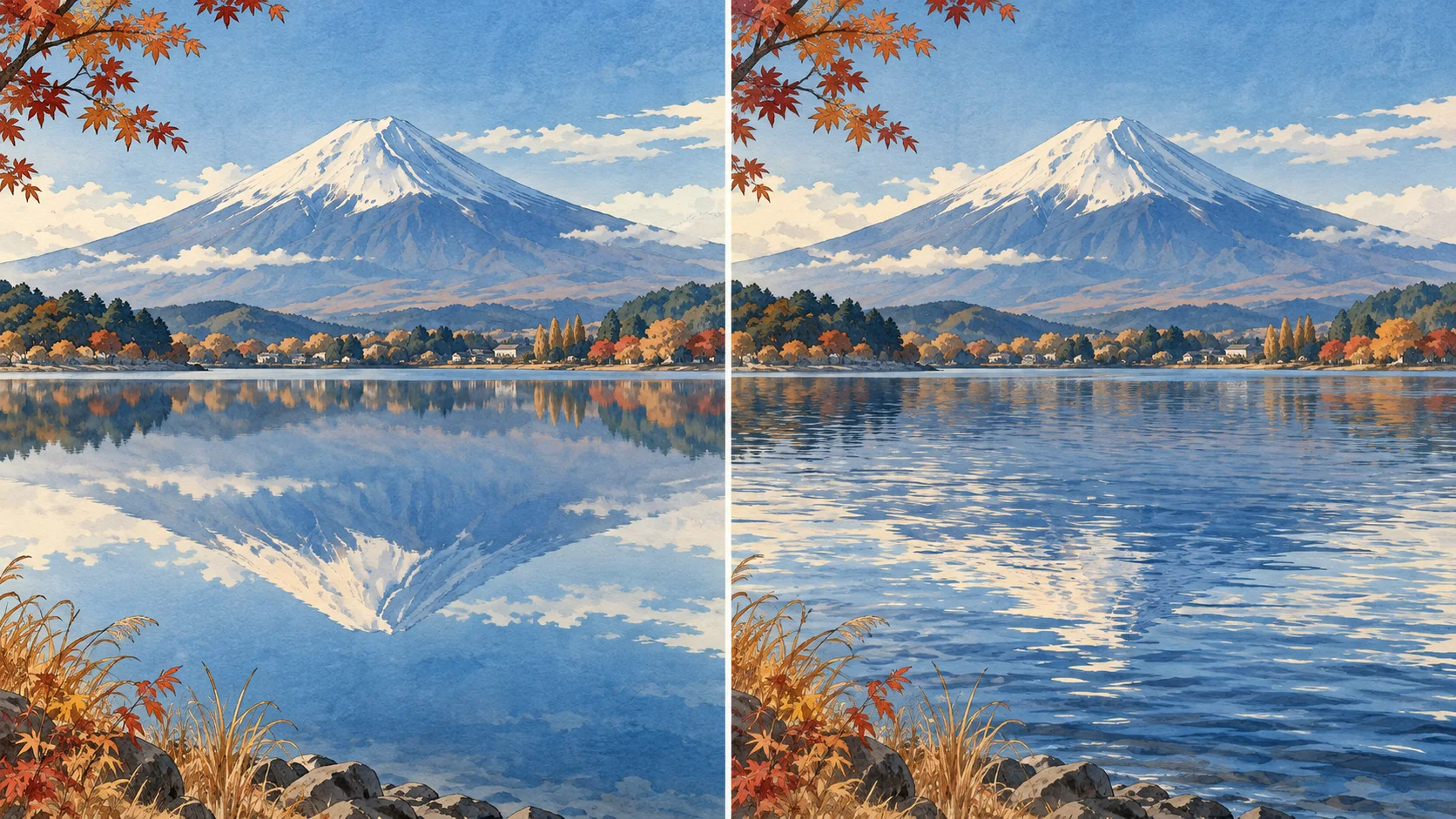
“Upside-down Fuji,” or sakasa Fuji, is the mountain reflected in the lake. You need a visible mountain and sufficiently calm water. If either condition is missing, the result may be ripples, cloud or part of the mountain rather than a complete reflection. A room described as Fuji-facing tells you its orientation. It does not promise a clear summit at a particular time, and it does not establish that you can photograph the whole reflection from that room.
The north shore, Oishi Park and the Nagasaki Park area are places to assess according to the day’s conditions. The transport ministry’s viewpoint information describes different shoreline and mountain angles. Shuhokaku Kogetsu’s website also describes the possibility of a reflection in good weather and provides a camera link. You can use the hotel’s Mount Fuji conditions page to help decide whether to head out, while remembering that a camera’s location and angle differ from your own.
Leave a little time to look at the lake in the morning, and ask whether guests can use the garden, terrace or lakeside entrance you have in mind at that hour. On a windy or cloudy day, a walk, breakfast and a bath can still fit the plan. Avoid chasing angles along stretches without legal parking. Tripods, selfie sticks and group photographs should leave a clear route for others, and equipment should not occupy the road or private land.
A day-trip sequence that fits your arrival time
For a morning arrival, confirm the journey back first, then head to the north shore and choose the Oishi Park or Nagasaki Park area for a walk and meal, finishing towards Momiji Corridor in the afternoon. Two nearby stopping areas can be enough for a daytime lake visit. To include the first evening lights, test the plan against both the local last bus and the booked departure for Tokyo. This is an editorial route suggestion; actual services, queues and your walking pace determine how much fits.
If you arrive after noon, avoid immediately trying to cover Oishi Park, Momiji Tunnel and Arakurayama in three different directions. Connect the station area, the lakeside and one main area, leaving time for lunch and the return to the station. A delayed highway bus, a full train or busy roads can reduce the usable afternoon. If the first stop takes longer than expected, dropping the final stop is usually more workable than turning the entire visit into a sequence of rushed connections.
Think about your Tokyo hotel area and transfers as part of the trip in both directions. An early departure includes the time needed to reach its terminal from your accommodation, and the journey back still has a final leg to your hotel. If you want an unhurried evening in Tokyo or leave for another city early the next morning, choose a shorter Kawaguchiko route that fits the wider trip.
Choosing a Kawaguchiko hotel: compare the location, room and shuttle together
When looking for Kawaguchiko hotel recommendations, express your main need in one sentence: walking back after the autumn lights, bathing and eating dinner at the property, catching an early departure, or getting help with wheelchair access and beds. These priorities point towards different locations and change what a room is worth to your group. The four properties below have official information that can be checked. The comparison concerns practical selection criteria, rather than first-hand stay ratings, a price ranking or a guarantee of current availability.
Kogetsu (秀峰閣湖月) is on the north shore and emphasizes lake and Mount Fuji views. Fuji Lake Hotel (富士レークホテル) is by the Funatsu lakeside, with Fuji-facing, lake-facing and accessible room options. Fuji View Hotel can suit a stay that includes the garden and time in the hotel itself. HAOSTAY Kawaguchiko offers regular and family room choices alongside shared viewing space. Within each property, distinguish the full room name, meal plan and shuttle arrangement rather than assuming one description covers every booking.
When comparing reservations, enter the guest count, children’s ages, whether everyone needs separate bedding, the meal plan and cancellation date together, then compare totals on the same basis. A single “from” price per night does not tell you whether it is for one person, two people sharing a room or accommodation without meals. For a ryokan booking, use the room and dining checks for a first onsen inn and decide how much of this particular night you want to spend at the property.
| Property | Main consideration | View and room checks | Transport or reservation limits |
|---|---|---|---|
| Kogetsu | North-shore views and meal-inclusive time at the hotel | All rooms face lake/Fuji; select the actual room category for a private bath | Station pickup 2:30–6:30 p.m.; separate 2027 construction restrictions |
| Fuji Lake Hotel | Funatsu lakeside, different wings and accessible-room options | Confirm mountain, lake and bath views by full room name | Call after station arrival; wheelchair transfer has size and occupancy limits |
| Fuji View Hotel | Garden walks and time at the property | Fuji-facing rooms differ from garden/lake-facing choices | Scheduled guest shuttle; no boarding when full or intermediate stops |
| HAOSTAY Kawaguchiko | Regular/family rooms and shared rooftop terrace | Some rooms face Fuji, not all; verify the specific property | Arrival pickup requires reservation at least 2 days ahead, not a call-on-arrival service |
Fuji views, lake views and open-air baths describe separate room features
“Fuji-facing” generally describes a room’s orientation, while a lake-view room emphasizes the water. The terms are not interchangeable. Fuji Lake Hotel’s official room list distinguishes Fuji views, Kawaguchiko views and several kinds of room with open-air or view baths. One suite with a lake-facing living room and Fuji-facing bath does not mean every room offers both views.
A room described as having an open-air bath includes the corresponding bath for that room category. Check the exact description for hot-spring water, a possible Fuji view and any steps between the room and bathroom. A reservable private bath is a separate facility that may involve a charge and restrictions on how it can be booked. Photographs on a hotel’s homepage cannot establish that your selected room includes the equipment shown.
Save the complete room name and view description from the booking page, then ask which room category the photographs represent. On a limited budget, a regular room with scenery enjoyed from shared spaces or the lakeside may work well. If you plan to spend much of the stay resting in the room, give its view, beds and bathroom more weight. Whichever you choose, cloud and weather affect what will be visible on the day.
Kogetsu: north-shore views, bathing and a station pickup with set hours
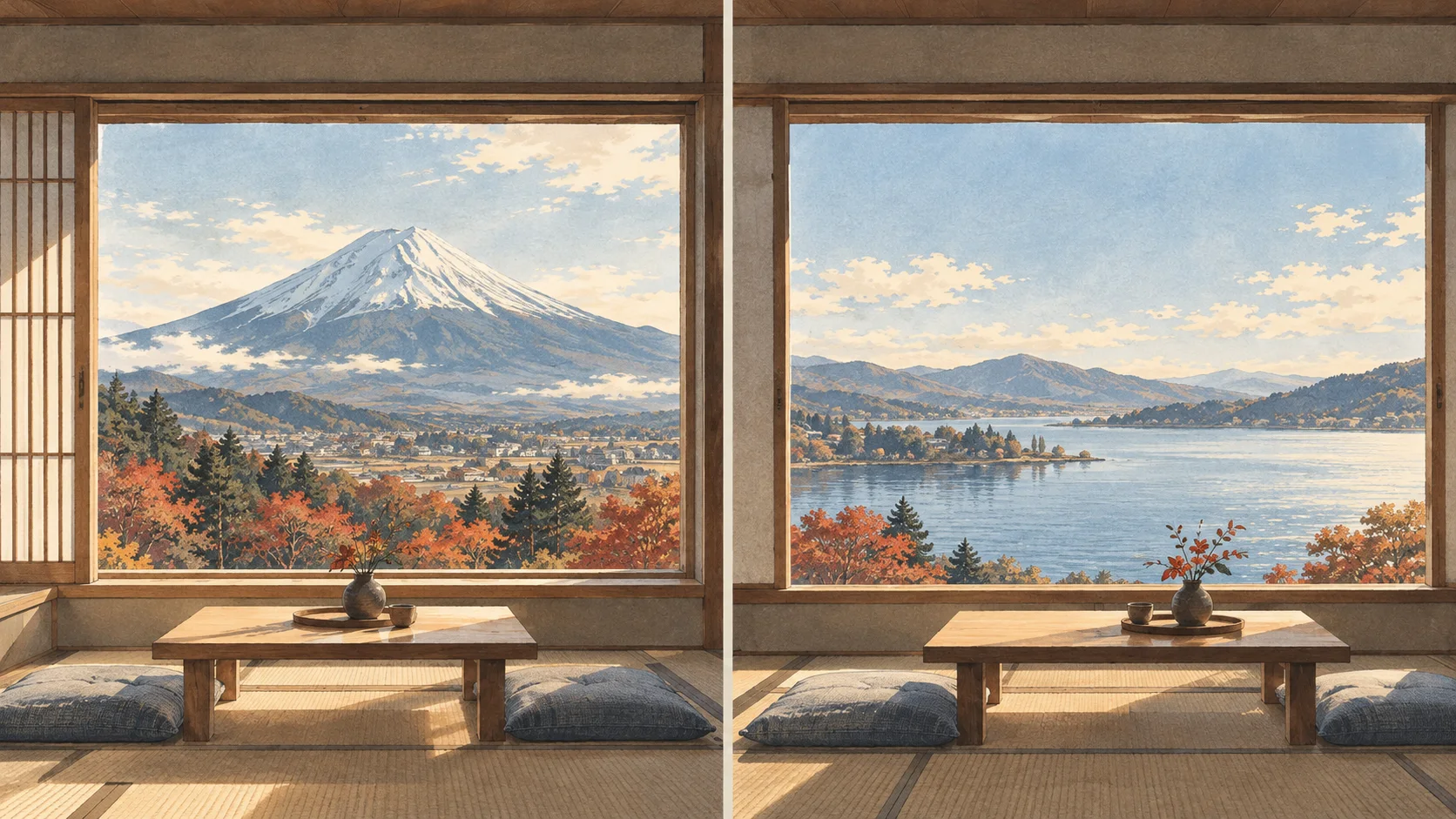
Kogetsu’s website says all rooms face Lake Kawaguchi and Mount Fuji, making the north-shore setting and time at the property a possible focus for an overnight stay. The hotel’s access information lists the sightseeing-bus stop at 久保田一竹美術館. Station pickup is offered between 2:30 and 6:30 p.m., with guests contacting the hotel after reaching Kawaguchiko Station. This is a station-to-hotel service, not a promise of a pickup from the festival whenever the lights finish.
For bathing as a family or private group, check the conditions for the reservable open-air baths. The baths named 湖光 and 月光 are for overnight guests, at ¥3,300 including tax per group for 50 minutes. Reservations are made after arrival, with no advance reservation accepted. Reserving one of these baths is separate from booking a room with its own private bath. If an in-room bath is essential, choose a room explicitly described as having an open-air bath and confirm that room’s equipment.
For meal-inclusive plans, explain dietary restrictions before booking. The FAQ says the hotel cannot replace or remove Japanese cooking stocks including bonito, kelp and mushrooms, cannot accommodate severe allergies or gluten-free needs, and does not completely separate cooking equipment by allergen. Vegetables in a menu do not establish that the full meal is vegan or free of an allergen. If these conditions do not fit your needs, arrange a different meal option before paying.
Kogetsu in 2027: dining-area work and room-capacity changes
Kogetsu’s 2027 dining-area renovation announcement gives 25 January–7 April as the construction period. During that period, ordinary rooms accept a maximum of two or three people depending on the room and plan, including children sharing existing bedding. Groups of four or more are generally not accepted. The exception is the four rooms with open-air baths on level 2F, each allowing up to four guests. Dinner is served in the rooms for all guests during the work.
For stays from 19 April, the announcement allows reservations within each room’s capacity, again counting children who share existing bedding. Dinner moves to the renewed dining area except for some rooms. Each group is limited to ten people; groups of eleven or more are not accepted, and a reservation may also be unavailable when dining-space capacity is reached. The old FAQ’s description of in-room dinner for parties of two or three should therefore not be applied automatically to every plan after 19 April.
The notice describes the construction period and the arrangements from 19 April, but does not fully explain 8–18 April in the same announcement. For a stay in that gap, ask the hotel about accepted guest numbers, where meals will be served and which services apply before paying. The notice does not say the property is closed throughout spring, nor does it establish that every room immediately returns to identical conditions after the stated work period.
Fuji Lake Hotel: check the wing, view and exact room conditions
Fuji Lake Hotel is beside the Funatsu lakeside. Its access page gives an approximately ten-minute walk from Kawaguchiko Station and a free station pickup requested by phone after arrival. The walk is the hotel’s reference estimate; allow more time for luggage, mobility equipment or rain. The pickup has its own waiting and operating arrangements and does not guarantee a late-night journey from the illumination venue.
The room list includes Fuji-facing rooms, lake-facing rooms, open-air baths, view baths and other configurations. Keep the wing and complete room name when comparing a booking. The FAQ lists East Wing check-in at 2 p.m. and checkout at 11 a.m., and West Wing check-in at 3 p.m. and checkout at 10 a.m. A particular room page or booked plan may give its own times. Applying one universal pair of times to the whole hotel could disrupt luggage and shuttle arrangements.
Some rooms suit an afternoon spent at the hotel; others support a simpler stay with views enjoyed from shared spaces. The official website warns that weather may hide Mount Fuji. For a view from a bath, check the bath description itself. The accessible corner room has a Fuji-facing room orientation, but the FAQ says its indoor bath has no view. The room’s outlook should not be extended into a promise about what can be seen while bathing.
Fuji View Hotel: leave time for the garden and match the scheduled shuttle
Fuji View Hotel’s room categories distinguish Fuji-facing, garden-facing and lake-and-garden-facing choices. Some otherwise similar room categories offer different orientations. To see the mountain from your room, select the Fuji-facing option rather than relying on “View” in the hotel’s name. Regular rooms and suites with view baths have different amenities and pricing terms.
This property is one to consider when the garden is part of the stay itself. Its cherry-blossom page preserves dated 2026 reports, while the official video below provides a reference for the garden’s scenery. Neither turns the flowers in the footage into a forecast for the following year. A spring stay might include a walk before breakfast; for autumn, check that season’s garden access and lighting arrangements before deciding whether to travel across the lake for evening foliage as well.
The free hotel-shuttle announcement describes a scheduled direct service between Kawaguchiko Station and the hotel for overnight guests, with no intermediate boarding or alighting. Individual guests generally do not need a reservation, while groups of ten or more should contact the hotel beforehand. Vehicles have a capacity limit and cannot take extra passengers when full. Traffic and weather may affect service, so compare your arrival with the actual shuttle timetable before selecting the plan.
HAOSTAY Kawaguchiko: compare the room with the shared rooftop space
If you want to spend on facilities you will actually use, compare HAOSTAY Kawaguchiko’s own room and facility information. This property describes a walk of about five minutes to the lake and about fourteen minutes to the station, with a shared rooftop terrace. Some Japanese-Western twin rooms face Fuji, while family rooms have their own configurations. A terrace view does not give every room the same outlook, and a regular guest room should not be assumed to include an onsen.
The brand has several addresses and accommodation formats. Confirm that the booking is for HAOSTAY Kawaguchiko before applying its photographs or shuttle details. The FAQ gives an arrival shuttle from 3–6 p.m. at 30-minute intervals, to be reserved at least two days before the stay through the booking platform’s messaging function. The departure shuttle runs from 9–10 a.m. at 30-minute intervals and is reserved at the front desk when checking in. Another hotel’s “call on arrival” approach does not apply to this arrangement.
The website describes breakfast starting at 7 a.m. and luggage storage before check-in or on the day of checkout by arrangement with the front desk. Whether breakfast is included depends on your selected plan. General check-in is 3–9 p.m., with checkout by 10 a.m. If you want to walk to the lake and return for breakfast, confirm access and your meal arrangements. You can put any room-category savings towards meals, transport or another night, without assuming this property is cheaper than every alternative on a particular date.
Travelling with children or grandparents: count beds, ages and meals separately
A family room’s maximum capacity does not necessarily give every person a separate bed, and children sharing existing bedding still need to be included in the information supplied to the hotel. For a tatami room, check whether futons need laying out and whether older relatives can comfortably get up from floor level. For Western beds, ask about width, joining beds, extra-bed arrangements and the bathroom route. Giving actual ages and the required bedding and meals is more useful than asking only whether children stay free.
Kogetsu’s child-charge FAQ lists elementary-school children at 70% of the adult accommodation charge and ages three to six at 50%. For ages three to six without meals, the facility charge is ¥3,300 without bedding; adding bedding costs another ¥3,300. Ages two and under are listed as free. Confirm the school-age classification, meals and selected plan. During the 2027 construction period, children sharing existing bedding still count towards room capacity; a reduced or waived charge does not remove the occupancy limit.
HAOSTAY’s FAQ uses bed numbers for occupancy and allows infants under one who do not need an extra bed to stay free. Cots are limited and require advance contact. Hotels have different age and bedding rules, so confirm them property by property. If your group needs an earlier dinner, an easier bathroom route or a quiet rest period, reduce the lakeside transfers and exchange some sightseeing time for a break at the accommodation.
Wheelchair access: examine the room and the entire journey separately
Fuji Lake Hotel’s accessible corner-room page specifies 42 square metres, a maximum of four guests, a level room layout, two adjustable beds, bathroom and toilet grab bars, and a seated shower. Those are concrete room details, but they do not establish that every common area, lakeside path or sightseeing bus suits every mobility device. The hotel’s official demonstration video below can help explain the room. Confirm the dimensions and assistance you need before booking.
The hotel also publishes a wheelchair station-transfer information sheet. The vehicle takes up to three passengers including the wheelchair user, excluding the driver, with one wheelchair user per trip. Two wheelchair users require separate journeys. The sheet gives wheelchair dimensions, combined-weight and ground-clearance limits, and notes that powered or stretcher-style chairs may not fit. Supply your equipment’s measurements before reserving rather than assuming any wheelchair can use a ramp-equipped vehicle.
Check the route from the station to the hotel, from the room to the restaurant, and from each bus stop to its viewing area separately. Evening crowds, uneven surfaces and weather also affect the actual journey. Choose a shorter lakeside outing if needed, and confirm suitable toilets and places to rest. A hotel lending a wheelchair is a different service from providing continuous accompaniment or help transferring between a chair and another seat. Explain the assistance you need directly.
Dinner and breakfast, or your own meals? Check timing and ingredients first
A dinner-and-breakfast plan normally includes the stay, an evening meal and breakfast, but the dining venue, start times and menu depend on the plan. If you want to stay late at the autumn illumination, confirm that dinner will fit before booking. If the meal time overlaps with the lights, change the sightseeing order or compare breakfast-only and room-only plans. Waiting until check-in and assuming a full set dinner can be delayed until the event ends may leave the evening unworkable.
Vegetarian, vegan, gluten-free, halal and allergy-related requests describe different needs. A dish centred on vegetables may still use fish stock, and removing visible meat may not make it suitable. Kogetsu’s FAQ gives clear limits on what it can accommodate. HAOSTAY’s FAQ says vegetarian food can be arranged in advance, but you should still explain whether eggs, dairy, fish stock or other ingredients are acceptable and obtain confirmation before choosing the plan.
If you need restaurants outside the hotel, check the options and opening days near your accommodation and allow for walking, waiting and the journey back. If your selected hotel does not serve lunch, confirm nearby lunch hours and queues separately. A hotel’s ability to call a taxi does not guarantee an immediate vehicle at night. The more specific the dietary requirement, the more useful it is to settle the food arrangements alongside the accommodation.
Compare the room total and cancellation deadline on the same terms
When comparing budget hotels, higher-priced stays and meal-inclusive ryokan, use the same date, guest count, room view, meal plan and cancellation conditions. A two-person room total cannot be compared directly with a per-person, per-night figure. A private-bath package is also a different product from a regular room-only stay. Read whether taxes are included in the advertised price and which amounts remain payable at the property before confirming.
Cancellation conditions depend on the chosen plan and booking channel. Kogetsu’s FAQ has a first listed cancellation tier of 10% from 21 to 15 days before arrival, rising closer to the stay. Some properties can therefore start charging earlier than a traveller expects. Fuji Lake Hotel’s FAQ conditions are limited to telephone or official-site reservations and should not be applied to every platform. Keep the confirmation and the exact cancellation date and time, and use the original booking channel if the plan changes.
If you are paying more for one night because of the view, meals or private bathing, leave the arrival afternoon and following morning available to enjoy them. A late check-in followed by departure immediately after breakfast may provide little time to use the room’s facilities. Compare the expense with a practical breakdown of a Japan travel budget, so the larger accommodation bill corresponds to something you want to spend time doing.
Tokyo to Kawaguchiko: coordinate the arrival with your hotel transfer
From Tokyo, compare a through train, a connection via Otsuki onto the Fujikyu Railway, and a highway bus to Kawaguchiko Station. Begin with the location of your accommodation and when its shuttle can collect you, then choose the arrival service. If the property requires advance pickup reservations, handle that once your arrival is booked. For a scheduled shuttle, leave time to find the boarding point and allow for road delays.
For rail planning, start with Fujikyu Railway’s Otsuki timetable and the entry for the year’s full-line timetable. Fuji Excursion is a through limited express using both JR and Fujikyu tracks. Check the ticket’s covered section and seat conditions; a through train does not make every JR pass automatically valid on both companies’ sections. If you need to compare passes, use the coverage checks for Japan rail passes and individual tickets.
For a highway bus, check the actual departure station, boarding location, reservation and luggage conditions, and the return ticket. In autumn or on holidays, allow for traffic rather than using the usual journey time to connect with an important dinner or another long-distance departure that day. This guide focuses on seasonal routes and accommodation. For the intercity journey, confirm the services and fares in the operator’s results for your actual travel date.
Local bus passes: one-day, two-day and wider Five Lakes products differ
Fujikyu Travel’s sightseeing-bus ticket page lists the Kawaguchiko–Saiko–Motosuko sightseeing ticket at ¥1,500 for adults and ¥750 for children for one day, or ¥2,000 and ¥1,000 for two days. It covers the specified Red, Green and Blue Lines, P-Line and parts of certain ordinary bus routes. It does not include the journey from Tokyo, and the Fujikyu name alone does not make it valid on every service operated by the group.
The separate Mount Fuji and Fuji Five Lakes Passport costs ¥3,300 for adults and ¥1,660 for children for two days. It covers a wider set of specified Five Lakes bus routes, with rail coverage only between Shimoyoshida and Kawaguchiko. The version including the full Fujikyu railway line costs ¥4,700 and ¥2,360. For this Passport, the operator classifies junior-high-school age and above as adults and elementary-school children as children. Fifth-station buses, highway buses, the Umagaeshi bus and city Town Sneaker services are among the exclusions.
To decide whether a pass helps, list the actual sections and number of rides, then compare individual fares with the relevant product. If you spend most of two days at one hotel and use its shuttle, you may not need a wider-area ticket. A trip to Shimoyoshida or other lakes makes it more useful to compare the included rail and bus sections carefully. Follow the validity conditions for the product you buy; “two days” should not be independently reinterpreted as any 48 hours from activation.
| Ticket | Adult | Child | Validity and main coverage |
|---|---|---|---|
| Kawaguchiko–Saiko–Motosuko sightseeing ticket | ¥1,500 | ¥750 | 1 day; specified sightseeing buses and some route sections |
| Kawaguchiko–Saiko–Motosuko sightseeing ticket | ¥2,000 | ¥1,000 | 2 days; specified sightseeing buses and some route sections |
| Mount Fuji and Fuji Five Lakes Passport | ¥3,300 | ¥1,660 | 2 days; specified Five Lakes buses, rail only Shimoyoshida–Kawaguchiko |
| Passport with full Fujikyu railway line | ¥4,700 | ¥2,360 | 2 days; specified Five Lakes buses and full Fujikyu railway line |
| Fujikyu Express Free Ticket | ¥3,000 | ¥1,500 | 2 days; designated rail coverage, with Fuji Excursion express tickets and other extras separate |
Mobile tickets and the rail free ticket: check display and extra-fare requirements
Fujikyu Travel’s mobile sightseeing-ticket process includes free membership registration, selecting the travel date and number of passengers, paying by the deadline and showing the mobile ticket from the member page to the bus staff. The instructions specify use on a smartphone screen. Confirm how to sign in, and have the necessary connection and battery power. Do not assume an order email, printout or single screenshot substitutes for the actual ticket. If companions will separate, check whether the purchased product can be shown independently.
The similarly named Fujikyu Express Free Ticket is a railway product. It costs ¥3,000 for adults and ¥1,500 for children for two days on the designated Otsuki–Kawaguchiko rail section, including some limited-express unreserved seating. Reserved limited-express seats, the Fuji Tozan train and the reserved-seat limited-express or seat-undesignated ticket needed for Fuji Excursion involve separate charges. It is not a two-day bus pass, and “Express” in the name does not mean every seat and train has already been paid for.
Check changes and refunds against the original product and sales channel. The Five Lakes Passport page describes refunds before the start of validity with the prescribed fee; that statement should not be applied to every digital sightseeing ticket. Read the conditions of the ticket you intend to buy and keep the purchase record. Decide when to activate it carefully, particularly if you are exploring the screen and could unintentionally start a ticket intended for a different date.
An overnight route, day one: north-shore walk, check-in and autumn lights
For an autumn stay on the north shore, handle luggage after reaching Kawaguchiko Station, then choose a lakeside walk around Oishi Park or Nagasaki Park according to transport. Keep lunch in the same area rather than crossing the lake for another restaurant. Return to the hotel in the afternoon, confirm dinner and transfer arrangements, and head to the festival venue towards evening. If dinner is at a fixed time, shorten the illumination visit or choose a meal plan that fits it.
This sequence deliberately leaves time after check-in to use the room and bath you selected. At a property that accepts private-bath reservations only after arrival, you can deal with that then. Children or older relatives can rest before deciding whether to head out again. If the morning journey is delayed, drop the farthest stop and keep the area around the accommodation and the evening venue. There is no need to squeeze every missed morning activity back into the afternoon.
Before leaving for the lights, establish the route back to your room and the latest time you can leave the venue. This matters especially when staying on a different shore. If you would rather avoid an evening transfer, see the foliage by day and spend dinner and bathing time at the hotel. Choosing between those options lets the accommodation serve as a place to rest instead of becoming only a bed between two rushed journeys.
Day two: look at the lake in the morning, then choose one final focus
Check the weather and water before deciding on a short pre-breakfast walk near the lake. If Fuji is hidden, keep the planned breakfast and checkout times rather than missing a reserved shuttle while waiting for the cloud to clear. Early access to a rooftop terrace, garden or shared hotel space depends on the property’s rules. Keep voices and photography quiet while other guests are resting.
After checkout, settle the luggage and choose one focus that fits the return direction: a stretch of shoreline missed the day before, a cultural facility, or the Shimoyoshida area if time and energy permit. Arakurayama and Kawaguchiko are not the same station or adjacent places simply because they appear together in photographs. If your departure is fixed, work backward from the time you must reach the station to see how much sightseeing time is actually available.
To connect Kawaguchiko with Hakone, check the inter-area transport and luggage arrangements separately rather than attempting the lake views and Hakone circuit in the same morning. Compare Hakone’s accommodation bases and sightseeing route to decide how much time each place deserves. If your main wish is mountain scenery, a lake and one night with an onsen, choosing one of the two areas can also leave more room in the rest of your Tokyo itinerary.
Driving or hiring a driver: allow for parking and waiting
A car can help with several people’s luggage, more remote accommodation or flexible stops, but it does not remove congestion around the festival and Oishi Park. Include entering and leaving parking facilities, finding a space and walking to the venue. A hotel parking space does not establish parking availability beside every attraction. Check that year’s venue map and road notices instead of assuming a temporary car park from an older event remains available.
For a car with a driver, clarify the service area, pickup and drop-off points, waiting time, parking charges, overtime and luggage space. The advertised passenger capacity may differ from what fits once your actual bags are loaded. Raise mobility equipment or special boarding needs before confirming a vehicle. If the plan is to leave after the autumn lights, verify that the booked service includes that period rather than assuming a “one-day” booking keeps the driver available until 9 p.m.
Apply the parking principles above when waiting for restaurants or taking lakeside photographs as well. A vehicle gives you the option to change plans; it does not require waiting at an entrance that is already full. If one area is crowded, returning to activities near your accommodation is easier to organize than stopping along the road.
Kawaguchiko food: start with the actual branch menu for hoto noodles
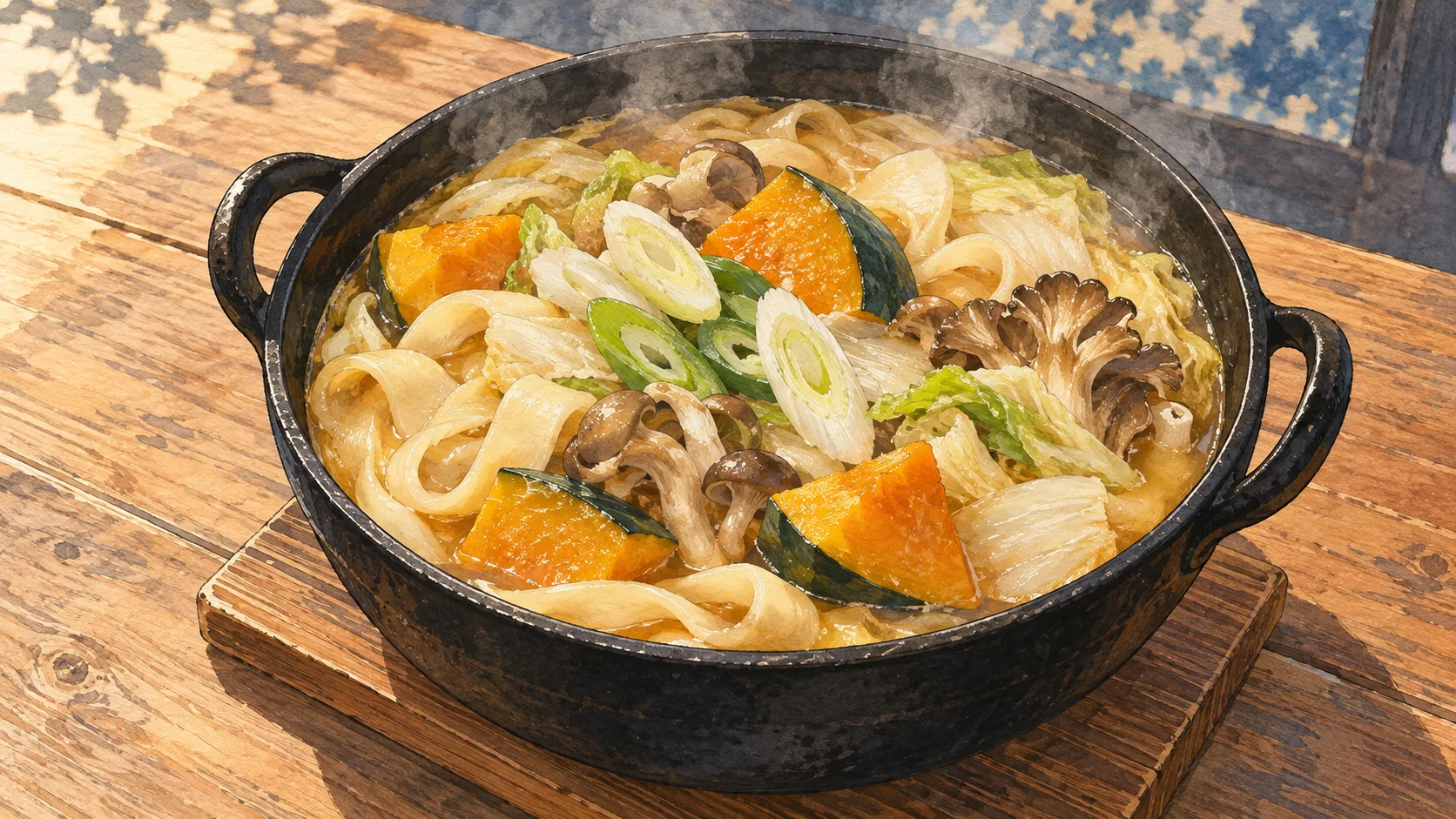
Hoto (ほうとう), a local Yamanashi specialty made with broad, flat noodles, can anchor one meal if the restaurant location fits the route. Kosaku’s official à la carte menu currently lists pumpkin hoto at ¥1,450, pork at ¥1,850 and mushroom at ¥2,100, with possible branch, availability and seasonal differences. These are menu figures checked for this guide; use the displayed price when ordering rather than treating an old restaurant review as today’s quotation.
The Kosaku Kawaguchiko branch information gives regular hours of 11 a.m.–8 p.m., last orders at 7:30 p.m., and no reservations, with seating in arrival order. The operator separately warns that during busy periods such as holidays and weekends, it may restrict admission before last orders. Arriving at 7:30 p.m. therefore does not guarantee entry. Stopping on the road outside is prohibited, and only a limited number of cars can wait when the parking area is full.
Pumpkin or mushroom in a dish name does not establish a vegan stock. Ask the restaurant about ingredients and kitchen handling for allergies or other dietary restrictions. The Kawaguchiko branch also does not serve every dish offered elsewhere in the group: the official menu specifically excludes its cold ozara hoto here. If a particular dish is the reason for the visit, checking the branch menu first is more useful than discovering the difference after arrival.
Rain, hidden Fuji or a crowded venue: keep a flexible half day
Begin the alternative plan with your accommodation. If you chose a property with bathing, a garden or shared places to rest, keep time available to use them. With a simple room-only stay, meals and shorter lakeside walks can still be arranged separately, without every part of the day depending on a distant mountain view. If weather makes a long period outside uncomfortable, shorten the outing, eat and rest, then decide whether to go out again.
For a museum or cultural facility as a rainy-day option, check the closure day, ticketing and entry times for the actual visit. A symbol on an official tourism map identifies a place but does not establish that it is open that day or replace its own notices. A site’s outdoor garden and indoor exhibition may have different visiting arrangements. If one part is removed from the plan, check the return connection again as well.
When transport runs late, protect the confirmed accommodation, dinner and return-departure times, and reduce the other activities to fit the time remaining. That adjustment need not involve finding another, more distant photography stop. Agree in advance on the one experience the group most wants and one stop it can drop. Weather or crowds can then change the order without forcing a fresh disagreement at each connection.
A two-person overnight budget: distinguish example room costs from official fares
For an editorial example of two adults spending two days and one night, assume ¥40,000 for one room with dinner and breakfast, ¥4,000 for two local two-day sightseeing-bus tickets, ¥2,900 for two pumpkin hoto meals at the checked ¥1,450 menu figure, and ¥6,000 set aside for other meals and drinks. The total is ¥52,900. The ¥40,000 room cost and ¥6,000 allowance are chosen assumptions. No room availability was searched for a specific date, and neither amount is a hotel’s current quotation.
The total excludes travel to and from Tokyo, attraction admission, private-bath charges, taxis, shopping and any applicable taxes not already included in a quoted price. Restaurant figures can vary by branch or change, and bus prices should be confirmed when buying. If you do not need the two-day pass, replace that line with the fares for the rides you will take. When comparing a regular hotel with a meal-inclusive ryokan, add dinner and breakfast back into the regular-room alternative instead of treating the room-price difference as the whole saving.
Build your own version with confirmed long-distance travel and the accommodation total first, then local transport, food and separately charged activities. To reduce spending, drop a cross-area transfer, choose a room category whose features you will use or omit a pass that does not help the route. Match each expense to an activity in your actual plan. That can preserve the lake view or dinner you care about while cutting costs elsewhere.
| Item | Assumption or calculation | Subtotal |
|---|---|---|
| One room with dinner and breakfast | Assume ¥40,000 per room for one night | ¥40,000 |
| Local two-day sightseeing-bus tickets | ¥2,000 × 2 | ¥4,000 |
| One pumpkin hoto meal each | Checked menu ¥1,450 × 2; confirm at the branch | ¥2,900 |
| Other meals and drinks | Your chosen allowance | ¥6,000 |
| Subtotal above | ¥40,000 + ¥4,000 + ¥2,900 + ¥6,000 | ¥52,900 |
| Conditional 2027 accommodation-tax example | If both taxable and not included: ¥200 × 2 | Add ¥400; ¥53,300 if all other assumptions stay unchanged |
The planned April 2027 accommodation tax depends on the night of the stay
The Ministry of Internal Affairs and Communications’ 30 June 2026 consent document for Fujikawaguchiko’s accommodation tax lists ¥200 per person per night, with the ordinance planned to take effect on 1 April 2027. The ministry document labels that effective date as planned. Check later town and hotel information when arranging a 2027 stay. The notice does not establish that this new tax is already charged for an autumn 2026 visit.
Fuji Lake Hotel’s 2027 accommodation-tax notice explains that the date of the stay determines application. For a stay spanning 1 April, only nights from 1 April are covered, and booking earlier does not necessarily avoid the charge. Children or infants with a paid accommodation charge are included under the hotel’s notice, while young children without an accommodation charge are outside its stated taxable group. The hotel says it will collect the amount separately at the front desk. For another property, check whether the quoted plan already includes it.
For two taxable adults staying one night, this tax alone would be ¥200 × 2, or ¥400. It is separate from bathing tax associated with hot springs; one does not automatically replace the other. Avoid adding a charge twice when a quotation already includes it. If every other assumption in the earlier ¥52,900 example remained unchanged, adding only ¥400 would produce ¥53,300. That is arithmetic for a conditional example, not a 2027 package price or a statement that all taxes and fees have been settled.
Keep the essential arrangements in one itinerary
Before departure, bring the return ticket, full property and room names, shuttle reservation, meal times and cancellation cutoff into one itinerary. Include Japanese place names such as もみじ回廊, 河口湖自然生活館 and 下吉田 when checking locations. This helps distinguish similar names and different sights. Give companions their own copy of the essential details so that a temporary separation does not leave one person without the information needed to reconnect.
If you are comparing Tokyo side trips, read Nikko’s shrines, temples, mountain and accommodation routes before choosing the scenery you most want. Kawaguchiko centres on the lake, Fuji views and seasonal events. Adding a second side trip should not squeeze the overnight stay you have already chosen until both places consist mainly of transfers and luggage storage.
For the final check, prioritize that year’s event announcement, bus operating information and the property’s own latest notices. Settle the room view, evening journey back and meal arrangements before deciding on one last photography stop. Even if Fuji spends part of the visit behind cloud, a plan with enough time to walk, eat and rest still gives the trip a clear focus.
A few useful answers
Is one day enough for Kawaguchiko?
A day can cover north-shore views and one walking area. An overnight stay makes the autumn lights and the next morning’s lakeside time easier to connect. Decide according to evening transport, hotel meals and the wider Tokyo itinerary.
When is the 2026 Kawaguchiko Autumn Leaves Festival, and when do the lights finish?
The official dates are 7–29 November 2026. Venue hours are 9 a.m.–7 p.m., with illumination from sunset until 9 p.m. Foliage varies during the period, and lighting until 9 does not establish the same closing time for stalls or services.
Can I use the same sightseeing bus after the Momiji Corridor lights finish at 9 p.m.?
Do not infer bus operation from the illumination end time. The 2026 leaflet lists the last station-bound bus at the Itchiku Kubota museum stop at 6:32 p.m. To stay later, confirm a walking route to the hotel, prearranged vehicle or hotel-approved pickup, and recheck service for the day.
Are Momiji Corridor and Momiji Tunnel the same place?
No. The corridor is around the Nashigawa stream and is the festival’s main area. The tunnel is a separate lakeside location in the Oishi area. Check the positions and transport individually rather than getting off based only on a similar name.
Can I use the 2026 cherry-blossom festival dates for 2027?
No. The north-shore 2026 event originally ran 28 March–12 April and was extended to 15 April. That is a past record. Check the following year’s event dates and actual flowering conditions separately against that year’s official updates.
Does the cancelled Arakurayama cherry-blossom festival mean Kawaguchiko’s festival was cancelled too?
No. Arakurayama Sengen Park is in Fujiyoshida, separate from the Kawaguchiko north-shore event. The cancelled 2026 festival was at Arakurayama, where safety and traffic measures still applied. Those spring arrangements also do not establish the rules for autumn or the following year.
Does a Fuji-facing room guarantee the mountain’s reflection?
No. Room orientation, visibility of the mountain and calm water are separate conditions. Weather, angle and ripples affect a reflection. Confirm lake views, mountain views and bath views independently.
Can a family of four stay at Kogetsu in spring 2027?
Check the date and full room category. During the 25 January–7 April work period, ordinary rooms accept two or three people including children sharing existing bedding; only the four rooms with open-air baths on level 2F are exceptions allowing up to four guests. Ask separately about 8–18 April. From 19 April, follow the new notice and actual room capacity.
Does a two-day local bus pass include Tokyo travel or the fifth station?
It does not include travel to/from Tokyo; use it only on its listed routes. The Five Lakes Passport and full-rail variant also exclude highway buses, fifth-station buses and other specified services. Similar product names do not make every Fujikyu service available.
Is an accessible room enough to plan a wheelchair trip?
Check the entire journey and equipment dimensions too. Fuji Lake Hotel lists specific corner-room facilities, but the wheelchair transfer takes one wheelchair user at a time and up to three passengers in total, with separate size and weight limits. Lakeside routes and individual attractions require their own checks.
Can pumpkin or mushroom hoto be assumed vegan?
The dish name is not enough. Confirm stock, seasonings and kitchen handling with the restaurant; availability can vary by branch. Explain severe allergies, gluten-free requirements or other dietary restrictions before booking accommodation or ordering.
Is the ¥52,900 two-adult overnight example an actual quote?
No. It assumes ¥40,000 for a meal-inclusive room, ¥4,000 for two local two-day passes, ¥2,900 for one meal each and ¥6,000 for other food/drinks. Tokyo travel, admissions, private baths, taxis, shopping and applicable taxes are excluded. Check the planned 2027 tax separately against stay dates and the booked plan.
Check with the source
Schedules, availability and rules can change. These official sources are the place to confirm details before you book.
- Fujikawaguchiko Tourism: 2026 autumn-festival dates and lighting
- 2026 official autumn-festival leaflet: venue map and last buses
- North Kawaguchiko Tourism Association: 2026 cherry festival and extension
- Fujiyoshida Tourism: 2026 Arakurayama spring event and traffic measures
- Fujiyoshida Tourism: official video collection and Arakurayama autumn film
- Ministry of Land, Infrastructure, Transport and Tourism: Kawaguchiko Fuji viewpoints
- Fujikawaguchiko Tourism: October 2026 Oishi Park congestion notice
- Fujikyu Bus: sightseeing routes, stop names and timetables
- Fujikyu Travel: mobile sightseeing-ticket scope, prices and use
- Fujikyu Bus: Five Lakes Passport and full-rail variant
- Fujikyu Railway: Otsuki and 2026 full-line timetable entry
- Fujikyu Railway: Express Free Ticket coverage and extra charges
- Kogetsu: north-shore setting, room orientation and conditions link
- Kogetsu: sightseeing-bus stop and station pickup
- Kogetsu: child charges, cancellation and dietary limitations
- Kogetsu: onsen and guest-only private-bath conditions
- Kogetsu: 2027 dining-area work, occupancy and dinner changes
- Fuji Lake Hotel: Fuji-facing, lake-facing and other rooms
- Fuji Lake Hotel: walking access and free station pickup
- Fuji Lake Hotel: accessible corner-room facilities and official video
- Fuji Lake Hotel: wing-specific times, indoor-bath view and booking FAQ
- Fuji Lake Hotel: wheelchair-transfer dimensions, weight and passenger limits
- Fuji View Hotel: room types and orientations
- Fuji View Hotel: dated garden blossom reports and official video
- Fuji View Hotel: scheduled guest shuttle and capacity limits
- HAOSTAY Kawaguchiko: rooms and shared viewing space
- HAOSTAY: shuttle reservations, breakfast, infants and luggage FAQ
- Kosaku: official à la carte menu and branch availability limits
- Kosaku Kawaguchiko: hours, reservations, payment and parking
- Kosaku: possible early admission cutoff during busy periods
- Ministry of Internal Affairs and Communications: Fujikawaguchiko tax consent and planned start
- Fuji Lake Hotel: April 2027 accommodation-tax notice