Stay by the Electric Town Exit for anime and hobby shops, or the Showa-dori side for the Hibiya Line. Compare hotels and capsule stays across Akihabara's three JR ticket gates, covering room layouts, late check-in, luggage storage, airport links and Tokyo's 2027 accommodation tax.
- Region & Focus
- TokyoAccommodation
- Reading Scope
- 19 min read · 11 chapters · 5 Q&As
- Official Verification
- 30 official sources checkedUpdated 22 November 2026
- Key Topics
- Where to stayBookingNeighbourhoods
Chapter Route Map (tap any stop)
- Which Exit to Check When Booking Around Akihabara Station
- One Hotel Compared from Each Station Exit
- Double Beds, Twin Rooms and Triple Occupancy
- Capsule Hotels: Late Check-In, Showers and Luggage Storage
- From Narita or Haneda: Plan the Final Leg First
- How Many Nights to Stay Depends on How Often You Drop Bags Off
- Large Suitcases, Parcels and Your Final Day
- Late Flights, Event Dates and Booking Terms
- Shopping Runs Back to the Room and Wet-Weather Routes
- Sunday Pedestrian Zone Changes Where Taxis Can Pick Up
- Japan's November 2026 Tax-Free Changes Affect Airport Departure Time
- Quick Q&A
Choosing where to stay in Akihabara comes down to which side of the station you will walk back to each day. If your trip revolves around figures, model kits and trading card shops—and dropping bags off in your room between hauls—pick the South Exit of the JR Electric Town Gate. If you will ride the Hibiya Line regularly to Ueno and Ginza, look towards the Showa-dori side. When your group is splitting up for different trains or riding the Tsukuba Express, the Central Gate is the easiest place to meet. All three sides connect on foot, so what justifies any difference in room rate is the stretch you will walk daily with suitcases, a pushchair or shopping bags.
Which Exit to Check When Booking Around Akihabara Station
JR Akihabara Station serves the Yamanote, Keihin-Tohoku and local Chuo-Sobu lines in one complex. West to east, you can place a hotel's block by the Electric Town Gate (Denkigai), Central Gate or Showa-dori Gate (signed 'Showa-dori Exit' at the station). Booking platforms tend to label all three sides simply as being outside Akihabara Station, whereas a hotel's own access page specifies which JR gate or Metro exit its walking time uses. Saving both your main exit and the hotel entrance as separate map pins makes the walk back far simpler than relying on a single station pin.
Outside the Electric Town Gate, exits split north and south. The South Exit puts you right by Radio Kaikan and JR-East Hotel Mets Premier Akihabara, suiting trips focused on Electric Town shopping. The North Exit crosses Akiba Bridge towards Akihabara UDX, and heading north along Chuo-dori brings you to Suehirocho Station on the Ginza Line. If a travel companion says 'meet at the Electric Town Exit', clarify South or North—or agree on the main entrance of Radio Kaikan. Spotting the yellow Denkigai Gate sign from the platform is only step one; follow the South Exit signs once you tap out.
The Central Gate works best if you treat Akihabara as a transport hub. From there, follow signs for the Tsukuba Express, where A1 is the line's signed JR transfer exit. Guests at remm Akihabara turn right out of the Central Gate and follow the pavement to reception on the 6th floor; Akihabara Washington Hotel sits near the same gate. When one person wants to browse shops while another heads straight back to the room, meeting outside the Central Gate or in the hotel lobby is far clearer than saying 'in front of Akihabara Station'. Compare the walk from each lobby to the ticket gate before deciding whether a slightly higher room rate is worth it.
The Showa-dori side links to the Tokyo Metro Hibiya Line, running north to Naka-okachimachi and Ueno, or south to Higashi-ginza, Ginza and Hibiya. Even on the same avenue or opposite corners, emerging from different underground exits can leave you a full junction apart. With luggage on the Metro, never mistake a hotel's 'nearest staircase' for the exit with a lift. Tokyo Metro marks Exit 3 at Akihabara Station as having a street-level lift, while the platform lift towards Kita-senju leads up to the ticket gate signed for JR Akihabara Station.
For wheelchair users, large suitcases or pushchairs transferring to JR at Akihabara, JR East notes that taking lifts from the Showa-dori Gate to the Yamanote and Keihin-Tohoku platforms requires changing between three separate lifts. Using the Central Gate cuts down those transfers, which also affects how guests staying on the east side reach Tokyo Station. If you have an early train, walk the route from your hotel to the right gate the evening before and spot the lift nearest your direction of travel. Travelling as a pair, agree to meet on the same concourse level so one person does not reach the platform while the other is still hunting for a lift.
| Main Station Exit | Best Suited For | Example Hotel on That Side |
|---|---|---|
| Electric Town Gate (South Exit) | Radio Kaikan, Sotokanda shopping and frequent bag drop-offs | JR-East Hotel Mets Premier Akihabara |
| Central Gate | JR and Tsukuba Express transfers, or groups splitting up | Akihabara Washington Hotel |
| Showa-dori Gate side | Regular Hibiya Line trips and the Yodobashi Akiba area | APA Hotel Akihabara Ekimae |
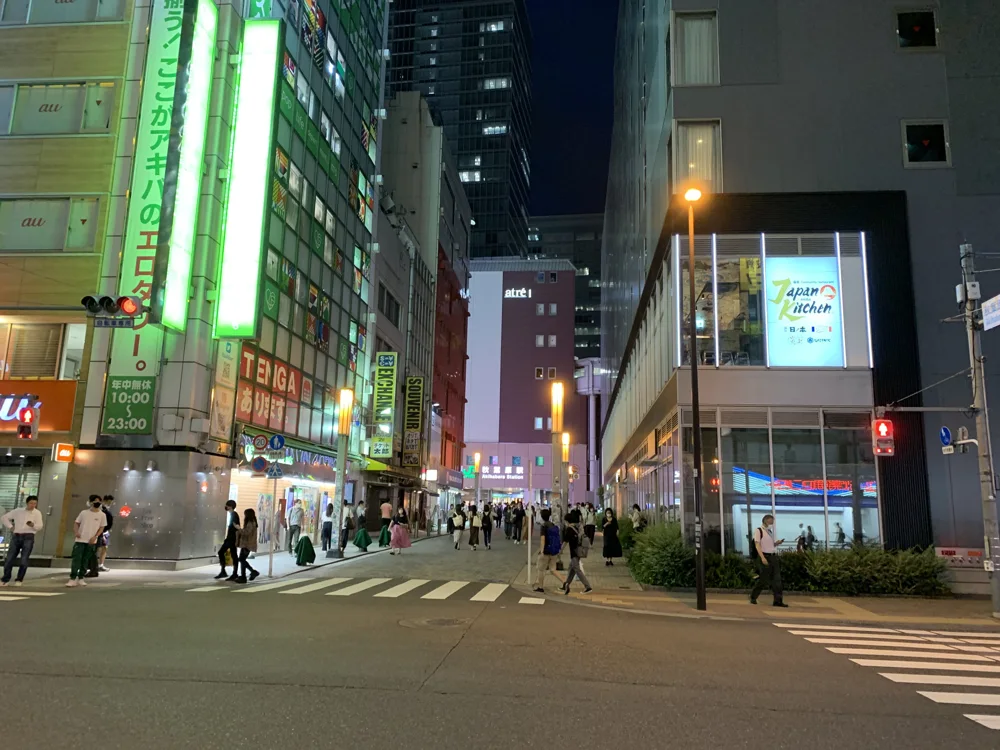
Stay by the Electric Town Exit for anime and hobby shops, or the Showa-dori side for the Hibiya Line. Compare hotels and capsule stays across Akihabara's three JR ticket gates, covering room layouts, late check-in, luggage storage, airport links and Tokyo's 2027 accommodation tax.
One Hotel Compared from Each Station Exit
JR-East Hotel Mets Premier Akihabara is roughly a 1-minute walk from the Electric Town Gate South Exit. Listed check-in is 15:00 and check-out is 11:00, with same-day luggage storage available before check-in and until midnight after check-out. Dedicated shoppers can drop bags first, browse the neighbouring blocks, then allow time after check-in to sort boxed purchases. Its Superior Twin measures 21 sq m with two 120 cm beds for one or two guests; the Deluxe Twin is 23 sq m for up to three, adding a 90 cm bed for a third guest. Both room types feature a separate washing area outside the bathtub, making bath time with young children much easier.
Akihabara Washington Hotel stands just outside the Central Gate, with official walking times of 1 minute from the Central Gate and 2 minutes from Hibiya Line Exit 5. Standard check-in is 14:00 and check-out is 11:00. Early arrivals can leave luggage at the 3rd-floor front desk, keeping valuables and fragile items with themselves. For groups of three, the hotel offers a 21 sq m Triple Room with two 120 cm beds plus a sofa converted into a 90 cm bed. This room cannot be booked on the day of arrival, so locking it in early lets a trio start exploring straight away once they land.
APA Hotel Akihabara Ekimae is around a 2-minute walk from the JR Showa-dori Exit, or roughly 1 minute from Hibiya Line Exit 1. Standard check-in is 15:00 and check-out is 10:00. Both its Single and Double rooms are listed at 11 sq m, with a 140 cm bed in the Double. If two guests each have a large suitcase and want to open both at once in the room, compare the rate against the hotel's 22 sq m Deluxe Twin with two 120 cm beds. Hibiya Line Exit 1 suits light travellers; anyone with a pushchair should recalculate the walk starting from the Exit 3 lift.
Several east-side hotels share nearly identical names, and APA Hotel Akihabara Ekimae is particularly easy to confuse with APA Hotel Akihabara-Eki Higashi. Keep the full hotel name and Japanese street address on your phone to show taxi drivers: APA Akihabara Ekimae is at 2-13-20 Kanda-Sakumacho. If you have back-to-back bookings at similarly named chain properties, add the check-in dates alongside the hotel name in your map pins so you can tell at a glance which branch you are heading to each night.
Double Beds, Twin Rooms and Triple Occupancy
For two guests, pick the bed configuration before comparing floor area. Booking sites often group 'Double' and 'Twin' rooms in the same search results, though a Double usually means one shared bed while a Twin gives you two separate beds. When rates look similar, compare bed widths, floor space shown in room photos for opening suitcases, and whether breakfast is included. On a multi-night stay where you repack camera gear or model boxes daily, desk space and a clear walkway by the door matter too. Even an extra two square metres changes completely once a third bed is squeezed in.
Families should enter every traveller and each child's exact age in the booking search, counting any child who needs their own bed. At Mets Premier Akihabara, for instance, the Superior Twin sleeps one to two guests and the Deluxe Twin sleeps one to three, with both allowing up to two pre-school children to share existing beds free of charge. If two adults plan to take one bed each and share with a child, check first whether a 120 cm width feels comfortable. Where children need their own beds, booking a triple room with an extra bed or two separate rooms is far simpler than sorting sleeping arrangements on arrival.
Three adults travelling together should price a triple room alongside a twin plus a single room. Sharing one room avoids splitting up, yet everyone shares the same bathroom, waking hours and packing space. If one person heads out early each morning, two rooms cut down on disruption. Parents booking two rooms with older children can request adjoining rooms at the time of booking and put one adult's name on each reservation. For friends arriving on later trains or flights, clarifying who checks in first, holds the booking details and carries the second key card works better than dropping one hotel name into a group chat.
If you need an accessible room, check the street-to-lobby route separately from the room itself. Station lifts only solve half the journey. Between the street exit and reception, you may face crossing Showa-dori, checking whether an alternative entrance exists beside a revolving door, or reaching an upper-floor lobby. Ask the hotel directly for doorway widths into the bedroom and bathroom, any step into the shower area, and transfer space beside the bed—and mention the exact model of your wheelchair or pushchair to get practical answers rather than a simple yes or no.
Capsule Hotels: Late Check-In, Showers and Luggage Storage
Akihabara BAY HOTEL is a women-only capsule hotel. Its official access guide puts it around 4 minutes from the JR Central Gate, 3 minutes from the Showa-dori Exit, or 2 minutes from Hibiya Line Exit 2. Check-in runs from 16:00 to 02:00—arrivals after midnight must notify the hotel in advance—and check-out is at 10:00. If your flight lands close to midnight, add immigration, baggage reclaim and the train ride into Akihabara before committing to that first night there. Starting fresh in Akihabara the next morning is often wiser than racing across late-night connections just to beat last check-in.
Guests at BAY HOTEL use shared shower rooms; individual capsules do not lock, so valuables go into floor lockers while oversized bags are held at reception. Luggage can be stored from the morning of check-in, though items left after check-out must be collected by 12:00 noon. On consecutive nights, guests cannot remain inside during the 10:00 to 16:00 cleaning window, although lockers and reception storage remain accessible. That daytime closure rules out midday naps, popping back to change clothes or working remotely from your capsule. Reception operates cashless only, so do not rely solely on Japanese yen cash.
Anshin Oyado Tokyo Man Akihabara Denkigai is a men-only capsule hotel restricted by house rules to guests aged 18 and over. Check-in opens at 12:00, with standard capsules available from 15:00—or from 12:00 if booked directly through the official website—and check-out by 12:00 the following day. Its artificial hot spring bath and high-temperature mist sauna each have scheduled cleaning windows, so check evening times if you want a soak before bed. Locks and security cables can be borrowed from reception, large suitcases go in the shared luggage area, and free storage runs from check-in day through check-out day.
Remember that capsule hotels charge per person, meaning two travellers require two separate capsules. Because both properties above are strictly single-sex, mixed-gender pairs, friends packing together or parents with children will find private hotel rooms much easier. BAY HOTEL does not admit primary-school children even when accompanied by an adult, and minors from junior high school age upwards need written consent from a legal guardian. Solo travellers trying to save money should compare a capsule rate against a standard business hotel single room for the same dates and ask whether they need daytime access: savings only add up if you strictly need a shower and a bed for the night, whereas a two-night stay with afternoon breaks makes a private single room worth the difference.
From Narita or Haneda: Plan the Final Leg First
From Narita Airport on the Keisei Skyliner, follow the Keisei-to-JR transfer signs at Nippori to join the outer-loop Yamanote Line towards Ueno and Tokyo. The train stops at Uguisudani, Ueno and Okachimachi before reaching Akihabara. The Skyliner also terminates at Keisei Ueno, though Keisei Ueno and JR Ueno are two separate stations. Small groups hauling large cases to Akihabara should check the transfer layout at Nippori first, reserving Keisei Ueno for trips where you plan to eat in Ueno or switch to the underground instead of JR. Narita Terminal 1 uses Narita Airport Station, while Terminals 2 and 3 use Airport Terminal 2 Station.
According to Keisei Electric Railway, an adult Skyliner fare between Nippori and Narita Airport or Airport Terminal 2 stations comes to ¥2,580 with a paper ticket (¥1,280 base fare plus ¥1,300 limited express seat fee). Tapping an IC card brings the base fare to ¥1,267, with the seat fee still purchased separately; neither total includes the onward JR fare from Nippori. When mapping your arrival, separate the Nippori transfer, the walk across Akihabara Station and hotel check-in—the arrival time printed on your ticket only gets you to the platform, not reception.
From Haneda Airport, either ride the Tokyo Monorail to Hamamatsucho for the JR Yamanote Line, or take a Keikyu Airport Line train towards Shinagawa and change to JR there. Tokyo Monorail lists a flat ¥520 adult paper ticket between Hamamatsucho and Haneda Terminals 1, 2 or 3, with the JR leg charged separately. On your first arrival at Haneda, double-check your flight's terminal and factor in the walk from arrivals down to the monorail platform. If a late flight risks missing your preferred connection, save your backup route alongside the hotel's phone number and address so you can call ahead once you land. To compare end-to-end times from both airports, see our Tokyo airport rail transfer guide.
From Akihabara to Tokyo Station, it is just two stops on the Yamanote Line via Kanda. Following JR East's fare revision on 14 March 2026, a single adult fare costs ¥155 by IC card or ¥160 for a paper ticket. Keihin-Tohoku Line trains also cover the stretch, though daytime rapid services skip certain stops—sticking to the Yamanote Line is simplest if you are meeting someone at Kanda. Allow extra time inside Tokyo Station to walk from conventional JR platforms to the Shinkansen gates. Heading to Hibiya instead takes roughly 14 minutes on the Tokyo Metro Hibiya Line at ¥178 by IC card or ¥180 by paper ticket, letting you skip a station transfer if you ride that line daily.
How Many Nights to Stay Depends on How Often You Drop Bags Off
If you only need half a day in Akihabara while spending most of your trip around Shibuya, Shinjuku or Tokyo Disney Resort, it is easy to travel light for one shopping run and stay elsewhere. The Yamanote and Chuo-Sobu lines link Akihabara right across the city, yet you will still repeat that commute every morning after breakfast and every night after dinner. Before booking three or four consecutive nights, line up your earliest meeting points, latest evening neighbourhoods and final-day airport route. A hotel that looks central on the map can feel surprisingly out of the way against your actual itinerary.
When your trip includes two distinct shopping sessions, a two-night stay strikes a sensible balance. Arrive on the first afternoon, store your bags, scout a major building to check box sizes and prices, and decide what is worth carrying home. On day two, leave yesterday's boxed items safely in the room and head out with a single tote bag so you can drop purchases back again afterwards. If you have dinner in Ginza or an exhibition lined up that second evening, leave time to swing back through Akihabara first rather than hauling merchandise everywhere with you. To pack more shops into day one, see our Akihabara half-day shopping route for store and floor-by-floor planning.
If your itinerary focuses on Ueno Park, the Tokyo National Museum or direct Narita transfers, look around Keisei Ueno and Okachimachi as well. Ueno and Akihabara sit one stop apart on JR, yet they solve different luggage problems. Departing via Keisei Ueno—or leaving bags near Ueno on your final day—often saves a suitcase haul if you stay there instead. Conversely, buying multiple boxed figures and parts in Electric Town is far easier when you can make two quick drop-offs back to a nearby room. You can weigh exits, hotel locations and airport links in our Keisei Ueno vs Okachimachi hotel guide.
Catching an early Shinkansen from Tokyo Station is still manageable from around Akihabara's Central Gate, especially if you stay in one hotel throughout and simply wheel packed bags out the door. Once your cases are zipped, however, collecting reserved tickets or meeting companions at the Shinkansen gates requires timing every step from the hotel entrance onwards. For very early departures, weigh the extra time spent shifting hotels near Tokyo Station the night before against setting off earlier from Akihabara. Staying night one by Electric Town and moving closer to your departure hub for the final night pays off whenever one move eliminates multiple morning transfers.
Large Suitcases, Parcels and Your Final Day
JR Akihabara Station's official station map marks every coin locker bank. First check whether a bank sits inside or outside the ticket gates, then choose the floor that suits your exit. Inside the gates works best if you will board another train later; if you are transferring to the Metro or hailing a taxi next, leave luggage at your hotel or use lockers outside the gates so you can head straight out towards your street exit. Anyone travelling with a 28-inch suitcase alongside paper carrier bags and cardboard boxes should measure their largest piece beforehand to make sure it fits an extra-large locker.
With hotel luggage storage, the key detail is the latest pickup time. Mets Premier holds bags until midnight on check-out day, ideal if you are returning to Electric Town for final pickups. BAY HOTEL stores luggage only until 12:00 noon on departure day, meaning afternoon plans call for station lockers or dropping bags at your next hotel. Anshin Oyado provides free check-out-day storage, while arriving parcels or luggage held a day before check-in or after check-out cost ¥1,000 per day under its published rules. If you have two or three hours of shopping after check-out, store your bags at the end nearest your final stops so your walk converges back towards the station rather than zig-zagging between shops, bags and platforms.
Sending parcels ahead to your hotel requires checking individual rules: BAY HOTEL, for instance, asks for the guest's full name and check-in date on the waybill and refuses cash-on-delivery, fresh or frozen deliveries. Its FAQ also notes that reception does not ship parcels out. Never assume every hotel handles outgoing courier forms. Before planning to forward a suitcase from your room to your next city, confirm whether reception accepts shipments, collection cut-off times and when the receiving hotel staffs its desk, then keep a spare change of clothes in your daypack. Groups should put one person per room in charge of waybills and booking references so the recipient name always matches the reservation.
Check-out mornings frequently snag on one small mistake: packing figure boxes at the very bottom beneath every layer of clothing. The night before, separate hold luggage from cabin bags, keep tax-free purchases accessible for airport inspection, and leave key cards, passports and next-day outfits outside your main case. If you plan to have breakfast after checking out, leave heavy suitcases at your agreed storage spot first and collect them on the way to the station, rather than dragging them through cafés or back around the shops.
Late Flights, Event Dates and Booking Terms
Whenever you are running behind your scheduled arrival, contact the hotel immediately to update your check-in time. This matters especially at Anshin Oyado: even though the Akihabara Denkigai branch operates 24 hours, its rules state that arriving more than 30 minutes past your registered check-in time may be treated as a no-show. BAY HOTEL sets a hard cut-off at 02:00 the following morning and requires advance notice for arrivals after midnight. On a late Haneda flight, line up the last available trains from the airport against the hotel's check-in cut-off on one timeline before you book.
If you are still waiting on event ticket lotteries or work rosters, compare refundable and prepaid rates for the exact same room type at the same property. BAY HOTEL's published cancellation policy, for example, charges 20% two to seven days before check-in, 50% the day before, 80% on the day and 100% for an unnotified no-show. Special promotional plans carry their own terms, and third-party bookings must be cancelled through the original platform. Before shifting dates, note the free-cancellation deadline for your existing booking alongside the check-in cut-off and luggage rules of the replacement room—log both in your calendar so you do not miss the cutoff while comparing new rates.
Always compare hotel prices using your exact travel dates and true guest count, checking the final checkout total rather than headline nightly rates. Include breakfast on a like-for-like basis and watch for any charges payable locally on arrival. When room sizes and rates are close, breakfast mostly comes down to when you leave each morning: early starts favour room-only rates, whereas late arrivals hoping to sleep in benefit more from a later check-out than a buffet. Weighing real schedule fit beats chasing an annual average rate.
Tokyo's accommodation tax changes in spring 2027. According to the Tokyo Metropolitan Government Bureau of Taxation, up to 31 March 2027 hotels and ryokan charge per person, per night based on the room-only rate (excluding meals): stays under ¥10,000 are exempt, ¥10,000 to under ¥15,000 incur ¥100, and ¥15,000 or more incur ¥200. From stays on 1 April 2027 onwards, the exemption threshold rises to under ¥13,000 per person per night, taxable stays are charged 3% of the room-only rate, and the levy expands to simple lodging and licensed short-term rentals. Because the tax is calculated per guest, per night, split multi-night rates across late March and early April when checking totals. Tokyo Metropolitan Government Bureau of Taxation accommodation tax comparison
Shopping Runs Back to the Room and Wet-Weather Routes
Radio Kaikan sits right outside the Electric Town South Exit, with general building hours listed as 10:00 to 20:00 (basement dining hours vary). If you want to photograph displays or queue for specific releases, follow the opening and entry announcements of the individual shop you are visiting. Arriving early means dropping bags at your hotel first and walking back just before doors open. Multi-generational trips or groups with children can pick the main entrance as a meeting point so card and figure shoppers can browse upstairs without keeping everyone else waiting by the tills.
On the east side of the station, Yodobashi Akiba opens its electronics and retail floors from 09:30 to 22:00, and its 8th-floor restaurant zone from 11:00 to 23:00. Store hours and individual restaurant last-order times are two separate clocks, so anyone eating late should pick a restaurant ahead of time. In heavy rain, guests on the Showa-dori side can tackle east-side shops and dinner first, then bundle South Exit stops into a single outing; those staying on the west side can reverse the order and take shelter near whichever side lets them drop bags and boxes off quickly. Bring an outer waterproof bag big enough to cover large cardboard boxes when crossing open junctions.
When your shopping list spans both sides of the station alongside another Tokyo district, split the day around those two main hubs. Browse models and trading cards by the South Exit first, walk boxed purchases back to your room, then cross to the east side for Yodobashi and dinner. On departure day, anchor your final stops to whichever side holds your luggage and leads to your train. Travelling with camera gear or two children, cutting out even one extra round trip carrying bags makes a noticeable difference.
Sunday Pedestrian Zone Changes Where Taxis Can Pick Up
The Tokyo Metropolitan Police Department closes Akihabara's Chuo-dori as a Sunday pedestrian zone between the Sotokanda 5-chome and Manseibashi intersections. Hours run from 13:00 to 18:00 between April and September, and 13:00 to 17:00 between October and March, subject to cancellation in bad weather (confirmed by the Akihabara Electrical Town Organization). Walking down the middle of the street makes it easy to spot upper-floor signs and move between shops, though street vending, performances and cycling are prohibited inside the closed stretch.
Travelling with large suitcases on a Sunday afternoon means walking straight to your hotel's designated vehicle pick-up point. When booking a taxi near Chuo-dori, ask reception which side street the driver can access and show the Japanese address of that entrance. If your hotel entrance faces another street, take the regular side-street approach rather than walking down the pedestrianised avenue until the next junction and doubling back. Rail passengers stick to their chosen ticket gate as usual: the closure affects Chuo-dori, leaving east-side routes via the Hibiya Line exits and the Central Gate unaffected.
If check-out and shopping both fall on a Sunday, leave suitcases at the hotel in the morning before heading onto Chuo-dori. Rather than sending just the hotel name to companions when it is time to call a cab, agree on a street corner where cars can actually stop—one person can handle the bags while slower walkers wait comfortably at the kerb. Bookmark the organiser's status page if you want to see the pedestrian zone up close; if wind or rain cancels the closure, normal pedestrian crossings apply and all your planned shops and restaurants stay open as usual.
Japan's November 2026 Tax-Free Changes Affect Airport Departure Time
Under rules announced by the Japan Tourism Agency, from 1 November 2026 eligible visitors pay the full tax-inclusive price at the till in tax-free shops. The minimum threshold remains ¥5,000 before tax per store, per day. When departing Japan within 90 days of purchase, customs confirms that the goods are leaving the country and the store or operator refunds the consumption tax equivalent. If you are budgeting shopping alongside your final two nights of accommodation, keep enough cash or card headroom to cover tax-inclusive checkout totals as well as trains and dinner.
At Haneda and Narita, tax-free procedures are completed before checking in hold luggage. Bring your passport and all tax-free items in that transaction to the self-service terminals and follow the on-screen steps; if selected for inspection, present the goods at the customs counter. The Japan Tourism Agency notes that eligible travellers at designated airports including Haneda and Narita can also process applications via Visit Japan Web over dedicated departure-hall Wi-Fi. Pack large figure boxes right at the top of your suitcase so you can show them easily before handing bags over at the airline desk. For early flights, work backwards from airline bag-drop deadlines to decide which train to catch from Akihabara. Japan Tourism Agency tax-free refund steps and airport maps
Customs verifies goods on a per-transaction basis. Pay separately for snacks you will eat in Japan or toiletries you will leave behind, rather than mixing them on one receipt with tax-free souvenirs—unpacking everything in your hotel room to sort receipts later is far more hassle. Keeping receipts neatly grouped also lets you pull out the exact items for a given transaction at the airport. If you need to return a defective item to a shop before flying home, check the store's exchange policy and opening hours before scheduling it for check-out morning, or handle it the day before if you have an early departure.
A few useful answers
Which Akihabara exit should first-time visitors choose for a hotel?
Pick the Electric Town Gate South Exit if shopping is your main focus. Choose the Showa-dori side for daily Hibiya Line rides (and use Metro Exit 3's lift if you have a pushchair), or stay near the Central Gate if you will use both JR and the Tsukuba Express.
How should three adults book a room in Akihabara?
Search directly for three guests. The Deluxe Twin at Mets Premier adds an extra bed, while Akihabara Washington Hotel's Triple Room converts a sofa into a bed and must be booked in advance.
Can I leave luggage at my hotel after checking out?
It depends on the property. BAY HOTEL requires luggage to be collected by 12:00 noon on check-out day, whereas Anshin Oyado Akihabara Denkigai offers free storage through check-out day. You can also check JR's station map for coin lockers inside and outside the ticket gates.
Is Akihabara convenient for catching the Shinkansen from Tokyo Station?
Yes—it is two stops to Tokyo Station on the Yamanote Line via Kanda. For early bullet trains, factor in the walk from your hotel to the Akihabara platform plus the transfer inside Tokyo Station to the Shinkansen gates.
Can I check into an Akihabara capsule hotel after midnight?
Akihabara BAY HOTEL accepts check-ins until 02:00 the following morning if you contact them in advance for post-midnight arrivals. Anshin Oyado Akihabara Denkigai is open 24 hours, though arriving more than 30 minutes past your registered time may be treated as a no-show unless you notify them first.
Official information and references
Sources used in this guide.
- JR East Akihabara Station Information
- JR East Akihabara Station Map and Accessibility Facilities
- JR East 2026 Fare Revision Pamphlet
- Tokyo Metro Akihabara Station Accessibility Information
- Tokyo Metro Akihabara Station Map and Street Exits
- Tokyo Metro Major Section Fares and Journey Times
- Tsukuba Express Akihabara Station Map
- Akihabara UDX Access Guide from Electric Town Exit
- remm Akihabara Access from Central Gate and Tsukuba Express
- JR East Nippori Station Keisei Line Transfer Gate Information
- JR-East Hotel Mets Premier Akihabara Access
- JR-East Hotel Mets Premier Akihabara Rooms and Check-in Hours
- JR-East Hotel Mets Premier Akihabara Facilities and Luggage Storage
- Akihabara Washington Hotel Access
- Akihabara Washington Hotel Triple Room
- Akihabara Washington Hotel Check-in and Luggage FAQ
- APA Hotel Akihabara Ekimae Rooms and Access
- Akihabara BAY HOTEL Access
- Akihabara BAY HOTEL Luggage, Late Arrival and Cancellation FAQ
- Akihabara BAY HOTEL Capsule and Locker Facilities
- Anshin Oyado Akihabara Denkigai Check-in Hours and House Rules
- Anshin Oyado Akihabara Denkigai Luggage Storage and Facilities
- Keisei Electric Railway Skyliner Tickets and Fares
- Tokyo Monorail Hamamatsucho Station Fare Table
- Tokyo Metropolitan Government Bureau of Taxation Accommodation Tax Revision
- Akihabara Radio Kaikan Access and Opening Hours
- Yodobashi Akiba Floor Opening Hours
- Tokyo Metropolitan Police Department Pedestrian Zone Hours and Area
- Akihabara Electrical Town Organization Sunday Pedestrian Zone Rules
- Japan Tourism Agency Tax-Free Refund Procedures for Visitors