Stay near the Electric Town Gate for anime and hobby shopping, or pick the Showa-dori side for the Hibiya Line. Compare Akihabara hotels and capsule stays across all three JR ticket gates, including room layouts, late arrivals, luggage storage, airport transit, and Tokyo's 2027 accommodation tax.
- Region & Focus
- TokyoHotels and stays
- Reading Scope
- 19 min read · 11 chapters · 5 Q&As
- Official Verification
- 30 official sources checkedUpdated November 22, 2026
- Key Topics
- Where to stayBookingNeighborhoods
Chapter Route Map (tap any stop)
- Same Station, Three Very Different Exits
- One Hotel From Each Gate, Compared
- Double Beds, Twin Beds, and Rooms for Three
- Capsule Hotels: Late Arrivals, Showers, and Storage
- Getting In From Narita or Haneda Airport
- How Long to Stay—And How Many Bag Drops You Need
- Big Suitcases, Parcels, and Checkout Morning
- Late Flights, Event Dates, and Booking Terms
- Shopping Runs and Rainy-Day Routing
- Sunday Pedestrian Zone and Taxi Pickups
- New Tax-Free Rules From November 2026 Affect Airport Timing
- Quick Q&A
Choosing where to stay in Akihabara comes down to which side of the station you will walk back to at night. If you plan to browse figure, model kit, and trading card shops and drop bags off mid-day, stay by the South Exit of the JR Electric Town Gate. If your itinerary leans on the Hibiya Line to Ueno and Ginza, look on the Showa-dori side. If your group will split up to catch different trains or use the Tsukuba Express, the Central Gate is the easiest base. All three zones connect on foot, so the real reason to pay more for one over another is the exact stretch you will walk every day with suitcases, strollers, or shopping bags.
Same Station, Three Very Different Exits
At JR Akihabara Station, the Yamanote, Keihin-Tohoku, and Chuo-Sobu local lines all share one complex. From west to east, you can pinpoint any hotel block by its nearest ticket gate: the Electric Town Gate, the Central Gate, and the Showa-dori Gate (posted as Showa-dori-guchi). Booking platforms tend to label everything as "in front of Akihabara Station," so check each hotel's official access page to see which JR gate or subway exit its walking time actually measures from. Saving two pins on your map—your preferred station exit and the hotel entrance—is far more reliable on the walk back than dropping a single pin on the station.
Outside the Electric Town Gate, the concourse splits north and south. The South Exit puts you right by Akihabara Radio Kaikan and JR-East Hotel Mets Premier Akihabara, making it the natural anchor for Electric Town shopping. The North Exit connects via Akiba Bridge to Akihabara UDX and leads north up Chuo-dori toward Suehirocho Station on the Ginza Line. If you tell travel companions to meet at the Electric Town Exit, specify North or South—or just pick the main entrance of Radio Kaikan. Spotting the yellow Electric Town Gate signs on the platform is only step one; look for the South Exit signs as soon as you clear the turnstiles.
The Central Gate works best if you treat Akihabara as a transit hub. Follow the signs from this gate toward the Tsukuba Express, where Exit A1 serves as the designated JR transfer exit. Guests staying at remm Akihabara turn right out of the Central Gate and walk along the sidewalk to reach the 6th-floor lobby, and Akihabara Washington Hotel sits right nearby. When part of your group wants to hit the shops while someone else heads back to rest, meeting outside the Central Gate or in the hotel lobby is much clearer than saying "meet at the station." When comparing two hotels, look at the walk from lobby to ticket gate first, then decide whether saving those steps justifies the rate difference.
The Showa-dori side links directly to the Tokyo Metro Hibiya Line, running north to Naka-Okachimachi and Ueno, and south to Higashi-Ginza, Ginza, and Hibiya. Even on the same avenue or opposite corners, stepping out of different subway exits can put you a block off course. Do not assume a hotel's "nearest exit" has an elevator if you are hauling bags up from the Metro. Tokyo Metro designates Exit 3 as having street-level elevator access, with the platform elevator located toward the Kita-Senju end leading up to the JR Akihabara transfer gates.
If you have a wheelchair, heavy bags, or a stroller and need to transfer to JR at Akihabara, JR East notes that taking elevators from the Showa-dori Gate to the Yamanote and Keihin-Tohoku platforms requires switching between three separate elevators. Using the Central Gate cuts down those transfers, which directly affects anyone staying on the east side who needs to reach Tokyo Station. Before an early train, take five minutes the night before to walk from your hotel to the right gate and spot the elevator closest to your route. If two of you are rolling luggage, agree to meet on the same concourse level so one person is not waiting on the platform while the other hunts for a lift.
| Primary Gate or Exit | Best-Fit Itinerary | Example Hotel on That Side |
|---|---|---|
| Electric Town Gate (South Exit) | Radio Kaikan and Sotokanda shopping with mid-day bag drop-offs | JR-East Hotel Mets Premier Akihabara |
| Central Gate | Heavy JR or Tsukuba Express use, or groups splitting up | Akihabara Washington Hotel |
| Showa-dori Gate side | Frequent Hibiya Line rides and errands around Yodobashi | APA Hotel Akihabara Ekimae |
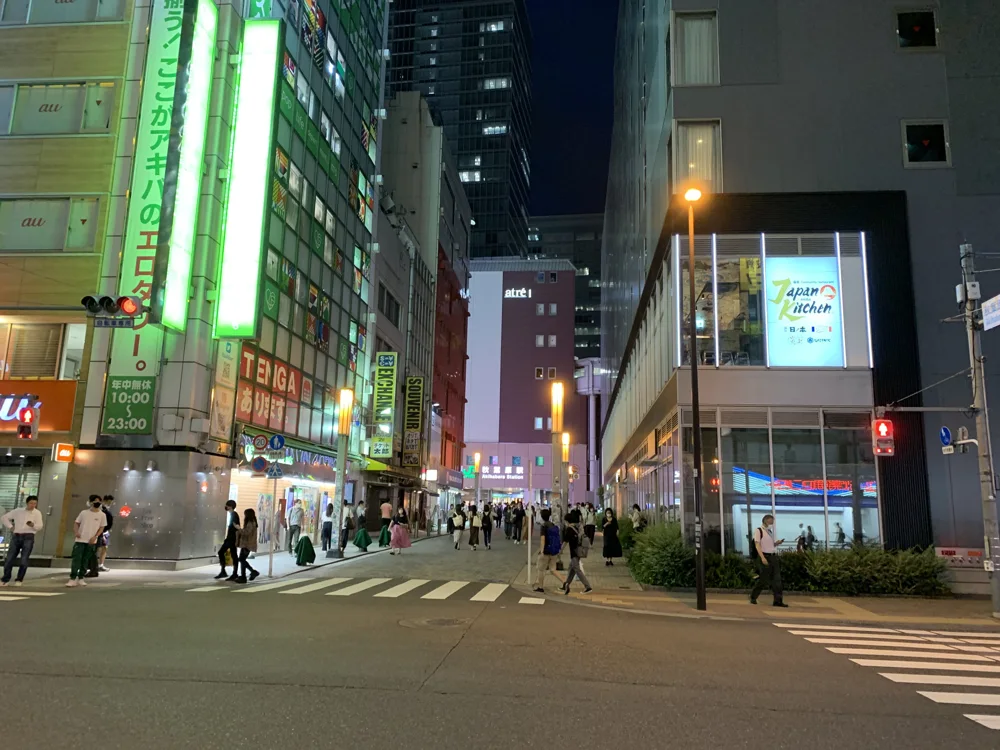
Stay near the Electric Town Gate for anime and hobby shopping, or pick the Showa-dori side for the Hibiya Line. Compare Akihabara hotels and capsule stays across all three JR ticket gates, including room layouts, late arrivals, luggage storage, airport transit, and Tokyo's 2027 accommodation tax.
One Hotel From Each Gate, Compared
JR-East Hotel Mets Premier Akihabara sits roughly a 1-minute walk from the Electric Town Gate's South Exit. Official check-in is 3:00 PM and checkout is 11:00 AM, and the front desk holds bags both before check-in and until midnight on your checkout day. Serious shoppers can drop bags off early, scout nearby buildings, and come back later to pack boxes comfortably. Superior Twins measure 21 square meters with two 120 cm-wide beds for one or two guests; Deluxe Twins measure 23 square meters for up to three guests, adding a 90 cm-wide extra bed. Both layouts feature a separate washing area outside the bathtub, making bath time much easier with young kids.
Akihabara Washington Hotel stands just outside the Central Gate, listed at 1 minute from the JR Central Gate and 2 minutes from Hibiya Line Exit 5. Standard check-in is 2:00 PM and checkout is 11:00 AM. Morning arrivals can leave luggage at the 3rd-floor front desk, though valuables and fragile items stay with you. For groups of three, the hotel offers a 21-square-meter Triple Room with two 120 cm-wide beds plus a sofa converted into a 90 cm-wide bed. Because this room type cannot be booked same-day, lock in your dates early so you can drop bags and head straight out upon arrival.
APA Hotel Akihabara Ekimae is about a 2-minute walk from the JR Showa-dori Gate or 1 minute from Hibiya Line Exit 1. Standard check-in is 3:00 PM and checkout is 10:00 AM. Both Single and Double rooms are listed at 11 square meters, with a 140 cm-wide bed in the Double. If two travelers each have a large suitcase and want to open them at the same time, compare the hotel's 22-square-meter Deluxe Twin with two 120 cm-wide beds instead. Exit 1 works fine when traveling light, though anyone with a stroller should recalculate the walk starting from the Exit 3 elevator.
Hotel names on the east side sound remarkably similar—APA Hotel Akihabara Ekimae is especially easy to mix up with APA Hotel Akihabara Eki-Higashi. Save the full property name and Japanese street address on your phone to show taxi drivers; for APA Akihabara Ekimae, that is Kanda-Sakumacho 2-chome 13-20. If you are splitting a trip across two similarly named chain hotels, add the stay dates right into your map labels so you can tell at a glance which building you are heading back to each night.
Double Beds, Twin Beds, and Rooms for Three
When booking for two, pick your bed count before looking at square footage. Search results often mix "Double" and "Twin" rooms together, even though a Double means sharing one bed while a Twin gives you two separate beds. When nightly rates look close, compare bed widths, floor space shown in room photos for opening suitcases, and whether breakfast is included. On multi-night stays where you sort camera gear or model boxes every evening, desk surface and doorway clearance matter just as much. Even two extra square meters changes feel completely once a third bed takes up the floor.
Families traveling with children should enter every traveler and child's age in the booking search, counting any child who needs their own bed. At Mets Premier Akihabara, for instance, both the Superior Twin (capacity 1–2) and Deluxe Twin (capacity 1–3) allow up to two preschool-age children to share existing beds with adults at no extra charge. If two adults plan to share a bed each with a child, check first whether a 120 cm-wide mattress feels comfortable enough. If kids need their own sleeping space, booking a triple with an extra bed or two separate rooms works far better than sorting out headcounts at check-in.
Three adults traveling together should price out a Triple Room side-by-side against a Twin plus a Single. Sharing one triple room saves splitting up, but it means sharing one bathroom and the same packing floor and alarm schedule. If one person heads out early every morning, separate rooms keep everyone rested. For an adult-and-child group across two rooms, request adjoining rooms when booking and put a different adult's name on each reservation. When companions arrive on late staggered flights, knowing ahead of time who checks in first, who holds each booking reference, and who gets the spare key card beats scrambling in a group chat.
For accessible rooms, check the path from the ticket gate to the lobby separately from the room interior itself. Station elevators only solve part of the trip. Between the street exit and your bed, you may still face crossing Showa-dori, navigating around revolving doors, or taking an elevator to an upper-floor reception desk. Ask the hotel directly for exact doorway and bathroom clearances, shower thresholds, and bedside transfer space—and include the dimensions or model of your stroller or wheelchair so you get usable answers.
Capsule Hotels: Late Arrivals, Showers, and Storage
Akihabara BAY HOTEL is a women-only capsule property listed at roughly 4 minutes from the JR Central Gate, 3 minutes from the Showa-dori Gate, or 2 minutes from Hibiya Line Exit 2. Check-in runs from 4:00 PM to 2:00 AM, with checkout at 10:00 AM, and you must contact the property in advance if arriving past midnight. If your flight lands close to midnight, add immigration, baggage claim, and train transfer times before deciding whether to sleep in Akihabara that night. Starting your shopping fresh the next morning usually beats racing late-night transfers just to make final check-in.
BAY HOTEL provides shared shower rooms and floor lockers, while capsules themselves do not lock and oversized bags stay at reception. You can drop luggage before check-in, though bags left on checkout day must be picked up by noon. During daily cleaning from 10:00 AM to 4:00 PM, even multi-night guests cannot remain inside the sleeping floors, though lockers and desk storage stay accessible. That window rules out afternoon naps, midday outfit changes, or remote work from your bunk. Reception also operates cashless, so do not rely solely on Japanese yen bills.
Anshin Oyado Tokyo Man Akihabara Denkigai is a men-only capsule hotel requiring guests to be at least 18 years old. Reception opens check-in at noon; standard capsule access starts at 3:00 PM, while guests who book directly on the official website can enter their capsules from noon. Checkout is noon the next day, and both the artificial hot spring bath and mist sauna have scheduled cleaning windows—worth checking ahead if you plan to soak immediately after arrival. Locks and security cables are available to borrow at reception, and large suitcases go in a shared storage area free from check-in day through checkout day.
Keep in mind that capsule stays price and assign one berth per person. Mixed-gender pairs, travelers who pack together, or parents with children will find independent hotel rooms much simpler, especially given strict guest policies: BAY HOTEL does not admit elementary-school children even with a parent, and middle-schoolers or older minors need guardian consent forms. Solo travelers looking to save money should compare a capsule rate against a business hotel single room for the exact same dates, then ask whether they need daytime room access. Capsules pay off when you only need a shower and a bed; on a two-night stay with planned afternoon breaks, a private room with anytime keycard access earns its price.
Getting In From Narita or Haneda Airport
From Narita Airport on the Keisei Skyliner, ride to Nippori and follow the Keisei-to-JR transfer gates onto the outer-loop Yamanote Line bound for Ueno and Tokyo. The train stops at Uguisudani, Ueno, and Okachimachi before reaching Akihabara. While the Skyliner also terminates at Keisei-Ueno, that station is a separate building from JR Ueno. Small groups hauling large suitcases usually find the in-station transfer at Nippori simpler; only stay on to Keisei-Ueno if you plan to eat in Ueno first or connect to the subway instead of JR. Note that Terminal 1 uses Narita Airport Station, while Terminals 2 and 3 use Airport Terminal 2 Station.
Per Keisei Electric Railway fares, an adult Skyliner ticket between Nippori and either Narita station costs ¥2,580 with a paper ticket (¥1,280 base fare plus ¥1,300 Limited Express surcharge). Tapping a transit IC card lowers the base fare to ¥1,267, though you still purchase the Limited Express seat ticket separately. Neither fare includes the JR hop from Nippori to Akihabara. When plotting your evening timeline, separate the Nippori transfer, the walk through Akihabara Station, and hotel check-in—your train ticket's arrival time only gets you to the platform, not the front desk.
From Haneda Airport, take the Tokyo Monorail to Hamamatsucho and transfer to the JR Yamanote Line, or ride a Shinagawa-bound Keikyu Airport Line train and switch to JR at Shinagawa. Tokyo Monorail lists an adult paper ticket between Hamamatsucho and Haneda Terminals 1, 2, or 3 at ¥520, with the JR leg charged separately. On your first arrival at Haneda, double-check your terminal and leave buffer time to walk from the terminal concourse to the monorail platform. If a late flight threatens your planned connection, keep a backup route plus your hotel's address and phone number handy on your phone so you can call ahead as soon as you land. For a full side-by-side look at both airports, see our Tokyo airport to city transit guide.
From Akihabara to Tokyo Station, the Yamanote Line takes just two stops via Kanda. Under JR East's fare revision effective March 14, 2026, an adult one-way ride costs ¥155 by IC card or ¥160 with a paper ticket. The Keihin-Tohoku Line also runs this stretch, though its daytime Rapid service skips certain stops, making the Yamanote Line the safest bet if you are meeting someone at Kanda. When catching a Shinkansen at Tokyo Station, leave extra minutes to move from the local JR tracks to the proper Shinkansen gates. Heading to Hibiya instead? Tokyo Metro lists the Hibiya Line ride from Akihabara to Hibiya at about 14 minutes for ¥178 on an IC card or ¥180 by paper ticket—saving an entire station transfer if you make that trip daily.
How Long to Stay—And How Many Bag Drops You Need
If you only need half a day in Akihabara while spending the rest of your trip around Shibuya, Shinjuku, or Tokyo Disney Resort, a light shopping run from your main hotel makes more sense. The Yamanote and Chuo-Sobu lines do connect Akihabara across central Tokyo, yet you will still repeat that commute every morning after breakfast and every night before bed. Before locking in three or four nights, compare your earliest morning meetup, your latest evening neighborhood, and your final airport route. A hotel that looks centered on a map can easily sit far off the path of your actual itinerary.
If your trip includes two dedicated shopping blocks, staying two nights in Akihabara hits a sweet spot. Arrive on day one afternoon, drop bags at the hotel, scout a flagship building to check sizes and prices, and decide how much you want to haul home. On day two morning, pack away the previous day's boxed goods and head back out with just a light bag, returning to your room to organize before dinner. If you head to Ginza or a night exhibition on day two, leave time to swing back through Akihabara first so you are not dragging merchandise bags around all evening. To map out your first afternoon by store and floor, check our Akihabara half-day shopping route.
If your itinerary centers on Ueno Park, the national museums, or round-trip Skyliner access from Narita, look around Keisei-Ueno and Okachimachi as well. JR connects Ueno and Akihabara directly in minutes, yet each base solves a different luggage problem. Leaving via Keisei-Ueno and storing bags nearby on your last day favors staying in Ueno to skip an extra suitcase transfer; buying bulky boxes and parts across Electric Town favors staying right there so you can make two easy drop-offs. Compare exits, hotel blocks, and airport links in our Keisei-Ueno and Okachimachi hotel guide.
Catching an early morning Shinkansen from Tokyo Station still works smoothly from around Akihabara's Central Gate, especially if you are already checked in and just wheeling packed bags out the door. Once your bags are zipped, though, remember to factor in picking up reserved rail tickets or meeting companions at the Shinkansen gates into the full door-to-door trip. For very early departures, weigh moving near Tokyo Station the night before against leaving Akihabara earlier in the morning. Spending night one by Electric Town and shifting hotels for the final night pays off if one short move eliminates multiple transfers the next morning.
Big Suitcases, Parcels, and Checkout Morning
JR Akihabara Station's official map marks coin locker banks clearly. Step one is checking whether a bank sits inside or outside the ticket gates, then noting which floor it is on. Paid-area lockers work well if you will be departing by JR train later; if you plan to walk to the Metro or catch a taxi next, leave bags at your hotel or use outside-the-gate lockers so you can head straight for your exit. Anyone carrying a 28-inch suitcase alongside shopping bags and boxes should measure their largest piece beforehand to verify it fits an available locker size.
When comparing hotel luggage storage, look first at the pickup cutoff. Mets Premier holds bags until midnight on checkout day, ideal if you have late errands in Electric Town. BAY HOTEL cuts off storage at noon, meaning afternoon plans require shifting bags to station lockers or your next hotel. Anshin Oyado stores bags free through checkout day, while deliveries arriving a day early or pickups held until the day after checkout cost ¥1,000 per day. If you plan two or three hours of post-checkout shopping, pick a storage spot near your final stops so your route converges on one side of the station instead of crisscrossing between shops, lockers, and tracks.
Before shipping a parcel ahead to your hotel, verify the rules—BAY HOTEL, for example, requires your check-in date and full guest name on the shipping label and refuses cash-on-delivery, fresh, or frozen packages, while its FAQ notes the front desk does not process outbound shipments. Never assume every hotel offers full courier service. If you plan to forward a suitcase from your room to your next city, confirm upfront whether reception handles outbound shipping, when pickups occur, and when the receiving hotel staffs its desk, then pack spare clothes accordingly. Groups should assign one person per room to hold tracking slips and match the exact booking name.
Checkout mornings often stall on one small oversight: packing figure boxes at the bottom of a suitcase only to realize you need to pull all your clean clothes back out on top of them. Separate checked and carry-on items the night before, keep tax-free purchases accessible for airport inspection, and leave room keys, passports, and tomorrow's outfit outside the zipped bags. If you want a sit-down breakfast after checking out, leave heavy suitcases at your chosen storage spot first so you can eat without dragging bags through a restaurant or circling back to shops afterward.
Late Flights, Event Dates, and Booking Terms
If you are running behind your scheduled check-in, call or message the hotel immediately with your new ETA. This matters especially at Anshin Oyado: even though the Akihabara Electric Town branch runs 24 hours, its policy warns that guests arriving more than 30 minutes past their registered check-in time may be treated as no-shows. At BAY HOTEL, standard check-in closes at 2:00 AM and anything past midnight requires advance notice. When booking a late Haneda arrival, map out the last trains you can realistically catch alongside your hotel's check-in cutoff before confirming the room.
If your trip hinges on event ticket lotteries or shifting schedules, compare flexible refundable rates against prepaid deals for the exact same property and room type. As an example, BAY HOTEL's official cancellation schedule charges 20% two to seven days out, 50% the day before, 80% on arrival day, and 100% for a no-show—though specific plans may vary, and third-party OTAs follow their own cancellation rules. Before shifting dates, mark the free-cancellation deadline for your existing booking on your calendar alongside the backup hotel's cutoff and storage rules so you never miss a window while comparing rates.
Always price-check hotels using your exact dates and true headcount, and compare final checkout totals rather than nightly teaser rates. Include breakfast on the same basis across options and watch for fees payable at the property. When room sizes and rates are close, let your morning schedule decide breakfast: grab a room-only rate for early train days, or weigh the value of a later checkout if you arrive late and plan to sleep in. Looking at concrete trip totals makes it much easier to see where extra spending actually pays off.
Tokyo's accommodation tax structure changes in spring 2027. According to the Tokyo Metropolitan Government Bureau of Taxation, through March 31, 2027, hotels and ryokan tax room-only rates per person, per night: under ¥10,000 is exempt, ¥10,000 to ¥14,999 is ¥100, and ¥15,000 or more is ¥200. Starting with stays on April 1, 2027, the exemption threshold rises to under ¥13,000 per person per night, taxable stays face a 3% rate on the room-only charge, and simplified lodgings plus minpaku (short-term rentals) fall under the tax. Because the tax applies per person per night, check individual nightly rates if your stay bridges late March and early April. Tokyo Bureau of Taxation accommodation tax comparison
Shopping Runs and Rainy-Day Routing
Akihabara Radio Kaikan stands right outside the Electric Town South Exit; official general store hours run 10:00 AM to 8:00 PM, with basement dining operating on separate hours. For limited releases or display setups, follow the specific shop's opening and entry announcements rather than the building's general schedule. Arriving early? Drop your bags at the hotel first and head over at posted entry times. Families visiting with grandparents or kids can set the building entrance as a meetup spot—collectors can browse upper floors freely without making everyone else wait at checkout counters.
On the east side, Yodobashi Akiba lists main retail hours from 9:30 AM to 10:00 PM and its 8th-floor restaurant level from 11:00 AM to 11:00 PM. Keep in mind that individual restaurants set their own last-order times earlier than floor closing, so pick a dinner spot in advance if eating late. On rainy days, guests on the Showa-dori side can tackle east-side shops and dinner first, then group South Exit stores into a single dry-spell run—while west-side guests can reverse the order and duck back inside whenever a downpour picks up. Carrying an outer cover or waterproof bag large enough for oversized cardboard boxes saves them from soaking at crosswalks.
If your shopping list spans both sides of the tracks and you have another Tokyo district on the schedule, split the day around those two anchor buildings. Hit the South Exit for models or cards first, drop boxes back in your room, then cross over to Yodobashi for browsing and dinner. On checkout day, sequence your stops around where your bags sit so your final errand ends on the same side as your station gate. Carrying fewer bags per trip makes a noticeable difference when juggling a camera or two kids.
Sunday Pedestrian Zone and Taxi Pickups
Per the Tokyo Metropolitan Police Department, Akihabara's Chuo-dori becomes a pedestrian zone on Sundays between the Sotokanda 5-chome intersection and Manseibashi intersection—running 1:00 PM to 6:00 PM from April through September, and 1:00 PM to 5:00 PM from October through March. Events may be canceled in poor weather, with live status posted by the Akihabara Electric Town Organization. While open, pedestrians can stroll down the middle of the avenue to view storefronts and cross freely, though street vending, performances, and cycling remain prohibited inside the closure.
If you are rolling large suitcases out on a Sunday afternoon, head straight to the pickup point specified by your hotel. When calling a taxi near Chuo-dori, ask the front desk which side street vehicles can reach and show the driver the entrance's Japanese address. If your hotel entrance faces away from the avenue, stick to the regular pedestrian route instead of walking down the closed boulevard only to backtrack at the next corner. Train riders continue using their chosen JR or subway gates as usual—the closure only affects Chuo-dori, leaving the east side's Hibiya Line exits and the Central Gate untouched.
Combining checkout and shopping on a Sunday works best if you leave bags at the hotel in the morning before heading to Chuo-dori. When leaving by taxi or rideshare, never just send companions a hotel pin—set a nearby street corner where cars can actually stop as your meetup point, and have one person handle luggage while slower walkers wait comfortably curbside. Bookmark the organizer's notice page if you want to catch the pedestrian zone; if weather cancels it, follow normal crosswalk signals and your planned shopping and dining spots remain open as usual.
New Tax-Free Rules From November 2026 Affect Airport Timing
Under Japan Tourism Agency rules taking effect for purchases from November 1, 2026, eligible visitors pay the full tax-included price at tax-free stores—meeting the minimum threshold of at least ¥5,000 before tax at a single store in one day. When departing Japan within 90 days of purchase, customs verifies that the items are leaving the country before the store or operator refunds the consumption tax equivalent. If your shopping budget shares the same card or cash pool as your final hotel nights, remember you will front the tax at the register and still need funds on hand for trains and meals.
At both Haneda and Narita, you must complete tax-free verification before checking bags with your airline. Bring your passport and all qualifying goods to the customs kiosks and follow the on-screen prompts; if flagged for inspection, present the items at the customs counter. The Japan Tourism Agency notes that eligible travelers at designated airports including Haneda and Narita can also submit via Visit Japan Web using dedicated Wi-Fi in the departure lobby. Pack bulky figure boxes right at the top of your checked suitcase so customs can inspect them easily before you drop the bag at airline check-in. On early departures, count backward from airline bag-drop cutoffs to factor in this step before picking your train out of Akihabara. Japan Tourism Agency tax-free refund steps and airport maps
Customs verifies tax-free items per individual purchase transaction. Check out separately for snacks you plan to eat in Japan or toiletries you will use during the trip, keeping them off the same receipt as tax-free goods you are taking home—far easier than sorting receipts back at the hotel. Doing so also lets you pull an entire transaction cleanly out of your suitcase if inspected. If you want to swap a defective item before flying home, verify the original store's exchange policy and opening hours first; for morning flights, handle any store returns the day before.
A few useful answers
Which Akihabara Station exit is best for a first-time hotel stay?
Pick the South Exit of the Electric Town Gate if your trip revolves around hobby and electronics shopping. Choose the Showa-dori side if you will ride the Hibiya Line daily, and use the Metro Exit 3 elevator if you have a stroller. If your group plans to use both JR lines and the Tsukuba Express, the area around the Central Gate works best.
How should three adults book a room in Akihabara?
Run your hotel search with all three adults entered from the start. At JR-East Hotel Mets Premier Akihabara, the Deluxe Twin accommodates three by adding an extra bed, while Akihabara Washington Hotel offers a Triple Room that converts a sofa into a bed and must be booked in advance.
Can I leave my luggage after checking out?
Policies vary by property. Akihabara BAY HOTEL requires you to pick up checked bags by noon on checkout day, while Anshin Oyado Akihabara Electric Town stores luggage for free through checkout day. You can also check JR East's station map for coin lockers inside and outside the ticket gates.
Is it easy to catch the Shinkansen at Tokyo Station from Akihabara?
Yes. The Yamanote Line takes two stops via Kanda directly to Tokyo Station. For early-morning Shinkansen departures, budget extra time to walk from your hotel to the Akihabara platform and transfer from the local tracks to the Shinkansen gates inside Tokyo Station.
Can I check into an Akihabara capsule hotel past midnight?
Akihabara BAY HOTEL accepts check-ins until 2:00 AM, though you must contact them ahead of time if arriving after midnight. Anshin Oyado Akihabara Electric Town operates 24 hours, but if you are more than 30 minutes past your stated arrival time, your reservation may be treated as a no-show unless you notify them.
Official information and references
Sources used in this guide.
- JR East Akihabara Station Information
- JR East Akihabara Station Map and Accessibility Facilities
- JR East 2026 Fare Revision Pamphlet
- Tokyo Metro Akihabara Station Accessibility Information
- Tokyo Metro Akihabara Station Map and Street Exits
- Tokyo Metro Major Route Fares and Travel Times
- Tsukuba Express Akihabara Station Map
- Akihabara UDX Walking Access from Electric Town Exit
- remm Akihabara Central Gate and Tsukuba Express Access
- JR East Nippori Station Keisei Line Transfer Gates
- JR-East Hotel Mets Premier Akihabara Access
- JR-East Hotel Mets Premier Akihabara Rooms and Check-In Hours
- JR-East Hotel Mets Premier Akihabara Facilities and Luggage Storage
- Akihabara Washington Hotel Access
- Akihabara Washington Hotel Triple Room Details
- Akihabara Washington Hotel Check-In and Luggage FAQ
- APA Hotel Akihabara Ekimae Rooms and Access
- Akihabara BAY HOTEL Access
- Akihabara BAY HOTEL Luggage, Late Arrival, and Cancellation Policy
- Akihabara BAY HOTEL Capsules and Locker Facilities
- Anshin Oyado Akihabara Electric Town Check-In Times and Rules
- Anshin Oyado Akihabara Electric Town Luggage and Facilities
- Keisei Electric Railway Skyliner Tickets and Fares
- Tokyo Monorail Hamamatsucho Station Fare Chart
- Tokyo Metropolitan Government Bureau of Taxation Accommodation Tax Revision
- Akihabara Radio Kaikan Access and Business Hours
- Yodobashi Akiba Floor Business Hours
- Tokyo Metropolitan Police Department Pedestrian Zone Hours and Boundaries
- Akihabara Electric Town Organization Sunday Pedestrian Zone Rules
- Japan Tourism Agency Tax-Free Shopping Refund Procedures