Compare Tokyo Station hotels in Marunouchi, Yaesu, and Kyobashi by Shinkansen, Narita, and Haneda access, plus family rooms, rainy-day routes, and the 2027 Tokyo accommodation tax.
- Region & Focus
- TokyoHotels and stays
- Reading Scope
- 21 min read · 9 chapters · 8 Q&As
- Official Verification
- 38 official sources checkedUpdated November 22, 2026
- Key Topics
- Where to stayNeighborhoodsBooking
Chapter Route Map (tap any stop)
- Pick Your Tokyo Station Exit Before Picking Your Hotel
- Two Hotels Directly Connected to Marunouchi, on Opposite Ends of the Station
- Yaesu Family Rooms and One-Night Transfers
- Kyobashi Works Best When the Ginza Line Is Your Daily Anchor
- Which Level Serves the Shinkansen, Narita Express, and Keiyo Line
- Narita Trains Run Underground; Haneda Buses Depart from Tekko Building
- Compare Multi-Night Costs Under Matching Room Terms
- Rainy-Day Exits and Where to Eat When Arriving Late
- Packing Differently for a One-Night Transfer vs. a Multi-Day Base
- Quick Q&A
If you are catching a morning Shinkansen, choose your Tokyo Station hotel by the exit it connects to. Yaesu Central or South Exits work best for Kyoto and Osaka, while Nihombashi Exit puts you closer to trains for Sendai and Kanazawa. Pick the Marunouchi side if you want to stay in the red-brick station building or walk straight to the Imperial Palace. If you only take the Shinkansen once and spend the rest of your trip around Ginza and Asakusa, staying near Kyobashi Station is smoother. Remember that "minutes on foot from Tokyo Station" on booking pages starts after you walk from the platform to that specific exit.
Pick Your Tokyo Station Exit Before Picking Your Hotel
Marunouchi sits on the west side of the station. Step out the ground-level Marunouchi Central Exit and the plaza opens onto Gyoko-dori Avenue toward the Imperial Palace; the Marunouchi South Exit connects directly to The Tokyo Station Hotel, while the North Exit dome houses the entrance to Tokyo Station Gallery. If you want to start your day with a walk to the Imperial Palace Outer Garden or cluster museums, cafes, and the historic brick facade into one half-day, staying on the west side lets you do it all on foot from your lobby. This side is also closest to the underground Sobu platforms, making it easy to drop down for the Narita Express.
Yaesu covers the east side. Its North Exit borders the Tekko Building and streets leading toward Nihombashi, the Central Exit drops straight into Yaesu Underground Shopping Mall, and the South Exit leads to Narita-bound highway bus stops. When your family arrives in the afternoon and needs dinner nearby without another train ride, Yaesu lets you drop bags at the hotel and head right back into Yaesu Underground Shopping Mall or Tokyo Station First Avenue. Using that same exit each morning also makes departure timing much more predictable.
Just south of Yaesu, Kyobashi borders Ginza-itchome. Mitsui Garden Hotel Kyobashi sits between Tokyo Station's Yaesu Central Exit and Ginza Line Kyobashi Station, while remm Tokyo Kyobashi is right by Kyobashi Station and uses Tokyo Station's Yaesu South Exit. Both give you Ginza Line access, though Mitsui Garden is the more direct walk if you haul bags back and forth through Yaesu Central Exit daily. If the Ginza Line will be your main commuter line, orient yourself from Exit 6 of Kyobashi Station right outside remm.
Always trace the walk from the train platform to your front door using the hotel's own access page. While the Marunouchi South Exit puts you steps from The Tokyo Station Hotel, you still have an indoor walk after descending from the Shinkansen platforms. If your train exits on the east side and you need to cross back to Marunouchi outside the ticket gates, use the North Free Passage via Yaesu North Exit; the south-side east-west free passage is still under construction. Treat a hotel's "Yaesu South Exit" and "Marunouchi South Exit" directions as completely separate doors so you do not drag suitcases the wrong way.
For a four- or five-night stay in Tokyo, count how many times you will actually use Tokyo Station. If you have multiple Shinkansen rides, the Narita Express, or suburban JR day trips from here, sleeping beside the tracks saves luggage hauling and early alarms. If your itinerary sticks to the east side—Nihombashi, Ginza, and Asakusa—look at Kyobashi and Nihombashi together. If most days center on Shinjuku, Shibuya, or Ueno with just one intercity train, staying in those neighborhoods and checking train times before deciding whether to move to Tokyo Station on your final night often makes more sense. You can compare late-night vibes and subway links across districts in our Tokyo neighborhood guide.
| Next Morning's First Leg | Where to Look First | Entrance to Find on the Map |
|---|---|---|
| Tokaido / Sanyo Shinkansen to Nagoya, Kyoto, or Osaka | Around Yaesu Central Exit or Yaesu South Exit | JR Central Shinkansen ticket gates |
| Tohoku, Hokkaido, Joetsu, or Hokuriku Shinkansen | Around Nihombashi Exit or Yaesu North Exit | JR East Shinkansen entrance at Nihombashi Exit |
| Narita Express (N'EX) | Marunouchi-side hotels with quick access down to the Sobu underground platforms | Marunouchi Underground Gates and Sobu Line signs |
| Haneda Airport Limousine Bus | Around Yaesu North Exit | Bus Stop No. 2 on 1F of Tekko Building |
| Multiple days riding the Tokyo Metro Ginza Line | Kyobashi | Exit 6 or Exit 7 of Kyobashi Station (Ginza Line) |
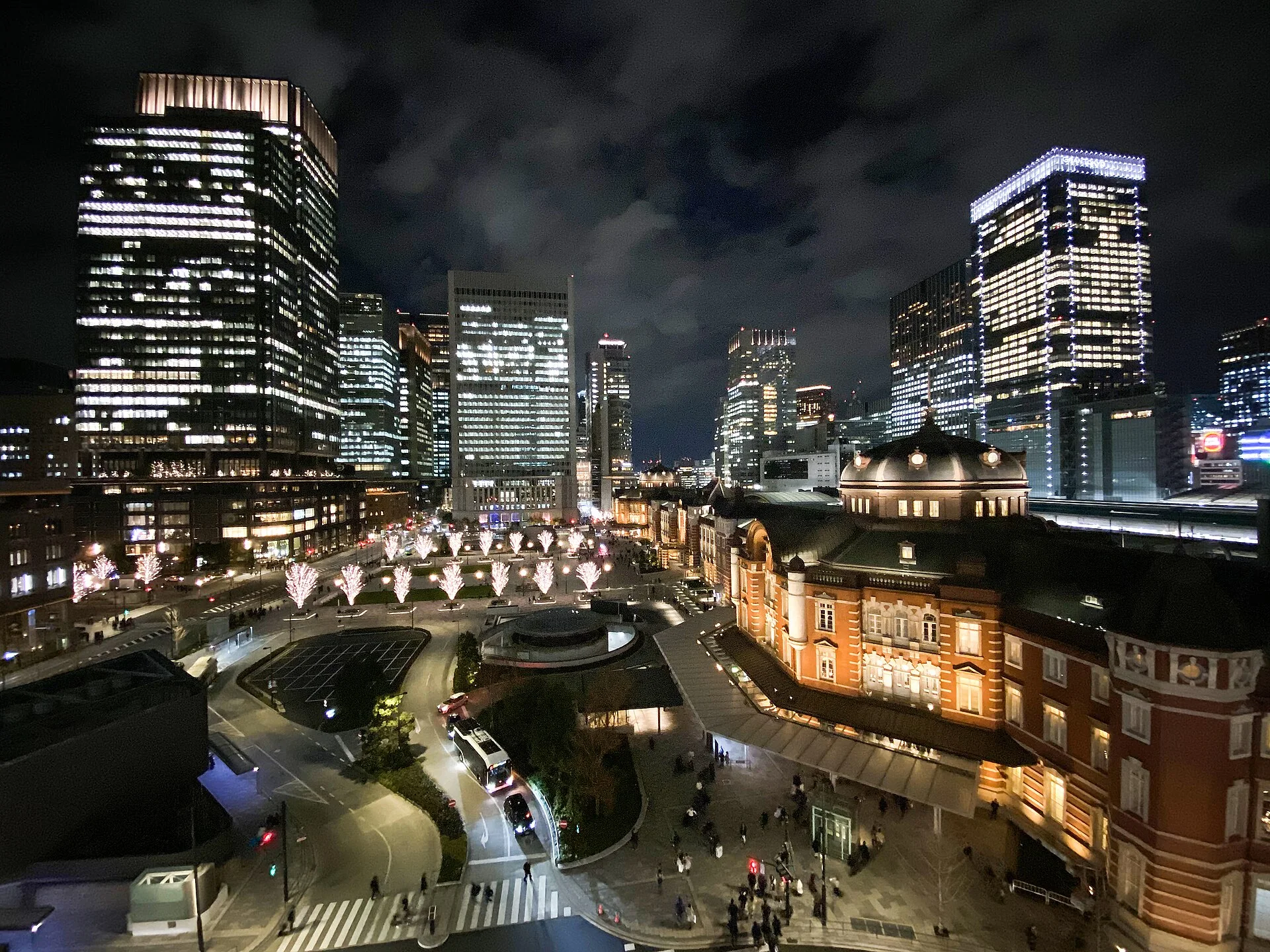
Compare Tokyo Station hotels in Marunouchi, Yaesu, and Kyobashi by Shinkansen, Narita, and Haneda access, plus family rooms, rainy-day routes, and the 2027 Tokyo accommodation tax.
Two Hotels Directly Connected to Marunouchi, on Opposite Ends of the Station
To stay inside the red-brick station itself, book The Tokyo Station Hotel (1-9-1 Marunouchi). Directly connected to the JR Marunouchi South Exit, standard check-in is 15:00 and check-out is 12:00. Exit the ground-level South Exit to find the main entrance, which is the route to use with rolling suitcases or wheelchairs. The hotel's floor map marks the B1F entrance as stairs-only, so if you arrive via underground passages and need a step-free route, aim for the 1F main entrance first.
Decide what you want out of the windows before paying for an upgrade. Dome Side rooms overlook the interior of the station's domed rotunda, letting you watch the reliefs and commuters below—a treat for architecture fans. For street views toward Marunouchi, look for explicitly labeled categories such as Palace View. Before a dawn train, any extra cost for a view really only buys you that single evening in the room; if your train leaves after noon, the 12:00 check-out gives you time for an unhurried breakfast and morning stroll.
The station building opened in 1914 and the hotel followed in 1915; after preservation and restoration work, the brick facade and twin domes were restored in 2012, with the hotel reopening that October. If you just want to admire the architecture, walking between the Marunouchi South and North Exits and looking back from the plaza is plenty. Book an overnight here for the dome-facing rooms or breakfast—if you plan to stay out late and depart at daybreak, a Yaesu or Kyobashi hotel still lets you see the illuminated brick facade before dinner.
Hotel Metropolitan Tokyo Marunouchi sits closer to the northern end of the station complex. Connected to the JR Tokyo Station Nihombashi Exit via Sapia Tower, you take an elevator straight up to the 27F lobby. Note that "Nihombashi Exit" here refers to a JR Tokyo Station exit, not the nearby Nihombashi subway station. When group members arrive separately, have everyone meet at the 27F front desk or hotel entrance so anyone coming out of the Marunouchi side still has a clear landmark.
Standard hours at Hotel Metropolitan Tokyo Marunouchi are 15:00 check-in and 12:00 check-out, with luggage storage at the 27F desk before and after your stay; the hotel asks guests arriving past midnight on their check-in date to contact the front desk ahead of time. Renovation work is scheduled from November 1, 2026 through March 31, 2027 (planned), during which rooms on the 29F and 30F are suspended and announced construction hours run 10:00–17:00. Red-eye arrivals hoping to sleep during the day should weigh those work hours against their check-in window.
The hotel has also announced temporary closures of its fitness room, coin laundry, and conference rooms from November 1, 2027 through March 31, 2028. Overnight transit travelers rarely need those facilities, but if you are spending a week in Tokyo with three or four days of clothes, plan your laundry access from night one. Over in Kyobashi, remm Tokyo Kyobashi has coin laundry machines on its 12F so you can wait in your room after a long day out—handy if packing one fewer suitcase is part of your multi-night plan.
Keep Palace Hotel Tokyo in a separate mental bucket if moat views are the priority. It anchors the Otemachi and Imperial Palace edge, linking underground to Otemachi Station Exit C13b and offering balcony rooms overlooking Wadakura Fountain Park. Those balconies and larger footprints shine when you explore the palace on day one and have a slow morning in the room on day two. If you are only booking near Tokyo Station for an early train, factor in the full walk from Palace Hotel to the JR gates and platforms rather than comparing nightly rates directly against a hotel steps from the South Exit.
Yaesu Family Rooms and One-Night Transfers
karaksa hotel TOKYO STATION is located at 1-5-3 Yaesu, about a 5-minute walk from the Yaesu North Exit according to its official directions. Sister property karaksa hotel colors Tokyo Yaesu uses the Yaesu Central Exit instead. When shipping luggage ahead or giving a taxi driver your destination, show both the exact hotel name and street address from your reservation—ending up at the wrong property means dragging bags across the east side of the station.
Parties of three who each need their own bed should compare a Standard Twin with extra bed against the 29 m² Family Triple. The former uses a 90 cm sofa bed as the third bed, while the latter provides a 100 cm extra bed. If you have two or three large suitcases to open each night, check the floor plan with all beds extended first. Two adults traveling with a teenager need to check the same extra-bed dimensions as three adults to avoid a cramped room.
Groups of five or six can book connecting rooms joined by an interior door—just search with your exact total headcount so those configurations appear. Two standard twin rooms on the same floor still force you into the hallway to check on each other. The hotel also offers four- and six-person Japanese-style family rooms with futons on tatami mats. Connecting Western rooms tend to work better if anyone needs a bed frame for support getting up, or if caregivers want separate sleeping and bathing zones.
To save on kids' lodging costs, decide early whether children will share existing beds or need their own. At karaksa, co-sleeping generally applies to children aged 6 and under, extending up to age 12 when booked directly through the official website, capped at one co-sleeping child per regular bed and two per room. Any child aged 6 or under who uses an independent bed is charged the adult rate. Enter your actual bed needs upfront when pricing rooms for a group so you do not have to re-quote later.
Even luxury hotels labeled Marunouchi can use an east-side approach. Four Seasons Hotel Tokyo at Marunouchi has a 1-11-1 Marunouchi street address, yet its official access guide directs walkers to the Yaesu South Exit—roughly a 4-minute walk—and notes an underground walkway connecting to Tokyo Station. Double-check the full English hotel name before heading over, because Four Seasons Hotel Tokyo at Otemachi is an entirely separate property with different pickup points and station exits.
Kyobashi Works Best When the Ginza Line Is Your Daily Anchor
Mitsui Garden Hotel Kyobashi lists three straightforward approaches on its site: about 5 minutes on foot from JR Yaesu Central Exit, about 1 minute from Exit 24 of the Yaesu Underground Shopping Mall, and about 2 minutes from Exit 7 of Kyobashi Station. In heavy rain, you can stay underground most of the way and only step outside briefly after Exit 24. If two travelers arrive separately via JR and the Ginza Line, meet right at the hotel entrance so nobody wastes time entering the wrong station gate.
remm Tokyo Kyobashi sits right outside Exit 6 of Kyobashi Station and lists roughly a 7-minute walk from Tokyo Station's Yaesu South Exit, with standard 14:00 check-in and 12:00 check-out. Using Exit 6 as your landmark is simple, though anyone rolling suitcases up from the Ginza Line should save the Tokyo Metro elevator route map—the stair exit closest to a hotel is often different from the step-free exit.
Even among two-bed rooms at remm, space and bathroom layouts differ sharply. The Economy Twin measures 18.4 m² with a shower booth (no bathtub) and an interior courtyard-well window. If you want a soaking tub or room to open two large suitcases, upgrade to the 23 m² Twin, which features a bathtub and a separate toilet; the Casual Twin also includes a bathtub with an interior-well window. Compare square footage, tub access, and window orientation side by side when checking rate differences—over a multi-night stay, that comfort matters more than saving two minutes to the JR gates.
From Kyobashi each morning, the Ginza Line takes you straight north toward Asakusa or south through Ginza and Shimbashi to Shibuya. If your multi-day Tokyo stay includes just one Shinkansen trip, walking straight down into Kyobashi Station each morning is effortless. If you plan frequent JR day trips out of Tokyo Station, however, you will repeat that connector walk every day—put hotels right by the Nihombashi or Yaesu North Exits in your comparison too.
Which Level Serves the Shinkansen, Narita Express, and Keiyo Line
Trains to Nagoya, Kyoto, Shin-Osaka, and Hakata follow Tokaido and Sanyo Shinkansen signs to Tokyo Station Tracks 14–19. As you walk from the Yaesu side toward the JR Central ticket gates, assign linked IC cards to each traveler before reaching the turnstiles. Passing out mobile or IC tickets one by one at the gate with four or five people almost guarantees someone scans through while another gets stuck behind. If you need to pick up physical tickets at a machine or counter, check the pickup office hours the night before.
For Shin-Aomori, Shin-Hakodate-Hokuto, Akita, Yamagata, Niigata, Nagano, and Kanazawa, follow JR East Shinkansen signs to Tracks 20–23. Coming down from Hotel Metropolitan Tokyo Marunouchi via the Nihombashi Exit takes you straight into this northern end of the Shinkansen concourse. If you are transferring at Tokyo Station from Kyoto onto a Sendai train, JR East lists 8 minutes as the standard intra-station transfer time between the two Shinkansen zones. Build in extra buffer if you plan to exit the gates to drop bags, buy ekiben, or swing by your hotel.
Returning to Tokyo from Kyoto or Osaka, any suitcase with total dimensions (length + width + height) over 160 cm and up to 250 cm requires a seat reservation with an oversized baggage area on the Tokaido and Sanyo Shinkansen. JR Central states that bringing oversized luggage onboard without a reservation incurs a ¥1,000 fee and requires placing the bag where the conductor directs. On a first-night stopover by Tokyo Station, locking in a train with available oversized baggage seats—and seeing if it gets you in before hotel dinner—often matters more than picking the exit closest to your lobby.
The Narita Express (N'EX) departs from the Sobu Underground platforms—follow signs for the Sobu Line (Rapid) / Yokosuka Line. JR East station maps also show Keiyo Underground platforms, and both underground zones use Track numbers 1–4. If you only remember "underground" or a track number, heading down the wrong shaft means a long backtrack. When transferring from a Shinkansen to N'EX, budget time for the multi-level walk before planning souvenir or bento shopping.
Maihama and Tokyo Disney Resort lie at the opposite extreme. The Keiyo Line runs from deep underground platforms on the south side of Tokyo Station, reached via a long connecting corridor from other JR tracks. Staying near the northern Yaesu exits makes Shinkansen rides easy and Maihama rides tedious. For two consecutive Disney park days with kids at rope drop, compare hotels in Maihama itself first; if you are going for just one day and want dinner back at Tokyo Station, count the walk from your hotel to the Keiyo Line platforms in your morning schedule rather than looking only at train ride duration.
Narita Trains Run Underground; Haneda Buses Depart from Tekko Building
JR East lists the fastest Narita Express ride from Narita Airport to Tokyo Station at 53 minutes. Official single-trip fares between Tokyo and Narita Airport Terminal 1 or Airport Terminal 2 stations are ¥3,140 in Ordinary Car and ¥3,910 in Green Car; you can tap a Suica card for the base fare, but you still need a separate Limited Express ticket. Check your flight's terminal before buying: Terminal 1 uses Narita Airport station, while Terminals 2 and 3 use Airport Terminal 2 station (with an extra walk or shuttle from the station to Terminal 3).
Travelers with heavy suitcases can use the unreserved oversized luggage racks inside N'EX cars. Pairs or groups should note their car numbers on their tickets or phones ahead of time so they can walk straight to the right boarding position on the platform. If you are departing Tokyo Station and need to buy your Limited Express ticket in person, pick it up the evening before so you can walk straight through the gates after check-out. Anyone planning to take Keisei trains from Ueno—especially if they want a final meal in Ueno—should compare hotels there alongside Tokyo Station.
If your flight uses Narita Terminal 3, the airport estimates roughly a 13-minute walk from the Airport Terminal 2 station ticket gates to the Terminal 3 2F departures information counter. Leave extra margin if you need to check bags or stop at restrooms with kids. Non-Japanese passport holders flying into and out of Narita can buy the N'EX TOKYO Round Trip Ticket for ¥5,200 (adults) or ¥2,600 (ages 6–11), valid for a round trip between Narita and central Tokyo within 14 days. Pick it up at JR stations in Narita Airport by presenting your passport.
To save on airport fares, use the AIRPORT BUS TYO-NRT. Buses to Narita board at ground-level Stops 7 and 8 outside Yaesu South Exit, while buses arriving from Narita drop off at Nihombashi Exit. Because departure and arrival stops are on opposite ends of the east side, hotels near Yaesu North Exit are convenient on arrival, while you need to factor in the walk south when heading back to the airport. Standard one-way fares from Tokyo Station are ¥1,500 for adults and ¥750 for elementary school students, rising to ¥3,000 for adults and ¥1,500 for children on designated late-night and early-morning departures.
TYO-NRT departures from Tokyo Station toward Narita currently operate on a non-reserved, first-come basis with advance reservations suspended. Holders of Suica or PASMO can line up and tap onboard; during standard daytime hours, cash or credit card riders buy tickets first at the JR Highway Bus ticket counter. For 5:00–6:00 departures before the counter opens, cash riders go straight to the bus stop, and credit cards are not accepted during that early window. Inbound buses from Narita generally require buying a timed ticket at the airport terminal counter—if a bus fills up, you wait for the next one, so never stake a tight flight check-in on a single departure.
Low-cost Narita buses limit checked luggage to one suitcase per passenger with total dimensions within 158 cm, and exclude skis, bicycles, and large musical instruments. Measure your bag at home including wheels and handles. If your suitcase sits right on the 158 cm threshold or one person is bringing two bags, compare rail and luggage forwarding instead—saving a few flights of stairs by Tokyo Station will not help if a bag is turned away at the curb.
For Haneda Airport, catch the limousine bus from Bus Stop No. 2 at the 1F terminal of Tekko Building near Yaesu North Exit. Keikyu Bus lists fares at ¥1,200 for adults and ¥600 for children, accepts transit IC cards, and allows online bookings from one month ahead up to 5 minutes before departure, with walk-up seats available if space permits. Since Tokyo Station buses cluster in the daytime, take JR to Hamamatsucho for the Tokyo Monorail or Shinagawa for the Keikyu Line on late-night, early-morning, or heavy-traffic trips—and verify your terminal, especially when flying different airlines outbound and inbound.
If a bus ticket reads "Bus Terminal Tokyo Yaesu Underground A" or "Underground B," that refers to the underground long-distance bus terminal serving other routes. Opened on March 20, 2026, Underground A sits beneath TOFROM YAESU TOWER and Underground B sits on the Tokyo Midtown Yaesu side; follow signs for A or B through Yaesu Underground Shopping Mall. Stick to ground-level Stops 7 and 8 for the low-cost Narita bus and Tekko Building for Haneda—typing only "Tokyo Yaesu Bus Stop" into a map app can easily route you to the wrong facility.
Compare Multi-Night Costs Under Matching Room Terms
Always compare rates across identical dates, guest counts, bed setups, and cancellation policies. When three people are sharing, enter three guests from the start to see the real total for an extra bed or triple room. Around public holidays, lock in a refundable rate first and note the exact free-cancellation cutoff date in Japan Standard Time (JST) while your group finalizes trains. Switching hotels mid-trip to save money only pays off if you factor in the midday gap between check-out and check-in—especially if your bags stay at a front desk all afternoon.
Through March 31, 2027, the Tokyo Metropolitan accommodation tax applies per person, per night based on the room-only rate: tax-exempt under ¥10,000, ¥100 from ¥10,000 to ¥14,999, and ¥200 at ¥15,000 or more. Starting with stays on April 1, 2027, stays under ¥13,000 per person per night are exempt, and stays of ¥13,000 or more are taxed at 3% of the room charge. Under Tokyo Metropolitan Bureau of Taxation rules, the tax is calculated on the pure lodging fee excluding meals. If your stay spans late March into early April, read the per-night tax breakdown individually.
For example, if two adults split a ¥24,000 room-only rate (¥12,000 per person), the old system charges ¥200 total per night while the new system falls into the tax-exempt bracket. On a ¥30,000 room-only night (¥15,000 per person), the total tax jumps from ¥400 under the old brackets to ¥900 under the 3% rate. Those two figures illustrate the tax change alone; when comparing breakfast-included packages, fluctuating nightly rates, or bookings where an OTA already collects tax, check the itemized room rate and tax lines in your booking summary.
Match meal plans to your departure schedule on multi-night stays. If you need to scan through ticket gates at 7:00 AM, book room-only and grab breakfast at the station or onboard. Leaving around noon lets you enjoy a morning walk through the Imperial Palace Outer Garden and pack at leisure, making a 12:00 check-out worth an extra luggage-free morning. If nightly rates vary sharply, pair one splurge night at The Tokyo Station Hotel on your final evening in Tokyo with regular-rate nights beforehand—check out of your first hotel, visit a gallery or cafe, and check into the station hotel that afternoon.
New Year holiday rail and hotel bookings run on different timelines. On the Tokaido Shinkansen, certain SmartEX products allow registration up to one year ahead, though bookings made more than a month before travel do not assign exact trains and seats until one month out. Use your provisional itinerary to set rough check-out windows, then double-check once train and seat assignments finalize—especially if you need oversized baggage spaces, seats together, or shorter platform walks—rather than locking in non-refundable hotel breakfasts and tight connections prematurely.
Rainy-Day Exits and Where to Eat When Arriving Late
In a downpour, break your walk into four segments: platform, outside-the-gates passage, street exit, and hotel door. Yaesu Underground Shopping Mall and Tokyo Station First Avenue sit on the Yaesu side, putting shops right outside the ticket gates; from Marunouchi outside the gates, head first for the North Free Passage. Note that Mitsui Garden Hotel Kyobashi still has a short open-air walk after coming up Exit 24 of Yaesu Underground Shopping Mall. If you have a stroller or wheelchair, mark the nearest elevator on the station map—switching to a step-free exit often changes the outdoor distance compared with a hotel's shortest walking estimate.
When heavy rain keeps you indoors, lean on the station complex itself. On the Yaesu side, Tokyo Station First Avenue lists main hours of 10:00–20:30 for Tokyo Character Street and 10:30–23:00 for Tokyo Ramen Street (with most last orders at 22:30, varying by shop). Families arriving late can browse character shops before grabbing ramen if energy holds, or have tired kids wait at the hotel after dropping bags while one adult walks back for takeout instead of waiting in a restaurant line together. If you have an early train the next morning, buy gifts and breakfast supplies that same night.
Inside the Marunouchi North Exit dome sits the entrance to Tokyo Station Gallery. If you only have time for one architectural stroll between trains, walking from the South Exit to the North Exit lets you take in the full facade. On rainy days in Kyobashi, swap an Imperial Palace walk for the Artizon Museum, about a 5-minute walk from Yaesu Central Exit or Kyobashi Station Exits 6 and 7. Artizon uses timed, date-specific admission, so check available entry slots before committing if you have a fixed Shinkansen departure—leave enough margin to retrieve your bags from the hotel without rushing to the platform mid-exhibition.
Save the Imperial Palace East Gardens for clear weather on the Marunouchi side. Step out the ground-level Marunouchi Central Exit, cross the station plaza and Gyoko-dori Avenue, and continue to Otemon Gate. Per the Imperial Household Agency, the East Gardens are generally closed Mondays, Fridays, and over the year-end/New Year period (with holiday exceptions), and entry is free with no advance reservation required. From November through February, open hours run 9:00–16:00 with last admission at 15:30—if you arrive on a winter afternoon thinking you can squeeze in a loop, count backward from last entry first, or stick to the station plaza and Marunouchi Naka-dori and save the gardens for morning.
Packing Differently for a One-Night Transfer vs. a Multi-Day Base
Arriving from Kyoto in the evening and heading to Sendai the next morning is easiest from a hotel with luggage storage near the Nihombashi or Yaesu North Exits. Pick your exact morning ticket gate the night before. At Hotel Metropolitan Tokyo Marunouchi, memorize the link between the lobby elevators and Nihombashi Exit; at a Yaesu hotel, walk along the east side from your arrival exit and locate the next day's Shinkansen gate on your way in. Eating dinner on the east side keeps kids from having to cross the entire station complex twice.
If your family arrives with just half a day before rooms are ready, drop bags at the front desk and let the kids' stamina dictate how far you walk. Multigenerational groups can split up easily here: meet at the North Exit dome to see the brick facade, send energetic walkers toward the Imperial Palace Outer Garden, and let tired family members relax over snacks in Yaesu. Always set your meetup point at a specific hotel by full property name—agreeing to meet at "Tokyo Station Central Exit" can leave people stranded on opposite east and west sides, especially when some arrive on JR and others on the Marunouchi Subway Line.
Red-eye and early-morning arrivals need different strategies for bag drops and room access. If you can hold out until afternoon, leave luggage at the desk, grab breakfast nearby, and plan light indoor stops or a walk. When older family members need to sleep right away, Hotel Metropolitan Tokyo Marunouchi notes that guaranteeing early room access requires booking from the night prior and informing the front desk of your actual arrival time. For flights landing past midnight, apply that same math to an airport-area hotel for night one and take a daytime train into central Tokyo instead of navigating station passages half-asleep.
Keep luggage handling down to a single round trip on your final day. Check out in the morning, store bags at your hotel, and eat or stroll on the same side of the station before catching an afternoon train. If your hotel is on the west side but you are taking the evening Narita bus from Yaesu South Exit, using a coin locker on the east side saves walking back across to retrieve bags—just snap a photo of the locker bank, floor, and nearest shop name. Around public holidays, with oversized bags, or on tight schedules, leaving bags at your hotel from start to finish is simpler. For sending bags ahead between cities versus same-day storage, see our Japan luggage forwarding and storage guide.
A few useful answers
Should I stay in Marunouchi, Yaesu, or Kyobashi near Tokyo Station?
Choose Marunouchi for the historic red-brick facade, walks to the Imperial Palace, and easier access to the underground Narita Express platforms. Pick the matching Yaesu exit for the Tokaido Shinkansen or highway airport buses. Stay in Kyobashi if you have a multi-night trip and will rely mostly on the Ginza Line.
What is the difference between the two hotels directly connected to Tokyo Station?
The Tokyo Station Hotel occupies the historic red-brick station building itself and connects directly to the Marunouchi South Exit. Hotel Metropolitan Tokyo Marunouchi sits inside Sapia Tower above the JR Nihombashi Exit, with its reception desk on the 27th floor.
Can you walk underground directly between the two South Exits outside the ticket gates?
To cross between Marunouchi and Yaesu outside the ticket gates, use the North Free Passage. JR East's south-side east-west free passage is still an ongoing construction project.
Which Tokyo Station exits do the Narita and Haneda airport buses depart from?
The AIRPORT BUS TYO-NRT to Narita departs from ground-level Bus Stops 7 and 8 outside the Yaesu South Exit. Joint Keikyu and Airport Limousine buses to Haneda depart from Bus Stop No. 2 on 1F of Tekko Building near the Yaesu North Exit.
Can five or six people stay together in one connected room setup?
Yes. karaksa hotel TOKYO STATION offers connecting rooms for up to six guests, as well as four- and six-person Japanese-style family rooms. Be sure to select your full guest count when booking connecting rooms so you get the paired rooms linked by an interior door.
Can you walk completely underground from Kyobashi hotels to Tokyo Station?
Mitsui Garden Hotel Kyobashi is about a one-minute street walk after coming up Exit 24 of the Yaesu Underground Shopping Mall. remm Tokyo Kyobashi sits right outside Kyobashi Station Exit 6, roughly a seven-minute walk from Tokyo Station's JR Yaesu South Exit.
How is the 2027 Tokyo accommodation tax calculated?
Starting April 1, 2027, stays under ¥13,000 per person per night (room charge only) are tax-exempt, while stays of ¥13,000 or more are taxed at 3% of the room charge. Through March 31, 2027, the flat ¥100 and ¥200 tiers remain in effect.
Will Hotel Metropolitan Tokyo Marunouchi remain open in winter 2026–2027?
Yes, the hotel remains open. Management has announced guest room renovations on floors 29 and 30 from November 1, 2026 through March 31, 2027 (planned), suspending stays on those two floors with work hours scheduled from 10:00 to 17:00.
Official information and references
Sources used in this guide.
- JR East | Tokyo Station Map, Platforms, and Intra-Station Transfer Times
- JR East | Tokyo Station South-Side East-West Free Passage Development
- The Tokyo Station Hotel | Access & Check-In
- The Tokyo Station Hotel | Dome Side Rooms
- The Tokyo Station Hotel | Station & Hotel History
- The Tokyo Station Hotel | Floor Guide & Entrance Map
- Hotel Metropolitan Tokyo Marunouchi | Access, Check-In & Luggage
- Hotel Metropolitan Tokyo Marunouchi | 2026–2027 Guest Room Renovations
- Hotel Metropolitan Tokyo Marunouchi | 2027–2028 Partial Facility Closures
- Palace Hotel Tokyo | Otemachi Access
- Palace Hotel Tokyo | Rooms, Suites & Balcony Views
- Four Seasons Hotel Tokyo at Marunouchi | Yaesu South Exit Walking Directions
- karaksa hotel TOKYO STATION | Access & Property Details
- karaksa hotel colors Tokyo Yaesu | Access & Property Details
- karaksa hotel TOKYO STATION | Room Layouts
- karaksa hotel TOKYO STATION | Check-In & Child Co-Sleeping Policy
- Mitsui Garden Hotel Kyobashi | Access
- Mitsui Garden Hotel Kyobashi | Rooms, Check-In & Check-Out
- remm Tokyo Kyobashi | Access
- remm Tokyo Kyobashi | Twin Rooms, Check-In & Check-Out
- Tokyo Metro | Ginza Line Kyobashi Station Accessibility
- JR Central | Shinkansen Oversized Baggage Rules
- SmartEX | Tokaido, Sanyo & Kyushu Shinkansen Advance Reservations
- JR East | Narita Express Travel Times & Luggage Facilities
- JR East | Narita Express Fares
- JR East | N'EX TOKYO Round Trip Ticket Eligibility & Pickup
- Narita Airport | Walkway Between Terminal 2 Station and Terminal 3
- AIRPORT BUS TYO-NRT | Tokyo Station Boarding & Drop-Off Stops
- AIRPORT BUS TYO-NRT | Fares & Ticket Purchase
- AIRPORT BUS TYO-NRT | Luggage Restrictions
- Keikyu Bus | Tokyo Station to Haneda Airport Fares, Timetable & Boarding Stop
- Bus Terminal Tokyo Yaesu | 2026 Opening of Underground A and A/B Zone Guide
- Tokyo Metropolitan Bureau of Taxation | Accommodation Tax Old and New Systems
- Tokyo Station First Avenue | Shop Hours & Ticket Gates
- Tokyo Station Gallery | Marunouchi North Exit Entrance
- Artizon Museum | Timed Ticket Reservations
- Artizon Museum | Kyobashi & Yaesu Access
- Imperial Household Agency | Imperial Palace East Gardens Open Days & Hours