Compare the two Sumida River launch areas and five citizen-supporter seating sites. The completed 2026 edition explains capacities, child counts, convenience-store ticket collection, nonrefundable donations, one-way bridges, and routes out of Asakusa.
- Region & Focus
- TokyoFestivals and fireworks
- Reading Scope
- 29 min read · 18 chapters · 5 Q&As
- Official Verification
- 14 official sources checkedUpdated October 26, 2026
- Key Topics
- SeasonsBookingRail travel
Chapter Route Map (tap any stop)
- Choose a launch area, then the bank you will stay on
- For competition fireworks, give the first area time for the individual works
- Two launch areas correspond to five citizen-supporter sites
- Five-person mats: count people, floor-seating needs, and the full unit cost
- Chair seats by bank: Soyokaze in the north, Kuramae and Ryogoku in the south
- From application to collection: turn each unit into a paper ticket for every person
- Children count from age one, and the applicant counts too
- Supporter sites opened at 4 or 4:30 p.m.; traffic controls began at 6 p.m.
- Five bridges ran one-way; Sakurabashi had a separate closure period
- First launch area, Taito bank: use the exact ground name to find the northern entrance
- First launch area, Sumida bank: distinguish Soyokaze Hiroba from the Skytree station choices
- Second launch area: Kuramae stays on Taito, Ryogoku stays on Sumida
- Without supporter seats, watch while walking; mats are prohibited on roads
- After the show, clear the exit before heading to a suggested station
- Road closures affect buses and taxis: do not depend on one street for both directions
- Arrange food, restrooms, and mobility needs for the site you actually choose
- Rain, cancellation, and no refunds: assess the full evening’s cost before paying
- Choose accommodation around a same-bank return and save more sightseeing for tomorrow
- Quick Q&A
For the Sumida River Fireworks, first choose between a seated view and watching while moving with the crowd. Then keep your evening on one bank. The first launch area has the fireworks competition; the second is nearer Kuramae and Ryogoku. The five citizen-supporter sites differ in seating, capacity, and entrance direction. Choosing one site and one route back to your accommodation makes it easier to watch the display than chasing both stretches of river in one evening.
Choose a launch area, then the bank you will stay on
The 49th Sumida River Fireworks Festival took place on July 25, 2026. The organizer’s event outline gave an overall window of 7–8:30 p.m. The first launch area started at 7 p.m., the second at 7:30 p.m., and both ended at 8:30 p.m. For a future edition, use that geography to choose an accommodation area, then follow the new announcements for the date, seat types, and sales times. Thinking of the first area as the northern stretch and the second as the southern stretch makes the ticket page easier to understand than simply remembering “Asakusa fireworks.”
The first launch area lies downstream of Sakurabashi and upstream of Kototoibashi. The second lies downstream of Komagatabashi and upstream of Umayabashi. City streets, bridges, and controlled areas separate them. Trying to watch one and then follow the river to the other spends viewing time moving with the crowd. Choose the first area for the competition. Consider the second for a shorter fireworks window. Then keep dinner, entry, and departure on the same bank.
Work backward from your companions’ needs. If you need to sit, start with supporter seats. If everyone can keep walking and mainly wants a Tokyo summer-night atmosphere, consider general walking viewing. Next check which bank your accommodation is on and which line takes you back. Even if two people stay in different directions, choose a shared seating area and exit direction first. Split for your trains after leaving the dense crowd, rather than trying to find each other at a bridgehead.
Video of the 48th Sumida River Fireworks Festival in 2025, published by Taito City’s official channel.
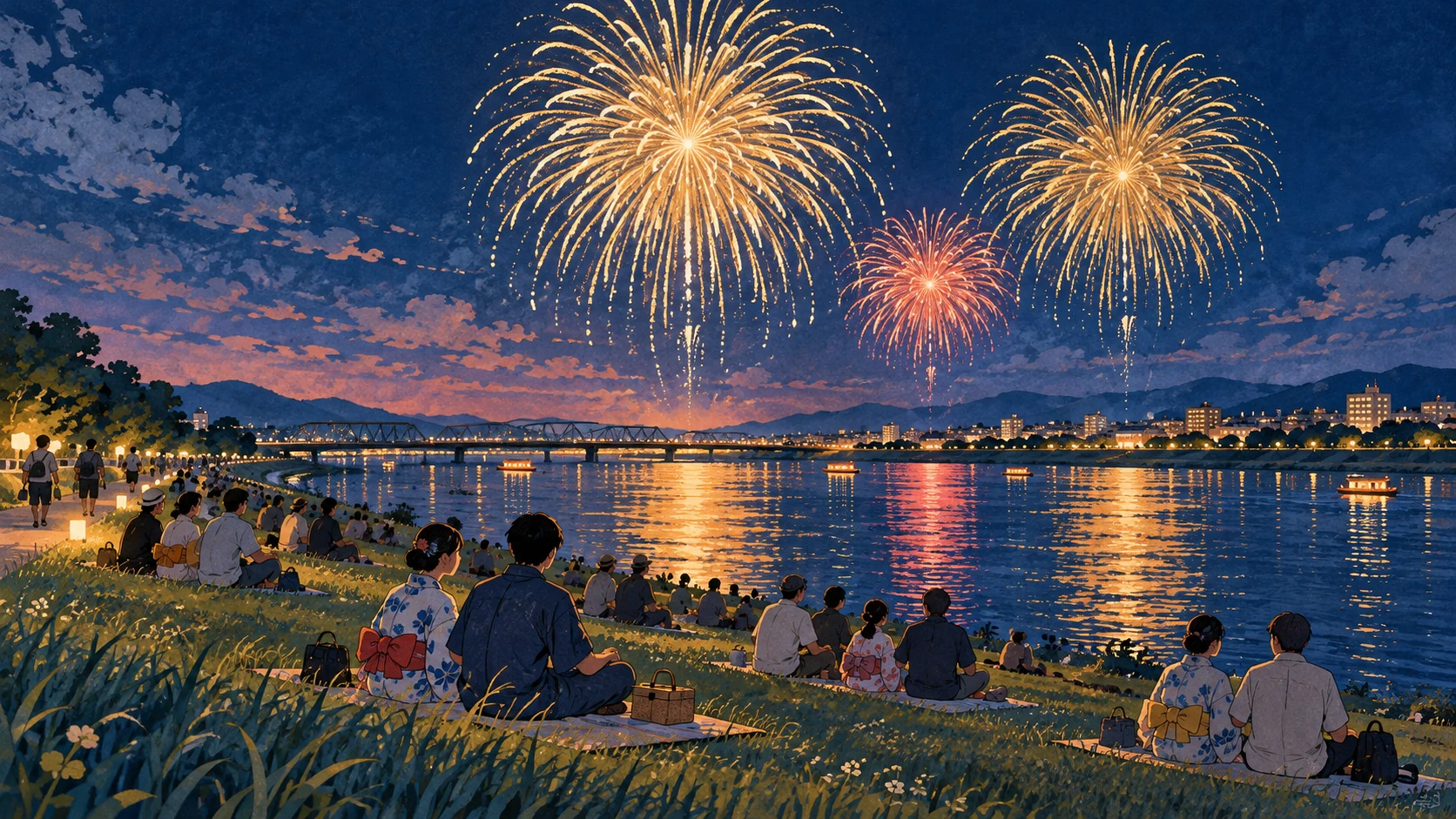
Compare the two Sumida River launch areas and five citizen-supporter seating sites. The completed 2026 edition explains capacities, child counts, convenience-store ticket collection, nonrefundable donations, one-way bridges, and routes out of Asakusa.
For competition fireworks, give the first area time for the individual works
The two launch areas have different programs. In 2026, the first hosted a competition among ten fireworks companies. TV Tokyo’s program for that edition listed the competition segment from 7:40 p.m., with entries launching in order from 7:42 p.m. and the segment ending at 8:04 p.m. Other displays followed, with the finale from 8:24 p.m. If the pyrotechnicians’ works are your reason for traveling, choose the first area and protect that time for settled viewing, rather than comparing only shot totals.
Watch the shape after a shell opens, then how its colors change and when its points of light fade. Each work has a name, and the program helps identify the order. You do not need specialist terms to notice how each work lingers and ends in the same sky. Holding up a phone throughout can make you focus on the screen’s edges. Record a short part if you wish, then look up directly for the rest.
The second area launched several themed sequences from 7:30 to 8:30 p.m. in 2026. If your priority is sitting with companions for a summer evening and getting back easily, rather than a specific competition entry, compare chair seats on both banks of the southern stretch. Each area has its own program and perspective. Once you choose, keep your time there.
Published 2026 figures also differed by announcement stage. The April plan listed about 9,350 shots for the first area. The July program listed 9,507, including 157 character-themed shots. The second area listed 10,650. These were changes between announcements for the same edition. The launch area, seating type, and return direction remain more practical criteria for choosing a seat.
Two launch areas correspond to five citizen-supporter sites
Citizen support is a personal donation to the festival, with special viewing seats provided in return. In 2026, there was more than one generic “Sumida River ticket.” The two Taito-side sports grounds and Sumida Park’s Soyokaze Hiroba on the Sumida side viewed the first launch area. Kuramae Riverside Terrace on the Taito side and Ryogoku Riverside Terrace on the Sumida side viewed the second. The supporter event outline published by Taito City specifies each relationship. Read the site name, bank, and number of people together when booking.
The table retains the prices from the completed 2026 edition to compare different purchase units. Mat spaces were sold as one five-person unit; chair seats as one single-person unit. Unused places were still included in the whole-unit price. A family of exactly five can calculate the mat’s cost per person easily. For two people, compare the actual full mat payment with two chair seats, rather than treating the five-person share as a two-person checkout price.
| Special site / launch area viewed | Seating and capacity | Donation / permitted application units |
|---|---|---|
| Taito Riverside Sports Center baseball ground / first launch area, Taito bank | Mat, 5 people | ¥25,000; 1, 2, or 4 units |
| Sports center youth baseball ground / first launch area, Taito bank | Mat, 5 people | ¥25,000; 1 unit only |
| Kuramae Riverside Terrace / second launch area, Taito bank | Chair, 1 person | ¥9,000; up to 4 units |
| Sumida Park Soyokaze Hiroba / first launch area, Sumida bank | Chair, 1 person | ¥8,000; up to 4 units |
| Ryogoku Riverside Terrace / second launch area, Sumida bank | Chair, 1 person | ¥8,000; up to 4 units |
Five-person mats: count people, floor-seating needs, and the full unit cost
The Taito-side Taito Riverside Sports Center baseball ground and youth baseball ground both served the first launch area but were separate invitation sites. The official location map placed the baseball ground north of Sakurabashi and the youth ground near its south side. A shared sports-center address does not make the other ground your entrance. Match the complete site name on the ticket to the map and choose a meeting point in the same direction.
In 2026, one ¥25,000 unit produced five tickets, each with a ¥275 issuing fee: ¥26,375 total. Split five ways, that was ¥5,275 per person. Four people still paid ¥26,375. Two units produced ten tickets and four units twenty, with both donations and issuing fees multiplied accordingly. The baseball ground allowed one, two, or four units; the youth ground allowed only one. This arrangement suits a settled group of friends or relatives, with one person coordinating numbers and payment before distributing the paper tickets.
The organizer’s FAQ described a five-person mat as about 1.8 by 1.8 meters, or approximately 3.3 square meters. Seat cushions were allowed; chairs and tables were not. These spaces are easier for people who can sit down on the ground and stand up again. Anyone needing a backrest or unable to bend their knees comfortably should compare chair seats directly. The five places also have to accommodate personal belongings. Keep backpacks within your own area and leave large luggage at your accommodation to preserve space around your feet.
Chair seats by bank: Soyokaze in the north, Kuramae and Ryogoku in the south
For a chair facing the first launch area, consider Sumida Park Soyokaze Hiroba on the Sumida side. In 2026, one single-person unit cost ¥8,000, with a maximum of four units. Including issuance, that was ¥8,275 per person. It is across the river from the Taito sports grounds. Keeping daytime activities and the return journey on the Sumida side aligns your departure point, meal, and entrance. For someone who wants the first area and needs a chair, that distinction matters more than comparing nearby bridges first.
Chair seating for the second launch area was split between Kuramae Riverside Terrace and Ryogoku Riverside Terrace. Including issuance, Kuramae cost ¥9,275 per person and Ryogoku ¥8,275, a ¥2,000 difference for two. If your accommodation and return route are on the Taito side, saving ¥1,000 each may not justify crossing and doubling back. If you already need a Sumida-side station, Ryogoku follows your existing departure direction.
The riverside terraces on the map are specific stretches connected to street level through entrances. Treat a chair site as a defined venue rather than going to the river to look for chairs. Find the ticket’s meeting and admission instructions, approach the entrance from the neighborhood, then enter the terrace. For mobility needs, ask about steps, ramps, and companion arrangements at that specific entrance so the chosen chair connects to a usable route.
From application to collection: turn each unit into a paper ticket for every person
The 2026 citizen-supporter application rules used first-come, first-served online applications through Ticket Pay from noon on May 10. Membership registration was required before applying. After application, tickets were issued at FamilyMart or 7-Eleven. Two five-person units produced ten tickets. The transaction unit was a donation unit; admission used individual tickets. The group coordinator needed to connect those two stages.
Before booking, write down everyone’s age, seat type, site, and total ticket count. Have the coordinator place the order. After payment, retain the application number and collection instructions, collect every ticket at the specified convenience store, and check the date and site on each. Give companions both their paper tickets and entry information. If someone arrives in Japan later, agree on a handover point so the only stack of tickets is not with someone still absent from the venue.
The rules invalidated multiple applications by the same person. All seating was assigned, and applicants could not select seats. Coordinate the group within the permitted number of units in one application. International travelers should schedule convenience-store collection after arriving in Japan and before fireworks day. If a member can no longer attend, the organizer’s FAQ prohibited auction listings and paid transfers such as resale for profit. Violations could lead to refused admission.
Children count from age one, and the applicant counts too
The 2026 rules counted children aged one or over on event day as one person. The invited headcount included the applicant. Two adults and three children aged at least one made five. Three adults and three children made six and did not fit a five-person unit. Work this out before choosing units; whether a child is willing to sit on an adult’s lap does not change it. Count preschool children by their actual birthdays rather than importing another attraction’s free-child age limit.
A mat does not suit every family. If children often need to get up, consider the surrounding aisles and other spectators. If an older relative needs a chair, the whole group can choose chairs: Soyokaze Hiroba for the first area, or Kuramae or Ryogoku Riverside Terrace for the second. Families with differing needs can also choose separate sites and eat together before entry. Separate viewing arrangements can be more comfortable than making everyone use unsuitable seating simply to stay in one area.
The organizer’s FAQ said seats from separate applications were assigned randomly by the system. Friends who order separately should not depend on on-site swapping to sit together. Put shared activities before entry. Once everyone has a ticket and knows their assigned area, they can enter separately even if queues divide them. Choose an identifiable corner or lawful space outside a shop, a little away from entrance crowds, for a meeting point. Leave the entrance itself clear for ticket checks.
Supporter sites opened at 4 or 4:30 p.m.; traffic controls began at 6 p.m.
The 2026 supporter outline gave a 4 p.m. opening for the three Taito-side sites and 4:30 p.m. for Soyokaze Hiroba and Ryogoku Riverside Terrace on the Sumida side. The organizer planned for entry before traffic controls began at 6 p.m. Use the afternoon to collect tickets, eat, use a restroom, and identify the entrance. Then settle in as daylight fades instead of treating the 7 p.m. launch as the time to reach the riverbank.
The official FAQ allowed entry after 6 p.m. and re-entry under staff instructions, but late arrivals still needed a route to their own entrance. If companions ate on the Taito side while their tickets were for the Sumida side, one-way bridge controls after 6 p.m. could require a detour. The simplest arrangement is a final meal on the ticketed bank, followed by a direct street route to entry.
The 2026 FAQ listed credit card or PayPay payment. Places were secured once application and payment were complete, and cancellation was not allowed after payment. No new supporter applications were accepted on event day. Before paying, check the date, site, and number of units. Save the application number afterward and collect the right ticket count using the instructions. If payment is incomplete, inspect order status and the ticket system’s message before acting, to avoid invalidating the application through a duplicate submission by the same person.
Five bridges ran one-way; Sakurabashi had a separate closure period
Taito City’s 2026 bulletin on traffic controls listed bridge directions from about 6 to 9:30 p.m. Kototoibashi, Komagatabashi, and Kuramaebashi carried pedestrians from Sumida to Taito. Azumabashi and Umayabashi carried them from Taito to Sumida. These alternating directions meant an entrance visible just across the river still required a bridge going the right way, followed by streets on that bank back to the entrance.
For example, a traveler going from Taito to Sumida could not simply join the Kototoibashi approach because it was close to the first launch area. Use a crossing permitted in your direction to reach the east bank. Conversely, a traveler going from Sumida to Kuramae Riverside Terrace needed to recognize that Umayabashi ran the opposite way. A navigation line may cross a bridge, but actual access follows traffic controls and police instructions.
Sakurabashi was closed from about 1 to 9:30 p.m. in 2026, so it was not a shortcut across the northern stretch after the display. Red no-entry areas beside the river differed from blue vehicle-control areas. Pedestrians could move through blue areas under instructions, while a red area remained closed even when no cars were present. Identify the colors first, then the arrows.
Bridge crossings could also be released intermittently. Before crossing as a family, put cameras away and keep tickets and phones accessible. Adults should guide children. If you need to stop to adjust clothing, first reach a permitted place where you will not block the route. Let passage take priority over photography; wait until you are clear of the bridgehead for city night photos.
First launch area, Taito bank: use the exact ground name to find the northern entrance
With baseball-ground or youth-ground tickets, plan daytime activities on the Taito side and gradually move toward Imado and the sports center. If you visit Senso-ji in the morning, finish worship and lunch, then reduce extra stops so the afternoon remains available for entry. Riverside paths used on ordinary Asakusa walks have closures on fireworks day. Heading north, use streets and ticket-site directions instead of testing every path with a water view.
The official invitation-seat map puts the two grounds in different locations near Sakurabashi. Baseball-ground ticket holders should check which ticketed site they need before reaching the youth ground. Save the same entrance map on companions’ phones and zoom to the site name and nearby intersections. That is clearer than sharing a single sports-center search point. Map search helps identify buildings; ticket instructions and signs on site guide the final approach to the correct area.
Stay on the Taito side after the event and choose Iriya, Tsukuba Express Asakusa, or another officially suggested station. The benefit is avoiding a river crossing for your train; the cost is still a walk from the northern grounds to a suitable station. Choose shoes and a walking pace for that departure. Avoid accumulating shopping bags all day. Let slower companions walk fewer extra blocks in the afternoon, preserving energy for seating and the night departure.
First launch area, Sumida bank: distinguish Soyokaze Hiroba from the Skytree station choices
Soyokaze Hiroba is on the Sumida side, suited to approaches and departures around Honjo-azumabashi, Tokyo Skytree Station, or Oshiage. The organizer’s venue guide lists Asakusa, Oshiage, Tokyo Skytree, and Hikifune near the first launch area. Compare them as transport access points, then find a same-bank route to your ticketed site. A daytime meal near Skytree can lead toward the river without a last-minute crossing from Asakusa.
Treat Tokyo Skytree Station and Oshiage as separate train decisions. The former serves Tobu; the latter connects with the Hanzomon Line and other routes. Your hotel-bound line changes the useful entrance and walking direction. Write down the station nearest your accommodation first, then choose a departure station that reduces transfers. A slightly longer walk can then make sense as part of a more direct overall route.
There is no need to add an observation deck or a cross-river photo trip that evening. Walking from the seat to a station is already a substantial leg on fireworks day. Make small purchases before entry or shop the next day. Put the pre-entry meeting point and first direction after departure in the same note. You can follow it out of the venue instead of stopping at the exit to discuss the plan again.
Second launch area: Kuramae stays on Taito, Ryogoku stays on Sumida
For Kuramae Riverside Terrace, arrange your final meal around Kuramae before approaching the Taito-side entrance. The second area starts at 7:30 p.m., but the afternoon still needs entry time. Use the extra half hour to settle and organize water rather than adding a distant attraction. After leaving the terrace, follow that edition’s routing toward Asakusabashi or another Taito-side station, with no need to switch to the east bank.
For Ryogoku Riverside Terrace, save JR Ryogoku and Toei Oedo Line Ryogoku separately. Their station buildings and entrances are in different places. Use the JR station for accommodation along the JR Sobu Line, or study the subway entrance for the Oedo Line. The seating site runs along the river. Exit to the street first, then walk toward the station you need. Do not overlook the operator because navigation says only “Ryogoku.”
Friends with separate Kuramae and Ryogoku tickets can eat together on one bank earlier in the afternoon, then reach their respective banks before bridge controls begin. Returning to separate accommodation and meeting the next day is more practical than gathering in the middle of a bridge. If returning together is essential, choose the same bank and exit direction during ticket selection.
Without supporter seats, watch while walking; mats are prohibited on roads
The organizer’s 2026 homepage stated that there were no seated viewing places outside the citizen-supporter sites. General spectators watched while walking along roads open under pedestrian controls, following arrows and keeping bridges moving. Spreading mats, placing chairs, and reserving space on roads were prohibited. This is an option for a free taste of the fireworks, but everyone must accept standing and slowly moving. Do not plan it as a riverbank picnic.
Both northern and southern stretches have closed waterfront sections. A cherry-blossom photo spot, everyday jogging path, or terrace entrance may become a closed area or supporter site on fireworks day. Read intersection signs and police instructions on arrival and follow open roads. Keep walking when fireworks appear. Do not stop in a line at a bridgehead or squeeze past barriers toward the water.
This format suits adults who can walk independently and accept a shorter stay. If the aim is for the whole family to sit through the full display, prioritize supporter seats. If no suitable seats are available, retain a daytime Asakusa visit and make another evening plan. Matching expectations to the viewing method avoids pushing deeper into crowds in search of somewhere to sit.
After the show, clear the exit before heading to a suggested station
The official 2026 return-station map warned of severe crowding at Asakusa stations on the Ginza, Asakusa, and Tobu lines from about 8:30 to 11 p.m. On the Sumida side it suggested Honjo-azumabashi, Tokyo Skytree, Oshiage, and Ryogoku. On the Taito side it suggested Iriya, Tsukuba Express Asakusa, Asakusabashi, and Ueno. Read the map by bank to avoid doubling back to Asakusa merely because the name is familiar.
Tsukuba Express Asakusa is in a different location from the riverside Ginza, Toei Asakusa, and Tobu Asakusa stations. If returning on Tsukuba Express, write the full line name and include “つくばエクスプレス” in map searches. For the Ginza Line, identify its station. Saying only “meet at Asakusa Station” can send friends to different places that night.
For Iriya or Ueno from the Taito side, compare the train route back with the walking distance. Do the same for Oshiage or Ryogoku from the Sumida side. Save one main station and one alternative on the same bank. After the show, follow police guidance to an available entrance instead of recalculating the whole family’s route outside a station.
If you delay taking a train, first clear the venue exit and bridgeheads, then eat or rest in a business that is still open and can admit you. The supporter outline required orderly departure after the fireworks. “Take a later train” did not mean retaining your seat while waiting for crowds to thin. Check late-night opening hours and the final route back too; resting does not remove the last leg.
Road closures affect buses and taxis: do not depend on one street for both directions
The Tokyo Metropolitan Bureau of Transportation’s 2026 bus-change notice listed split operations, shortened routes, and suspensions on several services, including To 42 (東42), Jo 23 (上23), and Kusa 24 (草24). Buses normally stopping near Asakusa Kaminarimon or the river might not use those stops on fireworks evening. Check event-day stops before arriving by bus, and base your departure on the walking route to your chosen railway station.
Driving and on-demand taxis face the controlled area too. The 2026 event had no dedicated parking, and the supporter outline did not accept entry by car or bicycle. Leaving luggage at the hotel, taking a train to a same-bank station, and walking to the entrance is a simpler route. For a pickup, choose a place where stopping is lawful and road closures do not prevent access, then confirm the walk between that point and the venue is manageable.
The extra-train notice for the 2026 Sumida River event focused on the Toei Asakusa Line: eight extra trains, plus seven Airport Kaitoku trains bound for Narita Airport. Those seven departed Sengakuji between 2:42 and 6:42 p.m. and made every stop between Sengakuji and Oshiage. The Oedo Line kept its ordinary Saturday and holiday timetable. If using Kuramae or Ryogoku, identify your line so you do not mistake Asakusa Line extras for Oedo Line extras. Departure still involves entering stations with the crowd. Schedule a fixed Shinkansen or airport-bus trip for the next day, leaving fireworks night for the journey within Tokyo.
Arrange food, restrooms, and mobility needs for the site you actually choose
In 2026, supporter sites allowed ordinary personal baggage and reasonable amounts of food and drink. Each had general, women-only, and wheelchair-accessible restrooms. Those facilities supported the afternoon wait, but your needs still had to connect to the correct entrance. For step-free travel, ask about continuous access between the ticketed area and street. If someone needs help sitting or standing, select a suitable seat type and arrange a companion.
Eat your main meal before entry. Carry small, easy-to-handle food portions and water, take trash away in a bag, and keep belongings within your seat area. The viewing rules warned that the launch waters were close to spectators and fireworks debris could fall. Towels and glasses could provide protection; injuries should be taken to a nearby first-aid station. During the afternoon wait, replenish water and salt and take breaks. Keep protective items within reach and leave aisles clear around both chairs and mats.
General walking spectators can use a restroom at their arrival station before entering dense crowds. The organizer publishes a restroom map. Check the bank and controlled area along with the location so a cross-river toilet trip does not send you along a one-way detour. With small children, handle food, changes of clothes, and rest needs together. If a child is frightened by the noise or already tired, follow staff directions out of the crowd and end the evening somewhere you can look after each other.
Rain, cancellation, and no refunds: assess the full evening’s cost before paying
The 2026 plan canceled the event in severe weather and other specified circumstances, with no postponement date. The decision was generally due at 8 a.m. on event day. The homepage could still update if weather changed suddenly. Read the official notice before departure and follow on-site guidance after entry. Pack small rain items that let you use your hands, and keep your attention on people ahead when crossing bridges or entrances.
The 2026 application rules made supporter donations and handling fees nonrefundable, including if the event was canceled. One five-person unit meant assessing the full ¥26,375 as a cost you could accept. Two ¥8,000 chair seats totaled ¥16,550 including issuance, also assessed in full. This donation condition was known before payment. Travelers who changed their plans and did not attend also could not recover it.
Accommodation, transport, and restaurant reservations have their own cancellation deadlines. If fireworks are an addition to your trip, retain a workable daytime Tokyo plan so you can stay around your accommodation area if the show is canceled. If traveling specifically for it, compare accommodation on the surrounding nights and departure transport together. Avoid adding several inflexible bookings for one evening. Pay once you accept the combined cost, so you can focus on enjoying the night.
Choose accommodation around a same-bank return and save more sightseeing for tomorrow
When choosing accommodation, put the supporter-site exit, suggested station, and hotel entrance on one map. Taito-side ticket holders can compare Asakusa, Ueno, or accommodation along their return line. Sumida-side ticket holders can compare Oshiage, Ryogoku, or another convenient base. If you already have a continuous Tokyo stay, first see whether a same-bank station gives a practical route to your existing hotel before deciding to move. Avoiding one luggage transfer often removes a task from fireworks afternoon.
“Walk back to the hotel” still depends on the actual bank and streets. A hotel across the river may require a detour to a bridge open in your direction even if its windows face the water. A hotel on the same bank still needs an open street route out of the controlled area. Before booking, check the address and night entrance, confirm late-return arrangements with the property, and save the route in an offline note.
The next day can hold an eastern Tokyo half-day without ticket pressure. If you stayed on the Taito side, finish the Asakusa streets you wanted to explore. On the Sumida side, have a slow breakfast before looking around nearby. For long-distance travel, collect luggage and eat before leaving. Separating the late departure from an early long journey lets this urban fireworks evening fit into an existing Tokyo trip without keeping the family rushing the next morning.
A few useful answers
When is the 2027 Sumida River Fireworks Festival?
The 49th edition took place on July 25, 2026. The next date awaits a new organizer announcement. You can first choose an accommodation area by your preferred launch area and bank.
Does a one-year-old count within a five-person space?
The 2026 rules counted anyone aged one or over on event day as one person. The applicant was included too. Two adults and three children aged at least one totaled five.
Without supporter seats, can I sit on a mat in the road?
Mats, chairs, and seated viewing on roads were prohibited. General spectators watched while walking along open roads and arrows, keeping bridges clear. Citizen-supporter sites provided assigned seating.
Are supporter donations refunded if the festival is canceled?
The 2026 application rules made donations and fees nonrefundable, including cancellation of the festival. Accommodation and transport follow their own booking terms.
Must I return through Asakusa Station?
The official 2026 departure map suggested surrounding stations by bank. Sumida-side options included Honjo-azumabashi, Tokyo Skytree, Oshiage, and Ryogoku; Taito-side options included Iriya, Tsukuba Express Asakusa, Asakusabashi, and Ueno.
Official information and references
Sources used in this guide.
- Sumida River Fireworks Festival: 2026 conclusion and citizen-supporter notices
- Sumida River Fireworks Festival: event plan outline
- 2026 citizen-supporter application rules: capacities, ticket issuance, and fees
- Taito City: 2026 supporter event outline and site facilities
- Taito City bulletin, April 20, 2026: prices for five supporter sites
- Taito City bulletin, July 5, 2026: program and one-way bridge controls
- Sumida River Fireworks Festival: venue, restroom, and departure maps
- Sumida River Fireworks Festival: 2026 return-station map
- Sumida River Fireworks Festival: FAQ
- Sumida River Fireworks Festival: viewing rules
- Tokyo Metropolitan Bureau of Transportation: bus changes on 2026 Sumida fireworks day
- Tokyo Metropolitan Bureau of Transportation: extra trains for 2026 fireworks
- TV Tokyo: 2026 programs for both launch areas
- Taito City: event plan announced April 7, 2026