Use one Nagahama base for Chikubushima’s Karamon Gate, Kannon Hall and Funa Corridor, then real festival floats, children’s kabuki stages and Kurokabe’s former bank. Includes port return times, separate fees, steps and a town itinerary.
- Region & Focus
- Nagahama and Chikubu Island
- Reading Scope
- 27 min read · 15 chapters · 4 Q&As
- Official Verification
- 21 official sources checkedUpdated November 22, 2026
Chapter Route Map (tap any stop)
- Use Nagahama Station as your base for one lakeside day and one old-town day
- Leave Nagahama Port at 10:15 and return there at 12:55
- Separate the boat fare, island admission and treasure hall
- Decide whether 165 steps are possible before choosing how far to climb
- Karamon: read the curves, black lacquer and painted carvings
- The vivid colors and conservation completed in 2020
- Kannon Hall: understand the hillside structure from second-floor height
- Funa Corridor: look up at its two roof heights before reaching the shrine
- Tsukubusuma Shrine: the main-hall exterior and lake-facing dragon-god platform
- Back in town, identify the float’s stage, dressing room and upper pavilion
- Juzan and Hoozan: from front-column metalwork to rear textiles
- Forty minutes on four and a half mats: see the float at a child actor’s scale
- Handle museum tickets, rest and pace in the morning
- Kurokabe Glass House was a bank: black walls and a history of reuse
- Look closely at one kind of glass, then leave the afternoon for the streets
- Quick Q&A
The 10:15 boat from Nagahama Port reaches Chikubushima 35 minutes later, leaving 90 minutes for island temples and shrines before returning to Nagahama for lunch. Save day two for the Hikiyama Museum and Kurokabe streets. The focus shifts from Karamon’s painted carvings and a hillside Kannon Hall to children’s kabuki stages and a former bank. Island worship involves 165 steps. Decide whether you can climb them before buying boat tickets. Staying at one Nagahama base also preserves a town day if boats stop running.
Use Nagahama Station as your base for one lakeside day and one old-town day
Nagahama Port is about 10 minutes on foot from Nagahama Station, at 4-17 Minatocho, Nagahama, Shiga. The Hikiyama Museum gives about seven minutes from the station. This makes a car-free two-day trip easy from one base: combine the lake crossing and stair climbing on day one, then visit the museum and Kurokabe on day two. Leave large luggage at your accommodation where possible and carry only what you need for the island and streets. Nagahama Port access Museum’s current float display
You can also walk between the port and old town. The boat company gives about 15 minutes from Nagahama Port to Kurokabe Glass House and 18 minutes to the Hikiyama Museum. These are movement estimates; add time for meals, shops and building photographs. Choose accommodation near the station or streets according to your main activity. This trip needs neither a second-day luggage move nor a return port on Lake Biwa’s western shore. Nagahama Port access
The example below visits the island on Thursday, November 5, 2026 and town on Friday, November 6. November 5 uses the Nagahama route’s weekday timetable, and day two avoids the museum’s Monday closure. Arrive the previous evening or early enough on day one to reach the port comfortably for the 10:15 boat. Do not schedule train arrival at the same moment as boat departure. The days can be swapped after matching the museum’s opening day. Nagahama route timetable and fares Museum’s current float display
Use one Nagahama base for Chikubushima’s Karamon Gate, Kannon Hall and Funa Corridor, then real festival floats, children’s kabuki stages and Kurokabe’s former bank. Includes port return times, separate fees, steps and a town itinerary.
Leave Nagahama Port at 10:15 and return there at 12:55
The Nagahama route takes 35 minutes each way. This example leaves Nagahama Port at 10:15, reaches Chikubushima at 10:50, allows 90 minutes ashore, leaves at 12:20 and returns at 12:55. Outbound and return sailings are paired in one itinerary. Select a round trip on the Nagahama route when buying. The company’s separate Lake Biwa crossing route goes to the opposite shore. With luggage and accommodation in Nagahama, a return to the original port is simplest. Nagahama route timetable and fares
The 90 minutes includes disembarking, paying island admission, climbing stone steps, worship and returning to the pier. Focus architectural viewing on Karamon Gate, Kannon Hall and Funa Corridor, then the shrine exterior and dragon-god worship platform. Include the main temple hall along the route and choose the treasure hall according to your pace. To read slowly at every building and enter the treasure hall, ask the port counter about returning on the next boat when purchasing. The company allows same-day transfer arrangements at the counter. Set this up before going ashore. Nagahama route timetable and fares Boat company passenger FAQ
November’s weekday timetable also has departures at 08:50, 11:40, 13:05 and 14:30. The final pair allows 85 minutes ashore and does not operate on specified dates. Its suspension from November 24 to December 6, 2026 particularly affects late arrivals. The winter timetable, December 7–25 and January 4–March 5, 2027, reduces service to the 10:15 and 13:05 pairs. Do not carry autumn’s five departures into winter planning. The 10:15 pair used here keeps the same outward and return times in those winter periods. Nagahama route timetable and fares
Separate the boat fare, island admission and treasure hall
The boat company’s prices checked on October 29, 2026 were ¥3,800 return from Nagahama Port for junior-high-school age and above, and ¥1,900 for elementary-school children, tax included. Island worship admission is extra: ¥600 for junior-high-school age and above and ¥300 for children, paid in cash at the ticket office about 50 meters in front of Chikubushima Port. Budget ¥4,400 per adult for the crossing and ordinary island worship. The boat counter accepts transport IC cards and other methods, but prepare island cash separately. Nagahama route timetable and fares Boat company passenger FAQ
Hogonji’s treasure hall charges another ¥300 for adults and ¥250 for children. This adds treasure-hall entry and is included in neither the boat fare nor island admission. An adult using all three pays ¥4,700; the temple and shrine architecture and worship route alone totals ¥4,400. List the spaces you will actually enter when budgeting, rather than arriving with a boat ticket and expecting it to cover the treasure hall. Hogonji visitor information Nagahama route timetable and fares
For boat fares, each adult may bring one preschool child free; additional preschool children pay the elementary-school fare. Free children sit on an adult’s lap. If a young child needs a separate seat, tell the counter when reserving or buying a same-day ticket. Consider seats, island stairs and nursing needs together. Nagahama, Imazu and Chikubushima ports and the boats have no nursing rooms. Nagahama Port’s accessible toilet has a diaper-changing table, useful before boarding. Boat company passenger FAQ
Online reservations and online changes close at 15:00 the previous day, but individual cancellation charges begin earlier. Cancellation is free through the previous morning, costs 50% from 12:00 the previous day and 100% on the day. Record the online-change cutoff and free-cancellation deadline separately. For changes after 15:00, call Nagahama Port at 0749-62-3390. If weather changes the sailing, ask the port how to handle the original order before submitting a personal cancellation and rebooking. Boat company passenger FAQ
Nagahama Port stores luggage for ¥500 on request at the counter. If you arrive with a suitcase before your accommodation can hold it, use port storage and board lightly. Collect it after the return sailing, then walk toward the station or accommodation. Food and drink may be carried aboard, but keep your stair-climbing bag focused on water, rain gear and essentials. Leaving the suitcase ashore makes both movement and boarding easier. Boat company passenger FAQ Nagahama Port access
Decide whether 165 steps are possible before choosing how far to climb
The company’s accessibility information states that 165 stone steps lie above Chikubushima’s admission office, and wheelchair users cannot ascend for worship. Nagahama Port’s waiting-room building has no internal level changes and has an accessible toilet. That differs from island access. Anyone chiefly visiting Karamon, Kannon Hall and the shrine needs to manage the island stairs. For someone who needs a wheelchair throughout, make Nagahama’s town venues the main itinerary. Port and vessel accessibility
On regular Chikubushima vessels such as Benten and Rio Grande, passengers must temporarily leave their wheelchair for staff-assisted boarding and disembarking. There are level changes inside, and toilet use also involves standing. Explain your actual mobility needs to the port when reserving. If you can walk short distances but cannot climb the island steps, discuss a lake-view sailing-only visit with the port. Clarify this before buying rather than discovering the stair barrier at the admission office. Port and vessel accessibility Boat company passenger FAQ
Even if you can climb, save energy for descending. Keep the bag light, leave a hand free for support, stand securely before taking photographs and keep the passage clear. Wear shoes with good grip in rain. Adjust the 90-minute plan to your pace: prioritize worship and the three buildings, leaving extra exhibition rooms until later. If someone walks slowly, use the shorter plan together from the start. A rest should not become a reason for the group to rush afterward. Port and vessel accessibility Nagahama route timetable and fares
Karamon: read the curves, black lacquer and painted carvings
The “kara” in Hogonji’s Karamon refers to its curved karahafu gable. This National Treasure gate has a cypress-bark roof, black lacquer, gilded metal fittings and colored carvings. First stand far enough back to see the complete gate and roof curve. Then approach the doors and beam. Your view shifts naturally from the building’s outline to its surface craftsmanship. Temple guide to Karamon Gate Temple conservation record
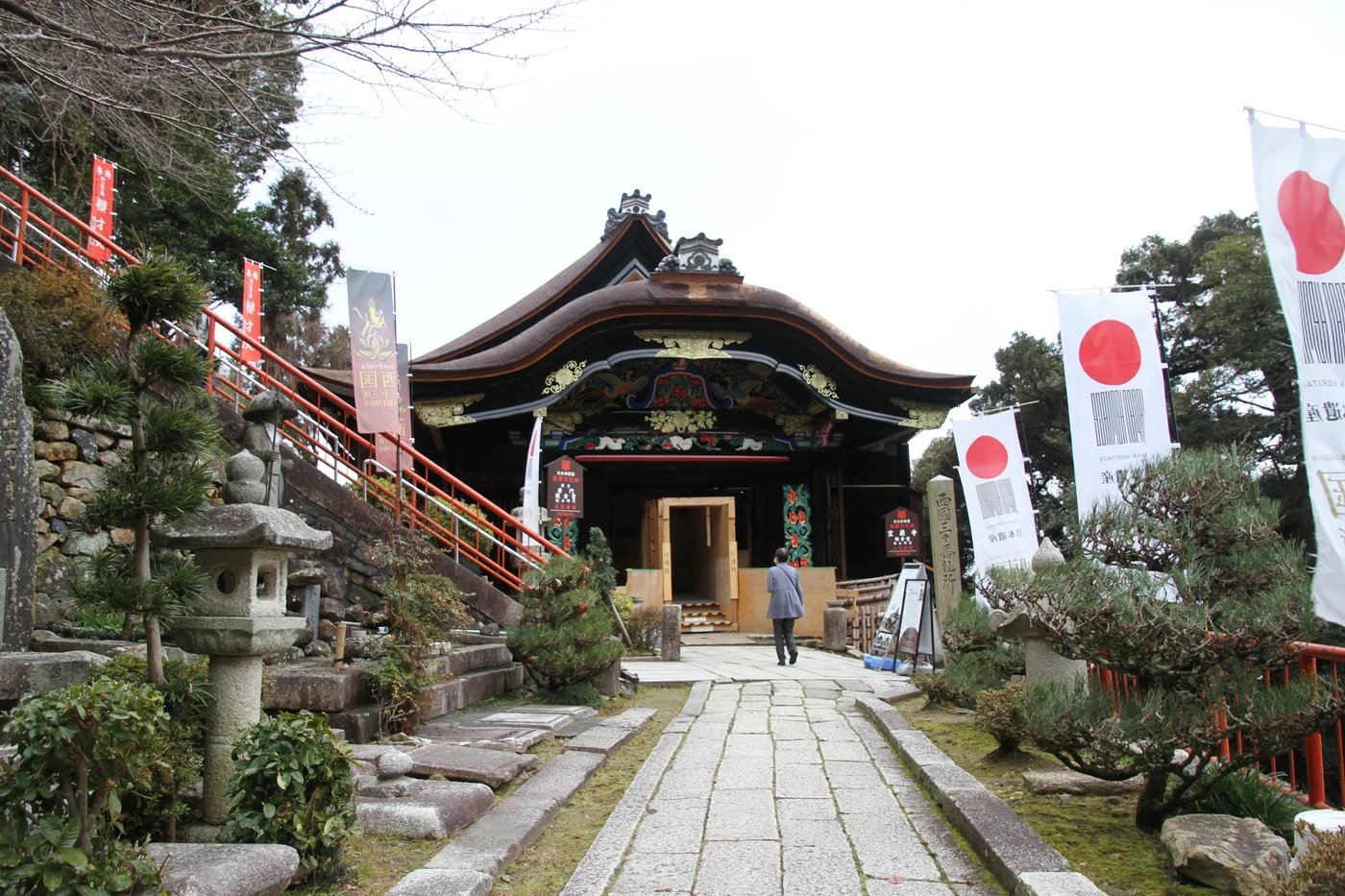
Around the bracket at the center of the curved beam, the temple identifies phoenixes, pine, rabbits and peonies. The two large paneled doors and adjoining wall surfaces have peony-scroll carvings. Follow one subject: peonies appear in branching door patterns, while animals and plants gather around beam components. This makes the placement of carving and its relationship to the structure clearer than fitting every gold and colored detail into one photograph. Temple guide to Karamon Gate
Karamon adjoins Kannon Hall partly because of the island terrain to which it was moved. The temple says it came from the Gokurakumon Gate of Toyokuni Mausoleum in Kyoto’s Higashiyama, under Toyotomi Hideyori’s order with Katagiri Katsumoto in charge. A ridge plaque dated 1603 anchors its establishment on the island. The hall behind shows how an existing building became part of a new worship space. The connection between gate and hall deserves as much attention as the gate itself. Temple guide to Karamon Gate Temple conservation record
For an earlier origin at Osaka Castle’s Gokurakubashi Bridge, the temple cites the Gien Jugo Nikki and Shunkyuki diaries to trace a route from Osaka Castle to Toyokuni Mausoleum and then Chikubushima. It also mentions an Osaka Castle folding screen discovered at Eggenberg Castle in Austria. Read this as the temple’s account of the building’s origins, then look at the Momoyama decoration on the island. Karamon, Kannon Hall and Funa Corridor together form a group shaped by relocation, reconnection and conservation. Temple guide to Karamon Gate Temple conservation record
The vivid colors and conservation completed in 2020
The temple’s conservation record says the overall repair of Karamon, Kannon Hall and Funa Corridor finished in March 2020, following a project begun in April 2013. Work covered full cypress-bark reroofing, lacquer, paint and metal fittings. Alongside the patterns, consider how these surfaces withstand sun and lake weather. Since the previous full repair, lacquer had cracked and flaked, colors had faded and roofing had decayed. Temple conservation record
The project did not replace every old surface uniformly. In Kannon Hall’s inner sanctuary and rear corridor, investigation found lacquer dating to the Keicho-period relocation. Existing lacquer was repaired with rubbed lacquer; surviving period paint was cleaned and treated against flaking. Where repainting was needed, remaining pigments and patterns were studied first. Conservation here includes both restoring an overall color scheme and retaining original surface layers. Temple conservation record
Cypress-bark roofing, black-lacquered timber and metal decoration require different maintenance. Repairable fittings were straightened; missing ones were recreated from similar neighboring patterns. Japanese lacquer was used for the final lacquerwork stage. View eaves, doors and decoration from the open visitor route. Temple conservation record
The temple’s spring promotional film, released in 2021.
Kannon Hall: understand the hillside structure from second-floor height
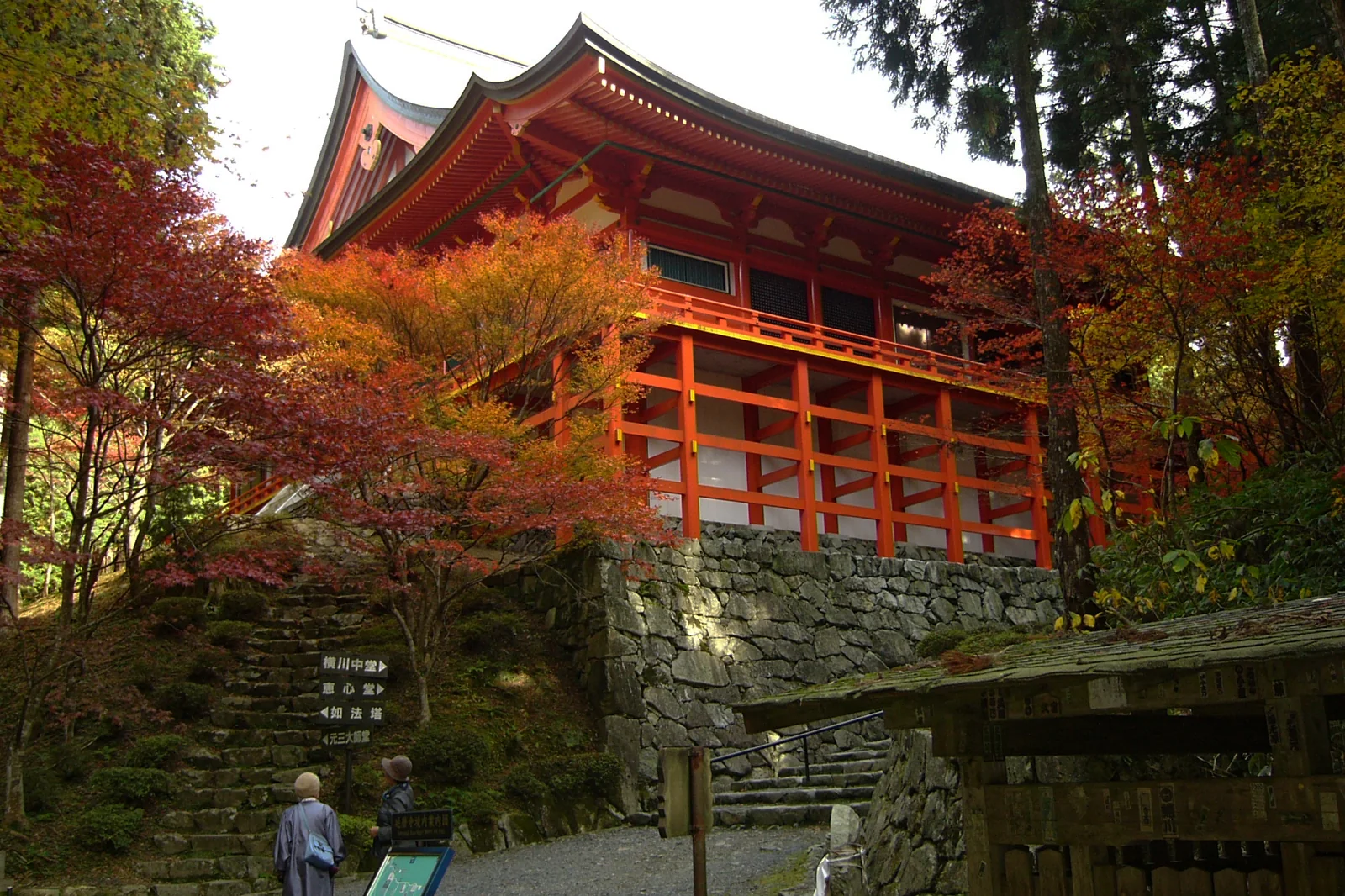
Kannon Hall uses the slope in what the temple calls a partial kakezukuri structure: long columns support the building from below. The worship room entered by visitors is at roughly second-floor height. Keep that vertical relationship in mind when looking at the hall and surrounding ground. It explains how the island stairs connect to the building. A route that seems level by the gate has supporting space underneath. Temple guide to Kannon Hall Temple conservation record
The conservation record describes a five-bay by four-bay hall with a hip-and-gable roof and cypress-bark covering. A veranda surrounds the center, with outer veranda columns extending to the eaves and windows around the perimeter. The southern bay forms the outer worship area; the north is the inner sanctuary housing the principal image. Without knowing timber-building terminology, understand two layers: columns below handle the terrain, and rooms above divide worship space from the principal image’s space. Follow the open route and do not enter the inner sanctuary. Temple conservation record
This is stop 30 on the Saigoku 33 Kannon pilgrimage. Kannon Hall’s principal image is the thousand-armed, thousand-eyed Kannon. The temple describes it as a hidden image inside an altar cabinet. On an ordinary visit, the standing image in front and the cabinet exterior explain that arrangement. Chrysanthemum crests appear on both sides of the doors, with a five-and-seven paulownia crest behind the front image. These specific marks give a clearer understanding than expecting direct sight of the principal image simply by entering the hall. Temple guide to Kannon Hall
The main hall enshrines Dai-Benzaiten, while Kannon Hall enshrines Senju Kannon. Each has its own place within the temple. The main-hall guide also distinguishes the front image from the hidden principal image and introduces Kanpo Arai’s murals of heavenly deities and flying celestial figures. Read the hall name first, then the relationship between images and principal deity. If collecting pilgrimage inscriptions, include worship and time at the inscription office within your island stay rather than counting only building photo stops. Temple guide to the main hall Temple guide to Kannon Hall Hogonji visitor information
Funa Corridor: look up at its two roof heights before reaching the shrine
Funa Corridor links Kannon Hall to Tsukubusuma Shrine. It is a roofed passage one bay wide. The conservation record divides it into an eight-bay low-roof section and a two-bay high-roof section, both with gabled, cypress-bark roofs. Inside, shift your gaze from the far exit to the changing roof height, then examine the lattice windows between the side columns. Temple conservation record Temple guide to Funa Corridor
Exposed rafters form a finished roof underside rising with the roof slope. Rafters, columns and lattice windows divide the long space into repeated bays. Compared with Karamon’s concentrated gilding and colored carving, this is a place to see timber connections continuing along a route. Moving beside the windows reveals how light enters from the side and how the passage combines circulation, rain shelter and a connection between hillside buildings. Temple conservation record
The temple explains the name and material history through a tradition that it was built using turret materials from Toyotomi Hideyoshi’s state vessel, Nihonmaru. First identify the roof, columns, windows and connected ends, then read the vessel story alongside the passage in front of you. Temple conservation record Temple guide to Funa Corridor
Tsukubusuma Shrine: the main-hall exterior and lake-facing dragon-god platform
Beyond the corridor described by the temple is Tsukubusuma Shrine, also called Chikubushima Shrine. The temple and shrine have separate buildings, explanations and worship places. Distinguish the shrine’s National Treasure main sanctuary from Hogonji’s main hall. The shrine’s building page currently states that inner-sanctuary visits are suspended. Worship outside the main sanctuary, then view the lake from the dragon-god platform. Use official explanations to learn about the interior ceiling paintings and maki-e decoration. Temple guide to Funa Corridor Shrine buildings and visitor access
The shrine describes its main sanctuary as a building moved from Fushimi Momoyama Castle’s imperial-envoy hall and introduces its Momoyama decoration. As at Karamon, relocation provides a way to understand the island group, but the buildings have different roles: a temple entrance and a shrine sanctuary. Compare the sizes of gate, hall and corridor from outside after worship. Paths and changes of level join the island’s cultural properties into one continuous route. Shrine buildings and visitor access Temple conservation record
The dragon-god worship platform projects toward Lake Biwa. Here, kawarake-nage involves writing a wish on an earthenware dish and throwing it toward Miyazaki Torii over the lake. The shrine associates a throw through the gate with fulfillment of the wish, as a worship custom. Obtain dishes according to that day’s guidance and wait until the space ahead is clear. Adults should accompany children. Without throwing, this is still a stop for viewing the island shore and lake. Shrine buildings and visitor access
Island worship also depends on safety management. A shrine notice dated June 23, 2026 says it may close before a typhoon approaches and suspend goshuin and amulet distribution. The boat company says strong winds or poor weather may alter sailings, port calls or the ability to dock. If boats stop on your departure day, retain the Nagahama town day and visit the Hikiyama Museum and Kurokabe first. Do not switch ports at short notice to chase another company’s boat simply to make up an island visit. Shrine safety notices Nagahama route timetable and fares
Back in town, identify the float’s stage, dressing room and upper pavilion
Start day two at the Hikiyama Museum. Nagahama retains 13 floats owned by their neighborhood groups. Naginatayama carries a decorative sword; the other 12 have children’s kabuki stages at the front. The curtained space behind the stage is the dressing room. The upper pavilion houses shagiri music with flutes and drums, while the lower structure supports the whole float. Identify these uses before examining carvings and fittings so the object has a clear working arrangement. Museum guide to float structure and decoration
The four-and-a-half-tatami front stage is the best starting point for understanding scale. It holds child actors, with waiting and accompaniment space behind and festival musicians above. These functions overlap within one moving building. The museum gives float dimensions of about 6–9 meters high, 3–3.5 meters wide and 4.5–6.2 tonnes. Stand back to see the whole float before approaching the front columns. This makes proportions clearer than starting with close-up decoration photographs. Museum guide to float structure and decoration
The museum houses the four actual floats due to appear in the following year’s festival, normally displaying two in rotation. The announced display from October 27, 2026 to January 17 the following year is Juzan and Hoozan. For the November 6 example, use those two as your main viewing subjects. Learn about the others through the museum’s 13-float guide. The city’s 13 surviving floats are not all on view in one room that day. Museum’s current float display
Juzan and Hoozan: from front-column metalwork to rear textiles
Juzan belongs to the Otemachi group. Its body was made in 1782 by Toshimitsu Fujioka Izumi. Pause at the stage’s front-column fittings of ascending and descending dragons, clouds and figures, made by Ransuido Ittoku. The museum records 13 years of work on the paired dragons. Find the columns first, then the dragons’ directions and nearby figures. This places metalwork on either side of the stage rather than treating every gold surface as the same pattern. Museum guide to float structure and decoration Museum’s current float display
Juzan’s upper pavilion has a yatsumune roof form, and its dressing-room sliding doors have dragon paintings by Kyuma Nakatani. The museum also lists a fully embroidered Suzhou-made body curtain depicting the Seven Sages of the Bamboo Grove and several rear curtains. Separate roof form, woodwork, metal fittings, painting and textiles as you read. One float combines many craftspeople’s work. Use current display labels to identify the curtain and materials actually mounted, then consult catalogs for other holdings. Museum guide to float structure and decoration
Hoozan belongs to the Iwaicho group and was made in 1829. A carved wooden phoenix stands on its pavilion, whose four-column roof has a convex mukuri curve. To compare it with Juzan, begin with the phoenix, then the roof and columns; the upper halves already become distinct. The stage has a painted coffered ceiling, while its roof carries Kanji Okumura’s inlaid metal fitting “Cranes Nesting.” Follow the subject from overall form back into detail. Museum guide to float structure and decoration Museum’s current float display
The museum’s Hoozan guide also lists a Persian-carpet body curtain and a 16th-century Belgian tapestry rear curtain, the latter an Important Cultural Property. These textiles connect Nagahama’s festival with overseas crafts. Alongside patterns, read material, origin and production-date labels. Upstairs, ceramic-panel displays reproduce the rear curtains of 12 floats for comparison. Distinguish actual textiles, ceramic panels and explanatory images before examining them. Museum guide to float structure and decoration Museum visitor facilities
Forty minutes on four and a half mats: see the float at a child actor’s scale
Nagahama’s kodomo kyogen is performed by boys of roughly five to 12 from the float groups, playing both male and female roles. Plays are adapted to the four-and-a-half-mat stage and children, with a different title each year. The museum gives about 40 minutes per performance. Behind the small stage are separate acting, narration, shamisen and festival-music roles. These explain why the float needs a stage, dressing room and upper pavilion together. Museum guide to children’s kabuki Museum guide to float structure and decoration
The museum records about three weeks of rehearsal from spring vacation in late March: reading practice, standing rehearsals and finally combined rehearsals with shamisen and narrator. Before the festival, public Senkoban rehearsals are timed. Families can engage more readily with this process than with memorizing festival rankings. Imagine turning, acting opposite someone and waiting in limited space, then look at the rear dressing room to connect front-stage and backstage work. Museum guide to children’s kabuki
A full-size stage model lets visitors remove their shoes and stand at the height and within the area used by child actors. Look at its width and depth, then return to the real floats. Four and a half mats becomes a physical size rather than a number. This is a reason to give the museum time on the town day: children understand the stage through their bodies, and adults see why decoration develops around the front performance space. Museum visitor facilities
The upstairs video room continuously screens children’s kabuki from the April 15 main festival day. On an ordinary museum visit, see the floats and model, then sit for part of a film to connect movements with the space you just saw. Live festival performances have their own dates and arrangements. A November visit consists of displays, the model and museum films. Craft enthusiasts can also view the restoration workshop through an upstairs window. When work is underway, observe how lacquer and metalwork return to floats still in use. Museum visitor facilities
Handle museum tickets, rest and pace in the morning
The Hikiyama Museum opens 09:00–17:00, with last admission at 16:30. It closes Mondays, or the next weekday when Monday is a public holiday or holiday, and December 29–January 3. The address is 14-8 Motohamacho. Arriving around 09:30, allow a suggested 90 minutes, longer for detailed reading and films. Walk to Kurokabe for lunch after 11:00 rather than squeezing the museum in before its afternoon closing. Museum’s current float display
Ordinary admission is ¥600 for adults, ¥300 for elementary- and junior-high-school students and free for preschool children. Unlike the boat fare, which treats junior-high-school students as adults, the museum includes them in the schoolchild category. Buy each venue’s appropriate category for a junior-high-school child rather than applying “half-price child” to the whole trip. The museum also lists free admission for elementary- and junior-high-school students from Nagahama and Maibara and reductions with specified documentation. Ordinary visitor budgets can start with standard individual tickets. Museum prices and school-age categories Nagahama route timetable and fares
The museum has an elevator, accessible toilets, two wheelchairs and a nursing room. Its first-floor Hikiyama Culture Gallery provides tables, chairs, reference shelves and rest space. Compared with the island stairs, this day can move more slowly, with time to sit and read before continuing. If a companion cannot climb the island, retaining this shared morning gives everyone substantial cultural content, followed by crafts, films or streets according to interest. Museum visitor facilities
Kurokabe Glass House was a bank: black walls and a history of reuse
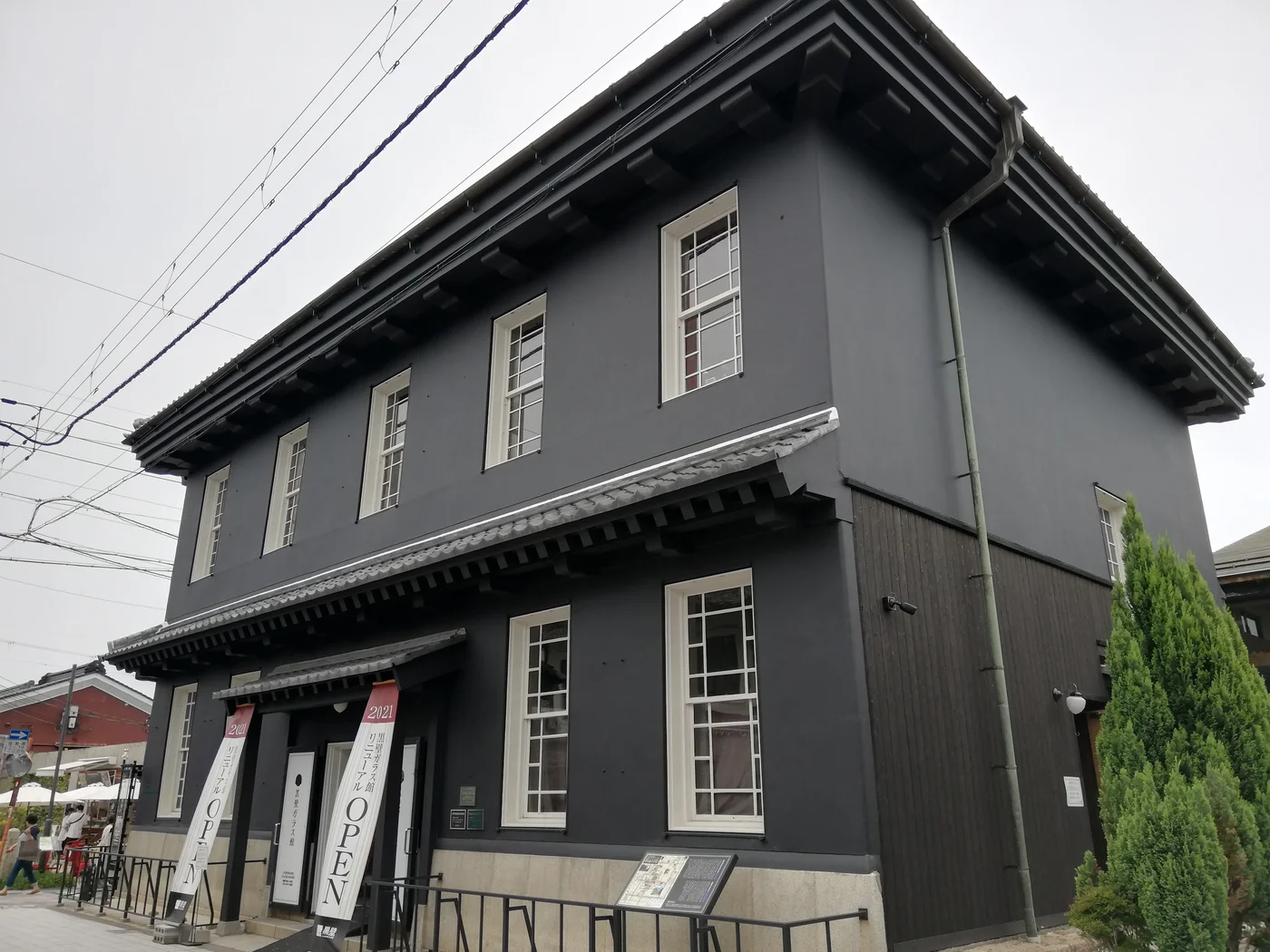
Kurokabe Glass House stands at 12-38 Motohamacho. Official hours are 10:00–17:00, with no fixed weekly closure. It is Kurokabe Building No. 1 and a main landmark for Kurokabe Square in the old Hokkoku Kaido streets. Shops, workshops, galleries, classes and dining places are spread through this district. Walk after lunch, then return to Building No. 1 for the architecture and glass products. It does not need to be treated as another museum with a fixed visitor route. Glass House hours and products Kurokabe official history
Completed in 1900 as the Nagahama branch of the 130th National Bank, the building became known locally as Kurokabe Bank for its black plaster walls. It became the Meiji Bank Nagahama branch in 1906, later served as a spinning company distribution office and tobacco monopoly sales office, and became Nagahama Catholic Church in 1954. Look at the black walls before reading this sequence of commercial and religious uses. Kurokabe official history
When the church moved in 1987 and the building faced sale, local people promoted preservation and reuse. Kurokabe Corporation was established in 1988. Staff visited Otaru and Hiroshima to study glass businesses that year, then bought stock in Europe. Kurokabe Square opened in July 1989. Glass was a new business developed after preserving the old building. Keep the bank building’s age separate from the glass shop’s founding date as you visit. Kurokabe official history
Walking from the Hikiyama Museum also reveals different periods of town culture. Neighborhood groups preserve the floats, whose decoration serves festival performance. At Kurokabe, late-20th-century building preservation, shops and crafts drew people back into the streets. See the craftspeople’s materials inside the museum, then see how buildings continue to be used outside. Museum guide to float structure and decoration Kurokabe official history
Look closely at one kind of glass, then leave the afternoon for the streets
The Glass House lists everyday cups and plates, jewelry, miniature glass, glass pens, seasonal ornaments and interior decorations. With limited time, choose a familiar object first: cup users can examine rims and shapes, writers can look at glass pens, and souvenir buyers can try miniature animals. This is product selection in a shop. Handle fragile objects according to staff arrangements and leave room for other customers. Glass House hours and products
The shop describes Bohemian glass through its cut decoration. Sand pictures seal water, air and sands of different weights between two glass panes, forming changing patterns as the sand moves. One lets you examine how surface cuts alter light; the other shows materials moving inside a transparent container. With children, one example of each is enough. They offer a different material experience from float metalwork and embroidery, without needing another large museum that afternoon. Glass House hours and products
Kurokabe lists making experiences separately as classes. Glass House shopping and a workshop are separate itinerary items. Finish this trip with walking, architecture and shopping; if you want a craft activity, add the selected class’s time and registration to the town day. Leave time to collect luggage and enter Nagahama Station. The walking route for these two days remains between Nagahama Port, Motohamacho and the station. Kurokabe official history Nagahama Port access
A few useful answers
How do I get from Nagahama Station to Chikubushima?
Walk about 10 minutes from Nagahama Station to the port. The weekday timetable example for November 5, 2026 pairs a 10:15 a.m. departure with a 10:50 a.m. arrival. It allows 90 minutes on the island before the 12:20 p.m. sailing back to Nagahama Port, due at 12:55 p.m.
How much do the ferry and island admission cost?
At the prices checked on October 29, 2026, the adult total was ¥4,400. The round-trip ferry cost ¥3,800, and admission to the temple and shrine cost ¥600 in cash on the island. The treasure hall at Hogonji Temple was an extra ¥300.
Can I reach the temple and shrine on Chikubushima in a wheelchair?
The route to the temple and shrine is inaccessible by wheelchair, with 165 stone steps above the island ticket booth. The Hikiyama Museum in central Nagahama has an elevator and accessible restrooms.
How should I fit the Hikiyama Museum and Kurokabe Glass Shop into one day?
Visit Hikiyama Museum in the morning (9 a.m.–5 p.m., last entry 4:30 p.m.). It closes Mondays, or the next weekday if Monday is a public holiday. Head to Kurokabe Glass Shop after lunch (10 a.m.–5 p.m.).
Official information and references
Sources used in this guide.
- Nagahama Port access
- Nagahama route timetable and fares
- Boat company passenger FAQ
- Port and vessel accessibility
- Hogonji visitor information
- Temple guide to Karamon Gate
- Temple guide to Kannon Hall
- Temple guide to Funa Corridor
- Temple conservation record
- Temple guide to the main hall
- Shrine buildings and visitor access
- Shrine safety notices
- Museum’s current float display
- Museum guide to float structure and decoration
- Museum guide to children’s kabuki
- Museum visitor facilities
- Museum prices and school-age categories
- Kurokabe official history
- Glass House hours and products
- Boat company island-visit information
- Hogonji official video gallery: spring promotional film