Plan a Meiji Mura day from the Main or North Gate. See the Saigo residence, Tomatsu House, Imperial Hotel and St. Francis Xavier Cathedral, fit in free tours and historic transport, or choose a shorter winter or afternoon route.
- Region & Focus
- ChubuAttractions
- Reading Scope
- 35 min read · 19 chapters · 7 Q&As
- Official Verification
- 29 official sources checkedUpdated October 28, 2026
- Key Topics
- ItinerariesRail travelBooking
Chapter Route Map (tap any stop)
- Choose houses, District 5 architecture or historic transport as your focus
- Match your exit to the Main or North Gate arrival
- Saigo Tsugumichi residence in District 1: Japanese decoration in a Western reception house
- Tomatsu House: give half an hour to a townhouse that grew upward and backward
- Zagyo-so in District 3: a side route for a Japanese villa and pond views
- District 4: choose the Machinery Hall or save time for the stations
- Imperial Hotel main entrance in District 5: identify what was preserved
- Inside the lobby, follow changes in floors, ceilings and sightlines
- St. Francis Xavier Cathedral: stained glass in a timber Gothic interior
- Free tours: fix one time and fit the rest around your route
- The steam train: five minutes aboard, plus carriages and coupling work
- Tram and village bus: one for operating details, one for longer distances
- A full day from the Main Gate: houses, then District 5, with time for the bus stop
- A driving day from the North Gate: hotel and church first, then one route south
- Arriving after noon: keep two buildings, or one building and one ride
- From Nagoya or Inuyama: pair actual dates with outbound and return buses
- Adding transport and ride costs: an example from Meitetsu Nagoya
- Lunch, strollers and bags: keep breaks on the main route
- Winter, rain and suspended rides: what to shorten
- Quick Q&A
Start a day at Meiji Mura by choosing one building to explore and one historic vehicle to ride. The bus from Inuyama Station brings you to the Main Gate for a route north from the Saigo Tsugumichi residence and Tomatsu House. Drivers parking at the North Gate can start with the Imperial Hotel main entrance and St. Francis Xavier Cathedral. Both routes need lunch and a return journey; neither needs all five districts. Ticket and opening information was checked through October 28, 2026.
Choose houses, District 5 architecture or historic transport as your focus
If you mainly want to photograph the Imperial Hotel and ride a steam train, northern Districts 4 and 5 can form the core of your day. To learn how people in the Meiji period received guests and ran shops, give more time to the Saigo Tsugumichi residence near the Main Gate and Tomatsu House in District 2. These interests call for different schedules. The first works with a self-guided walk and a ride. For the second, fix one free building tour in your schedule and fit other buildings around it.
The museum divides its roughly one million square meters into five districts and recommends choosing priorities. Even buildings next to each other on the map require time for slopes, entrances, indoor visits and waiting for transport. Aim to understand two buildings and compare a third rather than merely pass through all five districts. Compare domestic scale in a Western-style house and a townhouse, space and light in a hotel and church, or the operation of a tram and steam train.
If rides are the reason children want to visit, check that day's operations first and choose buildings near the stations. Architecture enthusiasts can do the reverse: reserve time for the Imperial Hotel or a house tour, then walk a smaller area if no service fits. Give Inuyama Castle and its town another half-day to a day. To distribute nights in Nagoya, see the Nagoya two-day and side-trip guide. A combined castle-and-village ticket name is no reason to rush both in one day.
Meiji Mura’s short film released in 2021 shows the Imperial Hotel main entrance, St. Francis Xavier Cathedral, tram and lakeshore, interspersed with nighttime illuminations. Use the daytime scenes to compare buildings and the scale of the grounds before choosing the main stops for your day.
Plan a Meiji Mura day from the Main or North Gate. See the Saigo residence, Tomatsu House, Imperial Hotel and St. Francis Xavier Cathedral, fit in free tours and historic transport, or choose a shorter winter or afternoon route.
Match your exit to the Main or North Gate arrival
The bus from Inuyama Station's East Exit brings you to the Main Gate side, suitable for starting in District 1. The museum's parking lot is beside the North Gate. The official navigation recommendation is Meiji Mura Parking Lot, at 1 Uchiyama Nebishiki, Inuyama, Aichi. That parking destination serves a different purpose from the museum's general address, 1 Aza Uchiyama, Inuyama. Select the parking lot so you do not start at the opposite end. Standard-car parking costs ¥1,000, paid on site, without reservations.
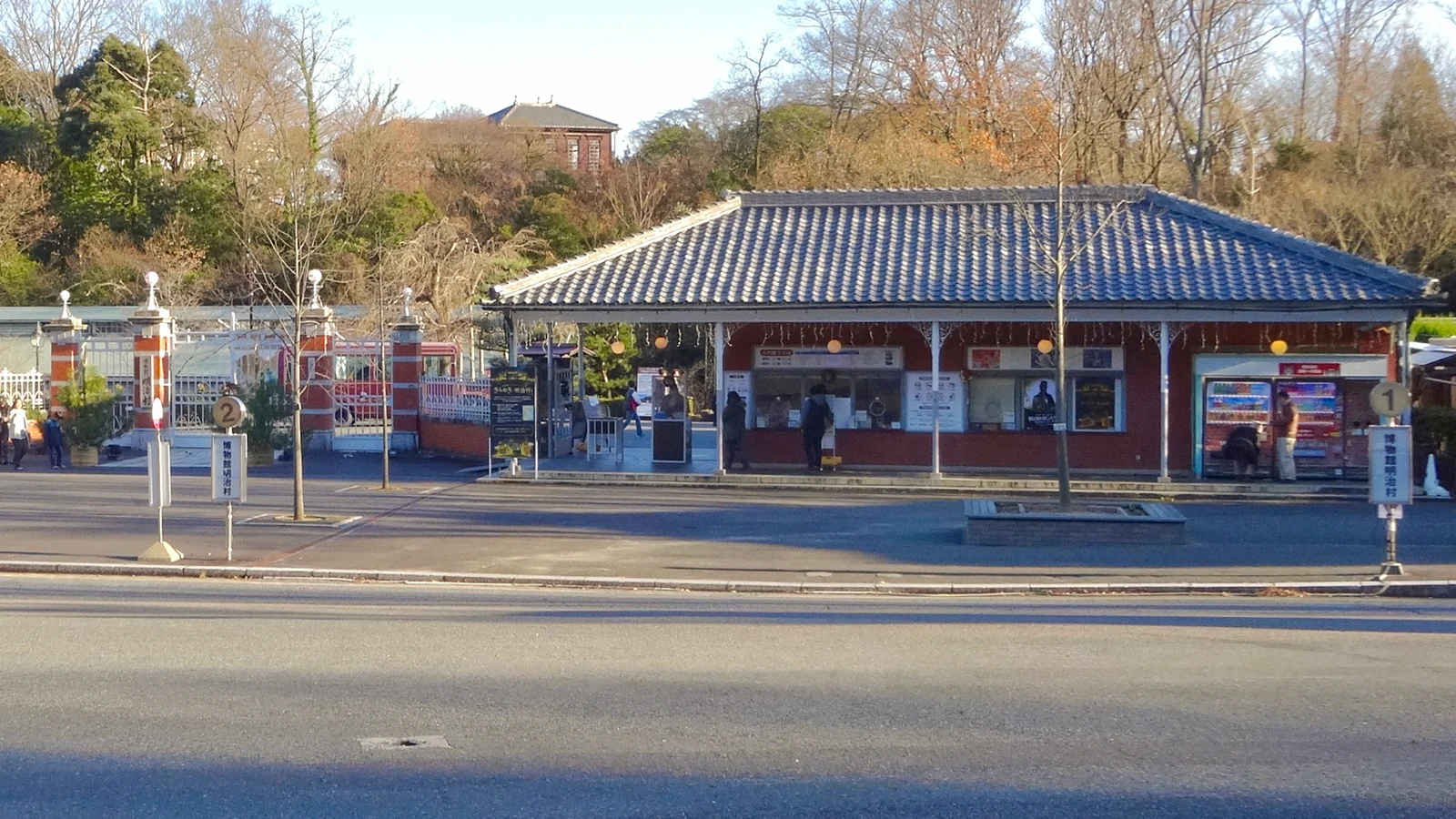
After entering the Main Gate, get a paper map, store bags and arrange your chosen house tour. Large lockers are inside the Main Gate near the museum shop. If you leave bags here, you must return in the afternoon and cannot simply leave through the North Gate after District 5. Drivers face the same issue in reverse: once you walk south to District 2, think about how to return toward District 5. Do not leave the car in the north and finish beside the Main Gate.
The village bus can help with a long return journey. The steam train and tram each have their own routes. Your entrance, parking lot and return bus stop set the day's boundaries; rides connect only part of that route. Circle your exit on arrival before deciding on a District 3 branch. Dropping one area is easier than hurrying back from the opposite end at closing time.
Saigo Tsugumichi residence in District 1: Japanese decoration in a Western reception house
The Saigo Tsugumichi residence stands at No. 8 in District 1. Built in 1880 in Meguro, Tokyo, it was the wooden Western-style guest house of Saigo's estate. It makes a useful first stop from the Main Gate. Starting with a house of clear purpose is easier than seeing many exteriors and trying to remember them later. Look for reception rooms, stairs and fireplaces. Ask what the host wanted foreign guests to see.
The mix of Japanese and Western work appears in specific materials and decoration. The second-floor main room has a Seto-ware fireplace surround painted with Japan's Three Scenic Views and Mount Fuji. The fireplace in the ladies' room beside the ground-floor entrance uses lacquer. Many curtain boxes, handrails, door fittings and ceiling decorations were made abroad.
Compare the same fixture in different rooms to see Japanese craft inside the Western-style house. You do not need a list of architectural terms first.
The curved staircase offers another comparison. Follow the handrail upward and see how turns connect to the rooms. A building tour includes the normally closed second floor. If you explore only the open rooms yourself, study the relationship between fireplaces, doors, windows and stairs before comparing it with Tomatsu House's narrow shop-and-home layout. Both concern domestic life, but the owners' status, reception customs and movement between floors differ greatly.
Tomatsu House: give half an hour to a townhouse that grew upward and backward
Tomatsu House, No. 18 in District 2, originally stood near Nagoya's Horikawa canal. The family first traded oil, then ran the Horikawa Savings Bank. It looks like a three-story townhouse, but its interest lies in repeated changes within a narrow frontage. The original single-story late-Edo house was moved backward in 1895, with a front second-floor addition. More construction above followed in 1901, creating today's layers. Remember that it was not built all at once, and its different floor levels become easier to read.
A through passage on the left of the ground floor leads to the rear, with shop and tatami rooms on the right. Above the passage, a void rises to the third floor, bringing in light through high windows. Rooms from the second floor upward connect at staggered levels, and the corridor before the tea room borrows light from the void.
First identify the relationship between business in front and living space behind, then look at how light reaches upstairs. For travelers used to apartments, this connects more easily with familiar home life than memorizing the townhouse's width and depth.
The free tour uses a maid's welcome as its presentation, introducing the interior in Nagoya dialect over about 30 minutes and opening normally closed areas. Keep that half-hour if you want to see the structure. A street photograph misses its most interesting vertical spaces. With children who do not understand Japanese, look for the through passage, high windows and floor levels together. Adults can also focus on the actual spaces without understanding every spoken sentence.
Zagyo-so in District 3: a side route for a Japanese villa and pond views
In District 3, a side path leaves the tram route toward Iruka Pond, with slopes past Western-style and Japanese houses. Saionji Kinmochi's villa, Zagyo-so, is No. 27 and originally stood on the Okitsu coast in Shizuoka as his home in later life. It suits visitors who want to add a Japanese domestic form to Saigo's reception house and the Tomatsu merchant home. If today's priorities are the steam train and District 5, omit this whole branch rather than walking halfway in and turning back.
At Zagyo-so, look at overlapping roofs, fittings and connections between rooms. The official building tour takes about 15 minutes, enters normally closed rooms and explains details designed for the elderly Saionji. The Western-style room, dressing room and Western toilet added in 1929 show the villa's practical functions. Compared with the Western house in District 1, ask how the owner lived here and how distances and facilities suited his age.
Slopes affect your group's choices directly. If lunch is at Nagoya-an in District 3, combine Zagyo-so and pond views in one leg. If you have eaten in District 5 and need an afternoon tour in District 2, avoid adding it at the last moment. Shinagawa Lighthouse tram stop is only a connection into District 3. There is still a walk after you get off; arrival at the stop is not the end of the house visit.
District 4: choose the Machinery Hall or save time for the stations
Moving north from the houses, District 4 can be a short connection or an industrial-history stop. The Shimbashi Railway Workshop Machinery Hall displays machinery used during modernization, in an iron-framed workshop. After the small fireplaces, doors and windows of the houses, a room built for large machines changes the scale. Machine enthusiasts can stay longer while others rest at nearby dining places, with the next shared meeting point at a station.
District 4 also has buildings used as a hospital, glass factory, emigrant home, theater and bathhouse.
Choose one purpose different from the houses you have seen and examine its entrances and users, rather than rushing through the full list. If children are waiting for a ride, make the Machinery Hall the only extra stop before either Nagoya tram station or SL Nagoya station. Both are in District 4, but serve different vehicles.
Add tram or SL to station names when finding your way. Keep museum station names separate from stations outside: SL Tokyo station only connects to another station within the village. Include the vehicle name in meeting messages to prevent people reaching the wrong station in the same district. The steam train can connect Districts 4 and 5 for the Imperial Hotel. If it is not running, walk between them using the map and drop distant extras.
Imperial Hotel main entrance in District 5: identify what was preserved
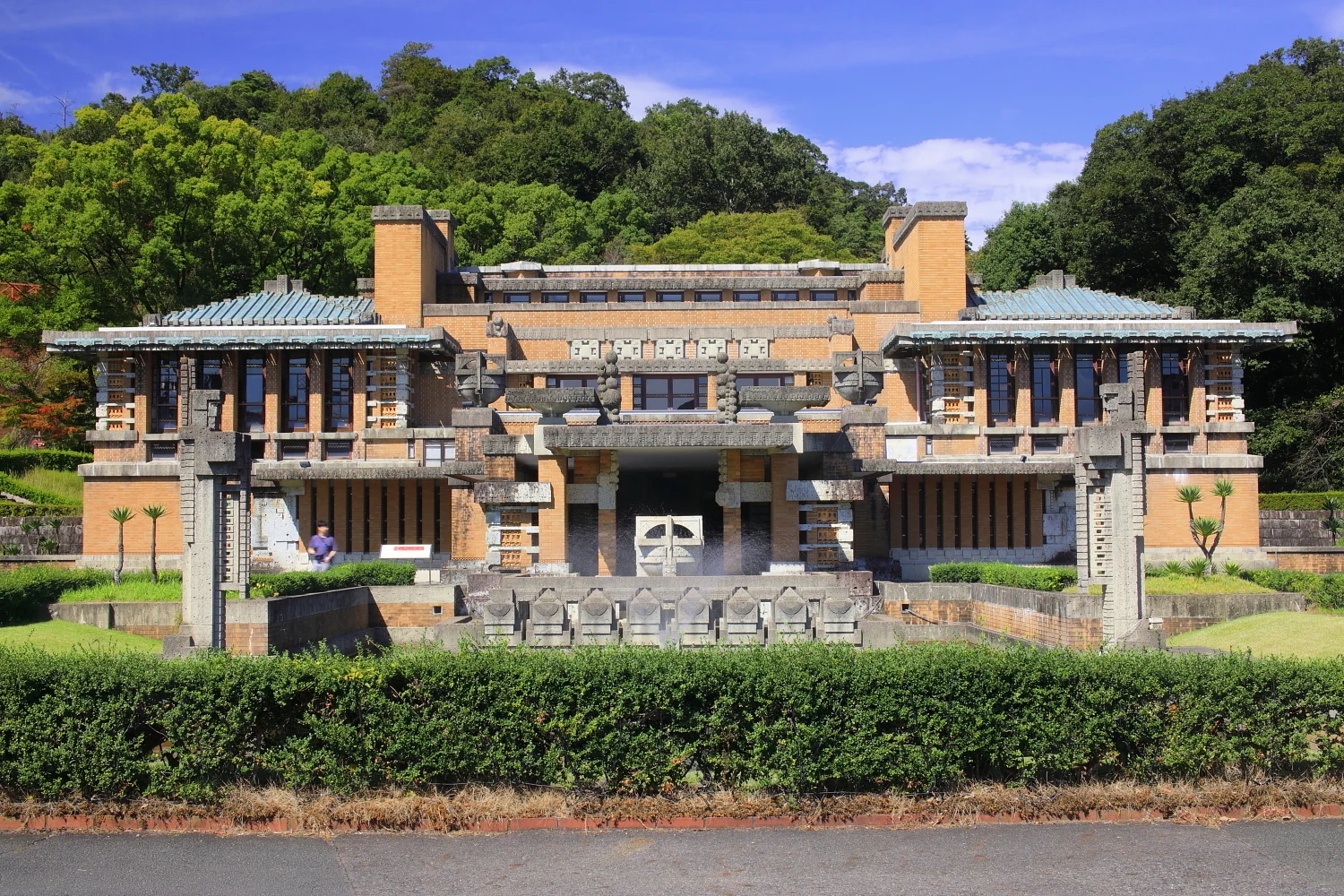
The Imperial Hotel main entrance, No. 67 in District 5, was the central entrance of the Tokyo Imperial Hotel designed by Frank Lloyd Wright and completed in 1923. The preserved section is the main entrance, with the front pool recreated. Understand that extent before studying the sides and front axis. It explains the concentration of public space better than imagining the whole hotel and its guest rooms were moved here.
From the front, look at the horizontally spread form. Up close, notice repeated Oya stone, ceramic decoration and geometric motifs. One look from far to near is enough; you need not circle repeatedly for a symmetrical photograph. A repair notice dated September 24, 2026, lists work on both towers from October 6 to 30, followed from October 30 to mid-December by work at the northern part of the west side, behind the building on the Miyazu Court side. Scaffolding obscures part of the exterior during this period. Choose dates with the work area in mind if exterior photography is your aim. For interior space, keep your focus on the entrance and lobby.
The relocation method is also worth reading about. The museum used stylistic preservation, retaining design principles, dimensions and spatial quality, while recreating parts that could not be reused with new materials. The main structure was also changed. The stone, decoration and spaces you see combine preservation and reconstruction. They let you study Wright's design and how a museum re-established part of a demolished building. Examine exterior materials and interior space as separate questions.
Inside the lobby, follow changes in floors, ceilings and sightlines
The Imperial Hotel deserves time inside its lobby. The central space rises through three stories, while surrounding floors and ceilings sit at different heights connected by stairs. Look into the center from an open passage, then change position along the permitted route and look back. This reveals changing sightlines more clearly than heading straight upstairs. No architectural training is needed: the same columns and ornaments feel different distances away from different levels.
Details in the museum's introduction include an Oya-stone wall fountain, light-cage columns, pierced ceramic decoration and large brackets called peacock feathers. Choose one, study its shape and find related geometry nearby rather than memorizing every term. Wright also designed furniture, lamps and tableware. Ask why a particular chair or light belongs in that room instead of assuming any replacement would have the same effect.
Treat a break in the Imperial Hotel tea room separately from exploring the lobby. One is for sitting and talking; the other needs changing viewpoints. With only a short gap, see the building before deciding whether to wait for a seat. Visitors walking north from the Main Gate can make this the main afternoon stop. From the North Gate, visit first so lunch and ride queues do not consume the indoor time you most want.
St. Francis Xavier Cathedral: stained glass in a timber Gothic interior
Also in District 5, St. Francis Xavier Cathedral is No. 51. It was completed in 1890 at Kawaramachi Sanjo in Kyoto. It pairs well with the Imperial Hotel, but calls for a different way of looking. In the hotel, change levels to study horizontal and vertical layers. At the church, start with the rose window outside, then find the nave, aisles and upper lighting inside, following the long axis toward the sanctuary.
Floral patterns were painted in white on colored glass, with clear glass added outside to form two layers. Take this detail with you instead of only calling the windows beautiful. Their patterns, light and position show how color enters the room. On a cloudy day, study the windows and structure; in sunshine, look at projected colored light. Do not miss a planned house tour or your return journey while waiting for one patch of light.
The interior columns and ribs use zelkova wood, translating a Gothic rib-vaulted ceiling into timber construction. Look up within a bay formed by four columns, see how ribs divide the ceiling, then look along the full row. Compared with Saigo's imported decoration and Tomatsu House's daylight, this offers another pairing of material and form. These few buildings alone give you enough for concrete comparisons in one day.
Free tours: fix one time and fit the rest around your route
Choose one tour at Tomatsu House, the Saigo residence or Zagyo-so as a fixed appointment. Tomatsu House currently starts at 11:00, 13:00 and 14:00, with an extra 15:00 tour on weekends and national holidays, lasting about 30 minutes. Saigo and Zagyo-so tours take about 15 minutes, normally with several sessions from 11:00 and another series from 13:00 after a midday gap. No reservation is needed on site. Capacity is limited to protect the buildings, with meeting points near their entrances.
Two 15-minute tours cannot necessarily be taken back to back. Saigo is in District 1 and Zagyo-so in District 3, with walks and entrance finding in between. From the Main Gate, townhouse enthusiasts can see open rooms in District 1 before the 11:00 Tomatsu tour. If choosing Saigo at 11:00, take Tomatsu at 13:00 and eat nearby. After two houses, there is no need to detour for a third tour in the afternoon.
There are also district volunteer tours of about 30 minutes for visitors who want the neighborhood buildings connected into a story. Their purpose differs from an in-depth house visit. With limited Japanese, choose the building you most want and use the Japanese-English audio guide at other stops instead of chasing every tour. The audio guide requires a ¥1,000 deposit, which is not returned if conditions such as damage apply. Allow time to return the device at the end.
Saigo and Zagyo-so use less frequent start times when a heatstroke alert is issued, and extra weekend sessions have conditions. Open the detailed activity pages before departure, then read the meeting notices on arrival. Mark your chosen tour on the map. If you miss it, move to the next area. Treating tours as timed options prevents the whole day being spent trying to catch a missed session.
The steam train: five minutes aboard, plus carriages and coupling work
The steam train connects SL Nagoya in District 4 with SL Tokyo in District 5 in about five minutes. The September 2026 resumption notice says it runs mainly on weekends and national holidays. The November vehicle calendar also lists Fridays, weekends, November 3 and November 23 as steam operating days. It normally does not run Monday to Thursday, while the tram and village bus are listed as operating. Check the calendar for your day, then its A, B or C timetable. Base weekday plans on walking or the village bus. From the North Gate, see District 5 before riding to District 4; walking north from the Main Gate, ride from 4 to 5. This suits visitors who want steam travel and need that connection, but it does not carry you all the way from the Main Gate to the Imperial Hotel. Confirm direction and your next building before buying a ticket.
The current museum introduction says the turntable has a fault and turning operations are suspended long term. To watch staff work, focus on visible tasks such as coupling and follow the safe visitor route. Do not expect the hand-operated turning shown in old online videos. Maintenance, coupling and operation are part of the working display too. Staying briefly to watch station work often fits the theme better than immediately hurrying to another building.
The carriages offer comparisons as well. Hafu 11 admits light differently from Hafu 13 and 14. The museum describes large front-and-rear windows in the first and clerestory windows in the others. Notice where natural light enters while riding. Hafu 11 may close in rain to protect its wooden body. If the steam train is a child's priority, confirm operation in the morning before buying. If it is suspended, substitute the tram or District 4 Machinery Hall to keep the same theme.
Tram and village bus: one for operating details, one for longer distances
The Kyoto tram links Kyoto Shichijo in District 2, Shinagawa Lighthouse in District 3 and Nagoya tram station in District 4, with about three minutes per section. Use it north after Tomatsu House, or south from District 4 toward District 2. It does not enter District 5, so the Imperial Hotel still needs walking or another connection. To save walking, find the actual stop on the map rather than assuming a day pass brings you to every building's door.
If vehicle operation interests you, watch the trolley pole change direction at Nagoya tram station or Shinagawa Lighthouse. This long pole collects power from the overhead wire and must be reset when direction changes, unlike the pantographs common today. Near Kyoto Shichijo, you can also listen for the difference between the warning bell and the conductor's confirmation bell. Even one short ride has more to offer if you include station work and observations inside.
The village bus serves nine stops, takes about 20 minutes from the Main Gate to the Imperial Hotel and has a separate ¥500 day pass. For travelers returning to Main Gate lockers or tired in the afternoon, it serves a clearer need than another steam ride. Use it for the final return leg, but do not depend on the last bus. Waiting, the circuit and the walk to the exit all take time. If service gaps are large, shorten the route and start back along your earlier path, choosing a final building near the exit.
A full day from the Main Gate: houses, then District 5, with time for the bus stop
This suggested route is for a short winter day; visit durations are planning allowances. Take the bus from Inuyama Station's East Exit to the Main Gate, enter around 10:00, see open parts of the Saigo residence in District 1, then reach District 2 for Tomatsu House's 11:00 tour. Eat nearby afterward. In the afternoon, take the tram or walk to District 4, choose either the Machinery Hall or steam train, then see the Imperial Hotel and St. Francis Xavier Cathedral in District 5. This main route crosses several districts but leaves the District 3 house branch for another visit.
If you spend a long time at Saigo in the morning, keep Tomatsu's 13:00 tour and stay south until lunch. If the 11:00 Tomatsu tour works, you can give District 5 longer in the afternoon. Choose the house-tour time before going north so you can continue north afterward without returning to District 2. The afternoon goal is the hotel and church; choose only one other building of interest along the way.
For a 16:00 closing day, start preparing to return to the Main Gate around 15:00. Read that day's village bus timetable before choosing bus or foot. To sit in the Imperial Hotel tea room, drop the Machinery Hall or extended shopping, rather than cutting return time. Collect bags, return the audio guide and use the restroom before waiting for the bus outside. This short finish keeps the last building from becoming a hurried photo stop.
A driving day from the North Gate: hotel and church first, then one route south
From North Gate parking, start in District 5 and see the Imperial Hotel entrance and St. Francis Xavier Cathedral in the morning. Eat at Romantei in the same district. In the afternoon, ride the steam train or walk to District 4 for the Machinery Hall. Only if you still have energy, take the tram toward District 2 for Tomatsu's 14:00 tour, then return north. District 4 can be your turning point, especially with a stroller or slower walkers on slopes, without a full circuit to the Main Gate.
Visitors who want a deeper house visit can still choose Tomatsu from the North Gate, but must start moving toward District 2 earlier in the afternoon. If you also want Saigo, use the Main Gate house route instead and arrange the connection from your northern starting point in advance. Do not suddenly decide on District 1 late in the day. A car frees up travel outside the village; tour times, closing and terrain inside remain fixed.
You must return to North Gate parking. After lunch, put the final stop on that return route. If rain increases or children tire, District 4 is a sensible turning point. With the two District 5 buildings already seen, one ride or the Machinery Hall still gives the day a clear theme. Standard-car parking is ¥1,000 per car. Keep it separate from each person's admission and ride tickets when sharing costs; do not add a public transport package to the driving plan.
Arriving after noon: keep two buildings, or one building and one ride
If you reach the Main Gate after 13:00 on a 16:00 closing day, stay in Districts 1 and 2 for Saigo and Tomatsu, take one tour you can still catch, have tea and return to the Main Gate. You can head directly to District 5 instead, but use the village bus or a clear walking route and omit the whole house group. Trying both ends usually leaves only exteriors, especially with luggage collection, shopping or restaurant queues.
From the North Gate in the afternoon, keep the Imperial Hotel and cathedral. If a child mainly wants the steam train, replace the church with a ride between Districts 4 and 5. Find a service you can take first, then see buildings during the gap. Do not miss the chosen train after sitting down at the hotel. This half-day works for visitors with clear priorities. For a first visit with house interiors, morning entry is better.
Official last entry is 30 minutes before closing. That is the ticketing and entry cutoff. An afternoon plan still needs full time for interiors, walking, waiting and returning to the exit. With only an hour, keep to one building and a short walk near the entrance. If you have just entered the Main Gate but want District 5, returning early another day is more practical than making the whole family hurry at the end.
From Nagoya or Inuyama: pair actual dates with outbound and return buses
From Nagoya, take Meitetsu to Inuyama and change to Gifu Bus at the East Exit. If staying in Inuyama, start there. The Meiji Mura Line PDF revised April 1, 2026 lists a weekday combination leaving Inuyama East Exit at 9:55 and reaching Meiji Mura at 10:22, then returning at 16:00 and reaching Inuyama at 16:22. This provides the outer schedule for a full winter day. For an earlier start, select an early bus that operates in that season and match the opening time.
For weekends, read the Saturday/Sunday/holiday table in the same PDF. An example is 9:28–9:50 outbound and 16:05–16:27 back to Inuyama, suitable for a 16:00 closing day. When November weekends close at 17:00, you can choose a later return, but do not mix weekday columns with weekend rows. The ◎ mark means operation from March 1 through the end of November. The seasonal 18:00 return does not run from November through February. December 29 to January 3 uses the Sunday/holiday timetable even on calendar weekdays.
If staying near Inuyama Station or the Kiso River, sort out large luggage after checkout before going to the East Exit. Re-entry after leaving the village is not allowed, so fit lunch and belongings into one admission. For dinner in Nagoya, a return around 16:00 leaves room for bus delays and train transfers. That is easier than adding one last building and booking dinner too tightly.
Adding transport and ride costs: an example from Meitetsu Nagoya
Regular admission costs ¥2,500 for adults, ¥1,500 for high school students and ¥700 for elementary and junior high school students. Preschool children enter free; high school students show student ID. Rides cost extra. For junior high school age and older, one steam ride is ¥700, one tram ride ¥500 and a steam/tram day pass ¥1,000. Elementary rates are ¥500, ¥300 and ¥700 respectively. An adult buying one of each ride pays ¥1,200 separately, versus ¥1,000 for the pass. For just one tram ride, buy the ¥500 single rather than paying for an undecided second journey. The village bus day pass is a separate ¥500 per person. Pay for rides in cash.
For a same-day return from Meitetsu Nagoya, the Meiji Mura Time Travel Ticket costs ¥4,100 for an adult and includes unlimited one-day travel on all Meitetsu lines and the Inuyama East Exit–Meiji Mura bus, plus village admission. Add an adult steam/tram day pass for a total of ¥5,100 covering transport, entry and both historic vehicles. With the village bus, it is ¥5,600. These ticket totals exclude meals, lockers and the Meitetsu special-car μticket.
For two adults and one elementary school student leaving from Meitetsu Nagoya, with a ¥1,850 child package, the base total is ¥10,050. Add three steam/tram day passes totaling ¥2,700 for ¥12,750; add a ¥500 village bus pass each for ¥14,250. Junior high students pay the same ordinary admission as elementary students but fall into adult bands for the rail package and village rides, so this family example does not apply to them. Meitetsu's child category is age six to under 12, also including 12-year-old elementary students under 13. A six-year-old not yet at school is in the young-child category.
The current Time Travel Ticket period runs through March 31, 2027, excluding village closure days and specified dates. Refunds require every coupon to remain unused within the validity period and incur a fee. Lost tickets are not reissued. If staying in Inuyama and only needing a bus return, compare the transport you will use before choosing ordinary admission or a package. Compare the Inuyama Castle combined ticket around visits on separate days. For today's building route, calculate only the tickets you will use today.
Lunch, strollers and bags: keep breaks on the main route
Let the morning's chosen district determine lunch. District 5 has Romantei, serving omelet rice and Western-style meals between the Imperial Hotel and church. District 3 has Nagoya-an for Nagoya flat noodles. District 4 has the Shokudoraku cafe and Meiji Coffee Jikan; District 2 has Nakai Saryo for sweets. Choose the eating area first, then a shop based on opening and queues, so lunch does not become another cross-village journey.
The Imperial Hotel tea room suits a seated break in the interior. In the afternoon, still allow for a queue and your return. With young children, eat before hunger becomes urgent, and offer water and snacks where eating is allowed. Eating and drinking are prohibited inside buildings other than dining facilities. The houses are not rain shelters for snacks. In rain, find a real dining place and avoid carrying food and drinks into historic buildings.
Strollers are available at both gates for ¥500 each, and manual wheelchairs are free, in limited numbers. Borrowing one does not remove steep slopes, steps or historic entrances. Choose one fewer branch rather than assuming a wheelchair makes all five districts possible. For companions needing substantial help, connect main areas by village bus and explore slowly within one district. Upper-floor house tours are for those able to manage the walk.
Main Gate lockers cost ¥600 large, ¥500 medium and ¥400 small. Sizes and numbers are on the official price page. The simplest plan with large luggage is to leave it at your accommodation or a chosen station storage point and bring only daily needs. Group equipment returns, bag collection and restroom time into the final stop so the last village ride takes you straight toward the exit.
Winter, rain and suspended rides: what to shorten
November hours are 9:30–16:00 on weekdays, extending to 17:00 on weekends and national holidays. December through February is normally 10:00–16:00. On a full winter day, keep the house tour and two District 5 buildings, and skip the District 3 pond branch in the afternoon. Closure dates include December 14–18 and 31, 2026, and January 1, 2027. Choose a date from the opening calendar before matching transport. A running bus does not establish that the museum is open.
In rain, shorten the route to buildings and dining in adjacent districts. From the Main Gate, keep Saigo, Tomatsu and a District 2 break. From the North Gate, keep the Imperial Hotel, church and Romantei, adding District 4 only if the rain is manageable. Buildings have interiors, but travel between them remains outdoors. Grip, rain gear and slopes determine how far you can go. In heavy rain, reduce the area rather than riding to a distant station just because you bought a pass.
If only the steam train is suspended, walk or take the village bus between Districts 4 and 5 and remove station waiting time. If the tram is suspended, keep buildings at one end of Districts 2–4 and connect the other by foot or bus. If weather affects several vehicles, return to two buildings and one rest stop. If the steam ride is your sole aim, come on an operating day. If architecture is the focus, shorter transfers can preserve the interiors you most want.
A few useful answers
With half a day from the Main Gate, should I still visit the Imperial Hotel?
Afternoon arrival on a 16:00 closing day calls for either houses in Districts 1 and 2 or a direct move to the hotel and church in District 5. For District 5, drop the houses and allow a return to the Main Gate. North Gate visitors can focus directly on District 5.
Which free tour should I choose, Tomatsu House or Saigo Tsugumichi's residence?
For light, staggered floors and a shop-home layout in a narrow townhouse, choose Tomatsu's roughly 30-minute tour. For a Western reception house and its normally closed second floor, choose Saigo's roughly 15-minute tour. Fix one, then add nearby buildings.
Does the steam train and tram day pass include the village bus?
The village bus requires a separate ¥500 day pass. Steam/tram day passes cost ¥1,000 for junior high school age and over and ¥700 for elementary students. One tram ride costs ¥500 and ¥300 respectively. Pay for rides in cash.
Will construction affect Imperial Hotel exterior photographs in autumn and winter 2026?
The museum lists tower work from October 6 to 30, then work from October 30 to mid-December on the northern west side, behind the building toward Miyazu Court. Scaffolding obscures part of the exterior. Plan photography around the work area.
What do transport and rides cost for two adults and one elementary student from Meitetsu Nagoya?
Two adult and one child Time Travel Tickets total ¥10,050, including Meitetsu, the specified bus and entry. Adding three steam/tram day passes gives ¥12,750; adding village bus passes as well gives ¥14,250. Meals, lockers and μtickets are extra.
Can a stroller or wheelchair cover all of Meiji Mura?
Strollers and manual wheelchairs are available at the gates, but steep slopes, steps and historic entrances remain. Choose adjacent areas and use the village bus for distance. Decide on District 3 branches and upstairs house tours according to walking ability.
How can I keep the day's theme in rain or when the steam train is suspended?
From the Main Gate, shorten to Saigo, Tomatsu and a District 2 break. From the North Gate, keep the Imperial Hotel, church and lunch in the same district. If only steam is suspended, walk or use the bus between Districts 4 and 5. If the steam ride is your only aim, choose an operating day.
Official information and references
Sources used in this guide.
- Meiji Mura | Village map and districts
- Meiji Mura | Rides and activities
- Meiji Mura | Free guides and tours
- Meiji Mura | District 5 map and introduction
- Meiji Mura | Access
- Meiji Mura | Open-air museum in Inuyama, Aichi
- Meiji Mura | District 1 map and introduction
- Meiji Mura | District 2 map and introduction
- Meiji Mura | District 3 map and introduction
- Meiji Mura | District 4 map and introduction
- Meiji Mura | Imperial Hotel main entrance
- Meiji Mura | St. Francis Xavier Cathedral
- Meiji Mura | Saigo Tsugumichi residence
- Meiji Mura | Tomatsu House
- Meiji Mura | Tickets and prices
- Meiji Mura | Opening hours and closure dates
- Meiji Mura | Exterior viewing restrictions during Imperial Hotel entrance repairs
- Meitetsu | Meiji Mura Time Travel Ticket
- Meiji Mura | Tomatsu House immersive building tour
- Meiji Mura | Saigo Tsugumichi residence building tour
- Meiji Mura | Saionji Kinmochi villa Zagyo-so building tour
- Meiji Mura | Steam train ride
- Meiji Mura | Kyoto tram ride
- Meiji Mura | Village bus
- Meitetsu | Adult and child ticket categories
- Meiji Mura | Resumption of steam locomotive operation
- Meiji Mura | Village vehicle timetables
- Gifu Bus | Meiji Mura Line weekday and weekend/holiday timetable, revised April 1, 2026
- Meiji Mura | 2026 village map