Plan a day at Meiji Mura from the Main or North Gate. Choose between the Saigo and Tomatsu houses, Imperial Hotel and St Francis Xavier Cathedral, with free tours, steam trains, trams, village buses and shorter winter or afternoon routes.
- Region & Focus
- ChubuAttractions
- Reading Scope
- 35 min read · 19 chapters · 7 Q&As
- Official Verification
- 29 official sources checkedUpdated 28 October 2026
- Key Topics
- ItinerariesRail travelBooking
Chapter Route Map (tap any stop)
- Choose houses, Area 5 architecture or historic transport as your focus
- Match your exit to your arrival gate
- Saigo Tsugumichi House: Japanese decoration in a Western-style reception house
- Tomatsu House: allow half an hour for a townhouse that grew upwards and backwards
- Zagyo-so in Area 3: a side route for a Japanese villa and pond views
- Area 4: choose the machinery hall or save time for the station
- Imperial Hotel entrance hall: identify what was preserved
- Inside the lobby: changing floors, ceilings and sightlines
- St Francis Xavier Cathedral: stained glass and timber Gothic space
- Free tours: fix one, then fit the rest to your route
- Steam trains: carriages and coupling as well as a five-minute ride
- Trams for operation, village buses for longer distances
- A full day from the Main Gate: houses, Area 5 and time for the bus stop
- Driving to the North Gate: see the hotel and church before heading south
- Afternoon arrivals: two buildings, or one building and one ride
- From Nagoya or Inuyama: match both journeys to the right calendar
- Adding transport and ride costs: an example from Meitetsu Nagoya
- Lunch, pushchairs and luggage: keep rest stops on your route
- Winter, rain and suspended rides: what to drop
- Quick Q&A
Start your day at Meiji Mura by choosing one building to explore inside and one historic vehicle to ride. The bus from Inuyama Station brings you to the Main Gate, suited to walking north from the Saigo Tsugumichi House and Tomatsu House. If you park by the North Gate, start with the Imperial Hotel entrance hall and St Francis Xavier Cathedral. Both routes need time for lunch and your return; you do not need to cover all five areas. Ticket and opening information was checked up to 28 October 2026.
Choose houses, Area 5 architecture or historic transport as your focus
If you mainly want to photograph the Imperial Hotel and ride a steam train, northern Areas 4 and 5 can form the core of your day. For how people received guests and ran shops in the Meiji period, give more time to the Saigo Tsugumichi House near the Main Gate and the Tomatsu House in Area 2. These interests call for different visits. You can explore the northern buildings independently with a ride between stops; for the houses, fix one free building tour in your plan and fit other stops around it.
The museum divides its roughly one million square metres into five areas and recommends selecting priorities. Buildings beside each other on the map still involve slopes, entrances, indoor visits and waits for transport. Aim to understand two buildings and compare a third rather than tick off all five areas. Compare living space in a Western-style house and a townhouse, space and daylight in the hotel and church, or the operation of a tram and steam train.
If rides are the reason for a family outing, check that day’s operations first and choose buildings near the stops. Architecture enthusiasts can work the other way: keep the Imperial Hotel or a house tour, then walk a smaller area if services do not fit. Give Inuyama Castle and its town another half-day to a day. For nights based in Nagoya, see the two-day Nagoya and side-trip guide. The name of a combined castle-and-museum ticket need not make you rush both into one day.
The museum’s short film released in 2021 shows the Imperial Hotel entrance hall, St Francis Xavier Cathedral, trams and lakeshore, with night-time illuminations between scenes. Use daytime views to compare the buildings and the scale of the grounds before choosing your main stops.
Plan a day at Meiji Mura from the Main or North Gate. Choose between the Saigo and Tomatsu houses, Imperial Hotel and St Francis Xavier Cathedral, with free tours, steam trains, trams, village buses and shorter winter or afternoon routes.
Match your exit to your arrival gate
Take the bus from Inuyama Station’s East Exit to Meiji Mura and begin with Area 1 near the Main Gate. The museum car park is beside the North Gate. The official recommended navigation search is “Meiji Mura car park”; its address is 1 Uchiyama Nebishiki, Inuyama, Aichi. The museum’s general address, 1 Uchiyama, Inuyama, serves a different purpose. Select the car park directly so you do not set your starting point at the opposite end. Standard-car parking costs ¥1,000, payable on site, without reservations.
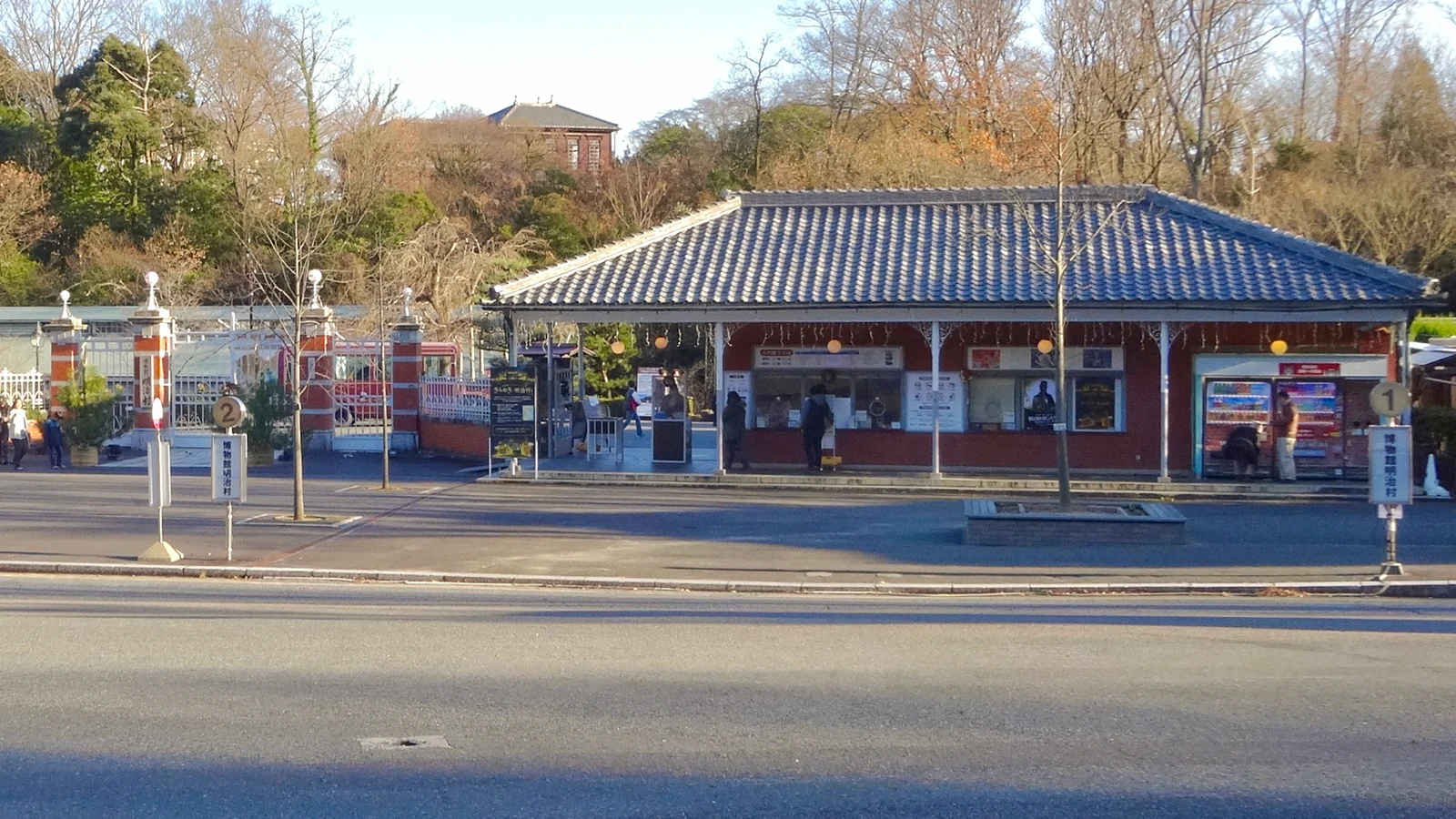
After entering the Main Gate, collect a paper map, store luggage and arrange your chosen house tour. Large lockers are inside the gate near the museum shop. If you leave bags here, return to the Main Gate that afternoon rather than leaving through the North Gate after Area 5. The same applies to drivers: once you walk south to Area 2, consider how to return towards Area 5. Avoid finishing beside the Main Gate with your car still at the north end.
The village bus helps with longer return journeys; the steam train and tram each have their own routes. Gates, parking and the onward bus stop frame your day. A ride only connects part of that route. Circle your exit on the map before deciding on Area 3 side paths. Leave out an area if that avoids rushing back across the museum at closing time.
Saigo Tsugumichi House: Japanese decoration in a Western-style reception house
The Saigo Tsugumichi House, building 8 in Area 1, stood originally in Meguro, Tokyo. Built in 1880, it was the wooden Western-style guest reception building on Saigo’s estate. It makes a useful first stop from the Main Gate: a house with a clear purpose is easier to understand than a series of unnamed exteriors. Look for reception space, stairs and fireplaces, asking what the host wanted foreign guests to see.
The blend of Japanese and Western work is visible in materials and decoration. The Seto-ware fireplace surround in the main upstairs room depicts Japan’s three famous scenic views and Mount Fuji. The fireplace surround in the ladies’ room beside the ground-floor entrance uses lacquer. Curtain boxes, handrails, door fittings and ceiling decorations are largely foreign-made.
Compare the same equipment in different rooms to see Japanese craft inside a Western-style house. You do not need to learn a list of architectural terms first.
The curved staircase is another useful comparison. Follow the handrail upwards and see how turns link to rooms. A building tour takes you to the normally closed second floor. If exploring only the independently open areas, study the relationship between fireplaces, windows, doors and stairs, then compare it with the long, narrow shop-house at the Tomatsu House. Both concern everyday life, but their owners’ status, reception customs and movement between floors differ.
Tomatsu House: allow half an hour for a townhouse that grew upwards and backwards
The Tomatsu House, building 18 in Area 2, originally stood near Nagoya’s Horikawa canal. Its owners first traded in oil, then operated the Horikawa Savings Bank. Behind its three-storey townhouse exterior lies a series of alterations within a narrow frontage. The original late-Edo single-storey house was moved backwards in 1895, when the front part of the second floor was added. Further upward expansion followed in 1901. Remember that it was not built all at once as you read the changes in floor level.
An earth-floored passage on the ground-floor left runs to the rear; the shop and tatami rooms connect on the right. Above the passage, an open space reaches the third floor, with light from high windows. Upper rooms connect at staggered levels, and the corridor before the tea room borrows light from the open space.
Start by identifying business at the front and domestic life at the rear, then see how the upper rooms receive light. For visitors used to flats, this connects more readily to familiar living spaces than memorising townhouse frontage and depth measurements.
The free tour takes about 30 minutes, with a guide performing the role of a maid and speaking in Nagoya dialect. It includes areas normally closed to visitors. Keep this half-hour if you want to understand the interior: photographing the street front misses its most interesting vertical space. With children who do not understand Japanese, look for the passage, high windows and floor levels together. Adults can focus on the actual space without needing to follow every sentence.
Zagyo-so in Area 3: a side route for a Japanese villa and pond views
In Area 3, a side road leaves the tram route towards Lake Iruka. Sloping paths lead past Western-style and Japanese houses. Saionji Kinmochi’s villa Zagyo-so, building 27, originally stood on the Okitsu coast in Shizuoka as his home in later life. Add it if you want a third form of domestic architecture after Saigo’s reception house and the Tomatsu shop-house. If today is mainly for steam trains and Area 5, leave out the whole side route rather than walking halfway and doubling back.
At Zagyo-so, study overlapping roofs, fittings and the relationships between rooms. The official building tour takes about 15 minutes, enters normally closed areas and explains details designed for the elderly Saionji. A Western-style room, dressing room and Western toilet added in 1929 show the practical functions of this Japanese villa. Compared with the Area 1 house, ask how its owner lived indoors and how movement distances and equipment suited his age.
Slopes matter to your group’s choice. If lunch is at Nagoya-an in Area 3, combine the villa with the pond-side scenery. If you have already eaten in Area 5 and need to return to Area 2 for a tour, avoid adding this route on impulse. Shinagawa Lighthouse tram stop is an access point to Area 3; walking remains after you get off. Reaching the stop does not complete a house visit.
Area 4: choose the machinery hall or save time for the station
On the way north from the houses, Area 4 can be a short link or an industrial-history stop. The Railway Bureau Shimbashi Workshop and machinery hall displays equipment used in modernisation inside an iron-framed factory. Moving from small domestic fireplaces, windows and doors to a space for large machines changes the scale of the visit. Machine enthusiasts can stay longer while others rest at nearby food outlets, with the station as the next group meeting point.
Area 4 also has buildings used as a hospital, glassworks, emigrant home, theatre and bathhouse.
Choose one use different from the houses already seen and examine its entrances and users, rather than hurrying through the entire list. If children are waiting for a ride, make the machinery hall your only extra and continue to Nagoya tram stop or SL Nagoya Station. Both are in Area 4, but they serve different vehicles.
Add “SL” or “tram” when using station names. Museum stops are separate from stations outside; SL Tokyo Station only connects to another station within the museum. Include the vehicle name in meeting messages to avoid reaching the wrong stop in the same area. The steam train can link Areas 4 and 5 for the Imperial Hotel. If it is suspended, walk between them using the map and drop distant extras.
Imperial Hotel entrance hall: identify what was preserved
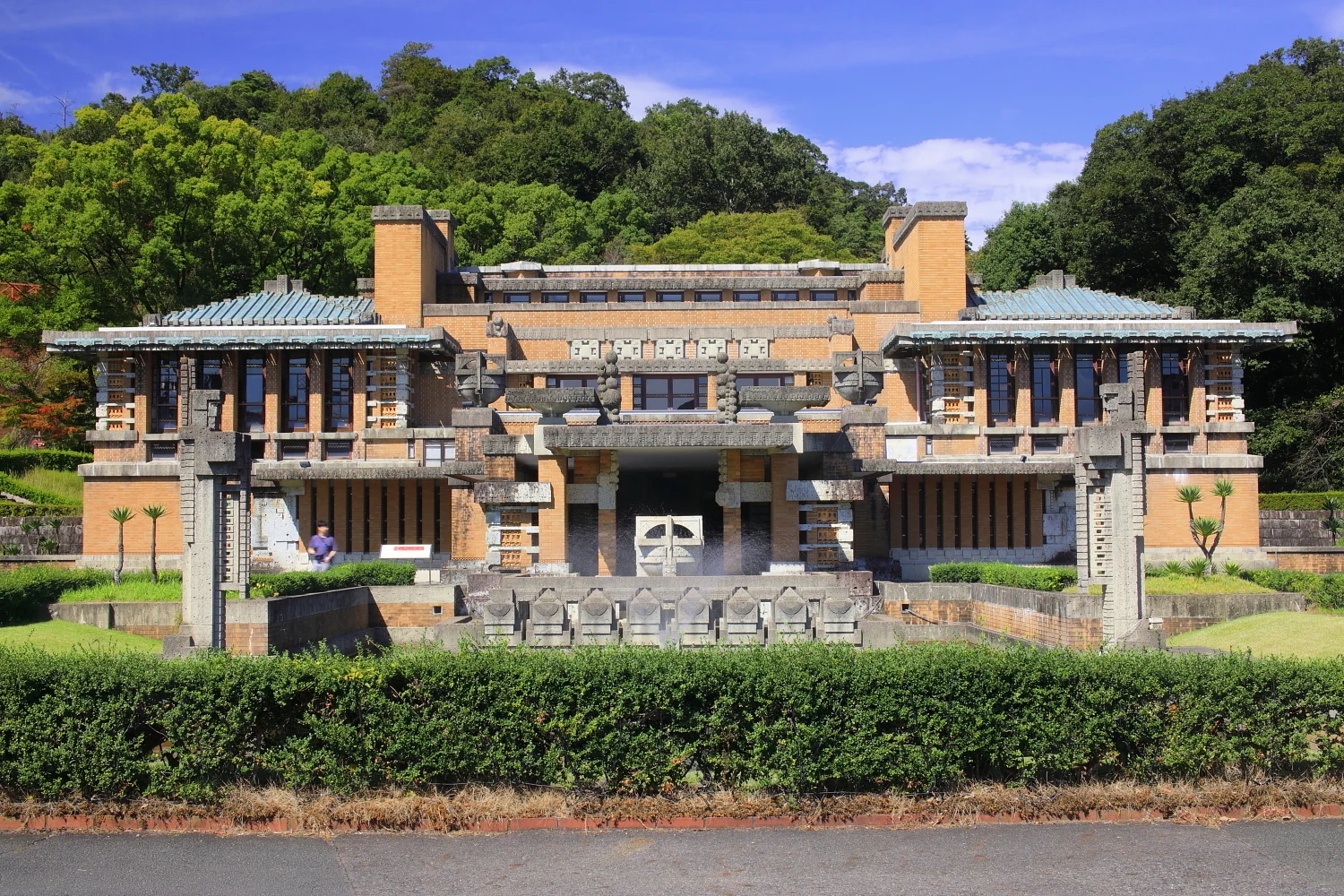
The Imperial Hotel entrance hall, building 67 in Area 5, is the central entrance portion of Frank Lloyd Wright’s Tokyo Imperial Hotel, completed in 1923. The museum preserves this central entrance and recreates the pool in front. Understand that extent before looking at the side volumes and front axis. This explains the concentration of public space better than imagining that the whole hotel and its guest rooms were moved here.
From the front, note the horizontal form, then look closely at repeated Oya stone, ceramic decoration and geometric patterns. One progression from distant to close views is enough; you need not circle the exterior repeatedly for a symmetrical photograph. The repair notice dated 24 September 2026 schedules work on both towers for 6–30 October, then the northern part of the west side, behind the building towards Miyazu Court, from 30 October to mid-December. Scaffolding obscures parts of the exterior during this period. If a complete exterior photograph is your aim, consider the work area when choosing a date. For indoor space, keep the entrance and lobby as your focus.
The relocation method is worth reading about too. The museum used a form-preservation approach, keeping design principles, dimensional systems and spatial qualities. Parts that could not be reused were recreated in new materials, and the main structure was changed. The stonework, decoration and spaces you see include preservation and reconstruction. They support the study of Wright’s design while showing how a museum re-established part of a demolished building. Study materials outside and space inside as separate questions.
Inside the lobby: changing floors, ceilings and sightlines
The lobby rewards time. Its central space rises to the third floor, while surrounding floors and ceilings sit at different heights linked by stairs. Start from an open circulation area, look towards the centre, then move along the permitted route and look back. This reveals changing sightlines more readily than heading straight upstairs. No architectural background is needed: the same pillars and decoration relate differently to you at different heights.
The museum highlights an Oya stone wall fountain, “light-cage columns”, pierced ceramic ornaments and large “peacock feather” brackets. Choose one detail, study its shape and find related geometry nearby rather than memorising every name. Wright also designed furniture, lights and tableware. Consider their coordination with the building: why does this chair or light belong in this room rather than being interchangeable with anything else?
Allow separate time for the Imperial Hotel cafe and for exploring the lobby. Sitting suits resting and talking; understanding the lobby needs changes of viewpoint. If time is short, see the architecture before deciding whether to queue for a table. From the Main Gate, make this your afternoon priority. From the North Gate, visit first so lunch or ride queues do not consume the indoor time you most wanted.
St Francis Xavier Cathedral: stained glass and timber Gothic space
St Francis Xavier Cathedral, building 51 in Area 5, was completed in 1890 at Kawaramachi Sanjo in Kyoto. Pair it with the Imperial Hotel but use a different way of looking. At the hotel, change heights to compare horizontal and vertical layers. At the church, start with the rose window, then find the nave, side aisles and upper daylight openings, following the long axis towards the chancel.
Floral patterns on the stained glass are painted in white on coloured glass, with clear glass outside to form a double layer. Bring this detail to the visit: study pattern, light and window position to see where colour enters the space. On a cloudy day, examine windows and construction; in sunshine, look for projected coloured light. You do not need to miss a scheduled house tour or your return to wait for one patch of light.
Interior columns and ribs use zelkova wood. The rib-vaulted ceiling translates Gothic space into timber construction. Look up from one bay enclosed by four columns, see how ribs divide the ceiling, then look back along the full colonnade. Compared with imported decoration at Saigo’s house and daylight at the Tomatsu House, this is another combination of material and form. These few buildings alone offer specific comparisons for one day.
Free tours: fix one, then fit the rest to your route
Choose one house tour at the Tomatsu House, Saigo House or Zagyo-so as a fixed appointment. Current Tomatsu starts are 11:00, 13:00 and 14:00, plus 15:00 at weekends and on public holidays, lasting about 30 minutes. Saigo and Zagyo-so tours take about 15 minutes, normally with several starts from 11:00 and a restart at 13:00 after the midday gap. All are walk-up without booking. Numbers are limited to protect the buildings; meeting points are near each entrance.
Two tours lasting about 15 minutes cannot necessarily be taken back to back. Saigo is in Area 1 and Zagyo-so in Area 3, with walking and finding entrances between them. From the Main Gate, townhouse enthusiasts can see open Area 1 spaces and join Tomatsu at 11:00. If you choose Saigo at 11:00, move Tomatsu to 13:00 and eat nearby. After two houses, there is no need to divert again for the Zagyo-so tour.
Volunteer area tours of about 30 minutes link buildings across a district, serving a different purpose from an in-depth house tour. With limited Japanese, choose the building you most want and use the Japanese-English audio guide elsewhere rather than chasing every tour. The audio guide requires a ¥1,000 deposit, which is not returned if, for example, the device is damaged. Allow time to return it at the end.
Saigo and Zagyo-so use less frequent start times under a heatstroke alert; extra weekend tours also have conditions. Read each building’s experience page before travelling and check meeting signs after arrival. Mark your chosen tour on the map. If you miss it, continue to the next area. Treat tours as timed options so the day does not become a pursuit of missed starts.
Steam trains: carriages and coupling as well as a five-minute ride
The steam railway links SL Nagoya Station in Area 4 with SL Tokyo Station in Area 5 in about five minutes. The September 2026 restart notice says it mainly runs at weekends and on public holidays. The November transport calendar also lists Fridays, weekends, 3 November and 23 November as operating days. Ordinary Mondays to Thursdays show no steam trains, while trams and village buses run. Match your date to the calendar, then use timetable A, B or C. Base weekday routes on walking or the village bus. From the North Gate, see Area 5 before riding to Area 4; from the Main Gate, ride north from Area 4. This suits visitors who want steam travel and need to cross areas, but it does not carry you from the Main Gate all the way to the Imperial Hotel. Confirm direction and your next building before buying.
The current museum introduction says the turntable is faulty and turning operations are suspended long term. For staff activity, watch visible coupling and other work from permitted safe areas. Old online footage of manual turning is not a programme promised for your day. Maintenance, coupling and operation are part of the working display too. A short station stop to watch them can be more relevant than immediately rushing to the next building.
Compare the carriages as well. Hafu 11 differs from Hafu 13 and 14 in daylight design. The museum describes large windows at the front and rear of the former, while the other two use clerestory windows. Notice where natural light enters. Hafu 11 may close in rain to protect its wooden body. If the steam train is a child’s main attraction, confirm operation in the morning before buying. Replace it with the tram or machinery hall if suspended, keeping the same theme.
Trams for operation, village buses for longer distances
The Kyoto tram links Kyoto Shichijo in Area 2, Shinagawa Lighthouse in Area 3 and Nagoya tram stop in Area 4, taking about three minutes per section. It connects a northbound route after the Tomatsu House or brings you south towards Area 2. It does not enter Area 5, so the Imperial Hotel needs a walk or another connection. Find your actual stop on the map before assuming a day pass takes you directly to every building.
At Nagoya or Shinagawa Lighthouse, watch the trolley pole being repositioned when the tram reverses. This long pole draws power from overhead wires and must be reset for the opposite direction, unlike a modern pantograph. Near Kyoto Shichijo, listen for the difference between the operating warning bell and the conductor’s confirmation bell. Even one short ride has more content when you include station work and observations inside.
The village bus serves nine stops, taking about 20 minutes from the Main Gate to the Imperial Hotel. Its separate day ticket costs ¥500. It is particularly useful for returning to Main Gate lockers or when you are tired in the afternoon. Use it for the final return, but avoid relying on the last service. Allow for queues, the circuit and the walk to the exit. With a long service gap, shorten the route and head back on foot, choosing the last building near your exit.
A full day from the Main Gate: houses, Area 5 and time for the bus stop
This suggested route is for a shorter winter day; visit durations are planning allowances. Take the bus from Inuyama East Exit, enter around 10:00 and see the open part of Saigo’s house in Area 1. Continue to Area 2 for Tomatsu’s 11:00 tour, then eat nearby. In the afternoon, walk or take the tram to Area 4, choose the machinery hall or steam train, then continue to the Imperial Hotel and cathedral in Area 5. The route crosses several areas but leaves the Area 3 house side route for another visit.
If you spend longer at Saigo in the morning, keep Tomatsu at 13:00 and do not head further north before lunch. If you complete Tomatsu at 11:00, give Area 5 more time that afternoon. Choose the tour slot before heading north so you can continue in one direction without returning to Area 2. The afternoon priorities are hotel and church; choose only one other building that interests you along the way.
For a 16:00 close, start preparing to return to the Main Gate around 15:00. Check the day’s village bus services, then choose bus or foot. To sit in the Imperial Hotel cafe, drop the machinery hall or a longer shopping stop instead of cutting return time. Collect luggage, return the audio guide and use toilets before waiting for the external bus. This final allowance keeps your last building visit from becoming a rushed tick-box stop.
Driving to the North Gate: see the hotel and church before heading south
From the North Gate car park, start in Area 5, visiting the Imperial Hotel entrance hall and cathedral in the morning, then eat at Romantei in the same area. In the afternoon, take the steam train or walk to the machinery hall in Area 4. Only if you have the energy, continue by tram to Tomatsu’s 14:00 tour in Area 2, then return to the North Gate. Area 4 is a sensible turning point, especially with a pushchair or slower walkers on slopes. You need not cross the whole museum to reach the Main Gate.
If you want a detailed house visit, the North Gate route can still include Tomatsu, but you need to head towards Area 2 earlier in the afternoon. To add Saigo as well, switch to the Main Gate house-focused route and plan the internal connection from the North Gate ahead. Do not decide to walk to Area 1 late in the day. A car makes travel outside more flexible; tour starts, closing times and terrain inside still apply.
You must return to the North Gate car park. After lunch, choose your final attraction in that direction. If rain increases or children tire, turn back at Area 4. Having seen both Area 5 buildings in the morning, one afternoon ride or machinery hall still gives the day a clear theme. Parking is ¥1,000 per standard car. Divide that separately from each person’s admission and ride tickets; do not add a public transport package to the driving plan.
Afternoon arrivals: two buildings, or one building and one ride
If you reach the Main Gate after 13:00 on a 16:00 closing day, keep to Saigo and Tomatsu in Areas 1 and 2, take an available tour and return after tea. You can head straight for Area 5 instead, but use the village bus or a clear walking route and drop the whole house group. Trying for both ends often leaves only exterior views, particularly with luggage storage, shopping or restaurant queues.
Entering through the North Gate in the afternoon, keep the Imperial Hotel and cathedral. If children only want the steam train, replace the church with the ride between Areas 4 and 5. Find a usable service first, then visit buildings in the waiting time so sitting down at the hotel does not make you miss it. This half-day suits visitors who know their priorities. For a first visit with house interiors, arrive in the morning.
Official last entry is 30 minutes before closing, a ticketing and admission boundary. Your afternoon plan still needs full time for buildings, walking, waiting and returning to the exit. With only an hour, visit one building near the gate and take a short walk. If you want Area 5 but have just arrived at the Main Gate, an earlier start on another day is more practical than making the family hurry at the end.
From Nagoya or Inuyama: match both journeys to the right calendar
From Nagoya, take Meitetsu to Inuyama, then Gifu Bus from the East Exit. If staying in Inuyama, start there. The Meiji Mura Line PDF revised on 1 April 2026 includes a weekday 09:55 departure arriving at 10:22, with a 16:00 return reaching Inuyama at 16:22. This frames a full winter day. For an earlier start, choose an early service operating in your season and match the museum’s opening time.
At weekends, use the Saturday/Sunday/public holiday table in the same PDF. Examples are 09:28–09:50 outbound and 16:05–16:27 return, suitable for a 16:00 closing day. When November weekends close at 17:00, choose a later return if wanted, keeping weekday rows separate. A circle mark indicates operation from 1 March to the end of November; the seasonal 18:00 return does not run November–February. From 29 December to 3 January, the Sunday/public holiday schedule applies even on calendar weekdays.
If staying near Inuyama Station or the Kiso River, store large bags after checkout before heading to the East Exit. Re-entry after leaving the museum is not permitted, so plan lunch and collecting items within your visit. For dinner back in Nagoya, a return around 16:00 leaves space for bus delays and train transfers. That is easier than adding a final building and booking dinner too tightly.
Adding transport and ride costs: an example from Meitetsu Nagoya
Standard admission costs ¥2,500 for adults, ¥1,500 for senior high school pupils and ¥700 for primary and junior high school pupils. Preschool children enter free; senior high school pupils need student ID. Rides cost extra. For junior high school age and over, single steam train/tram fares are ¥700/¥500, and a combined day pass is ¥1,000. Primary school rates are ¥500/¥300/¥700 respectively. An adult taking each once pays ¥1,200 separately or ¥1,000 for the pass. One tram ride needs only the ¥500 single. The separate village bus day ticket is ¥500 per person. Pay for rides in cash.
For a same-day return from Meitetsu Nagoya, the Meiji Mura Time Travel Ticket costs ¥4,100 per adult and includes unlimited travel for one day on all Meitetsu lines and the bus between Inuyama East Exit and Meiji Mura, plus museum admission. Add the ¥1,000 steam train/tram day pass for ¥5,100 in transport, admission and historic rides, or ¥5,600 with the village bus. These totals exclude food, lockers and the Meitetsu special-car μticket.
Two adults and a primary school child from Meitetsu Nagoya pay ¥10,050 for the base packages, using the ¥1,850 child ticket. Three steam train/tram day passes add ¥2,700 for ¥12,750 total; three ¥500 village bus passes bring it to ¥14,250. Junior high school pupils have the same ordinary admission as primary pupils but use adult categories for the rail package and internal rides, so this family example does not apply to them. Meitetsu child fares cover ages 6 to under 12; primary pupils aged 12 but under 13 remain children, while six-year-olds not yet at primary school are infants.
The current Time Travel Ticket runs to 31 March 2027, excluding museum closures and specified dates. Refunds require all coupons to be unused and within validity, with a handling fee; tickets are not reissued. If already staying in Inuyama and only needing a return bus, compare the transport you will actually use before choosing admission alone or a package. Compare the Inuyama Castle combined ticket against a plan to visit castle and museum on separate days. Today’s building route only needs today’s tickets.
Lunch, pushchairs and luggage: keep rest stops on your route
Choose lunch where the morning takes you. Area 5 has Romantei for omelette rice and Western-style meals between the hotel and cathedral. Nagoya-an in Area 3 serves Nagoya flat noodles. Area 4 has Shokudoraku’s cafe and Meiji Coffee Jikan; Area 2 has Nakai Saryo for sweets. Pick an area first, then choose an open venue according to queues. Lunch need not become another cross-museum search for a famous restaurant.
The Imperial Hotel cafe suits a seated look at the space; even in the afternoon, leave queue and return time. Feed young children before they become hungry, and offer water and snacks where eating is allowed. Eating and drinking inside buildings other than dining venues is prohibited. Historic houses are not rain shelters for picnics. In wet weather, find a proper dining spot so you are not carrying food and drinks through heritage buildings.
Pushchairs cost ¥500 to hire at the Main and North Gates; manual wheelchairs are free, with limited numbers. Steep slopes, level changes and historic entrances remain after hire. Leave out a side route rather than assume a wheelchair lets you cover all five areas. For companions needing substantial assistance, use the village bus along the main route and explore one area slowly. Upstairs house tours suit those able to manage the walking.
Main Gate lockers cost ¥600 large, ¥500 medium and ¥400 small. Sizes and numbers are on the official price page. Large luggage is simplest left at your accommodation or a chosen station storage point, taking only the day’s needs to the museum. Combine returning borrowed equipment, collecting bags and toilets in your final stop so the last internal journey takes you straight to the exit.
Winter, rain and suspended rides: what to drop
November hours are 09:30–16:00 on weekdays and until 17:00 at weekends and on public holidays. December–February hours are normally 10:00–16:00. For a full winter day, keep a house tour and the two Area 5 buildings, leaving the Area 3 pond-view side route out of the afternoon. Closures include 14–18 and 31 December 2026 and 1 January 2027. Choose a date on the opening calendar before matching transport. A bus running does not mean the attraction is open.
In rain, reduce the plan to adjoining areas with buildings and food stops. From the Main Gate, keep Saigo, Tomatsu and a rest in Area 2. From the North Gate, keep the hotel, church and Romantei, adding Area 4 only if rain permits. Buildings admit visitors, but travel between them remains outdoors. Grip, rain gear and slopes determine how far you can go. In heavy rain, shorten the area rather than travelling to a distant stop simply because you bought a day pass.
If only the steam train is suspended, walk or take the village bus between Areas 4 and 5 and remove station waiting time. Without trams, keep buildings at one end of Areas 2–4 and link the other by foot or bus. If weather affects several vehicles, return to two buildings and one rest stop. If historic rides are your sole purpose, come on an operating day. If buildings are the priority, less movement can preserve the interiors you most want.
A few useful answers
With only half a day from the Main Gate, should I still go to the Imperial Hotel?
On a 16:00 closing day with an afternoon arrival, choose houses in Areas 1 and 2 or go straight to Area 5 for the hotel and church. Drop the houses if choosing Area 5 and allow time back to the Main Gate. From the North Gate, focus directly on Area 5.
Should I choose the Tomatsu or Saigo free tour?
Choose Tomatsu’s roughly 30-minute tour for daylight, split levels and the shop-house relationship in a narrow townhouse. Choose Saigo’s roughly 15-minute tour for a Western-style reception house and the normally closed second floor. Fix one tour, then add nearby buildings.
Does the steam train and tram day pass include village buses?
No. The village bus has a separate ¥500 day ticket. The steam train/tram day pass costs ¥1,000 from junior high school age and ¥700 for primary pupils. One tram ride costs ¥500 and ¥300 respectively. Rides take cash.
Will repairs affect Imperial Hotel exterior photographs in autumn and winter 2026?
The museum schedules work on both towers for 6–30 October, then the northern west side behind the building towards Miyazu Court from 30 October to mid-December. Scaffolding obscures parts of the exterior. Plan photography around the work area.
What do transport and rides cost for two adults and a primary pupil from Meitetsu Nagoya?
Time Travel Tickets total ¥10,050, including Meitetsu, the specified bus and admission. Adding three steam train/tram day passes gives ¥12,750, or ¥14,250 with village bus passes for all three. Food, lockers and μtickets are extra.
Can a pushchair or wheelchair cover all of Meiji Mura?
They are available at the entrances, but steep slopes, level changes and historic entrances remain. Choose adjoining areas and use the village bus for longer distances. Decide on the Area 3 side route and upstairs tours according to walking ability.
How can I keep a theme in rain or without steam trains?
From the Main Gate, shorten to Saigo, Tomatsu and an Area 2 rest stop; from the North Gate, keep the hotel, church and local lunch. With only steam trains suspended, walk or take the bus between Areas 4 and 5. If riding the steam train is your sole aim, choose an operating day.
Official information and references
Sources used in this guide.
- Meiji Mura | Museum map and areas
- Meiji Mura | Historic transport experiences
- Meiji Mura | Free guided tours
- Meiji Mura | Area 5
- Meiji Mura | Access
- Meiji Mura | Open-air museum in Inuyama, Aichi
- Meiji Mura | Area 1
- Meiji Mura | Area 2
- Meiji Mura | Area 3
- Meiji Mura | Area 4
- Meiji Mura | Imperial Hotel entrance hall
- Meiji Mura | St Francis Xavier Cathedral
- Meiji Mura | Saigo Tsugumichi House
- Meiji Mura | Tomatsu House
- Meiji Mura | Tickets and prices
- Meiji Mura | Opening hours and closures
- Meiji Mura | Exterior viewing restrictions during Imperial Hotel repairs
- Meitetsu | Meiji Mura Time Travel Ticket
- Meiji Mura | Tomatsu House immersive building tour
- Meiji Mura | Saigo Tsugumichi House tour
- Meiji Mura | Saionji Kinmochi’s Zagyo-so villa tour
- Meiji Mura | Steam train experience
- Meiji Mura | Kyoto tram experience
- Meiji Mura | Village bus
- Meitetsu | Adult and child fare categories
- Meiji Mura | Resumption of steam train services
- Meiji Mura | Internal transport timetables
- Gifu Bus | Meiji Mura weekday and weekend/public holiday timetable, revised 1 April 2026
- Meiji Mura | 2026 museum map