Planning Kyoto's Gion Matsuri in July? Compare Saki Matsuri and Ato Matsuri dates, Yoiyama lanterns and street stalls, Yamaboko Junko procession routes, paid seating, mikoshi processions, and transit from Shijo-Karasuma or Gion-Shijo.
- Region & Focus
- Kyoto
- Reading Scope
- 24 min read · 11 chapters · 5 Q&As
- Official Verification
- 15 official sources checkedUpdated November 22, 2026
- Key Topics
- SeasonsItinerariesNeighborhoods
Chapter Route Map (tap any stop)
- Which July Dates Should You Circle Before Booking Flights?
- Gion Is East of the Kamo River—Where Do You Go for Yoiyama?
- What Can You See Before the Lanterns Are Hung on the Hoko?
- Which Streets and Times Make Yoiyama Easier to Navigate?
- Where to See Kaisho-kazari, Folding Screens, and Live Gion-bayashi
- Which Part of the Procession Should You Watch? Turns, Rituals, or Specific Floats
- Free Street Viewing vs. Paid Reserved Seating
- Morning Floats and Evening Mikoshi: Which Side Should You Choose?
- Shijo, Karasuma-Oike, Kawaramachi, or Gion-Shijo: Choosing Your Station and Stay
- Handling July Heat or Rain Without Missing the Best Moments
- Planning Gion Matsuri in Half a Day, One Evening, or Two Days
- Quick Q&A
For first-time visitors to Kyoto's Gion Matsuri, two approaches fit most itineraries cleanly. To see glowing paper lanterns and hear live Gion-bayashi music, pick the Saki Matsuri Yoiyama evenings from July 14 to 16 and walk into the float neighborhoods from Shijo-Karasuma. To watch towering yamaboko floats pivot around street corners, save the morning of July 17 or July 24 for the Yamaboko Junko procession. If you have one evening leading into the next morning, pair Yoiyama with the following day's parade from the same half of the festival. July's events stretch from Yasaka Shrine across both banks of the Kamo River, so decide what you want to see first, then lock in your stations and return route.
Which July Dates Should You Circle Before Booking Flights?
Kyoto's Gion Matsuri opens with Kippu-iri on July 1, when float neighborhoods begin preparations, and closes on July 31 with the Nagoshi-sai ritual at Eki-jinja inside Yasaka Shrine. If you want the liveliest street scenes, circle one of two core windows when booking hotels. For Saki Matsuri (the Earlier Procession), Yoiyama runs July 14 to 16, followed by the morning float procession on July 17 and the Shinko-sai mikoshi procession that evening. For Ato Matsuri (the Latter Procession), Yoiyama runs July 21 to 23, followed by the morning float and Hanagasa umbrella processions on July 24 and the Kanko-sai mikoshi return that evening. Even if your trip falls at the start or end of the month, shrine rituals still take place, though float displays and lantern evenings strictly follow those two main windows.
If you are coming for festival food stalls, notice that Yoiyama and street stalls (roten) are listed separately. The Kyoto City Tourism Association's 2026 guide lists street stalls only on July 15 and 16—not on July 14 or any of the three Ato Matsuri evenings. If you prefer an unobstructed look at the floats and woven tapestries, July 14 evening or Ato Matsuri is a better fit, with dinner before or after your walk. If street stalls are the priority, wait for that year's official Yoiyama guide to highlight the active stall nights, and agree in advance if anyone in your group plans to head back to the hotel early.
Arriving just ahead of either procession gives you a chance to see yama-tate and hoko-tate, when crews assemble the floats right in their home streets. In 2026, Saki Matsuri hoko assembly ran July 9 to 13 and yama assembly July 12 to 14, while Ato Matsuri assembly took place mainly from July 18 to 21. Official schedules group several neighborhoods under a single date range, so check the start time and neighborhood name for any specific hoko you want to watch rise. If you are just passing through, stick to one or two streets; you can usually tell how far construction has progressed right from the corner.
If your schedule only allows a single night in Kyoto, arriving July 16 for the July 17 Saki Matsuri—or July 23 for the July 24 Ato Matsuri—lets you pair Yoiyama with the next morning's parade. When July 16 or 23 is also your arrival day in Japan, factor in immigration, airport transit, and baggage drop-off, and keep that first evening brief. If you are switching hotels the next morning, ask your current hotel whether they will hold your bags after checkout before deciding how long to stand curbside.
| Dates | Main Events | Where to Check First |
|---|---|---|
| July 14-16 | Saki Matsuri Yoiyama | Float neighborhoods around Shijo-Karasuma; current-year street stall and pedestrian restrictions |
| July 17 | Morning Saki Matsuri Yamaboko Junko; evening Shinko-sai | Shijo-Karasuma starting point; mikoshi route from Yasaka Shrine to Shijo Otabisho |
| July 21-23 | Ato Matsuri Yoiyama | Muromachi-dori and Shinmachi-dori north of Shijo-dori, plus Ofune-hoko south of Shijo-dori |
| July 24 | Morning Ato Matsuri Yamaboko Junko and Hanagasa Junko; evening Kanko-sai | Karasuma-Oike starting point; mikoshi route from Shijo Otabisho back to Yasaka Shrine |
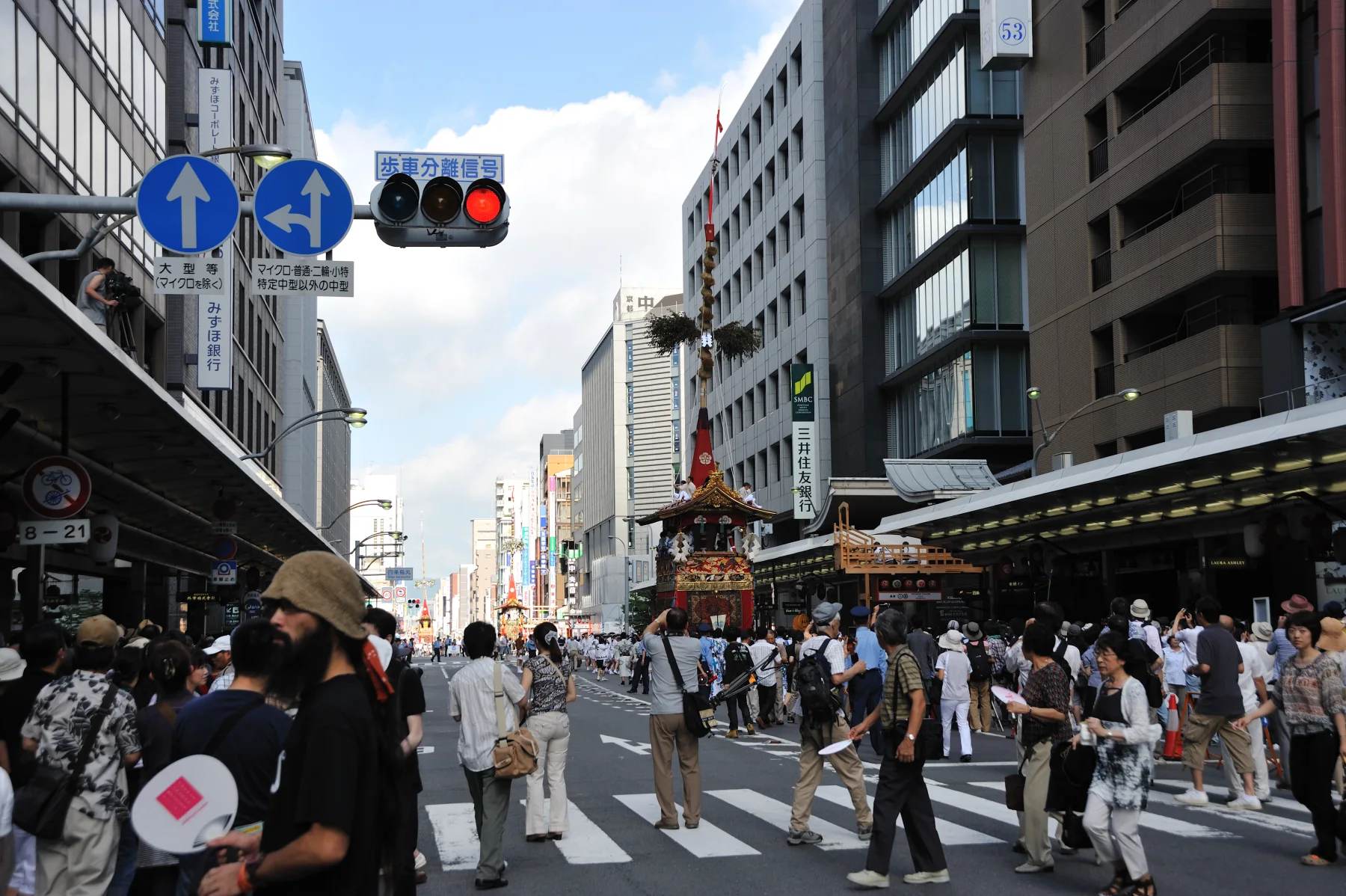
Planning Kyoto's Gion Matsuri in July? Compare Saki Matsuri and Ato Matsuri dates, Yoiyama lanterns and street stalls, Yamaboko Junko procession routes, paid seating, mikoshi processions, and transit from Shijo-Karasuma or Gion-Shijo.
Gion Is East of the Kamo River—Where Do You Go for Yoiyama?
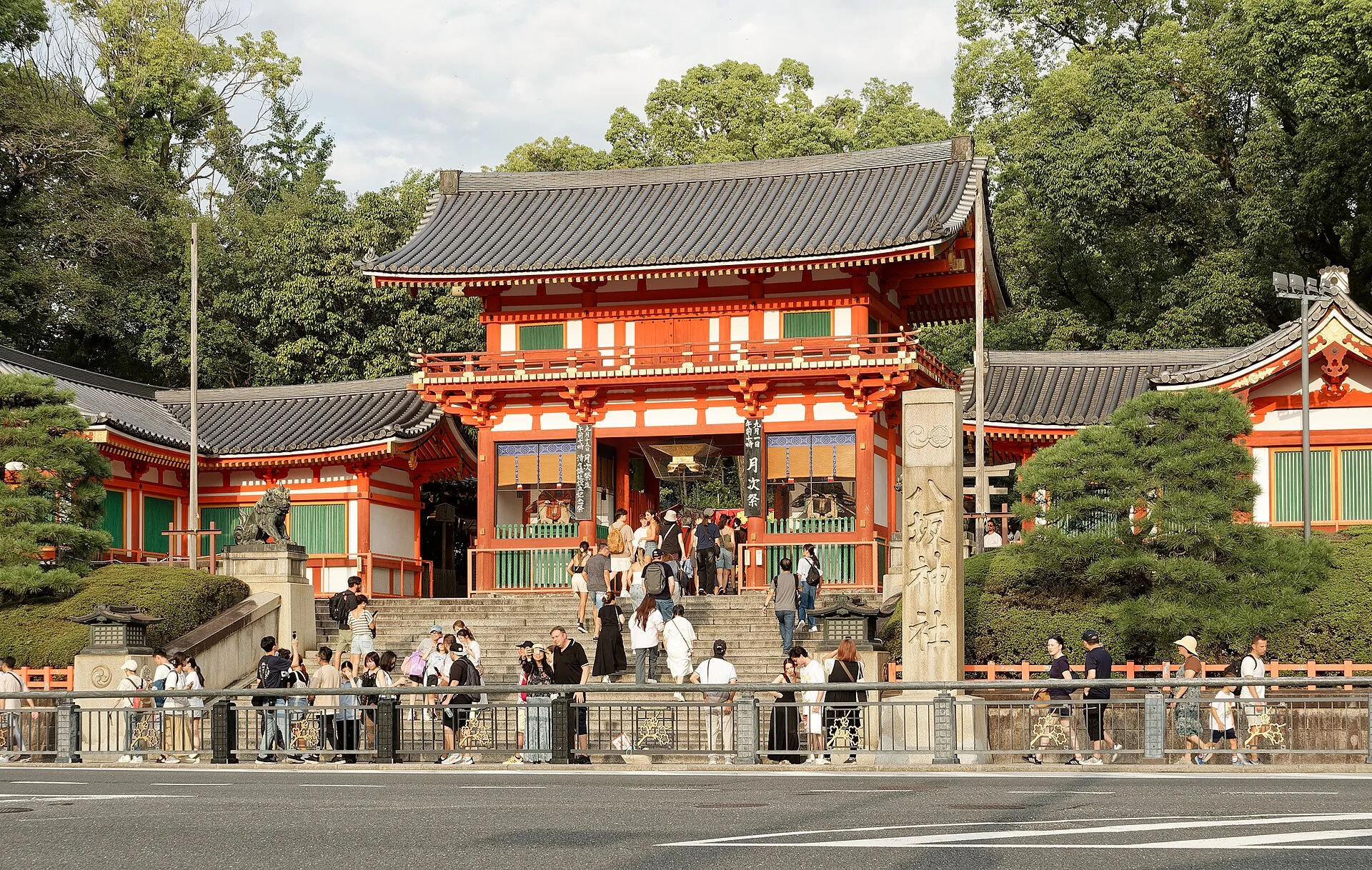
Typing "Gion" into a maps app usually drops you at Hanamikoji or Yasaka Shrine on the east bank of the Kamo River. For Yoiyama float viewing, shift your map across the river to Shijo-Karasuma on the west bank. Using Shijo-dori as your east-west spine, Muromachi-dori and Shinmachi-dori just west of Karasuma-dori host several Saki Matsuri float guildhalls and street displays. Heading east along Shijo-dori takes you past Teramachi and Kawaramachi and across Shijo Ohashi Bridge to the Yasaka Shrine area. For Ato Matsuri, check the sections of Muromachi and Shinmachi north of Shijo-dori first, then treat Ofune-hoko south of Shijo-dori as a separate stop. Searching by individual float names works far better than searching for a generic "Gion Matsuri venue."
Each yamaboko neighborhood (yamaboko-cho) centers on the home block of a specific float. While the float stands in the street, its guildhall (kaisho) sits right alongside or a few doors down, with staff directing entry at the door. Kyoto City's 2026 Yoiyama map marks both float locations and one-way pedestrian streets. Save a copy before you walk in so that when you hit a barricade sign, you know exactly which block ahead prohibits walking against the flow. Pair the festival map (which shows where you are allowed to walk) with a standard navigation app for street names on your way back, rather than letting your phone endlessly recalculate the shortest route.
When meeting up with friends, use Shijo-Karasuma as an orientation anchor, and pick a specific shopfront outside the tightest crowds or a hotel lobby as your rendezvous point. Always include the intersection name and subway exit number when texting your location. Casual messages often abbreviate Shijo, Karasuma, Kyoto-Kawaramachi, and Gion-Shijo stations to just "Shijo," which causes confusion when people arrive separately from Kyoto Station and Osaka—spell out Subway, Hankyu, or Keihan in your message. If your phone battery is running low, a screenshot of the shop name and intersection is much more reliable than a live location pin.
If your hotel is on the east bank, plan to cross the river once before Yoiyama and once on the way back. If you want to eat before entering the float districts west of Shijo, finish dinner before crossing into the busiest blocks. If you have dinner reservations back in Gion, leaving the float streets means cutting through Kawaramachi and over Shijo Ohashi Bridge, so pad your schedule in case you have to detour to an open crossing. When checking walking times, use your exact hotel or restaurant door as the origin and destination instead of searching "Shijo-Karasuma to Gion."
What Can You See Before the Lanterns Are Hung on the Hoko?
During hoko assembly, crews use a traditional rope-lashing method called nawagarami to bind wooden beams together without nails. Passing by during the day, watch how the intersecting timbers are cinched tight, then look up at the tall central mast, the shingi. Once the frame is locked in, workers drape tapestries and ornaments over the bare wood, dramatically changing how the same float looks from daytime construction to evening Yoiyama. If you are visiting with kids, point out the rope knots, massive wooden wheels, and undercarriage at eye level rather than waiting in one spot for an entire float to go up.
After assembly wraps up, some neighborhoods hold hikizome (test pulls for wheeled hoko) or kakizome (test lifts for shoulder-carried yama). If you spot a notice for one, double-check whether the gathering point is inside the home block or out on the main parade avenue. Stay strictly within the areas marked open to spectators near active work zones, and step back behind the ropes whenever crews are hoisting beams, pulling ropes, or rolling the float. For children, watching the giant wheels roll down a short stretch of street shows off the float's scale without blocking the pullers in front of the ropes.
To study one float in detail, inspect its timber joinery earlier in the day, then check the adjacent guildhall or information boards. At Naginata-hoko, pay attention to the long halberd blade atop the mast and the tapestries wrapping the body. Some blades and textiles on display are reproductions, with details on the originals listed by the preservation association or tourism board. Because the floats are assembled and dismantled outdoors every summer, preservation teams rotate fabrics to protect them from sun and weather. Knowing where each panel sits is easier than memorizing dates: walk around the front, sides, and rear to note the motifs so you can spot them again from a distance on parade day.
Which Streets and Times Make Yoiyama Easier to Navigate?
For Saki Matsuri, start along Shijo-dori past Naginata-hoko, Kanko-hoko, and Tsuki-hoko before turning down one of the side streets. Go during the day to study machiya townhouses and float details up close, then return to one favorite hoko after dusk to photograph its glowing komagata lanterns. Right around twilight, before the sky turns pitch black, both the roofline silhouettes and lit lanterns expose cleanly on a handheld phone. If you just want to give kids a brief taste of the festival, pick a single float with a full wall of lanterns, and head to a pre-selected indoor spot if the air feels stifling or crowds thicken.
For Ato Matsuri, pair Kita-kannon-yama and Minami-kannon-yama along Shinmachi-dori. If you want to see the ship-shaped Ofune-hoko, check its official spot south of Shijo-dori and budget a short walk down to see it. Since Ofune-hoko serves as the grand finale of the Ato Matsuri procession, Yoiyama is your chance to examine the entire hull from street level. If you also plan to catch the Hanagasa umbrella procession, tour the western float streets during Ato Matsuri Yoiyama so you can focus exclusively on Hanagasa the next morning instead of chasing two parades at once.
If you want to climb aboard a float, check boarding (tojo), viewing (haikan), and chimaki talisman distribution (chimaki juyo) separately. Certain floats allow visitors inside upon purchasing a ticket or designated charm, and guildhall entry often has separate rules from boarding; the Kyoto City Tourism Association also notes that some floats maintain traditional restrictions barring women from boarding. If you are traveling with toddlers, anyone with knee trouble, or companions who prefer to skip steep ladders, pick floats that are rewarding from street level, let those who want to climb join the line separately, and meet at an unobstructed exit nearby—or go up during daytime hours and save the evening for lanterns.
The chimaki sold at street stands are folded leaf talismans meant to be hung above a doorway or under eaves to ward off misfortune—unlike the edible rice dumplings known by a similar name elsewhere. Yasaka Shrine and each float neighborhood offer their own versions. If you want a chimaki from a specific float, note its full name, look for its juyosho (distribution counter), and carry small cash. You will also pass historic homes and shops displaying heirloom folding screens and artwork for the Byobu Matsuri (Folding Screen Festival). Street-facing pieces are visible from outside, while indoor entry signs post fees, photography rules, and traffic flow.
When you finish looking at a float and are ready to move on, put your phone away first and step into the pedestrian stream. If someone stops ahead to take a photo, leave half a step of space behind you; keeping umbrellas folded and avoiding tripods in narrow side lanes keeps traffic moving. If you buy street snacks, eat in designated open pockets rather than squeezing into guildhall queues with food in hand. In 2026, the two stall nights during Saki Matsuri featured eco-stations for reusable tableware—when active, return borrowed dishes to marked collection points and sort other trash according to on-site signs.
Where to See Kaisho-kazari, Folding Screens, and Live Gion-bayashi
Neighborhood guildhalls displaying float ornaments and textiles are labeled "kaisho-kazari" on Japanese maps and schedules. If you want to study embroidery and weave patterns up close, confirm which guildhalls are open first. For example, Naginata-hoko hangs different tapestries on its front and side panels, which require craning your neck once mounted on the float; viewing them laid out at a daytime kaisho display beats shooting across moving crowds at night. Whenever a placard reads "restored" or "reproduction," read the accompanying note to see how the preserved historic piece compares with what rides on the float.
If you saw Fune-hoko during Saki Matsuri and plan to see Ofune-hoko during Ato Matsuri, search their names separately so you do not mix them up. Fune-hoko features a golden mythical geki bird at the prow and a dragon-carved rudder at the stern. Ofune-hoko, also called Gaisen-fune-hoko, returned to the Ato Matsuri procession in 2014. If you only have one day during Saki Matsuri to walk from Shijo-dori into Shinmachi-dori, look up Fune-hoko; switch to Ofune-hoko once Ato Matsuri begins. The Kyoto City Tourism Association's float directory includes photos of each float so you know which vessel and which end to look for.
Byobu Matsuri displays work well as a daytime stop. In 2026, for instance, the Nagae Family Residence in Funehoko-cho held a three-day special opening during Saki Matsuri Yoiyama to show its machiya collection of folding screens, hanging scrolls, and plaques, open from 10:00 to 20:00 (last entry 19:30) with no advance reservation required for individuals. Because exact dates and cutoffs can shift from year to year, verify the current season's special opening notice before you go. Pairing a townhouse visit with the surrounding float streets lets you see two sides of the same neighborhood's festival heritage.
To hear live Gion-bayashi music, look for hoko or wheeled yama that host musicians. Some neighborhoods also perform hiyori-kagura on Yoiyama nights to pray for clear weather for the next morning's parade; most ensembles march from their home block to Shijo Otabisho, while Naginata-hoko's musicians walk all the way to Yasaka Shrine. To hear flutes, gongs, and taiko drums played from atop a float, arrive during each neighborhood's scheduled performance window. If you prefer a marching hiyori-kagura procession, confirm that the neighborhood is holding one and wait along an open outer curb—you can listen to one float's rhythm, then wander to the next rather than trailing a single group all the way to the shrine.
Which Part of the Procession Should You Watch? Turns, Rituals, or Specific Floats
On July 17, the Saki Matsuri procession starts at Shijo-Karasuma, heads east along Shijo-dori, turns north onto Kawaramachi-dori, and turns west onto Oike-dori toward Shinmachi. On July 24, Ato Matsuri reverses the loop: starting at Karasuma-Oike, heading east on Oike-dori, turning south onto Kawaramachi-dori, and turning west along Shijo-dori. In 2026, the official guide listed departure times at 9:00 for Saki Matsuri (23 floats) and 9:30 for Ato Matsuri (11 floats). Keep in mind those times reflect when the lead float departs or passes the front checkpoints; if you are waiting for a float near the back, add the time it takes every preceding float to pass and turn.
To see Saki Matsuri's opening rituals, stake out Shijo-Sakaimachi for the kuji-aratame lot inspection, or check crowd controls near Shijo-Fuyacho to watch Naginata-hoko's chigo cut the sacred shimenawa rope. Both take place close together, and when crowds stack up several rows deep, it is better to pick one moment to wait for than to fight across the sidewalk chasing both. If you mainly want to watch the decorated floats, pullers, and onboard musicians roll by, any open straightaway along the route works well and makes it easier to exit toward your next stop.
Tsujimawashi is the dramatic maneuver where crews turn the massive, non-steerable hoko 90 degrees at major intersections. Workers lay split bamboo under the wheels, douse it with water, and pull sideways in unison on command to inch the float onto the next street. For Saki Matsuri, prime corner turns include Shijo-Kawaramachi, Kawaramachi-Oike, and Oike-Shinmachi. When choosing a corner spot, check first whether you have a sightline down to the pavement, and note which direction the float enters and exits. Standing far back in the crowd lets you see the towering mast swing, but you may miss the wet bamboo and wheel action; if you want a clean look at the tapestries or a head-on shot, a straight avenue block is more practical.
If you are waiting for a specific float, save the latest official procession order on your phone. Naginata-hoko always leads Saki Matsuri, while Hashi-benkei-yama opens and Ofune-hoko closes Ato Matsuri—these kujitorazu floats hold fixed positions, while neighborhood representatives draw lots in early July for the remaining order. With kids at Saki Matsuri, look for the mechanical praying mantis atop Toro-yama; at Ato Matsuri, point out Benkei and Ushiwakamaru facing off on Gojo Bridge atop Hashi-benkei-yama, or the carp leaping up the waterfall on Koi-yama. Picking a favorite float together during Yoiyama makes parade morning much more engaging than checking off an entire list.
Before locking in your viewing spot, plan both where you will stand and how you will leave. Wide Oike-dori lets you step back and see the full height of the floats, whereas Shijo-dori's covered arcades need to keep pedestrian lanes clear for shops—follow on-site tape and staff directions. If you are heading back to Kyoto Station afterward, stand on a side with clear access to the Karasuma Subway Line; if you are continuing to Higashiyama, factor in crossing the river. Once pedestrian restrictions lock in, even crossing to the opposite curb may require detouring to an open intersection, so either wait for the street to reopen or eat on the side where you already stand.
Free Street Viewing vs. Paid Reserved Seating
Watching the Yamaboko Junko from open sidewalk areas is free. Paid reserved seating is worthwhile if you want to skip long hours standing or keep a family seated together. In 2026, the Kyoto City Tourism Association placed official reserved seats along Oike-dori, with different blocks and arrival windows for Saki Matsuri (between Kawaramachi-dori and Shinmachi-dori) and Ato Matsuri (between Karasuma-dori and Takakura-dori, and between Teramachi-dori and Kawaramachi-dori). Study the seating map to identify your exact zone and check-in street first. Per the tourism association's FAQ, seat numbers are assigned automatically by the system and shown on the confirmation screen just before payment; once you see your zone, cross-check the day's transit map so you arrive via a station that does not require crossing the parade route.
General ticket sales for 2026 opened on June 1 at 10:00 AM JST—a useful benchmark for when to check the official site for future seasons. Decide which procession and how many seats you need before sales open, because the official FAQ states that completed purchases cannot be changed, canceled, or adjusted for ticket count. Heat-sensitive travelers should also inspect section layouts carefully: outdoor reserved stands provide a seat, not guaranteed shade, which depends on sun angle, time of day, and temporary structures. Use the listed "lead float arrival" (sento tsuka) time on the ticket page to gauge sun exposure and total wait time, and follow the printed check-in instructions.
If half your group only wants to see a few floats while others want to stay until the end, split up intentionally. Those who need seats can settle into the stands while standing companions roam open blocks nearby and meet up for lunch afterward. Because crossing the parade route depends on intermittent street-opening gaps, pick a lunch spot on the same side of the avenue as the stands. Wheelchair users or anyone relying on elevators should check not only accessible seating but also which station elevator exits directly onto the correct side of the route, so you do not emerge into a closed intersection.
Morning Floats and Evening Mikoshi: Which Side Should You Choose?
Gion Matsuri began as the Gion Goryo-e, a ritual to appease spirits and quell epidemics. On a traveler's schedule, the morning float parade and evening mikoshi procession occupy two distinct slots: the neighborhood yamaboko symbolically clear away misfortune along the streets, while Yasaka Shrine's mikoshi welcome and carry the deities. On July 17, three mikoshi depart Yasaka Shrine in the evening, wind through their respective parish districts, and reach Shijo Otabisho near Shijo-Teramachi. Watching outside Yasaka Shrine's gate shows the energetic send-off, while waiting near Otabisho lets you see the shrines arrive one after another—pick one end rather than trying to catch both.
During Kanko-sai on July 24, the mikoshi leave Shijo Otabisho along separate routes and return to Yasaka Shrine through the night. If you only want a short glimpse, watch along a stretch on the same side of the river as your hotel so you can walk straight back when you are ready. If you stay to see the mikoshi return to Yasaka Shrine, book dinner on the shrine's side of the river and work backward from your train line's last departure. Visitors heading back to Osaka via a connecting line should pad extra time for station transfers.
Yasaka Shrine also holds Mikoshi-arai purification ceremonies on July 10 and July 28. According to the shrine's schedule, the Nakagoza mikoshi is carried onto Shijo Ohashi Bridge to be cleansed with sacred water drawn from the Kamo River and purified by priests. If your trip misses both float parades, these two evenings offer a compact alternative centered on the river. For a quieter shrine visit, go to the east bank on the morning of July 31 for Eki-jinja's Nagoshi-sai, where Yasaka Shrine's displays on the legend of Somin Shorai also explain the origin behind the chimaki talismans hung throughout the float neighborhoods.
On the morning of July 24, the Hanagasa Junko runs alongside Ato Matsuri, sending umbrella floats, children's troupes, and traditional performers toward Yasaka Shrine for dedicatory performances upon arrival. Because the two parades can overlap in time, split up if some travelers want to see Ofune-hoko close out Ato Matsuri while others want the shrine dances, then reunite later. If you want to catch both yourself, start at an early stretch of one route and calculate walking detours using both official maps—and if a road closure blocks your shortcut to the second spot, take an indoor break instead.
Shijo, Karasuma-Oike, Kawaramachi, or Gion-Shijo: Choosing Your Station and Stay
From JR Kyoto Station, take the Subway Karasuma Line to Shijo Station for Saki Matsuri Yoiyama or the Shijo-dori parade stretch. Hankyu's Karasuma Station sits right at the same junction, making it the natural stop if you are coming from Osaka-Umeda to see the blocks west of Karasuma-dori. For parade viewing on Oike-dori, use Karasuma-Oike Station or Kyoto Shiyakusho-mae Station on the Tozai Line to step out near your chosen block. Because Karasuma-Oike connects both the Karasuma and Tozai subway lines, it is also an easy place to split up after a meal if part of your group is heading to the east bank while others return to Kyoto Station.
Hankyu Kyoto-Kawaramachi Station sits on the west bank of the Kamo River and Keihan Gion-Shijo Station sits on the east bank, with Shijo Ohashi Bridge linking the two. If you are staying along the Keihan Line from Osaka and focusing on Yasaka Shrine rituals, Gion-Shijo is the most direct hub. To avoid crossing crowded intersections over the river, look for a return station on whichever bank you are already standing on. Keihan Sanjo and Subway Sanjo Keihan stations sit just up by Sanjo Bridge; if you detour north toward Sanjo, verify the rail operator and train direction before heading down into the Keihan entrance or transferring via the Tozai Line.
In 2026, the Kyoto City Municipal Transportation Bureau ran extra shuttle buses between Kyoto Station and Shijo-Kawaramachi on procession days while detouring regular city bus routes. To figure out which buses are usable during your visit, check that year's official festival detour chart to verify active boarding and drop-off stops. Confirm the revised stop locations again before boarding for your return, especially if your outgoing and return trips fall in different time windows. If you have a Shinkansen or timed ticket to catch, move away from the festival core toward a subway station early to allow for underground walking passages, and rely on rail when bus detours look unclear.
Choose lodging based on how easily you can get back at night. Staying near Shijo-Karasuma or Karasuma-Oike works best for linking Yoiyama with the next morning's parade and ducking back to your room for an afternoon rest—just check which side of the parade route your hotel entrance sits on when a listing says "steps from the subway." If you plan to watch the mikoshi return to Yasaka Shrine, staying on the Gion side saves a late-night river crossing. If you have an early Shinkansen departure, staying near Kyoto Station keeps you from rolling suitcases through festival crowds; if a companion arrives late, send them the hotel's Japanese name and which approach remains open after dark.
Handling July Heat or Rain Without Missing the Best Moments
Kyoto City's summer heat guidance emphasizes frequent hydration, rest breaks, and spending the hottest hours indoors. A morning parade may look brief on paper, yet waiting for both the lead and trailing floats adds up to hours on exposed pavement. If the forecast calls for extreme heat, watch a few floats near the start or catch a short middle stretch, then duck inside by midday. Wear breathable clothing and supportive walking shoes, carry water before entering restricted zones, keep umbrellas closed in tight crowds in favor of a sun hat, and watch companions for dizziness even during muggy, sunless Yoiyama evenings—step out to a cool space or ask staff for help right away.
When attending with children or older relatives, a reliable meeting spot matters more than covering maximum ground. Pick a sit-down cafe or restaurant before leaving the hotel, then choose the closest float neighborhood to it. Anyone needing an elevator should identify the elevator-equipped exit at their return station and save a backup station on the same riverbank. Keep strollers on wider avenues on the way back to transit rather than squeezing against foot traffic in side alleys. If you plan to wear a yukata for photos, save portraits for the brief window before sunset, wear comfortable footwear, and—if going out two nights in a row—keep the second evening simple in light clothes you can easily walk back in.
If rain is in the forecast, check the Kyoto City Tourism Association and Yasaka Shrine channels for schedule updates on your specific event, and consult the issuing office if you hold float-boarding, reserved-seat, or special-viewing tickets. In light rain when the procession proceeds, a lightweight poncho keeps your hands free and avoids blocking sightlines behind you with an umbrella; if thunder or heavy squalls move in, head straight indoors. After watching the parade on Oike-dori, The Museum of Kyoto at Sanjo-Takakura is normally about a three-minute walk from Karasuma-Oike Station Exit 5 (follow open exits on festival days), and manga fans can check the day's calendar for the Kyoto International Manga Museum just north of Karasuma-Oike.
If you want riverside dining on a Kamogawa noryo-yuka deck after Yoiyama, reserve ahead and work backward from your seating time to decide when to leave the floats. Kamogawa decks line the west bank from Nijo to Gojo, while Kifune's kawadoko platforms sit up north in Rakuhoku. Pontocho keeps you right on the Kawaramachi side for an easy walk after leaving Yoiyama early; confirm when booking whether the restaurant moves indoors or cancels in rain and whether tables and chairs are available. Because reaching Kifune requires taking the Eizan Railway to Kibuneguchi Station and transferring to a bus, staying in central Kyoto is far easier if you plan to watch an evening mikoshi procession—watching morning floats, napping at the hotel, and stepping back out for the evening rituals makes for a balanced day.
Planning Gion Matsuri in Half a Day, One Evening, or Two Days
With only a single morning, pick either Saki Matsuri or Ato Matsuri and keep lunch and your onward train on the same side of the route. For the July 17 parade, take the subway to Shijo Station to find an open stretch near the start if you want Naginata-hoko; if you head out later, aim for the middle or latter blocks along Oike-dori to meet the floats as they arrive. Once you have seen your top picks, exit on the nearest side—and if your bags are stored at Kyoto Station, eat somewhere along the Karasuma Line to skip another walk through Kawaramachi.
With just one evening, choose between Saki Matsuri's lanterns and food stalls or Ato Matsuri's quieter float blocks. Start with dinner near your arrival station, then walk toward one specific float you most want to see, adjusting how many blocks or guildhalls you add based on your group's energy. Staying across the Kamo River is fine as long as you factor bridge crossings and detours into the trip back and screenshot two reachable stations beforehand. If anyone in your group struggles with heat, arrive before dark, stroll briefly, and move into an air-conditioned restaurant before deciding whether to step back out after sunset.
With two full days, spend day one touring float guildhalls and folding screen displays by day, linger along nearby blocks after dinner to see the lanterns lit, and return the next morning to watch that same half's Yamaboko Junko from a chosen corner or straightaway. During Saki Matsuri, travelers with energy left can rest at the hotel in the afternoon and cross to the east bank for Shinko-sai's send-off; during Ato Matsuri, choose between Ofune-hoko and Hanagasa Junko in the morning and save the evening for Kanko-sai. Seeing towering floats from afar in the morning and shoulder-carried mikoshi pass down the same Shijo-dori corridor at night shows both sides of the festival in sharp contrast.
A few useful answers
For a first visit to Kyoto's Gion Matsuri, should I pick Saki Matsuri or Ato Matsuri?
Choose July 17 if you want to see more floats and the leading Naginata-hoko. Choose Ato Matsuri—with Yoiyama from July 21 to 23 and the morning procession on July 24—if you want to see Ofune-hoko, Hashi-benkei-yama, or lantern-lit streets in the quieter western float neighborhoods. For street food stalls, pick the Saki Matsuri Yoiyama evenings listed with stalls in that year's official guide.
Which train station should I use for Yoiyama?
Take the Kyoto Subway to Shijo Station or the Hankyu Line to Karasuma Station for the main float neighborhoods. For Ato Matsuri floats north of Shijo-dori, walk from Karasuma-Oike Station. For Yasaka Shrine rituals, take the Keihan Line to Gion-Shijo Station and head east.
Do I need to buy tickets for the Yamaboko Junko float procession?
Standing along open sections of the route is free. If you want a guaranteed seat, check the Kyoto City Tourism Association's reserved seating page and select tickets by procession half, seating zone, and check-in time.
Which days feature the mikoshi processions?
During Shinko-sai on the evening of July 17, three mikoshi leave Yasaka Shrine and arrive at Shijo Otabisho that night. During Kanko-sai starting in the evening of July 24, the mikoshi depart the Otabisho along separate routes and return to Yasaka Shrine at night.
What else is there to see in July if I miss July 17 and 24?
Before either parade, you can watch float assembly, test pulls, and Yoiyama evenings in the float neighborhoods. Mikoshi-arai purification ceremonies take place on July 10 and July 28, and Eki-jinja's Nagoshi-sai closes the festival at Yasaka Shrine on July 31.
Official information and references
Sources used in this guide.
- Kyoto City Tourism Association | Gion Matsuri Schedule and Yamaboko Junko Route
- Kyoto City Tourism Association | 2026 Gion Matsuri Event Calendar
- Kyoto City Tourism Association | 2026 Saki Matsuri and Ato Matsuri Yoiyama Guide
- Kyoto City Tourism Association | Yamaboko Float Directory and Festival Glossary
- Kyoto City Tourism Association | Yamaboko Junko Paid Reserved Seating
- Kyoto City Tourism Association | Gion Matsuri Viewing and Ticketing FAQ
- Kyoto City Tourism Association | Nagae Family Residence 2026 Byobu Matsuri Opening Notice
- Yasaka Shrine | Origins of Gion Matsuri, Mikoshi Processions, and Chimaki
- Yasaka Shrine | Gion Matsuri Shinto Rituals and Mikoshi Schedule
- City of Kyoto | 2026 Yoiyama Map and Crowd Control Information
- Kyoto City Municipal Transportation Bureau | 2026 Gion Matsuri Bus Detours and Extra Subway Service
- Kyoto City Municipal Transportation Bureau | Subway Station Layout Maps
- City of Kyoto | Summer Heatstroke Prevention Guidelines
- The Museum of Kyoto | Access and Location
- Kyoto City Tourism Association | Kamogawa Noryo-yuka and Kifune Kawadoko Dining