Planning Kyoto's Gion Matsuri in July? Compare Saki Matsuri and Ato Matsuri dates, Yoiyama lanterns and street stalls, Yamahoko Junko routes, reserved seating, mikoshi processions and return transport from Shijo-Karasuma or Gion-Shijo.
- Region & Focus
- Kyoto
- Reading Scope
- 24 min read · 11 chapters · 5 Q&As
- Official Verification
- 15 official sources checkedUpdated 22 November 2026
- Key Topics
- SeasonsItinerariesNeighbourhoods
Chapter Route Map (tap any stop)
- Which July Dates Should You Circle Before Booking Flights?
- Gion Sits East of the Kamo River – Where Should You Head for Yoiyama?
- What Can You See Before the Lanterns Go Up on the Floats?
- Which Yoiyama Streets Should You Pick, and When Is the Calmest Time to Enter?
- Where to See Float-Hall Displays, Folding Screens and Gion-Bayashi Music
- Which Part of the Procession Should You Watch? Corners, Rituals or Specific Floats
- Watching Free from the Pavement vs Buying Reserved Seats
- Morning Floats and Evening Mikoshi: Which Side Should You Choose?
- Choosing Between Shijo, Karasuma-Oike, Kawaramachi and Gion-Shijo
- Beating the July Heat or Rain: How to Save the Best Part of Your Day
- Planning Gion Matsuri with Half a Day, One Evening or Two Days
- Quick Q&A
For a first visit to Kyoto's Gion Matsuri, two approaches fit most easily into an itinerary. If you want to see glowing paper lanterns and hear traditional Gion-bayashi music, choose the Saki Matsuri Yoiyama evenings from 14 to 16 July and walk from Shijo-Karasuma into the yamahoko float neighbourhoods. If you want to watch towering floats make sharp turns at city intersections, keep the morning of 17 July or 24 July free for the Yamahoko Junko procession. With one evening and the following morning to spare, pair a Yoiyama night with the procession from the same half of the festival. July's rituals stretch from Yasaka Shrine across both banks of the Kamo River, so decide which events you want to see first, then pick your stations and return route.
Which July Dates Should You Circle Before Booking Flights?
The Kyoto Gion Matsuri opens on 1 July with Kippu-iri, when the float neighbourhoods begin preparations, and closes on 31 July with the Eki Shrine Nagoshi-sai summer purification rite inside Yasaka Shrine. If you want to catch the streets at their liveliest, there are two key blocks to circle when booking accommodation. Saki Matsuri (the Earlier Festival) holds its Yoiyama evenings from 14 to 16 July, followed by the morning float procession on 17 July and the evening Shinko-sai mikoshi portable shrine procession. Ato Matsuri (the Later Festival) runs its Yoiyama evenings from 21 to 23 July, followed on 24 July by both the Yamahoko Junko and Hanagasa Junko processions in the morning and the Kanko-sai mikoshi procession from early evening. Even if a trip only catches the start or end of the month, the shrine ceremonies are still worth checking, while the street floats and lantern displays follow those two main cycles.
Travellers keen on street food stalls should note that Yoiyama evenings and roten (street stalls) are listed separately. The Kyoto City Tourism Association's 2026 guide specifies street stalls on 15 and 16 July, with none of those stalls operating on 14 July or during the three Ato Matsuri evenings. If your focus is inspecting the float woodwork and tapestries without crowds around food vendors, 14 July or Ato Matsuri works better, leaving you free to dine before or after strolling. If food stalls are a priority, wait for that year's official Yoiyama guide to confirm which evenings feature them; if some members of your group plan to head back to the hotel early, you can split up smoothly from the outset.
If your dates fall just ahead of either cycle, you can watch yama-tate and hoko-tate, the on-street assembly of the floats. In 2026, Saki Matsuri hoko assembly ran from 9 to 13 July and yama assembly from 12 to 14 July, while Ato Matsuri assembly took place mainly from 18 to 21 July. Because a single schedule range covers multiple neighbourhoods, check the start time and neighbourhood name on the relevant row if you want to watch a specific hoko go up. If you are simply passing through, wandering one or two streets is plenty – you can usually tell from the corner how far the build has progressed.
When your itinerary only allows a single night in Kyoto, arriving on 16 July for the 17 July Saki Matsuri procession, or on 23 July for the 24 July Ato Matsuri procession, links Yoiyama and the parade in one smooth pairing. If it is your arrival day in Japan, factor in immigration, the transfer from the airport to Kyoto and dropping off bags; arriving in central Kyoto by early evening calls for a lighter night. If you are switching hotels the next morning, ask your first hotel in advance whether they can store luggage after check-out before deciding how long to wait along the procession route.
| Dates | Main Events | What to Check First |
|---|---|---|
| 14-16 July | Saki Matsuri Yoiyama | Float neighbourhoods around Shijo-Karasuma; that year's street-stall schedule and pedestrian controls |
| 17 July | Morning Saki Matsuri Yamahoko Junko; evening Shinko-sai | Shijo-Karasuma start point; mikoshi route from Yasaka Shrine to Shijo Otabisho |
| 21-23 July | Ato Matsuri Yoiyama | Muromachi-dori and Shinmachi-dori north of Shijo-dori, plus Ofune-hoko south of Shijo-dori |
| 24 July | Morning Ato Matsuri Yamahoko Junko and Hanagasa Junko; evening Kanko-sai | Karasuma-Oike start point; mikoshi return route from Shijo Otabisho to Yasaka Shrine |
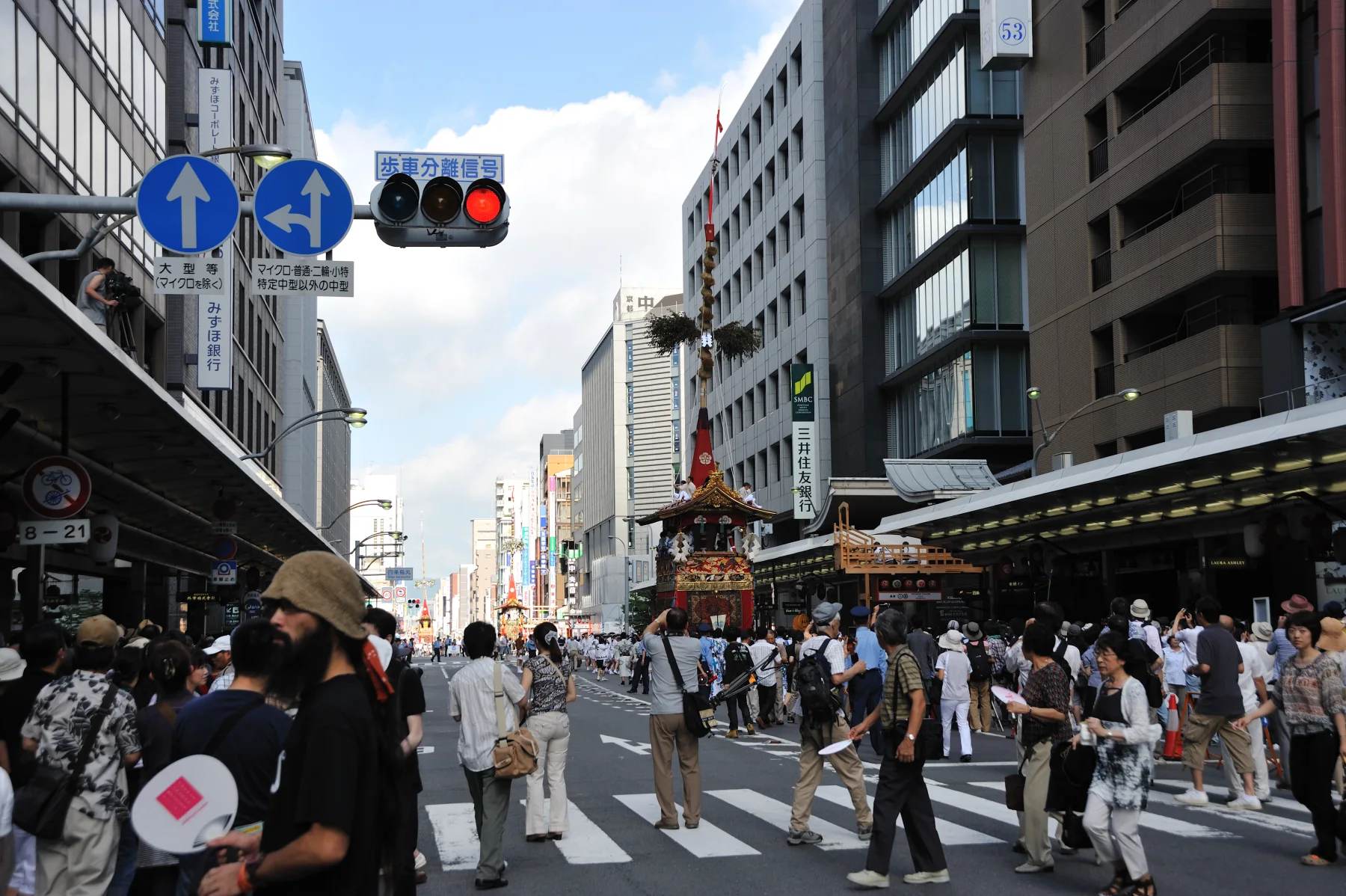
Planning Kyoto's Gion Matsuri in July? Compare Saki Matsuri and Ato Matsuri dates, Yoiyama lanterns and street stalls, Yamahoko Junko routes, reserved seating, mikoshi processions and return transport from Shijo-Karasuma or Gion-Shijo.
Gion Sits East of the Kamo River – Where Should You Head for Yoiyama?
Typing 'Gion' into a map app for the first time usually drops a pin at Hanamikoji or Yasaka Shrine on the east bank of the Kamo River. For Yoiyama float viewing, shift your map west across the river to Shijo-Karasuma. Using Shijo-dori as your east-west baseline, Muromachi-dori and Shinmachi-dori run just west of Karasuma-dori and hold many Saki Matsuri neighbourhood halls and street-level float displays. Heading east along Shijo-dori takes you past Teramachi and Kawaramachi and over Shijo-ohashi Bridge toward Yasaka Shrine. For Ato Matsuri, focus on the stretches of Muromachi-dori and Shinmachi-dori north of Shijo-dori, then add Ofune-hoko south of Shijo-dori as a separate stop. Searching by individual float names works far better as a walking target than typing 'Gion Matsuri venue'.
What visitors refer to as the 'yamahoko neighbourhoods' are the individual city blocks attached to each float. The float itself stands in the street, while its chokaisho (neighbourhood hall) sits alongside or a few doors down, with stewards guiding visitors at the entrance. Kyoto City's 2026 Yoiyama map marked both float locations and one-way pedestrian streets. Save a copy before you arrive so that when you see a street sign at an intersection, you know exactly which stretch ahead cannot be walked in reverse. Pairing the festival map (to see where foot traffic is allowed) with standard navigation (to read street names on the walk back) saves you from endlessly recalculating the shortest route.
When arranging to meet friends, use Shijo-Karasuma for orientation and choose a clear, accessible spot outside a shop or inside a hotel lobby nearby. Share both the junction name and the underground exit number when messaging your location. Shijo Station, Karasuma Station, Kyoto-Kawaramachi Station and Gion-Shijo Station all get casually shortened to 'Shijo' in texts, especially when people are travelling separately from Kyoto and Osaka, so specify whether you mean the underground, Hankyu or Keihan line. When phone battery is running low, a screenshot showing the shop name and intersection beats a live map pin that needs mobile data to load.
If you are staying on the east bank, plan around crossing the river just once before Yoiyama and once on the way back. If you want dinner before seeing the floats west of Shijo-Karasuma, eat before stepping into the busiest pedestrian zones. If you have booked dinner back in Gion, leaving the float districts still requires crossing Kawaramachi and Shijo-ohashi Bridge, so allow extra time in case you need to detour via an open crossing. When checking walking times, use your exact hotel or restaurant entrance rather than generic 'Shijo-Karasuma to Gion' endpoints.
What Can You See Before the Lanterns Go Up on the Floats?
Hoko construction relies on nawagarami, a traditional technique that binds timber joints tightly with thick rope rather than nails. As you walk past, look first at how the crossed beams are lashed together, then look up at the tall central mast, known as the shingi. Once the frame is in place, weavers' tapestries and ornaments are hung over the exposed timber, transforming how the same float looks between daytime assembly and Yoiyama evening. With children in tow, start with details at eye level – the rope knots, huge wooden wheels and carriage body – rather than standing in one spot waiting for an entire hoko to rise.
Once assembly finishes, some neighbourhoods hold hikizome (pulling trials) or kakizome (carrying trials). Check any street notice carefully to see whether the gathering point is within the side street or out on the main parade avenue. Around active work zones, stay strictly within areas marked open by stewards. When timbers are being hoisted, ropes tightened or wheels tested, photographers should step back behind the cordon as well. For younger children, watching the giant wheels roll down a short stretch of street gives a vivid sense of scale; standing directly in front of the tow ropes only blocks the crew.
To appreciate one float in depth, look at its structural craftsmanship during the day and then read the boards at its nearby hall. At Naginata-hoko, take note of the long halberd blade at the top and the textiles wrapping the lower frame. Both the blade and several tapestries in use are reproductions, while details of the originals are documented by the preservation association and the Kyoto City Tourism Association. Because the floats are assembled and dismantled outdoors every summer, the textiles must withstand sunlight and careful storage. Learning where each motif hangs is easier than memorising dates: walk around the front, sides and back to note the different patterns, and you will be able to spot them again from a distance on procession day.
Which Yoiyama Streets Should You Pick, and When Is the Calmest Time to Enter?
During Saki Matsuri, you can follow Shijo-dori past Naginata-hoko, Kanko-hoko and Tsuki-hoko, then turn into a neighbouring side street. For traditional townhouses and close-up ornament viewing, arrive on Muromachi-dori or Shinmachi-dori in daylight. If you want photographs of the illuminated komagata paper lanterns, wait until dusk and return to just one favourite float. Shooting while there is still a hint of light in the sky captures the outlines of the timber townhouses alongside the glowing lanterns, which also makes handheld smartphone shots far easier. If you simply want children to soak up a taste of the festival atmosphere, start at one float with a full row of lanterns and head to a pre-arranged indoor stop if the air feels stagnant or crowds build.
For Ato Matsuri, pair Kita-Kannon-yama and Minami-Kannon-yama along Shinmachi-dori. If you want to see the ship-shaped Ofune-hoko, check its official location south of Shijo-dori and plan a short walk down. Because Ofune-hoko serves as the final float in the Ato Matsuri procession, Yoiyama gives you a calm opportunity to see the full vessel along its home street. If you also want to catch the Hanagasa Junko procession, visit the western yamahoko neighbourhoods during Ato Matsuri Yoiyama so you can devote the next morning solely to Hanagasa instead of chasing two separate parades.
Anyone hoping to climb onto a float should check three separate listings: tojo (boarding the float), haikan (general viewing) and chimaki juyo (charm distribution). Some floats allow visitors aboard, which may require purchasing a ticket or receiving a designated charm. Access to the neighbourhood hall and access to the float itself can carry different rules, and the Kyoto City Tourism Association notes that certain floats restrict women from boarding under long-standing tradition. If you are travelling with toddlers, anyone with knee trouble or companions who prefer to skip steep ladders, choose floats that are rewarding from street level; those keen to climb can queue separately and agree to meet at an unobstructed spot near the exit. Daytime sessions are usually calmer for going inside, leaving evenings free for the lanterns.
The chimaki sold along the streets are protective charms wrapped in bamboo leaves to hang above your front door or eaves at home – unlike edible rice dumplings, they are not meant to be eaten. Both Yasaka Shrine and individual float neighbourhoods offer their own designs. To buy a chimaki from a specific float, note the float's full name, look for its juyosho (charm counter) and carry a little cash. Where historic merchant houses and shops display folding screens and heirlooms, you are looking at the Byobu Matsuri (Folding-Screen Festival). Pieces facing the street can be admired from outside; if you wish to step inside, check the entrance sign for admission fees, photography rules and entry flow.
When you are ready to leave a float during Yoiyama, put your phone away first and move with the pedestrian flow. When others pause to take photos, leaving half a step of space behind them keeps alleys moving far better than raising umbrellas or setting up tripods in narrow lanes. If you plan to eat from street stalls, step into designated stopping areas rather than juggling food while queuing for a neighbourhood hall. On the two Saki Matsuri evenings with stalls in 2026, the official guide listed eco-stations for returning reusable tableware; whenever those stations are operating, drop borrowed containers at the designated return points and sort other rubbish as signposted.
Where to See Float-Hall Displays, Folding Screens and Gion-Bayashi Music
When float ornaments are exhibited inside a neighbourhood hall, Japanese maps and timetables list this as kaisho-kazari. To study woven patterns and embroidery closely, check which halls are open and pick floats offering indoor displays. Naginata-hoko, for instance, hangs different tapestries across its front and side panels, which require craning your neck once mounted on the float. Seeing how an entire tapestry panel is composed at street level during Yoiyama daylight is far easier than shooting past rows of spectators on the move. When labels read 'restoration' or 'replica', read the accompanying notes to compare the preserved originals with the versions riding in the procession.
Visitors who spot Fune-hoko during Saki Matsuri should search separately for Ofune-hoko during Ato Matsuri so as not to confuse the two. Fune-hoko features a golden mythical geki bird at its prow and a dragon-carved rudder at the stern. Ofune-hoko, known as the Triumphant Fune-hoko, returned to the Ato Matsuri procession in 2014. If you only have one day during Saki Matsuri to walk from Shijo-dori into Shinmachi-dori, look up Fune-hoko; switch your schedule to Ofune-hoko if you are visiting for Ato Matsuri. The Kyoto City Tourism Association's float directory includes photographs of each float, helping you verify which vessel you are visiting and which end to look for.
The Byobu Matsuri folding-screen displays work well as a daytime activity. At the Nagae Residence in Fune-hoko-cho in 2026, special public openings ran across all three Saki Matsuri Yoiyama days, showcasing the townhouse's folding screens, hanging scrolls and plaques. Official hours that year were 10:00 to 20:00 JST (last entry 19:30 JST), with no advance booking needed for individual visitors. If dates vary in another year, consult that year's special-opening notice for exact dates and last admission. Pairing an indoor townhouse visit with the float standing in the same street lets you see two sides of one neighbourhood's festival heritage.
To hear Gion-bayashi music, seek out hoko or pulling-yama floats with onboard musicians. Some neighbourhoods also perform Hiyori Kagura on Yoiyama night to pray for clear skies the next morning, with most musical troupes walking from their home block to Shijo Otabisho, while Naginata-hoko's musicians march to Yasaka Shrine. If you want to hear the flutes, gongs and drums played from atop a float, arrive during that neighbourhood's scheduled performance window. If you prefer the roving Hiyori Kagura procession, confirm that the neighbourhood is holding it that evening and wait along a street edge where you can stand comfortably – listening to one troupe and then moving to another float lets you compare their rhythms without trailing the whole march.
Which Part of the Procession Should You Watch? Corners, Rituals or Specific Floats
On 17 July, the Saki Matsuri procession starts at Shijo-Karasuma, travels east along Shijo-dori, turns north onto Kawaramachi-dori and heads west along Oike-dori toward Shinmachi. On 24 July, the Ato Matsuri procession runs in reverse, starting at Karasuma-Oike, heading east along Oike-dori, turning south down Kawaramachi-dori and turning west along Shijo-dori. The 2026 official viewing guide scheduled departures at 09:00 JST for Saki Matsuri (23 floats) and 09:30 JST for Ato Matsuri (11 floats). Those times mark when the lead float sets off or passes the first checkpoint; if your main target sits further back in the order, allow extra waiting time for earlier floats to pass and negotiate the corners.
For Saki Matsuri's opening rituals, look toward Shijo-Sakaimachi for Kuji-aratame, where the drawn procession order is inspected, or check crowd controls near Shijo-Fuyacho to see the chigo page sever the sacred shimenawa rope from Naginata-hoko. Because the two spots sit close together and draw dense walls of spectators, pick one to wait for rather than pushing laterally through the crowd. If you are happiest watching the float decorations, tow teams and musicians pass smoothly, any open straight stretch along the route gives a clear view and makes choosing an exit direction much simpler.
Tsuji-mawashi is the dramatic moment when a towering hoko pivots at a major crossroads. Crew members lay split bamboo strips on the asphalt, douse them with water and haul the massive wooden wheels sideways in rhythmic bursts to swing the float onto the next avenue. For Saki Matsuri, key corners include Shijo-Kawaramachi, Kawaramachi-Oike and Oike-Shinmachi. When scouting a spot, check first whether you can see the road surface, as well as which way the floats enter and leave; standing several rows back often lets you see the upper spire swinging while hiding the bamboo and wheels entirely. If your priority is studying the tapestries or photographing the front of each float, a straight stretch facing oncoming floats is more practical.
If you are waiting for specific floats, save the latest procession order onto your phone. Naginata-hoko always leads Saki Matsuri, while Hashi-Benkei-yama and Ofune-hoko open and close Ato Matsuri – all three are kuji-torazu floats with fixed positions exempt from the draw. Representatives from the remaining neighbourhoods draw lots in early July to set the rest of the order. With children at Saki Matsuri, look out for Toro-yama and its mechanical mantis perched on the roof; at Ato Matsuri, look for Hashi-Benkei-yama depicting Benkei and Ushiwakamaru meeting on Gojo-ohashi Bridge. Koi-yama's leaping carp is another easy figure to spot. Picking one favourite float together at Yoiyama makes watching the procession far more engaging than ticking down a full list.
Once you settle on a viewing spot, plan how you will stay and how you will leave. Broad Oike-dori gives you room to stand further back and take in the full height of the floats, whereas Shijo-dori's covered pavements carry shopfronts and through-pedestrians where you must follow marked walkway lanes. If your next stop is Kyoto Station, stand on a side with direct access to the Karasuma Underground Line; if you are heading to Higashiyama, factor in time to cross the river. Once pedestrian controls take effect, reaching even the opposite pavement may require walking to an open crossing, so be prepared either to wait until the junction reopens or to eat on the side where you watched.
Watching Free from the Pavement vs Buying Reserved Seats
Standing along open stretches of the parade route is completely free. Official paid reserved seating makes sense if you want to avoid standing for long spells or need your whole party seated together. In 2026, the Kyoto City Tourism Association's reserved seats lined Oike-dori, with different blocks and arrival windows for Saki Matsuri and Ato Matsuri: Saki Matsuri seating spanned Kawaramachi-dori to Shinmachi-dori, while Ato Matsuri seating covered Karasuma-dori to Takakura-dori and Teramachi-dori to Kawaramachi-dori. When reading the seating map, check your block first and then note which cross-street serves as your check-in entrance. According to the association's ticketing FAQ, seat numbers are assigned automatically by the system and shown on the confirmation screen prior to payment; once you check the map, cross-reference the day's transport notice so you enter from a station on the right side without having to cross the procession path.
General ticket sales for 2026 opened at 10:00 JST on 1 June, a useful benchmark for when to check the official website for future seasons. Decide which procession and how many seats you need before sales open, because the official FAQ states that completed bookings cannot be changed, cancelled or adjusted in quantity. Anyone sensitive to heat should study the block orientation carefully: while reserved zones provide seats, exposure to sun depends on your section, the hour and available shade. Use the listed 'lead float passing' time on your ticket page to gauge sun exposure and total waiting time, and follow the assembly instructions for entry.
If some members of your group only want to watch a few floats while others want to stay until the end, consider splitting up. Those who need a seat can take their places in the reserved zone while companions happy to stand roam an open stretch nearby and meet up for lunch afterwards. Because crossing cordoned avenues depends on controlled release intervals, choose a lunch spot on the same side of the route. If anyone in your group uses a wheelchair or needs a lift, check before leaving the underground which step-free exit leads directly to your assigned seating entrance so you do not emerge from a lift only to meet a closed junction.
Morning Floats and Evening Mikoshi: Which Side Should You Choose?
The Gion Matsuri grew out of the Gion Goryo-e, a rite held to appease spirits and ward off pestilence. On a traveller's schedule, the morning yamahoko float procession and the evening mikoshi portable shrine procession from Yasaka Shrine occupy separate slots, reflecting their paired roles: the floats purify the city streets beforehand, and the mikoshi carry the deities out and back. On Saki Matsuri day, Yasaka Shrine's three mikoshi depart in the early evening, wind through their respective parish districts and finish at Shijo Otabisho near Shijo-Teramachi. You can watch the departure ceremony outside Yasaka Shrine's gate or see the portable shrines arrive one by one near Otabisho – picking one end is plenty.
On 24 July, Kanko-sai returns the three mikoshi from Shijo Otabisho back to Yasaka Shrine along separate routes, reaching the shrine later at night. If you only want to catch a brief glimpse, pick a spot along one of the routes on the same side of the river as your hotel so you can walk straight back when you are ready. If you plan to wait for the mikoshi to arrive at Yasaka Shrine, book dinner on the east bank and work backwards from the last train on your return line. If you are travelling back to Osaka and need to change lines at another hub, leave extra buffer time for station exits and transfers.
Mikoshi-arai (the portable shrine washing ritual) also takes place on 10 and 28 July. According to Yasaka Shrine's calendar, the Naka-goza mikoshi is carried to Shijo-ohashi Bridge and purified with water drawn from the Kamo River and blessed by priests. If your trip misses both float processions, these two dates offer a memorable riverfront ritual instead. For a quieter morning walk through the shrine grounds, aim for the Eki Shrine Nagoshi-sai on 31 July on the east bank. Visiting late in the month is also a good moment to read Yasaka Shrine's displays on Somin Shorai, linking back to the origins of the chimaki charms hanging in the float neighbourhoods.
On the morning of 24 July, the Hanagasa Junko procession also takes place, featuring flower parasols, children's performing troupes and traditional dedication groups marching toward Yasaka Shrine for celebratory performances on arrival. Because the Yamahoko Junko and Hanagasa Junko can overlap in timing, split up if some of your group want to see Ofune-hoko bring up the rear while others prefer the shrine performances, then meet around midday. If you hope to see both yourself, pick an early vantage point for the first procession and compare both official maps to calculate walking routes and road closures – and if closures block your way to the second spot, stop indoors for a rest instead.
Choosing Between Shijo, Karasuma-Oike, Kawaramachi and Gion-Shijo
From JR Kyoto Station, take the Karasuma Underground Line to Shijo Station for Saki Matsuri Yoiyama or the Shijo-dori stretch of the parade. Hankyu's Karasuma Station sits right at the same junction, making it the direct stop if you are arriving from Osaka-Umeda to see the floats west of Karasuma-dori. For watching the procession along Oike-dori, use Karasuma-Oike Station or Kyoto Shiyakusho-mae Station on the Tozai Line, aligning your exit with the block where you plan to stand. Karasuma-Oike is also the interchange between the Karasuma and Tozai lines, handy if part of your group is heading to the east bank after lunch while others return to Kyoto Station.
Hankyu Kyoto-Kawaramachi Station sits on the west bank of the Kamo River and Keihan Gion-Shijo Station sits on the east bank, with Shijo-ohashi Bridge linking the two. If you are staying along the Keihan Line from Osaka and focusing on Yasaka Shrine rituals, Gion-Shijo is the most direct choice. When you want to avoid crossing the river via packed junctions, look for a return station on whichever bank you are already standing on. Keihan Sanjo Station and Tozai Line Sanjo-Keihan Station sit by the next major bridge north; if you divert toward Sanjo on the spur of the moment, check the operator and train destination first so you head down the right entrance for Keihan or the Tozai Line.
In 2026, the Kyoto Municipal Transportation Bureau ran extra temporary buses between Kyoto Station and Shijo-Kawaramachi on procession days while detouring several regular city bus routes. To judge which buses are running smoothly in any given year, check the festival detour notice directly to verify both boarding and alighting stops. Double-check revised stop names and locations before heading back, particularly if your outbound and return journeys fall at different times of day. If you have a Shinkansen connection or a timed booking, walk toward an underground station early to allow time for concourse transfers; whenever buses are disrupted, the underground and private railways remain the most reliable fallback.
Choose your hotel with the return walk in mind. Staying around Shijo-Karasuma or Karasuma-Oike makes it easy to pair Yoiyama with the next morning's procession and slip back to your room for an afternoon break – if a listing says it is close to the underground, check which side of the procession route the hotel entrance sits on. If you plan to watch the mikoshi return to Yasaka Shrine at night, staying on the Gion side saves a late-night river crossing. If you are catching an early Shinkansen or leaving Kyoto straight afterwards, staying near Kyoto Station saves wheeling luggage across festival streets. For companions arriving late in the evening, send them the hotel's Japanese name and clear directions for an approach road open at night.
Beating the July Heat or Rain: How to Save the Best Part of Your Day
Kyoto City's summer heat guidance recommends staying hydrated, resting often and spending the hottest hours somewhere cool. A morning procession may look brief on paper, yet waiting for both the lead float and the tail end keeps you standing outdoors in full summer humidity. If the forecast is scorching, watch just a few floats near the start or catch a short middle section, then head indoors by midday. Wear breathable clothing and supportive walking shoes, and fill water bottles before entering cordoned areas. Close umbrellas in dense crowds and rely on a sun hat instead. Even after sunset, Yoiyama streets with little breeze can feel stifling; if anyone in your group feels dizzy or unwell, step out of the crowd into a cooled space immediately and ask stewards for help if needed.
When visiting with young children or older relatives, a reliable meeting spot matters more than squeezing in extra floats. Pick a sit-down cafe or restaurant first, then choose the nearest yamahoko around it. If anyone needs lifts, look up the lift-equipped exit for your return station before setting out and save a backup access point on the same side of the avenue. With a pushchair, leave narrow side streets via wider avenues back to the station rather than squeezing against oncoming foot traffic. If you want photos in a yukata, keep the outdoor shoot to a short window before dusk and wear comfortable footwear; across two consecutive festival nights, pack light, breathable clothes you can walk straight back to the hotel in on the second evening.
If rain arrives, check the Kyoto City Tourism Association and Yasaka Shrine notices first for any schedule changes to the specific event you plan to attend, and check the issuing channel for any float-boarding tickets, reserved seats or museum bookings. In light rain when the procession goes ahead, a lightweight poncho keeps your hands free and avoids blocking views with umbrellas behind the front row. If thunder or heavy squalls hit, move straight indoors. After watching along Oike-dori, The Museum of Kyoto at Sanjo-Takakura is an easy refuge – its standard access is around a three-minute walk from Exit 5 of Karasuma-Oike Station, following whichever station exits are open on festival days. Manga fans can also check the day's opening calendar for the Kyoto International Manga Museum just north of Karasuma-Oike.
If you want riverside dining on a Kamogawa noryo-yuka terrace after Yoiyama, book ahead and work backwards from your reservation time to leave the floats early. Kamogawa platforms run along the west bank between Nijo and Gojo, while Kibune's kawadoko platforms sit north of the city in Rakuhoku. Pontocho keeps you conveniently on the Kawaramachi side, ideal for stepping away from Yoiyama straight into dinner; ask the restaurant when booking whether wet-weather seating moves indoors and whether tables with chairs are available. Kibune requires taking the Eizan Electric Railway to Kibuneguchi and connecting by bus, so if you plan to catch an evening mikoshi procession, dining in central Kyoto makes for a far calmer evening. Watching floats in the morning, napping at your hotel in the afternoon and heading back out for the evening rituals makes for a well-paced day.
Planning Gion Matsuri with Half a Day, One Evening or Two Days
With only one morning, commit to either Saki Matsuri or Ato Matsuri and keep lunch and your onward transport on the same side of the route. For the 17 July procession, for instance, take the underground to Shijo if you want to catch Naginata-hoko near the open early stretch, or start later along the middle-to-late stretch on Oike-dori and wait for the floats to arrive. Once you have seen the floats you came for, exit toward the nearest open side street; if your bags are stored at Kyoto Station, look for lunch near the Karasuma Line to avoid crossing Kawaramachi an extra time.
With just one evening, pick either Saki Matsuri for lanterns and street stalls or Ato Matsuri for quieter float neighbourhoods. Start with an early dinner near your arrival station, then walk toward one specific float you most want to see. Let your group's stamina decide how many floats to visit, whether to queue for a neighbourhood hall and when to head back. Staying across the Kamo River is fine as long as you factor bridges and detours into the walk back and save screenshots of two reachable stations. If anyone in your party struggles with heat, arrive while there is still daylight, stroll a short stretch and step into an air-conditioned restaurant – once seated, you can decide whether to head back out after dark.
With two full days, spend the first afternoon visiting neighbourhood hall displays and the Byobu Matsuri folding screens, stroll a nearby block after dinner to see the lit lanterns, and take up your morning viewing spot for the next day's procession. On Saki Matsuri days, if energy holds, rest at your hotel in the afternoon and head to the east bank in the evening to watch Shinko-sai set off from Yasaka Shrine. On Ato Matsuri days, choose between Ofune-hoko and Hanagasa Junko in the morning, then keep the early evening for Kanko-sai. Seeing towering floats glide along Shijo-dori in the morning and shoulder-borne mikoshi surge through the same streets at night reveals both halves of the festival's rhythm.
A few useful answers
For a first visit to Kyoto's Gion Matsuri, should I pick Saki Matsuri or Ato Matsuri?
Choose Saki Matsuri on 17 July if you want the larger procession of floats and Naginata-hoko at the front. Choose Ato Matsuri – with Yoiyama evenings from 21 to 23 July and the morning procession on 24 July – to see Ofune-hoko, Hashi-Benkei-yama and calmer lantern-lit side streets in the western float neighbourhoods. If street food stalls are a must, pick one of the Saki Matsuri Yoiyama evenings officially listed with stalls for that year.
Which station should I get off at for Yoiyama?
For the main yamahoko float neighbourhoods, use Shijo Station on the Kyoto Underground or Hankyu Karasuma Station. For Ato Matsuri floats north of Shijo-dori, Karasuma-Oike Station is an easy walk. For rituals at Yasaka Shrine, take the Keihan Line to Gion-Shijo Station and walk east.
Do I need a ticket to watch the Yamahoko Junko float procession?
No – standing along open stretches of the pavement is free. If you prefer a guaranteed seat, check the Kyoto City Tourism Association's reserved-seating ticket page and choose by procession date, seating block and arrival time.
Which days can I see the mikoshi portable shrine processions?
During Shinko-sai on the evening of 17 July, the three mikoshi leave Yasaka Shrine and reach Shijo Otabisho at night. During Kanko-sai from early evening on 24 July, they leave Otabisho along separate routes and return to Yasaka Shrine late at night.
What else can I see in July if I miss 17 July and 24 July?
Look for float assembly, pulling trials or Yoiyama evenings in the days leading up to either procession. Mikoshi-arai (portable shrine washing) takes place on 10 and 28 July, and the Eki Shrine Nagoshi-sai purification ceremony is held inside Yasaka Shrine on 31 July.
Official information and references
Sources used in this guide.
- Kyoto City Tourism Association | Gion Matsuri Schedule and Yamahoko Junko Route
- Kyoto City Tourism Association | 2026 Gion Matsuri Event Calendar
- Kyoto City Tourism Association | 2026 Saki Matsuri and Ato Matsuri Yoiyama Guide
- Kyoto City Tourism Association | Yamahoko Float Directory and Festival Glossary
- Kyoto City Tourism Association | Yamahoko Junko Paid Reserved Seating
- Kyoto City Tourism Association | Gion Matsuri Viewing and Ticketing FAQ
- Kyoto City Tourism Association | Nagae Residence 2026 Byobu Matsuri Public Opening Notice
- Yasaka Shrine | Origins of Gion Matsuri, Mikoshi Processions and Chimaki
- Yasaka Shrine | Gion Matsuri Shinto Rituals and Mikoshi Schedule
- City of Kyoto | 2026 Yoiyama Map and Crowd Control Notice
- Kyoto Municipal Transportation Bureau | 2026 Gion Matsuri Extra Services and Bus Detours
- Kyoto Municipal Transportation Bureau | Kyoto Underground Station Layout Maps
- City of Kyoto | Summer Heat Illness Prevention Guidance
- The Museum of Kyoto | Access and Location
- Kyoto City Tourism Association | Kamogawa Noryo-yuka and Kibune Kawadoko Dining