Use the November 2–4, 2026 route map to identify four dry-lacquer floats, choose the evening procession or Nishinohama sand entry, and plan temporary bus stops, parking exits, and an overnight stay.
- Region & Focus
- Karatsu
- Reading Scope
- 36 min read · 17 chapters · 5 Q&As
- Official Verification
- 8 official sources checkedUpdated November 9, 2026
- Key Topics
- SeasonsItinerariesKyushu
Chapter Route Map (tap any stop)
- Choose your half-day first, then decide whether to return to Fukuoka
- Allow time for the other 13 floats after the scheduled start
- Paper, hemp cloth, and lacquer: study the surface and the movement
- Start with Katanamachi’s Red Lion, the reference point for the timetable
- Zaimokumachi’s Turtle and Urashima Taro: read both levels
- Uoyamachi’s Sea Bream: compare a whole fish with a lion’s head
- Komeyamachi’s Shuten Doji and Minamoto no Raiko’s Helmet: untangle the layers
- November 2 evening procession: watch the joining floats and stay for the finish
- November 3 at the Otabisho: make the sand entry your main activity
- November 4 town procession: daylight shapes and a midday stop in Komeyamachi
- Save five separate landmarks: station, shrine, Otabisho, Alpino, and temporary bus stop
- A workable Fukuoka day trip: November 3 entry and the 4:00 p.m. bus home
- Stay in Karatsu on November 2: leave luggage first and plan checkout around the Otabisho
- Three days of bus detours: replace the usual stops for Yobuko and Fukuoka
- Driving: check the exit deadline, because free parking has no shuttle
- Watch from a position you can leave: corners, ropes, and your group
- Outside festival dates: see the craft at the exhibition hall in Alpino
- Quick Q&A
For one day from a Fukuoka base, choose the Otabisho float entry at noon on November 3. To see the lantern procession on November 2 through its finish, stay overnight in Karatsu. Learn four float shapes first, then use the 2026 route map and temporary bus stops to plan viewing, departure, and luggage.
Choose your half-day first, then decide whether to return to Fukuoka
Each of Karatsu Kunchi’s three days offers a different reason to stay. On November 2, lanterns light the floats as they enter town at night. At noon on November 3, wheels enter the sand at Nishinohama and teams pull the floats into the Otabisho ritual resting place. On November 4, daylight makes town names and shapes easier to identify along the street procession. For a single day from Fukuoka, I would choose the noon entry on November 3 and return in the afternoon. If the lanterns and the final return matter most, stay in Karatsu on November 2.
The city’s October 6, 2026 announcement gives departure times of 7:00 p.m. on November 2, 9:30 a.m. on November 3, and 10:00 a.m. on November 4. The November 2 start is 30 minutes earlier than in 2025. November 3, 2026 is a Tuesday and Culture Day, so use holiday transport arrangements. Write down the full travel date before choosing a viewing period. This avoids using last year’s evening start or a weekday bus connection.
Choose one scene you most want to see, then fit lunch and travel around it. Keep noon free at the Otabisho for the sand entry. Choose the daytime street procession to study figures and decorations layered on helmets. If both appeal, stay on November 2 and continue watching on November 3. Use that extra night for the evening and next day’s festival; give the castle, kilns, and Yobuko harbor their own itinerary.
| Date | Main time and scene | Itinerary choice |
|---|---|---|
| Monday, November 2 | Evening procession from 7:00 p.m.; floats join en route; first float reaches Alpino around 9:30 p.m. | Stay in Karatsu to see the finish |
| Tuesday, November 3 (Culture Day) | Shrine procession departs 9:30 a.m.; Otabisho entry from noon; departure from 3:00 p.m. | Focus a Fukuoka day trip on the noon entry |
| Wednesday, November 4 | Town procession from 10:00 a.m.; midday assembly in Komeyamachi; departure at 2:30 p.m. | Study shapes in daylight during a morning or afternoon stretch |
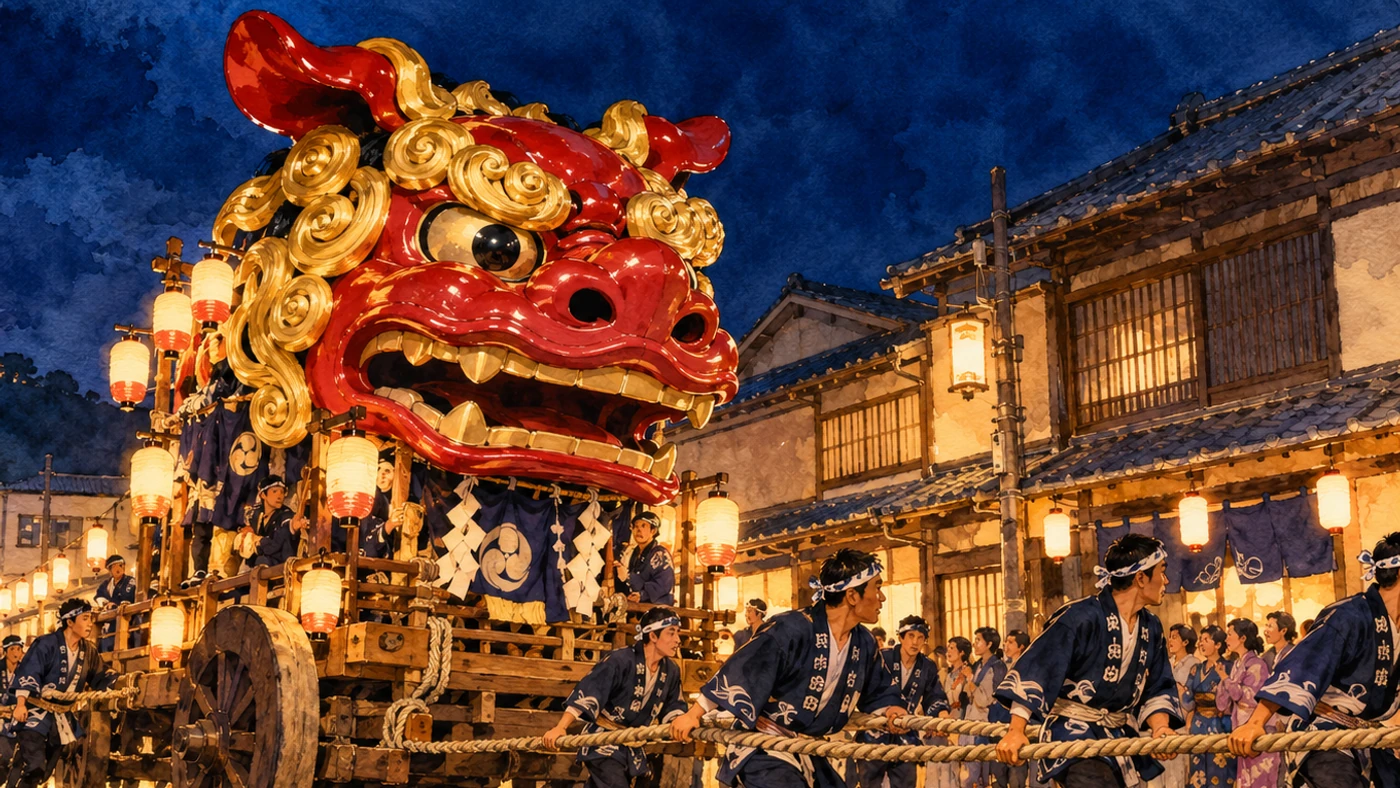
Use the November 2–4, 2026 route map to identify four dry-lacquer floats, choose the evening procession or Nishinohama sand entry, and plan temporary bus stops, parking exits, and an overnight stay.
Allow time for the other 13 floats after the scheduled start
The city’s festival guide ties every scheduled time to the first float, Akajishi, the Red Lion. All 14 take about 50 minutes to pass. The noon entry on November 3 means the line begins entering then. Likewise, the 4:40 p.m. return time on November 4 does not mean the entire procession has dispersed and visitors can immediately board transport. Those 50 minutes affect how long you watch. Add the walk out of the crowd when choosing a departure.
For a first visit, stay at one stretch of street open to spectators and let the floats pass in order. This makes their differences easier to recognize than rushing to another corner after the Red Lion. Pullers and steering crews need working space behind each float. An apparent gap between floats may still be part of the procession. Follow staff directions when changing position, and allow one full waiting period in the itinerary.
If someone in your group wants to stand for only half an hour, choose a few floats and leave while everyone still has energy. Those who want all 14 can stay for the full line. Agree on this and a meeting point before entering the crowd. Separate seeing a favorite shape from seeing every float, so each person gets what matters to them and the next transport leg has a clear starting point.
Paper, hemp cloth, and lacquer: study the surface and the movement
These huge lions, fish, and helmets use dry-lacquer construction. Karatsu Shrine’s account of the process describes a wooden frame and clay model, followed by repeated layers of washi paper, hemp cloth, and lacquer, then gold and silver decoration. Look at the joins between curves, raised forms, and decoration. Notice how the same layered method creates the different outlines of a lion’s head, a fish, and overlapping figures.
Daylight makes the full form easier to see. At night, lanterns draw attention first, making the outline and direction of travel useful points to follow. When seeing the same float twice, there is no need to repeat its history. Study head-to-body proportions by day; at night, watch how it appears, turns, and leaves within the width of the street. A different viewing question gives each period its own purpose.
The floats and the festival event have separate cultural-property designations. The city lists the 14 floats as Important Tangible Folk Cultural Properties of Saga Prefecture, and the float event as a nationally designated Important Intangible Folk Cultural Property. In 2016, the event joined UNESCO’s Intangible Cultural Heritage list as part of Japan’s Yama, Hoko, Yatai float festivals. You can see both preserved craft and the people who keep it moving through the streets. Watch the ropes, wheels, pullers, and festival musicians together with the shapes.
Festival footage from November 2–3, 2024 on Karatsu City’s official channel, to accompany this section’s introduction to float shapes and procession movement.
Start with Katanamachi’s Red Lion, the reference point for the timetable
Katanamachi’s Akajishi, the Red Lion, was made in 1819. It begins the surviving float tradition and leads the procession. The shrine records 15 floats made from then through 1876; one was destroyed in the middle of the Meiji period, leaving 14 today. This order lets you recognize the start by the Red Lion, then see how other towns follow. The procession continues for some time after you photograph the first float.
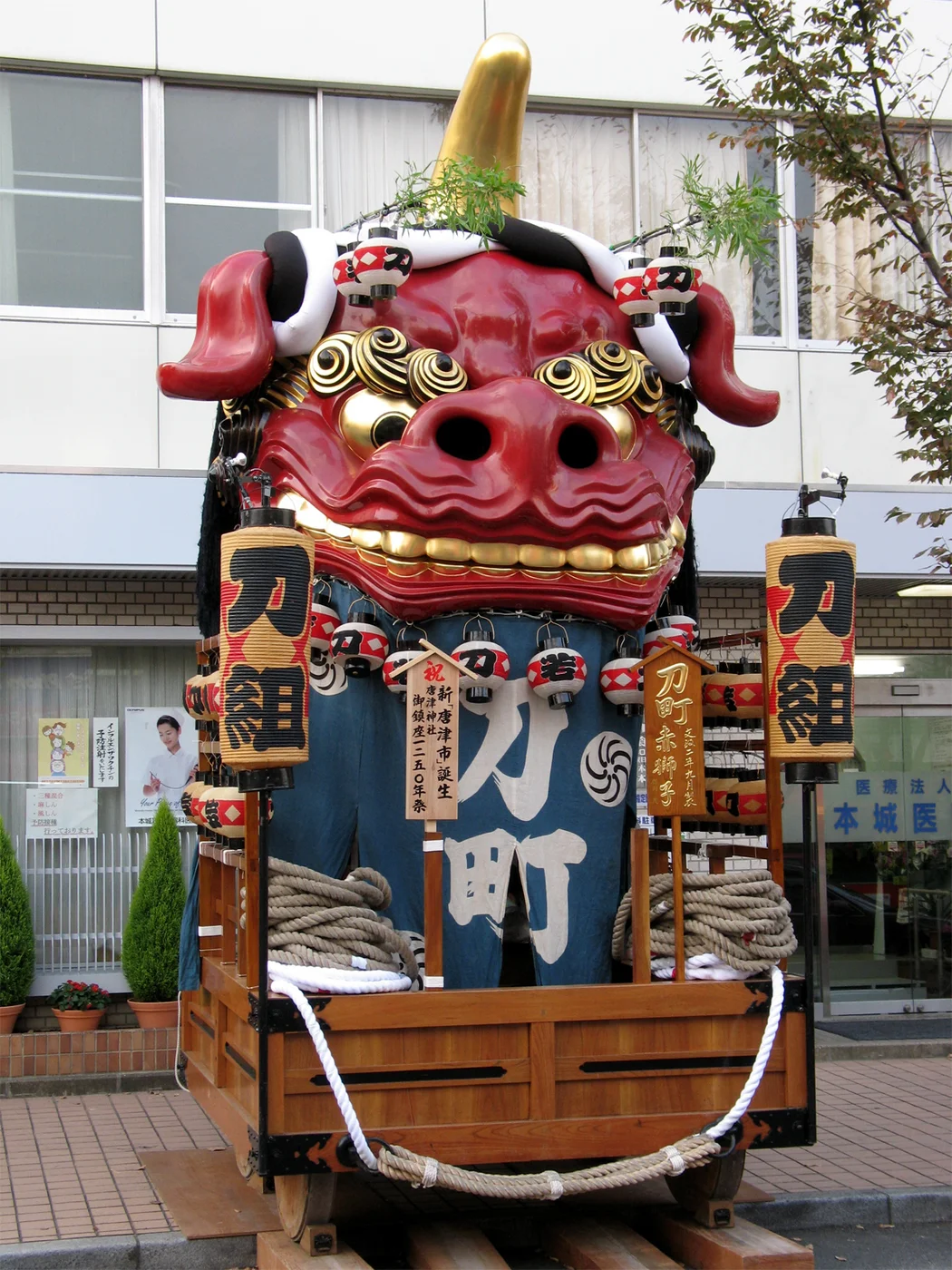
A lion’s head is a clear first identification exercise. Find the overall head shape, then look down at how much space the float, carriage, and pullers occupy. Spotting the red head from afar and seeing the entire float pass are two different viewing scales. Where your position allows, leave some distance so the upper form and the people pulling below fit within one view.
A Red Lion also appears as a ceramic statue outside Karatsu Station’s north exit. Its material and purpose differ from those of the festival float. Use the station statue as a landmark. The moving festival float was dedicated by Katanamachi and made with paper, lacquer, and other materials. For the statue’s connection to pottery, continue to the Nakano Tochi Kiln section of the Karatsu culture-day guide. For this festival visit, focus first on the actual lead float.
Zaimokumachi’s Turtle and Urashima Taro: read both levels
Zaimokumachi’s Turtle and Urashima Taro was made in 1841. It places a human figure and an animal on one float, giving you a different reading order from a single lion’s head. Find the turtle below, then look up for Urashima Taro and see how the two subjects form a whole. From a spot showing only the upper half, you may remember just the human figure. A fuller view reveals the relationship of one carrying the other.
The shrine catalog preserves a historical clue worth bringing to the street. An early description calls it Turtle and Jewel, and Tomino Kien’s painting of the Karatsu shrine festival procession records that form. A familiar-looking folktale figure thus gives you a question to investigate in earlier pictures. The visual record and today’s name each have their own origins. Reading the catalog before watching adds more than treating every subject simply as a myth.
At the evening procession, follow its overall outline as it approaches from afar. In daylight, compare the size and relative positions of the figure and turtle. Pair it with the Red Lion: one combines two characters, while the other concentrates on a huge head. Remember that difference and you have a practical way to identify them even without time to read the town names.
Uoyamachi’s Sea Bream: compare a whole fish with a lion’s head
Uoyamachi’s Tai, the Sea Bream, was made in 1845. After the lion’s head, turtle, and human figure, the subject becomes an entire fish. Find the direction of its head and body, then see how its outline appears as it turns. Stay in one place and let it pass naturally to see front and side views in sequence, without following it into the road.
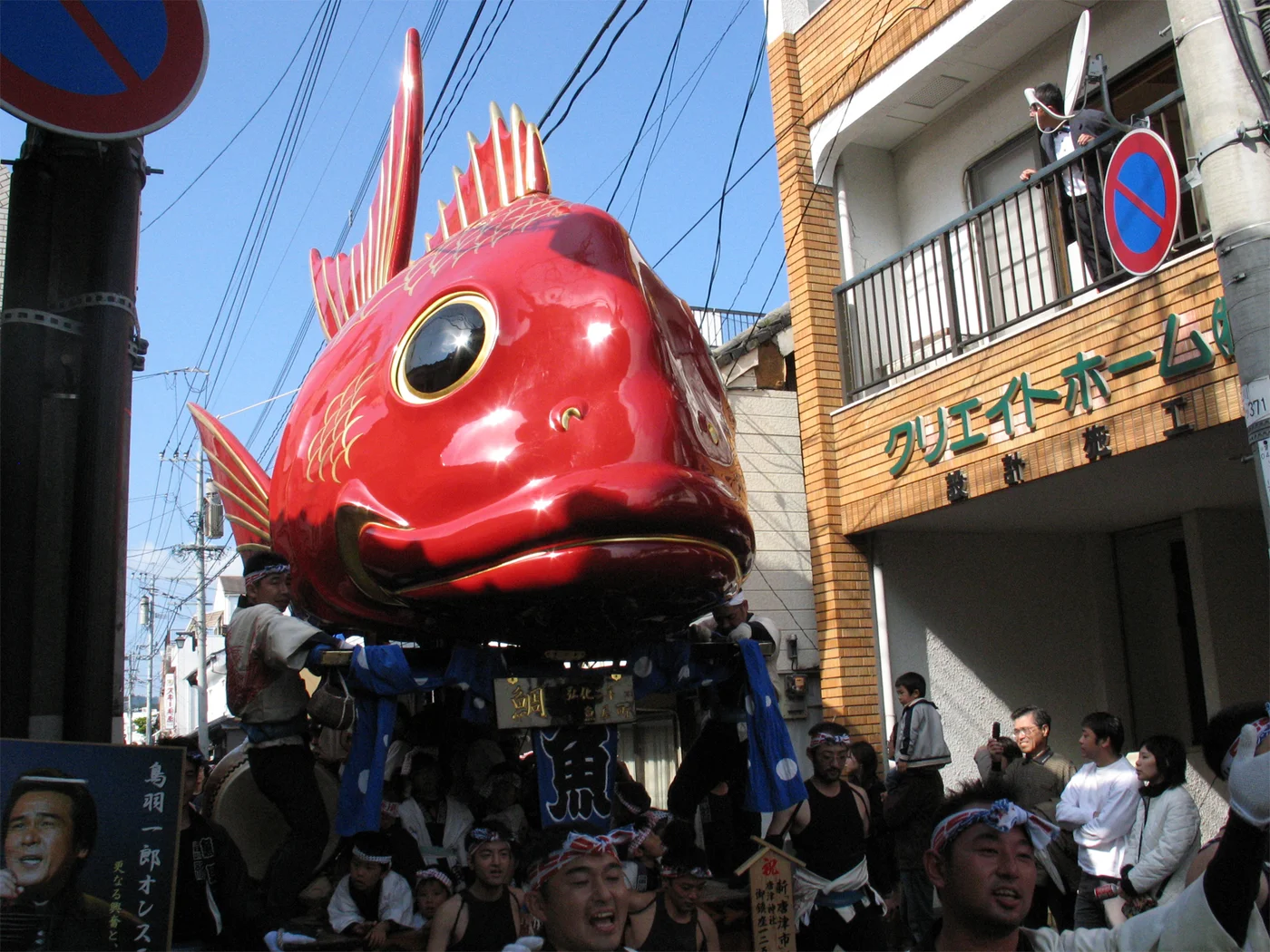
The shrine records different accounts of the subject’s origin, including a fish representing Uoyamachi and a sea bream used as an offering. Recognize the fish first, then read these two local traditions to connect the shape with the town’s life. With children, ask which body parts they can find on this and the turtle float. Adults can study how the same construction supports two different outlines. One float can engage different ages.
Komeyamachi’s Shuten Doji and Minamoto no Raiko’s Helmet: untangle the layers
Komeyamachi’s Shuten Doji and Minamoto no Raiko’s Helmet was made in 1869. Its subject comes from the defeat of the demon at Mount Oe: Shuten Doji’s severed head bites Raiko’s helmet. The shrine catalog describes this action clearly. Find the helmet first, then the head attached to it, to understand why the upper outline differs so much from a lion’s head or fish.
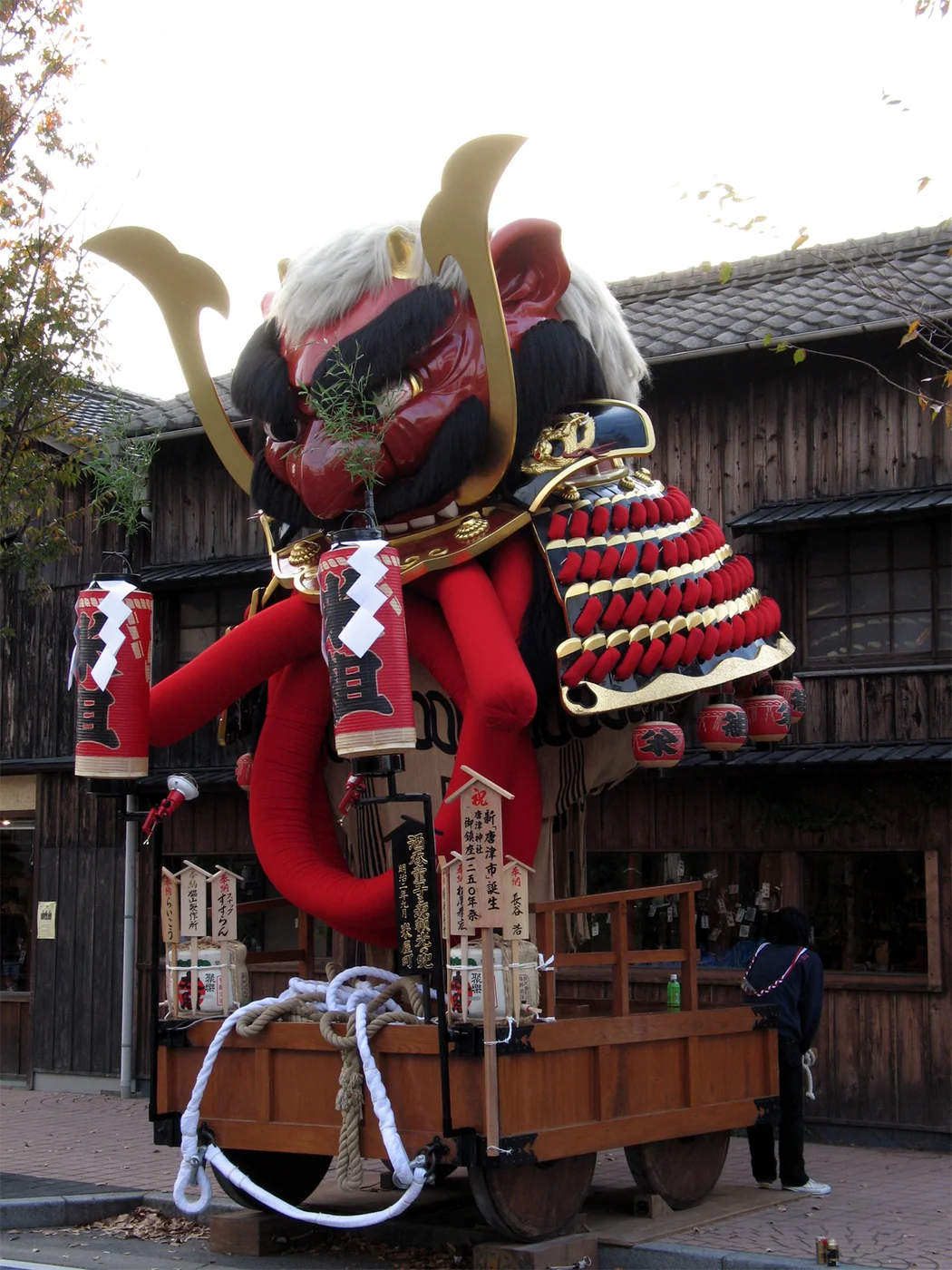
Give this float some daylight viewing. Its figures overlap, so from far away you may remember only a large head. The story explains the action. From an open spectator area, watch it approach, pass, and leave from another angle to connect the two parts. For photos, wait until the outlines are clearer. Take fewer pictures and leave time to look directly.
One question for each of four floats is enough: how does the Red Lion enlarge a head; how do the Turtle and Urashima Taro combine upper and lower characters; how does the Sea Bream show a whole fish; and how does Shuten Doji’s Helmet tell a story through overlap? Watch the remaining floats in sequence, then return to the shrine catalog for boats or other helmets that interest you. For a first festival, noticing differences between a few craft objects is more memorable than checking all 14 names.
November 2 evening procession: watch the joining floats and stay for the finish
The 2026 evening procession starts at Oteguchi at 7:00 p.m. Six floats set out first; eight more join from their towns along the route. Early on, you see the procession forming. Near the end, it is easier to watch the full line continuously. To identify all 14 at once, consider the joining order when choosing a spot. A start at Oteguchi does not mean all 14 occupy the same street from the first minute.
The city’s 2026 route map takes the night route to Alpino and the Hikiyama Exhibition Hall near Karatsu Station, where the first float arrives around 9:30 p.m. This endpoint helps with planning. If staying near the station, identify the north side, Kyomachi, and your accommodation entrance in daylight. Leave luggage at the accommodation and carry only what you need for walking and watching, making it easier to decide where to finish.
Watching the opening at Oteguchi and waiting for the full line near the end use the evening differently. The first lets you finish earlier if you only want a stretch of lantern-lit procession. For the latter, eat before the procession and expect a later bedtime. If dinner is included in your stay, ask about the last serving time and how to re-enter after going out before choosing a viewing location. Avoid a fixed dinner slot that overlaps your chosen procession.
For the Karatsu-go bus back to Fukuoka, the April 2026 regular timetable gives the last Oteguchi departure as 8:50 p.m. The temporary festival stop uses that time, while the first float reaches Alpino only around 9:30 p.m. Stay overnight in Karatsu to see the final stretch. If leaving by train, check JR Kyushu destinations and transfers for your travel date. Recording a train to Chikuzen-Maebaru is not enough; check the onward connection to your accommodation’s station in Fukuoka.
November 3 at the Otabisho: make the sand entry your main activity
At 9:30 a.m. on November 3, the portable shrine and floats leave Karatsu Shrine, pass through the castle town, and head to Nishinohama Otabisho. The shrine explains the floats’ origins through offerings to and protection of the portable shrine. Seeing both helps explain why the procession heads toward the sea. Watch the morning departure for the ritual context, or focus on the Otabisho if the action on sand matters most.
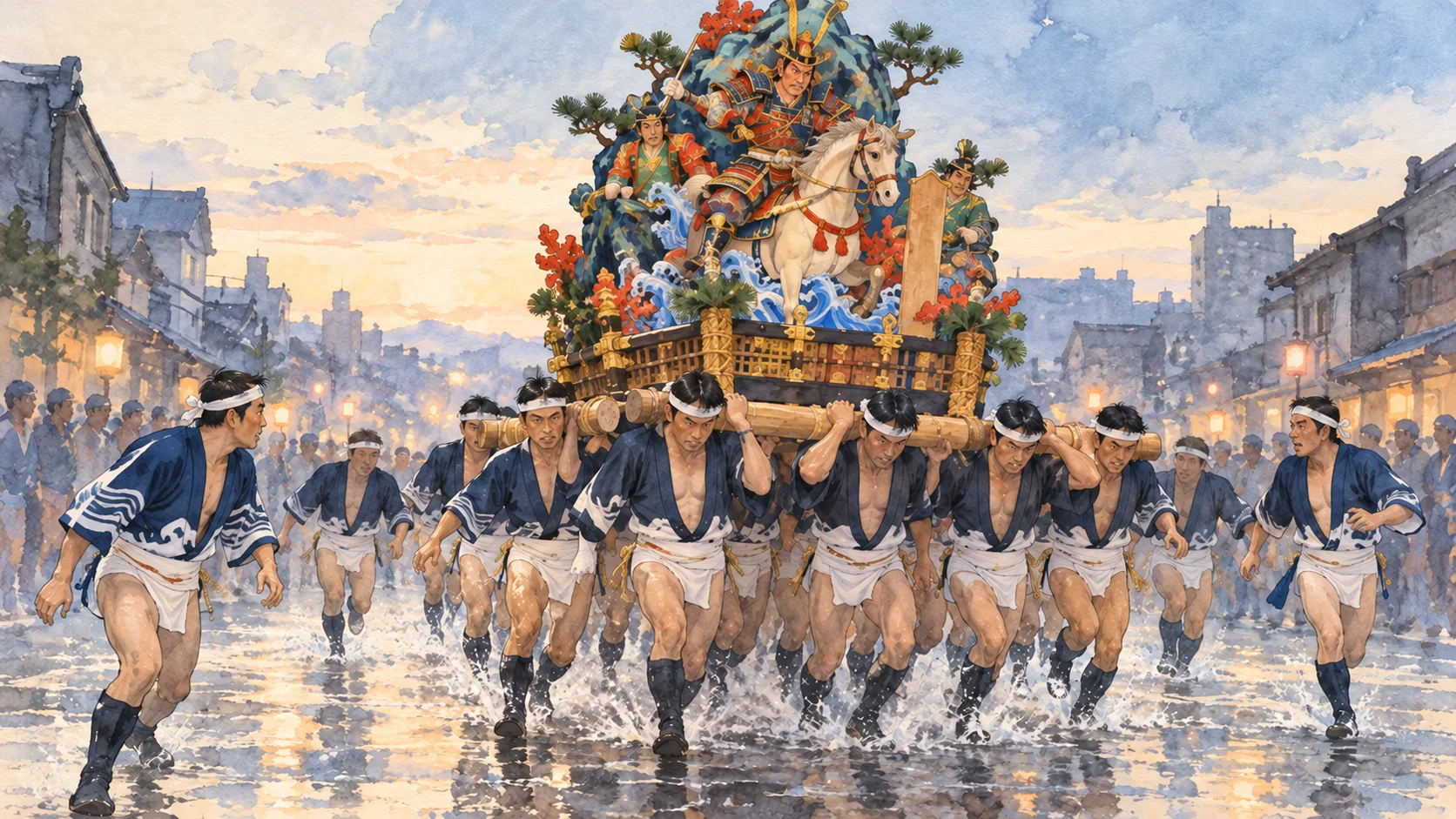
Entry to the Otabisho starts at noon, and departure starts at 3:00 p.m. Once the several-ton floats leave the road for sand, the wheels sink and the teams must pull together. This is the scene that differs most from an ordinary street procession. Shift your attention from the ornate upper form to the wheels, then follow ropes and pullers moving together. Watching the process from an authorized area shows more of the entry than waiting only for a stationary photo.
Handle breakfast, restrooms, and the walk to Nishinohama in the morning, then keep a full viewing period free near noon. Thirteen floats follow the first. Eat lunch after your chosen part of the line. For an afternoon return to Fukuoka, treat the noon entry as the main event and decide on the afternoon departure according to remaining time. If staying for both, rest nearby at midday rather than tiring yourself with a round trip through town.
The current city map marks a temporary information point, toilets, and nearby roads at the Otabisho. The city announcement also lists the November 3 information point. Identify these before entering the viewing area. When asking how to leave, specify Karatsu Station or the temporary Showa Bus stop. They serve different transport directions. Bus passengers must head for the temporary stop rather than return to Oteguchi out of habit.
November 4 town procession: daylight shapes and a midday stop in Komeyamachi
The procession leaves the shrine at 10:00 a.m. on November 4, without the portable shrine. Floats and pullers take the central role. If November 4 is your only available date, you can still see the floats moving, turning, and lining up in the castle town. Choose November 3 if the Nishinohama sand entry is your priority. The two days have different events; choose by the action you want to see.
The line assembles in Komeyamachi at midday and sets out again at 2:30 p.m. The current map marks the full assembly at 12:30 p.m. This suits a midday meal in town followed by afternoon viewing. If waiting in one spot for the whole line, eat earlier. Stay within open areas: crews service and prepare the floats nearby. Check their working routes before finding a photo position that does not obstruct others.
The first float returns to Alpino around 4:40 p.m., with more floats and crowd movement after that time. If leaving that evening, watch a morning stretch and return after lunch, or keep the afternoon procession and take later transport. Craft enthusiasts can use the four-float identification method in the morning, then stay only for their favorites in the afternoon. A second look may reveal proportions and actions missed the first time.
Save five separate landmarks: station, shrine, Otabisho, Alpino, and temporary bus stop
Start your walking plan by finding five places on the current route map. Karatsu Station, south of the town center, serves rail passengers and nearby accommodation. Karatsu Shrine, to the north, is the November 3 and 4 starting point. Nishinohama Otabisho lies northwest of the shrine and is the focus at noon on November 3. The map gives about seven minutes on foot from shrine to Otabisho; festival walking also follows open roads and crowd flow.
Alpino and the Hikiyama Exhibition Hall are near Karatsu Station, a separate destination from the shrine. The 2026 map directs the final stretches on November 2 and 4 toward this temporary hall. If an old article left you expecting the hall beside the shrine, use 2881-1 Shinkomachi for the static display. Save the shrine and temporary hall separately to avoid heading the wrong way at night.
The fifth point is the temporary bus stop outside Showa Bus Karatsu Depot. The map places it east of the river near Karatsu Post Office, separately from Oteguchi Karatsu Bus Center. Make this your endpoint when leaving by bus. If staying near Karatsu Station, you still need to walk there after collecting luggage. A hotel beside the station does not remove that leg.
Green, pink, and blue timetable markings represent November 2, 3, and 4 respectively; red arrows show the direction of travel. The map also marks dangerous corners and pedestrian zones. Find the day’s times and arrows, then choose a viewing side and the landmark to walk toward afterward. Use a general map for street names and buildings, and on-site controls to determine whether you can cross a road. If on the wrong side, take an open detour rather than step into the procession to save one block.
Pedestrian-zone hours also differ. Around the shrine and Taishi Elementary School, they run from 6:00 p.m. to midnight on November 2 and from 9:00 a.m. to 11:00 p.m. on November 3 and 4. Kyomachi north of Karatsu Station is marked 9:30–11:30 p.m. on November 2. Crowds may remain after the first float passes. Before returning to accommodation or transport, identify a route that continues on your side. If staying inside a pedestrian zone, ask about the walking entrance. For a vehicle pickup, arrange a separate place accessible to cars.
A workable Fukuoka day trip: November 3 entry and the 4:00 p.m. bus home
For November 3, 2026, use the Karatsu-go return timetable checked in the Fukuoka guide: depart Hakata Bus Terminal at 7:06 a.m., pass Nishitetsu Tenjin Expressway Bus Terminal at 7:22 a.m., and reach the regular Oteguchi stop at a scheduled 8:37 a.m. During all three festival days, buses instead use the temporary stop outside Showa Bus Karatsu Depot at the Oteguchi scheduled times. This early service leaves a morning for walking, food, and finding a viewing area, without starting to cross town close to noon.
Watch the noon Otabisho entry, eat after your chosen part of the line, and head toward the temporary bus stop in the afternoon. For a 4:00 p.m. departure, set your own meeting time at 3:30 p.m. That half hour allows for finding the stop and queuing. To see the departure that begins at 3:00 p.m., choose a later bus and add roughly 50 minutes for the full line plus the walk out. A 4:00 p.m. bus is a poor match for watching all 14 afternoon departures.
November 3 uses the weekend and holiday timetable. After 4:00 p.m., the next bus is 5:00 p.m.; there is no weekday 4:30 p.m. service. To watch longer, move the return to 5:00 p.m., normally due at Tenjin Nichigin-mae at 6:10 p.m. and Hakata at 6:20 p.m. Adjust dinner and luggage collection with your companions too. Choose a main bus and keep the next as extra time rather than discover the missing half-hour service at the stop. Compare both in the weekend/holiday column and use the festival detour notice for the boarding location.
The Showa Bus timetable effective April 1, 2026 lists the 4:00 p.m. Oteguchi departure arriving normally at Tenjin Nichigin-mae at 5:10 p.m. and Hakata Bus Terminal at 5:20 p.m. The festival detour notice explicitly warns of major delays. Dinner and accommodation are suitable next steps in Fukuoka; make separate arrangements for a tightly timed flight that evening. Outbound boarding at Tenjin is at the expressway bus terminal, while the return drop-off is Tenjin Nichigin-mae. Save both names.
The fare table effective October 1, 2026 gives an ordinary adult one-way fare of ¥1,200 between Karatsu and Tenjin or Hakata. Two ordinary single tickets cost ¥2,400, with food extra. Buses carry seated passengers only; if full, wait for the next service. This afternoon-return plan protects the noon entry and leaves room for later buses. Continue to the Fukuoka guide for full ticket and timetable details.
Stay in Karatsu on November 2: leave luggage first and plan checkout around the Otabisho
To combine the lantern procession and sand entry, arrive in Karatsu on the afternoon of November 2 and stay one night. Choose accommodation by the walking route from your evening viewing spot to its entrance, then check luggage storage, latest check-in, and re-entry after going out. If dinner is included, fit it before the 7:00 p.m. departure. For a breakfast-only stay, eat before the procession so you can return directly to your room afterward.
Accommodation near Karatsu Station groups luggage handling with rail travel. Staying toward the shrine or Nishinohama brings you closer to November 3’s main events. Choose according to whether you want the 9:30 a.m. departure or to go straight to the Otabisho for noon. Match map distances with the procession route. Marking the accommodation entrance helps more than looking only at minutes from the station.
After checkout on November 3, if luggage stays at the hotel, link three points for your departure: Otabisho, luggage collection, and transport origin. For Karatsu-go passengers, the last is the temporary depot stop; for rail passengers, it is Karatsu Station. Let the luggage location determine the order. This avoids walking to the station after the Otabisho and only then remembering luggage on the other side of the shrine.
For people who cannot stand for long periods, divide the two days: watch one evening stretch on November 2, sleep fully, and head straight to the Otabisho after breakfast on November 3. The 5:00 a.m. Kanda Kabukabu lion dedication, 9:30 a.m. shrine procession departure, and noon entry each require early arrival and waiting. Choose your most interesting scene first so energy goes toward what you came to see.
Three days of bus detours: replace the usual stops for Yobuko and Fukuoka
Showa Bus’s 2026 festival notice gives all-day detours from November 2 to 4. Karatsu-go does not stop at Waseda Saga Chuko-mae, Hoto Sanbashi, Alpino-mae, or Oteguchi. The temporary depot stop uses Oteguchi’s timetable. This is the key festival transport change. Even if staying beside Alpino, walk to the temporary stop rather than wait at the normally convenient stop.
During the same period, westbound routes for Yobuko, Minato, Hado Misaki, and Oshima skip Karatsu Station, Oteguchi, Asahimachi, and Nishi-Asahimachi. The Yobuko-bound Nitago 1-chome stop moves 30 meters. Eastbound routes toward Saga and Imari, and the Kirigo route, have their own canceled stops. To combine Yobuko with the festival, rebuild transfers around the temporary depot stop. The usual step of changing to a Yobuko bus at Karatsu Station changes on these three days.
All Kara-Wan Line services are suspended, and the announced detours still apply even if the event is canceled. This affects rainy-day alternatives: shorten viewing or leave earlier, but still follow festival transport arrangements. If Karatsu Kunchi is today’s purpose, leave Yobuko Morning Market and Nanatsugama sea caves for another day. That makes the noon viewing and afternoon return easier to keep. Continue to the Karatsu and Yobuko guide for a harbor day.
Driving: check the exit deadline, because free parking has no shuttle
Temporary free parking in 2026 opens from 5:00 to 10:30 p.m. on November 2 and from 9:00 a.m. to 5:00 p.m. on November 3 and 4. The city explicitly states that entry and exit are impossible outside those hours and that there is no shuttle to the venue. From lots east of the river, walk into town or connect with rail yourself. Include both the walk to your viewing point and the return to the car. Decide when to turn back before the final stretch of viewing ends.
Road-control hours on the route map are 6:00–11:30 p.m. on November 2, 7:00 a.m.–6:00 p.m. on November 3, and 8:30 a.m.–6:30 p.m. on November 4. These differ from free-parking hours. Zaimokumachi Municipal Parking also faces the route and restricts vehicle access at certain times. If you need a specific departure, avoid an exit blocked by the procession. To see the late evening stretch on November 2, weigh the 10:30 p.m. parking exit deadline against walking distance, and plan accommodation and parking together.
Watch from a position you can leave: corners, ropes, and your group
The city’s spectator rules are specific: keep away from floats and ropes during the procession, do not walk alongside or follow floats, and leave the rear clear for steering. Give corners extra road space. Pullers may run across the full road width, so watch from the sidewalk. To photograph a turn, first identify the working space from outside the restricted area, then choose your position. Do not wait inside the corner for a float to approach.
Do not enter procession roads or sit on their surface. Selfie sticks are prohibited, as are drones along the route and around the shrine. Keep your phone within your own standing space and do not extend an arm into the working route. To hear a full stretch of festival music, put the camera down. Listen to flutes, bells, and drums advancing with the pullers’ calls, then look back at the wheels and shapes.
With young children, older adults, or a stroller, limit viewing to one stretch and find a position with an exit along an open road. If someone returns early to rest, distribute keys and luggage responsibilities and agree on a meeting landmark. Leave the procession road to find a seat. On November 3, ask the Otabisho information point about current walking directions. On November 2 and 4, a temporary information point stands beside Higobori on the east side of City Hall.
Outside festival dates: see the craft at the exhibition hall in Alpino
If your trip falls outside November 2–4, the Hikiyama Exhibition Hall lets you slow down. The city’s facility page gives 2881-1 Shinkomachi, about five minutes on foot from JR Karatsu Station. Usual hours are 9:00 a.m.–5:00 p.m., with last entry at 4:40 p.m.; it closes December 29–31. Admission is ¥310 for general visitors, ¥150 for elementary and junior high school students, and free for preschool children. It is in the Furusato Kaikan Alpino area, separate from the old hall in front of the shrine.
A static display suits another comparison of the four floats. Stand back to see the Red Lion, turtle float, Sea Bream, and Shuten Doji’s Helmet as a whole, then read their dates and town names. In the hall, connect the subjects you had no time to study during the procession. Walk to the shrine afterward to place the regular display and festival starting point on the same city map.
During the three festival days, the main action is on the streets and at the Otabisho. The floats leave their usual static display to join the procession. Schedule the exhibition for another date and keep festival days for that day’s procession, rest, and return travel. For Karatsu Castle, old houses, or pottery-making, choose another full day from the Karatsu culture-day guide.
A few useful answers
Which of the three days is best for a first Karatsu Kunchi visit?
For a Fukuoka day trip, choose the Nishinohama Otabisho entry at noon on November 3 and return in the afternoon. For lanterns, choose the evening of November 2 and stay in Karatsu. For daylight detail, choose the town procession on November 4.
When does the 2026 evening procession start?
It starts at Oteguchi at 7:00 p.m. on November 2, 30 minutes earlier than in 2025. The first float reaches Alpino around 9:30 p.m. The full line takes about 50 minutes to pass; add walking and queuing for departure transport.
Can I board Karatsu-go at Oteguchi during the festival?
On November 2–4, 2026, buses use the temporary stop outside Showa Bus Karatsu Depot all day, at the regular Oteguchi times. They skip Oteguchi, Alpino-mae, Hoto Sanbashi, and Waseda Saga Chuko-mae.
Are Karatsu Kunchi floats made of pottery?
The procession floats start with wooden frames and clay forms, then use washi paper, hemp cloth, lacquer, and gold and silver decoration. The Red Lion outside Karatsu Station’s north exit is a separate ceramic statue with a different purpose.
Is there a shuttle from the temporary free parking lots?
There is no shuttle to the venue in 2026. Parking opens 5:00–10:30 p.m. on November 2 and 9:00 a.m.–5:00 p.m. on November 3 and 4. Entry and exit are impossible outside those hours. Include the walk back to the car in your departure plan.
Official information and references
Sources used in this guide.
- Karatsu City | Karatsu Kunchi visitor information (2026; updated October 6, 2026)
- Karatsu City | 2026 float route and scheduled times (PDF map)
- Karatsu City | Karatsu Kunchi, November 2–4 (updated September 24, 2026)
- Karatsu Shrine | Autumn grand festival: history and forms of the 14 floats
- Showa Bus | Karatsu Kunchi bus detours, November 2–4, 2026
- Showa Bus | Karatsu-go timetable (revised April 1, 2026)
- Showa Bus | Karatsu-go and Imari-go fares (from October 1, 2026)
- Karatsu City | Hikiyama Exhibition Hall: location, usual hours, and admission