Visit Iwami Ginzan by bus from JR Odashi: start at the World Heritage Center, walk to Ryugenji Mabu, then see the Kumagai and former Kawashima residences and eat Daikan Soba. Includes May 2026 bus times, the new ticket route, slopes and costs.
- Region & Focus
- Iwami Ginzan and Omori
- Reading Scope
- 27 min read · 15 chapters · 4 Q&As
- Official Verification
- 16 official sources checkedUpdated November 22, 2026
Chapter Route Map (tap any stop)
- Know the three stops: center, Omori and Omori Daikansho-ato
- Friday, November 6 buses: read each complete row
- At the center, place mining, homes and transport on the terrain
- Allow two hours for the return walk from Ginzan Park
- Buy at Ginzan Gate before entering Ryugenji Mabu
- The mine was part of a wider network of life and transport
- Back in Omori, see how buildings face the street
- Kumagai Residence: merchant scale in beams and columns
- Former Kawashima Residence: street, gate, garden and house
- Old courthouse and magistrate’s site: public buildings
- Lunch at Ohomori: cold warigo and hot kamaage soba
- Day schedule: keep movable time between the houses
- Costs: three buses, the center and two houses
- Shorten the route for afternoon arrivals, rain or Tuesdays
- Give Okubo Mabu its own day and plan around a confirmed tour
- Quick Q&A
From JR Odashi Station, give the day to Ryugenji Mabu and Omori. Start with the terrain model at the World Heritage Center, take a bus to Omori, then walk to the mine tunnel. Return to town for soba and visit the Kumagai and former Kawashima residences to see how merchants and local officials lived. The one-way walk from Ginzan Park to the tunnel is about 2.3 kilometers and 45 minutes, making the return trip the day’s longest walk. This example uses Friday, November 6, 2026, leaving Odashi at 08:47 and returning from Omori Daikansho-ato at 16:33, with separate time for walking, buildings and lunch.
Know the three stops: center, Omori and Omori Daikansho-ato
The Iwami Ginzan World Heritage Center stands outside the town and explains the extensive remains. Omori bus stop is near Iwami Ginzan Park, the starting point for Ryugenji Mabu. Omori Daikansho-ato is at the other end of the historic streets, near the museum, Kumagai Residence and lunch restaurant. Save all three full names on your phone for a first visit. Saving only Iwami Ginzan leaves you to choose a starting point after arrival. Iwami Ginzan Bus Map: times and fares from May 2, 2026
Buses from Odashi pass Omori Daikansho-ato, then Omori, before the World Heritage Center. To understand the mine before walking it, stay on to the center, then take a bus back in the opposite direction to Omori. This short return puts the indoor introduction before the mountain walk. Continue from Ginzan Park to the tunnel, then walk through town in the afternoon to Daikansho-ato for the bus back to Odashi.
The official walking map gives about 800 meters and 20 minutes one way between Omori Daikansho-ato and Ginzan Park. From the park to Ryugenji Mabu is another 2.3 kilometers and 45 minutes. Starting at Daikansho-ato therefore means about 65 minutes of basic walking to the tunnel. Save energy for the hill by getting off at Omori in the morning, then use Omori Daikansho-ato after the afternoon houses.
The main street follows the valley of the Ginzan River. The center describes the Omori Ginzan historic landscape as covering about 2.8 kilometers, while the tourist walking map marks the 800 meters between the magistrate’s office and Ginzan Park as the townscape area. These measure different areas. For a day plan, use 800 meters for town travel and calculate the mountain walk separately, rather than applying the entire preservation area’s length to the walking schedule.
Visit Iwami Ginzan by bus from JR Odashi: start at the World Heritage Center, walk to Ryugenji Mabu, then see the Kumagai and former Kawashima residences and eat Daikan Soba. Includes May 2026 bus times, the new ticket route, slopes and costs.
Friday, November 6 buses: read each complete row
The center’s access page currently links to the Bus Map effective May 2, 2026. On the example date, take the 08:47 from Odashi Station, reaching Omori Daikansho-ato at 09:13, Omori at 09:15 and the center at 09:20. The destination column on this row shows “大” for Oya. Although the destination is not labeled World Heritage Center, the same row includes its stop. Show the stop name together with the arrival time when boarding. Iwami Ginzan Bus Map: times and fares from May 2, 2026
From the center, take the 10:10 bus to Omori at 10:15; it reaches Omori Daikansho-ato at 10:17. This row’s “代” destination mark denotes Daikansho-ato, the terminus. Get off at Omori, head to Ginzan Park and sort out toilets, water and a walking map. Allow about ten minutes between the bus arrival and the mountain walk.
Return on the 16:33 from Omori Daikansho-ato, reaching Odashi Station at 16:59. If you are near Ginzan Park, the same bus stops at Omori at 16:31. The stops are two minutes apart; walking to the other end to chase it is impractical. Finish the day’s town walk at Daikansho-ato and reach the stop before 16:20, leaving 13 minutes to identify the direction and wait.
The Bus Map uses a filled circle for services that do not run Saturdays, Sundays or public holidays, and an open circle for services that run only on those days. None of these three buses has either mark, so this Friday example does not use weekday-only or holiday-only services. For another date, read the entire row again. In particular, do not mistake the blue and green center–Nima Station tables for the return to Odashi.
For an earlier return, leave Omori Daikansho-ato at 15:43 and reach Odashi at 16:09. The 17:23 reaches the station at 17:49. This plan uses 16:33 to leave some town time after the houses. Allow separate time after the bus for getting off, entering the station and waiting for JR; the bus arrival minute is not the rail connection time.
At the center, place mining, homes and transport on the terrain
A large three-dimensional model in the center’s free entrance area covers the entire inscribed property. Find the mining mountains, Omori streets and the direction of the coastal ports. This explains why a morning walk to one tunnel does not reach the silver transport roads and ports. The center stands in the heritage buffer zone; the inscribed property separately includes mines, settlements, roads and port towns. Iwami Ginzan World Heritage Center: viewing and walking Q&A
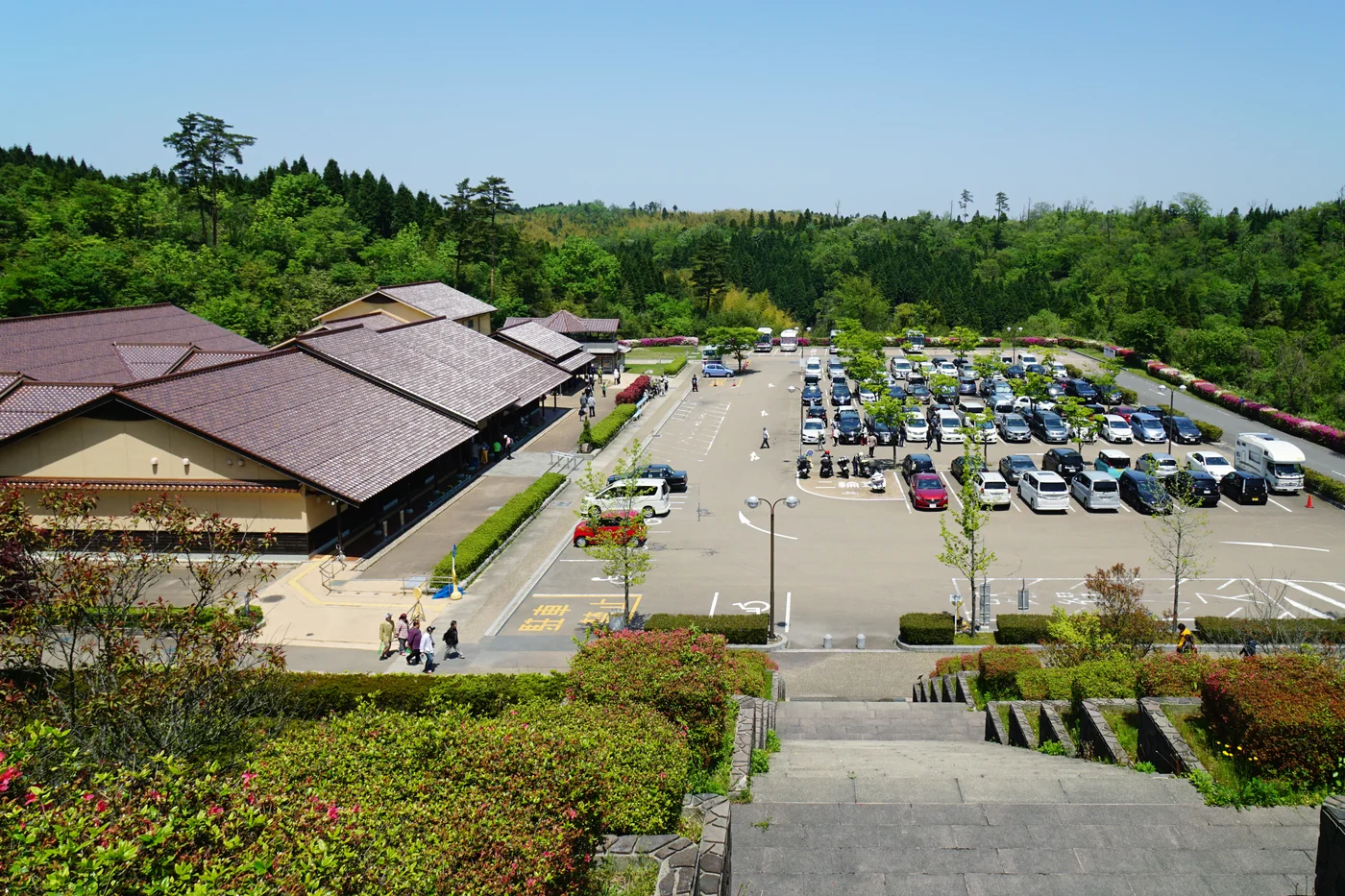
The paid exhibition uses models, video, replicas and reconstructions, along with excavated archaeological material. It suits an initial understanding of location and processes. The Iwami Ginzan Museum in town holds documents, mining tools and silver ore, offering a different way to study the site.
The bus reaches the center at 09:20. Aim to enter the exhibition around 09:25 and leave at 10:00 for the 10:10 bus. In 35 minutes, focus on terrain and the main silver-production explanations, pausing at particular objects that interest you. To read every display or add an activity, take a later bus into town and omit one afternoon building.
From March through November, the building opens 08:30–18:00 and the exhibition 09:00–17:30, with last admission at 17:00. From December through February, the building closes at 17:30, the exhibition at 17:00 and last exhibition admission is 16:30. It closes on the last Tuesday of each month and over New Year. The entrance opens half an hour before the exhibition, so early arrivals can begin with maps and the model.
Allow two hours for the return walk from Ginzan Park
Shimane’s accessible tourism page gives the Ginzan Park–Ryugenji Mabu walk as about 2.3 kilometers and 45 minutes one way, on a slope. The tourism association estimates about two hours return including the visit. This plan allows 10:25–12:35: 50 minutes each way, each including five minutes for roadside pauses and rests, plus 30 minutes for tickets and the tunnel. To study smelting remains along the way, remove an afternoon building. Shimane Tourism Federation: Omori accessible routes and slopes
The official walking map leads from the park toward the mine through the Shimogawara Fukiya smelting remains, then toward Anyoji, the Seisuiji rest area and Ryugenji Mabu. It places the river, smelting remains, tunnels and homes in one valley. Identify the next named landmark as you walk and read signs at junctions, rather than turning toward another tunnel simply because its sign says mabu.
The Shimizudani Refinery Remains have a separate branch off the main route. If the two houses are your afternoon priorities, complete the Ryugenji return and save Shimizudani for another visit. If industrial remains interest you more, omit the former Kawashima Residence and use that time for the refinery. Even a short branch on a map needs time to enter, look and return; straight-line distance is insufficient.
The park has a multipurpose toilet, as do the Seisuiji rest area facilities; toilets are also at the tunnel entrance and exit. Stop at the park first and organize water and belongings there, then maintain a steady pace on the slope. With children, use Seisuiji as a resting point and judge their energy before the final stretch.
There is a fairly steep uphill slope near the tunnel exit. Wheelchair users or companions who cannot manage steep slopes should discuss the exit route and assistance with the local service desk before planning the visit. A town-focused half-day can include the center, Kumagai Residence and a meal. The prefectural page says the tunnel’s paved surface is at least 110 centimeters wide and permits wheelchair visits; include the exit slope in transport planning too.
Buy at Ginzan Gate before entering Ryugenji Mabu
The operator announced a ticket-office change from December 2025. The management building at the tunnel mouth no longer sells tickets. Follow Ginzan Gate / Ticket Office signs in the mining area, buy first, then head to the tunnel entrance. Update any older travel account on your phone that tells you to buy directly at the mouth. Ryugenji Mabu operator: ticket location, tunnel and fees
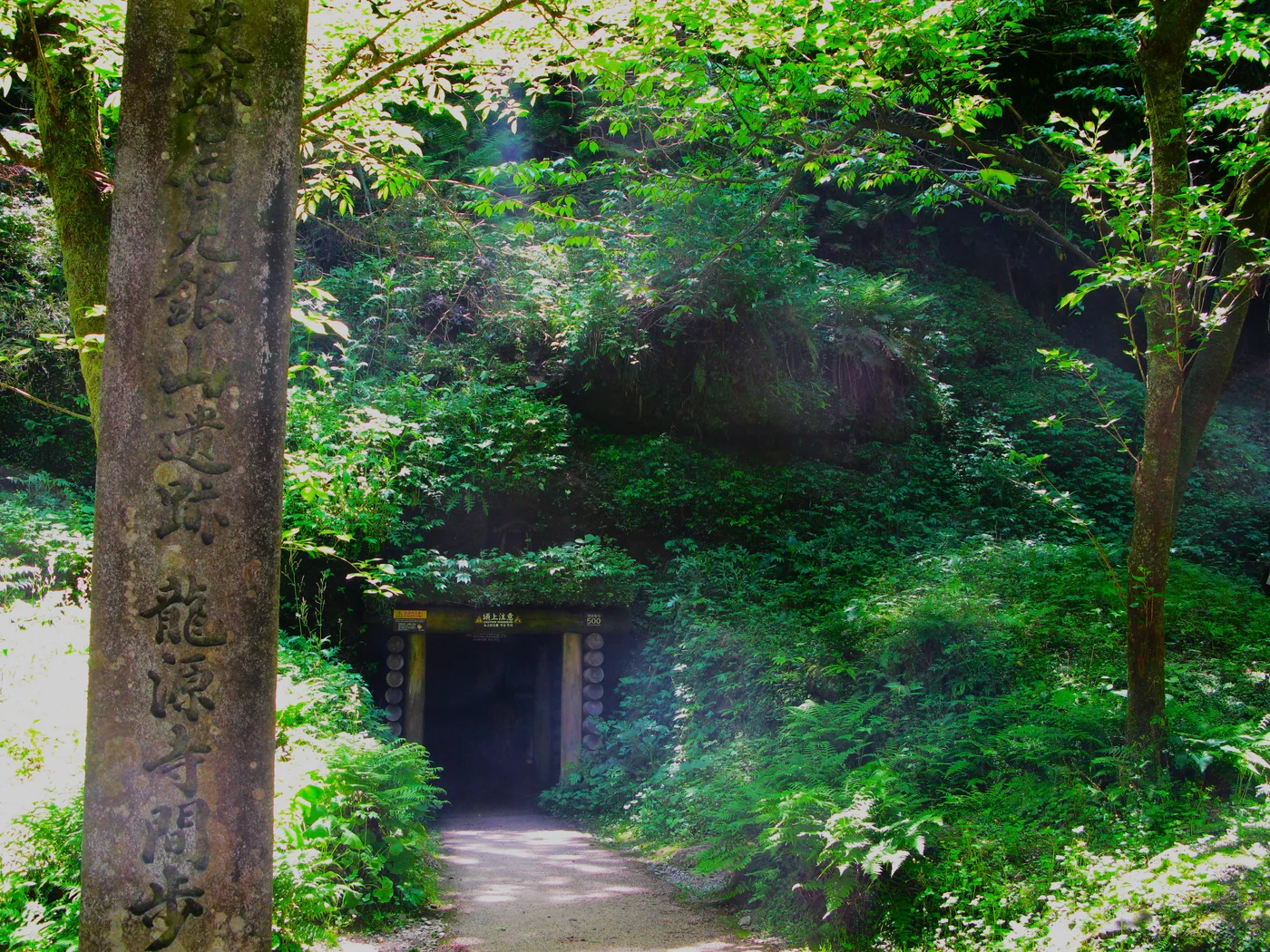
Mabu means a mine tunnel. Ryugenji is about 600 meters long, but the regularly open historic section is about 160 meters from the entrance, followed by the visitor exit route. Slow down for chisel marks, small workings following ore veins and the drainage shaft. The scale is much narrower than the mountain path, shifting your attention from the wooded hillside to the rock in front of you.
At a small side working, compare its direction with the sign for hioi-ko. These followed sheet-like ore veins and served a different purpose from the main visitor passage. Look at their direction and where they meet the main tunnel to see that mining did not hollow the whole mountain into one uniform-width passage. Stay on the open route and identify recesses from beside the walkway.
The shaft introduces drainage. The operator explains that water drained through a vertical shaft to the Eikyu tunnel about 100 meters below. Distinguish horizontal access, small side workings and vertical drainage to see several engineering functions in a short visit. Light boxes in the newer tunnel show the Iwami Ginzan Emaki scenes of underground work, helping relate the rock shapes to how people worked.
The tunnel is narrow, and condensation-covered rock can flake. The city asks visitors to watch overhead and beside them. Slow down at low points and examine chisel marks by sight. Children and adults can take turns approaching a sign, then move forward so others can pass.
General admission is ¥500 for high-school students and older and ¥250 for elementary and junior-high students. The city dates these prices to April 1, 2024; overseas visitors also pay the general rate. Hours are 09:00–17:00 March–November and until 16:00 December–February, with last entry ten minutes before closing in both seasons. It closes January 1. Finish the tunnel in the morning, then use the houses’ afternoon hours for a slower town visit.
The mine was part of a wider network of life and transport
The World Heritage property, Iwami Ginzan Silver Mine and its Cultural Landscape, was inscribed in 2007. Official interpretation centers on the connected sequence of mining, smelting, roads and ports. The morning model’s distribution gains a physical scale after the tunnel: ore had to leave the mountains, and people below handled administration, trade and daily life. The afternoon in Omori follows naturally with the homes and work of those who supported mining.
Omori was the administrative center for roughly 150 villages and about 48,000 koku of shogunal territory. The magistrate’s office, local officials’ homes, shops and temples clustered in the valley with different social roles. Connect administration at the office, official work at the Kawashima home and commerce at the Kumagai home to understand each building’s use.
Without advance historical reading, three kinds of space are enough for the day: extraction and drainage at Ryugenji, commerce and housework at Kumagai, and the separation of gate, garden and home at Kawashima. People still live here. Enter only clearly public entrances and follow the different uses of shopfronts and residential thresholds. The official walking map marks nonpublic facilities separately; read the sign before entering.
An introductory film from the Iwami Ginzan World Heritage Center, with English subtitles, to accompany the section on the mine remains and cultural landscape.
Back in Omori, see how buildings face the street
From Ginzan Park, the mining slope becomes a gently sloping paved town route. Walk slowly along the river as gates, walls, shops and public buildings appear. The streets deserve time in their own right. The official estimate for a leisurely visit to the 800-meter townscape is about 1.5 hours. Adding interiors at Kumagai and Kawashima naturally takes longer than a simple 20-minute walk. Oda Tourism Association: Iwami Ginzan visiting times and transport FAQ
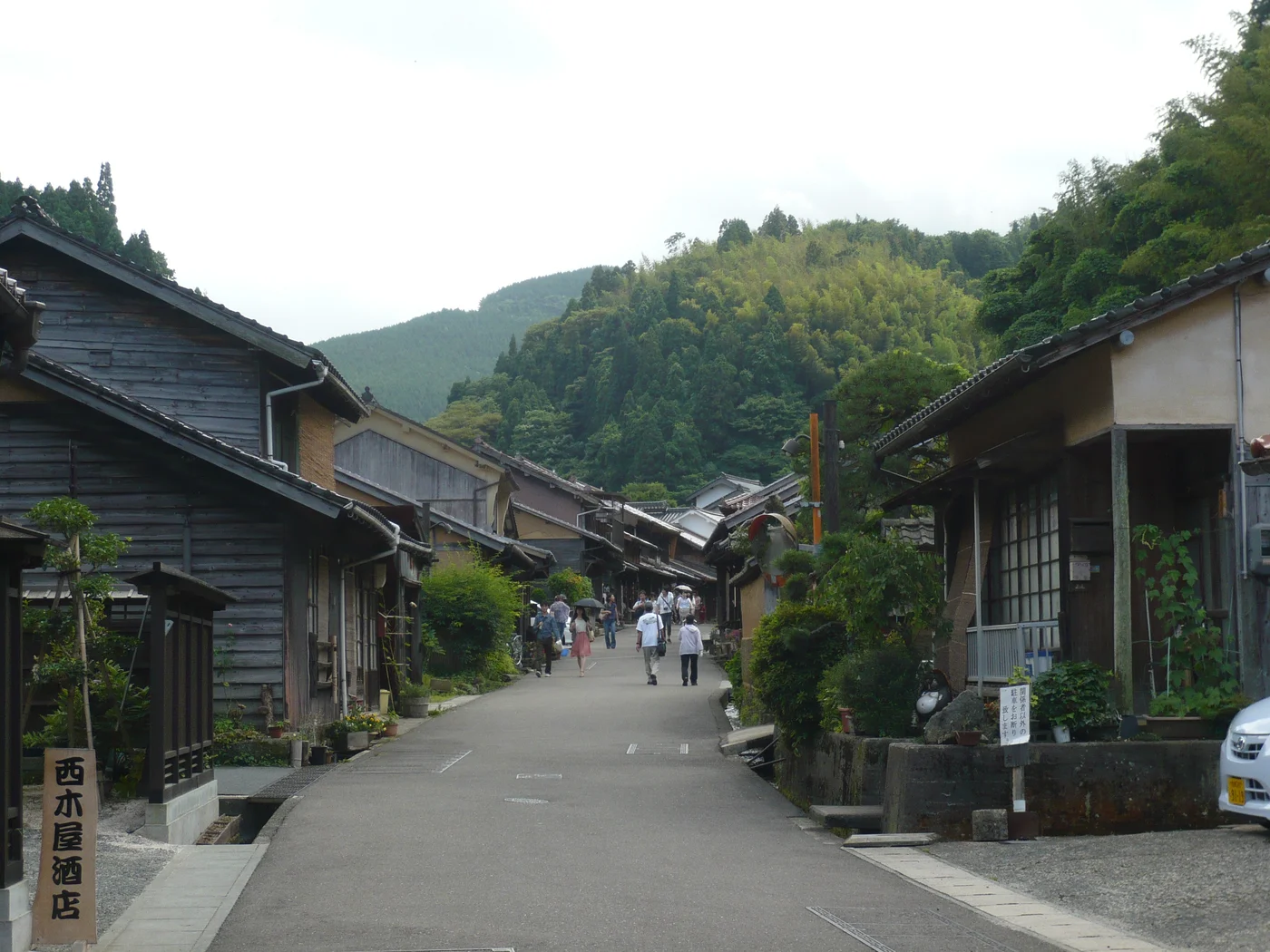
At Kumagai, the shop curtain and earthen-floor doma lead into a merchant’s interior. Kawashima separates street and main house with gate walls and a garden. The old courthouse faces the street with a public institution’s entrance. These three places show how commerce, residence and official business meet the road, giving photographs more specific subjects than a general street view.
After descending, walk first to lunch near Daikansho-ato, then return to Kumagai and Kawashima. This repeats a short street section but puts restaurant hours in the middle, instead of leaving lunch until both houses are done. On the return, examine entrances and roofs missed earlier.
Kumagai Residence: merchant scale in beams and columns
The Kumagai Residence was built in 1801, the year after the 1800 fire. Its main house and five earthen storehouses were conserved and repaired to present their late-Edo to early-Meiji appearance. After entering, look at the thick pine beams above the doma, then the large keyaki central column and single-plank cedar doors. These components listed by Shimane Tourism put materials, scale and everyday movement directly before you. Shimane Tourism Federation: Kumagai Residence, an Important Cultural Property
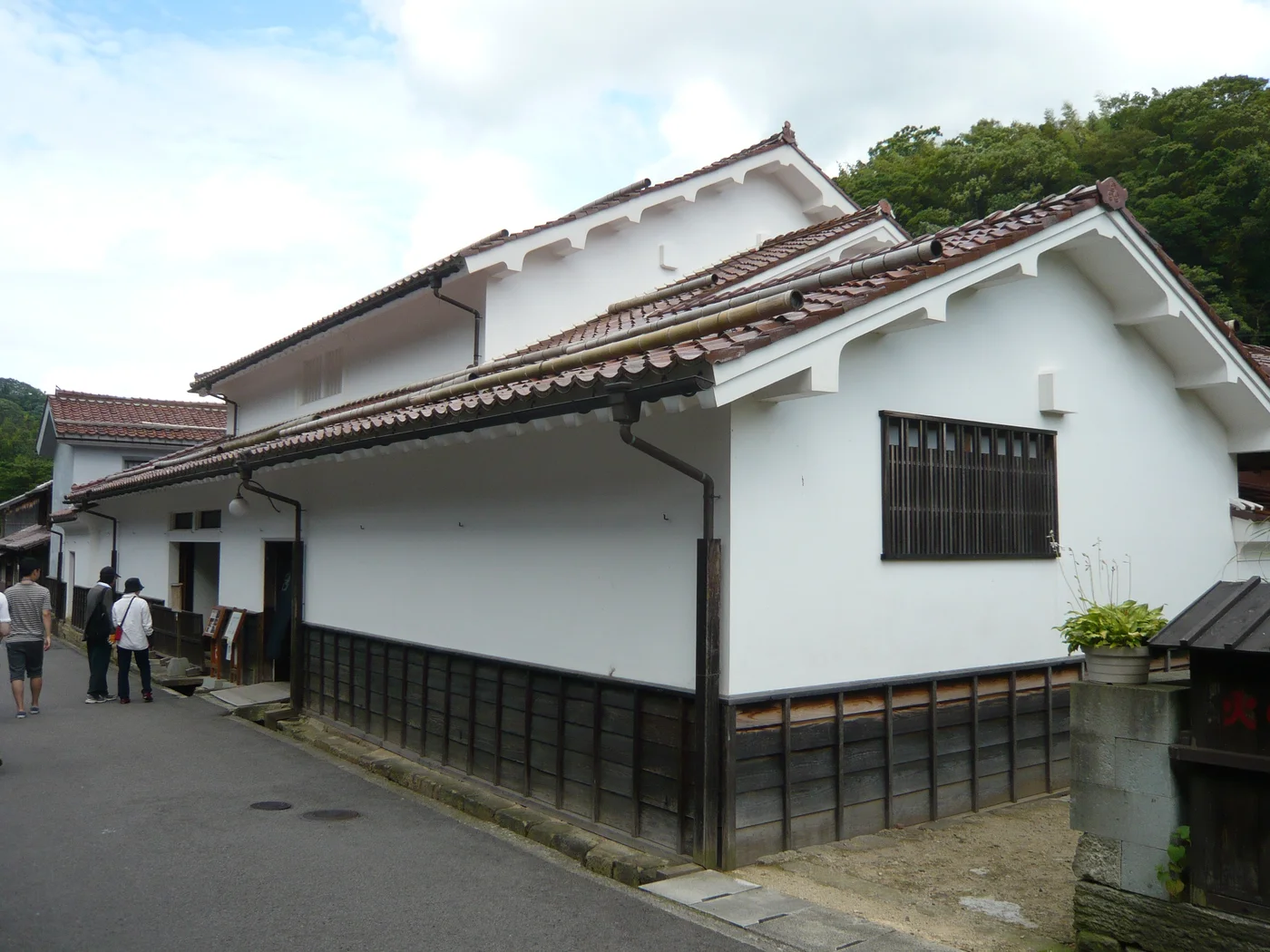
The doma is a useful first pause. Follow a column upward to a beam, then look back at the door’s size. This explains the main house more readily than immediately searching each room for exhibits. Relate the street facade to the internal frame to see what supports the building’s width. Follow the open route and leave the entrance clear for others.
The Kumagai family mined and brewed sake, and also served the magistrate’s office as financial agents, lodging providers and suppliers, and held the town-elder role. These duties explain the home’s commercial, official and domestic functions. See how the main house received people, then examine the storehouses and household displays behind it to relate indoor activities to the family’s place in town.
The five storehouses give the property depth beyond its street-facing shop. From permitted visitor areas, examine the front-to-back relationship between main house and stores, then the seasonal displays and possessions. Choose one group of household objects and consider its storage, use and cleaning space to bring the scale of the residence back to everyday life.
Aim to enter around 14:05 and allow about 55 minutes. Kumagai opens 09:30–17:00, with last admission at 16:30. It closes Tuesdays, the following day when Tuesday is a public holiday, over New Year and for temporary closures. Adults pay ¥600; elementary and junior-high students ¥200. Finish the house you most want to study before deciding on Kawashima, rather than entering the largest merchant home close to closing.
Former Kawashima Residence: street, gate, garden and house
Kawashima was a local official’s home; second-generation Saburoemon became kumigashira, head of the local officials. The surviving property was rebuilt in the first half of the 19th century. A gate and wall line the street, then a garden separates them from the main house with a mezzanine. Storage buildings and an earthen storehouse originally stood behind. Compare this with entering Kumagai through shop and doma. Oda Board of Education: FY2025 Iwami Ginzan study guide, 15th edition
Look at the gate walls from the road, then turn back toward the entrance from the garden. Notice the layers between street and main house. The gate concentrates access, the garden sets the home back from the street, and the main house accommodates living and receiving visitors. Different family roles and activities produced different entrance arrangements.
The study guide records a two-year repair project beginning in fiscal 1990 before Kawashima opened to visitors. Kumagai underwent partial dismantling and repair in fiscal 2001–2005, restoring its late-Edo to early-Meiji appearance. Separate the age of construction and use from the date of modern conservation. Read displayed details through each building’s explanation rather than broadly calling them untouched Edo houses.
Kawashima opens 09:30–16:30, half an hour earlier than Kumagai closes. Its Tuesday, post-holiday, New Year and temporary closure rules are the same as Kumagai’s. General adult admission is ¥300; elementary and junior-high students pay ¥200. Arrive around 15:10 and leave at 15:45 for Daikansho-ato. If Kumagai takes longer, choose between the houses and preserve the bus waiting time.
Old courthouse and magistrate’s site: public buildings
The Omori Townscape Exchange Center midway along the streets was built in 1888 and used as Omori District Court from 1890. A former courtroom is reconstructed inside. The exhibition opens 09:00–16:30, admission is free, and it closes over New Year. See the exterior on the walk to lunch, then enter in the afternoon if time remains. It adds a public building to the merchant and official residences. Oda Board of Education: FY2025 Iwami Ginzan study guide, 15th edition
The Iwami Ginzan Museum beside Daikansho-ato is also called the Imo Daikan Museum. The present building was constructed in 1902 as Nima District Office, on the earlier magistrate’s office site. Distinguish the site’s Edo administrative history from the Meiji building before you. Its documents, mining implements, historical material and silver ore extend the morning’s model-based introduction.
If documents and tools interest you more than homes, keep Kumagai and replace Kawashima’s roughly half-hour with the museum. This changes one visit while retaining the nearby Daikansho-ato return stop. Save the full names of the two centers and museum to distinguish the free courtroom display, mine interpretation center and museum collections.
Lunch at Ohomori: cold warigo and hot kamaage soba
Ohomori restaurant stands in front of Omori Daikansho-ato. Its operating company says window seats look toward the former office site, now used as the museum. Eat from 13:10 to 14:00 for a seated rest after the mountain and streets, near the afternoon’s first stop at Kumagai. The company lists hours of 11:00–15:00, closed Wednesdays, with changes possible for reservations and other circumstances. This plan uses Friday around 13:00. Ohomori operating company: location and hours
The signature Daikan Soba (代官そば) combines two servings of warigo soba (割子蕎麦), kamaage soba (釜揚蕎麦), tempura, grated yam, mountain vegetables, sweet-simmered plum and soba cooking water. Choose it to compare cold and hot preparations; individual warigo and kamaage dishes are also available. The website says the noodles are made in-house as nihachi soba using Japanese buckwheat flour. Keep the Japanese dish names handy to match the menu. Ohomori: individual visitor menu
The individual menu read on October 29, 2026 listed Daikan Soba at ¥1,680 including tax, warigo at ¥1,050 and kamaage at ¥900. Choose a single dish to leave more budget for buildings, or include the set and a seated break if you need a full meal after the morning walk. Group reservation menus have separate dishes; independent visitors can use the individual menu directly.
The meal also continues the houses’ story. Ohomori Kaikan explains that local people funded the relocation and conversion of a Kumagai family sake storehouse in 1972 to serve visitors. Later work on the restaurant, rear storehouse and detached building added a riverside terrace and elevator. Look at the building’s relation to the river before or after lunch, then visit Kumagai to compare how buildings left by the same merchant family remain in use.
Day schedule: keep movable time between the houses
The bus departures and arrivals below come from the official Bus Map effective May 2, 2026. Walking, meal and visiting periods are suggested for Friday, November 6.
The park–tunnel return alone is about 4.6 kilometers, with streets and interiors still to walk. You need not add every remaining temple after lunch. Finish the house you most want to see, then examine public buildings and shops along the same return street.
| Time | Plan | Travel and spare time |
|---|---|---|
| Around 08:35 | Reach Odashi Station bus stop | Allow about 12 minutes to find the direction |
| 08:47–09:20 | Local bus to World Heritage Center | Pass Daikansho-ato at 09:13 and Omori at 09:15 |
| 09:25–10:00 | Model and paid exhibition | Leave at 10:00, allowing ten minutes back to the stop |
| 10:10–10:15 | Bus from center to Omori | Prepare at Ginzan Park after getting off |
| 10:25–12:35 | Walk to Ryugenji Mabu and back | About 50 minutes each way, plus 30 for tickets and tunnel |
| 12:35–13:10 | Walk through town toward Daikansho-ato | Brief exterior stop at the old courthouse en route |
| 13:10–14:00 | Lunch at Ohomori | Separate 50-minute meal allowance |
| 14:05–15:00 | Kumagai Residence | Begin with doma framing and property layout |
| 15:10–15:45 | Former Kawashima Residence | Decide on entry according to progress |
| 15:45–16:20 | Return through town to Daikansho-ato | Includes pauses and finding the return stop |
| 16:33–16:59 | Bus to Odashi Station | Connect to JR after reaching the station |
Costs: three buses, the center and two houses
Under the Bus Map effective May 2, 2026, general adult fares are ¥760 from Odashi Station to the center, ¥200 from the center to Omori, and ¥640 from Omori Daikansho-ato back to Odashi. These three rides total ¥1,600. Getting off directly at Omori in the morning costs ¥680 but skips the center, changing this terrain-first route.
General adult admission is ¥400 for the center exhibition, ¥500 for Ryugenji, ¥600 for Kumagai and ¥300 for Kawashima: ¥1,800 for four places, or ¥3,400 with the buses. Adding the website’s ¥1,680 Daikan Soba gives ¥5,080, excluding JR and personal spending. Warigo soba instead gives ¥4,450. Itemizing makes it easy to calculate the effect of omitting a building or changing lunch.
For elementary and junior-high students, the respective admissions are ¥200, ¥250, ¥200 and ¥200, totaling ¥850. High-school students pay adult admission at these facilities. List each family member’s school stage first, then calculate transport under the bus operator’s ticket categories. Ryugenji’s current general ticket no longer has a dedicated overseas-visitor discount; budget ¥500.
Ryugenji’s current prices took effect April 1, 2024. Center, house and meal prices are those listed officially on October 29, 2026. Older walking maps still show amounts such as ¥410 and ¥520. Use those maps for roads, distances and landmarks, and current facility pages for payment amounts, so old figures do not carry into the trip.
Shorten the route for afternoon arrivals, rain or Tuesdays
For an afternoon arrival, choose the tunnel or houses as the main subject. For the tunnel, get off at Omori, start from Ginzan Park, allow about two hours return including the visit, then add time back to the stop. For merchant and official homes, get off at Omori Daikansho-ato and go directly to Kumagai, Kawashima and the streets. Fitting both the two-hour hill route and two houses into a short afternoon first cuts the time spent actually looking.
If you still want the tunnel in rain, transfer time from afternoon buildings to walking and use footwear with grip and rain gear suitable for slopes. If companions cannot manage a long wet walk, choose the center, lunch and one residence. The center provides indoor interpretation; Kumagai offers materials, framing and domestic displays. An indoor-focused route still has distinct subjects.
Kumagai and Kawashima normally close Tuesdays, while the center closes the last Tuesday of each month. On such dates, focus on Ryugenji and street exteriors, adding the exhibition according to the center’s opening day. To enter both houses, choose another day. The tunnel closes at 16:00 December–February, so afternoon hill walks must begin earlier. Tunnel first and town afterward is easier to connect in winter.
If the 4.6-kilometer tunnel return is too much, arrange an electric rental bicycle or Ginzan Cart from Daikansho-ato. The tourism association places both services near the square in front of the former office, 800 meters from Ginzan Park. To reduce walking, get off at Daikansho-ato in the morning and arrange transport before going uphill. Do not reach the park and count an unboarded ride as part of your return.
Give Okubo Mabu its own day and plan around a confirmed tour
Okubo Mabu suits visitors who want a larger guided tunnel and comparisons of Edo and Meiji mining. The tourism association describes the two-hour route as close to mountain hiking. The tunnel is about 10°C even in summer, so bring a warm outer layer and be fit for hill paths. Iwami Kanko operates the 2026 general limited tours, scheduled March 1–November 30 on Fridays, Saturdays, Sundays, public holidays, Golden Week and Obon periods, with none December–February. There are four tours daily, 20 people each, by advance reservation only. Secure a tour before arranging arrival at the center. Iwami Kanko: 2026 Okubo Mabu limited tours
Adults pay ¥4,500 and elementary and junior-high students ¥3,500, including tunnel entry, guiding and shuttle bus. Children below elementary-school age cannot participate. Tours are listed as 09:45–11:50, 11:00–13:05, 12:30–14:35 and 13:45–15:50, with meeting times of 09:15, 10:30, 12:00 and 13:15 respectively. Both meeting and finish are at the World Heritage Center. Put the 30-minute early meeting into your schedule.
The 08:47 Odashi bus arriving at 09:20 is already too late for the first meeting at 09:15. You could target the second tour’s 10:30 meeting, leaving over an hour after arrival for procedures and displays. The operator confirms reservation availability and whether the tour runs. Pay on the day at the Okubo Mabu desk inside the center.
The operator specifies a five-person minimum. A departure with no bookings five days beforehand may be canceled; same-day reservations are available only when an operating tour has vacancies. Book ahead once dates are fixed if Okubo is the main purpose. After its two-hour guided trip returns to the center, choose lunch in Omori and one residence. Save Ryugenji’s return walk for another day to give each tunnel adequate time.
A few useful answers
Which bus stop should I use for Iwami Ginzan from JR Odashi Station?
Get off at Omori for the walk from Ginzan Park to the Ryugenji mine tunnel, or at Omori Daikansho Ato for the old streets and the Kumagai Residence. The one-way adult fare from Odashi Station to Omori is ¥680.
How long is the walk from Ginzan Park to the Ryugenji mine tunnel?
The walk from Ginzan Park to the Ryugenji mine tunnel follows a sloping path for about 2.3 km and takes roughly 45 minutes. Allow about two hours for the round trip, including the visit. Kiyomizudera Rest Area is a good place to stop with kids.
Where do I buy tickets for the Ryugenji mine tunnel and how much do they cost?
Buy your ticket at the Ginzan Gate ticket office before walking to the tunnel entrance. It’s ¥500 for high school students and adults and ¥250 for elementary and middle school students. Last admission is 10 minutes before closing.
Do I need a reservation for the Okubo mine tour at Iwami Ginzan?
Yes. For the 2026 tour, book ahead and meet at the Iwami Ginzan World Heritage Center 30 minutes before the tour. Tickets cover the guide and shuttle bus and cost ¥4,500 for adults and ¥3,500 for elementary and middle school students.
Official information and references
Sources used in this guide.
- Iwami Ginzan Bus Map: times and fares from May 2, 2026
- Oda City: public facility admission and hours
- Ryugenji Mabu operator: ticket location, tunnel and fees
- Oda City: Ryugenji Mabu and April 1, 2024 price revision
- Iwami Ginzan World Heritage Center: viewing and walking Q&A
- Shimane Tourism Federation: Kumagai Residence, an Important Cultural Property
- Oda Board of Education: FY2025 Iwami Ginzan study guide, 15th edition
- Shimane Tourism Federation: Iwami Ginzan walking map, geography and distances
- Shimane Tourism Federation: Omori accessible routes and slopes
- Oda Tourism Association: Iwami Ginzan visiting times and transport FAQ
- Ohomori operating company: location and hours
- Ohomori Kaikan: relocated Kumagai sake storehouse and dining spaces
- Ohomori: individual visitor menu
- Iwami Kanko: 2026 Okubo Mabu limited tours
- Iwami Ginzan World Heritage Center: the center’s role
- Iwami Ginzan World Heritage Center: Omori historic buildings and streets