Walk from Hikone Station to Omotemon, explore Tenbin, Taikomon, the keep and Genkyuen’s borrowed scenery, and choose the climb or lower-level route. Includes tickets, tea, seasonal museum hours and half-day or full-day plans.
- Region & Focus
- Hikone
- Reading Scope
- 20 min read · 14 chapters · 4 Q&As
- Official Verification
- 12 official sources checkedUpdated November 22, 2026
Chapter Route Map (tap any stop)
- Start at Hikone Station, not the Shinkansen station
- Choose the ticket: ¥1,000 for castle and garden, ¥1,500 for all three
- Split routes at the foot rather than halfway up
- Pause at Tenbin Yagura to see how two uphill approaches converge
- At Taikomon and the bell, look beyond the front
- Study the keep’s roofs before choosing its steep stairs
- Add Nishinomaru if wanted; omit the closed Yamazaki path
- Descend through Kuromon and see the keep again across Genkyuen’s water
- Hoshodai’s ¥1,000 buys a seated garden view
- Give the castle museum another hour for palace rooms and the Noh stage
- Choose one display thread: red armor, instruments or tea utensils
- Using the museum with luggage, strollers and wheelchairs
- Half a day for castle and garden; a full day for the museum too
- Return beside the moat, with one last look at buildings you can identify
- Quick Q&A
About 140 steps lead from Omotemon to Hikone Castle’s main enclosure, followed by steep stairs at 60–62 degrees inside the keep. Decide whether to climb before buying tickets. If stairs suit you, visit the castle in the morning and descend through Kuromon to Genkyuen. Otherwise, focus on the moat, garden and castle museum below. Castle and garden fill half a day; allow a full day for palace rooms, the Noh stage and Ii family objects.
Start at Hikone Station, not the Shinkansen station
For Shinkansen arrivals, change at Maibara and get off at JR Hikone. The castle’s access guide gives about five minutes from Maibara on the JR Biwako Line, 46 minutes by Special Rapid from Kyoto and 80 minutes from Osaka. These help compare bases and travel, but add transfer, waiting and station-exit time. For a Kyoto day trip, choose a train arriving at Hikone and return from the same station for simpler luggage and transport.
Walk west toward the castle, setting Omotemon ticket office as your first destination. The castle lists about 15 minutes on foot and identifies Omotemon as the closest of its three entrances to JR Hikone. Those 15 minutes reach the foot of the hill; stone steps to the main enclosure follow. Assuming you can reach the keep’s top floor 15 minutes after leaving the train can delay lunch and afternoon bookings.
Use the Iroha Pines, Sawaguchi and Omotemon Bridge to orient yourself. The official route map places Omotemon, the museum, stable and Kaikoku Memorial Museum together at the foot, the keep above, and Genkyuen outside Kuromon. Understand these levels before mistaking the garden entrance for the castle climb. Use pedestrian crossings around the moat, then separate castle and museum routes at Omotemon.
This example uses daytime on November 5, 2026, walking both ways from Hikone Station without a seasonal bus or night event. Arrive around 9:00 and allow half an hour for the station exit, walk and tickets, rather than using the official 15 minutes as a tight connection. Return to the same station and choose a train to fit your actual visit.
Walk from Hikone Station to Omotemon, explore Tenbin, Taikomon, the keep and Genkyuen’s borrowed scenery, and choose the climb or lower-level route. Includes tickets, tea, seasonal museum hours and half-day or full-day plans.
Choose the ticket: ¥1,000 for castle and garden, ¥1,500 for all three
The admission guide checked October 29, 2026 uses prices effective October 1, 2024. Castle admission includes Genkyuen: ¥1,000 for ordinary individual admission and ¥300 for elementary and junior high school students. No extra garden ticket is needed afterward. Garden-only admission is ¥400 and ¥150 respectively, useful for companions who do not climb.
The castle museum charges ¥700 ordinary admission and ¥350 for elementary and junior high school students. For castle, garden and museum, the combined ticket is ¥1,500 or ¥550, saving ¥200 or ¥100 over separate castle-garden and museum tickets. Two adults and one elementary-school child pay ¥3,550 for all three. If one adult visits only garden and museum, two separate tickets total ¥1,100, ¥400 less than the full combined ticket.
The castle museum and Kaikoku Memorial Museum are different places. The latter and stable are free. Do not buy a museum-inclusive ticket just for a free building. Keep different companions’ tickets separate, retaining castle-garden tickets for the garden check and combined tickets through the museum. The reduced category covers elementary and junior high school students; high school students pay ordinary admission.
The combined ticket also requires the museum to be open. Its visitor guide lists closures on November 17–18, 2026, and December 8, 9, 17 and 25–31. The castle and garden’s year-round opening does not apply to the museum. On a museum closure date, keep a half-day castle-garden visit and buy that ticket.
Split routes at the foot rather than halfway up
Omotemon to the main enclosure climbs about 50 meters through roughly 140 deliberately uneven stone steps. Free walking sticks are available, but ordinary long sticks and umbrellas cannot enter the keep. Folding ones may be packed away; folding sticks also cannot be used on its interior stairs. Anyone relying continuously on a stick should treat the main-enclosure exterior and climbing inside the keep as separate choices.
The keep’s two stair flights are about 62 and 60 degrees, narrow and fitted with handrails. Climbing the hill and climbing inside require different abilities. Resting in the main enclosure and viewing the exterior is a complete castle visit. Explain shoe removal, handrails and the visitor route to children at the foot. Anyone uneasy about steep stairs can meet outside instead of climbing for a top-floor photograph.
Wheelchair users can choose the moat, Genkyuen, castle museum and Kaikoku Memorial Museum below. The castle has no uphill elevator or continuous ramp, and wheelchairs cannot pass through the keep floors. Genkyuen admits wheelchairs but has stone paving and gravel, so assess pushing assistance. Call the castle operations center at 0749-22-2742 about entrances and surfaces before travel.
Companions can reach Omotemon together, split between the climb and museum, then reunite below for Genkyuen. Meet outside Omotemon Bridge after the climbing group descends; that group should return by the same route. This avoids one group at Kuromon while another remains at the museum. Use the one-way Kuromon-to-garden route when everyone climbs.
Pause at Tenbin Yagura to see how two uphill approaches converge
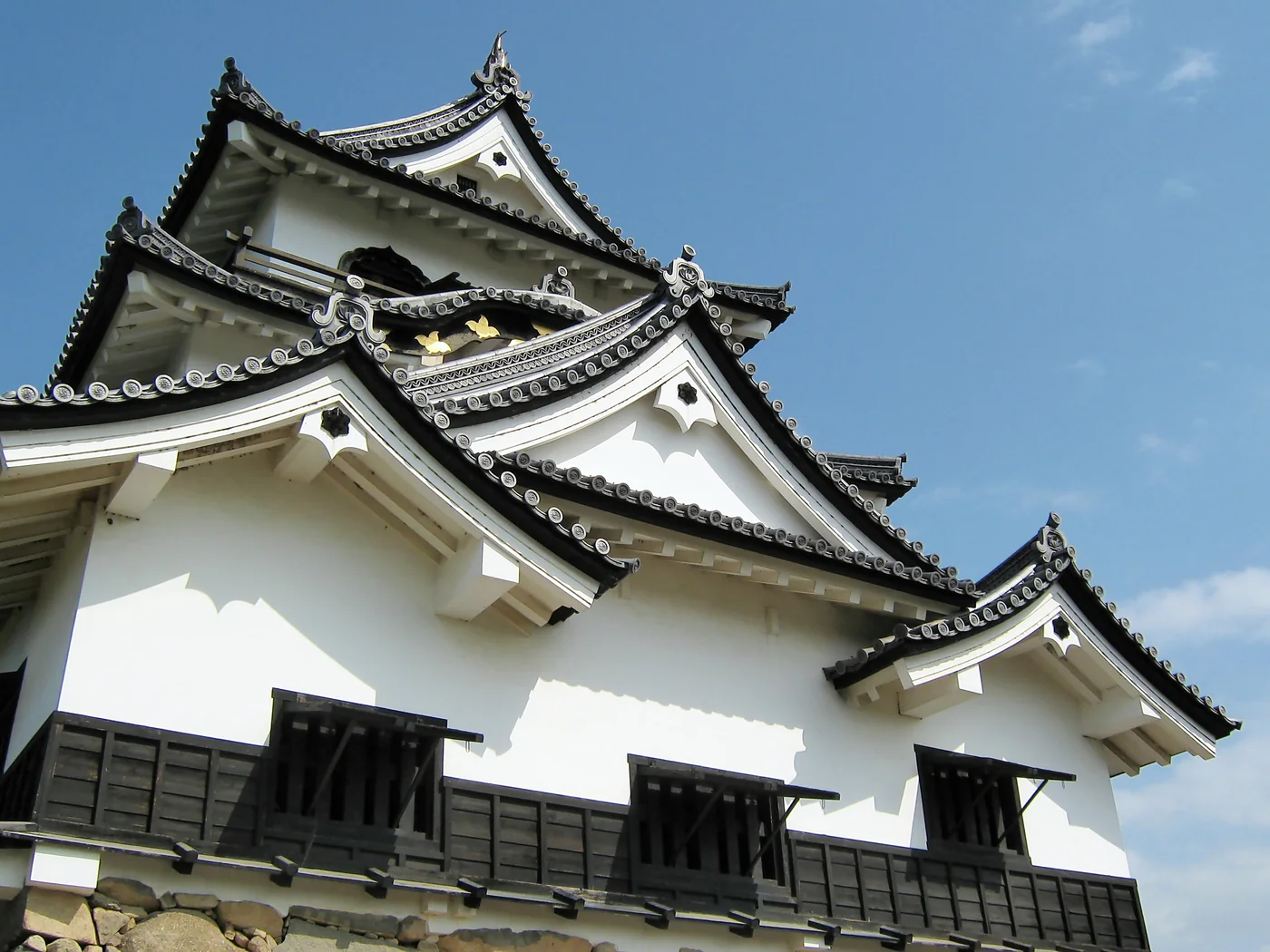
Tenbin Yagura is the first useful defensive viewpoint on the Omotemon climb. The official building guide explains how the Omotemon and Otemon slopes converge here. A central turret gate connects to the covered bridge, with a two-story turret at each end, resembling a balance scale. Compare the symmetry from before the bridge, then look back down the approach to connect name and terrain.
The covered bridge is said to have been removable in wartime. Without it, attackers from below still faced high stone walls before continuing toward the main enclosure. Study the bridge, gap and turret gate: the narrowing approach crosses a defensive space. This helps explain the next layers on the way through Taikomon.
Compare the stone walls beneath the turret. Facing it, the right side uses the original castle-building uchikomi-hagi masonry; the left uses late-Edo otoshi-zumi repairs. Joints and stone arrangement differ. Start from farther away, then examine how stones meet beside the path. You can see the contrast before learning the masonry terms.
See this on the ascent rather than returning after the keep. Remove shoes for the turret interior; Tenbin has shoe racks. Enter if open, or study the bridge and both walls fully before continuing if time is short. Step clear of the main stair route for photographs and leave passage space. Climbing the stone walls is prohibited.
At Taikomon and the bell, look beyond the front
Taikomon guards the main enclosure’s front entrance. Its name is said to come from a drum used for castle signals. The unusual feature is behind: an open-backed corridor with railings. Look at the defensive position as you enter, then turn to see this structure. Unlike Tenbin’s symmetry, its revealing angle is the reverse side.
Dismantling repairs found evidence in Taikomon’s timbers that it had been relocated from another castle gate. It preserves a history of adjustment, reuse and reassembly. Woodwork enthusiasts can give time to the gate, corridor and connected turret instead of heading only for the highest point. How a gate secures entry can explain more than another keep view.
The nearby time bell was moved from Kanenomaru so its sound could carry across town. The official tea-room page lists ringing at 6:00, 9:00, 12:00, 15:00 and 18:00 daily. Day visitors can most readily fit 9:00, noon or 15:00. If already uphill before lunch, pause near noon and continue afterward without making the whole morning a tight minute-by-minute schedule.
Choshoan beside the bell offers tatami and table seating. The official listing gives five seats, matcha and a sweet at ¥1,000, hours 9:00–16:00, last order 15:50, closed December 29–31. Different seats face the keep or the rear oblique view of Tenbin. It suits a rest during the climb. If planning tea in Genkyuen, use this time for the main enclosure instead.
Study the keep’s roofs before choosing its steep stairs
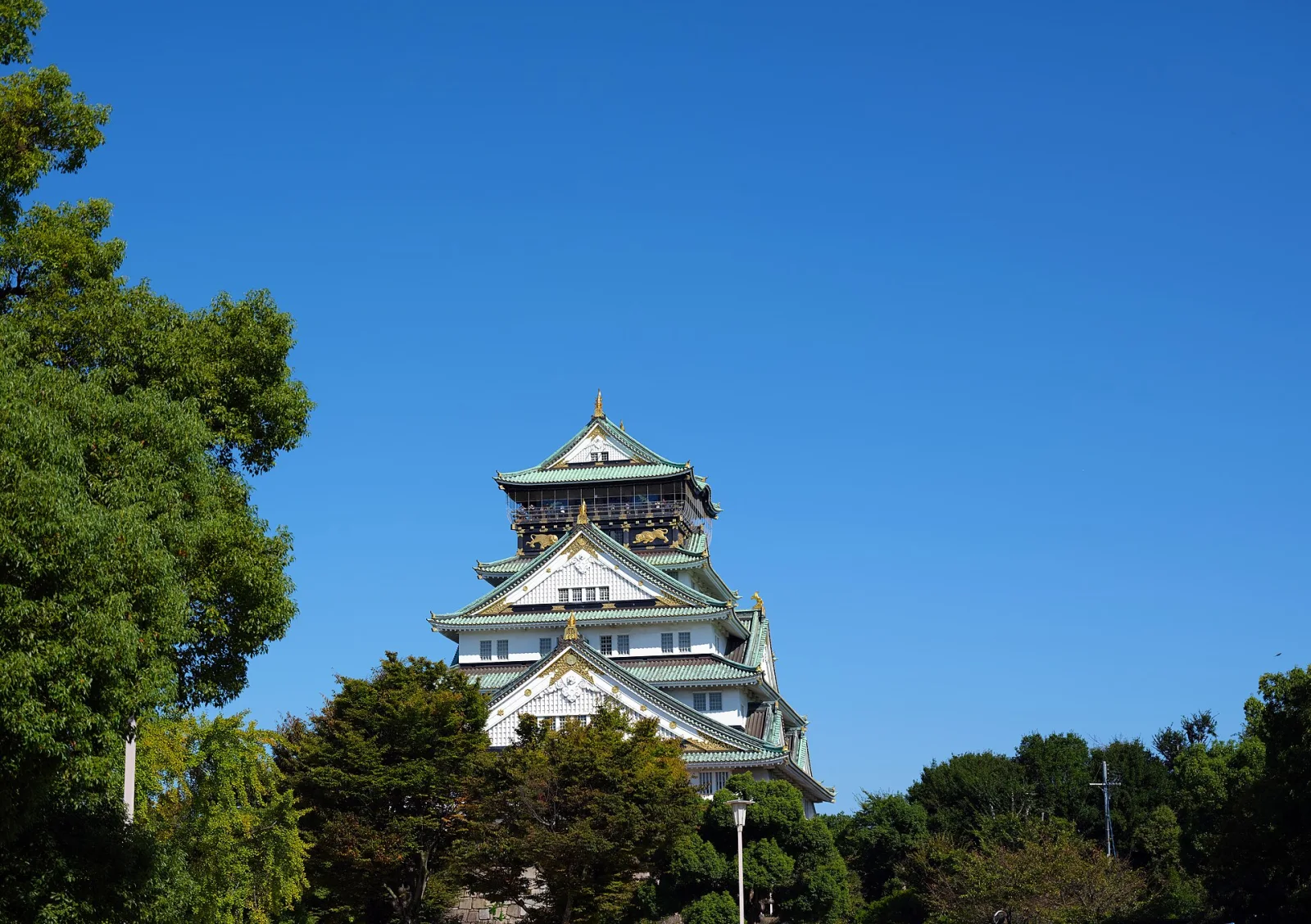
The keep has three floors and three roof levels, linked to attached and corridor turrets. Its profile is more than one shape shrinking upward: gable, hip-and-gable and curved karahafu forms mix straight peaks with curves. After the front view, change position on the main-enclosure path to find details hidden behind roofs rather than moving the camera as close as possible.
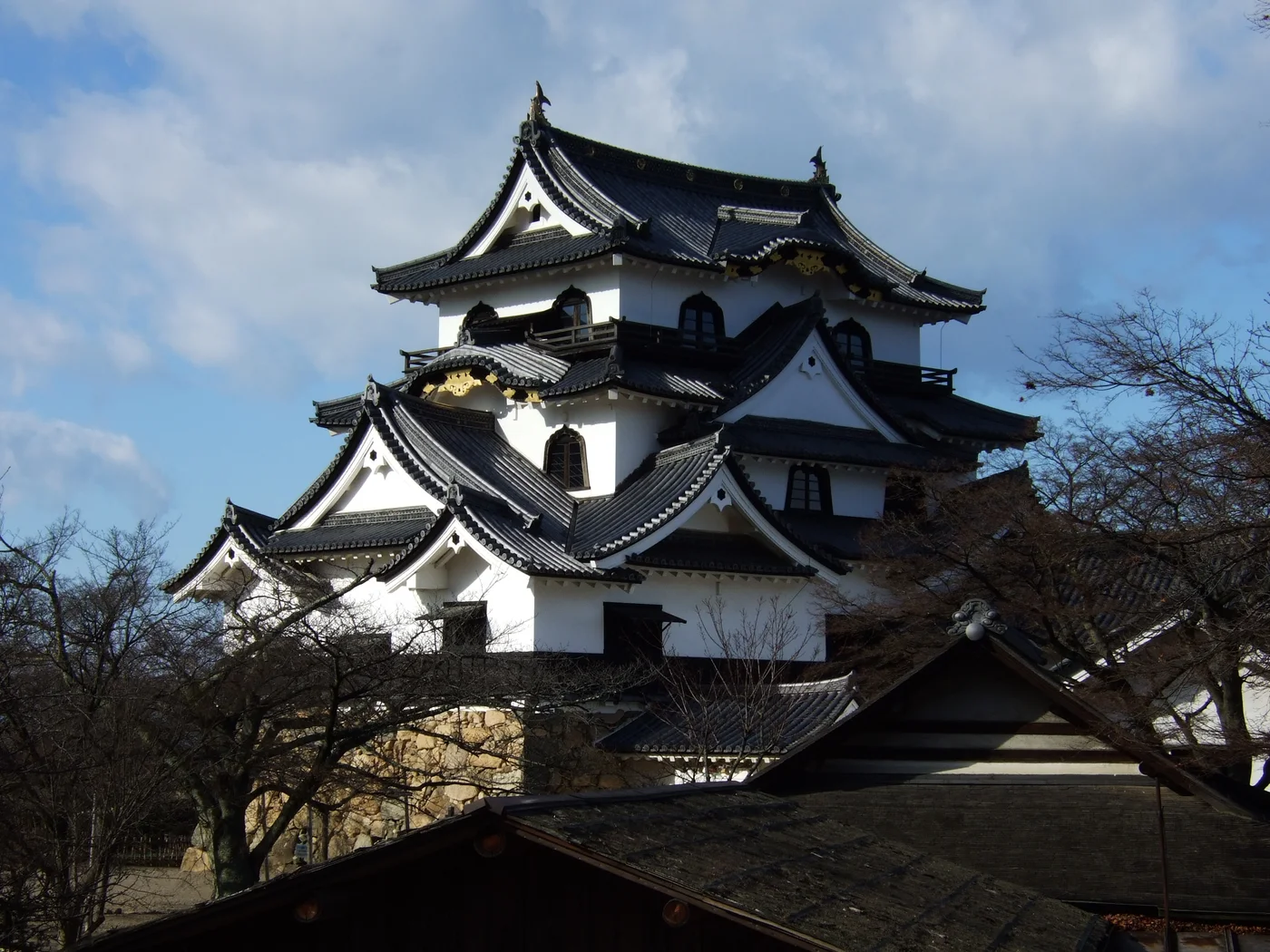
The official guide highlights cusped kato windows on the second and third floors and the railed veranda around the top. Identify roofs, window frames and railings separately for a more concrete view than the “National Treasure keep” label alone. Compare window curves with gables: one shapes wall openings, the other the roofline, together defining the exterior.
Remove shoes inside. Racks are provided; bring a shoe bag if concerned about mix-ups. Follow staff directions for long umbrellas and sticks and keep hands free for the stairs. The official interior estimate is 15–20 minutes, with queues and slow passage additional. It covers only inside, not the ascent from Omotemon.
If you want old architecture without steep internal stairs, spend longer in the main enclosure. The exterior has plenty of detail, and the castle offers a shorter exterior-only route returning to Omotemon. For Genkyuen with the whole group, continue downhill toward Kuromon. Decide the exit first; museum visitors need time to return from the garden to Omotemon afterward.
Add Nishinomaru if wanted; omit the closed Yamazaki path
For another turret, choose Nishinomaru’s three-story turret and adjoining corridor turret. They stand on the enclosure’s western side above a deep defensive cut separating a farther-west enclosure, guarding the rear and watching Lake Biwa in peacetime. Shift attention from roof decoration to terrain: locate the edge and the cut to understand the defensive position.
This turret should add another direction of defense, rather than merely another climb upstairs. Compare it with Tenbin on the front approach. If military architecture interests you less and you want time in the museum, omit it: Tenbin, Taikomon and the keep already explain the main route.
The official park map currently closes the Yamazaki path because the Nishinomaru covered bridge has deteriorated. Descend by Kuromon or Omotemon; do not plan Yamazaki enclosure and gate as a shortcut. Return to open paths after Nishinomaru. Mark the closure on the map before reaching it and having to retrace your steps.
Descend through Kuromon and see the keep again across Genkyuen’s water
When everyone has climbed and nobody is meeting at Omotemon, follow the official route from the main enclosure down to Kuromon, then Genkyuen. The student-group route gives about 15 minutes as a reference; slower walkers need more. Follow the outer path to the garden entrance and show the castle-garden ticket. The focus shifts from high defenses to water, bridges and islands.
Genkyuen is a strolling pond garden associated with the Tsuki Palace lower residence around today’s Rakurakuen. Four islands of different sizes occupy the central pond, connected by varied bridges. Follow the bank, then find a place where islands and bridges overlap. A turn changes the layers between bridge and building; the garden reveals itself through movement.
The official recommendation is the Musashino view of pond, Hoshodai and distant keep above. Start with the low bank, the tea building in the middle and the castle on the hill. Looking back from the water after standing beside the keep connects their height difference. Frame these layers before deciding on a reflection photograph; still water need not determine whether the garden is worth walking.
Rakurakuen refers to the lord’s lower residence and retirement quarters; Genkyuen is its associated garden. Neighboring map names have different meanings. The guide says conservation of Tsuki Palace’s historic buildings began in fiscal 2005. Follow open garden paths and view accessible exteriors. Distinguish this lower residence from the reconstructed Omote Palace in the museum, comparing domestic and administrative spaces on the same day.
Hoshodai’s ¥1,000 buys a seated garden view
The Hoshodai tea room stands on a small rise inside Genkyuen. It lists 12 seats, hours 9:00–16:00, last order 15:50, and matcha with a sweet for ¥1,000, separate from admission. An adult visiting only the garden and tea pays ¥400 plus ¥1,000, totaling ¥1,400. Castle-garden ticket holders add ¥1,000 to their existing ticket cost.
The reception buildings including Hoshodai were partly lost to fire in 1975 and reconstructed in 1977. Look down over pond, islands, inlets and bridges, then turn upward to the keep. Sitting on the rise changes height and distance compared with walking the bank. Garden enthusiasts can slow down here and omit another outer attraction.
The hanging scroll changes seasonally: the official list gives “The Divine Phoenix Dwells in Its Grove” for January–June, “Summer Clouds Form Many Strange Peaks” for July–August, and “At Ease, I See the Southern Mountain” for September–December. A November visit therefore has seasonal indoor material as well as tea. Read the scroll, then look outside to connect room and garden.
With limited seats, use it as a rest when space allows. After a late start, complete the garden first and fit tea before 15:50. Garden ticket sales until 16:30 and tea last orders at 15:50 are different limits. Allow a separate lunch: matcha and a sweet are a snack, especially on a day of climbing.
Give the castle museum another hour for palace rooms and the Noh stage
The castle museum combines a reconstructed Omote Palace with museum displays. The original palace was the domain’s administrative center. The museum includes reconstructed living rooms, tea rooms and gardens, plus an Edo-period Noh stage. The hilltop keep organizes defense through height and entrances; the palace explains administration, living and reception.
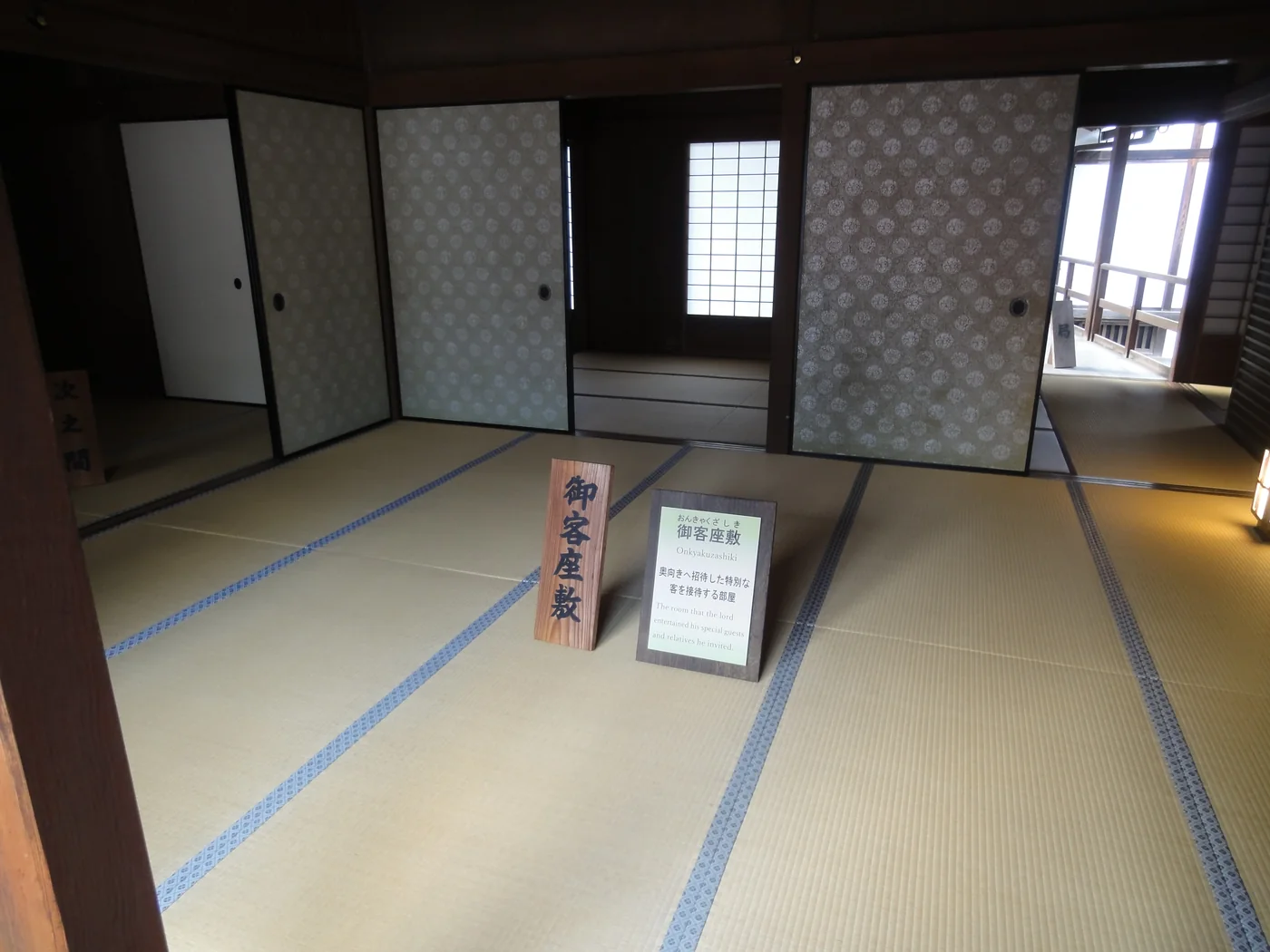
Notice the directions between living room, tea room and garden and sit for a garden view. November 5 falls within “Hikone Domain Painter Satake Eikai,” running October 23–December 7, 2026. It presents paintings by Tani Buncho’s pupil who served three generations of the Ii family. Compare partition paintings with room layouts to see how pictures fit their use.
Pause at the Noh stage, looking at its surrounding space before reading masks and costumes in the galleries. The stage is normally viewed as architecture; performances follow separate event dates, ticketing and admission times.
In October–November 2026 the museum opens 9:00–17:00, last entry 16:30. December 1–February 28 changes to 9:00–16:30, last entry 16:00. An afternoon visit can start around 14:00 in November, earlier in winter, allowing more than an hour before closing. Last entry tells you whether admission is possible; work backward from what you want to see for a useful visit length.
Hikone City’s 2021 curator-led video introduces the galleries and reconstructed Omote Palace.
Choose one display thread: red armor, instruments or tea utensils
The permanent-exhibition guide groups Ii family objects into seven themes, rotating works about every one to two months. For a first visit, choose an interest rather than distributing minutes equally across every case. Start with warrior equipment, Noh’s beauty, furnishings, tea utensils or gagaku instruments.
The Ii “red unit” used vermilion armor, flags and military dress. Compare where color appears, then individual armor parts, swords, horse equipment and bows. The exhibition explains that arms expressed warrior status as well as practical use, with swords important gifts. This links hilltop defenses to objects of identity and ceremony.
The Noh collection has a different history. Much of the Edo-period collection was lost in the 1923 Great Kanto Earthquake. A major source of today’s holdings is the 15th head Naotada’s collecting afterward. Distinguish inherited objects from the rebuilt collection instead of assuming everything survived from castle construction. The stage helps place masks and costumes in use.
The gagaku instrument collection was formed mainly by the 12th head Naoaki. The museum treats their bags and boxes as crafts too. If instruments are unfamiliar, start with container materials and decoration, then examine how they hold the instrument. After vermilion armor, these details shift attention to smaller workmanship.
For ceramics, choose tea utensils and Koto ware. The museum places Koto ware within Ii tea collections and describes Naosuke as a tea host, utensil maker and writer on tea. Connect this with a tea-room visit: bowls appear as collection and craft in cases, then return to drinking and garden viewing at Hoshodai. Read one or two current labels closely rather than hunting a fixed list through rotating displays.
Using the museum with luggage, strollers and wheelchairs
The facilities guide lists refundable ¥100 lockers in the lobby, with larger lockers for large items. Museum visitors can organize bags before palace and gallery rooms and collect them before leaving. Lockers are inside the museum. For castle and garden only, leave large luggage at your existing base and carry a light bag.
Outdoor shoes are prohibited inside. Use a free museum wheelchair or ask staff to wipe your own wheels. A ramp stands beside the entrance, though some areas remain inaccessible because of the building’s structure. Tell staff on arrival and follow the available route, including when making the museum the wheelchair group’s main stop.
Families can use the nursing room, changing table in the multipurpose toilet and free lobby stroller loans. These support rests in the lower-level route and reunion after other companions descend. With only one adult available for a child, choose museum, moat and garden together instead of splitting up for the keep; architecture, objects and garden views remain.
Half a day for castle and garden; a full day for the museum too
For the November 5 half-day example, arrive around 9:00, reach Omotemon around 9:30, visit Tenbin, Taikomon and the keep, descend through Kuromon, walk Genkyuen and return to the station. Allow three to four hours including both station walks, viewing and a slow pace. If the keep queue grows, drop Nishinomaru or tea and keep the main castle and garden, eating near the station afterward.
For a full day, keep castle and garden in the morning, lunch, then museum around 14:00–15:30. Depending on energy, briefly add the free stable or Kaikoku Memorial Museum before the station. For palace rooms and objects as the priority, enter the museum at 9:30, then climb and visit the garden after lunch. Hoshodai tea still needs to precede 15:50; do not push every outdoor stop into evening.
With two hours left, willing climbers can use Omotemon, the keep exterior or interior and return to Omotemon, leaving Genkyuen for another trip. For no climb, buy garden-only admission and walk part of the moat. Near 16:00, separate last-entry and building closures compress both options. Concentrate on one place rather than buying a combined ticket and rushing between hill-foot sites.
Castle and garden hours are 8:30–17:00, last entry 16:30. Interiors of the keep, Tenbin, Taikomon, Nishinomaru turret and stable close at 16:45; leave by 17:00. These are normal daytime hours. Finish main viewing in the afternoon and leave evening margin for the station. Rain does not remove steep stairs or stone steps. If climbing is unsuitable, use the museum and garden below and shorten garden walking to fit the rain.
Return beside the moat, with one last look at buildings you can identify
From Genkyuen, follow lower paths toward the Iroha Pines and Sawaguchi, then Hikone Station; there is no need to climb over the hill again. For an afternoon museum visit, return first to Omotemon, then toward the station afterward. Reuse the pines, Sawaguchi and bridge as landmarks. Allow about half an hour for walking, collecting belongings and entering the station.
The stable adds everyday castle life. The official guide says it held 21 horses belonging to the lord and others. Conservation preserves its thin wooden-shingle roof. Admission is free but the interior closes at 16:45. Compare its low, long shape with horse equipment in the museum. After closing, finish with the exterior instead of detouring for free entry.
Near Sawaguchi, Kaikoku Memorial Museum was recreated with citizens’ donations in 1960 for the centenary of Ii Naosuke’s death. It now houses castle displays, free, 8:30–17:00 with last entry 16:45. It closes December 25–31 and for exhibition changes. The neighboring Sawaguchi Tamon turret is not currently open. Distinguish the surviving cultural property from the later recreated exhibition building while viewing the entrance outline.
The Japan Top 100 Castles stamp is at Kaikoku Memorial Museum, moving to Omotemon ticket office when the museum closes. Omotemon service ends at 16:30. If essential, collect it on arrival in the morning, then return by your chosen route. For Kyoto take the Special Rapid direction; for Shinkansen, travel first to Maibara. Check destination and stops before boarding to complete the same-station day trip.
A few useful answers
How do I get to Hikone Castle by train from Kyoto or Osaka?
JR Special Rapid trains reach Hikone Station in about 46 minutes from Kyoto and 80 minutes from Osaka. If you’re taking the Shinkansen, change at Maibara for the JR Biwako Line, about five minutes to Hikone. The Omotemon Gate ticket office is about a 15-minute walk from Hikone Station.
How much are tickets for Hikone Castle and Genkyuen Garden?
Adult admission is ¥1,000 for Hikone Castle and Genkyuen Garden or ¥400 for the garden alone. A combo ticket that includes Hikone Castle Museum costs ¥1,500, and separate museum admission costs ¥700.
How steep are the stairs at Hikone Castle?
There are about 140 stone steps from Omotemon Gate to Honmaru, the main enclosure. Inside the keep, the two staircases are angled at roughly 60 and 62 degrees. To skip the climb, walk along the moat and visit Genkyuen Garden and Hikone Castle Museum at the foot of the hill.
Is half a day enough for Hikone Castle and Genkyuen Garden?
Allow three to four hours, including the walk to and from Hikone Station. Enter the castle through Omotemon Gate, then head down through Kuromon Gate to Genkyuen Garden. If you have a full day, stop for lunch and visit Hikone Castle Museum in the afternoon.
Official information and references
Sources used in this guide.
- Hikone Castle official | Steps, entrances and visiting rules
- Hikone Castle | Access
- Hikone Castle | Current tickets and hours
- Hikone Castle | Buildings and park map
- Hoshodai and Choshoan tea rooms
- Kaikoku Memorial Museum
- Hikone Castle Museum | Exhibitions
- Museum | Fiscal 2026 opening dates, closures and admission
- Museum | Palace and Noh stage
- Museum | Permanent themes and collection history
- Museum | Accessibility, family facilities and luggage
- Hikone Castle | Official student-group route map, 2023 version, route use only