2026 autumn foliage guide for Shiga's Koto Sanzan temples and Eigen-ji. Compare two seasonal Hikone Station shuttles, Kyoto's four-temple tour bus, driving order, and night illumination returns.
- Region & Focus
- KansaiFall foliage
- Reading Scope
- 23 min read · 11 chapters · 5 Q&As
- Official Verification
- 22 official sources checkedUpdated November 22, 2026
- Key Topics
- SeasonsItinerariesRail travel
Chapter Route Map (tap any stop)
- Half a Day or a Full Day: Pick Your Temples and Descent Time First
- Hikone Station West Exit: Riding the Koto Sanzan Shuttle
- Hikone Station East Exit: 2026 Kaede Kaido Free Shuttle and Dual Night Illuminations
- On Non-Shuttle Dates: Eigen-ji Route Buses and Hyakusai-ji Municipal Buses
- Saimyo-ji: From Horai-tei Garden to the National Treasure Three-Story Pagoda
- Kongorin-ji: Splitting the Thousand Jizo Path and Main Hall for Older Travelers
- Hyakusai-ji: Pond Gardens by Day, Stone-Walled Ruins at Dusk
- Eigen-ji: Crossing the Echi River up Rakanzaka to the Reed-Roofed Hojo
- Day Trips from Kyoto and Self-Driving Orders with Night Illuminations
- Where to Base Yourself: Hikone, Omihachiman, or Kyoto Next-Day Connections
- Foliage Timing and Rainy-Day Adjustments
- Quick Q&A
For daytime visits to Saimyo-ji, Kongorin-ji, and Hyakusai-ji in Shiga's Koto area in autumn 2026, catch the Koto Sanzan shuttle from JR Hikone Station West Exit between November 19 and 29. To see night illuminations at Eigen-ji or Hyakusai-ji, take the select-date free evening shuttle from Hikone Station East Exit, or check return bus times before heading up the mountain on your own. Departing from Kyoto with all four temples on your list? Ohmi Railway's seasonal sightseeing bus covers all four in one day and includes an Omi beef lunch.
Half a Day or a Full Day: Pick Your Temples and Descent Time First
Koto Sanzan refers to three Tendai Buddhist temples in the foothills of the Suzuka Mountains—from north to south: Saimyo-ji in Kora Town, Kongorin-ji in Aisho Town, and Hyakusai-ji in Higashiomi City. Eigen-ji is also in Higashiomi City, further upstream along the Echi River, and serves as the head temple of the Eigen-ji branch of Rinzai Zen. On a map, all four sit east of Lake Biwa, yet reaching each mountain valley from lakeside stations requires different transit routes. Whether you are commuting from Kyoto, boarding buses in Hikone, or staying near Yokaichi, decide which temple's night illumination you want to see before booking your lodging.
If you only have time for one temple, choose Saimyo-ji for historic architecture or Kongorin-ji for stone-stepped paths lined with Jizo statues. Hyakusai-ji rewards lingering by its pond garden, stone walls, and upper lookout terrace, while a daytime visit to Eigen-ji begins along the Echi River, crossing a bridge and climbing steps to the Somon gate. If traveling with young children or companions who take descents slowly, focus on one approach path or garden and leave the uphill climb to the Main Hall to faster walkers. Reaching the temple gate is only the start of the ascent, so factor walking time into your bus check-in or parking departure.
With a full day, you can cover all three Koto Sanzan temples by car or seasonal shuttle. To experience Eigen-ji from daylight into evening illuminations, save it for the afternoon and pick just one or two temples in the morning. Kyoto's seasonal sightseeing bus visits Eigen-ji first and saves Saimyo-ji and Kongorin-ji for the afternoon, delivering four distinct daytime views. If you also plan to visit Hikone Castle or Omihachiman, set aside another half-day so you aren't rushing through the gardens.
| Temple | Highlights | Regular Hours | Adult |
|---|---|---|---|
| Saimyo-ji | National Treasure Main Hall, Three-Story Pagoda, Horai-tei Garden, and Fudan-zakura cherry tree | Opens 08:30, last entry 16:30, closes 17:00 | ¥800 |
| Kongorin-ji | Thousand Jizo approach, National Treasure Main Hall, and Myoju-in Garden | Opens 08:30, last entry 16:30, closes 17:00 | ¥800 |
| Hyakusai-ji | Pond garden, stone-walled approach, and Nio-mon Gate | Opens 08:30, last entry 16:30, closes 17:00 | ¥600 |
| Eigen-ji | Echi River, Rakanzaka steps, Sanmon Gate, and Hojo hall | Usually 09:00-16:00; opens at 08:00 in November 2026 | ¥600 |
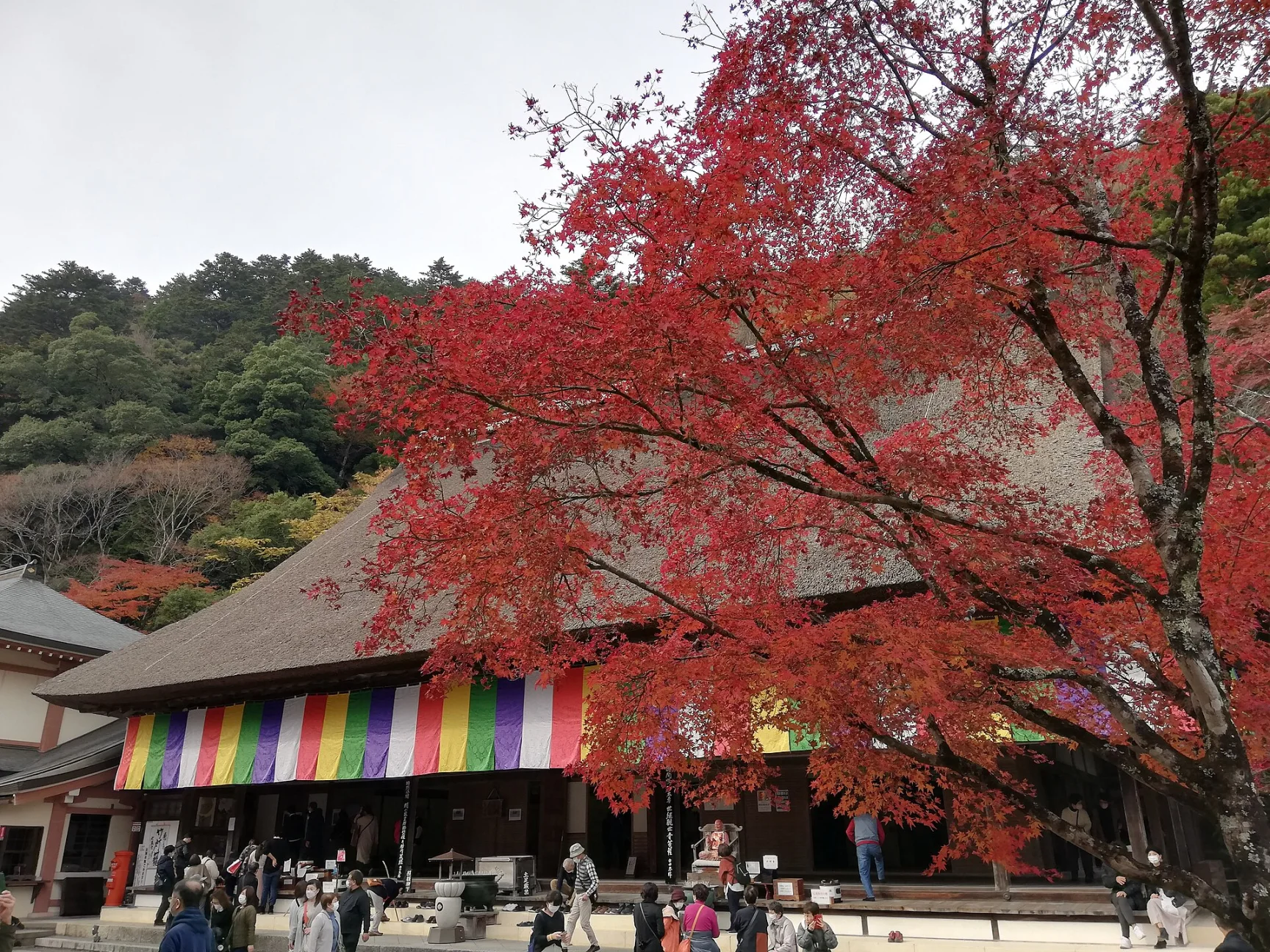
2026 autumn foliage guide for Shiga's Koto Sanzan temples and Eigen-ji. Compare two seasonal Hikone Station shuttles, Kyoto's four-temple tour bus, driving order, and night illumination returns.
Hikone Station West Exit: Riding the Koto Sanzan Shuttle
Kokoku Bus runs the Koto Sanzan autumn shuttle daily from November 19 to 29, 2026, departing from Stop 4 outside JR Hikone Station West Exit. Riders starting from Hikone can reserve their first leg in advance if they buy the Momiji Kippu pass, paid in cash at Hikone Station on the day of travel. Online reservations close two days before departure, and phone bookings are accepted until the day before. Subsequent boardings at each temple are first-come, first-served in line—even if you've already ridden once, you must queue again for the next bus. If you plan to visit all three temples in one day, note each stop's dwell time and boarding direction, and adjust your lunch break once you've caught the first bus.
The cleanest four-leg loop runs Hikone Station -> Saimyo-ji -> Kongorin-ji -> Hyakusai-ji -> Hikone Station. Using the operator's sample 09:00 departure, you arrive at Saimyo-ji at 09:32, depart Saimyo-ji at 10:32, leave Kongorin-ji at 11:47, and reach Hyakusai-ji at 12:10. From Hyakusai-ji, you can catch the 13:10 bus or stay until 14:10 so you aren't cramming lunch into a single hour of temple sightseeing. If you want time to photograph Kongorin-ji's garden and climb to its Main Hall, take the 12:47 southbound bus instead of the 11:47, which brings you to Hyakusai-ji in time for the 14:10 or later return. Always check the final destination on the timetable: the 09:00 bus from Hikone terminates at Saimyo-ji, and the 10:00 bus terminates at Kongorin-ji.
The Momiji Kippu pass costs ¥2,500 for adults and ¥1,250 for children, offering unlimited rides on the shuttle for the day plus a ¥50 adult admission discount at each of the three temples. Paying point-to-point adult fares for the four legs costs ¥700, ¥200, ¥300, and ¥1,000, totaling ¥2,200. Combined with full adult temple admission totaling ¥2,200, point-to-point fares plus entry come to ¥4,400, compared with ¥4,550 for the day pass with discounted entry—a ¥150 difference. Choose the day pass if you want the first-leg reservation or plan to hop off an extra time; if you are only visiting Saimyo-ji or two temples, calculate the exact legs first. Tracking transit, admission, and meal costs separately makes it easy to see what you're spending on getting around.
On the 2026 timetable, the last return bus leaves Hyakusai-ji at 16:20, stopping at Kongorin-ji at 16:43 and Saimyo-ji at 16:53 before reaching Hikone Station at 17:30. Factor in time to pack your camera, walk down to the gate, and find the right-direction bus stop, aiming for one bus earlier than the last departure if you can. To stay for Hyakusai-ji's 17:00 illumination, take the free evening shuttle from Hikone East Exit instead, or ride the West Exit shuttle in and pre-arrange a late-evening pickup. Travelers arriving on the West Exit bus cannot switch to the East Exit free shuttle at the temple and would have to return to Hikone Station East Exit to queue.
Hikone Station East Exit: 2026 Kaede Kaido Free Shuttle and Dual Night Illuminations
Higashiomi City's free Kaede Kaido (Maple Road) shuttle operates in 2026 on November 21, 22, 23, 27, and 28, departing from JR Hikone Station East Exit. This route links Eigen-ji, Hyakusai-ji, and Kawarayazen-ji with daytime and evening departures—it is a separate service from Kokoku Bus's West Exit shuttle to Saimyo-ji, Kongorin-ji, and Hyakusai-ji. November 23 is a Japanese national holiday; check the timetable for your exact travel date, including Friday, November 27, rather than assuming the five-day schedule runs every weekend.
The free shuttle only accepts riders in order of arrival at Hikone Station East Exit—no reservations are taken, boarding closes once full, and no extra buses are added. Once boarded at the East Exit, you can exit at any of the temples or finish at Yokaichi Station. If you took a local route bus from Yokaichi to Eigen-ji in the morning, you cannot board the free shuttle outside the temple in the evening. Take a photo of the departure schedule and dwell times posted at the East Exit before boarding: even if mountain traffic delays arrival, departures from each temple stay on schedule, cutting into your time on the ground.
The daytime free shuttle leaves the East Exit at 09:00, reaching Eigen-ji at 10:00 and Hyakusai-ji at 11:30 before returning to Hikone at 14:40. The night shuttle departs at 16:00, stops at Eigen-ji from 17:00 to 18:00, stops at Hyakusai-ji from 18:15 to 19:00, reaches Kawarayazen-ji at 19:30, and passes Yokaichi Station on its way back to Hikone at 21:00. If you want to see both temples lit up and return to a hotel in Hikone without booking a taxi, this evening run does the job; if you want more than an hour at Eigen-ji, ride the regular bus from Yokaichi and time the illuminations at your own pace. The East Exit night shuttle reaches Yokaichi Station at 20:00, making it easy to hop off early if you're staying nearby.
Eigen-ji's 2026 illuminations run from November 14 to 28, with gates opening at 08:00 and closing at 18:30 Monday through Thursday, extended to 20:00 on Fridays, Saturdays, Sundays, and national holidays, with no daytime-to-evening ticket switch or clearing. Regular adult admission is ¥600. To watch the light fade, arrive in the afternoon to walk Rakanzaka and the Hojo hall first, then pick a stretch to walk back once the lights come on. Watch your footing on stone steps and corners during evening events or performances, and keep paths clear for visitors walking to and from the Sanmon Gate. On November 29 and 30, Eigen-ji returns to a 17:00 closing time, so plan on Hyakusai-ji for night foliage on those dates.
Hyakusai-ji's Honbo Garden is illuminated from November 14 to 30 starting at 17:00. On weekdays, last entry is 19:00 and closing is 19:30; on weekends and national holidays, last entry is 20:30 and closing is 21:00. The Higashiomi City Tourism Association event page lists admission at ¥600 for adults, ¥300 for junior high students, and ¥200 for elementary students. If you explore the grounds until daytime closing and want to stay for the night session, arrange dinner and your pickup spot beforehand and double-check the ticket entrance. Focus daytime hours on the stone walls and Main Hall, then center your evening visit on the Honbo Garden—one uphill walk and one downhill walk is plenty.
On Non-Shuttle Dates: Eigen-ji Route Buses and Hyakusai-ji Municipal Buses
To visit Eigen-ji alone, take the JR Biwako Line from Kyoto or Osaka to Omihachiman, transfer to the Ohmi Railway to Yokaichi, and board the Misono Line bus from Stop 1 at Yokaichi Station, getting off at "Eigenji-mae." Ohmi Bus lists a ¥670 one-way fare, and the prefectural tourism site puts the ride at around 35 minutes; treat the walk across Taiketsu-kyo Bridge, up Rakanzaka, and through ticket purchase as a separate segment. Yokaichi is read "Yokaichi," and searching "Yokaichi-eki" (Yokaichi Station) matches the origin on the bus timetable directly. Look for "Eigenji Shako" (Eigenji Depot) on the bus headsign, then get off one stop earlier at "Eigenji-mae."
For the return from Eigen-ji, open the "Eigenji-mae" timetable for buses bound for Yokaichi Station and match your outbound drop-off stop to the return bus shelter. Ohmi Bus's current schedule lists the last departure at 20:27 on weekdays and 19:16 on Saturdays, Sundays, and holidays. To catch the 19:16 weekend bus, leave the temple before its 20:00 closing; the November 21-23 holiday weekend also follows the weekend/holiday column. For an earlier exit, the current weekend/holiday timetable includes an 18:16 departure. Add your walk to the bus stop and transfer time at Yokaichi before deciding how long to shoot at the Sanmon Gate; after transferring from bus to Ohmi Railway, you still have the JR transfer at Omihachiman. On weekdays when the temple closes at 18:30, catching the 18:54 bus gets you back in town easily for dinner.
Ohmi Railway's "Ohmi Mankitsu Pass" costs ¥2,500 for adults and is sold exclusively through the RYDE PASS app. It covers Ohmi Railway trains, regular Ohmi Bus routes, regular Kokoku Bus routes, and the Hachimanyama Ropeway. If you are only traveling from Omihachiman through Yokaichi to Eigen-ji and back, first add up the ¥1,340 round-trip bus fare and two private rail legs; only factor in the pass if you are adding the ropeway or extra stops that day. The pass excludes JR lines, seasonal sightseeing buses, the limited-run Koto Sanzan shuttle, and Higashiomi municipal buses—check the operating company name before buying.
Hyakusai-ji can also be reached from Yokaichi on Higashiomi City's "Chokotto Bus" Aito Line Northbound loop, getting off at "Hyakusai-ji Honbo-mae" for ¥200 per ride for adults (junior high age and older). "Hyakusai-ji Honmachi" and "Hyakusai-ji Honbo-mae" are two separate stops, so save Honbo-mae in your map if you are heading straight for the pond garden. Check the current municipal timetable for both outbound and return runs on the day of travel, making sure your chosen direction actually stops at Honbo-mae. If you want to combine Eigen-ji and Hyakusai-ji, plan each bus route independently—if transfer waits stretch too long, return to Yokaichi and stick to one temple, or book a taxi between them.
For Kongorin-ji on its own, transfer at JR Inae Station to Aisho Town's reservation-only shared taxi, "Ainori Taxi Aisho," which runs between Inae and the temple for ¥800 one-way per adult. Regular daytime runs must be booked at least one hour ahead by calling Ohmi Taxi's Hikone Office (0749-22-1111), while departures before 09:00 must be reserved by 21:00 the night before. Book your return at the same time—the temple lists 16:42 as the last pickup; the service runs daily except December 29 to January 3. Agree on the temple pickup point with your group beforehand, and if you finish the stone steps close to pickup time, save Myoju-in Garden for another trip instead of rushing down the stairs.
Saimyo-ji: From Horai-tei Garden to the National Treasure Three-Story Pagoda
Both Saimyo-ji's Main Hall and Three-Story Pagoda are designated National Treasures. Entering from the seasonal shuttle stop or the parking lot in front of the Honbo, pass the ticket counter near Horai-tei Garden and decide whether to tour the garden first or head straight up to the halls and pagoda. If you arrive early, combine the Main Hall and Three-Story Pagoda in a single uphill climb and save Horai-tei Garden for the way down. The temple notes about 80 meters and roughly 80 stone steps from the Honbo-front parking lot to the Main Hall—account for both distance and elevation when pacing yourself; walking up the front approach from the national highway adds another stretch of mountain path. If anyone in your group uses a cane or tires easily, check at the entrance which staircases have handrails before deciding how far to climb.
At the Niten-mon Gate, step aside out of the walkway to admire the lintel and joinery before continuing toward the Main Hall and Three-Story Pagoda. Contrast the low, sweeping roof of the Kamakura-period Main Hall against the pagoda's tapering tiers. Step back a few paces when photographing the pagoda to frame foreground foliage while keeping the eaves clearly defined; when fallen leaves carpet the ground, tilt slightly downward to capture the stone path and cedars too. If the Fudan-zakura winter-blooming cherry tree is in flower, its pale blossoms are much smaller than maple leaves and easily lost in a wide shot—move in close on a branch to see them clearly.
Horai-tei Garden is included with regular admission; do not set up tripods inside the garden or on the moss, and note that eating outside food on temple grounds is prohibited. Admission is ¥800 for adults, ¥500 for junior high students, and ¥300 for elementary students. From October 1 to December 13, 2026, the temple is also holding a special viewing of its Kamakura-period Crowned Bishamonten statue inside the Main Hall's inner sanctum. If you are making the trip specifically for this statue, enter the Main Hall first and leave yourself a full circuit of unhurried viewing before deciding how long to spend in the garden. With the Koto Sanzan shuttle's strict departure times from Saimyo-ji, wrap up near the ticket desk well before boarding.
Kongorin-ji: Splitting the Thousand Jizo Path and Main Hall for Older Travelers
The approach from Kongorin-ji's Somon Gate to the Main Hall measures roughly 500 meters, and the higher you climb, the more time you need to budget for the walk back down. Spot the entrance to the Honbo, Myoju-in, along the lower stretch before climbing stone steps lined with Jizo statues up to the Niten-mon Gate. Beyond the gate stands the Daihikaku Main Hall—a National Treasure built in 1288—with the Important Cultural Property Three-Story Pagoda perched slightly higher to the side. While Saimyo-ji's pagoda pairs cleanly with its Main Hall in silhouette, Kongorin-ji is best experienced by feeling the grade of the approach before pausing on the Main Hall's broad veranda.
Kongorin-ji's maples are famously called "blood-dyed maples" (chizome momiji), with both the temple and shuttle operators highlighting the Main Hall grounds and gardens as the prime viewing spots. If someone in your group starts out slowly, pause at Myoju-in's garden to enjoy the hillside pond, rock arrangements, and maple branches. The garden comprises South, East, and North sections showing landscaping traces from different eras; if you only have 30 minutes left, stay in the lower section rather than turning back halfway up the Thousand Jizo steps to chase a bus. On a full climb, build in short rests on both ascent and descent, and avoid stopping a whole group for photos along the narrow Jizo-lined stretches.
If you are driving with someone who cannot manage the long approach, temple staff allow visitors to ask at the ticket counter whether they can drive up to the Main Hall parking lot, skipping the longest uphill climb. You still need to factor in getting out of the car, short flights of steps, and walking around the hall plaza. By comparison, Saimyo-ji still requires roughly 80 steps from its Honbo-front lot to the Main Hall, while Hyakusai-ji lets visitors stay almost entirely level around its Honbo garden. Regular admission at Kongorin-ji is ¥800 for adults, ¥300 for junior high students, and ¥200 for elementary students. Arriving at the ticket gate at 16:30 leaves very little time to climb to the Main Hall and back down—schedule it first or second in the day so you actually reach the top.
Hyakusai-ji: Pond Gardens by Day, Stone-Walled Ruins at Dusk
On Hyakusai-ji's map, the vermilion outer gate is called Akamon, from which a stone-walled approach climbs roughly 400 meters to the Kiken-in Honbo area. Park near the Honbo to step right into the pond garden—often praised as a "famed garden overlooking the realm"—before climbing stone steps to the Nio-mon Gate hung with giant straw sandals and up to the Main Hall. Starting from Akamon gives a better sense of the temple's historic footprint; starting near the Honbo saves your legs and focuses your time on water reflections, maples, and long-range views. If you are riding the Koto Sanzan shuttle, check where the "Hyakusai-ji" bus stop is located before exploring so you don't walk all the way down to "Hyakusai-ji Honmachi" by mistake.
Mountain stream water feeds through stone channels into the pond; standing at the water's edge, you can look up into the hillside trees and climb to the upper lookout terrace for views toward the western shore of Lake Biwa. On clear days, Mount Hiei rises in the distance; in mist or rain, the foreground pond edges and moss-draped stone walls stand out even more clearly. Because the garden, paths, and Main Hall steps sit on different tiers, families with young children can set the Honbo entrance as a meeting point—sending faster walkers up to the Nio-mon Gate while everyone else stays by the pond.
Shiga Prefecture tourism records trace Hyakusai-ji's founding to the reign of Empress Suiko, with temple tradition attributing its establishment to Prince Shotoku in 606 before it was later burned by Oda Nobunaga. Walking past the stone walls of former sub-temple quarters along the approach helps connect the hillside terrain with the modern garden. In November, when daytime temple treasure viewings and evening garden illuminations coincide, pick one or the other and give it a dedicated block of time. For pond reflections, find stable footing along the open walkways; if wind ripples the surface, pivot to close-ups of shoreline branches and stone arrangements.
Eigen-ji: Crossing the Echi River up Rakanzaka to the Reed-Roofed Hojo
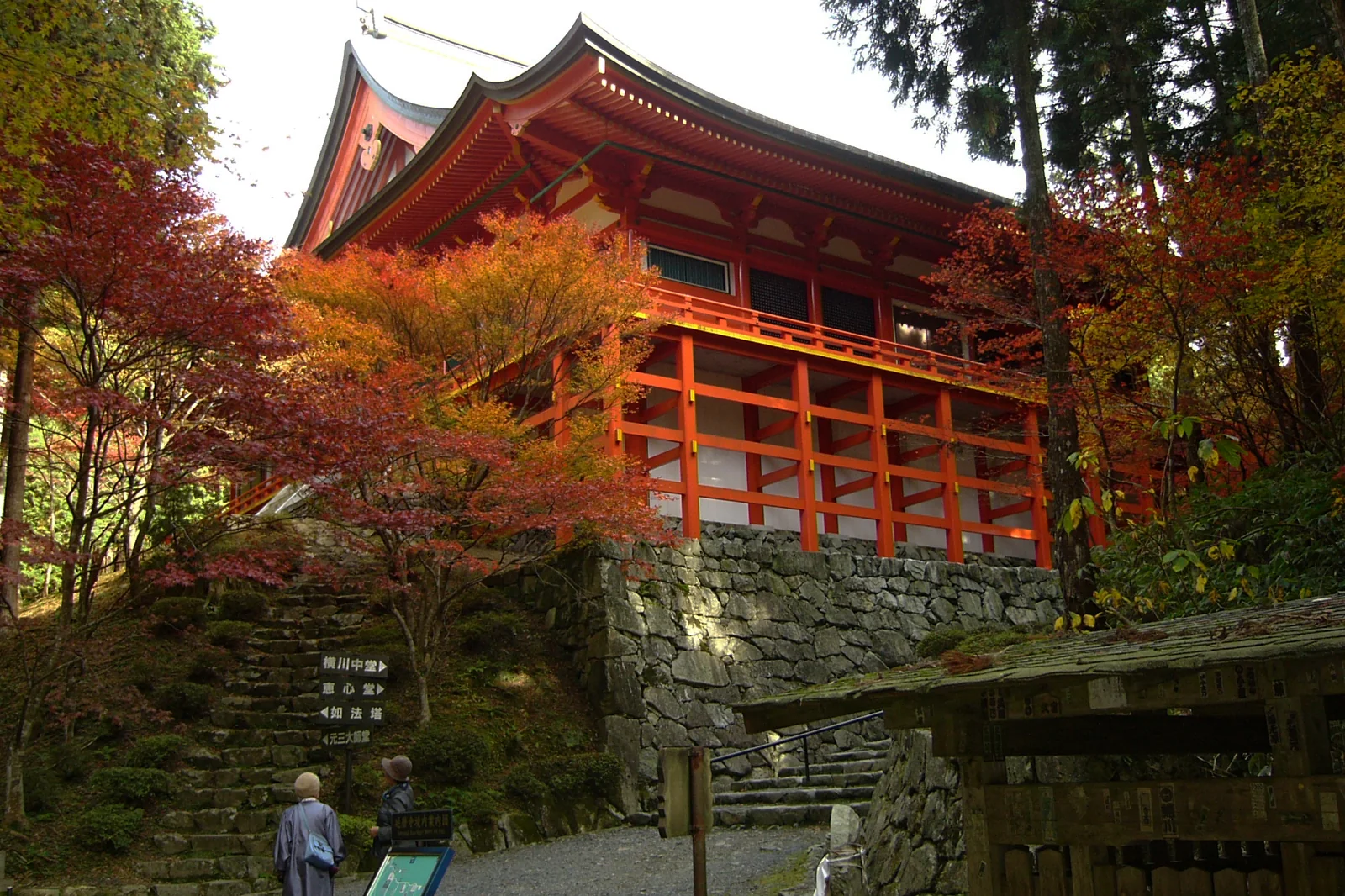
From the "Eigenji-mae" bus stop, walk down toward the Echi River, follow signs across Taiketsu-kyo Bridge, and climb Rakanzaka—listed by the temple at about 120 stone steps. Beside the rock cliff at the top stand stone statues of the Shaka Triad and Sixteen Arhats (Rakan), followed by the Somon gate where tickets are sold; pass through it to reach the two-story Sanmon Gate. To enjoy both the river gorge and the temple buildings, take in the bridge views before entering so you can focus solely on the stone steps on your way down after sunset. If you stop on the bridge or stairs to look at the river, step aside where pedestrians can pass.
Eigen-ji was founded in 1361 when Omi provincial governor Sasaki Rokkaku Ujiyori donated the land to Zen Master Jakushitsu Genko to establish the monastery. Beyond the Sanmon Gate stands the Hojo (Main Hall), roofed in reeds harvested from Lake Biwa and bearing the mountain-name plaque "Zuisekisan," which the temple attributes to its founding master's calligraphy. Nearby stand the Hatto (Dharma Hall) and bell tower; if architecture is your priority, locate both the Hojo and Hatto early on. Looking back from the bridge as you leave, you can see how the temple roofs step naturally up the slope above the Echi River as it winds toward Lake Biwa.
For 2026, guided tours of the Sanmon Gate and the Hatto's Dragon in Clouds ceiling painting offer another timed daytime option. The Higashiomi City Tourism Association lists three daily tours from November 7 to 23 at 10:00, 11:30, and 14:00 for ¥1,500 including admission, meeting at the Eigen-ji Tourist Information Center (52 Eigenji Takano-cho)—a different spot from the hilltop ticket gate. If your group arrives separately or in two cars, share the exact Japanese name of the meeting point. From November 7 to 30, Ganku-in Garden and the Hyogetsu-tei tea room also open from 09:00 to 17:00 (last entry 16:45) for ¥700 per tea service, separate from temple admission. Since the East Exit daytime shuttle only reaches Eigen-ji at 10:00 and departs at 11:15, ride the earlier Misono Line bus if you want to catch a guided gate tour.
Eigen-ji asks visitors not to use tripods, drones, or climb onto stone walls and elevated ledges for photos; monopods are permitted as long as you remain mindful of people around you. Shooting on a phone? Frame the opposite wooded hillside before crossing the bridge, look up at maple boughs framing the Sanmon Gate, and after dark focus on illuminated eaves and individual clusters of lit leaves. When photographing the Rakan statues, wait until you reach the wider landing at the top of the stairs so climbers can pass; on the descent, pack your camera away so you have a free hand for the railing or a light.
Day Trips from Kyoto and Self-Driving Orders with Night Illuminations
Ohmi Railway's seasonal sightseeing bus departs JR Kyoto Station Hachijo Exit daily from November 14 to December 13, 2026, leaving at 09:10 and returning to Hachijo Exit at 17:45. The published itinerary visits Eigen-ji, Hyakusai-ji, lunch at Sennaritei, Saimyo-ji, and Kongorin-ji, with roughly one hour at each temple. Follow the exact meeting time and location at Kyoto Station Hachijo Exit printed on your booking—don't exit the subway at the Karasuma side and join the city bus queues by mistake. Leave buffer time for getting back to your hotel from Kyoto Station afterward; if you are transferring to a Shinkansen on return, the operator recommends allowing an extra 30 to 60 minutes.
Adult tickets cost ¥14,000 (children ¥7,000) through December 6, dropping to ¥9,900 for adults (children ¥4,950) from December 7 to 13, including transport, temple admission, and an Omi beef lunch at Sennaritei. Because Eigen-ji comes first in the morning, the tour runs entirely in daylight—if night illuminations are your priority, set aside a separate evening via route bus or pre-booked ride. When comparing the tour price against driving, tally car rental, parking, expressway tolls, individual temple admissions, and meals separately; per-person math shifts between couples and groups of four, and slower stair climbers should treat the one-hour temple stops as firm boarding deadlines.
Driving from Hikone or Maibara, work north to south: Saimyo-ji and Kongorin-ji in the morning, lunch, then Hyakusai-ji followed by Eigen-ji. If you are driving from Kyoto specifically for Eigen-ji's night illumination, stick to the two southern temples—Hyakusai-ji and Eigen-ji—or add Kongorin-ji first in the morning before heading south. The Meishin Expressway "Koto Sanzan Smart IC" requires ETC, so confirm with your rental agency that both card and onboard unit work before departure; cars without ETC can exit via Hikone IC or Yokaichi IC as noted by Saimyo-ji. Save individual temple or parking lot names in your navigation app rather than searching "Koto Sanzan," which can route you to expressway service facilities.
Eigen-ji's official parking centers on the "Daihonzan Eigen-ji Parking Lot" near Dando-bashi Bridge off Route 421, supplemented by private lots during peak autumn season. If the main lot is full, follow roadside attendants to secondary lots and note which side of the road you parked on so you aren't crossing dark traffic searching for your car after illuminations. When hiring a private charter driver, specify each pickup by temple name plus exact landmark—such as outside Saimyo-ji's Honbo or near Eigen-ji's Dando-bashi Bridge—and build evening waiting time, pickup, and final station drop-off into your booked hours if staying past dusk.
Where to Base Yourself: Hikone, Omihachiman, or Kyoto Next-Day Connections
To ride the Hikone shuttles and also see Hikone Castle and Genkyu-en Garden, spend a night near JR Hikone Station. Dedicate day one to the castle town and lakeside before catching the West Exit shuttle early on day two; if you arrive via Maibara on the first afternoon, book dinner near the station or along Yumekyobashi. If you arrange an evening pickup back from Eigen-ji or Hyakusai-ji, keep dinner reservations flexible and send your driver your hotel address or preferred JR Hikone Station exit. For pacing the castle and garden on foot, see a car-free day at Hikone Castle and Genkyu-en Garden. Eigen-ji's Ii clan mausoleum enshrines Hikone feudal lord Ii Naooki—who laid out Genkyu-en—along with his family, forming a direct historical thread from the previous day's garden walk. While the mausoleum itself is closed to entry, visiting both places lets you trace the clan from their castle garden to their Zen retreat.
For travelers pairing Eigen-ji and Hyakusai-ji by bus or planning a compact foliage getaway, Omihachiman links JR trains with the Ohmi Railway, while Yokaichi serves as the hub for the Misono Line and municipal buses. Staying in Omihachiman leaves an extra half-day for the Hachimanbori Canal and old merchant streets, whereas staying in Yokaichi saves you another train wait after night illuminations end. Plan an Omi beef dinner back in town where restaurants stay open, or choose the Kyoto sightseeing bus that includes lunch. Drivers looking for an afternoon break in Aito can stop at Michi-no-Eki Higashiomi Aito Margaret Station along Route 307 for local produce before dinner instead of squeezing shopping into temple parking windows. Check our Omihachiman day-trip and overnight guide for downtown routes.
If you are already based in Kyoto for multiple nights, taking the four-temple sightseeing bus avoids hotel changes, or you can ride JR to Omihachiman and spend half a day at Eigen-ji. Before catching a long-distance train at the end of your trip, staying in Hikone or Omihachiman makes it easy to leave bags at your hotel and collect them before transferring at Maibara or Kyoto rather than hauling luggage into the mountains. If you want to continue onward to Nagahama or Chikubu Island, give ferries and port transfers a full separate daytime slot instead of trying to make a fixed boat sailing after the last three-temple shuttle. Decide first whether mountain temples, castle towns, or Lake Biwa are your priority, then match your base to the direction of travel.
Foliage Timing and Rainy-Day Adjustments
For November trips, target mid-to-late November as your primary window, then check weekly updates from the temples and railway operators. Eigen-ji's website lists early to late November as its autumn viewing season, with mid-month typically bringing the strongest color. JR West's Shiga foliage tracker specifies exact viewing spots at each temple, such as around Kongorin-ji's Main Hall or Hyakusai-ji's pond garden and approach. Updates logged on November 22, 2026, listed Saimyo-ji at peak foliage as of November 20, Eigen-ji as of November 21, and both Kongorin-ji and Hyakusai-ji as of November 22. If you are traveling in December, use these zone-by-zone reports to choose spots—Kyoto's sightseeing bus runs through December 13, spanning late color and fallen-leaf carpets.
If you arrive a week early while leaves are still partly green, Eigen-ji's reed-roofed Hojo and Saimyo-ji's pagoda and Horai-tei Garden still offer plenty of architectural detail. Once canopies thin out, Hyakusai-ji's stone walls and pond edges catch fallen leaves along the water. In rain, swap a full uphill climb for one temple paired with a castle town, sticking to the Honbo or lower entrance paths once you arrive; when wet leaves cling to slick stone steps, shorten your stride and never take stairs two at a time chasing a bus. Groups with toddlers or travelers needing wider paths can split up using the parking lots and garden walkways noted above, then regroup at each temple's entrance or bus stop so everyone gets comfortable seating and restroom breaks rather than forcing every climb.
A few useful answers
Is Eigen-ji part of Koto Sanzan?
Koto Sanzan comprises three Tendai temples: Saimyo-ji, Kongorin-ji, and Hyakusai-ji. Eigen-ji is another major autumn foliage destination in the same Koto region, located upstream along the Echi River as the head temple of the Eigen-ji branch of Rinzai Zen.
Can you visit all three Koto Sanzan temples and Eigen-ji from Kyoto in one day by public transit?
Yes. From November 14 to December 13, 2026, the seasonal sightseeing bus departs JR Kyoto Station Hachijo Exit at 09:10 and is scheduled to return at 17:45, spending about one hour at each of the four temples with transport, admission, and an Omi beef lunch included.
Can you still catch a bus back to Yokaichi after Eigen-ji's night illumination?
The November 2026 schedule lists the last bus from Eigenji-mae to Yokaichi Station at 20:27 on weekdays and 19:16 on weekends and holidays. On weekends and holidays, leave the temple early before closing, and factor in walking down Rakanzaka, reaching the bus stop, and transferring at Yokaichi.
Both Hikone shuttles stop at Hyakusai-ji—what's the difference?
The paid West Exit shuttle serves the three Koto Sanzan temples daily from November 19 to 29, 2026, with advance first-leg reservations available from Hikone when buying the day pass. The free East Exit shuttle covers Eigen-ji, Hyakusai-ji, and Kawarayazen-ji on November 21-23, 27, and 28 only, boarding first-come, first-served exclusively at Hikone Station East Exit.
How can a family visiting just one temple minimize stone steps?
At Hyakusai-ji, you can enter the pond garden near the Honbo, leaving the steeper climb to the Nio-mon Gate and Main Hall for those who want it. At Kongorin-ji, visitors driving with companions who cannot manage the long approach can ask at the ticket counter about driving up to the Main Hall parking lot.
Official information and references
Sources used in this guide.
- Ohmi Bus & Kokoku Bus | 2026 Koto Sanzan Shuttle, Fares, and Reservations
- Ohmi Bus & Kokoku Bus | 2026 Koto Sanzan Shuttle Timetable and Route Map
- Ohmi Bus & Kokoku Bus | Kyoto Seasonal Four-Temple Sightseeing Bus
- Shiga Autumn Tourism | Hikone Station East Exit Kaede Kaido Free Shuttle
- Shiga Autumn Tourism | Eigen-ji Night Illumination and Closing Hours
- Daihonzan Eigen-ji | November Foliage Season Visiting Hours
- Daihonzan Eigen-ji | Admission Fees, Parking, and Photography Rules
- Daihonzan Eigen-ji | Rakanzaka, Sanmon Gate, Hojo, and Grounds Map
- Higashiomi City Tourism Association | 2026 Eigen-ji Sanmon Gate & Dragon Painting Tours and Tea Service
- Higashiomi City Tourism Association | 2026 Hyakusai-ji Honbo Garden Illumination
- Shiga Prefecture Tourism | Hyakusai-ji Kiken-in Honbo and Pond Garden
- Ohmi Bus & Kokoku Bus | Yokaichi Station to Eigenji-mae Fares and Bus Stop
- Ohmi Bus & Kokoku Bus | Misono Line Eigenji-mae to Yokaichi Station Timetable
- Ohmi Railway | Ohmi Mankitsu Pass Price, Coverage, and How to Buy
- Higashiomi City | Chokotto Bus Routes, Fares, and Current Timetable
- Saimyo-ji | Daytime Hours, Admission, and Approach Elevation
- Saimyo-ji | Expressway Exits, Seasonal Shuttles, and Parking
- Saimyo-ji | 2026 Autumn Special Viewing of Crowned Bishamonten
- Kongorin-ji | Grounds, Admission Fees, and Main Hall Parking
- Kongorin-ji | Inae Station Shared Taxi and Booking Rules
- JR West | Shiga Autumn Foliage Spot Updates
- Higashiomi City Tourism Association | Michi-no-Eki Aito Margaret Station Direct Farm Market