Ranked among Japan's three great float festivals alongside Kyoto's Gion Matsuri and Hida's Takayama Festival, the Chichibu Night Festival holds UNESCO Intangible Cultural Heritage status. On December 2 (Yoimiya), four yatai floats parade past 500 starmine fireworks; on December 3 (Main Festival), six floats roll through town into the early morning beneath 4,000 winter fireworks. Reach Seibu-Chichibu Station from Ikebukuro in about 80 minutes on the Seibu Laview limited express, with extra trains running until midnight on Dec. 3. This guide covers the two-day schedule, fireworks viewing spots, hotel picks, and traffic closures.
- Region & Focus
- Chichibu
- Reading Scope
- 14 min read · 6 chapters · 4 Q&As
- Official Verification
- 12 official sources checkedUpdated November 20, 2026
- Key Topics
- ItinerariesWinterTokyo & Kanto
Chapter Route Map (tap any stop)
- Festival Standing: Japan's Three Great Float Festivals and UNESCO Status
- The 2026 Two-Day Blueprint: Yoimiya Eve and Main Festival
- Winter Fireworks: 500 Shots and 4,000 Shots over Hitsujiyama Park
- Getting There and Away: Traffic Closures, Extra Trains, and Limited Express Service
- Where to Stay: Station-Side Picks and 7 Official Directory Highlights
- On-Site Support and Wrapping Up a Two-Day Itinerary
- Quick Q&A
Ranked alongside Kyoto's Gion Matsuri and Hida's Takayama Festival as one of Japan's three great float festivals, the Chichibu Night Festival was inscribed on UNESCO's Intangible Cultural Heritage list in December 2016 as part of the country's "Yama, Hoko, Yatai, float festivals." Held every December 2 (Yoimiya) and December 3 (Main Festival) at Chichibu Shrine and across central Chichibu, the celebration sends six National Important Tangible Folk Cultural Property floats—two kasaboko and four yatai—rumbling through town. On the night of Dec. 3, the sacred Shinko-gyoretsu procession and the dramatic team haul up the steep Dangozaka slope bring the festival to its peak, matched overhead by 500 starmine fireworks on Dec. 2 and 4,000 winter fireworks on Dec. 3 from Hitsujiyama Park. Direct Seibu Laview limited express trains reach Seibu-Chichibu Station from Ikebukuro in roughly 80 minutes, with special late-night service until midnight on Dec. 3—essential given the sweeping downtown traffic closures that make rail the only sensible way in. Based on the latest updates from the Chichibu Tourism Association and Chichibu City, this guide maps out the 2026 two-day itinerary, best fireworks viewpoints, sold-out paid seating status, station-side hotels, Seibu ticket release times, and daytime stops from Hidari Jingoro's shrine carvings to Hitsujiyama Park and the anime pilgrimage landmark Chichibu Bridge.
Festival Standing: Japan's Three Great Float Festivals and UNESCO Status
The Chichibu Night Festival serves as the annual grand festival of Chichibu Shrine, the regional head shrine with founding legends stretching back 2,000 years, and carries triple heritage recognition. Nationally, it stands alongside Kyoto's Gion Matsuri and Hida's Takayama Festival as one of Japan's three great float festivals. Internationally, it was inscribed on December 1, 2016 as one of 33 Japanese "Yama, Hoko, Yatai, float festivals" on UNESCO's Intangible Cultural Heritage list. Domestically, "Chichibu Festival Yatai Procession and Kagura" (including yatai kabuki, hikimai dances, and Chichibu Shrine kagura) is designated an Important Intangible Folk Cultural Property, while the six kasaboko and yatai floats were named Important Tangible Folk Cultural Properties back in 1962. According to tourism association records, historical documentation of the festival dates to the Kanbun era (1661–1672), giving it more than 350 years of recorded history.
Its many local nicknames reflect the festival's layered heritage. Locals call it Fuyumatsuri (Winter Festival) or Yomatsuri (Night Festival); older names include Myoken-sama, while silk-farming households knew it as Okaiko-matsuri (Silkworm Festival) and merchants called it Myoken-sama no Oichi (Myoken-sama's Great Market). During the Edo period, the night festival grew alongside Chichibu's booming silk trade, making it equal parts sacred ritual and annual craft-and-commerce fair. For 2026, the Chichibu Silk Market (Chichibu Kinuichi) runs on Kaitsugisho-dori and Kuromon-dori from 11:00 a.m. to 7:00 p.m. on Dec. 2 and 11:00 a.m. to 8:00 p.m. on Dec. 3, giving daytime visitors a lively market stroll between float sightings.
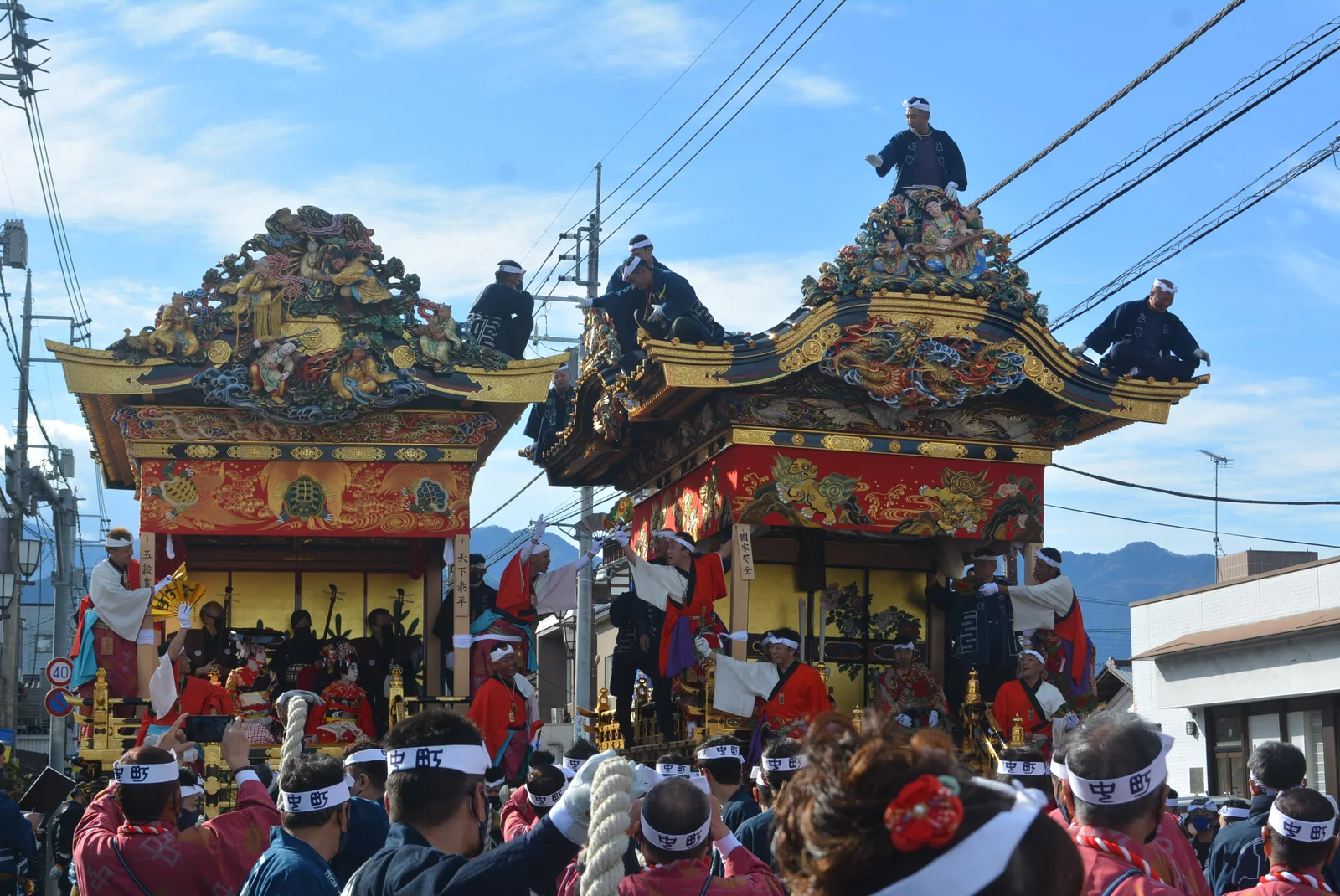
Six towering floats anchor the street processions: two kasaboko (Nakachika and Shimogo) and four yatai (Miyaji, Kamimachi, Nakamachi, and Honmachi). On the night of Dec. 3, crews haul these roughly 20-metric-ton structures up the steep Dangozaka slope in unison, delivering the festival's defining spectacle. Each yatai doubles as a two-tier performance space, with an upper stage that unfolds for yatai kabuki (operated on a strict annual rotation of Miyaji, Honmachi, Kamimachi, and Nakamachi) and a lower deck for the hayashi musicians. Each neighborhood even preserves its own traditional title for its musicians—hayashiko in Miyaji, kajitori in Nakamachi, and jubangi in Honmachi—underscoring the deep neighborhood guild roots behind the event.
Knowing the structural difference between a kasaboko and a yatai makes watching the parade far more rewarding. The Nakachika and Shimogo kasaboko represent an older, more archaic float style topped with tall spear-like ornaments and dragged directly along the ground without standard wheels in a technique called jibiki. By contrast, the four yatai from Miyaji, Kamimachi, Nakamachi, and Honmachi have two-level frames: a lower hayashi stage that blasts relentless festival rhythms while moving, and a concealed upper kabuki stage whose side wings fold outward whenever the float halts for a play. Maintained and operated year after year by residents of their respective districts, the six national cultural property floats embody Chichibu's tight-knit community history.
Beyond the festival itself, Chichibu blends heritage architecture, seasonal blooms, and anime landmarks into an easy daytime itinerary. Inside Chichibu Shrine stand four famed woodcarvings attributed to master Edo sculptor Hidari Jingoro: the Tethered Dragon, Mother Tiger and Cubs, Lively Three Monkeys, and North Star Owl. In spring, Hitsujiyama Park's Shibazakura Hill bursts with over 400,000 moss phlox plants across nine varieties, whose patchwork palette takes inspiration from the red-and-white juban robes worn by the festival's hayashi musicians. Nearby, Chichibu Bridge and surrounding streets draw fans of anime titles such as Anohana: The Flower We Saw That Day (featured on Chichibu City's official anime pilgrimage page updated in September 2026).
Ranked among Japan's three great float festivals alongside Kyoto's Gion Matsuri and Hida's Takayama Festival, the Chichibu Night Festival holds UNESCO Intangible Cultural Heritage status. On December 2 (Yoimiya), four yatai floats parade past 500 starmine fireworks; on December 3 (Main Festival), six floats roll through town into the early morning beneath 4,000 winter fireworks. Reach Seibu-Chichibu Station from Ikebukuro in about 80 minutes on the Seibu Laview limited express, with extra trains running until midnight on Dec. 3. This guide covers the two-day schedule, fireworks viewing spots, hotel picks, and traffic closures.
The 2026 Two-Day Blueprint: Yoimiya Eve and Main Festival
December 2, known as Yoimiya (Festival Eve), moves at an unhurried pace ideal for catching details up close. The four yatai floats—Miyaji, Kamimachi, Nakamachi, and Honmachi—parade from morning until wrapping up at 8:00 p.m.; per Chichibu City's official FAQ, they begin rolling out along Odori between roughly 9:00 and 11:00 a.m. With thinner crowds than the next day, float crossings, hikimai dances (shosa), and miyamairi shrine visits are all easy to see. Miyaji yatai performs yatai kabuki from noon to 2:00 p.m., and 500 Yoimiya fireworks from Hitsujiyama Park cap the evening.
December 3, the Main Festival, is a round-the-clock marathon running from dawn until the following morning. All six kasaboko and yatai floats follow two official parade blocks: 6:00 a.m. to 4:00 p.m., then 4:00 p.m. to 5:00 a.m. the next day. Miyaji yatai stages two more kabuki performances from 12:30 to 2:30 p.m. and 4:30 to 6:30 p.m. At dusk, attention shifts to the Shinko-gyoretsu sacred procession, scheduled in 2026 to depart Chichibu Shrine around 6:00 p.m. (in past years it often stepped off after 7:00 p.m. and reached peak intensity at the Otabisho around 10:00 p.m.). Lantern-lit floats advance to thunderous kagura and hayashi music, and once the portable mikoshi shrine is enshrined at the Otabisho, fireworks light up the night sky.
Follow Chichibu City's recommended timing to pick your vantage points: stay around Chichibu Shrine and Odori during daylight hours, then shift after dark to the areas outside Chichibu Shrine, Chichibu Railway's Chichibu Station, Honmachi-dori, Nakamachi-dori, and Shonin-dori. Knowing four local terms also unlocks the action: girimawashi refers to sharp pivot turns (Kamimachi yatai uses a mechanical kirin jack beneath the float to lift and spin it), surechigai is the standoff when two floats pass in a narrow lane while trying to outplay each other with the surging Onami rhythm, miyamairi is the daytime procession of all six floats paying respects before Chichibu Shrine's gate, and momiai captures the tense, surging crowd pushes as crews maneuver the floats.
Working backward from the two-day schedule, the most rewarding plan is to check into a Chichibu hotel on Dec. 2, enjoy the Yoimiya fireworks without rushing, and spend all of Dec. 3 downtown following the Main Festival floats, Shinko-gyoretsu procession, and 4,000 winter fireworks before catching a late special train back to Tokyo or staying a second night. Day-trippers forced to pick just one day have to choose between Yoimiya's calmer crowds and shorter fireworks, or the Main Festival's full six-float spectacle and peak congestion.
Because yatai kabuki follows a strict four-year district rotation (Miyaji, Honmachi, Kamimachi, then Nakamachi), which neighborhood takes the stage is always a major talking point in town. In 2026, Miyaji yatai holds the lead role, presenting one performance on Yoimiya (noon–2:00 p.m.) and two on the Main Festival (12:30–2:30 p.m. and 4:30–6:30 p.m.). Because the duty district spends the longest time preparing, these daytime shows deliver polished staging worth building your schedule around.
Up close, these traditional maneuvers feel electric. During a surechigai crossing, two towering floats squeeze past each other in tight streets while both drum-and-flute teams pour everything into the Onami beat, creating a wall of sound you feel in your chest. At intersections, watching a 90-degree girimawashi—especially when Kamimachi's crew jacks up more than ten tons of timber on a kirin pivot—shows off extraordinary human coordination. Daytime miyamairi ceremonies and nighttime momiai surges show the festival's solemn and wild sides in turn; since announcers and printed programs use these exact terms, learning them beforehand lets you read the street like a local.
Do not skip the Chichibu Festival Museum (Chichibu Matsuri Kaikan), which serves as an ideal primer during festival week. It extends hours to 8:00 p.m. on Dec. 2 and 9:00 p.m. on Dec. 3 (normal December–March hours are 10:00 a.m.–5:00 p.m., closed Tuesdays in December). Touring the full-size yatai exhibits and fold-out kabuki stage mechanisms by day makes watching the real floats navigate the streets after dark far richer.
Downtown shoppers can also browse the Chichibu Silk Market, open 11:00 a.m.–7:00 p.m. on Dec. 2 (3 shops on Kaitsugisho-dori and 10 on Kuromon-dori) and 11:00 a.m.–8:00 p.m. on Dec. 3 (7 shops on Kaitsugisho-dori and 12 on Kuromon-dori). Running alongside the daytime float processions, this descendant of the Edo-era silk fair fills the old merchant streets with festive commerce—another reason an overnight stay beats a quick day trip.
Winter Fireworks: 500 Shots and 4,000 Shots over Hitsujiyama Park
According to 2026 figures updated by the Chichibu Tourism Association on November 11, the Dec. 2 Yoimiya display runs from 7:00 to 8:00 p.m. with 500 single shells and rapid-fire starmine barrages. On Dec. 3, the Main Festival fireworks expand dramatically from 7:30 to 9:55 p.m., launching 4,000 shots. As one of Japan's rare major festivals to pair midwinter floats with large-scale pyrotechnics, it launches shakudama shells and starmines from Hitsujiyama Park on the southern hillside (closed to entry during restricted hours) into crisp, clear December skies.
You do not need to crowd the base of the hill—the station districts on the north side of downtown face directly toward Hitsujiyama Park's launch zone. Official viewpoints recommended by the tourism association and city FAQ include National Route 140 between the Seibu-Chichibu Station traffic signal and the Uenomachi intersection, the Chichibu City Hall parking lot (designated fireworks viewing venue), Seibu-Chichibu Station plaza, Chichibu Station plaza, and the plaza in front of the Chichibu Civic Hall.
Keep two practical caveats in mind before heading out. First, drone flying is strictly banned throughout the festival area; any drone entering restricted airspace can force an immediate halt to the fireworks. Second, the 2026 official webpage contains conflicting weekday labels (the fireworks section lists Dec. 2 as Tuesday while the calendar lists Wednesday), so plan strictly by the exact dates—Dec. 2 and Dec. 3—and posted times.
As for reserved seating, paid Yatai Viewing Seat B tickets for Dec. 3, 2026 (all reserved seating at ¥4,000 per person for ages 3 and up) are completely sold out—both the 200 counter-sale tickets offered Oct. 31–Nov. 3 and the 150 postcard-lottery seats have closed. Otabisho grandstand (sajiki) seats are handled separately through the Chichibu Tourism Association desk (city hall and the executive committee do not field inquiries). Officials also note that watching the Dangozaka slope haul is virtually impossible without a reservation, so travelers without paid tickets are best served staking out free viewpoints around Chichibu Shrine, Chichibu Station, and National Route 140.
While most Japanese fireworks festivals happen in peak summer, Chichibu fires 4,000 shells in early December because the pyrotechnics—alongside the floats—originally served as tsukematsuri (attendant offerings) escorting the sacred mikoshi to the Otabisho. Dry, haze-free winter mountain air keeps every burst razor-sharp, while the surrounding valley walls amplify the concussive boom in a way summer coastal shows rarely match, drawing pyrotechnic fans specifically for this winter spectacle.
Knowing the Shinko-gyoretsu route helps you track the night's pacing. Prior to 1975, the procession followed Banba-dori, Chichibu Shrine's main approach; today it travels along Honmachi-dori to the Otabisho. As the parade crosses the Suwa-watari section near Chichibu Brand-kan on Honmachi-dori, the deafening hayashi drums and flutes suddenly fall completely silent—an eerie, solemn pause in the middle of the night. Upon reaching the Otabisho, priests raise a towering oheisoku paper wand behind the Kamenoko-ishi stone and enshrine the mikoshi; spotting these landmarks tells you exactly what act of the ritual is unfolding.
The contrast between the two nights is clear-cut. Dec. 2's 500-shot program makes a crisp one-hour opener wrapping up at 8:00 p.m., leaving time to wander the old town or turn in early. Dec. 3's 4,000-shot marathon spans nearly two and a half hours (7:30–9:55 p.m.) and runs right alongside the illuminated night procession, giving downtown viewpoints an unforgettable frame of glowing festival floats beneath bursting winter shells.
Getting There and Away: Traffic Closures, Extra Trains, and Limited Express Service
Widespread road closures across central Chichibu on Dec. 2 and 3 cause heavy congestion on surrounding highways, prompting the Chichibu Tourism Association to urge visitors to arrive exclusively by train; all rail lines will run extra trains until roughly midnight on Dec. 3. Drivers face tight limits: while local elementary and junior high school grounds open as paid temporary lots on Dec. 3, Dec. 2 offers only one free temporary lot at Miyaji Ground, and overnight parking is strictly prohibited on both nights. Rental bicycles downtown also suspend service from Dec. 2 through the morning of Dec. 4.
Seibu Railway has finalized its 2026 festival timetable. On Dec. 3, extra trains run between Hanno and Seibu-Chichibu, supplemented after 9:00 p.m. by direct return trains from Seibu-Chichibu to Ikebukuro and Tokorozawa. Laview limited express trains step up to roughly every 30 minutes starting in the 11:00 a.m. hour, with extra upbound evening departures as well. Reserved limited express tickets go on sale at 7:00 a.m. JST on Nov. 2 for Dec. 2 trains and at 7:00 a.m. JST on Nov. 3 for Dec. 3 trains (limit 8 tickets per person), with a ¥200 surcharge if purchased onboard. On Yoimiya night (Dec. 2), select upbound limited express services—such as an extended Musashi No. 58—also originate from Seibu-Chichibu so viewers can ride straight back to Ikebukuro after the 500-shot fireworks.
Chichibu's two rail lines serve opposite ends of downtown. From Ikebukuro, the all-reserved Seibu Laview limited express (¥900 limited express fare for adults; stops at Ikebukuro, Tokorozawa, Irumashi, Hanno, Yokoze, and Seibu-Chichibu) reaches Seibu-Chichibu Station in about 80 minutes. From Kumagaya, the Chichibu Railway takes roughly 70 minutes to Chichibu Station. Walking from Seibu-Chichibu Station to Chichibu Shrine takes about 15 minutes normally (longer in festival crowds), whereas Chichibu Station sits closest to the shrine—so whichever station you book near effectively sets your walking and departure logistics for both days.
As of November 20, 2026, Chichibu Railway has not yet released detailed timetables for its dedicated festival specials (such as the Ohanabi-go), so check the official Chichibu Railway website before departing while keeping the tourism association's midnight late-train guideline in mind. Note also that while the SL Paleo Express steam locomotive's 2026 season runs through Dec. 6, no steam departures are scheduled during the two festival days.
The gap in pace between the two days usually settles whether to stay overnight. Yoimiya on Dec. 2 favors daytime exploring and photography—floats start between 9:00 and 11:00 a.m., hayashi and kabuki run through the afternoon, and both floats and fireworks wrap up by 8:00 p.m., making a Tokyo day trip effortless. The Main Festival on Dec. 3 runs from 6:00 a.m. past midnight, packing in daytime miyamairi visits, the 4:30 p.m. kabuki performance, the 6:00 p.m. Shinko-gyoretsu, the 7:30 p.m. main fireworks, and late-night float hauls—meaning a local hotel saves you from a frantic dash for the last train.
Where to Stay: Station-Side Picks and 7 Official Directory Highlights
Properties on the Chichibu Tourism Association's official directory split neatly between the two stations and specialty retreats. Near Seibu-Chichibu Station stand Hotel Route-Inn Seibu-Chichibu Ekimae (a 3-minute walk) and Ryokan Hiyoshi (a 7-minute walk, offering private reservable baths and Wi-Fi). Near Chichibu and Ohanabatake stations sit Ryokan Tachibana right outside Ohanabatake Station, APA Hotel Chichibu Ekimae (newly opened October 31, 2025 in front of Chichibu Station), and Hotel Miyama, where every room has private bath facilities alongside its signature Yomatsuri Bath and Megami Bath. Specialty stays range from the century-old restored kominka NIPPONIA Chichibu Monzenmachi (serving French-inspired local cuisine) and the scattered-room townhouse stay Machiju Kyakushitsu Chichibu-yado to Chichibu Onsen Hananoya (private open-air baths in every room), budget workation-friendly Chichibu Suijin Hotel (from ¥2,980 per night), and the forest cabins at PICA Chichibu inside Chichibu Muse Park.
Matching your hotel to your festival priority saves serious walking. Travelers focused on the Yoimiya and Main Festival fireworks should stay on the Seibu-Chichibu Station side—the station plaza itself is an official fireworks viewing zone, putting your bed a three-minute stroll away after the finale. Visitors prioritizing the late-night Main Festival floats and Shinko-gyoretsu procession will prefer the Chichibu Station side or downtown core, steps from Chichibu Shrine, Honmachi-dori, and Nakamachi-dori. Architecture lovers gravitate toward NIPPONIA Chichibu or Machiju Kyakushitsu Chichibu-yado, while hot-spring fans head straight for Hananoya's private open-air baths.
Between downtown road closures, heavy surrounding traffic, and late-night crowds packing trains until midnight, rooms around Dec. 2–3 routinely sell out far in advance. Lock in reservations early if you plan to stay overnight, before only distant suburban inns remain.
With central Chichibu virtually closed to private cars and temporary school parking lots filling fast on Dec. 3, rail remains the most dependable way in and out. Even so, ticket counters and fare-adjustment machines at Seibu-Chichibu Station build long lines after the finale—Seibu Railway specifically advises charging your PASMO or Suica IC card before arriving so you can tap straight through the gates.
Your station choice also shapes your exit strategy. Guests near Seibu-Chichibu Station can catch Seibu's extra direct trains to Ikebukuro and Tokorozawa after 9:00 p.m. on Dec. 3, while those near Chichibu Station connect via Chichibu Railway toward Kumagaya. Verify last-train schedules on both operators' official sites before heading out, and remember that the SL Paleo Express does not operate on either festival day.
For travelers seeking deeper local character, Chichibu's two scattered heritage stays stand out. NIPPONIA Chichibu Monzenmachi converts century-old merchant homes into boutique rooms paired with seasonal French dinners using local ingredients, while Machiju Kyakushitsu Chichibu-yado lets guests rent entire historic townhouses and live inside the old quarter like residents. Stepping straight out your wooden front door onto float-lined streets beats any standard business hotel—just book early, as their tiny room counts make them the first to sell out for festival week.
On-Site Support and Wrapping Up a Two-Day Itinerary
Comprehensive visitor support runs throughout town during the festival. Located at 2-8 Banbamachi, the Chichibu Festival Museum extends its hours (9:00 a.m.–5:00 p.m. on Dec. 1, 9:00 a.m.–8:00 p.m. on Dec. 2, and 9:00 a.m.–9:00 p.m. on Dec. 3; standard Dec.–March hours are 10:00 a.m.–5:00 p.m., closed Tuesdays in December), making it both an educational stop on float engineering and a warm refuge between parades. Outside Seibu-Chichibu Station, the Chichibu Tourist Information Center stays open throughout the festival without holidays, backed by a live parking availability page updated specifically on Dec. 3 so visitors can get real-time guidance if crowd routes shift.
Save daytime hours for a proper visit to Chichibu Shrine. Its existing main hall, rebuilt on orders from Tokugawa Ieyasu in the Gongen-zukuri style and designated a prefectural Important Cultural Property, displays vibrant Hidari Jingoro carvings including the Tethered Dragon, Mother Tiger and Cubs, and Lively Three Monkeys. Inside, the shrine venerates four deities led by Yagokoro-omoikane-no-mikoto, with Mount Buko revered as its sacred mountain. The night festival's Shinko-gyoretsu escorts the mikoshi along Honmachi-dori to the Otabisho (using the Banba-dori approach before 1975), highlighted by the Dec. 2 Suwa-watari ritual when every float falls silent as it passes Chichibu Brand-kan.
Putting both days together flows smoothly: arrive on the morning of Dec. 2 to watch the Yoimiya floats and the noon–2:00 p.m. Miyaji yatai kabuki, browse the Chichibu Silk Market, watch the 500-shot fireworks from 7:00 to 8:00 p.m., and check into your downtown hotel. On Dec. 3, catch the six floats rolling out in the morning, follow the daytime miyamairi visits and two kabuki shows, trace the 6:00 p.m. Shinko-gyoretsu toward the Otabisho, settle into an official viewing spot for the 4,000 winter fireworks at 7:30 p.m., and after the 9:55 p.m. finale either board a direct Seibu train back to Ikebukuro or stay a second night. Extra daytime hours easily accommodate a side trip to Chichibu Bridge and nearby Anohana anime spots.
Factoring in traffic gridlock, sweeping downtown closures, restricted Dangozaka viewing, and sold-out B-section seats, the lowest-stress way to experience the 2026 Chichibu Night Festival is simple: book a Chichibu hotel early, travel strictly by train, and claim an official free viewing spot ahead of time.
The October 31, 2025 opening of APA Hotel Chichibu Ekimae also reshaped lodging around Chichibu Station. Previously dominated by traditional family-run inns, the station front now gives international travelers used to standardized chain rooms and English-friendly online booking a straightforward option—while travelers chasing both festival access and hot springs still have Chichibu Onsen Hananoya's private open-air baths.
As for the fireworks launch site, Hitsujiyama Park (6360 Omiya, Chichibu City) sits on the foothills of 1,304-meter Mount Buko. From mid-April to early May, its 17,600-square-meter Shibazakura Hill blooms with over 400,000 moss phlox plants across nine varieties inspired by the red-and-white robes of festival musicians (note there are no blooms in winter). On ordinary days it is a 1.5-kilometer uphill walk from Seibu-Chichibu Station, 1.4 kilometers from Yokoze Station, or 1.5 kilometers from Ohanabatake Station; on festival nights the park is sealed off, so unless you know local paths outside the cordon, the free station-area viewing zones downtown offer wide-open sightlines without the climb.
Few regional festivals in Japan publish schedules, FAQs, seating updates, and traffic maps as thorough as Chichibu's, making navigation straightforward if you follow official advisories. The real tests on the ground are the dense evening crowds and freezing early-December night air—lock in your hotel, cold-weather layers, and viewing spot early, and all that remains is taking in more than 350 years of winter floats and fireworks.
A few useful answers
What are the dates and main events of the 2026 Chichibu Night Festival?
On December 2 (Yoimiya), four yatai floats parade from morning until 8:00 p.m., Miyaji yatai performs kabuki from noon to 2:00 p.m., and 500 fireworks launch from 7:00 to 8:00 p.m. On December 3 (Main Festival), all six floats (two kasaboko and four yatai) parade from 6:00 a.m. through 5:00 a.m. the next morning, Miyaji yatai stages two additional kabuki performances, the Shinko-gyoretsu sacred procession departs Chichibu Shrine around 6:00 p.m., and Hitsujiyama Park hosts a 4,000-shot winter fireworks display from 7:30 to 9:55 p.m.
How do I get to the Chichibu Night Festival from Tokyo?
Take the Seibu Railway Laview limited express from Ikebukuro Station directly to Seibu-Chichibu Station in about 80 minutes (all seats reserved; limited express fare ¥900). On Dec. 3, Laview runs every 30 minutes starting around 11:00 a.m.; tickets go on sale at 7:00 a.m. JST on Nov. 2 for Dec. 2 trains and at 7:00 a.m. JST on Nov. 3 for Dec. 3 trains. Alternatively, take the Chichibu Railway from Kumagaya Station to Chichibu Station (about 70 minutes). Because central Chichibu is closed to most vehicle traffic on both days, officials strongly advise traveling by rail—extra late-night trains operate until around midnight on Dec. 3.
Where is the best place to watch the fireworks, and are paid seats still available?
Official recommended free viewing spots include along National Route 140 between the Seibu-Chichibu Station intersection and Uenomachi intersection, the Chichibu City Hall parking lot (official fireworks viewing area), and the plazas in front of Seibu-Chichibu Station, Chichibu Station, and the Chichibu Civic Hall. Paid Yatai Viewing Seat B tickets (¥4,000) for Dec. 3, 2026 are already sold out, and watching the Dangozaka slope haul without a reservation is nearly impossible, making the free station-area spots the most practical choice. Drones are strictly prohibited across the entire venue.
Where should I stay for the Chichibu Night Festival?
Key properties on the Chichibu Tourism Association's official list include Hotel Route-Inn Seibu-Chichibu Ekimae (3-minute walk) and Ryokan Hiyoshi (7-minute walk) near Seibu-Chichibu Station; APA Hotel Chichibu Ekimae (opened October 2025) and Ryokan Tachibana near Chichibu and Ohanabatake stations; and specialty stays such as the century-old kominka NIPPONIA Chichibu Monzenmachi, Machiju Kyakushitsu Chichibu-yado, and Chichibu Onsen Hananoya (featuring private open-air baths in every room). Stay near Seibu-Chichibu Station for the easiest fireworks access, or near Chichibu Station to be closer to the late-night float processions.
Official information and references
Sources used in this guide.
- Chichibu Tourism Association | Chichibu Night Festival Overview (Three Great Float Festivals, UNESCO, Float Lineup, Nicknames)
- Chichibu Tourism Association | Reiwa 8 Night Festival 2026 (Schedule, Fireworks, Transit, Silk Market, Stations)
- Chichibu Tourism Association | Paid Yatai Viewing Seat B Notice (¥4,000, Sold Out for 2026)
- Chichibu City Official Tourism Navi | Chichibu Night Festival (Float Lineup, Dangozaka, Festival History)
- Chichibu City Official Tourism Navi | Chichibu Night Festival Q&A (Viewing Spots, Nighttime Locations, Dangozaka Access Limits)
- Chichibu Shrine | Official Website (Night Festival Rituals, Nicknames, Osuwa-watari)
- Chichibu Festival Museum | Extended Festival Opening Hours Notice
- Seibu Railway | Night Festival Extra Trains and Limited Express Increase Notice (Dec. 3 Until Midnight, Ticket Release Schedule)
- Seibu Railway | Limited Express Laview (All-Reserved Seating, ¥900 Fare, Stops)
- Chichibu Tourism Association | Accommodations Directory (Official List)
- Chichibu Tourism Association | Chichibu Shrine Spot Guide (1-3 Banbamachi, Gongen-zukuri, Hidari Jingoro Dragon)
- Chichibu Tourism Association | Hitsujiyama Park Spot Guide (Shibazakura Hill, Fireworks Launch Site, Station Distances)