The Chichibu Night Festival (Chichibu Yomatsuri) ranks alongside the Gion and Takayama festivals as one of Japan's three great float festivals, and gained UNESCO Intangible Cultural Heritage status in 2016. On 2 December (Yoimiya), four yatai floats parade alongside 500 starmine fireworks; on 3 December (Honmatsuri), six floats process until dawn beneath 4,000 winter fireworks. Seibu's Laview Limited Express reaches Seibu-Chichibu in around 80 minutes from Ikebukuro, with extra trains running until midnight on 3 December. Here is everything you need for the two-day schedule, firework vantage points, accommodation near both stations, and road closures.
- Region & Focus
- Chichibu
- Reading Scope
- 14 min read · 6 chapters · 4 Q&As
- Official Verification
- 12 official sources checkedUpdated 20 November 2026
- Key Topics
- ItinerariesWinterTokyo & Kanto
Chapter Route Map (tap any stop)
- Heritage Status: Japan's Three Great Float Festivals and UNESCO Listing
- The Two-Day Framework for 2026: Yoimiya and Honmatsuri
- Winter Fireworks: 500 Shells and 4,000 Shells Over Hitsujiyama Park
- Getting There: Traffic Restrictions, Extra Seibu Trains and Express Services
- Where to Stay: Both Station Sides and Seven Official Highlights
- On-Site Facilities and Putting Together Your Two-Day Itinerary
- Quick Q&A
Ranking alongside Kyoto's Gion Matsuri and Hida's Takayama Matsuri as one of Japan's three great float festivals (Hikiyama Matsuri), the Chichibu Night Festival (Chichibu Yomatsuri) was inscribed on the UNESCO Intangible Cultural Heritage list in December 2016 as part of the nation's Yama, Hoko, Yatai float festivals. Held every year at Chichibu Shrine and across central Chichibu on 2 December (Yoimiya eve) and 3 December (Honmatsuri main day), the festival centres on six Nationally Designated Important Tangible Folk Cultural Property floats: two kasaboko and four yatai. On the evening of 3 December, the Shinko Gyoretsu sacred procession and the dramatic uphill haul up the steep Dangozaka slope bring the crowds to fever pitch, while Hitsujiyama Park launches 500 starmine fireworks on 2 December and 4,000 winter fireworks on 3 December. Seibu Railway's Laview Limited Express connects Ikebukuro to Seibu-Chichibu Station in about 80 minutes, with extra services running until midnight on 3 December. Because central Chichibu is placed under sweeping traffic restrictions, officials strongly urge all visitors to travel by rail. Drawing on the latest updates from the Chichibu Tourist Association and Chichibu City, this guide covers the 2026 two-day itinerary, the best free firework viewpoints, sold-out paid seating, hotels by both railway stations and the Laview ticket-release schedule—alongside daytime sights such as Hidari Jingoro's carvings at Chichibu Shrine, Hitsujiyama Park's moss phlox hill and the anime pilgrimage site of Chichibu Bridge.
Heritage Status: Japan's Three Great Float Festivals and UNESCO Listing
The Chichibu Night Festival is the annual grand festival of Chichibu Shrine, the principal shrine of the Chichibu region whose founding legend stretches back two millennia. Its cultural pedigree rests on three distinct honours: it stands alongside Kyoto's Gion Matsuri and Hida's Takayama Matsuri as one of Japan's three great float festivals; on 1 December 2016 it was inscribed on the UNESCO Intangible Cultural Heritage list among 33 Japanese Yama, Hoko, Yatai float festivals; and domestically, both the festival's float rituals and sacred kagura music-dance (including yatai kabuki, hikimai dance and Chichibu Shrine kagura) are designated Important Intangible Folk Cultural Properties, while the six kasaboko and yatai floats were named Important Tangible Folk Cultural Properties back in 1962. According to the tourist association, archival records of the festival date back to the Kanbun era (1661–1672), giving it more than 350 years of documented history.
The many local nicknames still heard around town reflect the festival's layered character: residents call it the Winter Festival (Fuyu Matsuri) or Night Festival (Yomatsuri), an older title is Myoken-sama, silk farmers knew it as Okosan Matsuri (the Silkworm Festival), and stallholders referred to it as Myoken-sama's Great Market. During the Edo period, the night festival grew hand in hand with Chichibu's booming silk trade, making it both a solemn Shinto rite and the region's premier annual craft and textile fair. In 2026, the Chichibu Silk Market (Chichibu Kinu-ichi) runs from 11:00 to 19:00 on 2 December and 11:00 to 20:00 on 3 December along Kaitsugisho-dori and Kuromon-dori, making it easy to combine market browsing with daytime float watching.
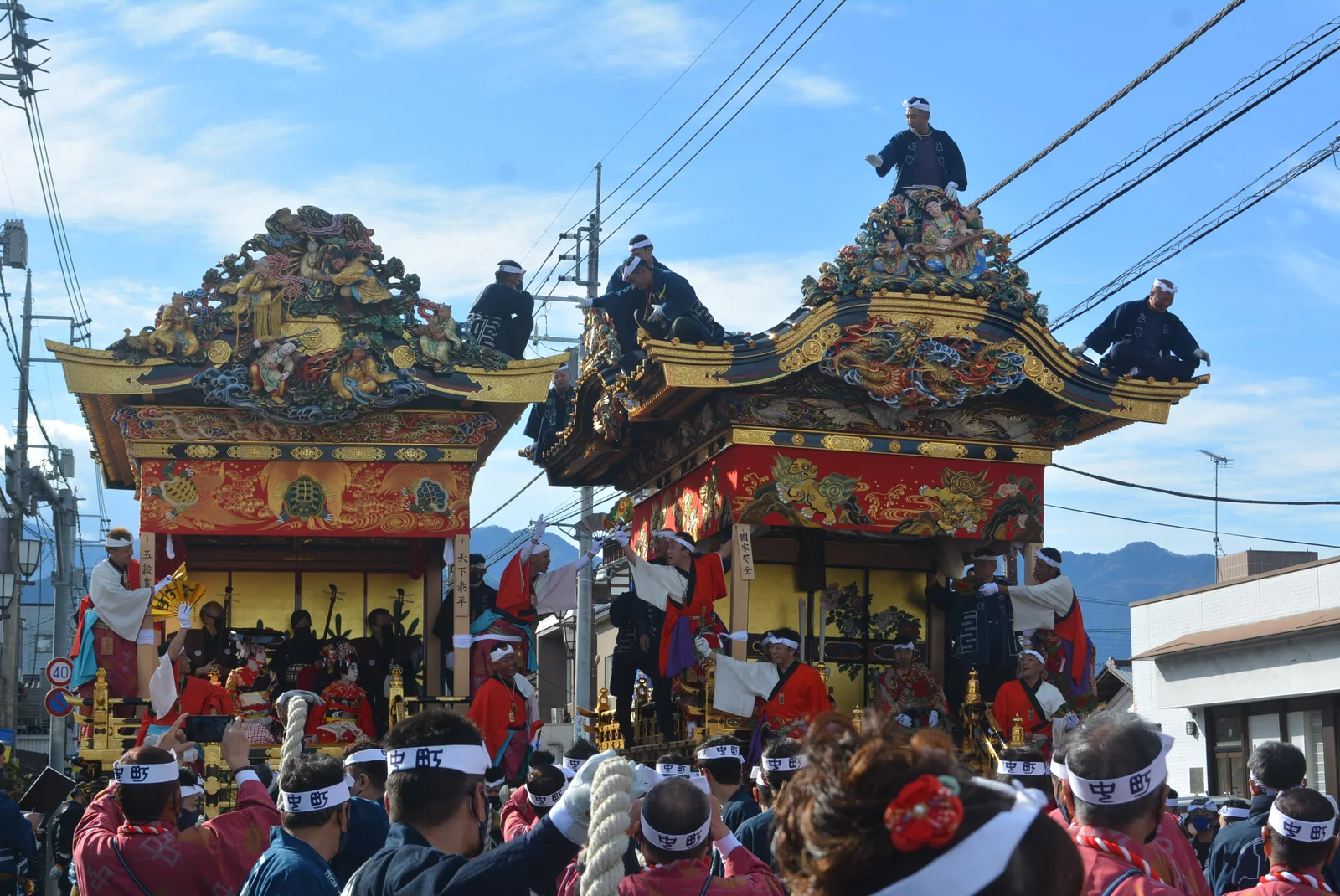
Six grand floats lead the street processions: two kasaboko (Nakachika and Shimogo) and four yatai (Miyaji, Kamimachi, Nakamachi and Honmachi). On the night of 3 December, hauling these 20-tonne timber structures up the steep Dangozaka slope to the chants of the pullers forms the dramatic climax of the entire festival. Each yatai is built with an upper stage for kabuki performances (rotating annually on a strict duty roster: Miyaji, then Honmachi, Kamimachi and Nakamachi) and a lower hayashi deck for musicians. Even the musicians' titles differ by neighbourhood—hayashiko in Miyaji, kajitori in Nakamachi and jubangi in Honmachi—reflecting centuries of deeply rooted ward-level organisation.
Understanding the structural difference between a kasaboko and a yatai makes watching the parade far more rewarding. The two kasaboko (Nakachika and Shimogo) represent an older float design topped with tall, halberd-like pole ornaments; instead of rolling on standard wheels, they are dragged along on ground skids (jibiki). By contrast, the four yatai (Miyaji, Kamimachi, Nakamachi and Honmachi) are two-storey structures housing a musicians' deck below and a fold-out kabuki stage above, filling the streets with driving percussion on the move and unfolding into a theatre whenever they halt. Owned and maintained by their respective neighbourhoods, all six cultural-property floats showcase the tight-knit civic pride of old Chichibu.
Beyond the festival itself, Chichibu rewards visitors with history, seasonal blooms and pop-culture landmarks. Inside Chichibu Shrine, look for master carver Hidari Jingoro's celebrated works, including the Tethered Dragon, the Tiger Caring for Its Young, the Lively Three Wise Monkeys and the Owl of the North Star. In spring, Hitsujiyama Park's Shibazakura Hill bursts into bloom with more than 400,000 moss phlox plants across nine varieties—whose patchwork of pinks and whites deliberately echoes the red-and-white juban robes worn by the night festival's musicians. Nearby Chichibu Bridge also draws fans as a pilgrimage spot for the anime Anohana: The Flower We Saw That Day (Chichibu City updated its official anime location guide in September 2026), rounding out an effortless daytime extension.
The Chichibu Night Festival (Chichibu Yomatsuri) ranks alongside the Gion and Takayama festivals as one of Japan's three great float festivals, and gained UNESCO Intangible Cultural Heritage status in 2016. On 2 December (Yoimiya), four yatai floats parade alongside 500 starmine fireworks; on 3 December (Honmatsuri), six floats process until dawn beneath 4,000 winter fireworks. Seibu's Laview Limited Express reaches Seibu-Chichibu in around 80 minutes from Ikebukuro, with extra trains running until midnight on 3 December. Here is everything you need for the two-day schedule, firework vantage points, accommodation near both stations, and road closures.
The Two-Day Framework for 2026: Yoimiya and Honmatsuri
Yoimiya on 2 December moves at a gentler pace and is ideal for appreciating the finer details. The four yatai floats (Miyaji, Kamimachi, Nakamachi and Honmachi) parade from morning until 20:00—official Chichibu City guidance notes they begin pulling out along Odori between roughly 09:00 and 11:00—offering a calmer atmosphere than the main day to watch floats cross paths, shosa gesture dances and daytime shrine visits (miyamairi). From 12:00 to 14:00, the Miyaji yatai stages a kabuki performance, before 500 Yoimiya fireworks over Hitsujiyama Park bring the opening evening to a close.
Honmatsuri on 3 December is a full-throttle marathon from dawn until the early hours of the following morning. All six kasaboko and yatai floats follow the official timetable in two main blocks: 06:00–16:00 and 16:00–05:00 the next day, with the Miyaji yatai adding two further kabuki performances at 12:30–14:30 and 16:30–18:30. As dusk falls, attention shifts to the Shinko Gyoretsu sacred procession, scheduled in 2026 to depart Chichibu Shrine at around 18:00 (in past years it typically left after 19:00 and peaked on arrival at the Otabisho around 22:00). Lantern-lit floats advance to pounding kagura and hayashi rhythms, and once the portable shrine is enshrined at the Otabisho, fireworks light up the winter sky.
For the best vantage points, follow Chichibu City's time-based recommendations: focus on the streets around Chichibu Shrine and Odori during daylight hours, then shift after dark to the areas in front of Chichibu Shrine, outside Chichibu Station on the Chichibu Railway, and along Honmachi-dori, Nakamachi-dori and Shonin-dori. Knowing a few key terms makes the action easy to read: girimawashi refers to sharp pivot turns (Kamimachi's float uses a wooden kirin jack to spin); surechigai is the musical duel when two floats meet in a narrow lane playing the Onami rhythm; miyamairi is the daytime procession of all six floats to Chichibu Shrine's gate; and momiai captures the tense, surging crowd pushes.
Working backwards from the two-day structure, the most fulfilling plan is to check into a Chichibu hotel on 2 December, enjoy the Yoimiya fireworks without rushing, spend all of 3 December following the six floats, the sacred procession and the 4,000-shot firework display, and then either catch a late-night extra train back to Tokyo or stay a second night. If you can only manage a day trip, you will need to choose between Yoimiya—quieter and easier to follow, though with shorter fireworks—and Honmatsuri, which delivers the full spectacle alongside the heaviest crowds.
Yatai kabuki follows a strict four-year neighbourhood rotation (Miyaji, Honmachi, Kamimachi, Nakamachi), and which ward takes the stage is always a major talking point in town. In 2026 the honour falls to the Miyaji yatai, performing once on Yoimiya (12:00–14:00) and twice on Honmatsuri (12:30–14:30 and 16:30–18:30). Because the duty ward spends the longest preparing, standards are consistently high—well worth prioritising in your daytime schedule.
Catching these traditional set pieces up close is deeply memorable. During a surechigai passing manoeuvre, two towering floats squeeze past one another in a narrow street while both teams of drummers and flautists hammer out the Onami beat at full volume, creating an extraordinary wall of sound. At junctions, watch for the 90-degree girimawashi turns—especially when the Kamimachi crew jacks its 10-plus-tonne yatai up on its under-carriage kirin pivot to swing it round with astonishing precision. Between the solemnity of daytime miyamairi and the visceral energy of night-time momiai, learning the vocabulary from the announcements and festival programmes unlocks the whole show.
Do not overlook the Chichibu Matsuri Kaikan (Festival Museum) as an essential warm-up stop. During the festival, it extends its hours until 20:00 on 2 December and 21:00 on 3 December (normal December-to-March hours are 10:00–17:00, closed Tuesdays in December). Stepping inside by day to inspect full-scale yatai construction and the folding kabuki stage mechanism transforms what you notice when the real floats roll past after dark.
During the day, the old quarter also hosts the Chichibu Silk Market (Chichibu Kinu-ichi), running 11:00–19:00 on 2 December (three stalls on Kaitsugisho-dori and 10 on Kuromon-dori) and 11:00–20:00 on 3 December (seven stalls on Kaitsugisho-dori and 12 on Kuromon-dori). Descending directly from Edo-period silk fairs, this year-end market runs alongside the daytime float hauls, filling the streets with festive trade and making an overnight stay far more rewarding than a rushed whistle-stop visit.
Winter Fireworks: 500 Shells and 4,000 Shells Over Hitsujiyama Park
According to the Chichibu Tourist Association's 2026 schedule updated on 11 November, the Yoimiya fireworks run from 19:00 to 20:00 on 2 December with 500 single shells and rapid-fire starmine barrages. The Honmatsuri firework display on 3 December then runs from 19:30 to 21:55 with an impressive 4,000 shells. Chichibu Night Festival is rare among Japan's major traditional festivals for staging full-scale pyrotechnics in midwinter; launched from Hitsujiyama Park on the hillside south of town (closed to the public during the restriction period), massive shakudama shells and starmines soar into the crisp night air to widespread acclaim.
There is no need to crowd right up to the foot of the hill—the station areas on the north side of town face directly towards the Hitsujiyama Park launch site. Official recommendations from the tourist association and Chichibu City highlight clear sightlines along National Route 140 between the Seibu-Chichibu Station traffic lights and the Uenomachi intersection, at the Chichibu City Hall car park (the official firework viewing venue), outside Seibu-Chichibu Station, outside Chichibu Station and in front of the Civic Hall.
Keep two practical rules in mind when watching. First, drones are strictly banned throughout the festival zone; any unauthorised drone entering the restricted airspace above the launch area can force the fireworks to be halted immediately. Second, the official 2026 webpage contains a minor day-of-week typo (listing 2 December as Tuesday in the firework box but Wednesday on the calendar); always plan around the exact dates of 2 December and 3 December and their published times.
As for paid seating, Paid Yatai Viewing Stand Seat B for 3 December 2026 (all reserved seats, ¥4,000 per person for ages three and up) is completely sold out, with both the 200 over-the-counter tickets sold from 31 October to 3 November and the 150 postcard-lottery seats now closed. Separately, Otabisho sajiki tiered seats are handled solely through the Chichibu Tourist Association office (neither the city hall nor the festival committee accepts enquiries). Officials also state bluntly that watching the Dangozaka hill climb without a reservation is virtually impossible, making the free city-centre viewpoints outside Chichibu Shrine, Chichibu Station and along National Route 140 the most realistic option for independent travellers.
While most Japanese firework displays take place at the height of summer, Chichibu's 4,000-shell display falls in early December because the pyrotechnics, together with the float parades, form part of the tsukematsuri festivities accompanying the sacred palanquin to the Otabisho. Dry, haze-free mountain air keeps every burst razor-sharp against the dark valley sky, while the thunderous boom echoing off the surrounding peaks gives winter fireworks a tactile power summer shows rarely match.
Knowing the route of the Shinko Gyoretsu helps you track how the evening unfolds. Before 1975, the procession travelled along Banba-dori, the front approach to Chichibu Shrine; today it follows Honmachi-dori to the Otabisho. When the parade enters the Suwa-watari section near the Chichibu Brand Pavilion on Honmachi-dori, the deafening float music cuts out completely as the floats glide past in total silence—easily the most atmospheric moment of the night. Upon reaching the Otabisho, a large sacred oheisoku wand is raised behind the Kamenoko-ishi stone and the palanquin is enshrined, signalling the climax.
The two nights offer markedly different rhythms. The 500 shells on 2 December make a brisk one-hour curtain-raiser wrapping up at 20:00, leaving time for an unhurried stroll or an early night. On 3 December, the 4,000-shell display spans nearly two and a half hours (19:30–21:55) and overlaps directly with the night-time sacred procession—creating the unmistakable sight of glowing lantern-lit floats framed by overhead bursts, easily captured from any of the recommended free town spots if you stake out your place early.
Getting There: Traffic Restrictions, Extra Seibu Trains and Express Services
Sweeping traffic restrictions take effect across central Chichibu on 2 and 3 December, with heavy congestion expected on approach roads. The Chichibu Tourist Association explicitly advises everyone to arrive and depart by train, with railway operators running extra services until around midnight on 3 December. For anyone determined to drive, paid temporary car parks open on local school grounds on 3 December, whereas 2 December has only one free temporary car park at Miyaji Ground—and overnight parking is strictly prohibited on both nights, leaving road access and spaces tightly squeezed. Municipal bicycle hire also closes completely from 2 December through the morning of 4 December.
Seibu Railway has confirmed its 2026 night-festival timetable. On 3 December, extra local trains run between Hanno and Seibu-Chichibu, supplemented after 21:00 by additional direct return services from Seibu-Chichibu to Ikebukuro and Tokorozawa. Limited Express Laview trains ramp up to roughly every 30 minutes from the 11:00 hour onwards, with extra Tokyo-bound evening services added as well. Advance Laview seat tickets go on sale at 07:00 JST on 2 November for 2 December trains and at 07:00 JST on 3 November for 3 December trains (capped at eight tickets per person), with a ¥200 surcharge if purchased on board. On the evening of 2 December, selected Tokyo-bound limited expresses—such as an extended Musashi No. 58—also start from Seibu-Chichibu so visitors leaving after the 500-shell display can ride straight back to Ikebukuro.
Two separate railway lines anchor opposite sides of town. From Ikebukuro, the Seibu Limited Express Laview (all seats reserved; limited express supplement ¥900 for adults, calling at Ikebukuro, Tokorozawa, Irumashi, Hanno, Yokoze and Seibu-Chichibu) takes around 80 minutes to Seibu-Chichibu Station. Alternatively, the Chichibu Railway connects Kumagaya to Chichibu Station in roughly 70 minutes. Seibu-Chichibu Station is normally a 15-minute walk from Chichibu Shrine (longer in peak festival crowds), whereas Chichibu Station sits closest to the shrine itself—so choosing which station to stay near largely determines your walking routes and journey home.
As of 20 November 2026, Chichibu Railway had not yet released the detailed timetable for its dedicated night-festival Ohanabi-go trains, leaving the tourist association's pledge of extra services until around midnight on 3 December as the working baseline; check Chichibu Railway's official website shortly before travelling. Note also that although the SL Paleo Express steam train operates through 6 December in 2026, it does not run during the two night-festival days.
The contrast between the two festival days largely settles whether you should stay overnight. Yoimiya on 2 December shines during the day—floats set off between 09:00 and 11:00, static hayashi music and kabuki performances fill the afternoon, and both parades and fireworks wrap up by 20:00—making a day return to Tokyo straightforward. Honmatsuri on 3 December runs from 06:00 straight through to the following morning, packing in daytime shrine visits, a second kabuki staging at 16:30, the 18:00 sacred procession, the 19:30 main fireworks and late-night hauls; booking a room in Chichibu lets you watch the finale without scrambling for the last train.
Where to Stay: Both Station Sides and Seven Official Highlights
Properties on the Chichibu Tourist Association's official accommodation list fall neatly into three groups: near Seibu-Chichibu Station, near Chichibu and Ohanabatake stations, and character stays. Around Seibu-Chichibu Station, standouts include Hotel Route-Inn Seibu-Chichibu Ekimae (three minutes on foot) and Ryokan Hiyoshi (seven minutes on foot, offering private bookable baths and Wi-Fi). Closer to Chichibu and Ohanabatake stations are Ryokan Tachibana right by Ohanabatake Station, the new APA Hotel outside Chichibu Station (opened 31 October 2025), and Hotel Miyama, where every room has en-suite facilities alongside themed Yomatsuri and Megami communal baths. For distinctive stays, options span NIPPONIA Chichibu Monzenmachi (a century-old merchant house serving French-inspired dinners), the scattered-village Machijukyakushitsu Chichibuyado, Chichibu Onsen Hananoya (with open-air baths in every room), workation-focused Chichibu Suijin Hotel from ¥2,980 per night, and woodland cabins at PICA Chichibu inside Chichibu Muse Park.
Matching your hotel to your main priority keeps logistics effortless. If the Yoimiya and Honmatsuri fireworks are your focus, the Seibu-Chichibu Station side is easiest—the station forecourt itself is an official firework viewpoint, putting you a three-minute stroll from bed once the smoke clears. If you want to follow the late-night Honmatsuri float hauls and Shinko Gyoretsu, staying near Chichibu Station or in the town centre keeps you closer to Chichibu Shrine, Honmachi-dori and Nakamachi-dori. Travellers seeking heritage atmosphere should look to NIPPONIA Chichibu or Machijukyakushitsu Chichibuyado, while hot-spring enthusiasts will gravitate to Hananoya's private open-air baths.
Because central roads close, surrounding highways jam and extra trains draw huge crowds until midnight, rooms around 2 and 3 December sell out fast every year. If you plan to stay overnight in Chichibu, reserve as early as possible before only outlying lodgings remain.
Given the near-total central traffic ban and overflowing school car parks on 3 December, rail remains by far the smartest way in and out. Even so, fare-adjustment counters and ticket machines at Seibu-Chichibu Station inevitably build long queues after the late-night finale; Seibu Railway specifically advises topping up your PASMO or Suica IC card before arriving so you can tap straight through the barriers.
Which side of town you stay on also shapes your route home. Guests near Seibu-Chichibu Station benefit from Seibu Railway's wave of direct extra trains to Ikebukuro and Tokorozawa after 21:00 on 3 December, whereas guests near Chichibu Station rely on Chichibu Railway services towards Kumagaya for onward connections. Double-check the final extra-train times for whichever line you use before setting out, and remember not to plan a steam-train ride on the SL Paleo Express over the two festival nights, as it is suspended for the event.
For a deeper cultural stay, two heritage properties stand out. NIPPONIA Chichibu Monzenmachi restores century-old wooden townhouses into a boutique hotel pairing local ingredients with creative French dining, while Machijukyakushitsu Chichibuyado offers whole-house stays designed to let you live inside the historic quarter like a local. Stepping through a timber doorway straight onto the float-parade streets creates an experience worlds apart from a standard business hotel—though their tiny room counts mean both are usually the first in town to book out for festival week.
On-Site Facilities and Putting Together Your Two-Day Itinerary
Chichibu maintains an unusually well-staffed network of visitor services throughout the festival. At 2-8 Banbamachi, the Chichibu Matsuri Kaikan extends its hours (09:00–17:00 on 1 December, 09:00–20:00 on 2 December and 09:00–21:00 on 3 December, compared with 10:00–17:00 from December to March and Tuesday closures in December), doubling as both an educational float gallery and a warm refuge between parades. Meanwhile, the Chichibu Tourist Information Centre in front of Seibu-Chichibu Station stays open daily throughout the festival, backed by a live parking availability page active exclusively on 3 December should any routes change.
Make time during daylight hours to visit Chichibu Shrine properly. Rebuilt on the orders of Tokugawa Ieyasu, the current main sanctuary is a Prefectural Important Cultural Property in the Gongen-zukuri style, adorned with vivid carvings by Hidari Jingoro including the Tethered Dragon, the Tiger Caring for Its Young and the Lively Three Wise Monkeys. Dedicated to four deities led by Yagokoro Omoikane-no-Mikoto, the shrine reveres 1,304-metre Mount Buko as its sacred mountain. The festival's Shinko Gyoretsu escorts the portable shrine from here along Honmachi-dori to the Otabisho (a route shifted from Banba-dori in 1975), featuring the unforgettable Suwa-watari silent passage past the Chichibu Brand Pavilion on the night of 2 December.
Stitching the two days together is straightforward. Arrive on the morning of 2 December to catch the Yoimiya float parades, the 12:00–14:00 Miyaji yatai kabuki and the Chichibu Silk Market, then watch the 500 fireworks from 19:00 to 20:00 before checking into your hotel. On 3 December, catch the early-morning departure of all six floats, follow the daytime shrine visits and both kabuki performances, join the 18:00 Shinko Gyoretsu towards the Otabisho, watch the 4,000 winter fireworks from 19:30 at an official viewpoint, and after 21:55 either board a direct Seibu extra train to Ikebukuro or stay a second night. Any spare daytime hours can easily go towards Chichibu Bridge and other Anohana anime landmarks.
Factoring in the traffic gridlock, central road closures, reservation-only Dangozaka access and sold-out Seat B stands, the lowest-stress, most complete strategy for the 2026 Chichibu Night Festival is clear: book an overnight stay in town well ahead, travel exclusively by rail, and claim a spot early at one of the free official firework and float viewpoints.
The opening of the APA Hotel outside Chichibu Station on 31 October 2025 has also reshaped local accommodation options. Where the Chichibu Station side once consisted almost entirely of traditional Japanese inns, having a major national hotel chain right by the gates gives international visitors familiar room standards and straightforward online booking—while travellers wanting hot springs alongside the parades can still look to Chichibu Onsen Hananoya with open-air baths in every suite.
Hitsujiyama Park (6360 Omiya, Chichibu-shi), which serves as the firework launch base, occupies the lower slopes of 1,304-metre Mount Buko. From mid-April to early May, its 17,600-square-metre Shibazakura Hill blooms with over 400,000 moss phlox plants across nine varieties (bare in winter, though its colour palette honours the red-and-white robes of the festival musicians). Normally a 1.5-kilometre walk from Seibu-Chichibu or Ohanabatake stations and 1.4 kilometres from Yokoze Station (uphill at the end), the park is completely cordoned off on firework nights; apart from locals who know the perimeter trails, most visitors enjoy far clearer, hassle-free views from the free viewing zones outside the stations downtown.
Among Japan's regional festivals, Chichibu Night Festival publishes exceptionally thorough timetables, Q&As, paid-seating updates and traffic maps, making it easy to navigate if you follow official guidance. The real test of stamina is simply the late-night crowds and sharp early-December cold—sort out your hotel, warm layers and chosen viewpoint in advance, and you can focus entirely on more than 350 years of lantern-lit floats and winter fireworks.
A few useful answers
What are the 2026 dates and main events for the Chichibu Night Festival?
On 2 December (Yoimiya), four yatai floats parade from morning until 20:00, the Miyaji yatai performs kabuki from 12:00 to 14:00, and 500 Yoimiya fireworks launch from 19:00 to 20:00. On 3 December (Honmatsuri), all six floats (two kasaboko and four yatai) parade from early morning until dawn the next day, the Miyaji yatai stages two more kabuki shows, the Shinko Gyoretsu sacred procession departs Chichibu Shrine around 18:00, and 4,000 fireworks light up the sky from Hitsujiyama Park between 19:30 and 21:55.
How do I get to the Chichibu Night Festival from Tokyo?
Take the Seibu Limited Express Laview from Ikebukuro straight to Seibu-Chichibu Station in about 80 minutes (all seats reserved; ¥900 limited express fare; extra trains run roughly every 30 minutes from the 11:00 hour on 3 December, with tickets released at 07:00 JST on 2 November for 2 December travel and 07:00 JST on 3 November for 3 December travel). Alternatively, ride the Chichibu Railway from Kumagaya to Chichibu Station in around 70 minutes. Due to widespread central road closures on both days, officials strongly recommend travelling by train, with extra services operating until roughly midnight on 3 December.
Where are the best places to watch the fireworks, and are paid seats still available?
Official recommended viewpoints include National Route 140 between the Seibu-Chichibu Station traffic lights and the Uenomachi intersection, the Chichibu City Hall car park (official firework viewing area), outside Seibu-Chichibu Station, outside Chichibu Station and in front of the Civic Hall. Paid Yatai Viewing Stand Seat B for 3 December 2026 (¥4,000) has already sold out, and watching the Dangozaka slope haul without a booking is virtually impossible, so sticking to the free station-area viewpoints is the best plan. Drones are strictly prohibited across the entire venue.
Where should I stay for the Chichibu Night Festival?
Top choices on the Chichibu Tourist Association list include Hotel Route-Inn Seibu-Chichibu Ekimae (three minutes' walk) and Ryokan Hiyoshi (seven minutes' walk) on the Seibu-Chichibu Station side; the APA Hotel opened in October 2025 and Ryokan Tachibana on the Chichibu Station side; and character stays such as the century-old townhouse NIPPONIA Chichibu Monzenmachi, Machijukyakushitsu Chichibuyado and Chichibu Onsen Hananoya with private open-air baths in every room. Stay near Seibu-Chichibu Station for the easiest firework viewing, or near Chichibu Station to stay close to the late-night Honmatsuri float routes.
Official information and references
Sources used in this guide.
- Chichibu Tourist Association | Chichibu Night Festival Overview (Three Great Float Festivals, UNESCO, Float Breakdown and Nicknames)
- Chichibu Tourist Association | Chichibu Night Festival 2026 Guide (Schedule, Fireworks, Access, Silk Market and Stations)
- Chichibu Tourist Association | Paid Yatai Viewing Stand Seat B Notice (¥4,000, Sold Out for 2026)
- Chichibu City Official Tourism Navi | Chichibu Night Festival (Float Line-up, Dangozaka and History)
- Chichibu City Official Tourism Navi | Chichibu Night Festival Q&A (Viewpoints, Night Spots and Dangozaka Restrictions)
- Chichibu Shrine | Official Website (Night Festival Rites, Historical Names and Suwa-watari)
- Chichibu Matsuri Kaikan | Night Festival Extended Opening Hours Notice
- Seibu Railway | Night Festival Extra Trains and Limited Express Increase Notice (Midnight Services on 3 Dec and Ticket Release Dates)
- Seibu Railway | Limited Express Laview (All-Reserved Seating, ¥900 Fare and Stops)
- Chichibu Tourist Association | Accommodation Directory (Official Listing)
- Chichibu Tourist Association | Chichibu Shrine Spot Guide (1-3 Banbamachi, Gongen-zukuri and Hidari Jingoro Dragon)
- Chichibu Tourist Association | Hitsujiyama Park Spot Guide (Shibazakura Hill, Firework Launch Site and Station Distances)