Yokohama Red Brick Warehouse Christmas Market runs from 20 November to 25 December 2026. Standard tickets cost ¥500 or ¥1,000. Guide to standard vs special dates, split opening hours, child exemptions, two free zones, and a half-day harbour itinerary via Bashamichi.
- Region & Focus
- Yokohama
- Reading Scope
- 24 min read · 15 chapters · 10 Q&As
- Official Verification
- 6 official sources checkedUpdated 22 November 2026
- Key Topics
- WinterSeasonsTokyo & Kanto
Chapter Route Map (tap any stop)
- Dates and opening hours: extended until 22:00 from 5 December
- ¥500 vs ¥1,000: check standard and special dates, not just the day of the week
- Standard, priority, and mug-bundled tickets: what the extra spend buys
- Two free zones: Christmas Gate and Christmas Village
- Pokemon free zone: opening night starts at 20:00 on 25 November
- The 11-metre main tree, 15-minute light shows, and how the free-zone trees differ
- ¥900 original mugs, bundled mugs, and Yokohama Residents' Appreciation Day
- Food and shopping: check the menu before deciding on a mug
- Getting there: choose Bashamichi, Nihon-odori, or Sakuragicho by your first stop
- Sea Bass water bus combo ticket from Yokohama station: sold only until 4 December
- Pairing with the Kannai market: keep the two ¥200 mug discounts straight
- Staying in Yokohama? Compare ticket-and-mug hotel packages against room-only rates
- Half-day itinerary: architecture by day, illuminations from 16:00
- Families, pets, and rainy days: practical rules before you queue
- Payments, toilets, and photography: on-the-ground essentials
- Quick Q&A
The 2026 Yokohama Red Brick Warehouse Christmas Market runs from 20 November to 25 December. Standard admission costs ¥500 on standard days and ¥1,000 on special days—including ¥500 sessions on late-November weekends—so check the official date calendar before buying. Arrive before the 16:00 switch-on for dusk views of the red-brick facade, mulled wine, and wooden stalls, or start with the two free zones if you prefer a casual stroll. Because the main market, indoor commercial buildings, and Christmas tree close at different times, plan your evening around the market timetable for your date.
Dates and opening hours: extended until 22:00 from 5 December
The market runs for 36 days from 20 November to 25 December 2026. Opening day on 20 November starts at 17:00; from 21 November to 4 December, daily hours are 11:00–21:00 (last orders 20:30); and from 5 to 25 December, hours extend to 11:00–22:00 (last orders 21:30). This schedule governs the main ticketed market, while the two free zones and special installations keep their own hours. The official event page lists ticket tiers alongside same-day operational notices.
General venue illuminations switch on at 16:00 and stay lit until closing, except on opening night when they begin with the lighting ceremony. The main Christmas tree remains illuminated until 23:00. For photos as daylight fades over the harbour, stroll along the waterfront just before 16:00 before heading inside to browse the wooden huts and eat. Bear in mind that the 23:00 lights-out applies only to the tree—stalls still close at 21:00 or 22:00.
The market operates in wet weather, though storms or severe conditions can trigger temporary closures. Any changes are announced on the event page, the main warehouse website, and the official X account—check before setting out to avoid a wasted trip to the pier. Outdoor harbourfront seating offers little shelter from wind and rain, so dress for cold coastal evenings.
| Dates | Opening hours | Last orders |
|---|---|---|
| 20 November | 17:00–21:00 | 20:30 |
| 21 November–4 December | 11:00–21:00 | 20:30 |
| 5–25 December | 11:00–22:00 | 21:30 |
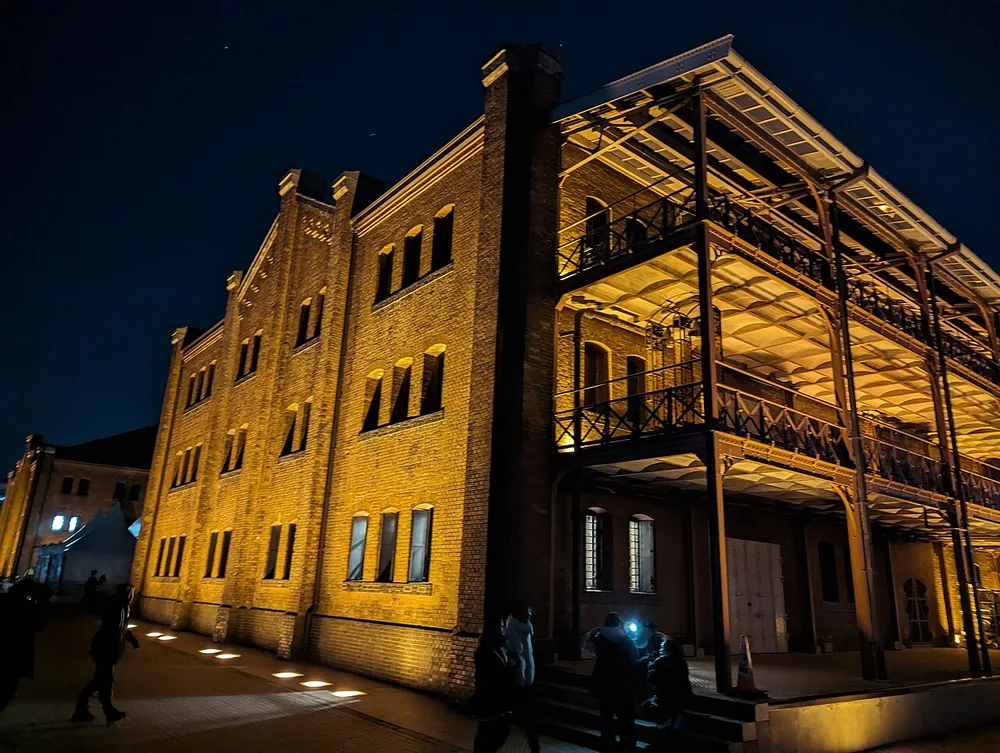
Yokohama Red Brick Warehouse Christmas Market runs from 20 November to 25 December 2026. Standard tickets cost ¥500 or ¥1,000. Guide to standard vs special dates, split opening hours, child exemptions, two free zones, and a half-day harbour itinerary via Bashamichi.
¥500 vs ¥1,000: check standard and special dates, not just the day of the week
Standard admission is ¥500 on standard days and ¥1,000 on special days, tax included. Standard days cover the entire stretch from 20 November to 4 December, meaning weekends such as 21–22 November fall within the ¥500 tier. Treating ¥500 as a weekday-only rate misses those weekend slots; travellers in town during late November have the best pick of lower-priced dates.
The remaining standard days are 7–11 December, 14–17 December, and 21–23 December. Special days are 5–6 December, 12–13 December, 18–20 December, and 24–25 December. Note that Friday 18 December, Thursday 24 December, and Friday 25 December all fall under the ¥1,000 special-day rate—pricing follows the official calendar rather than a blanket weekday/weekend split.
Primary-school pupils and younger enter free when accompanied by a parent or guardian; up to 4 December, junior-high-school pupils and younger also qualify for free entry. Families should check both school age and visit date rather than assuming early-December exemptions carry through to Christmas week. Note that free admission does not bypass queues when entry controls are in place.
Food, drink, and merchandise are all paid separately: the ¥500 or ¥1,000 ticket covers entry to the main market only. Factor a drink, a hot dish, and any souvenirs into your evening budget. If you only want illuminations and photos, explore the free zones first and decide afterwards whether to buy a ticket for the main market.
| Tier | 2026 applicable dates | Standard admission |
|---|---|---|
| Standard days | 20 Nov–4 Dec, 7–11 Dec, 14–17 Dec, 21–23 Dec | ¥500 |
| Special days | 5–6 Dec, 12–13 Dec, 18–20 Dec, 24–25 Dec | ¥1,000 |
Standard, priority, and mug-bundled tickets: what the extra spend buys
Standard tickets can be bought in cash at the main gate on the day, or online with cashless payment via the official Asoview ticketing link. Buying a standard ticket online saves faffing with cash at the kiosk, but you still join the general entrance queue alongside cash buyers—online payment does not include fast-track access.
Priority entry tickets cost ¥2,000 on standard days and ¥2,500 on special days—a ¥1,500 premium over standard admission on either tier. These are date-specific, sold in limited quantities strictly in advance via Asoview, and grant access via a dedicated priority lane. Weigh that ¥1,500 surcharge against your tolerance for queues; if your evening schedule is flexible, standard entry keeps costs down.
Priority tickets bundled with a red Noritake premium mug cost ¥4,500 on standard days and ¥5,000 on special days, with one mug per ticket. Both cost ¥2,500 more than the mug-free priority ticket on the same day—buy this tier only if you actually want the Noritake mug, as food and drink are still charged separately at each stall.
Private Premium Lounges follow a different structure altogether: each cabin accommodates up to two adults and includes a meal set, two priority entry tickets, and a matching red-and-blue pair of premium mugs, priced between ¥15,000 and ¥40,000 depending on date and time slot. It is a private dining and seating package for two, not directly comparable with single admission tickets.
Have your e-ticket QR code loaded before reaching the gate. Organisers note that mobile signal can be patchy around the crowded pier, so open the booking page and screenshot or cache your ticket before joining the queue. There are no group discounts; calculate multi-person budgets per individual ticket tier and child exemption.
Two free zones: Christmas Gate and Christmas Village
Alongside the main ticketed market, two free-entry zones operate nearby. "Yorunoyo x Christmas Gate 2026" at Shinko Central Square runs from 20 November to 25 December, while Christmas Village at Akarenga Park hosts the Pokemon collaboration "Erabu! Pokemon Illumination 1025" starting slightly later on 25 November. Visitors arriving between 20 and 24 November can visit the main market and Christmas Gate, though the Pokemon area will not yet be open.
If you only have an hour to spare, pairing the free zones with the illuminated red-brick facade gives plenty of atmosphere without queuing or hunting for outdoor tables. Families can also start in Christmas Village and gauge energy levels before committing to a paid ticket. Should you decide to eat or shop inside the main market afterwards, simply join the main gate queue.
The shops and restaurants inside Red Brick Warehouse Buildings 1 and 2 are permanent commercial tenants, separate from the outdoor market stalls. Combining outdoor lights with indoor browsing gives you an easy bolt-hole if the harbour wind picks up or rain starts, though individual shop and restaurant hours differ from the market timetable.
Christmas Gate opens 17:00–21:05 on 20 November, then 11:00–21:05 daily from 21 November to 25 December (last orders 20:30). Expect 18 stalls selling Christmas gifts, chocolate, coffee, and pizza, plus a woodchip play area for children and photo-friendly wooden huts. This zone is strictly cashless—bring a working bank card or mobile payment method, as the main market's cash option does not apply here.
Inside Christmas Gate, the Yorunoyo Shop keeps its own schedule: from 21 November to 18 December it opens at 16:00 on weekdays and 11:00 on weekends and public holidays, then daily from 11:00 between 19 and 25 December, closing at 21:05 throughout. If you are after the whale-shaped marshmallow hot chocolate or shop exclusives on a weekday, arriving before 16:00 means waiting—do not assume the 11:00 zone opening covers this shop.
Pokemon free zone: opening night starts at 20:00 on 25 November
The Pokemon collaboration at Christmas Village runs from 25 November to 25 December, but opens only from 20:00 to 21:00 on its first night. From 26 November to 4 December it opens 11:00–21:00, extending to 11:00–22:00 from 5 to 25 December. Because it launches five days after the main market with a brief one-hour opening slot on day one, families planning specifically around Pokemon must note these dates separately.
"Pokemon 1025 Luminous Box" showcases all 1,025 Pokemon across 15 colour-coded gift boxes, letting visitors hunt down favourites by colour for photos. Displays are strictly hands-off and have sharp protruding corners—keep young children at a safe distance and watch your footing in the dark. Crowd controls may restrict viewing or photos at peak times, so allow proper time rather than squeezing this in right before your train.
"Pokemon 30th Special Tree" requires a same-day numbered timed-entry ticket (seiriken). Distribution starts on-site at 11:00, releasing hourly batches covering the next three hours; tickets are limited to one per person, cannot be collected on someone else's behalf, and allow one experience per visitor. Free zone entry does not guarantee walk-up access to this tree—pick up your numbered ticket first, then fit meals or market browsing around it.
Once you have a numbered ticket, scan its QR code to pick which Pokemon will appear in your photo, then return at your designated slot. Everyone in a group who wants a turn must queue in person for their own ticket—do not send one runner for the whole family. While waiting, browse the free zone or grab a bite nearby, keeping an eye on your return window separately from any main market entry plans.
Visitors can also claim a commemorative visit medal in the mobile version of Pokemon HOME using an account already linked to a Nintendo Account. Complete the login and linking back at your hotel so you are not troubleshooting account settings on a cold pier; if you are only strolling through for photos, no account setup is needed.
The 11-metre main tree, 15-minute light shows, and how the free-zone trees differ
This year's main market centrepiece is a real Sakhalin spruce standing roughly 11 metres tall, dressed in around 20,000 LEDs. From 16:00 onwards, a roughly five-minute light show runs every 15 minutes on the hour, :15, :30, and :45, with themes rotating weekly; from 5 December onwards, these shows stop after 22:00. Since the tree stays lit until 23:00 but full shows end earlier, latecomers should time their visit around an active show slot.
From 4 December onwards, special shows synchronised with "Highlights of Yokohama" run daily at 17:00, 19:00, and 21:00, replacing the regular show at those three times. Visitors in late November see the standard sequence; anyone visiting from 4 December onwards who wants the synchronised edition can target one of those three hours and fit food or gift shopping before and after.
Christmas Gate features its own roughly 8-metre tree from Tokachi, Hokkaido, standing in the centre of the free zone beside the woodchip play area and huts, while the Pokemon Special Tree is a separate installation altogether. Locate all three zones—main market, Christmas Gate, and Christmas Village—on the map first, and name both the zone and the tree when agreeing a meeting spot with friends.
The main venue also features a roughly 30-metre illumination roof and light tunnel that photograph well independently of the red-brick facade. Tackle the time-sensitive tree show first, then walk the roof and tunnel at leisure. Photography is permitted for personal use provided it does not block walkways or inconvenience others—step aside once you have your shot so the next group can move in.
¥900 original mugs, bundled mugs, and Yokohama Residents' Appreciation Day
This year's original market mugs come in red and white at ¥900 each, capped at two per person. Single mugs are sold at the information booth beside the general entrance, while selected food and drink stalls inside the main market offer them as part of drink sets. If you only want the mug, head straight to the information booth; if you want a hot drink as well, check stall set menus first—¥900 buys the empty mug alone, not mulled wine.
Noritake premium mugs are not sold individually over the counter: a mug-bundled priority ticket comes with one red mug, while Premium Lounge packages and partner hotel plans include one red and one blue mug. If two people want a matched red-and-blue pair, check the package terms first—buying two mug-bundled priority tickets simply gives you two red mugs.
On 25 November, Yokohama Residents' Appreciation Day grants free standard admission to locals presenting proof of current Yokohama residency. Hotel guests staying a night in Yokohama do not qualify on a hotel booking alone, and the resident discount does not apply to priority entry tickets, mug-bundled priority tickets, or Premium Lounge bookings.
Food and shopping: check the menu before deciding on a mug
Official 2026 listings cover roughly 60 food, drink, and craft stalls centred on German sausages, mulled wine, and festive ornaments. Around 20 vendors serve white mulled wine this year, alongside freshly grilled sausages, carved prosciutto, and European fried pastries. Pick a main dish and drink in advance from the official venue map and menu rather than queuing blindly at stall after stall.
Mulled wine contains alcohol, so non-drinkers, families with children, and anyone driving afterwards should choose hot chocolate, spiced tea, or other alcohol-free options from the menu. Japanese law prohibits drinking under age 20 and any drink-driving; note also that popular stalls and daily limited items can sell out.
Keep original mugs, premium mugs, and mug-bundled tickets clear in your mind before paying: check the exact design, whether a drink is included, and the total cost. Every mug here is either retail merchandise or a ticket perk—none works on a return-for-deposit system.
Outdoor tables and chairs are provided alongside a dedicated member lounge space. If your group wants to eat together, claim a meeting spot in the seating area before splitting up to queue at different food stalls rather than wandering with hot plates. Clearing up is self-service: sort used tableware and rubbish at the recycling stations so tables turn over cleanly for the next visitors.
Getting there: choose Bashamichi, Nihon-odori, or Sakuragicho by your first stop
According to the official access guide, Bashamichi and Nihon-odori stations on the Minatomirai Line are both about a 6-minute walk, and Minatomirai station is roughly 12 minutes. From JR or Municipal Underground Sakuragicho station, the walk across the Kishamichi Promenade takes around 15 minutes. Allow extra time on top for photo stops, browsing, and entry queues; the official access page provides walking maps and alternative routes.
If you want the shortest walk straight to the market, pick Bashamichi or Nihon-odori. If you prefer harbour views and photos on the way in, start from Sakuragicho along Kishamichi into Shinko. Those heading onwards to Yamashita Park or Yokohama Chinatown can save the waterfront stroll for after the market and leave via Motomachi-Chukagai station instead of doubling back.
Travellers coming from Tokyo should pick JR or the Tokyu Toyoko Line depending on where they are staying, then connect into the Minatomirai waterfront area. Do not base your timing solely on the train arrival at Yokohama station: allow for platform transfers, the walk to the warehouse, and gate queues. Anyone with a dinner booking back in Tokyo should work backwards from their return train before setting market arrival and meal times.
Market stall receipts do not count towards Red Brick Warehouse car-park validation. If you drive in, expect standard parking charges regardless of how much you eat or spend—taking the train is simpler and removes any worry over drinking mulled wine. Guests staying in Yokohama can also drop shopping bags at their hotel before heading out into the evening cold.
Sea Bass water bus combo ticket from Yokohama station: sold only until 4 December
A combo ticket pairing standard market entry with a one-way SEA BASS water bus ride is available from 20 November to 4 December, sold exclusively at the SEA BASS boarding counter on the 2nd floor of Yokohama Bay Quarter at Yokohama Station East Exit. It is not sold at the market gate or on Asoview—if you want to arrive by water, buy the ticket at the pier before boarding rather than heading to the Red Brick Warehouse first.
For the combo ticket, adults (junior-high-school age and above) pay ¥1,670, while children aged 3 to primary-school age pay ¥1,090; one infant aged 0–2 rides free per paying adult. Note the difference from the main market's child policy: junior-high-school pupils enter the market free until 4 December, but still pay the adult combo fare for the boat. Calculate boat fares and market tickets separately for families.
The one-way crossing is valid only on the day of purchase and while allocations last. It makes an appealing morning or afternoon arrival from Yokohama station across the bay; if you are dining elsewhere first and just want quick access in the evening, walking from Bashamichi or Nihon-odori makes far more sense. Decide whether you want the boat trip on its own merits rather than detouring just to use the combo.
This is a one-way boat ticket plus standard admission—not a return sailing, and not priority entry. You will still need rail or another route back, join the regular entrance queue at the market, and match sailing times to market hours. Because rough seas can disrupt services, check the operator's timetable and same-day status on the official collaboration page before heading to the pier.
Pairing with the Kannai market: keep the two ¥200 mug discounts straight
"BALLPARK Xmas YOKOHAMA KANNAI 2026" at Yokohama Park shares a mutual ¥200 mug discount with the Red Brick Warehouse market. Show your Red Brick Warehouse entry wristband at the official BALLPARK Xmas shop to get ¥200 off one BALLPARK original mug per wristband. This applies only to BALLPARK's official original mug—not random stall drinks, and not as a refund on your warehouse ticket.
In the opposite direction, present a single tax-included receipt of ¥1,000 or more from the official BALLPARK Xmas shop at the Red Brick Warehouse general entry information booth to get ¥200 off an original Red Brick Warehouse mug. Smaller receipts cannot be combined; each qualifying receipt discounts one mug, up to the usual limit of two mugs per person.
Both promotions run from 20 November to 25 December while promotional mugs last. This works nicely if you are already visiting Kannai or Chinatown and want both souvenirs; spending ¥1,000 unnecessarily just to shave ¥200 off a mug obviously costs more overall. Keep your wristband and receipts intact when leaving the first venue so you can claim smoothly at the second.
Staying in Yokohama? Compare ticket-and-mug hotel packages against room-only rates
Eight partner hotels offer accommodation packages including priority market entry and premium mugs for two: InterContinental Yokohama Pier 8, InterContinental Yokohama Grand, Hilton Yokohama, Hotel New Grand, The Kahala Hotel & Resort Yokohama, members-only Yokohama Baycourt Club, Yokohama Bay Sheraton Hotel & Towers, and Rose Hotel Yokohama. Room types and available dates vary by each hotel's booking page.
These packages suit couples already planning an overnight stay in Yokohama. Compare the package rate against a room-only booking for the exact same dates, room category, and meal inclusions—do not assume the Christmas market label guarantees savings over buying rooms and priority tickets separately. Note too that Yokohama Baycourt Club is members-only, so not all eight properties are open to general bookings.
Once booked, check how and when your tickets are collected and plan your market arrival accordingly. Priority entry only speeds up the gate queue and does not turn an outdoor evening market into an indoor experience; if you have restaurant reservations that night, allow realistic transfer times back to your hotel to drop off bags or mugs. Note also that hotel packages include one red and one blue premium mug, unlike standard mug-bundled priority tickets which give two red mugs if bought as a pair.
Half-day itinerary: architecture by day, illuminations from 16:00
For an afternoon-into-evening plan, walk in from Bashamichi or Nihon-odori, explore the free zones and red-brick exterior in late daylight, then enter the main market after the 16:00 switch-on. Claim a table and order hot food and drinks early, leaving the illuminated tree and gift huts for afterwards. This keeps your visit inside full operating hours without standing around in the cold waiting for dusk.
For a longer half-day or full-day loop, start at Sakuragicho and cross the Kishamichi Promenade into Shinko, having lunch and browsing the indoor Red Brick Warehouse shops by day before stepping out into the market after sunset. With young children or older relatives, resting inside the buildings mid-afternoon makes the evening outdoors far more comfortable. If you already have dinner booked in Chinatown, treat the market as a shorter evening stop for lights and one hot drink rather than crowding in two full meals.
Check your visit date carefully if arriving near 21:00: the market closes at 21:00 through 4 December and only stays open until 22:00 from 5 December onwards. The tree staying lit until 23:00 will not rescue missed stall hours, and last orders fall 30 minutes earlier at 20:30 or 21:30.
After leaving the market, take a short walk along the illuminated waterfront if everyone is still warm and energetic, or head straight to the nearest station if the harbour breeze is biting. Waterfront strolls can always be trimmed short; last trains back to Tokyo and restaurant bookings cannot. Pairing the market with one nearby promenade makes for a much smoother evening than trying to dash between two distant night events.
Families, pets, and rainy days: practical rules before you queue
Confirm child ticket exemptions against your visit date before setting out. Up to 4 December, junior-high-school pupils and younger enter free; from 5 December onwards, free entry narrows to primary-school pupils and younger accompanied by a parent or guardian. Eligible children travelling with a priority-ticket adult can use the priority lane together; otherwise, everyone uses the general entrance.
Outside food and drink are not allowed inside the market. Feed young children beforehand or pick from the stalls inside—bringing convenience-store meals through the gate goes against venue rules. Check menus online in advance if anyone has strict preferences so you are not figuring things out mid-queue.
Pets are welcome provided they remain completely enclosed inside a carrier or covered pet buggy with no part of their body sticking out. Pets are not permitted in the App member area or Premium Lounges, though guide dogs, hearing dogs, and service dogs are accommodated under separate rules. Plan breaks in pet-friendly outdoor areas rather than booking a lounge package you cannot use.
Although the market opens in rain, seating and stalls are outdoors; anyone needing a proper warm-up break should use the cafes and shops inside Buildings 1 and 2 before or after queuing. In severe weather, check the official closure notice before leaving your hotel, and remember that indoor shops, free zones, and the ticketed market do not always open or close together.
Payments, toilets, and photography: on-the-ground essentials
Market stalls generally accept both cash and supported cashless methods depending on the vendor, whereas same-day standard tickets at the gate are cash-only (use Asoview for cashless tickets). You cannot top up electronic money inside the venue, so load IC cards or wallets at stations, convenience stores, or an ATM beforehand. There is an ATM on the ground floor of Building 2, which opens at 11:00.
Public toilets are located on the street-facing side of Building 1. When visiting in a group, note the entrance, toilets, and seating area on the map before splitting up for food or shopping, and agree a clear meeting point rather than trying to find each other between crowded hut queues. Keep thoroughfares clear when stopping for photos or waiting for tables.
Personal photography and video for YouTube or social media are permitted as long as you do not obstruct walkways, bother other visitors, or film people intrusively; staff may ask you to stop, and commercial shoots face separate restrictions. Do not assume tripods are practical or welcome in a packed square—handheld shooting fits the crowd flow best. Ask individual stalls directly at payment if you need an itemised receipt.
A few useful answers
Until when does the Yokohama Red Brick Warehouse Christmas Market 2026 run?
It runs from 20 November to 25 December 2026. Hours are 11:00–21:00 from 21 November to 4 December, and 11:00–22:00 from 5 to 25 December, with last food and drink orders at 20:30 and 21:30 respectively. General illuminations run from 16:00 until closing, while the main Christmas tree stays lit until 23:00.
Is the ¥500 ticket only available on weekdays?
No. Standard days cover 20 November–4 December, 7–11 December, 14–17 December, and 21–23 December, which include late-November weekends at ¥500. Special days—5–6, 12–13, 18–20, and 24–25 December—cost ¥1,000 for standard admission.
Does buying a standard ticket online let me skip the queue?
No. Standard tickets bought through Asoview still use the general entrance queue. Only priority entry tickets—¥2,000 on standard days and ¥2,500 on special days, date-specific and in limited numbers—include access to the dedicated lane.
Are there areas I can visit without buying a ticket?
Yes. Both Christmas Gate at Shinko Central Square and Christmas Village at Akarenga Park are free-entry zones with their own schedules. The shops and restaurants inside Yokohama Red Brick Warehouse Buildings 1 and 2 also operate independently under their usual hours. To eat or shop at the main market stalls, you will need a market ticket.
Do children need a ticket?
Primary-school pupils and younger enter free when accompanied by a parent or guardian. Up to 4 December, junior-high-school pupils and younger also enter free. Eligible children travelling with an adult who holds a priority entry ticket may use the priority lane together.
Is there a refundable deposit on mulled wine mugs?
No. The market sells original mugs and premium mugs as standalone merchandise or bundled with specific ticket tiers. Check which mug you are buying, whether a drink is included, and the total price upfront—this event does not operate the refundable cup-deposit scheme common at German markets.
Can I bring outside food and drink into the market?
No. Organisers do not permit food or drink bought outside the venue to be brought in. Inside, there are food and drink stalls, outdoor seating, and a dedicated member lounge area; check the official menu beforehand if anyone in your group has specific dietary needs.
Which station is closest on foot?
According to the official access guide, Bashamichi and Nihon-odori stations are roughly a 6-minute walk, Minatomirai station is around 12 minutes, and Sakuragicho station via the Kishamichi Promenade takes about 15 minutes. Choose your station based on where you want to start or finish, and allow extra time for photos and queues.
Does the market stay open when it rains?
Yes, the market goes ahead in the rain, though severe weather such as storms may force a closure. Check the official event page, facility website, and official X account for updates, and bear in mind that the indoor warehouse shops, free zones, and main market operate on separate schedules.
Can I withdraw cash or top up IC cards at the venue?
There is an ATM on the ground floor of Building 2, which opens from 11:00, but you cannot top up electronic wallets inside the market grounds. Standard tickets at the gate are cash-only, while cashless ticket purchases go through Asoview. Payment methods at individual stalls vary by vendor.
Official information and references
Sources used in this guide.
- Christmas Market in Yokohama Red Brick Warehouse 2026 Official Site: Dates, Hours, Tickets, Zones & FAQ
- Yokohama Red Brick Warehouse Official Access Guide
- Official Christmas Gate Free Zone Information
- Official Christmas Village Free Zone Information
- Official 2026 Event Highlights: Main Tree Shows, ¥900 Original Mugs & Residents' Appreciation Day
- 2026 Official Collaborations: SEA BASS One-Way Combo, Eight Partner Hotels & BALLPARK Mug Tie-In