Plan a day exploring Oya stone in Utsunomiya: the underground quarry, Oya-ji rock carvings, Peace Kannon and old public hall. Includes December 2026 works, stair access, weekend quarry visits and half-day choices.
- Region & Focus
- Utsunomiya
- Reading Scope
- 28 min read · 15 chapters · 4 Q&As
- Official Verification
- 12 official sources checkedUpdated 22 November 2026
- Key Topics
- ItinerariesTokyo & Kanto
Chapter Route Map (tap any stop)
- Choose between going underground and exploring stone above ground
- Start with one stone wall in the 20,000-square-metre underground quarry
- Separate the stone’s name, extraction methods and quarry forms
- How did a 150-kilogram block leave the quarry?
- December 2026 renovation and a winter visit
- At Oya-ji, start with the principal image, then the three triads
- Beyond today’s stone colour: paint and gold leaf
- Peace Kannon: distinguish ancient carvings from post-war sculpture
- Mount Otome requires an out-and-back walk
- The old public hall: follow a building’s restoration through its stone
- KANEHON’s open-air quarry adds another view of extraction
- Utsunomiya to Oya: match the bus stop to the final sight
- Oya sightseeing day ticket: compare admission first, then bus fares
- Allocate half-day or full-day stops to your interests
- Prepare admission, cash and photography rules before leaving
- Quick Q&A
Start a day in Oya in the underground quarry, continue to the Buddhist figures carved into Oya-ji’s rock face, and finish at the old public hall. The same local material records three different activities: quarrying, carving and building. If you can manage stairs, make Oya History Museum and Oya-ji the main route. For open-air quarry scenery, consider KANEHON on its weekend opening dates. From December 2026, the museum’s above-ground exhibition room closes for renovation, while the underground space remains open. The quarry can still be the focus of a winter visit.
Choose between going underground and exploring stone above ground
Oya, in Utsunomiya, suits a day built around a clear subject: where the stone comes from, how people removed it and how they used what remained. Oya History Museum takes you into the space left by extraction. Oya-ji preserves Buddhist figures carved into the rock face. The public hall shows stone used in a civic building, then dismantled and reused. This order connects the sights into a coherent trip and makes it easy to shorten.
The first decision is stairs. Ordinary museum entry does not admit wheelchairs, pushchairs or handcarts. For visitors who have difficulty walking, a weekday-only golf cart arrangement requires advance booking and an extra charge; same-day booking is unavailable. Golden Week, Obon, group vehicles and filming can also affect availability. Arrange this dedicated underground access with the museum before choosing a date. If it is not arranged, make the public hall and above-ground stone scenery the focus.
For a first visit by people able to manage stairs, treat the museum and Oya-ji as the two main stops, with lunch between them and time afterwards for the public hall and a park walk. Spend longer at the museum for industrial history, or at Oya-ji for sculpture and temples. They offer different ways of looking; there is no need to fill one day with every stone-related facility.
A weekday visit works with scheduled buses and walking. Consider KANEHON’s open-air quarry or the seasonal low-speed electric vehicle on weekends. Select underground quarrying, open-air quarrying, rock carvings and public architecture individually before buying the package with the most facilities. With half a day, choose either the underground quarry or the above-ground Buddhist carvings as the main stop, then add one short visit.
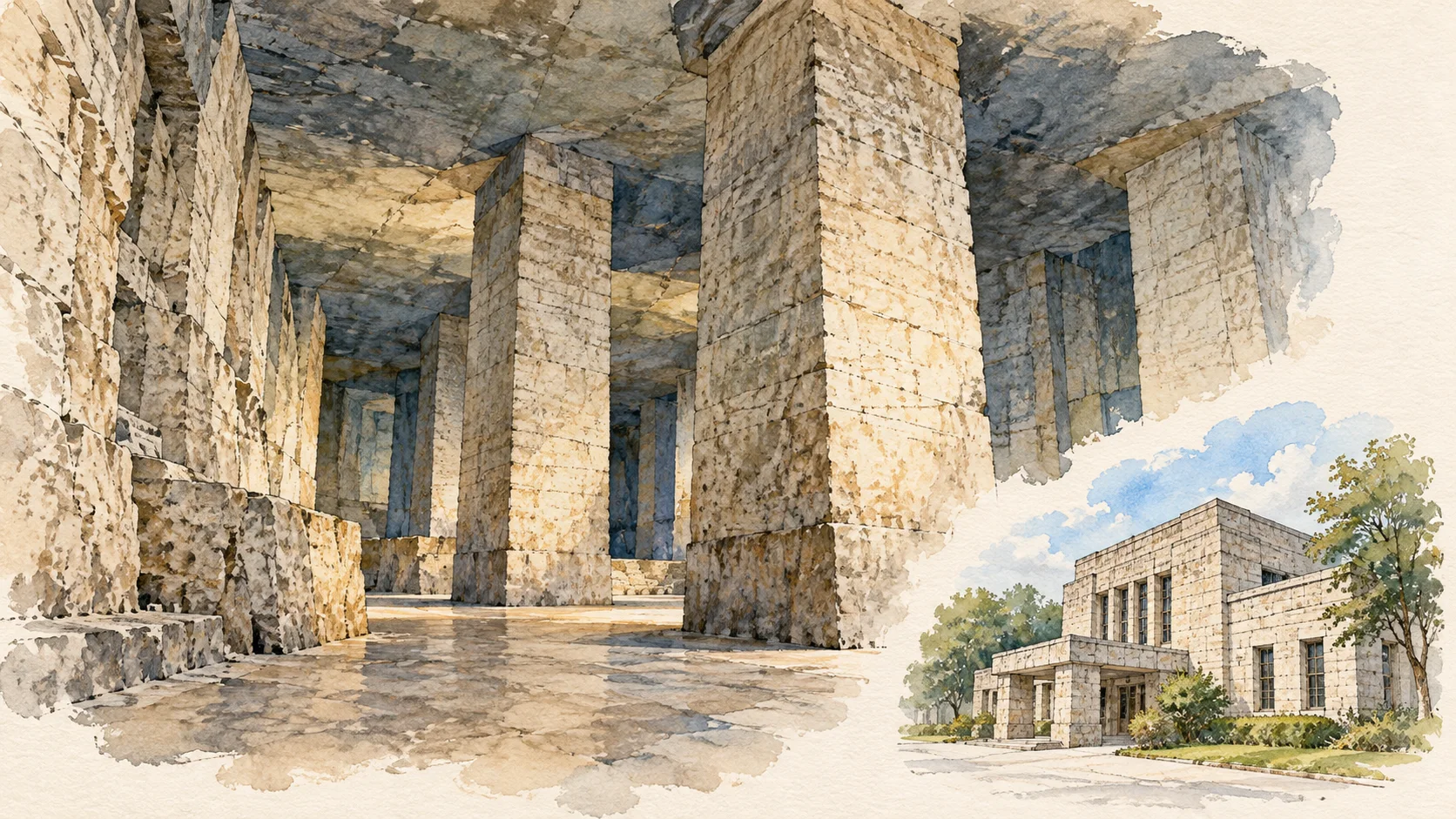
Plan a day exploring Oya stone in Utsunomiya: the underground quarry, Oya-ji rock carvings, Peace Kannon and old public hall. Includes December 2026 works, stair access, weekend quarry visits and half-day choices.
Start with one stone wall in the 20,000-square-metre underground quarry
The former underground quarry at Oya History Museum covers about 20,000 square metres and reaches about 30 metres deep. The figures describe its scale, but begin with a small section of wall: its flat surface, corners and tool marks. Then look upwards and into the distance. Close views reveal the work; distant views show the volume of stone removed. Together they make it easier to understand this as a former workplace.
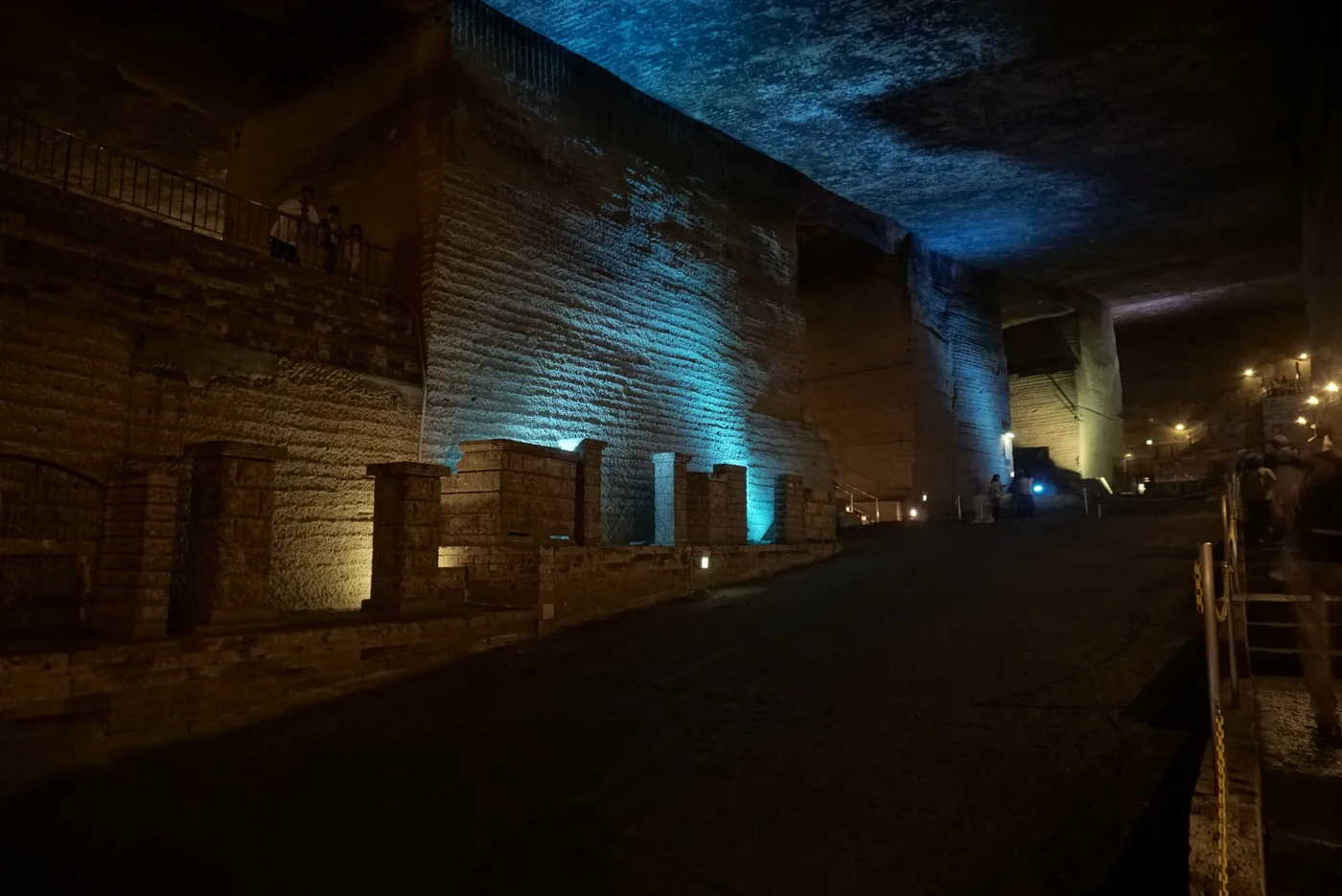
The museum explicitly identifies pickaxe marks from the hand-quarrying era on the stone surfaces. Choose a clear patch and look at the marks’ direction, density and relation to adjacent planes. Then step back to a permitted stopping place to view the whole wall.
Imagine the empty space filled with the stone that once occupied it. Buildings normally add material; a quarry leaves walkable space after material is removed. Look at wall corners and high masses as well as the passages. Today’s visitor route is only part of what you see; the original extent of extraction determined the space’s scale.
Tochigi Prefecture’s 2016 introduction to Oya History Museum covers Oya stone quarrying history and the underground quarry.
Separate the stone’s name, extraction methods and quarry forms
Oya stone is the collective name for rhyolitic breccia tuff quarried around Oya-machi in Utsunomiya. For visitors, this geological term connects the underground quarry, rock-face Buddhist figures and stone buildings to one source material. Compare the rock in place, its carved surfaces and its appearance after being cut into building blocks. The use changes how you look at it.
The museum distinguishes “hiraba-bori” and “kakine-bori” when describing extraction methods, and “roten-bori” and “konai-bori” when describing quarry forms. The first pair concerns how stone is extracted; the second concerns open-air and underground quarrying. Keep these questions separate when reading the displays. Hiraba-bori does not simply mean open-air quarrying, nor kakine-bori underground quarrying.
How did a 150-kilogram block leave the quarry?
The museum’s account of removal says that, during hand quarrying, workers carried individual blocks weighing as much as 150 kilograms on their backs. This brings the underground space back to human scale. Cutting a block was only part of the task: it still had to leave the working face. After looking at the high walls, think about how blocks travelled along the carrying routes. Extraction and removal required different arrangements.
The museum separates the hand-quarrying period, from increasing activity in the mid-Edo period until mechanisation around 1960, from the later mechanised period. Hand tools included several types of pickaxe and back carriers for stone. Motors and winches were used after mechanisation. Read tools, weight and space together: how tools met stone, how transport handled the weight, and how the quarry accommodated the work.
After leaving the quarry, the stone still had to reach its destination. The museum lists changes from rafts, packhorses, horse carts and trolleys to railways and lorries; lorries now dominate. Picture removal from the quarry and transport elsewhere as two separate diagrams. One deals with heights and paths within the quarry, the other with longer distances. Changes to both enabled the material’s use in many kinds of building.
December 2026 renovation and a winter visit
Oya History Museum’s notice of 20 October 2026 says the exhibition room closes for renovation from December, while the underground space remains open as usual. Reopening the following spring is the planned schedule. Keep the underground quarry in a winter itinerary and use the history of tools and transport as background for understanding the space. Visit the physical displays above ground after the room reopens.
If pickaxes, back carriers and quarrying machines are your main interest, plan around the exhibition room’s reopening notice. If the underground quarry is the priority, focus on wall marks, space and the visitor route, then continue to Oya-ji or the public hall. The works change which displays you can see during the day; they do not require cancelling the whole Oya trip.
Winter opening hours also change. From December to March the museum opens 9:30–16:30, with last entry at 16:00. It closes on Tuesdays during this period, moving the closure to the following day when Tuesday is a public holiday, and also closes 26 December–3 January. Oya-ji’s regular closure is Thursday, except public holidays, and it closes 26–31 December. Choose a date when both are open before planning a combined visit, with the longer underground stop in the morning.
Warm clothing directly affects the underground visit. The museum asks visitors to bring a jacket and has stopped lending summer blankets. Bring a layer that is easy to put on and remove, rather than rushing through once you feel cold. Eat and rest above ground afterwards; food and drink are prohibited underground. In winter you will move between outdoors and underground several times, so leave some room in your bag for the layer.
At Oya-ji, start with the principal image, then the three triads
Oya-ji’s principal Thousand-armed Kannon is about four metres tall and carved directly into the rock. Shaka, Yakushi and Amida triads bring the total to ten stone Buddhist figures. Make the principal image a complete first stop, then turn to the three groups. Distinguishing a single principal image from grouped figures helps you remember what you have seen. The temple dates their designation as a national Special Historic Site to 1954 and as Important Cultural Properties to 1961.
For rock carvings, look at the connection between figure and wall: how the form emerges from the rock and where its outline meets the surrounding surface. This contrasts well with the museum’s tool marks. Quarrying removes stone; the Buddhist figures leave an image for worship in place. Both involve working the rock, but their purposes and final forms differ.
Beyond today’s stone colour: paint and gold leaf
The temple describes several stages in making the principal image: carving the rock, applying vermilion, refining it with clay, then adding lacquer and gold leaf. This raises another question for the visit: what colours and surfaces did the figure have in the past? Separating the carved form from later surface layers shows that making a stone Buddhist figure involved more than chiselling its outline.
Read this account before entering, then give the figures your attention inside. Look at the relationship between form, rock face and conservation as a whole, rather than crowding close or moving repeatedly to seek one tiny patch of colour. Photography of the Buddhist carvings inside the hall is prohibited. The temple also states that photography is prohibited inside buildings and allowed in the grounds.
The temple retains two different kinds of account of the principal image’s origins: the tradition that Kobo Daishi made it in 810, and a newer theory proposed by Kitaguchi Hideo linking it to the late Nara period and monks travelling the Silk Road.
For a longer view of local life, briefly stop at the excavated pottery and stone tools displayed at the temple. The temple describes Jomon-period finds beneath the hall and links natural rock shelters to life at that time. This differs from the Buddhist carvings: one concerns rock made into a religious image, the other traces of life sheltered by it. With limited time, keep the carvings central and treat the excavated material as an extension.
Peace Kannon: distinguish ancient carvings from post-war sculpture
The scale grows markedly at Peace Kannon. This 27-metre figure was made to commemorate those who died in the Pacific War and pray for world peace. Work began in 1948 and finished in 1954. The temple credits Tobita Asajiro with its design and creation, with Oya stoneworkers taking part in carving. This post-war history differs from that of the ancient carvings inside the hall; pause at each separately.
First view the whole figure from the park, then its relationship with the rock behind. Oya-ji gives a close view of carving joined to a rock face; Peace Kannon shows how a large sculpture enters an outdoor landscape. Together they show stoneworking responding to different purposes in different periods. Temple worship, post-war commemoration and park rest can each have a quiet place in the day.
The park containing Peace Kannon is freely accessible for worship and suits a ground-level walk after Oya-ji. If your party has spent enough energy underground and at the temple, make this the final outdoor stop before taking the bus back to Utsunomiya. Photograph from a position that keeps the path clear. One view showing the figure and rock can be enough, leaving time for worship and rest.
Mount Otome requires an out-and-back walk
Oya-ji’s Mount Otome is known for unusual Oya stone formations and Japanese red pines, and was designated a national Place of Scenic Beauty in 2006. If you enjoy natural rock, add it as a separate walk after the temple and decide how much walking time to give it. If you also want the public hall after the underground visit and temple, omit the mountain entirely and save your energy for the ground-level public spaces.
The temple states that Mount Otome has slippery areas and lacks safety fences and similar equipment to preserve the natural landscape. Wear suitable trainers and read the walking precautions. Weather can also close the mountain. The summit is a dead end; there is no descent on the other side. Allow for the climb, time at the top and return by the same path. Do not treat the far side on a map as a through-route to the museum.
Choose this walk when the ground is dry and everyone still has energy. In rain, with unsuitable soles or with someone experiencing knee discomfort, stay around Oya-ji and Peace Kannon. The underground space and rock carvings already give the day a clear theme. Add the mountain only if you want the walk, making the plan easier for everyone.
The old public hall: follow a building’s restoration through its stone
Oya CONNECT includes the Old Oya Public Hall, a visitor centre and an outdoor multipurpose space. It works at the start or end of the day. The hall was completed in 1929. Restoration reused dismantled stone to recover its early appearance. After the underground quarry, your attention can shift naturally from large rock masses to individual shaped building blocks.
Look at the whole hall first, then approach the walls to see the arrangement of blocks and their joints. This is an accessible way to observe architecture without knowing every structural term. Underground, you saw surfaces left after stone was removed. Here you can see one piece joined to the next to form a building’s scale and outline.
The adjacent new visitor centre also uses Oya stone inside and out. Observe it from the same distances: proportions from afar, surfaces and joints close up, then how the material meets entrances used by people. The old and new buildings place conservation beside present-day visitor services. You can compare uses of the local material without travelling to another distant building.
The visitor centre has resident tourist information staff, an accessible toilet and infant-care facilities. In the morning it is useful for organising the day’s ground-level route. At the end, it offers a rest and toilet stop before the bus. General hall visits and the visitor centre run 9:00–17:00, closing on the third Tuesday of each month and 29 December–3 January. Distinguish evening venue-hire hours from general visiting hours.
KANEHON’s open-air quarry adds another view of extraction
If the underground quarry is your strongest interest, KANEHON can extend the subject on a weekend. Utsunomiya’s tourism association describes it as a working quarry offering visits and several activities during tourism opening periods. Underground, you see the interior left by extraction. At an open-air quarry, you place the work within the ground-level landscape. Each then answers a different question.
The association’s current listing gives opening as 10:00–15:00 on the first, third and fifth Saturdays, Sundays and public holidays. It closes Monday–Friday except public holidays. Check which Saturday you are choosing: “weekend” does not make the second or fourth Saturday a regular opening day. On weekdays, complete the museum, Oya-ji and public hall route and save the open-air quarry for a suitable date.
The association lists admission at ¥500 and a quarry viewing tour at ¥300, charged separately. For a quarrying theme, start with entry and the tour. Pizza, stonecraft and other activities have separate fees and booking arrangements. This gives a clear basic budget and leaves time to return to Utsunomiya, without turning every activity into a requirement.
To include KANEHON in one full day, make it another main stop, shorten the park walk after the temple and omit Mount Otome. If ancient Buddhist figures and the hall restoration matter more, leave out the quarry extension. Both open-air and underground sites merit attention. Choose for the quarry landscapes you want to compare, rather than the number of places visited.
Utsunomiya to Oya: match the bus stop to the final sight
At JR Utsunomiya Station, take a Kanto Bus towards Oya and Tateiwa from West Exit stop 6. The museum website gives about 30 minutes on the bus to Shiryokan Iriguchi, then about five minutes on foot. From near Tobu-Utsunomiya Station, board at Tobu Ekimae. Save the full stop names to spend arrival time visiting rather than searching among similar place names.
For Oya-ji, use Oya Kannon-mae; the temple gives about three minutes on foot from the stop. For KANEHON, use the Tateiwa terminus; the tourism association also gives about three minutes on foot. These stops serve different endpoints, and you can return from near your last visit. Search Kanto Transportation for outward and return services on your travel date, including the walk from the last sight to the bus stop.
The 2026 Oya low-speed electric vehicle season runs 25 April–23 November, with services on selected weekends and holidays, 10:00–16:30, between Oya CONNECT and the KANEHON area. It links scenery with guiding along the way. For a December underground visit, use scheduled buses and walking. The seasonal local vehicle and buses to and from Utsunomiya have different roles; the former is not essential winter transport.
On the operator’s Utsunomiya West Exit timetable, read the column “45 大谷経由 立岩” (Tateiwa via Oya). The same page also lists “47 荒針経由 新鹿沼” (Shin-Kanuma via Arahari); do not mix minutes from the two columns. The weekday timetable checked on 29 October 2026 gives morning Tateiwa departures at 8:51, 9:10, 9:59 and 10:26. Missing a planned 9:10 means waiting 49 minutes until 9:59 and moving the morning visit later.
For a return from Oya Keikan Koen stop, the weekday timetable gives 15:09, 15:43, 16:05 and 16:35 towards “01 宇都宮駅” (Utsunomiya Station). These are departures from the park. Shiryokan Iriguchi, Oya Kannon-mae and Tateiwa each have their own timetable. If ending at the park, fix that return stop too. A departure time at another stop is not your deadline for reaching this one.
Oya sightseeing day ticket: compare admission first, then bus fares
Kanto Transportation’s prices from 1 April 2026 are ¥2,200 for adults, ¥1,400 for junior high school students and ¥700 for primary school pupils. The Oya Kanko Ichinichi Joshaken includes museum admission, Oya-ji admission and a day of unlimited bus boarding and alighting on the JR Utsunomiya–Oya–Tateiwa route at the stops listed on the ticket. Taking the bus out, visiting both sites and returning is its simplest use. Add KANEHON entry and tour fees separately.
Separate adult admission to the museum and Oya-ji totals ¥1,500, so the pass costs ¥700 more. It saves money only when your otherwise payable bus fares on the route exceed ¥700; exactly ¥700 breaks even. Junior high school admission totals ¥600, leaving a difference of ¥800 from the ¥1,400 pass. Primary school admission totals ¥500, only ¥200 below the ¥700 pass. Calculate each family member’s category separately rather than applying adult savings to children.
If visiting only the underground museum, adult admission is ¥1,000 and the gap to the pass is ¥1,200; transport must exceed that to save money. For Oya-ji alone, adult admission is ¥500 and the gap is ¥1,700. If your date falls on the temple’s Thursday closure or the museum’s winter Tuesday closure, first select the facility you can enter, then use the same calculation. These differences are break-even thresholds. Add the fares for outward, return and intermediate rides to decide.
The city’s ticket information updated on 16 September 2026 lists sales at the tourist information centre beside JR’s conventional-line ticket gates, daily 9:00–14:50 except year-end/New Year and other closure days. For an earlier arrival, Kanto Transportation’s Utsunomiya Station commuter pass centre is about a minute from the West Exit, south of Chisun Hotel. It opens weekdays 8:00–19:00 and weekends/holidays 8:30–17:00, with sales suspended 12:00–13:00. For the 9:10 bus, buy there first and return to stop 6 rather than squeezing purchase into the ten minutes after the information centre opens.
The city also lists Tobu Hotel Grande and Four Points Flex by Sheraton Utsunomiya as outlets. These hotels and the tourist information centre suspend sales when Oya-ji or the museum is closed. From Tobu-Utsunomiya, Grande near Tobu Ekimae is convenient. From JR, use the station information centre or West Exit pass centre. This scheduled-bus day ticket and the local low-speed electric vehicle passport are separate products. One covers travel from Utsunomiya and intermediate bus rides; the other operates locally in Oya. Give the full ticket name when buying.
Allocate half-day or full-day stops to your interests
The following stay lengths are suggested planning allowances. For an underground half-day, allow 60–90 minutes at the museum and 30–45 minutes at the public hall and visitor centre, plus buses, walks to stops and rests. If tools and industrial history interest you, add reading time while the exhibition room is open. In winter, focus on the underground space, eat above ground afterwards, then return to Utsunomiya.
For a Buddhist sculpture half-day, allow 45–60 minutes at Oya-ji, 20–30 minutes for Peace Kannon and a park walk, then see the public hall. This gives separate time to ancient figures, post-war sculpture and modern civic architecture, suiting an above-ground stone theme. Allocate Mount Otome’s return walk separately; with older adults or children, replace it with a seated rest.
For a full day, use the basic order of underground visit, lunch above ground, Oya-ji and Peace Kannon in the afternoon, then the hall. Complete the stair-dependent main stop in the morning and shorten the park walk later if tired. For more temple time, make the hall brief. For architecture, reserve the hall time first. One place worth lingering at is enough to anchor the day, with other stops providing comparisons.
For a longer weekend quarrying route, make KANEHON and the underground quarry the two main destinations. Add Oya-ji only if opening hours and energy allow. The open-air quarry lists a 15:00 finish, so it cannot wait until everything else is done. Visit KANEHON first and leave enough afternoon time before the museum’s seasonal last entry, or visit underground first and head to KANEHON after lunch, with the hall a short return stop.
For example, choose Friday 30 October 2026 and the weekday timetable checked on 29 October. Buy the ticket first, take the 9:10 Tateiwa bus from JR Utsunomiya West Exit and alight at Shiryokan Iriguchi. With the museum’s estimated 30-minute ride and five-minute walk, plan a 10:00–11:30 visit. This is an itinerary allocation; move it later if traffic delays the bus. Taking 9:59 still leaves the underground visit possible by shortening the park stop after lunch. The Friday version omits KANEHON, closed on ordinary weekdays, and needs no seasonal local vehicle transfer.
After the museum, the tourism association’s walking route lists about ten minutes to Oya Keikan Park, then five minutes to Oya-ji. Fit lunch and a rest into this ground-level movement, reserve 13:00–14:00 for Oya-ji, then continue to Peace Kannon and the hall. Without Mount Otome, no mountain return walk is needed. The park lies between museum and temple. Returning there for the bus also gives a final stop with grass and rock faces across the Sugata River.
Aim for the park stop’s 15:43 bus, ending the final visit at 15:20 and allowing 20 minutes to walk to the stop, sort your jacket and wait. The 16:05 is the next fallback, 22 minutes later. Initially allow 60 minutes for the return journey to Utsunomiya, then 30 minutes to enter the station, buy food or take your next train. If waiting beside the temple instead, look up the Oya Kannon-mae return timetable and remove the park’s 15:43 from the plan.
Prepare admission, cash and photography rules before leaving
After the museum’s adult price change in April 2026, ordinary admission is ¥1,000 for adults and ¥400 for primary and junior high school pupils. Preschool children enter free, and payment is cash only. Oya-ji charges ¥500 for adults, ¥200 for junior high school students and ¥100 for primary school pupils. Two adults buying separate admission to both pay ¥3,000. Add transport and food for the basic budget of the main day route.
Individual bus fares can be paid in cash or by IC card. The operator instructs passengers to board at the rear and leave at the front. Cash users take a numbered ticket on boarding, check the onboard fare display when alighting, and put ticket and fare into the box together. IC users tap both on and off. The museum ticket office is cash only, so even if using an IC card on the bus, retain enough cash for separate admission.
The museum opens April–November 9:00–17:00, last entry 16:30. Oya-ji opens at 8:30 in April–September and 9:00 in October–March, closing at 16:30 throughout, with reception ending 20 minutes earlier. If arriving in the afternoon, choose the paid site you most want to see, then finish with the park or hall. This preserves more viewing time than rushing between two admission deadlines.
Follow the walking route when photographing underground. The museum prohibits tripods, monopods and selfie sticks, stopping for photographs on stairs, landings or narrow passages, and fixing cameras to the ground or handrails. Reach a place where stopping is permitted, then use a handheld camera. Photography lasting more than two hours requires permission. Shoots using human-shaped figures, props or special costumes incur separate charges and require an application.
For other travel choices from Tokyo, read Tokyo day trips and overnight stays. To continue exploring Oya stone as a building material, the Meiji Mura buildings and rides guide includes a visit to the Imperial Hotel’s central entrance.
A few useful answers
How do I get to the Oya History Museum or Oya Temple from JR Utsunomiya Station?
Take a Kanto bus towards Oya and Tateiwa from stand 6 at the west exit of JR Utsunomiya Station. For the museum, get off at Shiryokan Iriguchi after about 30 minutes, then walk for about 5 minutes. For Oya Temple, get off at Oya Kannon-mae, around 3 minutes away on foot.
What does the adult Oya sightseeing day ticket cost and what’s included?
From 1 April 2026, the adult ticket costs ¥2,200 and includes the Oya History Museum, Oya Temple and unlimited bus travel that day on the JR Utsunomiya Station–Oya–Tateiwa route. Separate admission to both sites comes to ¥1,500, so the day ticket works out cheaper if your bus fares exceed ¥700.
Will Oya’s underground quarry stay open during the works from December 2026?
The underground quarry stays open when the exhibition room above ground shuts for refurbishment in December 2026. From December to March it opens 9.30 am to 4.30 pm, with last entry at 4 pm. It closes on Tuesdays (the following day if a public holiday falls on Tuesday) and from 26 December to 3 January.
Can I take a wheelchair or pushchair into the Oya History Museum’s underground quarry?
Wheelchairs, pushchairs and handcarts are prohibited on standard visits to the underground quarry. If you have difficulty walking, the museum offers a weekday golf buggy ride into the quarry for a fee. You must book it in advance.
Official information and references
Sources used in this guide.
- Oya History Museum: admission, transport and visitor rules
- Utsunomiya City: 2026 Oya low-speed electric vehicles
- Utsunomiya City: Oya CONNECT and public hall restoration
- Oya History Museum: exhibits and quarrying history
- Utsunomiya tourism association: KANEHON quarry
- Oya-ji: stone Buddhist figures, Mount Otome, Peace Kannon and visiting information
- Oya History Museum: December 2026 exhibition room renovation notice
- Kanto Transportation: Oya day ticket prices from April 2026
- Utsunomiya City: Oya day ticket coverage and outlets (updated 16 September 2026)
- Kanto Transportation: weekday timetable from Utsunomiya West Exit to Oya and Tateiwa
- Kanto Transportation: weekday timetable from Oya Keikan Koen to Utsunomiya
- Utsunomiya tourism association: car-free Oya walking route