A 5-minute walk from JR Ueno Station's Park Exit: see the 30-metre outdoor blue whale, then head down to Global Gallery B1 for T. rex and real Triceratops fossils. Covers free age tiers, THEATER 36○ queues, ComPaSS booking, and a half-day family route.
- Region & Focus
- TokyoFamily attractions
- Reading Scope
- 18 min read · 8 chapters · 6 Q&As
- Official Verification
- 26 official sources checkedUpdated 22 November 2026
- Key Topics
- First tripTravel budgetNeighbourhoods
Chapter Route Map (tap any stop)
- Walking from Ueno Station's Park Exit to the Blue Whale
- Opening Hours, Free Ages, and How Tickets Work
- Tyrannosaurus and Triceratops in Global Gallery B1
- The Japan Gallery's Dome, Hachiko, and Myriad-Year Clock
- THEATER 36○: A Six-Minute Film Inside a Sphere
- ComPaSS Discovery Room: Booking, Ages, and Check-In
- Exploring Without Translating Every Plaque
- A Three-Hour Family Route Starting From One Priority
- Quick Q&A
In Ueno Park, a 30-metre blue whale raises its flukes towards the treetops while its snout dips just above the pavement. Step past it into the National Museum of Nature and Science, and basement level 1 of the Global Gallery reveals a full-scale Tyrannosaurus skeleton replica alongside a Triceratops fossil still resting in its excavated posture. For a first family visit, set aside around three hours for the dinosaurs, the Japan Gallery's dome and Hachiko, plus either THEATER 36○ or the ComPaSS discovery room. A single ¥630 ticket covers both permanent galleries for adults and university students, while high school students and younger children enter free.
Walking from Ueno Station's Park Exit to the Blue Whale
The Ueno Main Building sits at 7-20 Ueno-koen, Taito-ku, Tokyo. On arrival at JR Ueno Station, follow signs for the Park Gate (Koen-kaisatsu), which brings you straight out at the Park Exit, roughly a five-minute walk according to the museum. Once outside, head past the National Museum of Western Art along the park path towards the science museum. Ueno Station is vast, with a noticeable walk from train doors to ticket barriers, so if you have booked a timed ComPaSS slot, factor in navigation, ticket purchase, and heading upstairs to check in.
Visitors staying near Asakusa, Ginza, or along the Hibiya Line can arrive smoothly on the Tokyo Metro. From Exit 7 of Ueno Station on either the Ginza or Hibiya Line, the museum estimates a 10-minute walk. With a pushchair on the Ginza Line, take the Ueno Park-bound ticket gate to the lift serving Exit 5a. On the Hibiya Line, follow Tokyo Metro's step-free map to the dedicated lift entrance at the JR Ueno Station front plaza, open 7:30–22:00. Families arriving from Narita on the Keisei Skyliner or Keisei Main Line also have about a 10-minute walk from Keisei Ueno Station's Main Exit. Because the station names sound alike, specify JR or Keisei when texting your group where to meet.
As you pass the National Museum of Western Art, watch for signs reading National Museum of Nature and Science (often shortened locally to Kahaku). Ueno Park also houses the Tokyo National Museum, known as Tohaku, which focuses on fine art and antiquities. If your party is arriving separately, agree to meet right at the science museum's permanent exhibition entrance or beside the blue whale on the park path—sending only "Ueno Museum" risks half your group waiting outside the wrong building.
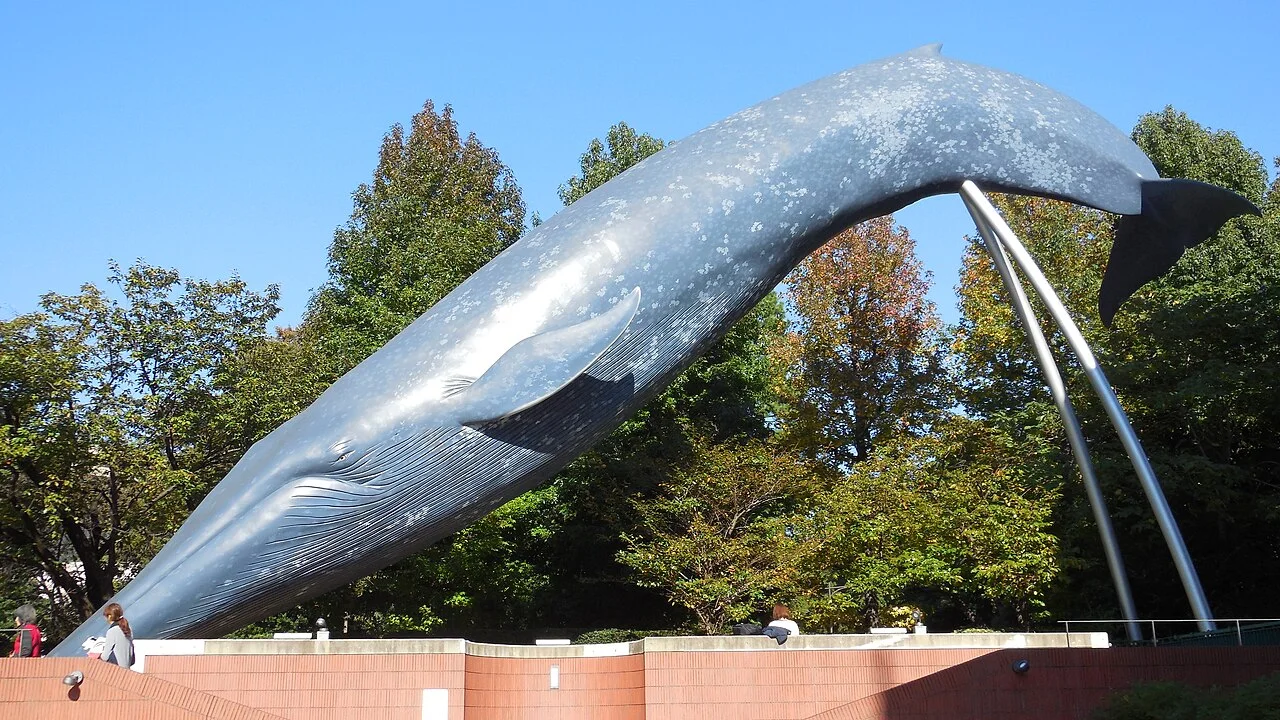
The outdoor blue whale stretches diagonally above its plinth. Step close to inspect the pleated throat grooves along its underside, then step back to take in the sweep of its tail. Measuring 30 metres from snout to fluke, the model captures the largest living animal on Earth at the moment it dives beneath the surface. Walking children from nose to tail lets them pace out its true scale with their own footsteps, and framing a family photo with passers-by or trees in the background brings that sheer length home once you are back.
Just nearby outdoors stands a D51 steam locomotive, built in 1939 and in freight service until 1975 according to museum plaques. Train-mad children can hunt down the locomotive number on the front plate before crouching to trace the connecting rods linking the huge driving wheels. With the engine stationary, it is easy to follow how power travels down the chassis. If you are eager to get inside, save the D51 for the end of your visit rather than doubling back between the park path and the station.
Space enthusiasts with energy to spare can circle behind the Global Gallery towards the JR railway tracks to see the Lambda rocket launcher, the very pad used to launch Japan's first satellite, Ohsumi, in 1970. The museum's outdoor exhibit map marks the locomotive, launcher, and whale together if you lose your bearings. On a rainy morning, head straight indoors and pick just one outdoor piece on the way out so everyone keeps dry shoes while standing in front of the fossils.
| Station | Exit | Museum walk estimate |
|---|---|---|
| JR Ueno Station | Park Exit (follow Park Gate signs inside) | Approx. 5 mins |
| Tokyo Metro Ueno Station | Exit 7 (Ginza & Hibiya Lines) | Approx. 10 mins |
| Keisei Ueno Station | Main Exit | Approx. 10 mins |
A 5-minute walk from JR Ueno Station's Park Exit: see the 30-metre outdoor blue whale, then head down to Global Gallery B1 for T. rex and real Triceratops fossils. Covers free age tiers, THEATER 36○ queues, ComPaSS booking, and a half-day family route.
Opening Hours, Free Ages, and How Tickets Work
The permanent galleries generally open from 9:00 to 17:00, with last admission at 16:30. Regular closures fall on Mondays, shifting to Tuesday or another weekday whenever Monday is a Japanese national holiday—for instance, the museum opens on Monday 23 November 2026 and closes on Tuesday 24 November instead. Over the New Year break, it closes from 28 December 2026 to 1 January 2027, reopening on 2 January. If you are planning around Japan's public holidays in February or March, check the closed days on the official museum calendar before locking in your date.
One permanent exhibition ticket grants entry to both the Japan Gallery and the Global Gallery, as well as THEATER 36○. General admission and university students pay ¥630, while primary, junior high, and senior high school students—and younger children—enter free. Free admission also applies to visitors aged 65 and over and anyone under 18 (up to and including the first 31 March after turning 18); simply present age ID at the entrance. Keep teenagers' or grandparents' IDs in the same pouch as your tickets so nobody has to rummage through a rucksack at the gate.
Two adults with one primary-school child visiting only the permanent galleries and THEATER 36○ pay ¥1,260 in total. Adding ComPaSS for all three adds ¥900, bringing the total to ¥2,160. Many families send one adult inside the discovery room with the child while the other stays in the wildlife gallery on the same floor; agreeing on a meeting spot for the end of the 45-minute session saves one ComPaSS ticket and gives the second adult quiet time to browse.
Permanent tickets can be bought on site or booked online via Asoview through the museum's visitor guide page. The ticket window accepts credit cards, transport IC cards such as Suica and PASMO, plus PayPay and Alipay. If only part of your group requires paid tickets, tally the paid and free counts beforehand to keep the transaction brisk. When pairing permanent admission with a timed ComPaSS slot, keep the e-ticket and ComPaSS confirmation email open in separate tabs so you can flash them smoothly at the main gate and the third-floor desk.
To mark its 150th anniversary, the museum is staging a major special exhibition, Dinosaur Expo 2027, from 13 March to 13 June 2027 with its own dedicated ticket. Families happy simply to stand beside a Tyrannosaurus for scale already have an entire dinosaur floor in Global Gallery B1 included with standard admission. Those travelling specifically for the special exhibition should book via the current exhibitions page first, time their arrival around its entry slot, and slot the permanent dinosaur gallery in before or after.
Even exploring just one or two floors makes for a rewarding trip. Families aiming for an early timed session should handle tickets and lockers first and leave outdoor group photos until departure. Afternoon visitors need to watch the clock: an hour or slightly more covers a stretch of dinosaurs plus a highlight in the Japan Gallery, though if THEATER 36○ is on your list, arrive earlier before the final queue fills up. To step outside for lunch, apply for same-day re-entry at the Japan Gallery B1 information desk before exiting.
| Exhibition or area | Fee | Admission method |
|---|---|---|
| Japan Gallery & Global Gallery permanent exhibitions | ¥630 adults & university students; free for high school students and younger | Buy at ticket window or online e-ticket via museum site |
| THEATER 36○ | Included in permanent admission | First-come, first-served queue; whole party must be present |
| ComPaSS discovery room | ¥300 per person (free for ages 0–1) | Timed reservation required for every entrant |
| Special exhibitions | Separate ticket per exhibition | Book via the current exhibition's ticket link |
Tyrannosaurus and Triceratops in Global Gallery B1
Once inside, follow signs specifically for Global Gallery B1F. The museum has two separate B1 levels: the Japan Gallery basement houses the dome theatre and visitor lounge, whereas the dinosaurs live in the neighbouring building. Global Gallery B1 explores the theme "Exploring the Mysteries of Dinosaurs", arranging specimens around evolution and anatomy. Pick out the floor name first, let each child choose one must-see specimen, and expect everyone in the family to nominate a different favourite bone by the end of the hall.
The Tyrannosaurus mount makes it remarkably easy to trace how the skull, powerful hind legs, and tail balance one body. The museum's permanent collection database lists both the full skeleton and the exploded skull display alongside it as replicas. To read its proportions, look at the jaws first and then drop your eyes to where the feet plant on the floor. Head-on, you grasp the breadth of the bite; from the side, skull, legs, and tail snap into one silhouette. Have children hold out their hands to measure from chin to nose, then compare that against how much of the T. rex head is pure jaw.
Triceratops deserves two separate stops. The standing full skeleton is a replica, letting you follow the brow horns and frill right down to the forelimbs; nearby sits an in situ fossil preserving the bones in their excavated burial position, which does contain real fossilised material. Challenge children to spot a feature they learned on the standing mount inside the rock matrix—an eight-year-old can usually point out a horn or section of skull and explain why, which beats memorising Latin names off a plaque.
For more real bone, look up at the full-body Apatosaurus skeleton, catalogued by the museum as containing original fossils, and check the Pachycephalosaurus section where the domed skull is an authentic specimen. Walking beneath the long-necked, whip-tailed Apatosaurus is an ideal moment to recall the 30-metre blue whale paced out earlier: glance up the neck, sweep down the ribcage, and finish at the floor label to flip from full-body scale to bone detail in seconds.
To picture what dinosaurs ate every day, seek out the touchable replica of a Parasaurolophus lower jaw tooth row, where tightly packed teeth form a broad grinding battery. Next to it, a model of the hadrosaur chewing mechanism demonstrates how those jaws sheared past each other. This floor also features a touchable Stegosaurus tail replica, offering welcome hands-on relief for children after peering into glass cases—treat the museum's "touchable" signs as mini waypoints across the room.
Further along the gallery sits a real fossilised feather dated to roughly 100 million years ago. Encourage children to lean close to the glass for the delicate barbs, then look back at the giant skeletons to talk about what survives in stone and what usually vanishes. Small pieces like this reward slowing down. Adults wanting deeper background notes can save the museum's English floor map onto a phone beforehand so you can match zone numbers to displays without crowding around text panels.
If you have stamina for one more level, head down to Global Gallery B2F for the history of life and mass extinctions, home to giant ammonites, pterosaurs, and a Columbian mammoth skeleton replica. When time allows for only two or three stops, pick one dinosaur relative and one wildly unfamiliar creature. Note that Global Gallery B3F is closed for refurbishment from 8 September 2026, so older itineraries extending below B2 stop here; parts of Global Gallery 2F's science and technology section are also closed, and the Myriad-Year Clock formerly on 2F has moved to Japan Gallery 1F.
| What to look at | Specimen type | What to spot up close |
|---|---|---|
| Tyrannosaurus full skeleton | Replica | Proportions between skull, hind legs, and tail |
| Standing Triceratops | Full-body replica | Horns, neck frill, and four-legged stance |
| Triceratops in burial posture | Contains real fossils | Relative position of bones preserved in rock |
| Apatosaurus full skeleton | Contains real fossils | Slender neck balanced against a massive torso |
| Parasaurolophus lower jaw dentition | Touchable replica | Rows of teeth packed into a flat grinding surface |
The Japan Gallery's Dome, Hachiko, and Myriad-Year Clock
Follow signs for the Japan Gallery to step inside the museum's oldest wing. Completed in 1931 in Neo-Renaissance style, the building reopened as the Japan Gallery in 2007 and was designated an Important Cultural Property of Japan the following year. The 1F central hall is the easiest place to appreciate the architecture without extra walking: stand beneath the white dome and look up at the stained glass. After the dark, dramatic lighting of the dinosaur halls, natural daylight here gives tired eyes a welcome rest before you climb the stairs.
Take a moment in the central hall to orient yourselves—look back at where you entered, then spot the entrances to each wing. To find Hachiko, head for Japan Gallery 2F North Wing, themed "The Japanese People and Nature". The museum's permanent database lists Hachiko as a taxidermy specimen of the Akita dog Hachi in the section on animals bred in Japan. Visitors who have already seen the bronze statue outside Shibuya Station can inspect his real ear shape, coat colour, and four-legged stance up close, matching the familiar silhouette to the real animal.
Nearby sit Kuro, a Kai Ken dog, and Jiro, the Sakhalin Husky who joined the Japanese Antarctic Research Expedition—museum publications note both mounts stand just behind Hachiko. If your children love dogs, ask them to compare two of the mounts, checking ear angle, tail curl, and overall build. Seeing the taxidermy specimens side by side in the 2F display cases gives a far clearer sense of proportion than any dog breed guidebook.
Leaving the North Wing, cross to the 1F South Wing to see the Myriad-Year Clock (Mannen-dokei). Formerly displayed on Global Gallery 2F, it moved near the front of the newly refurbished Japan Gallery South Wing when it reopened on 21 April 2026. This intricate mechanical clock features multiple dials, accompanied by museum videos showing how the 24 solar terms and lunar phases advance together. Ask children to point out the dial that looks most like a clock at home, then spot the unfamiliar dials before continuing to the traditional Japanese clocks (wadokei), calendars, and astronomical instruments beside it.
Families keen on wildlife can devote more time to Japan Gallery 2F South Wing or 3F. The 2F South Wing traces how plants and animals adapted and diversified across the Japanese archipelago's varied island climates. Upstairs on 3F, displays shift to the surrounding seas, illustrating the Kuroshio and Oyashio currents and how water temperature shapes marine life. Even focusing on one chart and a single specimen gives children something to recognise later at the beach, a fish market, or the dinner table.
On your way down to the dome theatre, stop in the Japan Gallery B1 central hall to watch the Foucault pendulum. Scale markings on the base track how the swing plane appears to shift over time, demonstrating the Earth's rotation. It is an ideal pause while waiting for someone in the toilets or refilling water bottles: note the pendulum's position against the dial on arrival, then check how far it has moved when you return. If short on time, locate the North Wing theatre entrance first; you can easily wander back from the lounge on the same floor later.
THEATER 36○: A Six-Minute Film Inside a Sphere
Tucked into the Japan Gallery B1 North Wing, THEATER 36○ began life as the Earth Room pavilion at Expo 2005 Aichi. Stepping inside the 12.8-metre-diameter sphere, visitors stand on a bridge near the centre while seamless projections wrap overhead and beneath their feet—the museum notes it as the world's first theatre built to this design. For children, the biggest surprise is the imagery below: as the scene ahead glides forward, glancing down reveals the same world stretching away beneath the transparent floor while the bridge stays rock solid.
Each screening shows one original museum-produced short lasting roughly six minutes. Screenings run from 9:30 to 16:30, capped at 40 visitors per session via an on-site, first-come, first-served queue; your entire party must be present to join. Waiting time affects your schedule far more than the short runtime. If you want to fit the theatre into the morning, drop down to Japan Gallery B1 early to check the queue and next screening board rather than crossing buildings midway through your tour. Each month's programme loops continuously, making afternoon visits straightforward to slot in between galleries.
Everyone stands on the bridge, no entry or exit is permitted once the film begins, and children may not sit on adults' shoulders. Fast-moving sequences or sudden drops can create a floating sensation, so children who dislike the dark, feel uneasy with movement underfoot, or get travel-sick easily may prefer waiting outside with an adult. Let them decide; the B1 hall right outside offers the Foucault pendulum, Whale Cafe, and seating lounge, all moments away from the 2F stairs back up to Hachiko.
The film programme changes monthly. Museum listings schedule deep-sea exploration and submersibles for November 2026, followed in December by the sea voyage of humans reaching Japan 30,000 years ago. January 2027 follows the marine food chain, February features dinosaurs, and March highlights the rivers of Japan. Families visiting in February can hunt for skeletons in the Global Gallery first, then watch fossils come to life inside the sphere; those visiting in December with dinosaur-obsessed children can finish the fossil floor before catching how ancient seafarers crossed the ocean.
To make the sphere a shared highlight, agree before stepping in to stand together and put phones away once the lights dim—photography, recording, and mobile phone use are strictly prohibited inside. Afterwards, ask each person to name the detail they remember best and whether it appeared to the left, overhead, or beneath their feet, piecing the whole 360-degree scene back together outside.
ComPaSS Discovery Room: Booking, Ages, and Check-In
If you are travelling with four-to-six-year-olds who love hands-on exploration, make ComPaSS on Global Gallery 3F a centrepiece of your half-day plan. Its full Japanese name translates as the Parent and Child Discovery Space, designed for families to explore natural history specimens together. Children can scramble across suspension bridges and peer through portholes at mounted animals from different heights, assemble magnetic puzzles, stroke furry specimens in a dedicated tactile zone, and browse picture reference books. Primary-school children can enter too, though eight-year-olds eager to spend longer among the dinosaurs will find the permanent fossil halls just as rewarding.
Tailored primarily for ages four to six, the room welcomes children from newborns up to sixth grade of primary school, accompanied by at least one adult aged 18 or over. Admission is ¥300 per person for adults and children aged two through sixth grade; infants aged 0–1 enter free but still require a booked ticket. Junior and senior high school students may accompany an eligible family group at ¥300 each. One guardian may supervise up to three children, with a maximum of six people per booking, while relatives who prefer the regular galleries can browse the surrounding animal displays outside.
Timed-entry tickets are sold via ART PASS. Slots for the following month open on the 1st of each month at 12:00 JST—for example, December 2026 sessions went on sale at noon on 1 November. Confirm everyone entering the room before booking, including babies carried in slings. Once payment clears, you receive an email containing a QR code; show it on your phone or print a copy beforehand. Because existing orders cannot be edited to add or remove tickets or switch age tiers, finalise your group list before checking out.
Standard daily sessions start at 10:00, 11:00, 13:00, 14:00, and 15:00, capped at 60 visitors for 45 minutes. Everyone in your booking must check in at Global Gallery 3F five minutes before start time and remove shoes before entering. Even if you arrive late, your session still ends strictly at 45 minutes past the hour. Before leaving your hotel, share the meeting point—Global Gallery 3F—and the QR code with another adult in your party so whoever leads older children upstairs and whoever brings the pushchair by lift can both arrive on time.
If you are already at the museum and places remain, you can buy a same-day slot by credit card on your phone up to 10 minutes after a session begins, leaving at that session's usual end time. Existing bookings can be rescheduled free of charge up to five times via your ART PASS order link until 9:00 on the day, subject to availability. Cancellations are accepted until 23:59 the night before, minus a ¥100 fee per paid ticket. All booking, rescheduling, and cancellation cut-offs follow Japan Standard Time (JST).
Drop-in workshops run during the 13:00 and 14:00 sessions on Wednesdays, Saturdays, and Sundays, free to join for anyone inside. Note that workshops pause on 26–27 December 2026 and 2–3 January 2027, though regular ComPaSS play sessions continue according to the ART PASS calendar. Sessions clear promptly at the bell; if parents want to swap halfway through while one watches siblings on another floor, send the adult planning to stay until the end in from the start.
If you miss out on ComPaSS tickets, Global Gallery 3F also houses the permanent Animals of the Earth gallery, packed with wild mammals and birds. To skip stairs altogether, Global Gallery 1F features biodiversity exhibits including a giant squid and a full sperm whale skeleton. Walking from the whale skeleton to the squid display lets children compare how very different ocean creatures move through water—and anyone who photographed the blue whale outside that morning can compare its silhouette with the sperm whale indoors.
Exploring Without Translating Every Plaque
Before your visit, let children explore the museum's Kahaku VR 3D tour on a phone or laptop, clicking through gallery junctions to get their bearings. To preview the Tyrannosaurus, open Global Gallery B1 and trace the route from the entrance until the skull appears, making it effortless to spot on arrival. Both the Japan Gallery and Global Gallery also provide downloadable floor maps in English; save both onto your phone beforehand so anyone unfamiliar with Japanese can orient themselves by zone number and exhibit location if your group splits up.
Inside the permanent galleries, you can pull up the free Kahaku Handy Guide on your own smartphone, or hire a handheld audio guide or a Kahaku Navi tablet at ¥320 each (cash only, photo ID required). Both rental devices offer English commentary, and the tablet also maps out themed routes. Adults and children can listen to different stops independently, then regroup beside a display so the person holding the guide can point out one detail nobody else noticed.
Running until 17 January 2027, the Kahaku Discovery Wagon programme sends volunteers rolling specimen carts through both permanent wings for close-up viewing and touchable models. Scheduled slots are 10:00–10:30, 11:00–11:30, 13:00–13:30, and 14:00–14:30, with informal five-minute demonstrations you can drop into freely. Noticeboards in the Japan Gallery 1F stair hall and at the Global Gallery entrance list which carts are out that day—if you catch the dinosaur teeth station, look closely at tooth shape first and guess what that animal ate.
If a Discovery Wagon draws a crowd, circle nearby displays and return a few minutes later. Visitors fascinated by the Myriad-Year Clock should watch for the wadokei cart using working models to show how Edo-period Japan divided the day, while Global Gallery carts explore marine mammals beneath the sperm whale skeleton. When your schedule already includes THEATER 36○ or ComPaSS, catch whichever cart happens to cross your path; once children have handled a model bone or gear, they often recognise the same feature on real specimens later that afternoon.
For primary-school children who enjoy a scavenger hunt, the museum's gallery worksheets are pitched at younger primary ages—covering animal sizes in Global Gallery 3F and familiar creatures in Japan Gallery 2F North Wing. Print or pick one sheet beforehand and turn a Japanese prompt into one simple question together, or skip writing altogether and pause for one extra look: challenge them to pick the most unusual pair of ears in the animal hall, notice their size and shape, and sketch them back at the hotel.
A Three-Hour Family Route Starting From One Priority
If someone in your group asks where the T. rex is the moment you enter the park, head straight for Global Gallery B1 first. Spend ten minutes walking the blue whale from snout to tail outside, then give the dinosaur floor 45 to 60 minutes. When children start pointing out specimens on their own, follow their lead around nearby cases rather than rushing them back for posed photos. Next, cross to Japan Gallery B1 to check the THEATER 36○ queue and grab water in the lounge, then climb to 2F for Hachiko and finish beneath the 1F central dome.
Families holding an 11:00 ComPaSS reservation should aim to reach the museum around 9:15, clear the permanent entrance, and go straight down to Global Gallery B1. Wrap up around 10:40 to make the 3F check-in cleanly, then grab lunch on the Global Gallery 2F mezzanine when your session ends at 11:45 before exploring the Japan Gallery in the afternoon. Saving the Japan Gallery until after lunch gives you leeway: if the children want extra minutes with the fossils, trim one afternoon hall rather than risking your 10:55 ComPaSS check-in.
If THEATER 36○ is everyone's top priority, start in the Japan Gallery basement right away—the first screening is at 9:30, so arrive early to gauge the queue. Grandparents keen to admire the central dome and Hachiko can complete the Japan Gallery in one sweep before crossing to the Global Gallery, cutting out extra walking between buildings. For toddlers who tire quickly, pause in the lounge for snacks or narrow the Global Gallery down to Tyrannosaurus and Triceratops; slowing down to really examine one small fossil beats racing through extra floors.
For a sit-down meal, stay on site at the Museion restaurant on the Global Gallery 2F mezzanine or the Whale Cafe on Japan Gallery B1; both typically serve from 10:30 to 17:00 with last orders 30 minutes before closing. Japan Gallery B1 also provides a food-friendly lounge with vending machines, ideal for packed snacks. Baby-feeding and nursing rooms sit inside the Japan Gallery B1 lounge near the theatre and beside the escalators on Global Gallery 3F.
Families with pushchairs should favour the lifts, and the museum lends out two pushchairs and two wheelchairs from the entrance desk on a first-come basis. If you have just arrived in Ueno from Narita Airport, store large suitcases in station lockers or at your hotel first, as bulky luggage is not permitted inside. When visiting as two families and someone steps out to pick up lunch, name the rendezvous clearly as "Japan Gallery B1 Lounge" or "Global Gallery 3F Escalators" so identical floor numbers across the two wings do not cause a mix-up.
On wet days, treat the outdoor blue whale as a quick landmark en route indoors and get settled inside promptly. Because the B1 lounge fills up fast in rainy weather, eating slightly outside peak lunch hours—or dining nearby before entering—works better than hovering for a table. On fine days, save the D51 locomotive or blue whale for last before a picnic or stroll in the park; in autumn, you can continue towards Shinobazu Pond following our Ueno Park walking guide. If pairing Kahaku with the Tokyo National Museum on the same day, pick just one building there for the afternoon and leave generous buffer time for walking and rests.
| Top priority | Where to start | How to follow up |
|---|---|---|
| Dinosaurs and the outdoor blue whale | Walk the blue whale outside, then head down to Global Gallery B1 | Queue for THEATER 36○ or head up to Japan Gallery 2F for Hachiko |
| 11:00 ComPaSS reservation | Start in Global Gallery B1, reaching Global Gallery 3F by 10:55 | Exit at 11:45, lunch on the 2F mezzanine, then explore the Japan Gallery |
| THEATER 36○, central dome, and Hachiko | Go straight to Japan Gallery B1 to check the theatre queue | Stay for the 1F hall and 2F North Wing before crossing to the dinosaurs |
A few useful answers
Do children need a ticket for the National Museum of Nature and Science in Ueno?
High school students and younger children enter the permanent exhibitions free of charge, while adults and university students normally pay ¥630 each. THEATER 36○ is included in permanent admission. ComPaSS requires a separate timed ticket: children aged 0–1 enter free (a reservation is still required), and participants aged 2 through sixth grade of primary school pay ¥300 each.
Are the Tyrannosaurus and Triceratops skeletons real fossils?
The full-body Tyrannosaurus skeleton and the standing Triceratops skeleton in Global Gallery B1 are replicas. However, the separate Triceratops fossil preserved in its excavated burial posture contains real fossilised bone, as does the full-body Apatosaurus skeleton.
Does THEATER 36○ require reservations, and can young children go in?
No advance booking is needed—entry is via an on-site, first-come, first-served queue of 40 visitors per screening, and your whole group must be present to join the line. Preschool children must be accompanied by an adult. Everyone stands for the roughly six-minute film, with no entry or exit once it begins.
Can an eight-year-old enter ComPaSS, and when do bookings open?
Yes. Children up to sixth grade of primary school can enter when booked together with an adult aged 18 or over. Slots for the following month go on sale on the 1st of each month at 12:00 JST.
Which station exit is best when visiting with a pushchair?
If arriving by JR at Ueno Station, follow the step-free lift route towards the Park Gate and walk roughly five minutes from the Park Exit. On the Tokyo Metro Ginza Line, take the lift from Exit 5a to street level. On the Hibiya Line, use the dedicated lift entrance at the JR Ueno Station front plaza.
When is the museum closed over the 2026–2027 New Year period?
The Ueno Main Building is closed from 28 December 2026 through 1 January 2027. It reopens on 2 January 2027, though ComPaSS workshops are paused on 2 and 3 January.
Official information and references
Sources used in this guide.
- National Museum of Nature and Science — Visitor Information (Ueno Main Building)
- National Museum of Nature and Science — Opening Calendar
- National Museum of Nature and Science — Access and Directions
- JR East — Ueno Station Map and Accessible Routes
- Tokyo Metro — Ueno Station Accessibility Facilities
- National Museum of Nature and Science — Permanent Exhibitions and Outdoor Exhibits
- National Museum of Nature and Science — Floor Guide and Multilingual Maps
- National Museum of Nature and Science — Japan Gallery and Global Gallery Floor Maps
- Kahaku Permanent Exhibition Database — Tyrannosaurus Full Skeleton
- Kahaku Permanent Exhibition Database — Triceratops In Situ Fossil
- Kahaku Permanent Exhibition Database — Apatosaurus Full Skeleton
- Kahaku Permanent Exhibition Database — Touchable Parasaurolophus Dentition
- Kahaku Permanent Exhibition Database — Hachiko Specimen Record
- Kahaku Magazine milsil Issue 96 — Japanese Dogs Feature
- Japan Gallery 1F South Wing Reopening and Myriad-Year Clock Announcement
- THEATER 36○ — Viewing Guide and Screening Schedule
- ComPaSS Parent and Child Discovery Space — Sessions and Workshops
- ComPaSS — Ticket Prices, Age Rules, and ART PASS Booking
- ComPaSS — Entry and Ticketing FAQ
- National Museum of Nature and Science — Restaurants, Cafe, and Lounges
- National Museum of Nature and Science — Accessibility and Family Facilities
- National Museum of Nature and Science — Late 2026 and Early 2027 Events Bulletin
- ComPaSS — Floor Plan, Play Areas, and Specimen Displays
- National Museum of Nature and Science — Kahaku VR 3D Exhibition Rooms
- National Museum of Nature and Science — Kahaku Discovery Wagon Schedule
- National Museum of Nature and Science — Gallery Worksheets for School Pupils