A 5-minute walk from JR Ueno Station's Park Exit, start with the 30-meter outdoor blue whale before heading to the Global Gallery for a T. rex and real Triceratops fossils. Covers free admission ages, THEATER 36○ queues, ComPaSS bookings, and a half-day family route.
- Region & Focus
- TokyoFamily attractions
- Reading Scope
- 18 min read · 8 chapters · 6 Q&As
- Official Verification
- 26 official sources checkedUpdated November 22, 2026
- Key Topics
- First tripTravel budgetNeighborhoods
Chapter Route Map (tap any stop)
- Walking from Ueno Station's Park Exit to the Blue Whale
- Hours, Free Ages & Three Ticket Types
- T. rex & Triceratops in Global Gallery B1
- The Japan Gallery Dome, Hachiko & the Myriad-Year Clock
- THEATER 36○: A 6-Minute Film Inside a Sphere
- ComPaSS Reservations, Age Rules & Entry Logistics
- Skip Translating Every Sign: Let Kids Pick One Exhibit
- A 3-Hour Family Route Starting From One Must-See
- Quick Q&A
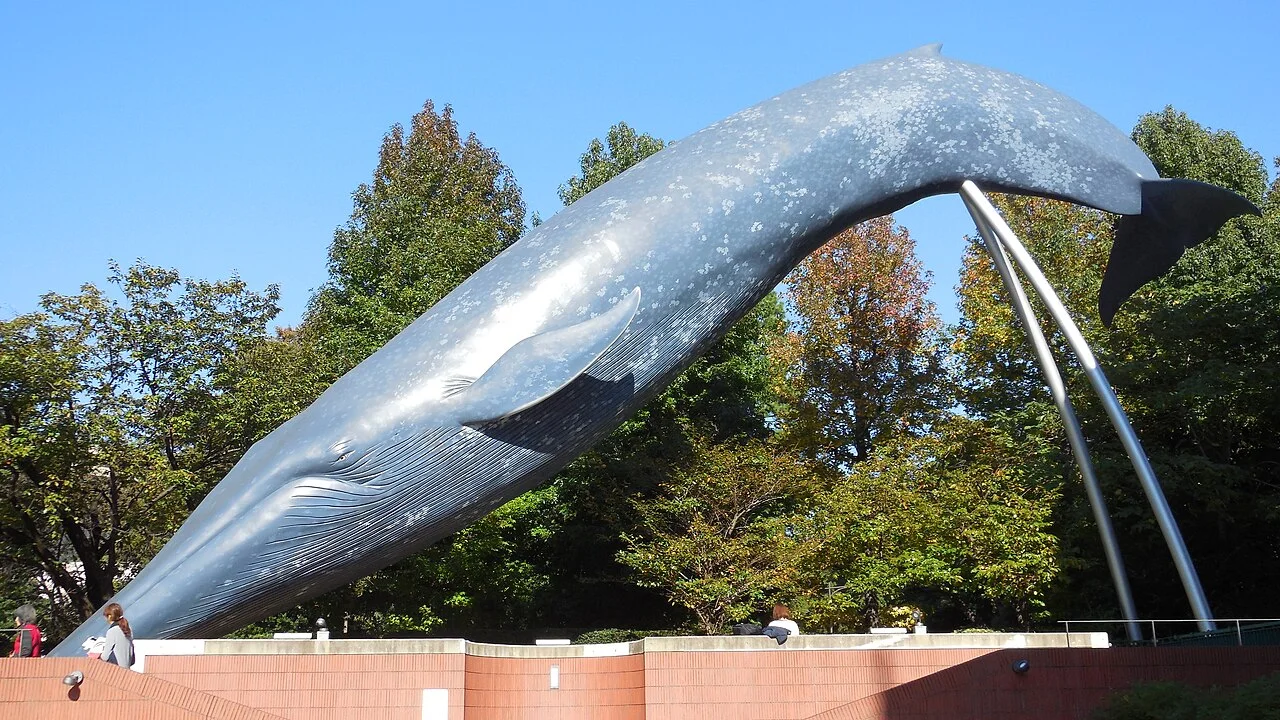
Inside Ueno Park, a 30-meter blue whale lifts its tail toward the treetops while its nose dips inches above the sidewalk. Step past it into the National Museum of Nature and Science, and on the Global Gallery's B1 level you'll find a full T. rex cast skeleton alongside a Triceratops fossil preserved in the pose it was unearthed. For a first family visit, budget about three hours for the dinosaurs, the Japan Gallery's stained-glass dome, and Hachiko, plus either the 360-degree dome theater or the ComPaSS play space. One ticket covers both permanent galleries: ¥630 for adults and university students, and free for high schoolers and younger.
Walking from Ueno Station's Park Exit to the Blue Whale
The main Ueno campus of the National Museum of Nature and Science sits at 7-20 Ueno-koen, Taito-ku, Tokyo. If you arrive by JR, follow signs for the Park Gate (Koen-kaisatsu), which lets you straight out the Park Exit. The museum estimates the walk at about 5 minutes: turn toward the National Museum of Western Art and follow the park path to Kahaku. Ueno Station is huge, and getting from your train car to the fare gates takes a few minutes on its own. If you have a timed slot booked for the ComPaSS exploration room, factor in station navigation, buying permanent exhibition tickets, and heading upstairs to check in.
If you are staying near Asakusa, Ginza, or along the Hibiya Line, Tokyo Metro is just as easy. Both the Ginza and Hibiya lines connect to Exit 7 toward Ueno Park, roughly a 10-minute walk according to the museum. Families with strollers riding the Ginza Line can use the Ueno Park Gate to reach the elevator at Exit 5a. On the Hibiya Line, follow Tokyo Metro's barrier-free map to the dedicated elevator exit at JR Ueno Station Plaza, open 7:30–22:00. Coming from Narita on the Keisei Electric Railway? Keisei Ueno Station's Main Exit (Shomen-guchi) is also about a 10-minute walk. Because the station names sound alike, specify JR or Keisei when texting a meetup spot.
Once you pass the National Museum of Western Art, look for directional signs pointing to the National Museum of Nature and Science or "Kahaku." Ueno Park is also home to the Tokyo National Museum (nicknamed Tohaku), which focuses on art and antiquities. If your group is arriving separately, agree to meet right at Kahaku's permanent exhibition entrance or along the park path beside the blue whale. Texting just "Ueno Museum" can easily leave half your party waiting outside the wrong building.
Outside, the full-scale blue whale tilts across its support frame. Step close to see the pleated grooves along its throat and belly, then back up to take in the curve of the tail. Measuring 30 meters from snout to fluke, the model depicts the largest living animal on Earth mid-dive. Walk your kids along the path from nose to tail so they can pace out its size themselves. For a group photo, step far enough back to fit both ends in frame with passersby or trees for scale—otherwise it's hard to tell later just how massive it really is.
Also displayed outdoors is a D51 steam locomotive. Museum signage notes that this freight engine was built in 1939 and ran until 1975. Train-loving kids can spot the number plate on the front and crouch down to trace the rods linking the giant drive wheels. Because the wheels are stationary, it's easy to follow how power moved from wheel to wheel. If you are rushing to make an entry slot, save the D51 for the walk back to the station rather than doubling back.
Space fans with energy to spare can walk behind the Global Gallery along the JR tracks to see the Lambda rocket launcher, the pad used to send up Japan's first satellite, Ohsumi, in 1970. The museum's outdoor exhibit map marks the locomotive, launcher, and whale together if you need help locating it. In heavy rain, head straight inside first and pick one outdoor exhibit on the way out—dry shoes make standing in front of dinosaur fossils far more pleasant.
| Station | Exit | Museum Walk Estimate |
|---|---|---|
| JR Ueno Station | Park Exit (follow Park Gate signs inside) | About 5 minutes |
| Tokyo Metro Ueno Station | Exit 7 (Ginza and Hibiya lines) | About 10 minutes |
| Keisei Ueno Station | Main Exit (Shomen-guchi) | About 10 minutes |
A 5-minute walk from JR Ueno Station's Park Exit, start with the 30-meter outdoor blue whale before heading to the Global Gallery for a T. rex and real Triceratops fossils. Covers free admission ages, THEATER 36○ queues, ComPaSS bookings, and a half-day family route.
Hours, Free Ages & Three Ticket Types
The permanent exhibitions at the Ueno main campus generally open at 9:00 and close at 17:00, with last entry at 16:30. Regular closure is Monday, shifting to Tuesday or another weekday when a Japanese public holiday falls on Monday—for example, open Monday, November 23, 2026, and closed Tuesday, November 24. Over New Year's, the museum closes from December 28, 2026 through January 1, 2027, reopening on January 2. If you are planning around Japanese holidays in February or March, check the closure days on the museum's official calendar.
A single permanent exhibition ticket covers both the Japan Gallery and the Global Gallery, as well as THEATER 36○. Admission is ¥630 for adults and university students, and free for elementary, junior high, and high school students, as well as younger children. Visitors aged 65 and over or under 18 qualify for free entry by showing age verification at the gate; the museum also extends the youth exemption through the first March 31 after turning 18. Keep any ID for teens or grandparents in the same pouch as your tickets so you aren't digging through a backpack at the entrance.
For two adults and one elementary-school child visiting only the permanent galleries and dome theater, total admission comes to ¥1,260. Add ComPaSS for all three and you'll pay an extra ¥900, bringing the total to ¥2,160. Some families send one parent into ComPaSS with the younger child while the other browses the animal exhibits on the same floor. Agree on a meetup spot for when the session ends—you save one ComPaSS ticket and give everyone a little breathing room.
You can buy permanent exhibition tickets at the window on site or book Asoview e-tickets through the museum's visitor guide page. Ticket windows accept credit cards, transit IC cards such as Suica and PASMO, plus PayPay and Alipay. If only part of your group needs paid tickets, count your paid and free visitors beforehand so you can state the exact breakdown at the counter. If you also booked a timed ComPaSS slot, keep the museum e-ticket and ComPaSS confirmation email open in separate browser tabs for the main gate and the third-floor check-in desk.
From March 13 to June 13, 2027, the museum is staging a 150th-anniversary special exhibition, "Dino Expo 2027," which requires a separate ticket. Still, if your kids mainly want to stand beside a T. rex to gauge its size, the Global Gallery's B1 permanent floor already fills an entire hall under regular admission. Families making a trip specifically for the special exhibition should book via its official ticketing page first and build their permanent dinosaur visit around that entry time.
You don't have to cover every floor to have a great visit. Families aiming for an early timed slot should buy tickets and stash bags in lockers first, leaving the outdoor whale photo for the way out. Arriving in the afternoon means watching the clock: with just over an hour, focus on part of the dinosaur hall plus one Japan Gallery highlight. If THEATER 36○ is a priority, arrive earlier—once the final screening fills up, the line closes. Need to step out for lunch? Stop by the Japan Gallery B1 information desk for a same-day permanent exhibition re-entry pass before heading outside.
| What You Want to See | Fee | How to Enter |
|---|---|---|
| Japan & Global Galleries (Permanent) | ¥630 adults & university students; free for high schoolers & younger | Buy at the gate or online e-ticket via museum site |
| THEATER 36○ Dome | Included with permanent exhibition ticket | All party members present; first-come, first-served line |
| ComPaSS Exploration Space | ¥300 per participant; free for ages 0–1 | Advance timed reservation required for everyone entering |
| Special Exhibitions | Separate ticket per exhibition | Purchase via current exhibition announcement page |
T. rex & Triceratops in Global Gallery B1
Once inside, follow signs for Global Gallery B1F. Kahaku has two B1 levels in separate wings—Japan Gallery B1 houses the theater and service counters, while the dinosaurs live in the other building. The Global Gallery's B1 floor is themed "Exploring the Mysteries of Dinosaurs," arranging specimens around evolutionary clues and body mechanics. Have the adults spot the floor sign first, then let the kids pick one must-see skeleton. After weaving through a few bays, everyone in the family usually ends up with a different favorite bone.
The Tyrannosaurus mount makes it immediately clear how the skull, hind legs, and tail balance into a single frame. The museum's permanent collection database lists both this full-body skeleton and the exploded skull display as casts. To read a T. rex, start at the jaws, then trace back to where the feet plant. Looking head-on shows how wide the bite is; stepping to the side puts skull, legs, and tail in one sweep. Have your kids measure from their own chin to the tip of their nose, then compare that against how much of a T. rex's head is pure mouth.
Triceratops rewards looking in two places at once. The standing full-body mount is a cast—follow its brow horns and frill down to the forelimbs. Nearby sits an in-situ fossil block preserving the bones in their excavated positions, which contains real fossilized material. Challenge kids to match the parts they spotted on the standing cast to the shapes emerging from the rock. By age eight, most kids can explain which features identify a dinosaur on sight—from horns to skull shape—which is far more engaging than memorizing Latin names off placards.
Looking for more real bone? Check out the full Apatosaurus skeleton, which the museum catalogs as containing real fossil material, and point out the domed Pachycephalosaurus skull listed as an original specimen. Standing beside the long-necked, whip-tailed Apatosaurus is the perfect moment to recall the 30-meter blue whale you walked past outside. Sweep your eyes up the neck, down the ribs, and back to the floor label—in seconds you shift from sheer scale to anatomical detail.
To see what dinosaurs chewed all day, find the touchable cast of a Parasaurolophus lower jaw. Hundreds of teeth pack tight into a continuous grinding battery, and the nearby hadrosaur chewing mechanism display lets you picture how the upper and lower jaws locked together. You can also spot a touchable Stegosaurus tail cast on this floor, giving kids who have been staring behind glass a hands-on break. Treating the "touchable" markers as mini checkpoints keeps younger visitors moving.
Further along the permanent route sits a real feather fossil dated to roughly 100 million years ago. Invite kids up to the glass to look for the fine barbs, then compare it with the massive skeletons nearby to talk about what kind of body parts actually survive in stone. Small specimens like this take a quiet pause to notice. If adults want deeper background notes, download the museum's official floor map to your phone beforehand so you can match zone numbers directly on the floor.
If you still have stamina after the dinosaurs, drop down one more level to Global Gallery B2F for the origins and extinction of life, featuring giant ammonites, pterosaurs, and a Columbian mammoth cast skeleton. Short on time? Pick one dinosaur-era neighbor and one creature with a completely different body plan. Note that Global Gallery B3F is closed for renovations from September 8, 2026, so older itineraries that continue down past B2 stop here. Parts of Global Gallery 2F are also closed, and the Mannen Tokei (Myriad-Year Clock) previously on 2F has moved to Japan Gallery 1F.
| Exhibit | Specimen Type | What to Look For |
|---|---|---|
| Tyrannosaurus full skeleton | Cast | Proportions of skull, hind legs, and tail |
| Standing Triceratops | Full-skeleton cast | Horns, neck frill, and four-legged stance |
| Excavated-pose Triceratops | Includes real fossils | Relative bone positions as buried in rock |
| Apatosaurus full skeleton | Includes real fossils | Slender neck paired with a massive torso |
| Parasaurolophus jaw | Touchable cast | Tightly packed teeth forming a grinding surface |
The Japan Gallery Dome, Hachiko & the Myriad-Year Clock
Once you see signs for the Japan Gallery, you've reached the museum's oldest landmark. Completed in 1931 in a Neo-Renaissance style, it reopened as the Japan Gallery after restoration in 2007 and became a National Important Cultural Property the next year. The first-floor central hall is the easiest place to take in the architecture without extra walking: stand still and look up at the white dome and stained glass. After the dark, dramatic lighting of the dinosaur hall, the natural daylight here gives everyone's eyes a welcome rest before heading upstairs.
The central hall is also a handy place to orient yourselves: note which doorway you came through, then spot the entrances to the North and South wings. To find Hachiko, head to Japan Gallery 2F North Wing, in the "Japanese People and Nature" section. The museum database catalogs Hachiko as a taxidermy mount of the Akita dog "Hachi" in the gallery on animals bred in Japan. If you've already seen the bronze statue in Shibuya, coming here lets you study his actual ears, coat, and stance up close and match the statue's familiar silhouette to the real animal.
In the same area, look for the Kai Ken "Kuro" and the Sakhalin Husky "Jiro," who accompanied a Japanese Antarctic expedition. Museum publications note both mounts stand just behind Hachiko. Dog-loving kids can pick two and compare ear angle, tail curl, and overall build to spot how the breeds differ. Looking at them side by side in the 2F cases makes body proportions far clearer than flipping through a dog breed guide.
Leaving the North Wing, drop down to the 1F South Wing for the Mannen Tokei (Myriad-Year Clock). Formerly housed on Global Gallery 2F, it moved near the front of the renovated Japan Gallery South Wing when it reopened on April 21, 2026. This intricate mechanical clock displays multiple dials, paired with a museum video demonstrating how solar terms, lunar phases, and other cycles move together. Have kids find the dial that looks most like a normal home clock first, then investigate the unfamiliar ones alongside nearby traditional Japanese clocks (wadokei), calendars, and surveying tools.
Families more drawn to wildlife can spend extra time in Japan Gallery 2F South Wing or 3F. The 2F South Wing explores how species diverged and adapted across the Japanese archipelago, showcasing island habitats and varying climates. Upstairs on 3F, the focus shifts to the surrounding seas—look for maps of the Kuroshio and Oyashio currents and see how shifting water temperatures change the marine life on display. Even picking just one map and one specimen gives kids something they'll recognize later at the beach, a fish market, or dinner.
Before heading down to the theater, pause at the Foucault pendulum in Japan Gallery B1's central hall. Markings around the base let you track how the swing plane appears to shift over time, demonstrating Earth's rotation. It's a great spot to linger for a minute—if you're waiting while someone uses the restroom or refills water, note the pendulum's position against the scale when you arrive and check it again before leaving. If you're catching a screening, locate the North Wing theater first, knowing you can circle back from the same-floor lounge later.
THEATER 36○: A 6-Minute Film Inside a Sphere
Tucked into Japan Gallery B1 North Wing, THEATER 36○ was relocated from the "Earth Room" pavilion at Expo 2005 Aichi. Step inside a 12.8-meter-diameter sphere onto a central bridge, and seamless projection wraps from overhead all the way beneath your feet. The museum bills it as the first theater of its kind in the world. For kids, the biggest surprise is seeing images move below the walkway—even as the floor shifts into depth beneath you, the bridge stays firmly in place.
Each screening runs one original museum short film lasting roughly six minutes. Shows run from 9:30 to 16:30, capped at 40 people per session on a first-come, first-served basis, and everyone in your group must be present to join the line. Wait time affects your schedule more than the film length itself. If you want to hit the dome in the morning, check the queue and next showtime at Japan Gallery B1 right away rather than trekking back across buildings mid-visit. The month's featured films repeat in rotation, so afternoon visitors can time their crossing around a convenient slot.
Everyone stands on the bridge, no entry or exit is allowed once the film starts, and kids cannot ride on shoulders. Rapid camera sweeps or sudden drops can trigger a floating sensation, so children who dislike the dark, feel uneasy with moving floors, or get motion sick easily may prefer waiting outside with an adult. Let kids choose whether to go in—there is plenty nearby to keep non-riders busy, including the Foucault pendulum, Kujira Cafe, and the B1 lounge, before meeting back up to see Hachiko on 2F.
Lineups rotate monthly. The museum's schedule features deep-sea exploration and submersibles in November 2026, followed by the ocean crossing that brought humans to Japan 30,000 years ago in December. In 2027, January tracks marine food webs, February spotlights dinosaurs, and March explores Japan's rivers. Visiting in February? Check out the Global Gallery fossils first, then watch the dome bring those fossil clues to life. Visiting in December with dinosaur fans? Give them their fill of skeletons first, then head to the sphere to see how ancient voyagers crossed those waters.
To make the theater a shared memory, agree beforehand to stand together and put phones away as soon as you enter—photography, audio recording, and phone use are strictly prohibited inside. Afterward, ask each person to name the single image they remember most and whether it appeared overhead, to the side, or under their feet, piecing the scene back together once you step out.
ComPaSS Reservations, Age Rules & Entry Logistics
If you have kids aged four to six who learn best with their hands, make ComPaSS on Global Gallery 3F a centerpiece of your half-day plan. Formally called "Oyako to Ko no Tanken Hiroba ComPaSS" (Parents and Children Exploration Space), it lets families explore animal specimens side by side. Kids can cross suspension bridges and crawl through tunnels to peek through porthole windows at wildlife mounts from every height, play with magnetic puzzles, feel fur specimens, and flip through picture guides. Elementary kids can enter too, though eight-year-olds eager for dinosaurs may be just as happy sticking to the permanent bone halls.
While designed primarily for ages four to six, reservations are open to children from age 0 through 6th grade, accompanied by at least one adult aged 18 or older. Admission is ¥300 per person for adults and children aged 2 through 6th grade; infants aged 0–1 are free but still require a ticket. Junior high and high school students may join an eligible parent-child group with a ¥300 ticket. Each adult guardian can accompany up to three children, with a maximum of six people per booking—family members who only want the permanent galleries can browse the animal exhibits right outside.
Timed tickets are sold via ART PASS, with the next month's slots opening on the 1st of each month at 12:00 PM JST (meaning December 2026 sessions went on sale November 1 at noon in Japan). Before booking, finalize exactly who is entering—even a baby in a carrier must be counted. After payment, you'll receive an email with a QR code to show on your phone or print out. Because existing orders cannot add or swap ticket counts by age bracket, lock in your headcount before you check out.
Standard daily sessions run at 10:00, 11:00, 13:00, 14:00, and 15:00. Each slot holds 60 visitors for 45 minutes; everyone in your party should check in at Global Gallery 3F five minutes early and remove shoes before entering. Late arrivals still finish at the 45-minute mark. Share the 3F meeting point and QR code with a second adult before leaving your hotel so that if one parent walks ahead with older kids and the other takes the elevator with a stroller, both reach the check-in desk on time.
Already inside the museum? If spots remain, you can still buy same-day tickets by credit card on your phone up to 10 minutes after a session starts, exiting at the scheduled end time. Need to reschedule an existing booking? Open your ART PASS order link—subject to availability, you can change slots free up to five times until 9:00 JST on the morning of your visit. Cancellations are allowed until 23:59 JST the night before for a ¥100 fee per paid ticket. All cutoff times are in Japan Standard Time (JST), so keep the time difference in mind if you are booking from abroad.
Optional workshops run during the 13:00 and 14:00 sessions on Wednesdays, Saturdays, and Sundays. Note that workshops are suspended on December 26–27, 2026 and January 2–3, 2027, though regular ComPaSS play sessions follow whatever slots appear on ART PASS over New Year's. Kids are free to ignore the workshop and keep exploring the specimen zones. Everyone clears out at the end of the 45-minute slot; if parents want to tag-team halfway, send the adult staying until the end inside first while the other takes siblings to another floor.
Didn't snag a ComPaSS slot? Just outside on Global Gallery 3F sits "Life Driving on the Earth," a sweeping permanent hall filled with large wild mammals and birds. To skip stairs and elevators altogether, head toward the biodiversity exhibits on Global Gallery 1F to spot the giant squid and sperm whale skeleton. Walking from whale skeleton to squid lets kids compare how two very different ocean giants propel themselves—and anyone who snapped the outdoor blue whale in the morning can compare its silhouette directly against the sperm whale inside.
Skip Translating Every Sign: Let Kids Pick One Exhibit
Before your visit, let kids open "Kahaku VR" on a phone or computer to preview the 3D galleries and click through intersections. To preview the T. rex, jump to Global Gallery B1 and virtually trace the path from the entrance until the skull comes into view—then follow that exact side in person. Both the Japan Gallery and Global Gallery also have downloadable multilingual floor maps. If anyone in your group doesn't read Japanese, save both maps beforehand so you can pinpoint your location by exhibit and floor number if you split up.
Inside the permanent galleries, you can pull up the free "Kahaku Handy Guide" on your own smartphone or rent a dedicated audio guide or "Kahaku Navi" tablet. Both rental devices typically cost ¥320 in cash only, offer multilingual options, and require ID at pickup, with the tablet also suggesting curated routes. Parents and kids can each listen to whatever catches their eye, then reunite at a specimen and challenge each other to point out one detail nobody else noticed.
Through January 17, 2027, the "Kahaku Monogatari Wagon" puts volunteers on the permanent gallery floors with mobile discovery carts for close-up specimen viewing and touchable models. Scheduled windows are 10:00–10:30, 11:00–11:30, 13:00–13:30, and 14:00–14:30, with drop-in demos lasting about five minutes. Check the boards in Japan Gallery 1F's stairwell hall or the Global Gallery entrance for that day's cart stations. At the dinosaur tooth cart, let kids inspect the tooth shape first and guess what that animal ate.
If a discovery cart looks crowded, browse nearby cases first and loop back. Curious about the Myriad-Year Clock in the Japan Gallery? Look for the wagon covering traditional Japanese clocks (wadokei), where volunteers use models to explain Edo-period timekeeping; over in the Global Gallery, another cart connects the sperm whale skeleton to marine mammals. If you're juggling THEATER 36○ or a ComPaSS slot, just catch whichever cart is along your path—once kids handle a specimen up close, they often spot the same feature again on their own later in the day.
For elementary students who enjoy a scavenger hunt, the museum offers printable worksheets geared toward lower and middle elementary grades, including animal-size prompts in Global Gallery 3F and familiar-animal prompts in Japan Gallery 2F North Wing. Print one sheet ahead of time and summarize any Japanese prompt into a quick spoken question. Or skip writing altogether and simply pause longer at one case—ask your child to find the wildest pair of ears in the room, name which animal wears them, and save drawing them for back at the hotel.
A 3-Hour Family Route Starting From One Must-See
If someone in your group asks where the T. rex is the second you enter the park, start straight at Global Gallery B1. Spend 10 minutes pacing the blue whale from nose to tail outside, then give the dinosaur floor 45 to 60 minutes. When your kids start pointing out plaques on their own, let them lead you around a few neighboring displays rather than pulling them right back for photos. From there, walk over to Japan Gallery B1 to check the THEATER 36○ line and grab water in the lounge, head up to 2F for Hachiko if time allows, and finish under the 1F central hall dome.
Booked for the 11:00 ComPaSS slot? Arrive at Kahaku around 9:15, clear the main entrance, and drop right down to Global Gallery B1. Wrap up around 10:40 and head up to 3F to check in. You'll exit ComPaSS just before noon—perfect timing for lunch at the Global Gallery 2F mezzanine restaurant before touring the Japan Gallery in the afternoon. Saving the Japan Gallery for after lunch gives you flexibility: if your kids linger over one more dinosaur skeleton, simply trim an afternoon wing while still hitting your 10:55 check-in on 3F.
If THEATER 36○ is everyone's top priority, start in the Japan Gallery basement. The first show is at 9:30, so arrive early to gauge the queue. Grandparents eager to see the dome and Hachiko can finish the Japan Gallery in one sweep before crossing to the Global Gallery, cutting out an extra back-and-forth walk. With toddlers who run out of steam fast, build in a snack break inside or narrow the Global Gallery down to just T. rex and Triceratops—slowing down to really see one small fossil beats rushing through extra floors.
For a sit-down meal without leaving the building, head to the Museion restaurant on the Global Gallery 2F mezzanine or Kujira Cafe on Japan Gallery B1; both typically run 10:30–17:00 with last orders 30 minutes before close. Japan Gallery B1 also has a food-friendly lounge with vending machines if you brought your own snacks. Need a quiet spot to feed an infant? Nursing rooms are located at the back of the Japan Gallery B1 lounge near the theater and beside the Global Gallery 3F escalators.
With a stroller, stick to the indoor elevators; the entrance desk also lends out two strollers and two wheelchairs on a first-come basis when available. Coming straight from Narita? Store large suitcases in station lockers or at your hotel first, as oversized luggage isn't permitted inside. If a multi-family group splits up for lunch runs, name exact spots like "Japan Gallery B1 Lounge" or "Global Gallery 3F Escalators" so nobody mixes up identically numbered floors across the two buildings.
On a rainy day, treat the blue whale as a quick visual landmark on your way indoors. The museum notes that the B1 lounge fills up fast when it rains, so eating before or after peak lunch hours works better than hovering for an open table. On sunny days, save the D51 locomotive or blue whale for last before heading into the park for lunch or a stroll—in autumn, you can continue down toward Shinobazu Pond using this Ueno Park walking guide. Pairing Kahaku with Tokyo National Museum on the same day? Pick just one Tohaku building for the afternoon and leave buffer time for rests and the walk between museums.
| Top Priority | Start Here | Where to Go Next |
|---|---|---|
| Dinosaurs & outdoor blue whale | Walk the blue whale path, then head to Global Gallery B1 | Join the THEATER 36○ line or head up to Japan Gallery 2F for Hachiko |
| 11:00 ComPaSS reservation | Tour Global Gallery B1 first; reach Global Gallery 3F by 10:55 | Exit at 11:45, lunch on Global Gallery 2F mezzanine, then Japan Gallery |
| THEATER 36○, dome & Hachiko | Check the THEATER 36○ queue in Japan Gallery B1 upon entry | Stay in Japan Gallery for 1F hall & 2F North Wing, then cross to dinosaurs |
A few useful answers
Do children need to pay for admission at the National Museum of Nature and Science in Ueno?
Permanent exhibition entry is free for high school students and younger, while adults and university students typically pay ¥630. THEATER 36○ is included in permanent admission. ComPaSS requires a separate timed ticket: ¥300 for ages 2 through 6th grade, and free for ages 0–1 (who still need a reservation).
Are the T. rex and Triceratops skeletons real fossils?
In Global Gallery B1, both the full-body Tyrannosaurus skeleton and the standing Triceratops skeleton are casts. However, the nearby excavated-pose Triceratops block contains real fossil material, as does the full Apatosaurus skeleton.
Does THEATER 36○ require advance reservations, and can young kids enter?
No reservation is needed—entry is first-come, first-served in person, capped at 40 people per show, and your entire group must be present in line. Preschoolers must be accompanied by an adult. Everyone stands on the central bridge for about six minutes, and entry or exit isn't permitted once the film starts.
Can an 8-year-old enter ComPaSS, and when do tickets go on sale?
Yes. Children up to 6th grade can enter when booked alongside at least one adult aged 18 or older. Next month's slots go on sale on the 1st of each month at 12:00 PM JST.
Which Ueno Station exit is best with a stroller?
If taking JR to Ueno Station, follow the accessible elevator route inside toward the Park Gate and walk roughly five minutes from the Park Exit. On the Tokyo Metro Ginza Line, take the elevator at Exit 5a; on the Hibiya Line, use the dedicated elevator exit at JR Ueno Station Plaza.
When is the museum closed over the 2026–2027 New Year's holiday?
The Ueno main campus is closed from December 28, 2026 through January 1, 2027. It reopens on January 2, 2027, though ComPaSS workshops are paused on January 2 and 3.
Official information and references
Sources used in this guide.
- National Museum of Nature and Science (Ueno Main Campus) Visitor Information
- National Museum of Nature and Science Opening Calendar
- National Museum of Nature and Science Access & Walking Directions
- JR East Ueno Station Map & Accessible Routes
- Tokyo Metro Ueno Station Accessibility Facilities
- National Museum of Nature and Science Permanent & Outdoor Exhibits
- National Museum of Nature and Science Gallery Guide & Multilingual Floor Maps
- National Museum of Nature and Science Japan Gallery & Global Gallery Floor-by-Floor Maps
- Kahaku Collection Database: Tyrannosaurus Full Skeleton
- Kahaku Collection Database: Excavated-Pose Triceratops
- Kahaku Collection Database: Apatosaurus Full Skeleton
- Kahaku Collection Database: Touchable Parasaurolophus Tooth Row
- Kahaku Collection Database: Hachiko Specimen Record
- Kahaku Magazine milsil Issue 96: Japanese Dogs Feature
- Japan Gallery 1F South Wing Reopening & Mannen Tokei Press Release
- THEATER 36○ Usage Guide & Monthly Screening Schedule
- ComPaSS Exploration Space Session Hours & Workshops
- ComPaSS Admission Fees, Age Rules & ART PASS Booking
- ComPaSS Entry & Ticketing FAQ
- National Museum of Nature and Science Restaurants, Cafe & Lounge
- National Museum of Nature and Science Accessibility & Family Facilities
- National Museum of Nature and Science Winter 2026–2027 Event Bulletin
- ComPaSS Floor Plan, Play Zones & Specimen Guide
- National Museum of Nature and Science Permanent Exhibition 3D VR
- National Museum of Nature and Science Discovery Cart (Wagon) Demo Schedule
- National Museum of Nature and Science Gallery Worksheets