Use Nakamura as your base. Compare Sada Bridge cycle hire, a guided two-bridge ride, three river cruise operators and Kawarakko canoe trips, with lunch and return trains.
- Region & Focus
- ShikokuAttractions
- Reading Scope
- 30 min read · 18 chapters · 5 Q&As
- Official Verification
- 25 official sources checkedUpdated 7 November 2026
- Key Topics
- ItinerariesRail travelFood
Chapter Route Map (tap any stop)
- Stay a night in Nakamura and choose how to spend your time on the river
- Arriving by train: the river is a separate journey from the station
- Which bicycle and which return point? Three different options
- Nakamura to Sada: town streets, willow woods and the bridge
- Ride independently to Sada or join a guided Sada–Misato route
- Save Takase, Katsuma and Ekawasaki for a longer cycling day
- Car-free options in 2026: river bus or a pre-booked taxi
- Sakoya from Sada: a short cruise focused on two low-water bridges
- Shimanto no Ao from Misato: follow the river bend and return to the same pier
- Nattoku at Tadenokawa: tables, chairs and an upstream base
- Canoeing at Kawarakko: meet at the centre; conditions decide the river route
- Choose the boat type first for children and first-time paddlers
- Allow time to change before your afternoon journey
- A cycling day: Sada in the morning, Nakamura in the afternoon
- A cruise day: one bridge, one boat and a river-food lunch
- A canoeing day: stay in Nakamura, paddle in the morning and add a bridge
- Eating at Shimantoya: Yamachi, rather than the Sada bridgehead
- Understand the river ashore: save Gakuyukan for the afternoon
- Quick Q&A
For a day on the Shimanto River, choose your main activity in Nakamura first: cycle along the river to Sada, take a covered boat through its bends, or paddle with an instructor at Tadenokawa. Each has different hire returns, boarding points and meeting times. Arrange the journey back to Nakamura at the same time, then fit lunch and an afternoon stop around it.
Stay a night in Nakamura and choose how to spend your time on the river
Choose a bicycle if you want to stop for bridge photographs or linger on a riverbank. Choose a covered river boat if you are travelling with older relatives and want to stay dry. To paddle yourself, set aside a full half-day for canoeing. From a Nakamura base, one main activity plus a meal or a stop in town makes a comfortable day. A long ride followed by a fixed-time canoe tour leaves less time for rests and the journey to the meeting point. On a first visit, spread those activities over two days.
Find Nakamura Station, Sada, Misato and Tadenokawa on the map first. Sada is the downstream low-water bridge nearest town; Misato is further upstream. Kawarakko and Nattoku are both in Tadenokawa but have separate entrances. Ekawasaki Station in Nishitosa serves another stretch of river, while Kubokawa in Shimanto Town is a different town altogether. Expand the address when a hotel search returns “Shimanto” so your base is on the right side for your activity. With two nights in Nakamura, you can explore town on arrival, spend the next full day by the river and leave on the third day. One night also works: stay before a morning canoe trip or an early river bus, or stay afterwards if you want a relaxed shower and dinner after an afternoon paddle.
Use Nakamura as your base. Compare Sada Bridge cycle hire, a guided two-bridge ride, three river cruise operators and Kawarakko canoe trips, with lunch and return trains.
Arriving by train: the river is a separate journey from the station
Trains from Kochi to Nakamura head into western Kochi Prefecture. The Tosa Kuroshio Railway timetable page for the Nakamura and Sukumo lines links to the current full connecting timetable. Plan Kochi–Nakamura and Nakamura–boarding point as separate journeys. The tourist association and cycle hire are beside Nakamura Station, but boats and canoe trips do not leave from the station entrance. For a day return from Kochi, an afternoon river cruise is easier to reach than an activity with morning registration.
The timetable revised on 14 March 2026 lists return services including Ashizuri 12, leaving Nakamura at 15:13 and reaching Kochi at 17:04, and Ashizuri 14, leaving at 16:42 and arriving at 18:29. Later, Shimanto 4 leaves at 18:47 and arrives at 20:29. Use these to compare an early finish with staying for dinner. If an afternoon activity ends around 15:30, choose a later train. Allow time to change, travel back from Tadenokawa, collect luggage and buy tickets. The 15:13 departure is already too early.
Leave large bags at your accommodation or use the tourist association’s luggage storage during opening hours. Take only what you need to the river. Do not hang luggage from bicycle handlebars: weight affects steering and can unbalance the bicycle when parked. If you leave that afternoon, schedule luggage collection alongside the bicycle return. The ride back from the bridge is only part of that process.
Which bicycle and which return point? Three different options
The Shimanto City Tourist Association’s short-distance hire suits a ride from Nakamura back to Nakamura. Standard city bicycles and mountain bikes cost ¥1,000 for up to five hours or ¥1,500 for 24 hours. From 1 July 2026, electric-assist bicycles cost ¥2,500 for up to five hours and tandems ¥3,000 for the same period; e-bikes cost ¥4,800 for up to five hours. These latter types must be returned by 17:30. Before choosing a frame, check that you can put your feet firmly on the ground and test the brakes.
A separate mountain-bike option allows returns between town hire points. It costs ¥1,200 for up to five hours or ¥1,700 for 24 hours. Locations include the tourist association, New Royal Hotel Shimanto, Nakamura Prince Hotel and Shimanto River Gakuyukan Akitsuio. This lets you finish a town visit at a return point; the tourist association coordinates stock. The network serves the Nakamura area. Do not assume it allows a return in Ekawasaki.
For hire and returns across different stretches of river, use Shimanto River Rinrin Cycle. Its 26-inch mountain bikes require a reservation. Hire costs ¥1,500 for the same day, 08:30–17:00, or ¥2,000 for 24 hours. The seven locations are Ekawasaki Station, Roadside Station Yotte Nishitosa, Canoekan, Shimanto Gakusha, Kawarakko, New Royal Hotel Shimanto and Shimanto City Tourist Association. State the collection point, return point, date and number of riders together so staff can prepare bicycles in the right place.
The two one-way return options sound similar, but use different bicycles and locations. For a shorter child, look first at the short-distance scheme’s 20-inch option rather than Rinrin’s 26-inch-only bikes. A ride all the way down from Ekawasaki needs the long-distance scheme and transport to Ekawasaki. Return electric bicycles to the location and by the deadline stated in the hire agreement.
Nakamura to Sada: town streets, willow woods and the bridge
The tourist association’s published half-day route runs: Tourist Association → Red Iron Bridge → Nyuta Willow Forest → Shimanto River Sakurazutsumi Park → Sada Low-Water Bridge → Ichijo Shrine → Tourist Association. This loop links town and riverbank. Photography, the willow woods and the shrine all involve getting off the bicycle. With a five-hour hire, plan lunch after returning it.
The Red Iron Bridge first shows how Nakamura relates to the river. The riverbank still meets the town; fields and embankments gradually replace shops. At Nyuta Willow Forest, park securely and explore the trees and river beach on foot. It is known for spring rapeseed flowers, while other seasons offer willows, riverside plants and water views. Sakurazutsumi Park is also seasonal scenery, but its paths are useful outside blossom season. Take this stretch slowly and make Sada the morning’s destination, rather than a pin to race towards straight from the station. Return via Ichijo Shrine for a short walk before lunch in town instead of retracing the entire outward route. Park properly before entering the worship area. Anyone who prefers to avoid steps can rest in town. Lunch back in Nakamura lets you return the bicycle first and sit as long as you like without using the five-hour hire period.
Ride independently to Sada or join a guided Sada–Misato route
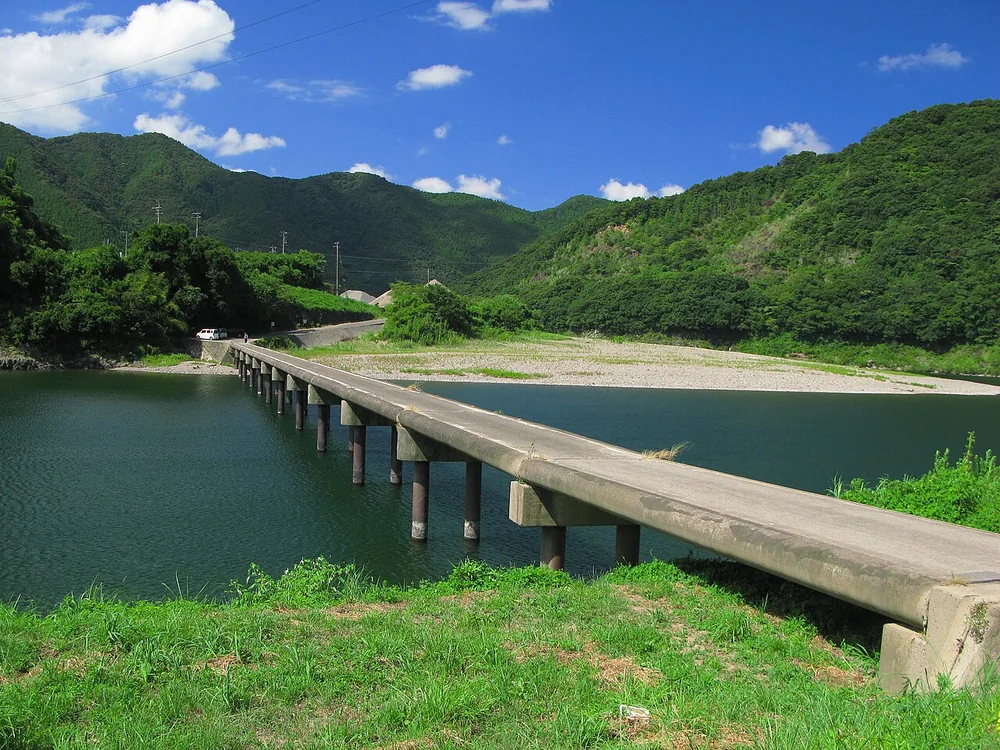
The tourist association’s low-water bridge guide gives cycling times from Nakamura Station of about 40 minutes to Sada and 50 minutes to Misato. Sada, also known as Imanari Bridge, is the furthest downstream low-water bridge on the Shimanto River and is 291.6 metres long. Its long span and broad river setting make a good first overview. Misato is 145.8 metres long, with a different balance between bridge and surrounding hills. Combine it with a river cruise or a guided two-bridge cycle trip.
For an independent ride, follow the Sada loop above via the Red Iron Bridge, Nyuta Willow Forest and Sakurazutsumi Park, then return via Ichijo Shrine. To link Sada and Misato, the tourist association’s guided cycle tour listed by Kochi Prefecture meets at the association at 13:00 and leaves at 13:10. It visits the Red Iron Bridge, Sada and Misato over about 20 km, finishing at 16:00. The ¥5,500 per person price includes guiding, bicycle hire and insurance. It runs with two to six people and must be booked one week ahead. Participants must be at least seven and able to ride a 20-inch bicycle; helmets are available to borrow. Spend the morning in Nakamura and leave the afternoon for the guided ride. The tour is cancelled if the Japan Meteorological Agency forecast issued at 17:00 the previous day predicts rain or a rain probability of 50% or more. It also stops for weather warnings or if the operator judges conditions unsafe.
Low-water bridges have no railings and remain roads used by residents. Dismount at the entrance and push your bicycle across after checking for oncoming vehicles. Stop for photographs where you will not obstruct traffic, and never leave a bicycle sideways across the bridge. There is a river beach downstream on Misato’s left bank; Kochi’s tourism guide lists it as a viewpoint. Choose a riverside spot according to access on the day. Do not climb down from the bridge edge or jump into the river.
Save Takase, Katsuma and Ekawasaki for a longer cycling day
Further upstream are low-water bridges including Takase, Katsuma and Iwama. If long-distance cycling is your priority, connect riverside hire points with Rinrin Cycle, either returning to the same location or riding one way to Nakamura. The operator requires at least four hours for hire and return between Ekawasaki/Canoekan and Nakamura Tourist Association. Add more time for meals, bridges and walks to take photographs.
Riding downstream one way saves backtracking, but it does not remove all the effort. Roads leave the water, bend and rise and fall, and carry other traffic. For a first ride on Japanese roads, a trip with children or slow stops at every bridge, the official Nakamura–Sada half-day loop is a better fit. Use Ekawasaki collection and Nakamura return as a separate full-day activity only if everyone has long-distance experience. Return locations also have closing days. The Ekawasaki Station point and Shimanto Gakusha are normally closed on Wednesdays. Kawarakko is normally closed on Mondays, or the following day after a public holiday, with some summer exceptions. Reserve a return point that is open that day. If you cannot arrive on time, contact Canoekan before 17:00 so the operator can resolve the hire arrangements. Do not lock a bicycle outside a closed location and leave.
Car-free options in 2026: river bus or a pre-booked taxi
The tourist association’s 2026 bus information lists the Shimanto River Bus on Saturdays, Sundays and public holidays from April 2026 to March 2027, with daily service from 25 April to 6 May and from 1 to 31 August. It does not run from 26 December to 3 January. There is one return journey a day between Nakamura and Nishitosa. It suits visitors happy to follow the timetable and watch the river scenery. Boats, paddling activities and meals require separate bookings and payment.
The Nuo-go circular sightseeing bus separately links central Nakamura with Sada. The same page lists day tickets at ¥500 for adults and ¥250 for primary-school-age children and younger, with infants free. Buy from the driver and show the ticket when boarding again that day. This town loop and the river bus towards Ekawasaki serve different destinations and river sections. For Sada followed by lunch in town, start with the circular bus. For a longer riverside journey, study the river bus map and return service.
For a weekday boat trip, or a booking that does not match the bus timetable, a taxi is the most direct option. Give one of the Nakamura taxi operators listed by the association the formal boarding-point name, your accommodation or station, the required arrival time and the return collection point. Arrange both directions. Collection at the same pier after the cruise is easier for the driver to identify. If you plan to walk to the bridge afterwards, arrange a legal waiting place at the bridge entrance instead.
Roadworks also affect recent driving routes to Sada and Misato. The Shimanto no Ao access notice lists a full Sada Tunnel closure from 08:30 to 17:00 between 19 October and 19 November 2026, generally with access on Saturdays and Sundays. Alternating single-lane traffic is planned from 19 November to 10 December. During this period, approach the piers and bridges from Nakamura via National Route 441 and follow diversion signs. Riverside operators remain open. Add the diversion to both driving and taxi journey times; boat departures and canoe registration remain as booked.
An official Shimanto City Tourist Association video introducing the river bus and low-water bridges along its route.
Sakoya from Sada: a short cruise focused on two low-water bridges
Yakatabune Sakoya leaves near Sada Low-Water Bridge and makes a return trip towards Misato, normally lasting about 50 minutes. It costs ¥2,000 for adults of junior-high-school age and above, ¥1,000 for primary school pupils, and nothing for younger children. You can combine a walk by Sada Bridge with the cruise at the same location, without first cycling to an upstream pier. On calm stretches, the boat is rowed with a traditional scull, and the skipper introduces the river from a fisher’s perspective.
Departures are generally on demand with priority for reservations. Request your preferred time by telephone or form. A form submission first receives an acknowledgement; the later confirmation email secures the departure. Arrive at the Sada boarding point ten minutes before departure and pay in cash. The standard cruise excludes lunch; boxed meals are available only for private charters.
The official cancellation rule charges 100% for same-day cancellations or no-shows, and 50% for cancellations notified by the previous day or earlier. Settle passenger numbers and transport before requesting a booking. If combining it with cycling, keep the morning ride within the Sada area and allow time between hire collection and departure to find the entrance. Without bicycles, a return taxi and one cruise make a clear morning plan.
Shimanto no Ao from Misato: follow the river bend and return to the same pier
The Furatto Tanno Course run by Yakatabune Shimanto no Ao boards at 1446 Misato and lasts about 60 minutes. It costs ¥2,000 for junior-high-school-age passengers and above, ¥1,000 for children, with infants free. Listed departures are hourly from 09:00 to 16:00. Walk-ins are accepted, though reservations are useful at busy times. From Misato Pier, the route heads downstream, passes beneath Misato Low-Water Bridge and follows the broad bend towards Sada Low-Water Bridge before turning back. It returns to the original pier, so drivers and taxi passengers need not coordinate two boarding points.
Beyond the bridges, this cruise rewards attention to the river’s curves. Hillsides and views change around each bend, and a bridge looks different as the boat approaches and moves away. If you walked across Sada that morning, you can now sit and watch the banks without standing for every angle. A life jacket is required to go onto the deck while the boat is moving.
For lunch aboard, the meal page lists ayu rice bento at ¥1,320, Ao special bento at ¥1,870 and grilled eel over rice at ¥3,300. Order by 12:00 the previous day; the boat fare is separate. Bento or eel boxes can be added to the standard cruise. The Shimanto gourmet course meal and mini course meal are for private charters only. Without an advance meal order, plan lunch ashore.
Nattoku at Tadenokawa: tables, chairs and an upstream base
The Nattoku scheduled cruise has a cabin with tables and chairs. The journey lasts about 40–50 minutes and costs ¥2,200 for adults and ¥1,100 for primary school pupils, with preschool children free. Contact the operator by telephone or form at least two days ahead. Form bookings become valid after the operator replies by telephone or email. It suits those who want a set time and chair seating. With friends, use the same departure as the group’s meeting time.
The address is 846-1 Tadenokawa; Kawarakko is at number 24 in the same area. Do not confuse their signs. Paste the full operator name and address into a map search. Tell the taxi driver “Yakatabune Nattoku boarding point”, rather than just Tadenokawa. If some people canoe while others cruise, meeting afterwards at an agreed restaurant in town is simpler than trying to synchronise different piers and arrange collection on the spot. This area works best with a car or pre-arranged return transport. For a river bus connection, book the boat around the bus arrival and departure times and use the wait for a rest on the bank. Lunch cruises, coffee and other products are separate options. Start with the meal packages if you want to eat aboard; for river views alone, keep the standard scheduled cruise and eat back in Nakamura.
Canoeing at Kawarakko: meet at the centre; conditions decide the river route
Kawarakko’s river canoe trips have two directions. One starts upstream and returns with the current to Kawarakko, with views of Katsuma Low-Water Bridge. The route downstream from the centre passes Takase Low-Water Bridge and ends a little below Kawanobori Bridge. Both require registration at the centre; do not go directly to Katsuma Bridge to wait for an instructor. The usage rules explain that the upstream trip includes transport to the start, while the downstream trip includes transport back from the finish. Leave your car in the centre’s free car park.
Morning registration closes at 09:00, with the activity from 09:30 to about 12:00. Afternoon registration closes at 12:30, with the activity from 13:00 to about 15:30. These activity times include equipment collection. River conditions determine the actual route, and morning and afternoon trips may follow the same direction. If you want to see a particular bridge, add a separate viewpoint stop on land.
Distinguish transport between the centre and the river start or finish from transport between Nakamura Station and the centre. The operator handles the former as part of the downriver activity. Travellers arrange the latter to reach the meeting point. Book a taxi from Nakamura to the centre at 24 Tadenokawa, and arrange collection there afterwards.
Choose the boat type first for children and first-time paddlers
Kawarakko’s single kayak costs ¥6,000 for adults or ¥5,000 for junior-high-school-age children and younger. Participants must be in Japanese primary school Year 3 or above, or at least 140 cm tall. A tandem kayak costs ¥9,500 for two adults or ¥8,500 for an adult and a child of junior-high-school age or younger. The minimum age is five, and at least one occupant must be an adult. A Canadian canoe takes two or three people: ¥9,500 for two adults or ¥10,500 for two adults and one child. The minimum age is five, with no more than two adults. First work out which craft each child can use, then calculate how many boats your family needs.
The distinction is more than passenger numbers. To paddle independently, everyone must qualify for a single kayak. For younger children sharing with adults, look at a tandem or Canadian canoe. Adults caring for children should not also plan to take individual photographs or split into separate channels. Listen together as the instructor explains stopping, turning and how to cooperate if a problem occurs. Put phones in waterproof cases first. To try paddling without a downriver journey, choose the canoe experience below the centre within the supervisor’s sight. Up to two hours costs ¥2,600 per single kayak or ¥3,600 per tandem or Canadian canoe, including equipment. You remain within the designated area, rather than travelling through changing scenery downstream. It suits time for children to practise and rest ashore. The boats also serve guided groups, so arrange a time with the centre if you need a particular type.
Allow time to change before your afternoon journey
Wear clothes that can get wet and water shoes or other footwear that covers your toes. Bring dry clothes, a towel and drinking water. Leave a full change at the centre, and keep wallets and train tickets secure. If taking a phone aboard, use a secured waterproof case. After collecting equipment, check that it does not interfere with paddling. Kawarakko’s facilities include changing rooms, showers and laundry equipment. Get yourself ready before boarding transport back to Nakamura.
Trips may run in rain, but stop for heavy rain, thunderstorms or unsuitable water levels. The operator charges no cancellation fee for weather cancellations. Pregnant people, anyone who has been drinking alcohol and anyone who does not follow the guide’s instructions cannot participate. These conditions determine who can paddle when you book. Non-participants can choose a boat cruise or somewhere in town.
From October to June, Kawarakko is normally closed on Mondays, moving to Tuesday when Monday is a public holiday. It opens daily from July to September and closes from 29 December to 3 January. Plan around closing days in autumn and winter to use the facilities and activities. After a morning trip, lunch can be on the way back to Nakamura. Eat before registration for an afternoon trip: many restaurants finish serving lunch before you return.
A cycling day: Sada in the morning, Nakamura in the afternoon
Stay in Nakamura the night before and hire a bicycle at the tourist association after breakfast. For the official half-day route, leave around 09:00 and ride via the Red Iron Bridge, Nyuta Willow Forest and Sakurazutsumi Park to Sada. Spend time by the bridge, then return to town for lunch. With a five-hour hire, return the bicycle before lunch or very soon afterwards. This independent version turns back at Sada and leaves time for a full lunch and afternoon visits.
Tailor the afternoon to your companions. For ecology, plan Akitsuio in advance and use a town-scheme mountain bike that can be returned at the museum’s hire point. For town exploring, return a standard bicycle to the tourist association and walk around Ichijo Shrine. A museum drop-off needs separate transport back to the station; there is no need to ride back to the original hire point simply to keep the bicycle. To include both low-water bridges in a cycling day, choose the official afternoon guided tour above. Have breakfast and explore near Ichijo Shrine in Nakamura, then return to the association after lunch for the 13:00 meeting and 16:00 finish. Remove the afternoon museum visit and give the whole period to the roughly 20 km ride.
A cruise day: one bridge, one boat and a river-food lunch
Without a car, choose a morning sailing and book a taxi from your Nakamura accommodation to the pier. For Sakoya, make the Sada bridge area the morning’s focus: walk by the bridge before boarding, or cruise first and walk afterwards. Both stay in the same area. For Shimanto no Ao, go directly to Misato to board. The cruise already includes the stretch looking towards Sada, so spend your time ashore around Misato. First choose an early sailing that can finish around 10:00–11:00. After the cruise, return to Nakamura or go to Shimantoya for lunch, then visit Gakuyukan in the afternoon.
To reduce travel ashore, order a meal on Shimanto no Ao and combine the river and lunch on one sailing. To try more river dishes, take the standard cruise and eat at Shimantoya afterwards, choosing eel, river prawns or gori fish dishes. If someone does not eat fish, plan the meal so everyone at the table has something they can order.
With a car, a cruise that returns to the same pier is easiest. A morning boat trip, lunch and one afternoon museum already fill a day. Watch the sunset near town without driving upstream to Iwama. For a day return by train from Kochi, move the cruise to an early afternoon departure and go directly back to the station afterwards. Omit the afternoon museum; you still have a full experience on the river.
A canoeing day: stay in Nakamura, paddle in the morning and add a bridge
For the morning session, arrive in Nakamura the previous day and prepare breakfast and paddling supplies. Take your booked transport to Kawarakko and register before 09:00. The activity ends around 12:00. Change into dry clothes, have lunch, then choose one bridge viewpoint on land or return towards Nakamura for Gakuyukan. If you paddled towards Katsuma, choose Takase for the afternoon. If the morning route went towards Takase, spend the afternoon at Sada rather than repeating a stretch you already saw from the water.
The afternoon session suits a slower morning. Have breakfast, explore and eat an early lunch in Nakamura, then register at the centre before 12:30. After the activity ends around 15:30, change and return to town. Stay in Nakamura or leave on a later train. Before collecting luggage at the station, allow time to drink and sort out wet footwear. Pack wet clothes separately to keep the vehicle dry and make the onward journey more comfortable.
Drivers leave their car at the centre and use the tour vehicle for the upstream or downstream transfer, then drive away in the afternoon. Without a car, book the return taxi at the centre and keep a phone number for contacting the driver if the activity finishes late. For a morning session, compare River Bus Route C: the 2026 official information lists a 07:50 Nakamura Station departure and 15:00 return, with the activity charged separately. The provisional 2026 timetable lists arrival at Kawarakko at 08:50, with the return bus arriving at 13:08 and departing at 13:10. This can connect with registration before 09:00 and a morning activity ending around 12:00. The afternoon activity ends around 15:30, so use a car or pre-booked taxi. The river bus has already returned to Nakamura Station at 15:00.
Eating at Shimantoya: Yamachi, rather than the Sada bridgehead
Shimantoya is at 2494-1 Yamachi, Shimanto, near National Route 321 towards Ashizuri from Nakamura. It is separate from the upstream bridge route. The menu includes eel rice, the Shimanto River Marugoto set meal, fried river prawns, fried gori fish and green laver tempura. Choose a set meal for several river ingredients, or an eel box or bowl if eel is your priority. Wild eel is limited each day; farmed eel is also available.
Food service starts at 10:00, with last orders at 15:30. It closes on Wednesdays and from 31 December to 2 January; arrangements change when a public holiday falls on Wednesday. The restaurant does not accept reservations, so place it after a morning cruise or canoe trip and drop one sightseeing stop if lunch involves a wait. The upstairs dining area has no lift. For someone unable to use stairs, a meal aboard or another Nakamura restaurant is a better choice. Pets cannot enter, so passengers cruising with pets also need another meal plan. Before afternoon canoeing, do not turn this into a long lunch that starts just before registration. Eat in Nakamura first or save Shimantoya for another day leaving town. It fits a southbound journey.
Understand the river ashore: save Gakuyukan for the afternoon
Shimanto River Gakuyukan Akitsuio, at 8055-5 Gudo, Shimanto, has a dragonfly hall and a fish hall. It links the morning’s river views with wildlife and habitats. The fish hall focuses on Shimanto River fish and also has freshwater and brackish-water species. Outside, observation paths in Shimanto Dragonfly Nature Park pass ponds, plants and insects. Spend longer indoors in rain, then explore the park when the weather suits, without arranging another journey to the riverbank.
The halls open from 09:00 to 17:00 and normally close on Mondays, or the next day when Monday is a public holiday. Daily opening applies during spring holidays, Golden Week, summer holidays and the year-end/New Year period. Admission to the halls is ¥880 for adults, ¥440 for junior and senior high school pupils and ¥330 for children aged four and above. The outdoor park is free. The official site gives a taxi journey of about ten minutes from Nakamura Station; use the same method to return after an afternoon visit. The nature park is a protected area. Collecting any plants or animals is prohibited, including catching and releasing them. Observe and photograph instead. Children who did not get a clear look at fish from the boat have time to find them in the tanks.
A few useful answers
Should I cycle, take a cruise or canoe on a one-day Shimanto River visit?
For cycling and bridges, choose Nakamura–Sada or the official two-bridge guided ride. For seated river views without wet clothes, take a covered boat. To paddle yourself, reserve half a day for Kawarakko. On a first visit, choose one main activity plus lunch and a town or Gakuyukan visit.
Can I return an electric bicycle hired in Nakamura at Ekawasaki?
The tourist association’s short-distance electric bicycles and Rinrin Cycle are different schemes. Reserved 26-inch Rinrin mountain bikes allow hire and return between Nakamura and Ekawasaki. Return a short-distance electric bicycle to the location in its hire agreement.
Does Kawarakko’s transfer include Nakamura Station?
The downriver activity transfer runs between the centre and the river start or finish. Arrange a bus, taxi or car separately for the return journey between Nakamura Station and the meeting point at 24 Tadenokawa.
Can I visit the Shimanto River without a car on a weekday?
Hire a bicycle around Nakamura or pre-book a return taxi to a boat pier. In the 2026 operating year, the river bus and town circular bus mainly run on weekends, public holidays and specified holiday periods.
Can a five-year-old join a canoe trip?
Kawarakko’s downriver tandem kayaks and Canadian canoes list a minimum age of five. A tandem needs at least one adult; a Canadian canoe allows no more than two adults. Single kayaks separately require Japanese primary school Year 3 or above, or a height of at least 140 cm.
Official information and references
Sources used in this guide.
- Shimanto City Tourist Association | Short-distance cycle hire, July 2026 price changes and half-day route
- Canoekan | Rinrin Cycle’s current seven locations, bicycles and hire returns
- Shimanto City Tourist Association | Low-water bridges and journey estimates from Nakamura
- Kochi Tourism | Misato Low-Water Bridge and river beach
- Shimanto City Tourist Association | 2026 river bus and town circular bus
- Shimanto City Tourist Association | Access, taxis and stations
- Shimanto City Tourist Association | Luggage storage and cycle hire
- Tosa Kuroshio Railway | Nakamura and Sukumo line timetables
- Tosa Kuroshio Railway | Connecting timetable revised on 14 March 2026
- Yakatabune Sakoya | Route, fares and reservations
- Shimanto no Ao | Standard cruises and fares
- Shimanto no Ao | Misato–Sada return route
- Shimanto no Ao | Onboard meals and noon booking deadline the previous day
- Shimanto no Ao | Autumn 2026 Sada Tunnel works and Route 441 diversion
- Nattoku | Scheduled cruises
- Nattoku | Booking confirmation process
- Nattoku | Boarding point at 846-1 Tadenokawa
- Kawarakko | River canoeing, craft types and registration
- Kawarakko | River transfers, reservations and weather rules
- Kawarakko | Paddling experience in a fixed area
- Kawarakko | Facilities, changing and closing days
- Shimantoya | Meals, upstairs access and opening hours
- Dragonfly Kingdom | Akitsuio displays, closing days and protected-area rules
- Shimanto City Tourist Association | River bus and official video
- Kochi Prefecture Doppuri Kochi Tabi | Tourist association guided Sada and Misato cycle tour