Travel from Matsuyama to Shimonada on the Yosan Line coast route by matching your return train before picking a sunset slot. Check adult fares, sightseeing train stops and meal vouchers, platform etiquette, and parking.
- Region & Focus
- ShikokuAttractions
- Reading Scope
- 16 min read · 11 chapters · 4 Q&As
- Official Verification
- 19 official sources checkedUpdated 22 November 2026
- Key Topics
- Rail travelItinerariesFirst trip
Chapter Route Map (tap any stop)
- Which ticket to buy from Matsuyama to Shimonada
- Picking trains around your return: how three stay lengths compare
- Starting or connecting via Iyoshi or Ozu instead
- Paying fares when boarding at an unstaffed station
- Seaside views at Shimonada before sunset
- Leaving the platform to passengers when trains arrive and depart
- Driving or hiring a car: decide where the vehicle waits first
- Saving time outside platform limits at Futami Seaside Park
- How the Iyonada Monogatari stops—and which route to book
- Seats, meal vouchers, and rail passes for the sightseeing train
- Putting together a day trip with Matsuyama and Ozu
- Quick Q&A
A local train from JR Matsuyama Station to Shimonada takes around 50 minutes. Taking the 22 November 2026 timetable as an example, a train arrives at 16:34 with a direct return to Matsuyama at 17:08; miss that and the next is at 19:38. Those 34 minutes are enough to take in the sea view and snap a few platform photos. If you want to watch the sun go down, plan on taking the 19:38 return from the start, or save sunset for Futami Seaside Park, which has food, drink, and toilets. As for the Iyonada Monogatari sightseeing limited express that stops at Shimonada, it works best when you treat a stretch of coastal railway as the journey itself, with photo time set by the train's scheduled stop.
Which ticket to buy from Matsuyama to Shimonada
Shimonada Station (S09) sits in Futami-cho, Iyo City, Ehime Prefecture. From central Matsuyama, head into JR Matsuyama Station and board a local train on the Yosan Line coast route (the Ai-aru Iyonada Line) that stops at Shimonada. When checking timetables on your phone, enter "Matsuyama (Ehime)" as your origin and "Shimonada" as your destination, along with the date and time. If you see "Matsuyamashi" or "Matsuyama City Station", double-check your origin—that is Iyotetsu's Matsuyamashi Station. Coming from Dogo Onsen or Okaido, get off the tram at "JR Matsuyama-ekimae" before walking into the railway station, and allow extra time to cross over and buy a ticket.
Heading south, the Yosan Line splits into the coast route and the Uchiko inland route, both rejoining at Iyo-Ozu. At Matsuyama Station you will also see trains bound for Yawatahama or Uwajima, so look for the coast-route indicator or open the list of stops and check for Shimonada. Local services include direct trains as well as connections at Iyoshi. If you need to change, note down the departure time and train type of your onward service so you do not board an Uchiko-bound train at Iyoshi by mistake. The same applies coming from Ozu: look for coast-route trains running via Iyo-Nagahama and Shimonada. The two lines look close on a map between Ozu and Matsuyama, and boarding the wrong one means doubling back to a station where you can switch direction, adding extra travel time both ways.
An adult single fare on a local train from Matsuyama to Shimonada is ¥630, or ¥1,260 for a straightforward return. Buy a paper outbound ticket in Matsuyama and keep coins handy for the return, or ask the Matsuyama Station ticket office to issue all the tickets you need for the day in one go. Shimonada lies outside JR Shikoku's transport IC card area, so do not assume Suica or ICOCA works here as it does in major cities. Travel on a paper ticket from Matsuyama, and when boarding at an unstaffed station follow the on-board instructions to take a numbered boarding ticket (seiriken) or show a valid pass. JR Shikoku's current fare and timetable portal is "My Dia" on JR Odekake Net; before setting off, also open the Train Operation Information page to check service status on the day.
Travel from Matsuyama to Shimonada on the Yosan Line coast route by matching your return train before picking a sunset slot. Check adult fares, sightseeing train stops and meal vouchers, platform etiquette, and parking.
Picking trains around your return: how three stay lengths compare
Write your return time straight after your outbound arrival time and count the minutes in between. On Sunday, 22 November 2026, you can catch the 09:45 local train arriving at Shimonada at 10:34, then return at 11:12 to reach Matsuyama at 12:02—a 38-minute stay that leaves lunch in Matsuyama. To linger longer, take the 13:25 departure instead, which immediately adds more than two hours. Because Shimonada's appeal centres on one small station, whether those extra two hours are worth waiting depends on whether you want to photograph trains, wait for the light, or simply take a brief look at the sea.
In the afternoon, the 15:45 from Matsuyama reaches Shimonada at 16:34, and the 17:08 return gets back to Matsuyama at 18:02—a neat fit if you want late-afternoon light and dinner back in the city. Once you step off, you will need a few minutes to position yourself and queue for boarding, so actual camera time is shorter than 34 minutes. JR Shikoku lists November sunset at Shimonada at roughly 17:00 to 17:20, meaning on days with a slightly later sunset the 17:08 train may arrive before the sun dips. If you want to watch the sky change colour, take the 19:38 train (arriving in Matsuyama at 20:36) and factor in the wait beside the station after dark. Summer sunsets come much later, though the method stays the same: pair that day's sunset time with the departure timetable first.
The last train towards Matsuyama that day leaves Shimonada at 21:40, terminating at Iyoshi at 22:03, where the date-specific timetable shows a 22:09 local connection reaching Matsuyama at 22:26. That six-minute transfer is worth noting as a backup before you set out, though late-evening crowds or any slight delay on the first leg can quickly eat into your margin at Iyoshi. If your ticket only covers you to Iyoshi, you will also have to sort out the onward fare before changing trains; setting your final JR destination at the ticket machine before departure avoids that step. Fixed-schedule accommodation shuttles, trams back to Dogo, and hotel dinner cut-offs all depend on when you reach the final leg, not merely on seeing that "Shimonada still has a train".
You will still find a station PDF on the timetable page showing services effective from March 2025. Use it while sketching an itinerary to gauge how many trains run each day, then verify your exact travel date against JR's date-specific route timetable. In June, concentrated daytime track works on the coast line saw some local trains replaced by rail-replacement buses; if you spot a similar notice, check whether the suspension affects the coast line or the Uchiko line, and whether the replacement bus calls at Shimonada. If the day's return connections do not line up well, treat Shimonada as a brief stop and spend sunset at Futami instead rather than handing an entire afternoon to the gap between two trains.
Waiting time on a timetable spent at Matsuyama Station, Iyoshi Station, or your hotel is easy to fill with a meal nearby, whereas two and a half hours at Shimonada is far harder to put to use. Taking that evening pairing as an example, anyone aiming for the 19:38 return who only wants to see sunset can use a car drop-off to arrive just before dusk instead of waiting from 16:34. If you are travelling strictly by train, keep a windproof layer, water, and a small snack in your bag. In winter, light drops rapidly around 17:00, so travellers with young children or slower mobility will find an earlier return to Matsuyama easier. If a railway delay alert pops up before you leave, recalculate how many minutes you will have left on arrival—anyone who only planned a half-hour window can switch to the next outbound-and-return pair or move Shimonada to the next day. Where the return connection is tight, stay inside Iyoshi Station during the wait.
| Trip style | Outbound (Matsuyama to Shimonada) | Return (Shimonada to Shimonada) |
|---|---|---|
| Short morning stop (38 mins) | 09:45–10:34 | 11:12–12:02 |
| Short dusk stop (34 mins) | 15:45–16:34 | 17:08–18:02 |
| Stay past sunset | 15:45–16:34 | 19:38–20:36 |
Starting or connecting via Iyoshi or Ozu instead
If you are staying in Ozu, board a coast-route local train at JR Iyo-Ozu Station and ride through Iyo-Nagahama to Shimonada. On 22 November, the 10:29 from Iyo-Ozu reaches Shimonada at 11:12; continuing north in the same direction, you can catch the 13:25 train to Matsuyama, arriving at 14:37. To return to Ozu instead, check the opposite direction towards Yawatahama and Iyo-Ozu—that day's 12:34 departure reaches Iyo-Ozu at 13:17, a different service from the Matsuyama continuation. Sketching the directions on paper with one sample day makes it immediately clear which station gives you room to eat, store bags, or step outside.
Starting from Matsuyamashi Station in central Matsuyama, you can also ride the Iyotetsu Gunchu Line to its terminus at Gunchuko and walk across to nearby JR Iyoshi Station to transfer. This route suits travellers already around Matsuyamashi, particularly groups who would rather skip a tram ride. Check timetables under each operator's station name and leave margin for the walk and ticket purchase. If you are heading to Dogo afterwards, factor in the onward tram; if your hotel is near JR Matsuyama Station, a direct JR train usually saves a transfer. Rail pass rules for JR coast-line local trains and ticketing on the Iyotetsu Gunchu Line are separate: Iyotetsu withdrew from ALL SHIKOKU Rail Pass coverage on 7 March 2026. Following the 1 April 2026 fare revision, an adult single between Matsuyamashi and Gunchuko costs ¥520 by paper ticket (¥20 less with a transport IC card), with a separate fare or eligible rail pass required once you switch to JR.
Whenever you alter your outbound train on the spot, re-check your return direction as well. Shimonada appears on Yosan Line timetables in both directions, so it is easier to read the Ozu-bound and Matsuyama-bound sheets separately. A route with a longer transfer is not necessarily worse—especially if you already plan to explore Ozu's castle town—but if your sole aim is a quick photo stop at Shimonada, pairing direct trains both ways cuts waiting time at interchange stations to a minimum.
Paying fares when boarding at an unstaffed station
Shimonada has no ticket window and no left-luggage lockers. Local trains marked for driver-only operation (wanman) leave door and fare handling to the driver. Under JR Shikoku's local-train boarding guide, passengers getting on at an unstaffed station normally use the rear boarding door in the direction of travel. If you do not hold a ticket, take a numbered boarding ticket (seiriken) as you step on; when getting off, follow the on-board signs to the front door to show a valid pass to the driver or drop your seiriken and exact fare into the fare box. The display board at the front of the carriage lists the fare beside each ticket number. On services with a different door layout, follow the train's "Entrance / Exit" signs and announcements.
Keep coins and paper tickets in an outer pocket rather than rummaging through a bag just as the train pulls in and holding up passengers behind you. If you are travelling in a group, hand out everyone's seiriken before arrival so each person can check the fare for their own ticket number. Starting from a staffed station with ticket machines is simplest with a paper ticket bought in advance. If you carry a rail pass or mobile ticket, make sure you can pull up the inspection screen straight away and save the official QR-ticket instructions beforehand. Paying for a single local ride on board differs from having a pass checked, so it is quicker to clarify the procedure at your departure station than to test things at the last second on Shimonada's platform.
If you are based in Matsuyama and making a short stop at Shimonada, leave large suitcases at your hotel or in a locker at JR Matsuyama Station before setting out. Travelling point-to-point between cities, look for luggage storage at Iyo-Ozu or Yawatahama first. Shimonada's narrow platform walkway must stay clear for passengers boarding and alighting, and wheeling heavy suitcases around while taking turns for photos leaves even less room to move. If your goal is watching sunset over the sea with luggage in tow before heading on to the next city, Futami Seaside Park—with parking and toilets—is far easier to manage.
Seaside views at Shimonada before sunset
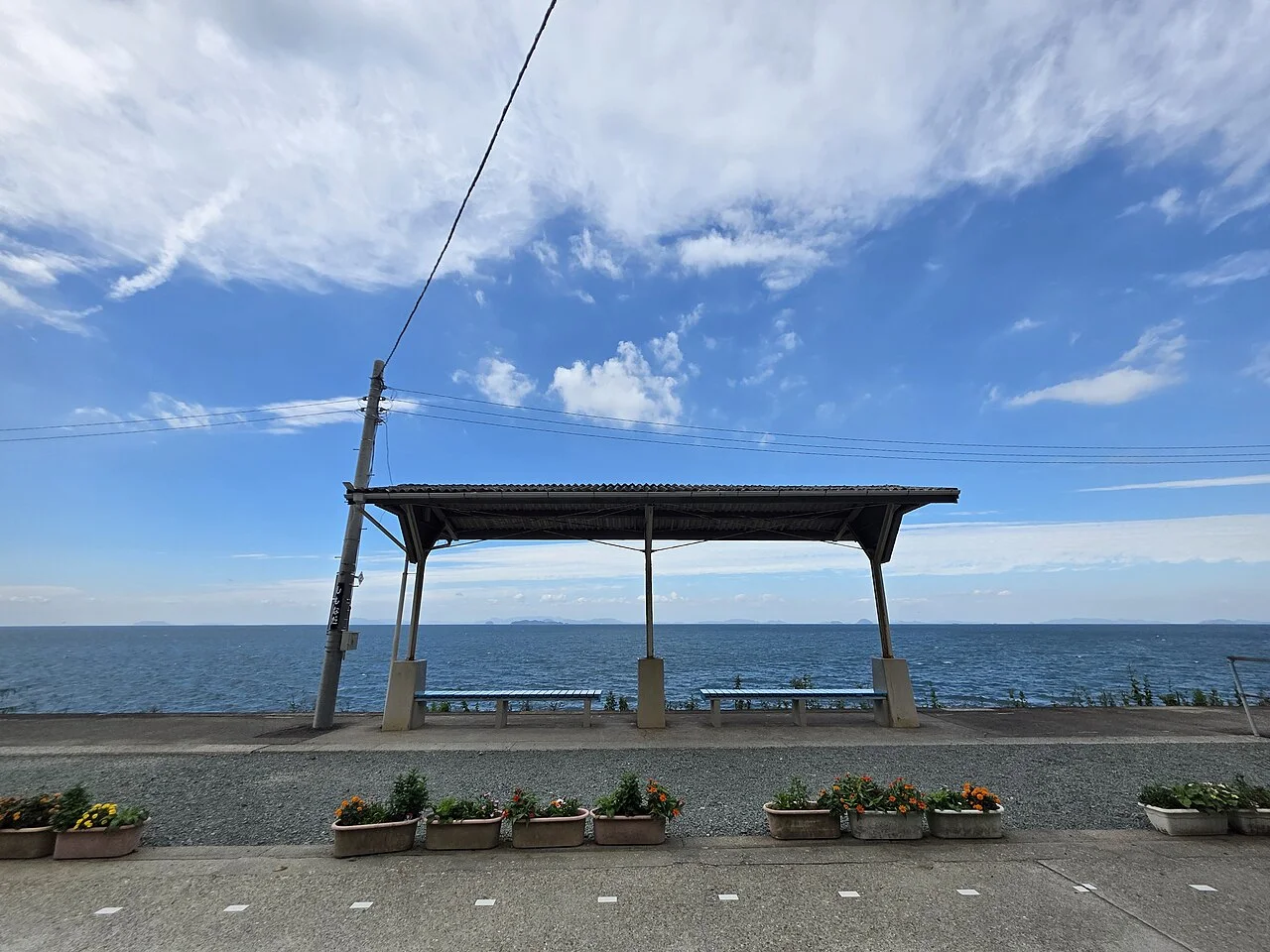
Shimonada's platform sits on the Iyo-nada Sea side, with National Route 378 running between the platform and the shoreline. According to Iyo City, before the highway was built the stop was famed among photographers as "the station closest to the sea in Japan", and it later appeared repeatedly on Seishun 18 Kippu promotional posters. You can still fit the station nameboard, waiting shelter, and horizon into one frame: keep within public walkways and adjust your angle slightly from inside the shelter area to reduce how much of the road enters the shot. Check the sun and cloud cover before framing; tidal changes affect the shoreline below, though they make little difference to the horizon line seen from the platform.
For clear, bright sea colours, pick a daytime train with strong light. Contrast between the shade inside the waiting shelter and glare off the sea can be stark on a phone screen, so leave a bit of the shelter roof and space in wide shots if you may crop to portrait later. For silhouettes, arrive before sunset and dial down your phone's exposure slightly as the sky warms. When photographing companions inside the shelter with the sea behind them, lock exposure on their face first and lift brightness gently. You do not need extra lenses—a phone captures the platform cleanly. With a wide-angle lens, keep the shelter posts vertical and leave breathing room around people near the edges; to highlight the sea beside the station sign, tighten your framing slightly to crop out pillars, glass reflections, and bags on the ground.
JR Shikoku's excursion guide puts sunset around 17:00 to 17:20 in November, 17:00 to 17:15 in December, and 19:10 to 19:30 in June and July—all given as monthly ranges. Start by checking which trains run around that slot on your actual date, then plan your shooting window ahead of sunset. On overcast days, let clouds over the water carry the frame and include the nameboard to anchor the location. When the sea is bright and the shelter dark, lean into silhouettes rather than over-brightening shadows. If you want a single shot with both the train and the station sign, decide your composition and focal length beforehand, step off the platform when trains arrive or depart as requested by staff, and shoot only from permitted public areas.
Leaving the platform to passengers when trains arrive and depart
JR Shikoku sets specific etiquette rules for visiting Shimonada. When a train arrives or departs, anyone not boarding or alighting must step off the platform. Passengers waiting to travel should stand in a safe spot and let doors open before boarding or getting off. Security staff may also be on duty—if you hear instructions, pack away your gear straight away. Once a train pulls out and it is your turn, take your photos and step aside from the nameboard and benches. Right after the doors close, crowds take a moment to clear, so pausing a beat before stepping forward gets in fewer passengers' way.
JR Shikoku also asks visitors not to use tripods or stepladders on the platform and not to use flash towards moving trains. Keep rucksacks and camera gear close to your body, and leave the flowerbeds for the blooms tended by locals. Adjust your own footing rather than stepping onto the tracks, climbing over fences, or sitting on the platform edge with your legs dangling over the rail side. Keep identifiable strangers out of frame, particularly children waiting for trains and staff on duty. With a larger group, taking one group shot works much better than commandeering half the platform for a queue of individual portraits.
Take any food wrappers and empty bottles away with you. If you bring a pet, keep it inside a carrier as soon as you enter station grounds in line with JR Shikoku rules. The Iyonada Monogatari sightseeing train enforces a stricter rule: because meals are served on board, pets are not permitted even inside a dedicated carrier. When travelling with children, pick a safe spot near the waiting area to look out at the sea, and hold hands as you move back into the walkway when a train approaches. If children are walking around on the platform, put the camera down first rather than trying to watch them through a viewfinder.
Driving or hiring a car: decide where the vehicle waits first
Driving along National Route 378 towards Shimonada, set your satnav to the visitor car parks designated by Iyo City. Bays directly in front of Shimonada Station are strictly for pick-ups and drop-offs; even for a quick photo stop, park in the municipal visitor spaces instead. The city-run temporary car park sits 150 to 200 metres west of the station, with 20 free spaces listed on Iyo City's tourism site. The entrance is narrow—follow roadside signs and enter from the Ozu / Nagahama side. If traffic is already backing up when you arrive, driving straight on to the second car park saves more time than waiting on the highway for spaces to clear.
The second option is Shimonada Sports Park (Shimonada Undo Koen) beside the Shimonada Community Centre, where Iyo City normally opens spaces behind the centre and gymnasium, around a 15-minute walk from the station. Spaces may close when events are on at the park. If you are travelling with older relatives or young children, add 30 minutes for the round-trip walk and watch for traffic along the road at dusk. Over the 21–23 November 2026 long weekend, the city closed the temporary car park near the station and directed drivers to the Sports Park instead. Always check Iyo City's latest notice before setting off on an autumn or holiday weekend rather than assuming the closer car park is open.
If using a drop-off vehicle or private hire, agree on the exact pick-up/drop-off spot and return time in advance. For drop-offs only, let the driver pull in according to on-site guidance on the day; if the driver is waiting while you take photos, build a proper parking spot into their route. Let your operator know beforehand if anyone uses a pushchair, wheelchair, or needs step-free access between the drop-off bay and the temporary car park. Anyone needing rail boarding assistance can contact JR Shikoku ahead of travel with exact train times and origin/destination stations so staff can arrange support. If you arrive by train and plan to call a cab back, pre-book your pick-up slot rather than waiting until after the last train has gone. Drivers returning after sunset should note the temporary car park entrance and road junction in daylight, as the walk back involves slopes up and down.
While researching transport, you may come across Iyo City's on-demand shared taxi, "Smile-go", which is restricted to residents of Futami-cho and Nakayama-cho; visitors should book a standard taxi or private hire instead. Road verges near the station have a few wider stretches, including around the Kaminohama-side junction off National Route 378, which Iyo City explicitly marks as no-kerbside-parking zones. If companions are hopping out to shoot while the driver goes to park, agree on a meeting point so the vehicle can clear the drop-off bay straight away. City notices include maps of both car parks and the walking path from the Sports Park—save them to your phone before driving out.
Saving time outside platform limits at Futami Seaside Park
To combine a coastal train ride with a seaside stroll, park at Futami Seaside Park (Michi-no-Eki Futami) and walk roughly five minutes to JR Iyo-Kaminada Station. Shimonada is the very next stop towards Iyo-Nagahama, at ¥480 return for an adult. Pair a neat train connection first: on 22 November 2026, the 16:28 from Iyo-Kaminada reaches Shimonada at 16:34, with the 17:08 return getting back to Iyo-Kaminada at 17:15. You can also explore the beach beforehand, provided you allow enough time to walk back to the station—especially after browsing the shops or queueing for the toilets.
Futami Seaside Park offers a sandy beach, viewing decks, and sea-facing steps, letting you save Shimonada for the station sign and railway while leaving beach time and sunset-watching to the park. If you want somewhere to sit for a while or are looking after toddlers or elderly relatives, the park's seating and lunch options are all in one place. Iyo City's tourism website lists 128 free parking bays and 24-hour toilets, though the western car park towards Nagahama closes from 22:00 to 05:00. Most shops shut around 17:00 and restaurant last orders are earlier still; in winter, eating before sunset is usually far easier than hunting for hot food afterwards.
Iyo-Kaminada and Shimonada are about five kilometres apart by rail. If the gap to the next return train is long, a pre-booked pick-up or heading straight to the park is far more practical than trying to walk along the main road. Families with children can leave time for sand play at the park and spend just one train interval at Shimonada. When the station's nearby car park is closed, starting from the park and taking the train from Iyo-Kaminada also avoids improvised roadside drop-offs.
To split the two stops across the day, ride directly from Matsuyama to Shimonada in the morning, get off at Iyo-Kaminada on the way back for lunch at the park, then buy a fresh ticket onward to Matsuyama. On that same Sunday timetable, the 11:12 from Shimonada arrives at Iyo-Kaminada at 11:18, leaving plenty of time for lunch before the 13:32 local train to Matsuyama (arriving 14:37). Stepping out for lunch at Iyo-Kaminada means buying two separate tickets rather than a single Matsuyama–Shimonada return. Note that park shops close on the third Tuesday of the month (though they advertise normal opening in July and August), so keep lunch in Matsuyama on closed Tuesdays.
How the Iyonada Monogatari stops—and which route to book
Iyonada Monogatari is an all-reserved sightseeing limited express. JR Shikoku's October 2026–March 2027 brochure lists four routes: the Ozu run (Matsuyama to Iyo-Ozu) stops at Shimonada for 11 minutes in the morning; the Futami run (Iyo-Ozu to Matsuyama) stops for 12 minutes at midday; the Yawatahama run (Matsuyama to Yawatahama) pauses for 8 minutes in the afternoon; and the Dogo run (Yawatahama back to Matsuyama) is scheduled to depart Shimonada at 17:40 after an 8-minute stop. The Dogo run terminates at JR Matsuyama Station, so heading on to Dogo Onsen requires a tram or car transfer. Operating dates follow the brochure calendar, and not all four runs operate on every service day.
The stop at Shimonada gives on-board passengers a brief look-out break; standard booking interfaces list Matsuyama, Iyo-Ozu, or Yawatahama as endpoints. If you plan to end your trip at Shimonada with luggage and stay until dusk, book regular local trains instead. To experience the sightseeing train and still photograph Shimonada at leisure, separate the two across the day: for example, ride the morning Ozu run to arrive at Iyo-Ozu at 10:28, explore Ozu's castle town, then take a northbound coast-line local train. On 22 November, leaving Iyo-Ozu at 14:25 puts you at Shimonada at 15:31 ahead of the 17:08 return to Matsuyama—roughly 97 minutes on site. Buy local tickets in two separate legs (Ozu–Shimonada and Shimonada–Matsuyama) so you can exit the station cleanly. You get a first glimpse of the sea during the Ozu run's brief pause, saving relaxed photography, golden-hour light, and walks outside the station for the afternoon.
Fare differences between routes also reflect how you pair your stops. Under fares effective from October 2026 (excluding private compartments and group seating), a one-way seat in Cars 1 or 2 costs ¥4,780 between Matsuyama and Iyo-Ozu and ¥5,130 between Matsuyama and Yawatahama, covering the base fare, limited express charge, and Green Car seat; pre-booked meals cost extra. Buy a local train or other ticket separately for your return leg. To catch the afternoon Dogo run, spend time in Yawatahama first and board its 16:27 departure to reach Matsuyama at 18:30. When connecting from another train, pick one that arrives at Yawatahama comfortably ahead of time: the brochure specifically warns that the Uwakai No. 19 arriving at 16:27 cannot connect onto the Dogo run departing at the same minute.
Seats, meal vouchers, and rail passes for the sightseeing train
Once your dates are fixed, book seats first. On JR West's e5489 system, reservations typically open one month prior at 10:00 JST. Following JR Shikoku's guide, choose the seat-map selection option (Zaseki-hyo kara erabu) to pick specific seats. Standard paper tickets must be collected before boarding from an e5489-compatible counter or reserved-seat ticket machine; if you choose a ticketless sightseeing-train option, arrange your base fare ticket separately and open your mobile ticket as instructed. Popular peak-date Futami midday and Dogo runs sell out fast—if your preferred direction is full, switch to another run or keep Shimonada on local trains and move the sightseeing train to a different day. Collecting tickets takes time, so if you are riding the morning Ozu run, pick them up the day before after arriving in Matsuyama and walk straight to the platform next morning.
Meal vouchers and seat reservations are handled separately. JR Shikoku's on-board dining plans require riding from the route's starting terminal to its final station. Official sales information lists breakfast on the Ozu run and afternoon tea on the Dogo run at ¥3,500 each, and meals on the Futami and Yawatahama runs at ¥6,000 each. Standard meal-voucher sales close four days before travel, while some channels—including JR Shikoku's travel website and telephone bookings—close ten days ahead; counter-issued meal vouchers generally allow changes or refunds up to four days prior. Lock in your full-route seats before buying a meal voucher so you are never stuck with a meal you cannot ride for. If you simply want sea views and the carriage interior, keep your budget to transport and seats.
Travellers holding an ALL SHIKOKU Rail Pass can use it on coast-line local trains to and from Shimonada. To ride the Iyonada Monogatari with a valid pass, JR's FAQs and terms specify purchasing an additional limited express and Green Car ticket beforehand at a JR Midori-no-madoguchi ticket office or JR Shikoku travel agency. A revised pass going on sale from 1 December 2026 adds JR Shikoku limited express ordinary-car reserved seats, though because Iyonada Monogatari is Green Car throughout, separate sightseeing-train supplements still apply. JR Shikoku also offers the "Uchiko & Ozu Town Stroll 1-Day Pass" covering Shimonada at ¥4,000 for adults in FY2026—worth comparing against point-to-point fares only if you plan a full loop from Matsuyama via the coast line to Shimonada and onward to Ozu or Uchiko by eligible ordinary cars in a single day. For a simple Matsuyama–Shimonada return at ¥1,260, standard local tickets remain cheaper.
Putting together a day trip with Matsuyama and Ozu
On a first visit to Ehime with dinner booked in Dogo, a morning local return trip works cleanly: get back to JR Matsuyama Station by midday and head to Matsuyama Castle or Dogo shopping arcade with plenty of flexibility for outdoor sightseeing and an onsen soak. If you want late-afternoon light at Shimonada, visit Matsuyama Castle in the morning and check your real platform window for the afternoon. Where a hotel sets a strict dinner seating, count back from arrival at the accommodation rather than JR Matsuyama Station alone—the 20:36 late arrival only gets you as far as the railway station, with a tram or taxi ride still ahead. Dining near Matsuyama Station or eating in town before heading out to the coast avoids squeezing sunset and a hotel dinner deadline into the same tight window.
Travellers heading from Ozu or Yawatahama towards Matsuyama can slot Shimonada in as a mid-journey stop: eat or store luggage at the previous town, take a Matsuyama-bound coast-line local train, and catch the next departure according to that day's timetable. To add Ozu Castle or Garyu Sanso, give Ozu its own half-day so you can browse the castle town without rushing, then join an afternoon coastal train. If most of your rail travel uses the Uchiko route, riding the coast line in just one direction saves a separate round trip to Shimonada. With family in tow, match each place to the right pace: give children a seated sightseeing-train ride or the single-stop hop from Iyo-Kaminada, and keep unhurried strolling and seated sea views for Futami Seaside Park so Shimonada stays just long enough for photos.
The easiest half-day at Shimonada is a morning round trip; the most time-consuming is chasing sunset by train alone. If you want both, photograph the station in daylight, head to Futami in the afternoon for lunch and a walk, then watch sunset from the seaside steps. That way, even if the platform is busy, you are not stuck queuing behind one station sign—the best part of the afternoon moves down the coast to the very next stop.
A few useful answers
Which train should I take from Matsuyama to Shimonada, and how much is the fare?
Board a local train on the Yosan Line coast route from JR Matsuyama Station that stops at Shimonada. The journey takes around 50 minutes and costs ¥630 one way for adults. Shimonada lies outside JR Shikoku's IC card zone, so buy a paper ticket or pay the cash fare.
How should I plan a return train after sunset at Shimonada?
Line up that day's sunset time with Matsuyama-bound departures first. On 22 November 2026, the 17:08 departure only allows a short stop, with 19:38 as the next direct train to Matsuyama. For a longer wait with toilets and food nearby, watch sunset from Futami Seaside Park instead.
Can I take the Iyonada Monogatari sightseeing train and finish my trip at Shimonada?
No—its stop at Shimonada is a brief viewing pause for through-passengers, with reservations running between Matsuyama, Iyo-Ozu, and Yawatahama. To disembark and stay at Shimonada, use regular coast-line local trains.
Where can I park when driving to Shimonada?
On ordinary days, follow Iyo City's parking map to the municipal temporary car park west of the station, or use Shimonada Sports Park about a 15-minute walk away. Bays directly outside the station are for drop-offs and pick-ups only.
Official information and references
Sources used in this guide.
- JR Shikoku | Shimonada Station & Boarding Etiquette
- JR Shikoku | Shimonada Fares, Sunset Windows & Futami Route
- JR Date-Specific Timetable | Towards Iyo-Ozu (22 November 2026)
- JR Date-Specific Timetable | Towards Matsuyama (22 November 2026)
- JR Shikoku | Local Train Boarding & Payment Diagram
- JR Shikoku | Transport IC Card Coverage Area
- JR Shikoku | Train Operation Information
- JR Shikoku | Coast-Line Maintenance & Replacement Bus Example
- Iyo City | Shimonada Station Location & History
- Iyo City | Two Visitor Car Parks for Shimonada
- Iyo City | Temporary Car Park Closure (21–23 November)
- Iyo City Tourism | Futami Seaside Park Facilities & Hours
- Iyo City | Eligibility for On-Demand Shared Taxi
- JR Shikoku | Iyonada Monogatari Brochure (October 2026–March 2027)
- JR Shikoku | Iyonada Monogatari Seat Reservations & Ticket Pick-Up
- JR Shikoku Travel | Iyonada Monogatari Meal Vouchers & Prices
- JR Shikoku | ALL SHIKOKU Rail Pass Revision (from December 2026)
- JR Shikoku Travel | Uchiko & Ozu Town Stroll 1-Day Pass
- Iyotetsu | Revised Local Railway Fares (from April 2026)