Take the Yosan Coast Line from Matsuyama to Shimonada Station by pairing your return train before picking a sunset slot. Covers adult fares, Iyonada Monogatari stops and meal vouchers, platform etiquette, and parking.
- Region & Focus
- ShikokuAttractions
- Reading Scope
- 16 min read · 11 chapters · 4 Q&As
- Official Verification
- 19 official sources checkedUpdated November 22, 2026
- Key Topics
- Rail travelItinerariesFirst trip
Chapter Route Map (tap any stop)
- Getting from Matsuyama to Shimonada and Which Ticket to Buy
- Plan Around Your Return Train: How Three Stay Lengths Compare
- Starting or Connecting Through Iyoshi or Ozu
- Paying Fares and Boarding at an Unstaffed Station
- Photographing Shimonada Before Sunset
- Platform Etiquette When Trains Arrive and Depart
- Driving or Hiring a Car: Decide Where to Park First
- Build Unhurried Beach Time at Futami Seaside Park
- How the Iyonada Monogatari Stops at Shimonada—and Which Route to Book
- Sightseeing Train Reservations, Meal Vouchers, and Rail Passes
- Pairing Shimonada with Matsuyama and Ozu in One Day
- Quick Q&A
Local trains from JR Matsuyama Station take about 50 minutes to reach Shimonada. Using the November 22, 2026 timetable as an example, an afternoon arrival at 16:34 connects to a direct train back to Matsuyama at 17:08—miss it, and you wait until 19:38. Those 34 minutes work well for taking in the sea and grabbing a few platform photos. If you want to stay through sunset, build your plan around the 19:38 return, or save sunset for Futami Seaside Park, where food and restrooms are on hand. The sightseeing limited express Iyonada Monogatari also stops at Shimonada, making the coastal rail journey the main event, with your photo window limited to the train's scheduled stop.
Getting from Matsuyama to Shimonada and Which Ticket to Buy
Shimonada Station (station code S09) sits in Futami-cho, Iyo City, Ehime Prefecture. From central Matsuyama, head to JR Matsuyama Station and board a local train on the Yosan Line's coastal branch—branded as the Ai-aru Iyonada Line—that stops at Shimonada. When looking up trains on your phone, enter "Matsuyama (Ehime)" as your origin and "Shimonada" as your destination, along with your travel date and time. If you see "Matsuyamashi" or "Matsuyamashi Station," double-check your origin: that's the separate Iyotetsu Railway station, not JR. Coming from Dogo Onsen or Okaido on the streetcar, get off at the "JR Matsuyama Ekimae" stop and walk into the JR station, leaving extra time to reach the platform and buy a ticket.
Heading south from Matsuyama, the Yosan Line splits into two branches—the coastal route and the inland route via Uchiko—before rejoining at Iyo-Ozu. At Matsuyama Station, you'll see trains bound for "Yawatahama" or "Uwajima" on both routes, so look for the coastal line markings or open the stop list to confirm Shimonada is included. Some local trains run direct, while others require a transfer at Iyoshi. If your itinerary has a transfer, note both the departure time and train type of the connecting train so you don't accidentally board an Uchiko-bound service at Iyoshi. The same rule applies coming from Ozu: take a coastal train routed via Iyo-Nagahama and Shimonada. The two branches look close on a map between Ozu and Matsuyama, and taking the wrong one means riding to a junction station to backtrack.
The regular adult local fare between Matsuyama and Shimonada is ¥630 one-way, or ¥1,260 round-trip. Buy a paper outbound ticket in Matsuyama and keep coins handy for the return, or ask the Matsuyama Station ticket counter to issue all the tickets you need for the day at once. Shimonada lies outside JR Shikoku's transit IC card zone, so don't assume Suica or ICOCA will work here the way it does in major cities. Use a paper ticket from Matsuyama, and when boarding at an unstaffed station, follow the onboard instructions to take a numbered boarding ticket (seiriken) or show a valid pass. JR Shikoku's current fare and timetable lookup tool is "My Dia" on JR Odekake Net; check the "Train Operation Information" page before setting out to confirm trains are running normally.
Take the Yosan Coast Line from Matsuyama to Shimonada Station by pairing your return train before picking a sunset slot. Covers adult fares, Iyonada Monogatari stops and meal vouchers, platform etiquette, and parking.
Plan Around Your Return Train: How Three Stay Lengths Compare
Write your return departure right next to your arrival time and count the minutes in between. On Sunday, November 22, 2026, you can take the 09:45 local train arriving at Shimonada at 10:34, then catch the 11:12 return to reach Matsuyama at 12:02—a 38-minute stop that still gets you back in Matsuyama for lunch. Taking the 13:25 return instead adds more than two hours to your stay. Since Shimonada's appeal is centered on one small station, whether those extra two hours are worthwhile depends on whether you're waiting to photograph passing trains, chasing specific light, or just dropping by to see the coast.
In the afternoon, a 15:45 departure from Matsuyama reaches Shimonada at 16:34. Returning on the 17:08 train gets you back to Matsuyama at 18:02, which suits travelers who want late-day light and dinner in the city. Once you factor in stepping off the train and lining up to board the next one, your actual photo window is shorter than 34 minutes. JR Shikoku lists November sunsets at Shimonada between roughly 17:00 and 17:20, so on days when the sun sets toward the later end of that range, the 17:08 train may arrive before the sun is down. To watch the full post-sunset sky shift, aim for the 19:38 departure (arriving in Matsuyama at 20:36) and plan for a long wait beside the station after dark. Summer sunsets run much later, though the math is the same: match that day's sunset time against the timetable first.
The day's final departure toward Matsuyama leaves Shimonada at 21:40 and terminates at Iyoshi at 22:03, where the date-specific timetable shows a 22:09 local connection reaching Matsuyama at 22:26. That transfer leaves only a six-minute margin, so verify your backup plan before heading out. Late-night crowds or even a minor delay on the first leg can squeeze your transfer window at Iyoshi, and if you only bought a ticket as far as Iyoshi, you'll have to sort out the second fare mid-transfer—buying through to your final JR destination at the ticket machine beforehand avoids that extra step. Scheduled hotel shuttles, streetcars back to Dogo, and hotel dinner cutoffs all depend on when you reach your final stop, not simply on whether a train is still leaving Shimonada.
You'll still see station PDF timetables online dated from March 2025. Those are fine for getting a rough sense of daily frequency while planning, but confirm your exact travel date against JR's date-specific route timetable. This past June, daytime track maintenance along the coastal line suspended some local trains in favor of replacement buses—if you spot a similar notice, check whether the disruption affects the coastal branch or the Uchiko branch, and whether replacement buses serve Shimonada. If the return intervals don't line up for your date, treat Shimonada as a quick stop and shift your sunset wait to Futami rather than burning an entire afternoon between two trains.
Wait time built into a schedule is easy to spend in Matsuyama, Iyoshi, or around your hotel, where you can grab a bite nearby; two and a half hours stranded at Shimonada is much harder to fill. In the evening example above, if you plan to take the 19:38 train back and have someone dropping you off, time your arrival just before sunset instead of waiting from 16:34. If you're relying solely on trains, pack a windbreaker, water, and a snack. In winter, light fades fast around 17:00, making an earlier return to Matsuyama easier when traveling with young kids or anyone with limited mobility. If a service alert reports delays before you leave, recalculate how many minutes you'll actually have on the platform—if your original half-hour window shrinks, shift to a later round-trip pair or move Shimonada to the next day. And on tight return transfers, stay inside Iyoshi Station rather than stepping outside between trains.
| Option | Outbound (Matsuyama to Shimonada) | Return (Shimonada to Matsuyama) |
|---|---|---|
| Morning quick stop (38 min) | 09:45 to 10:34 | 11:12 to 12:02 |
| Late-afternoon quick stop (34 min) | 15:45 to 16:34 | 17:08 to 18:02 |
| Stay past sunset | 15:45 to 16:34 | 19:38 to 20:36 |
Starting or Connecting Through Iyoshi or Ozu
If you're staying in Ozu, board a coastal local train at JR Iyo-Ozu Station and ride via Iyo-Nagahama to Shimonada. On November 22, for instance, a train leaves Iyo-Ozu at 10:29 and reaches Shimonada at 11:12; continuing north, you can catch the 13:25 train arriving in Matsuyama at 14:37. If you're heading back to Ozu instead, check southbound departures toward Yawatahama and Iyo-Ozu—that same day, a 12:34 train arrives back at Iyo-Ozu at 13:17, on a different schedule from the northbound Matsuyama run. Sketching the directions out on paper makes it easy to spot which station gives you time to eat, store bags, or step outside.
From downtown Matsuyama's Matsuyamashi Station, another option is riding the Iyotetsu Gunchu Line to its Gunchuko terminus and walking over to nearby JR Iyoshi Station to transfer. That route makes sense if you're already near Matsuyamashi and want to skip an extra streetcar leg. Look up schedules separately under each company's station names and leave buffer time to walk between stations and buy tickets. Factor in the connecting streetcar if your return ends in Dogo; if your hotel is near JR Matsuyama Station, a direct JR train usually saves a transfer. Keep in mind that JR coastal train passes and Iyotetsu Gunchu Line fares are separate: Iyotetsu withdrew from the ALL SHIKOKU Rail Pass on March 7, 2026. Under the fare revision effective April 1, 2026, a one-way adult Iyotetsu ticket from Matsuyamashi to Gunchuko costs ¥520 by paper ticket (¥20 less with a transit IC card), after which you pay the JR fare separately or show an eligible rail pass.
If you swap your outbound train at the last minute, recheck the return schedule in the matching direction too. Shimonada appears on both northbound and southbound Yosan Line timetables, so it helps to pull up the Ozu-bound and Matsuyama-bound schedules separately. A route with a longer layover isn't necessarily worse—especially if you already wanted to stroll Ozu's castle town—but if your main goal is snapping photos at Shimonada, choosing a direct round-trip pair cuts out dead time at transfer stations.
Paying Fares and Boarding at an Unstaffed Station
Shimonada has no ticket counter and no coin lockers. Local trains marked "one-man" (driver-operated) handle both doors and fare collection through the driver. According to JR Shikoku's local train boarding guide, passengers getting on at an unstaffed station generally enter through the rear door relative to the direction of travel. Without a pre-purchased ticket, pull a numbered boarding ticket (seiriken) from the dispenser as you step aboard; when getting off, follow onboard signs to exit through the front door, either showing your pass to the driver or dropping your numbered ticket and exact fare into the farebox. An electronic fare board at the front of the car displays the amount owed by ticket number. On trains with a different door configuration, follow the "Entrance / Exit" signs and onboard announcements.
Keep coins and paper tickets in an outer pocket so you aren't blocking the aisle digging through a bag right before your stop. If you're traveling in a group, hand out everyone's numbered boarding ticket before arriving and check each ticket's fare on the display ahead of time. When starting from a staffed station or one with ticket machines, buying a paper ticket up front is simplest. If you're using a rail pass or mobile ticket, pull up the validation screen ready to show and save the official QR-ticket instructions offline if needed. Regular fare collection and pass inspection work differently on board, so sorting out the rules at your departure station beats trying to figure out a tap reader on Shimonada's platform.
If you're based in Matsuyama and only stopping at Shimonada briefly, leave large bags at your hotel or in a locker at JR Matsuyama Station before setting out. Traveling point-to-point between cities? Plan luggage storage at Iyo-Ozu or Yawatahama instead. Shimonada's narrow platform corridor needs to stay clear for passengers boarding and exiting, and rolling big suitcases around while taking turns for photos eats up everyone's space. If your goal is watching sunset over the water with luggage in tow before moving on, Futami Seaside Park—with parking and restrooms—is far easier to manage.
Photographing Shimonada Before Sunset
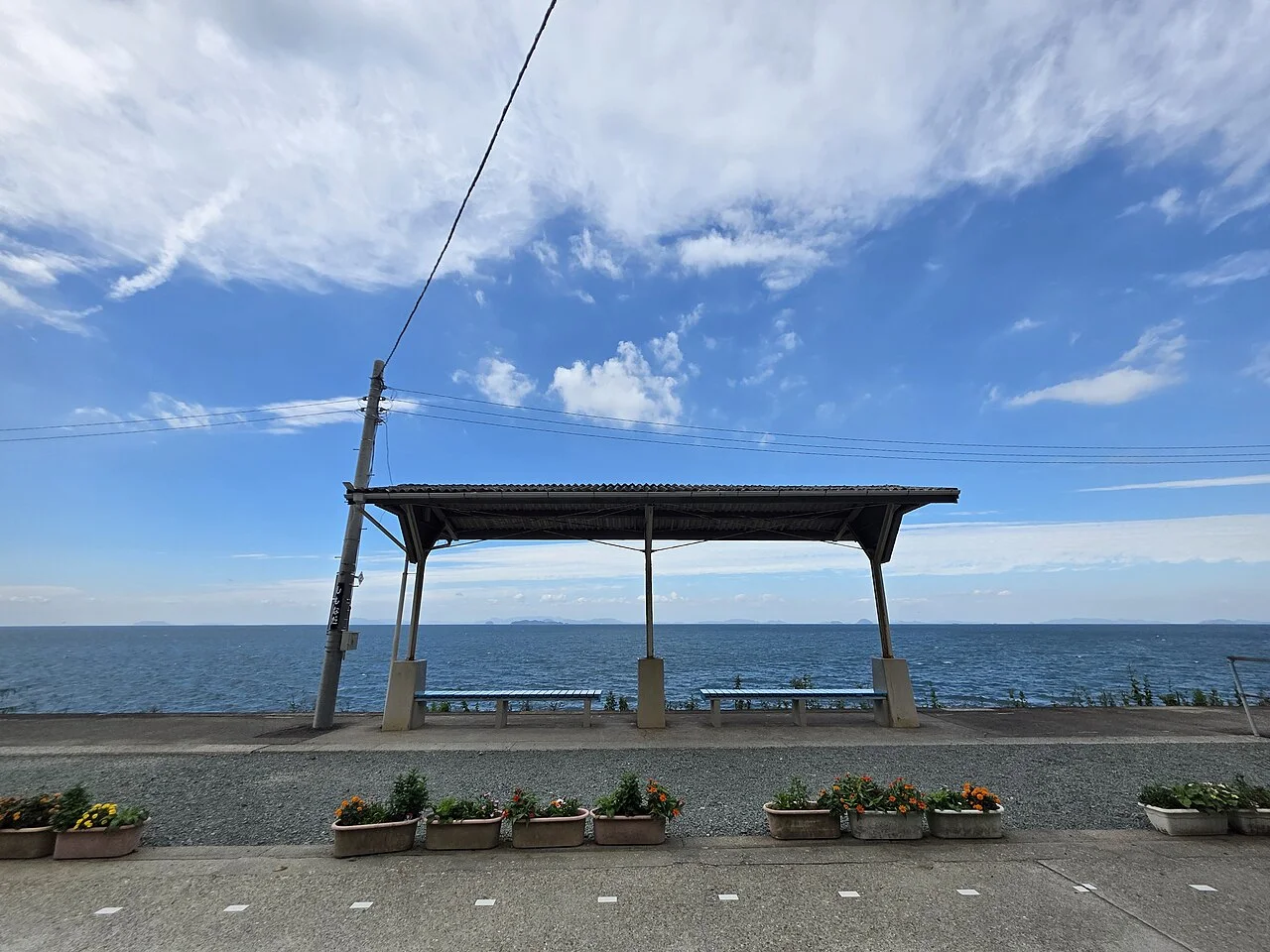
Shimonada's platform faces the Iyo Sea, with National Route 378 running between the tracks and the shoreline. According to Iyo City, before the highway was built the stop was famed among photographers as "the station closest to the sea in Japan," and it has appeared repeatedly on Seishun 18 Kippu promotional posters. You can still frame the station sign, waiting shelter, and sea horizon in a single shot. Stay within public walkways and shift your angle slightly from inside the waiting area to minimize the road below. Check the sun and cloud cover before setting up your shot; while tides change the look of the immediate shoreline, they make little difference to the horizon line seen from the platform.
For clear, bright blue water, pick a midday train with strong daylight. Contrast between the shaded shelter and sun glare off the water can overwhelm a phone sensor, so leave a bit of breathing room around the shelter in wide shots if you plan to crop a vertical frame later. For silhouettes, arrive before sunset and dial phone exposure down slightly as the sky warms. For portraits of travel companions with the sea behind them, have them stand inside the waiting area, tap to meter on their face, and nudge exposure up a touch. You don't need extra lenses—a phone captures the platform clearly. When shooting the shelter wide, keep the support posts close to vertical and leave space between people and the frame edges; to feature the sea beside the station sign cleanly, zoom in slightly to crop out pillars, glass reflections, and bags on the ground.
JR Shikoku's excursion guide lists monthly sunset windows around 17:00 to 17:20 in November, 17:00 to 17:15 in December, and 19:10 to 19:30 in June and July. Those are general monthly ranges, so check the trains running around sunset on your exact date and aim to set up before the sun drops. On overcast days, make the cloud layers over the water the focus, using the station sign to anchor the scene; when the water is bright and the shelter falls into deep shadow, leaning into a silhouette looks far more natural than over-lifting the shadows. If you want both a train and the station sign in one shot, pre-frame your focal length in advance, step off the platform when trains arrive or depart as instructed by rail guidelines, and shoot from designated public areas.
Platform Etiquette When Trains Arrive and Depart
JR Shikoku posts dedicated station etiquette rules for Shimonada. Anyone not boarding or alighting must step off the platform whenever a train arrives or departs, while waiting passengers stand in a safe spot until the doors open. Security staff may also be stationed there during busy periods—pack away your gear promptly if directed. Once the train pulls out, take your photos when it's your turn and step aside so others can use the station sign and benches. Waiting a beat after the doors close lets disembarking riders clear out instead of crowding their path.
JR Shikoku also asks visitors not to use tripods or step stools on the platform, and never to fire a flash at moving trains. Keep backpacks and camera bags close to you, and stay clear of the flower beds tended by locals. Adjust your angle by shifting your own footing—never step onto the tracks, climb over fences, or sit on the platform edge with your legs dangling over the rails. Keep identifiable strangers, especially waiting children and station staff, out of your frame. With a large group, taking smaller cluster shots works better than commandeering half the platform to line everyone up.
Pack out all food wrappers and empty bottles. If you bring a pet to the station grounds, JR Shikoku requires keeping it inside a carrier at all times; note that the Iyonada Monogatari sightseeing train follows stricter rules and does not allow pets aboard even in a carrier because meals are served inside. With young kids, pick a safe spot near the waiting area to look out at the water, hold their hand, and guide them toward the inner walkway as a train approaches. Putting your camera away while children walk along the platform works much better than trying to supervise through a viewfinder.
Driving or Hiring a Car: Decide Where to Park First
Approaching along National Route 378, set your navigation to one of the visitor parking lots designated by Iyo City. The spaces right in front of Shimonada Station are for quick drop-offs and pickups only—even for a brief photo stop, park in the city's visitor lots. The city-run temporary parking lot sits roughly 150 to 200 meters west of the station and offers 20 free spaces according to the Iyo City tourism site. Its entrance is narrow; follow highway signs to enter from the Ozu/Nagahama side. If cars are already backed up when you arrive, drive straight to the alternate lot a few minutes away instead of idling on the highway waiting for a spot to open.
The second option is Shimonada Sports Park, next to the Shimonada Community Center. Iyo City normally opens parking behind the center and gymnasium, about a 15-minute walk from the station, though spaces may close during park events. Factor that 30-minute round-trip walk into your schedule if you're traveling with older adults or kids, and watch for traffic along the road when walking back after dusk. During the November 21–23, 2026 holiday weekend, the city closed the temporary lot near the station and directed drivers to the sports park instead. Check Iyo City's latest notices before traveling on holiday weekends rather than assuming the closer lot will be open.
If you're being dropped off and picked up, agree on the exact pickup spot and return time beforehand. For drop-offs only, have the driver follow on-site traffic guidance; if the driver plans to wait while you take photos, route them to an authorized parking area. Travelers with older companions, strollers, or wheelchairs should ask drivers or operators in advance about the slope between the drop-off zone and temporary lot, as well as station access. Anyone needing boarding assistance on JR trains can contact JR Shikoku ahead of time with exact train numbers and origin/destination stations so staff can coordinate based on day-of operations. If you arrive by train and want a taxi or hired car back, book the pickup window in advance rather than waiting until after the last train leaves. Drivers staying past sunset should take note of the temporary lot's entrance and exit onto the road in daylight—the walk back includes hills.
While researching local transit, you may come across Iyo City's on-demand shared taxi, "Smile-go." City eligibility is restricted to residents of Futami-cho and Nakayama-cho, so visitors should book a regular taxi or private car instead. Even along wider stretches of road near the station—including near the Kamihama-side junction where Route 378 connects to the station approach—Iyo City explicitly prohibits roadside parking. If passengers want to jump out for photos while the driver goes to park, agree on a meeting point so the car clears the drop-off zone right away. Save the city's official driving map for both lots and the walking route from the sports park to your phone before setting out.
Build Unhurried Beach Time at Futami Seaside Park
To combine a coastal train ride with a walk on the beach, park at Futami Seaside Park (Michi-no-Eki Futami) and walk about five minutes to JR Iyo-Kaminada Station. Shimonada is the very next stop toward Iyo-Nagahama, costing ¥480 round-trip for adults. Start by picking a good train pair: on November 22, 2026, a train leaves Iyo-Kaminada at 16:28 and arrives at Shimonada at 16:34, with a 17:08 return back to Iyo-Kaminada at 17:15. Exploring the waterfront before catching the train works well too—just leave enough cushion to walk back from the park, especially after shopping or restroom stops.
Futami Seaside Park offers a sandy beach, viewing decks, and sea-facing steps—save Shimonada for the station sign and tracks, and spend your beach and sunset hours at the park. If you want to sit by the water for a while or are traveling with young kids or older adults, the park keeps seating and lunch options close together. The Iyo City tourism site lists 128 free parking spaces and 24-hour restrooms (the western parking lot toward Nagahama closes from 22:00 to 05:00). Most shops close around 17:00, with restaurant last orders even earlier; in winter, eating first and stepping outside for sunset works far better than hunting for hot food afterward.
Iyo-Kaminada and Shimonada are separated by roughly five kilometers of track, so if there's a long gap until the next return train, relying on a pre-booked pickup or shifting to the park makes far more sense than walking along the highway. With kids, budget sand-play time at the park and keep Shimonada to a single train interval. And if the lot near Shimonada is closed, pairing Futami Seaside Park with a short hop from Iyo-Kaminada avoids scrambling for roadside drop-offs.
If you want to split the two stops without a car, ride straight from Matsuyama to Shimonada in the morning, hop off at Iyo-Kaminada on the way back for lunch at the park, and buy a separate ticket onward to Matsuyama. On that same Sunday timetable, the 11:12 train from Shimonada reaches Iyo-Kaminada at 11:18, leaving plenty of time for lunch before a 13:32 local back to Matsuyama arriving at 14:37. Stepping out at Iyo-Kaminada requires point-to-point tickets rather than a single cheapest Matsuyama–Shimonada round-trip. Keep in mind that park shops normally close on the third Tuesday of the month (aside from July and August, when they are listed as staying open), so plan lunch in Matsuyama on that day.
How the Iyonada Monogatari Stops at Shimonada—and Which Route to Book
The Iyonada Monogatari is an all-reserved sightseeing limited express. Its official October 2026–March 2027 brochure lists four directional runs: the Ozu Hen (Matsuyama to Iyo-Ozu), which stops at Shimonada for 11 minutes in the morning; the Futami Hen (Iyo-Ozu to Matsuyama), stopping for 12 minutes around midday; the Yawatahama Hen (Matsuyama to Yawatahama), stopping for 8 minutes in the afternoon; and the Dogo Hen (Yawatahama to Matsuyama), scheduled to stop for 8 minutes and depart Shimonada at 17:40. Note that the Dogo Hen terminates at JR Matsuyama Station, so reaching Dogo Onsen still requires a streetcar or car transfer. Operating days follow the brochure's calendar, and only select runs operate on certain dates.
The Shimonada stop is strictly a brief scenic pause for onboard passengers; standard booking screens only sell origin-destination pairs between Matsuyama, Iyo-Ozu, and Yawatahama. If you want to get off with luggage and linger until evening, book a regular local train instead. To ride the sightseeing train once and still take unhurried photos at Shimonada, split the two into separate legs. For example, ride the morning Ozu Hen into Iyo-Ozu at 10:28, explore Ozu's castle town, and catch a coastal local north later: on November 22, departing Iyo-Ozu at 14:25 puts you at Shimonada at 15:31 ahead of the 17:08 return to Matsuyama, giving you roughly 97 minutes at the station. Buy separate local tickets for Ozu–Shimonada and Shimonada–Matsuyama so you can exit the station cleanly. You get a first glimpse of the water during the Ozu Hen stop, then save your unhurried shooting and sunset light for the afternoon.
Pricing also varies by route. Under fares effective October 2026 (excluding private compartments and group seating), standard seats in Cars 1 and 2 cost ¥4,780 one-way between Matsuyama and Iyo-Ozu, and ¥5,130 between Matsuyama and Yawatahama, combining base fare, limited express charge, and Green Car seat fee—pre-booked meals cost extra. You'll buy a separate local or regular train ticket for the other leg. To ride the afternoon Dogo Hen, spend time in Yawatahama first and board the 16:27 departure arriving back in Matsuyama at 18:30. If connecting from another train into Yawatahama, pick an earlier arrival: the brochure explicitly notes that the Uwakai No. 19, arriving at 16:27, cannot connect to the Dogo Hen departing at that exact same minute.
Sightseeing Train Reservations, Meal Vouchers, and Rail Passes
Once your date is set, book seats first. Sales on JR West's e5489 system generally open one month prior to travel at 10:00 JST. Following JR Shikoku's booking instructions, pick the seat-map option to select your exact seat. Paper tickets can be picked up before boarding at e5489-compatible counters or reserved-seat ticket machines; if you book a ticketless sightseeing plan, arrange your base fare ticket separately and follow the service's instructions to display your mobile ticket. The midday Futami Hen and sunset-timed Dogo Hen are especially competitive on busy dates—if your first choice sells out, try another direction or move the sightseeing ride to a different day while keeping your local-train photo visit. Ticket pickup takes time, so if you're catching the morning Ozu Hen, collect your physical tickets the evening before in Matsuyama so you can walk straight to the platform from your hotel.
Meal vouchers are booked separately from train seats, and JR Shikoku's onboard meal plans require riding the full route from terminus to terminus for that run. Official sales listings set breakfast on the Ozu Hen and afternoon tea on the Dogo Hen at ¥3,500 each, and meals on the Futami Hen and Yawatahama Hen at ¥6,000 each. Standard meal voucher bookings close four days before departure, though some channels cut off earlier—JR Shikoku Travel's website and phone bookings close ten days prior. Changes or refunds on counter-issued meal vouchers are typically allowed up to four days before travel. Secure your full-route seat reservation before buying a meal voucher so you don't end up holding a meal ticket without a matching seat. If you mainly want the ocean views and train interior, skip the meal and keep your budget for the fare and seat fee.
Travelers with an ALL SHIKOKU Rail Pass can ride coastal local trains to and from Shimonada on the pass. If you want to ride the Iyonada Monogatari with a valid rail pass, JR's FAQs and terms explain that you must purchase the separate limited express and Green Car supplements in advance at a JR Midori-no-Madoguchi ticket office or JR Shikoku travel agency. Even with the updated pass version going on sale December 1, 2026—which adds reserved standard-car seats on JR Shikoku limited express trains—the Iyonada Monogatari is an all-Green-Car train and still requires those extra tickets. JR Shikoku also sells the Uchiko and Ozu Town Stroll 1-Day Pass covering Shimonada for ¥4,000 per adult in FY2026, though it only pays off if you're riding from Matsuyama via the coast to Shimonada and continuing on to Ozu or Uchiko on eligible ordinary-car services in a single day. For a simple Matsuyama–Shimonada round-trip at ¥1,260, regular tickets are cheaper.
Pairing Shimonada with Matsuyama and Ozu in One Day
If it's your first trip to Ehime and you have dinner plans in Dogo, take the morning local round-trip. Returning to JR Matsuyama Station around noon leaves plenty of flexibility for Matsuyama Castle, the Dogo shopping arcade, and an evening soak. If you want late-day light at Shimonada, visit Matsuyama Castle in the morning and calculate your exact usable platform time for the afternoon. When your hotel enforces strict dinner seating times, work backward from when you'll actually reach the hotel—that 20:36 direct train only drops you at JR Matsuyama Station, with a streetcar ride still ahead. Eating near Matsuyama Station or having an early meal downtown before heading to the coast avoids trying to squeeze both sunset and a hotel dinner into an impossible gap.
If you're traveling between Ozu or Yawatahama and Matsuyama, Shimonada works well as an en-route stop. Eat or stash bags at your starting town, catch a Matsuyama-bound coastal local, and connect onward on the next scheduled train. To include Ozu Castle or Garyu Sanso Villa, give Ozu a dedicated half-day so you can browse the castle town at a relaxed pace before catching an afternoon coastal train. Even if your main transit runs along the inland Uchiko route, riding the coastal branch in just one direction saves you a separate round-trip out to Shimonada. Clarifying what Shimonada is for also helps when traveling as a family: for kids, pick a reserved seat on the sightseeing train or take the one-stop hop from Iyo-Kaminada; for older relatives who want to sit and watch the sea, save the slow strolling and rest breaks for Futami Seaside Park and keep the station stop just long enough for photos.
The easiest half-day at Shimonada is a morning round-trip, while chasing sunset eats up the most time. If you want both, shoot the station in good daylight earlier on, then shift to Futami in the afternoon for lunch, a walk, and sunset from the sea-facing steps—that way, even if the platform is crowded, you aren't stuck waiting behind everyone at the same station sign when the next stop down the coast gives you room to spread out.
A few useful answers
Which train goes from Matsuyama to Shimonada, and how much is the fare?
Board a local train from JR Matsuyama Station via the Yosan Line's coastal branch that lists Shimonada as a stop. The ride takes about 50 minutes and costs ¥630 one-way for adults. Shimonada is outside JR Shikoku's transit IC card area, so use a paper ticket or pay the cash fare on board.
How should I plan my return train if I stay for sunset at Shimonada?
Compare sunset time on your travel date against Matsuyama-bound departures first. On November 22, 2026, for example, a 17:08 train gives you a short stop, while the next direct return to Matsuyama isn't until 19:38. If you want restrooms and food nearby while waiting out sunset, go to Futami Seaside Park instead.
Can I take the Iyonada Monogatari sightseeing train and end my trip at Shimonada?
No—the sightseeing train's stop at Shimonada is only a brief scenic pause for ticketed riders, and reservations run between Matsuyama, Iyo-Ozu, and Yawatahama. To stop and stay at Shimonada on your own schedule, take a coastal local train.
Where should I park if driving to Shimonada?
On regular days, follow Iyo City's parking map to the city-run temporary lot just west of the station, or use Shimonada Sports Park about a 15-minute walk away. Spaces directly in front of the station are for quick drop-offs and pickups only.
Official information and references
Sources used in this guide.
- JR Shikoku: Shimonada Station & Boarding Etiquette
- JR Shikoku: Shimonada Fares, Sunset Windows & Futami Route
- JR Date-Specific Timetable: Toward Iyo-Ozu (November 22, 2026)
- JR Date-Specific Timetable: Toward Matsuyama (November 22, 2026)
- JR Shikoku: How to Board and Pay on Local Trains
- JR Shikoku: Transit IC Card Coverage Area
- JR Shikoku: Train Operation Information
- JR Shikoku: Coastal Line Maintenance & Replacement Bus Notice
- Iyo City: Shimonada Station Location & History
- Iyo City: Two Visitor Parking Lots for Shimonada
- Iyo City: Temporary Parking Lot Closure (November 21–23)
- Iyo City Tourism: Futami Seaside Park Facilities & Hours
- Iyo City: On-Demand Shared Taxi Eligibility
- JR Shikoku: Iyonada Monogatari Brochure (October 2026–March 2027)
- JR Shikoku: Iyonada Monogatari Reservations & Ticket Pickup
- JR Shikoku Travel: Iyonada Monogatari Meal Vouchers & Pricing
- JR Shikoku: ALL SHIKOKU Rail Pass Revision (Effective December 1, 2026)
- JR Shikoku Travel: Uchiko & Ozu Town Stroll 1-Day Pass
- Iyotetsu: Revised Local Fares Effective April 2026