Take route Ku 4 from New Chitose Airport or Chitose Station to Shikotsuko Onsen. Use the 2026 bus timetable to plan the shore, Yamasen Bridge, visitor centre and sightseeing boat, with return times, luggage and Kyukamura stays.
- Region & Focus
- HokkaidoSide trips
- Reading Scope
- 30 min read · 17 chapters · 7 Q&As
- Official Verification
- 18 official sources checkedUpdated 9 November 2026
- Key Topics
- ItinerariesRail travelSeasons
Chapter Route Map (tap any stop)
- Can you visit on arrival day? Start with the bus you can reach
- Airport stops: domestic 28 or 1, international 85; look for 空4 to Shikotsuko
- Save both directions: weekend extras do not run on weekdays
- From Sapporo, change at Chitose Station rather than the airport
- Where you leave the case decides whether you return to the airport or Chitose
- A short lakeside route: bus stop, visitor centre, pier and shore
- Yamasen Bridge: pause where the lake flows into the Chitose River
- Use the visitor centre for landforms, fish and rain shelter, not just a map
- Choose one water activity: a 30-minute sightseeing boat with same-day individual tickets
- A 3-hour-13-minute afternoon: fit lunch and the sailing first
- Find the Shikotsuko return stop first: the current last bus is 17:45
- Late autumn and winter change the activities and indoor time
- Children, pushchairs and wheelchairs: start with the short lakeside route
- Half-day costs: separate transport, boat and food
- A night at Kyukamura Shikotsuko gives time for forest and morning
- Save meals, transfer and cancellation deadlines with the overnight booking
- Linking the Hokkaido trip: give Shikotsu a day, with Sapporo and Toya separately
- Quick Q&A
The bus from New Chitose Airport reaches Lake Shikotsu in about an hour. The gaps between services determine what fits into half a day. On weekdays, an 11:35 airport departure, 12:32 lake arrival and 15:45 return leave 3 hours 13 minutes for lunch, the red bridge and one activity. In late October, the last sightseeing boat leaves at 15:30, so the 14:30 airport bus suits a shore walk instead. Choose a bus you can reach, then fit luggage, walking and the return to the city into the afternoon.
Can you visit on arrival day? Start with the bus you can reach
New Chitose Airport and JR Chitose Station are the most convenient starting points for Lake Shikotsu without a car. For a first visit returning to the city that evening, choose a combination reaching the shore around midday and leaving in the afternoon. A walk and one activity in the same area are enough for an afternoon with lake views. After landing, complete immigration, bag collection and storage, then choose by the time you can actually reach the bus stop. The flight’s arrival time is only the start of that process.
The current timetable checked on 27 October 2026 gives a weekday departure from domestic terminal stop 28 at 11:35 and arrival at Shikotsuko at 12:32. Returning at 15:45 gives 3 hours 13 minutes by the lake. This suits lunch, a bridge walk and a boat according to that day’s sailings. If you can only catch the 14:30 bus, arrival is 15:27: choose walking or a pre-booked accommodation transfer.
For the sightseeing boat in late October, work backwards from its sailing time. From 16 October to 3 November, the last boat leaves at 15:30. The 14:30 airport bus arrives just three minutes earlier, before you have alighted, walked to the pier or bought a ticket. It is unsuitable for a trip centred on the boat. If you only want the lake, bridge and a seated rest, there is no need to come a full bus earlier for a boat ticket. Choose your priority first.
On a departure day with a flight, I would put Lake Shikotsu on another day. Gaps between scheduled buses are several hours; after missing one, the next may be too late for airline formalities. With an evening flight already planned, calculate the full time to reach the airport, collect bags and walk to the airline counter. If no other workable fallback remains, spend the final half-day at the airport.
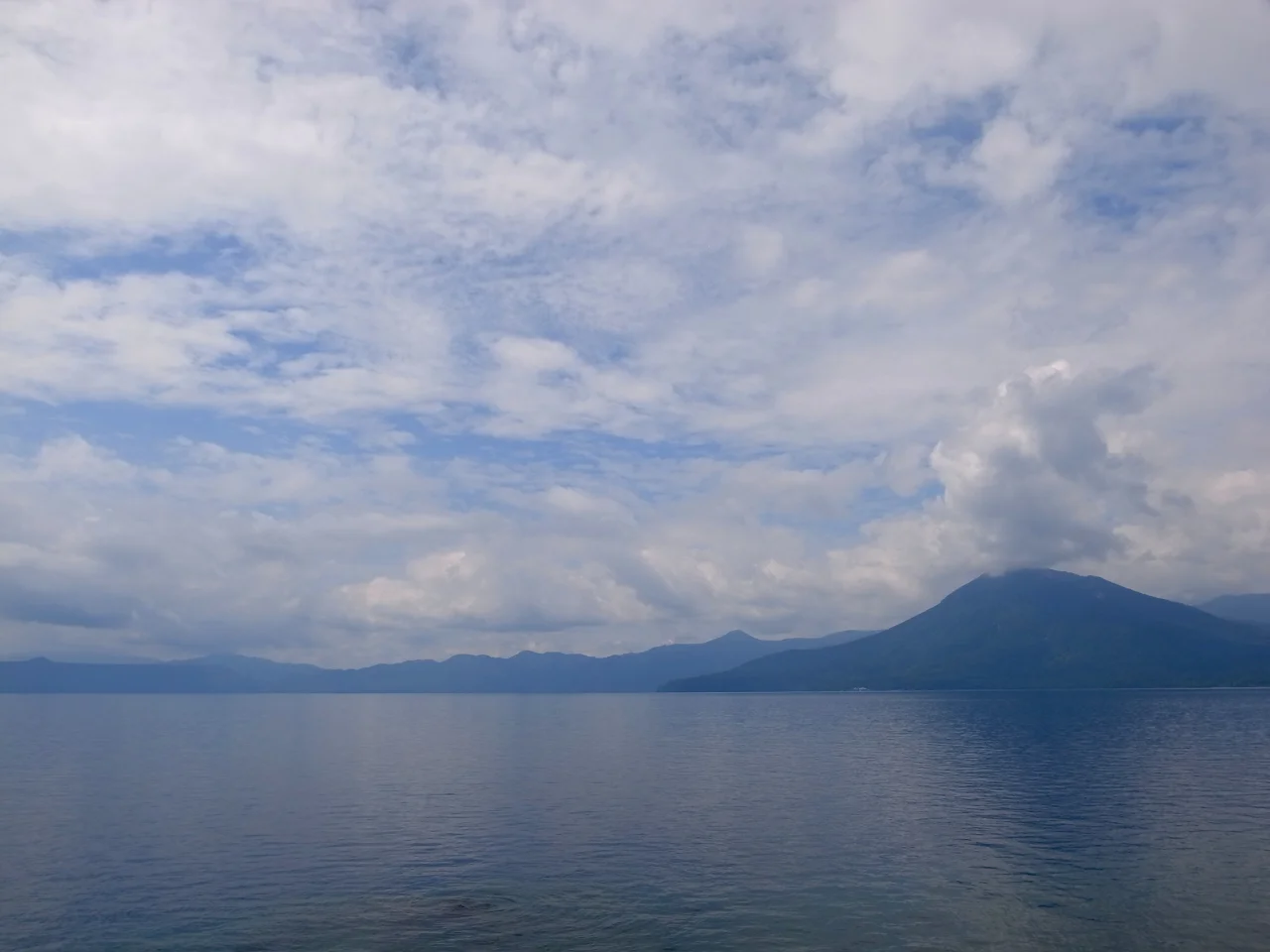
Take route Ku 4 from New Chitose Airport or Chitose Station to Shikotsuko Onsen. Use the 2026 bus timetable to plan the shore, Yamasen Bridge, visitor centre and sightseeing boat, with return times, luggage and Kyukamura stays.
Airport stops: domestic 28 or 1, international 85; look for 空4 to Shikotsuko
The visitor centre’s access page lists domestic terminal stops 28 or 1 and international terminal stop 85. The same bus calls at the two domestic stops one minute apart, then at the international terminal three minutes later. The table below uses domestic stop 28 throughout. From the international terminal, the 11:35 service calls at stop 85 at 11:39. Use your own stop rather than crossing terminals to match the table. Lake Shikotsu Visitor Centre: access.
Check both the route code 空4 and destination Shikotsuko. Route 空5 goes to Shinsei and 空6 to Honcho 2-chome. They share part of the route but do not continue to the lake. A busy airport timetable can make lake services look more frequent than they are. Read whether the Shikotsuko row has an arrival time. Boarding a city-only service and trying to connect later adds another change and wait.
The current 2026 PDF lists an adult airport–lake single fare of ¥1,260. Before boarding, ask the driver about luggage placement, payment equipment and any assistance needed. Prepare the fare so that the group and bags can board and alight together. Do not assume a JR ticket includes the bus. Record transport costs separately.
Save the official PDF’s weekday or weekend page and your intended stop names. At the stop, check temporary notices and the destination on the vehicle. Old online introductions still mention international stop 66. This guide uses stop 85, listed by both the visitor centre and Chitose City in the current information. At the airport, identify the Shikotsuko direction as well.
Save both directions: weekend extras do not run on weekdays
The table comes from Chitose City’s published Shikotsuko Line PDF. It states a revision date of 1 April 2026; the city’s timetable index was updated on 5 October. This was the current published version on 27 October. Four services reach the lake on weekdays, with two more on Saturdays, Sundays and Japanese public holidays. The table also says 13–15 August uses the weekend/holiday timetable. Chitose City: current Shikotsuko Line timetable and fare PDF.
Daily lake departures are 09:35, 12:50, 15:45 and 17:45, with 10:50 and 13:50 added on weekends and holidays. For a half-day, circle your preferred return and a later return you are willing to use. The gap is the extra stay if you miss the first. With an immovable booking later, that gap matters more than the one-hour single journey.
Chitose Station times in the table are towards the lake. Returning to the airport uses the opposite stop and separate times. The 15:45 lake departure reaches Chitose Station at 16:23, domestic stop 28 at 16:34 and international stop 85 at 16:39. The 17:45 departure reaches them at 18:23, 18:34 and 18:39. These are scheduled arrivals. Add walking after alighting when booking dinner or flights.
| Airport stop 28 departure | Chitose Station departure | Shikotsuko arrival | Operating days and use |
|---|---|---|---|
| 8:25 | 8:38 | 9:22 | Daily; a full morning available |
| 9:35 | 9:48 | 10:32 | Weekends/holidays only; later morning start |
| 11:35 | 11:48 | 12:32 | Daily; suits a midday half-day |
| 12:35 | 12:48 | 13:32 | Weekends/holidays only; shorter afternoon activities |
| 14:30 | 14:43 | 15:27 | Daily; late October walking or accommodation |
| 16:30 | 16:45 | 17:30 | Daily; for pre-arranged accommodation and transfer |
From Sapporo, change at Chitose Station rather than the airport
From Sapporo, take JR to Chitose Station and change to 空4. Lake-bound buses leave station stop 4; returning airport-bound buses call at stop 5. Chitose City’s PDF marks the directions. If already staying in Sapporo, going to New Chitose Airport and doubling back to Chitose adds rail distance without speeding up the bus. Plan hotel to JR platform, train arrival, station exit and the walk to stop 4 in order.
The adult single fare from Chitose Station to the lake is ¥1,140, ¥120 less than from the airport. Choose mainly by where you already are. An extra airport change just to save ¥120 is unnecessary. A daypack trip from Sapporo leaves large cases at your accommodation; going directly after airport arrival avoids travelling into Sapporo to drop bags and back out again. Each suits a different starting day.
The visitor centre also lists a transfer at Minami-Chitose Station, with about 50 minutes to the lake, compared with about 44 minutes from Chitose. If arriving from another city at Minami-Chitose, changing there makes sense. Distinguish Chitose, Minami-Chitose and New Chitose Airport in searches instead of treating every result containing Chitose as the same gateway.
The official access page currently states that no regular route bus runs directly from Sapporo or Tomakomai to the lakeside. A web estimate of about 70 minutes from Sapporo is a driving reference. Without a car, use door-to-door JR plus 空4 times. For a day trip from Sapporo, give the day to Lake Shikotsu and return for dinner. Keep Otaru for another day.
Where you leave the case decides whether you return to the airport or Chitose
Luggage can add a return leg to an otherwise neat route. Staying in Sapporo with bags at the airport means returning to the airport after the lake, collecting them and taking JR to Sapporo. With bags already at your Sapporo hotel, alight at Chitose for the train. Mark luggage as a fixed point before choosing where to leave the bus. Do not discover just before Chitose that you cannot get off early.
New Chitose Airport publishes information on lockers and storage facilities, plus staffed storage locations and acceptance details. After exiting, find a facility suited to the case size and save the terminal, floor and collection deadline. Storage, finding a locker and returning to the bus stop use time before departure. If they cause you to miss 11:35, change the later plan too. New Chitose Airport: lockers · New Chitose Airport: luggage storage.
For a lakeside stay with a case, arrange the hotel transfer first, drop the bags and then walk. Kyukamura Shikotsuko stands in forest on higher ground, with a further transfer from the terminus. Arrange luggage, dinner and check-in together rather than wheeling a case up stepped paths and returning to the stop. For a day trip, carry a warm layer, rainwear, water and enough battery power, leaving shopping until you return to the city.
Do not keep the storage receipt or locker number only on one companion’s phone. If splitting up, both should know where the bags are and where to meet last. If collecting bags before a flight, include queues at the storage counter. A bus arriving at 16:34 is different from standing at the airline counter with bags collected at 16:34.
A short lakeside route: bus stop, visitor centre, pier and shore
At the Shikotsuko terminus, identify the return waiting area before walking towards the visitor centre and shops. This is the walking base for a car-free half-day, with the pier, shore and Yamasen Bridge in one area. The official 2026 Shikotsuko Onsen walking map shows the stop, toilets, visitor centre, boat boarding point and bridge together. Download it first, then choose your direction on site. Shikotsuko Onsen walking map 2026.
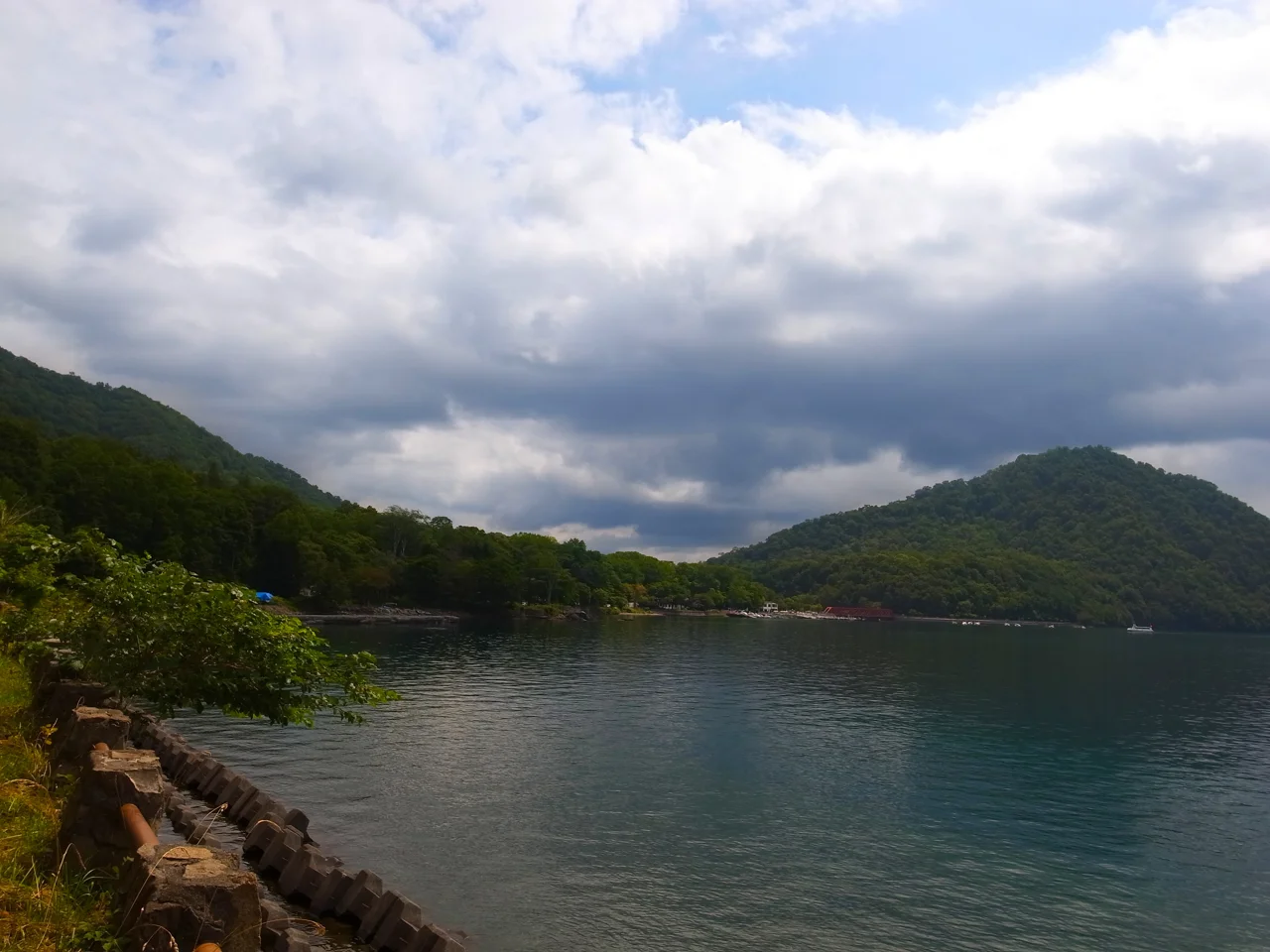
The shortest version goes from the visitor centre to the water, pauses for a lake view and walks towards Yamasen Bridge before returning. The lake, river outlet and red bridge offer different views. You do not need to keep walking away in one direction to have seen the lake. Start with a wide photograph of the opposite mountains, then look at the water colour near the railing. If wind or rain increases, return indoors or to the shops and shorten outdoor time.
The official map also marks an approximately one-hour loop via the bridge, waterside plaza, Kyukamura plaza and Kohan Bridge. It includes mountain-path-like steps and long flights of stairs. Use the full loop when surfaces, footwear and stamina suit it. With a pushchair or a wish to avoid steps, walk out and back on the hot-spring village side. You need not increase the difficulty just to follow every map arrow.
Other lakeside bases share Lake Shikotsu but lie outside this half-day walking area. Save Shikotsuko Onsen as your first-visit base rather than navigating to an arbitrary lake-name pin on another shore. With three hours, allow an hour for walking and another period for sitting and lunch before considering an activity. Keep the rest for queues, directions and returning to the stop.
The Hokkaido Tourism Organization’s Lake Shikotsu video introduces the scale of the shore and mountains before you link the bus stop, pier and waterfront into one walk.
Yamasen Bridge: pause where the lake flows into the Chitose River
Follow the official walking map from the visitor centre to Yamasen Bridge, staying initially between the bridge and village. The bridge crosses the Chitose River flowing out of Lake Shikotsu and now carries pedestrians. Compare the open lake with the narrower river before and after crossing. To see the red bridge, reaching it or crossing and returning the same way is enough; there is no need to climb the higher ground.
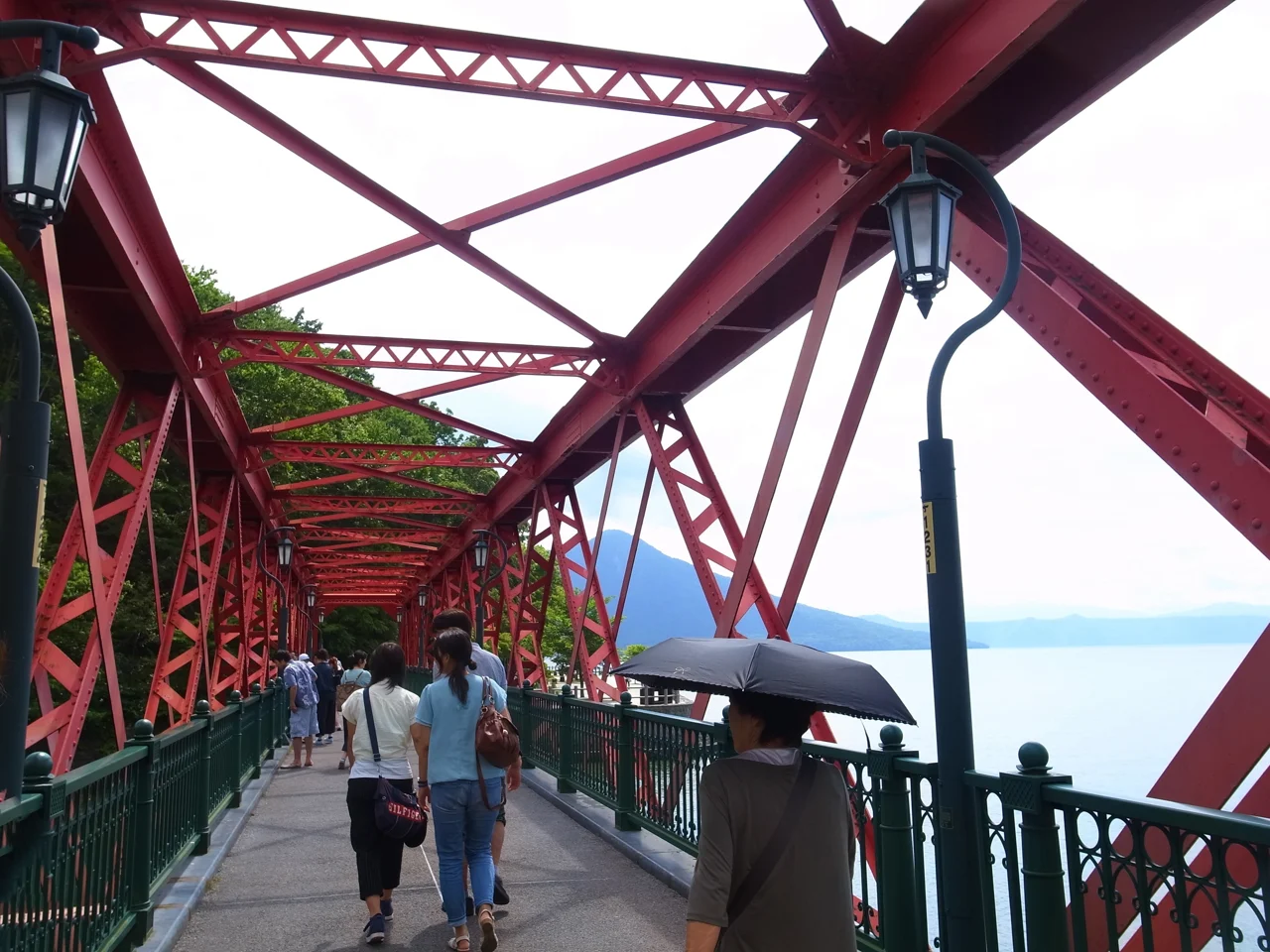
The bridge’s history deserves a closer look. The Cultural Heritage Online listing says it was originally the First Sorachi Bridge on the Hokkaido Government Railway’s Kamikawa Line and was moved to Lake Shikotsu in 1923. The steelwork, rivets and trusses then become more than a red photo spot. For children interested in trains, see the visitor centre’s railway and local-history displays first, then find the components on the bridge. Cultural Heritage Online: Yamasen Bridge.
Keep space for others on the bridge. For a full-bridge photograph, choose an angle from the shore. The clear water at the outlet can be observed from the bridge and open park paths. Reaching outside railings or descending closed banks adds nothing to the walk. In rain or snow, inspect the deck and steps. If a companion cannot continue, complete the outing on the same bank.
Winter time often goes on removing and replacing gloves, slow walking and finding dry footing. Count walking, viewing and return to the waiting area together. If you want twenty minutes beside the bridge, take that time from shopping or the full loop so that your main interest keeps its place.
Use the visitor centre for landforms, fish and rain shelter, not just a map
Lake Shikotsu Visitor Centre opens 09:00–17:30 from April to November and 09:30–16:30 from December to March. It closes Tuesdays in winter, moving to the following day for a public holiday, and also closes over New Year. Remove closure days from a winter plan before making it the main indoor stop. A later summer or autumn bus does not extend the building’s hours.
Displays cover the lake, volcanic landforms, forest life and local livelihoods. Start with the model to place the mountains and outlet seen from the shore, then choose fish, aquatic plants or railway history for a closer look. For a trip mainly outdoors, I would allow 30–45 minutes here, shortening it according to interest rather than covering every display.
The centre’s display introduction also lists a roughly 15-minute film about nature and geological history, with Japanese, English, Chinese and other languages. If weather deteriorates, see the exhibits and film before deciding whether to return to the shore. That is easier than standing in rain to see whether boats will sail. Children interested in the fish can have a shorter bridge walk and more time inside. Lake Shikotsu Visitor Centre: displays and services.
The counter provides seasonal nature information. Facilities include an accessible toilet and nappy-changing equipment, with a limited number of wheelchairs available for park paths. If you need one, contact 0123-25-2404 before travel, stating the date, equipment and intended route. Ask separately about centre services, path gradients and bus boarding for useful practical answers.
Choose one water activity: a 30-minute sightseeing boat with same-day individual tickets
For a first car-free visit with one water activity, I would choose the sightseeing boat with underwater windows. Its pier is beside the village waterfront and the trip takes about 30 minutes, making it easier to fit around fixed buses. You can see the lake from the deck and through underwater observation windows in the cabin. For landforms and water colour, it can be the main experience beyond walking. If the riverbank interests you more, keep the walk instead.
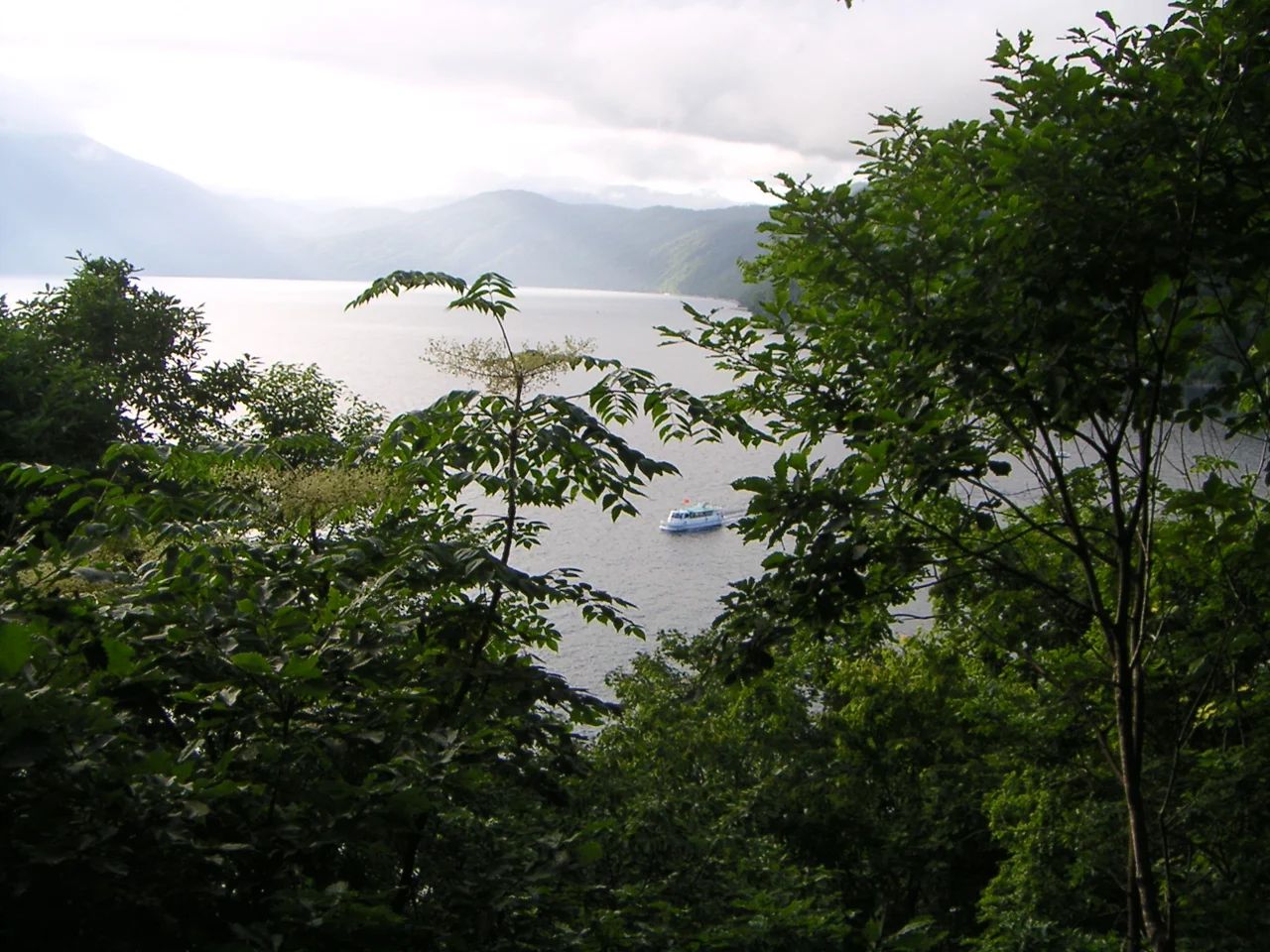
The operator’s current fare table lists tax-inclusive prices of ¥2,000 per adult and ¥1,000 per primary school pupil. Its FAQ says individuals buy on the day; reservations are only for groups. On reaching the lake, check available sailings, capacity and the day’s operation at the ticket office before arranging lunch. Lake Shikotsu sightseeing boats: fares and trip length · Lake Shikotsu sightseeing boats: individual tickets and operations FAQ.
The sightseeing boat’s 2026 season runs until 3 November, with the last departure at 15:30 from 16 October. Speedboats and pedal boats ended their season on 25 October. Late-October visitors cannot compare all three using the same summer menu. The operator announces the next year’s opening separately; winter daytime plans should use the shore route.
The operator decides sailing according to wind and waves that day. Its FAQ gives 0123-25-2031 for current conditions. If cancelled, keep the ticket money and spend longer on exhibits or food rather than pursuing a distant water-activity meeting point. For a 15:45 bus, choose only a sailing that finishes with time to return to the stop. A final sailing after 15:00 suits visitors accepting the 17:45 return or an overnight stay.
For primary school age and younger children other than infants, the operator requires children’s lifejackets. Follow crew instructions after boarding. If using a pushchair or wheelchair, or unable to manage steps independently, explain equipment and assistance needs before buying and decide then. The shore still offers lake views and the bridge without splitting the group just to use a ticket.
A 3-hour-13-minute afternoon: fit lunch and the sailing first
For a 12:32 arrival and 15:45 departure, find lunch and the return stop around 12:40, finish eating after 13:00 and use about an hour for the centre, shore and bridge. For a boat trip, ask about available sailings immediately after alighting and swap lunch and exhibits as needed. Keep the final part near the bus stop rather than the far side of the loop. Fill in the boat time using the ticket office’s actual sailings that day.
Without the boat, slow the same afternoon down. Stay longer at the shore after lunch, walk to the bridge and return for the visitor-centre film. For the full one-hour official loop, shorten shopping and displays and omit the boat. A half-day should differ by the chosen content rather than reducing every item to five minutes. If children need food, a nappy change or rest, remove an item rather than hurrying throughout.
On a weekend, the 12:35 airport departure arrives at 13:32, leaving 2 hours 13 minutes before the 15:45 return. Lunch and a short bridge walk are easiest. For a boat, eat beforehand or move the return to 17:45, accepting that indoor facilities may close earlier and dinner will be later. If some want the loop and others want to sit, agree to meet near the centre and use the same return-time assumption.
The walking version leaving the airport at 14:30 arrives at 15:27, just eighteen minutes before the 15:45 return. The practical return is usually 17:45. That means more than two hours at the lake, then a JR connection at Chitose to reach Sapporo. For only a brief lake visit, come on an earlier bus and finish with an earlier return. A later start does not necessarily make the whole outing shorter.
| Lake arrival / departure | Time available | Main plan | Who it suits |
|---|---|---|---|
| 12:32 / 15:45 | 3 hours 13 minutes | Lunch + short walk; choose a boat according to sailings | First visit, returning to the city that night |
| 13:32 / 15:45 | 2 hours 13 minutes; weekend outbound only | Eat beforehand, then bridge walk or one boat trip | A shorter outdoor stay |
| 15:27 / 17:45 | 2 hours 18 minutes | Shore, bridge and facilities within opening hours | Afternoon arrival with a later city return |
| 09:22 / 12:50 | 3 hours 28 minutes | Morning walk and displays; lunch if time allows | Early start after a night in Chitose |
Find the Shikotsuko return stop first: the current last bus is 17:45
Take 空4 towards New Chitose Airport for the return, including if alighting at Chitose Station. Photograph the sign, waiting area and day’s last bus on arrival, then return to the place you already identified after walking. Aim to be at the waiting area at least fifteen minutes before departure, leaving time to find the stop, use the toilet and pack belongings.
The current last bus leaves the lake at 17:45, reaching Chitose Station at 18:23 and airport domestic stop 28 at 18:34. For a reserved dinner in Sapporo, add alighting, entering Chitose Station, waiting for a train and walking after arrival in Sapporo. Reserve by the full journey to the restaurant rather than treating arrival at Chitose as arrival in central Sapporo.
If you miss 15:45, assess whether 17:45 and the following rail journey are acceptable. If you miss 17:45, contact an available taxi or arrange accommodation locally. Do not try to walk the main road to the next city station. Seek assistance near a staffed facility and specify “Shikotsuko Onsen, Shikotsuko bus stop” so a driver finds the correct shore. Ask the taxi company directly about fares and dispatch time rather than treating a taxi as a fixed, instantly available replacement service.
If notices show cancellation or major delays, change the outing at the airport or Chitose. If already at the lake when disruption occurs, first arrange departure and contact that night’s accommodation, then remove sightseeing. The timed return is the part of this route to protect; photographs and meals can finish earlier.
Late autumn and winter change the activities and indoor time
Late October is near the end of the boat season. After 3 November, the sightseeing boat’s 2026 operation has ended, so use the shore, red bridge and visitor centre. Do not buy other fixed arrangements around a boat that does not run in winter. Autumn colour and weather change daily. Choose a day with a suitable forecast and operating transport for lake views rather than depending on one photographic colour palette.
In winter the centre opens 09:30–16:30 and closes Tuesdays. Using the 17:45 return leaves a gap after the building closes, outdoors or looking for an open shop. For less time at dusk, arrive earlier and leave at 15:45. Recheck the timetable after the next seasonal revision: building hours and bus times must both work.
Grippy soles, a windproof outer layer and dry gloves help more than another viewpoint. In snow, start with the short village-side route and cross bridge surfaces and steps slowly. The map’s one-hour loop is not a snow-day duration. If clouds hide the opposite mountains, nearby shore and outlet views remain. If wind and snow affect walking, shorten the outdoor section to what you can complete comfortably.
For a special winter event, choose dates and transport announced by the organiser before planning an evening stay. A normal daytime return does not automatically cover night events. For lights, use a product with a confirmed return or stay overnight. Event tickets, event shuttles and hotel transfers are separate services. Keep each booking record.
Children, pushchairs and wheelchairs: start with the short lakeside route
For a family half-day, show children the visitor centre’s fish and landforms, then find the mountains and bridge outside. This connects indoors and outdoors while leaving pauses for water, nappy changes and meals. If a child usually sleeps on buses, choose the 15:45 return and dinner in the city. Make the boat the afternoon’s only paid focus rather than adding another timed activity.
For a pushchair, start with the bus stop, centre and an out-and-back walk on the village-side shore. The full official loop has steps. Turn back at slippery ground or a section requiring lifting. If one adult cannot safely carry a pushchair and care for another child together, staying on the same bank is easier. Reaching a clear view of the red bridge can meet a child’s wish to see it.
Wheelchair users should contact the bus operator’s Chitose office on 0123-23-2171 first, giving boarding and alighting stops, intended service and wheelchair type. Ask the visitor centre separately about loan equipment and park paths. Seek answers on the usable service, boarding assistance and accessible route, rather than only asking whether the attraction is friendly. Ask about cabin steps before paying for a boat activity.
Keep a return stop name and departure time on everyone’s phone or paper copy. Those seeing more exhibits or buying drinks should return to the same area around twenty minutes before departure and go to the waiting area together. Meet near an obvious fixed building rather than waiting separately at the shore, across the bridge and in the car park.
Half-day costs: separate transport, boat and food
For one adult returning from the airport, buses cost ¥1,260 × 2 = ¥2,520. Add the ¥2,000 sightseeing boat for ¥4,520. From Chitose Station, ¥1,140 × 2 = ¥2,280, or ¥4,280 with the boat. These subtotals cover the stated buses and standard boat tickets. Add lunch, storage, Sapporo–Chitose JR, shopping and accommodation separately. If already at the airport, do not change to JR plus bus just to save the ¥240 return-fare difference.
Two adults travelling from the airport and both taking the boat total ¥9,040, plus meals and a shared locker or storage fee. A shore-only route keeps ¥4,000 of boat-ticket budget. Calculate confirmed transport and boat costs first, then add the food you actually order.
With children, check bus child fares separately from the boat’s primary-school ticket category. Adult and primary-school columns do not establish free travel for every other age. State actual ages, numbers and seat needs when buying, and prepare return fares too. Ask the counter about any discount certificate you hold under the scheme you can use, rather than applying another region’s visitor offers.
The most effective savings are the walking version, boarding where you already are at the airport or Chitose, and catching the return on time. An unscheduled taxi can cost far more than the small bus-fare difference. For an overnight stay, compare the whole group’s room, meals, taxes and transfer total before moving a night from Sapporo.
A night at Kyukamura Shikotsuko gives time for forest and morning
If lake views and nature walks are the main purpose, an overnight stay removes pressure from the afternoon return. Kyukamura Shikotsuko stands in forest on higher ground and suits guests happy to stay among trees and return to the shore the next day. The property’s FAQ explicitly says none of its rooms has a lake view. Choose it for the forest, meals and hot-spring stay. For a lake view from the room, find accommodation explicitly offering it. Kyukamura Shikotsuko: rooms, check-in and transfer FAQ.
Kyukamura’s access page lists an approximately five-minute transfer from Shikotsuko terminus, with advance notice of the arriving bus required. Overnight guests can contact 0123-25-2201 after choosing their service. This transfer starts at the lake bus stop; the airport–lake leg remains a scheduled bus journey. Arrange transfer and bags before arriving, then choose check-in or a walk first rather than taking a large case up the steps. Kyukamura Shikotsuko: access and bus-stop transfers.
Normal check-in is 15:00 and checkout 10:00. With a midday lake arrival, arrange storage or transfer with the property and use the afternoon for the shore. Breakfast before leaving the next morning makes fuller use of the stay. If taking the last 16:30 airport bus and arriving at 17:30, focus on the transfer and dinner arrival requirements. Leave daytime sightseeing for the next day rather than chasing boats that have finished.
The property also lists day bathing from 11:00 to 15:00, with final reception at 14:30, closed Tuesdays and Wednesdays. Day-use restaurant and café services are not operating, and transfers are generally for overnight guests only. With just three hours at the lake, bathing must replace enough time for the trip up and back and the bath itself. Do not treat the overnight shuttle as day-use transport. The shore and visitor centre remain more direct for an easy first afternoon.
Save meals, transfer and cancellation deadlines with the overnight booking
When booking Kyukamura, choose the room and guest numbers you need, then meals, beds, any self-service futon arrangement and movement within the building. Enter dates and all adult and child ages, comparing room charges and taxes on the checkout page. Dinner-and-breakfast and breakfast-only totals cannot be compared just by a per-person starting price. For care or night-time equipment needs, ask about the selected room before arrival rather than changing rooms on site.
The Kyukamura Association’s general accommodation cancellation rules list 20% from seven days before through the day before, and 50% on the day or for a no-show, for groups of 30 or fewer. Save the selected plan’s cancellation table. Different special-plan or travel-agent conditions follow that contract. This comparison is for general accommodation; the campsite page’s three-day rule does not replace the hotel booking terms. Kyukamura Association: general accommodation cancellation terms.
For late arrival, a flight delay or a missed bus, contact the property first with your actual location and possible arrival time so that transfer and food can be adjusted together. Hotel cancellation and airline or bus disruption are handled separately. If deciding not to go, cancel through the original booking channel and retain the reply rather than only deleting the trip from your calendar.
Arrange the next day’s transfer to the bus stop the evening before departure, then choose Chitose or airport alighting. For the 09:35 lake departure, align breakfast, checkout and the station transfer with the property. For a morning walk, choose a later return and arrange bags after checkout. The extra night lets you use afternoon and morning separately rather than forcing more sights into the same list.
Linking the Hokkaido trip: give Shikotsu a day, with Sapporo and Toya separately
For the Sapporo and Otaru four-day route, visit the lake on arrival day and continue to Sapporo that evening. If the flight arrives late, use a flexible day from Sapporo for a return via Chitose. The first option needs airport luggage arrangements; the second adds return rail travel from Sapporo but gives a lighter pack and easier weather-based date changes. The bus you can catch after landing decides the version. Sapporo and Otaru four-day route.
For Lake Toya and Noboribetsu stays, use the south-west Hokkaido hot-spring and resort base comparison. 空4 only connects Chitose with this lakeside. Moving on to another hot-spring base needs separate buses, trains and hotel transfers. A Lake Shikotsu afternoon followed by a rush to another dinner-inclusive stay puts two late-arrival deadlines on one day. For a short trip, choose one overnight base. South-west Hokkaido hot-spring and resort bases.
A few useful answers
Is there a direct bus from New Chitose Airport to Lake Shikotsu?
Yes. Hokkaido Chuo Bus route 空4 runs via Chitose Station to Shikotsuko terminus. Current boarding stops are domestic 28 or 1 and international 85. The adult single fare is ¥1,260. Only 空4 services showing Shikotsuko continue to the lake.
How long is a weekday midday half-day?
The current 11:35 departure from airport stop 28 arrives at 12:32. Leaving at 15:45 gives 3 hours 13 minutes. The same bus leaves Chitose Station at 11:48.
Can the 14:30 airport bus reach the last sightseeing boat in late October?
It arrives at 15:27, only three minutes before the 15:30 last sailing, so it is unsuitable for a boat-focused visit. Choose a shore walk, the visitor centre within opening hours or a pre-booked accommodation transfer.
Do I need to reserve the sightseeing boat?
The official FAQ says individuals buy on the day and only groups can reserve. The approximately 30-minute sightseeing boat costs ¥2,000 for adults and ¥1,000 for primary school pupils. Its 2026 season runs until 3 November, with operation subject to wind and waves that day.
When is the last airport-bound bus?
The current timetable checked on 27 October 2026 gives a 17:45 lake departure, reaching Chitose Station at 18:23, airport domestic stop 28 at 18:34 and international stop 85 at 18:39. For travel across seasons, use the current timetable from the official index.
Must I go to the airport first from Sapporo?
No. Take JR to Chitose Station and change at stop 4 to 空4. The adult single fare to the lake is ¥1,140. Alight at Chitose on the return for JR.
Do Kyukamura Shikotsuko rooms have lake views?
The property states that none has a lake view. It stands in forest on higher ground. Overnight guests can arrange the roughly five-minute transfer from the bus terminus in advance. Normal check-in is 15:00 and checkout 10:00.
Official information and references
Sources used in this guide.
- Chitose City: city bus timetable index
- Chitose City: current Shikotsuko Line timetable and fare PDF
- Hokkaido Chuo Bus: Chitose routes
- Lake Shikotsu Visitor Centre: access
- New Chitose Airport: bus stops
- New Chitose Airport: lockers
- New Chitose Airport: luggage storage
- Lake Shikotsu Visitor Centre: opening and closures
- Lake Shikotsu Visitor Centre: displays and services
- Shikotsuko Onsen walking map 2026
- Cultural Heritage Online: Yamasen Bridge
- Lake Shikotsu sightseeing boats: fares and trip length
- Lake Shikotsu sightseeing boats: individual tickets and operations FAQ
- Lake Shikotsu sightseeing boats: end of the 2026 season
- Lake Shikotsu sightseeing boats: autumn 2026 timetable
- Kyukamura Shikotsuko: rooms, check-in and transfer FAQ
- Kyukamura Shikotsuko: access and bus-stop transfers
- Kyukamura Association: general accommodation cancellation terms