Choose Railway Museum activities by school year. Compare advance admission, Seven Ticket activity packages, app draws and free first-come activities, with half-day and full-day plans, New Shuttle connections, packed lunches and pushchairs.
- Region & Focus
- KantoFamily attractions
- Reading Scope
- 24 min read · 13 chapters · 4 Q&As
- Official Verification
- 5 official sources checkedUpdated 22 November 2026
- Key Topics
- Rail travelBookingItineraries
Chapter Route Map (tap any stop)
- Start with your child’s school year, then decide how much activity time to allow
- Advance admission saves ¥100 per person; choose activity places separately
- Change to the New Shuttle at Omiya; the one-minute walk starts after that ride
- Slow down in the vehicle hall and let your child choose a train to explore
- For the Miniature Operating Train, separate driver eligibility from its three seats
- E5, conductor, D51 and the driver classroom offer different kinds of operation
- Four free conventional-line simulators provide an alternative to the draws
- Station work and free demonstrations: from issuing tickets to closing doors
- Hear the whistle at midday, then choose a mechanical demonstration
- With preschool children, alternate little Shinkansen rides, viewing and rest
- Eat lunch inside, using the designated packed-lunch areas
- Deal with pushchairs, feeding, luggage and payment on arrival
- Choose between a half-day train visit and a full day with one main activity
- Quick Q&A
For a family visit to the Railway Museum in Omiya, choose the activity your child most wants to try by school year, then decide between half a day viewing trains and a full day. Admission and activity packages have separate purchase options. Other activities use draws, first-come queues or demonstrations without reservations. Plan one main activity and lunch, then leave time for full-size trains, models and whatever catches your child’s attention.
Start with your child’s school year, then decide how much activity time to allow
The Railway Museum in Omiya suits both a half-day visit to see real trains and hear a whistle, and a full day with driving activities. Your child’s school year is the first dividing line: driving the Miniature Operating Train, the E5 Shinkansen simulator and the conductor simulator starts at primary-school age. The D51 steam locomotive simulator starts at junior-high-school age. Preschool children can ride the Miniature Operating Train with an eligible driver. Use this distinction when a child wants to operate a train themselves.
On a first family visit, choose just one paid activity that matters most, alongside the vehicle displays and one free demonstration. For a Shinkansen fan, consider the E5 first. For a child interested in levers, signals and moving outdoors, compare the Miniature Operating Train. Making every draw-based activity compulsory because others recommend it can mean too much time checking phones and rushing to meeting points, with too little time beside the trains your child actually likes.
If siblings are in different school years, allow a short time apart. A primary-school child can try the conductor activity while another adult takes a preschool child to the trains or Kids Plaza, then everyone meets for lunch. With one adult and two children, favour activities you can do together. The Train Driver Experience Classroom requires an accompanying adult for Japanese primary Years 1–4. That adult cannot accompany one child in class and take the other elsewhere at the same time.
There is no fixed route through the museum. The museum suggests about 2–3 hours for a general visit, with extra time for activities and model railway commentary. Start from this half-day estimate if you need to return to Tokyo in the afternoon. Allow a full day if you want unhurried viewing and another activity after lunch. For other nearby options on a separate day, see day trips and overnight stays near Tokyo.
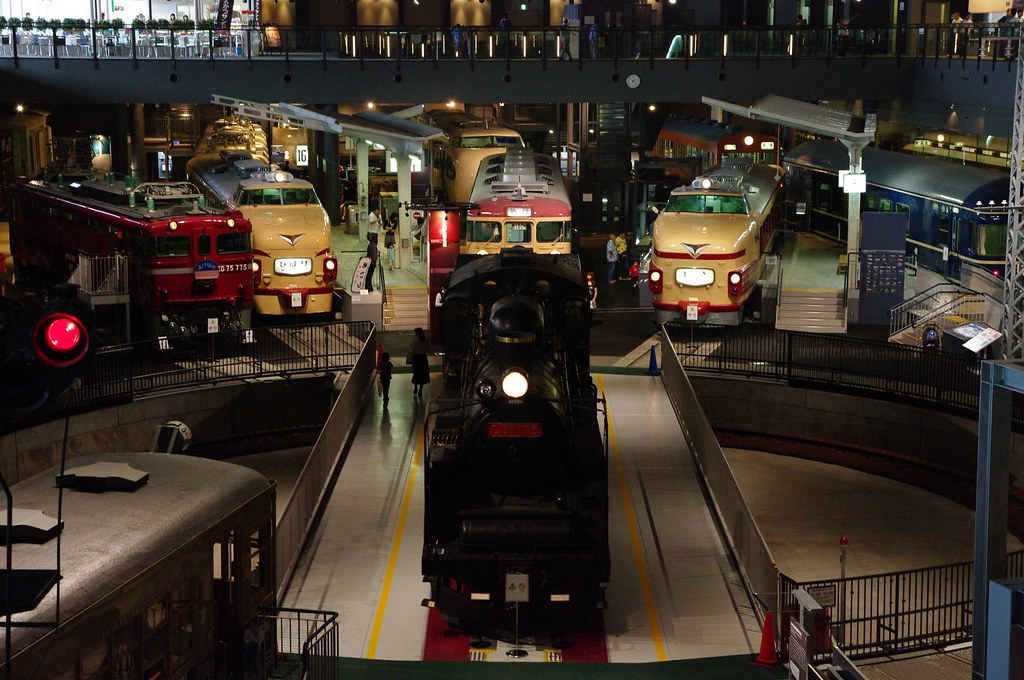
Choose Railway Museum activities by school year. Compare advance admission, Seven Ticket activity packages, app draws and free first-come activities, with half-day and full-day plans, New Shuttle connections, packed lunches and pushchairs.
Advance admission saves ¥100 per person; choose activity places separately
According to the museum’s visitor information dated 28 October 2026, advance tickets bought by the previous day cost ¥1,500 for adults, ¥500 for primary to senior-high-school pupils, and ¥200 for preschool children aged 3 and over. Same-day prices are ¥1,600, ¥600 and ¥300 respectively. Each advance category saves ¥100. The museum offers online admission tickets without member registration. Advance tickets are also sold at 7-Eleven, Lawson and Ministop.
For two adults and one primary-school child, advance admission is ¥1,500 × 2 + ¥500 = ¥3,500, compared with ¥3,800 on the day. Add one Miniature Operating Train at ¥600 and the total is ¥4,100 with advance admission. This example covers admission for three people and one train. List travel from Tokyo, the New Shuttle at Omiya, meals and other activities separately to see the family’s full daily cost.
If the Miniature Operating Train, E5, D51 or conductor simulator is your child’s priority, compare the admission tickets with an activity reservation through the official ticket portal first. These four activity packages are sold only by Seven Ticket. An ordinary online ticket covers admission; a pre-arranged activity requires the corresponding package. Before paying, read the eligibility rules, visit date, activity slot and number of people included. Put the activity slot in your day plan.
If you decide on the day, museum ticket machines sell admission from 10:00 on opening days and accept cash or transport IC cards. Holders of JR East shareholder service vouchers, discount vouchers or admission exchange vouchers should go directly to the entrance counter under the museum’s rules. Applicable discounts are calculated there. Choose this route first if using a discount, to avoid buying ordinary advance admission before dealing with a different voucher.
| Category | Advance: by the previous day | Same day |
|---|---|---|
| Adult | 1,500 | 1,600 |
| Primary to senior-high-school pupil | 500 | 600 |
| Preschool child aged 3 or over | 200 | 300 |
Change to the New Shuttle at Omiya; the one-minute walk starts after that ride
The museum is at 3-47 Onaricho, Omiya-ku, Saitama City, Saitama Prefecture. When planning from your Tokyo accommodation, set the destination to Tetsudo-Hakubutsukan Station and check that the final leg uses the New Shuttle. The museum’s access page directs visitors to change from JR at Omiya, take the New Shuttle to Tetsudo-Hakubutsukan, then walk about one minute. That minute starts at the New Shuttle station.
With a pushchair, or on a first visit to Omiya, allow separate time to get from the JR platform to the New Shuttle. Find a convenient route from your accommodation to Omiya, then study the transfer map. There is no need to change hotels for this day trip. You pass through Omiya in both directions, so you can decide about a station meal on the way back. Keep the morning for admission and arranging activities.
If you already have a rail pass, check its full product name and validity dates. The Japan rail pass comparison lists the New Shuttle section between Omiya and Tetsudo-Hakubutsukan as covered by the JR TOKYO Wide Pass. Other passes have their own coverage. If most of your trip is in Tokyo with just one day in Omiya, calculate the actual return fare first. This short journey need not lead to extra long-distance travel.
Parking for an ordinary car costs ¥1,000 a day, and the car park closes when the museum closes. The museum warns that it can fill on holidays. Rail travel makes it easier to keep your visit time inside the museum. If parking is part of your family’s convenience plan, include time to find a space and gather belongings after getting out. Once an activity slot is booked, the navigation app’s driving time alone is not your arrival time.
Slow down in the vehicle hall and let your child choose a train to explore
After entering, deal with booked activities or same-day draws, then put the phone away for a while in the vehicle exhibition. Standing beside a real train to look at its nose, wheels and doors offers children something different from identifying trains in a model display. Start with a train your child recognises. Let them find differences from the trains they normally ride, then move to a vehicle from another period or with another purpose. There is no need to complete them in number order.
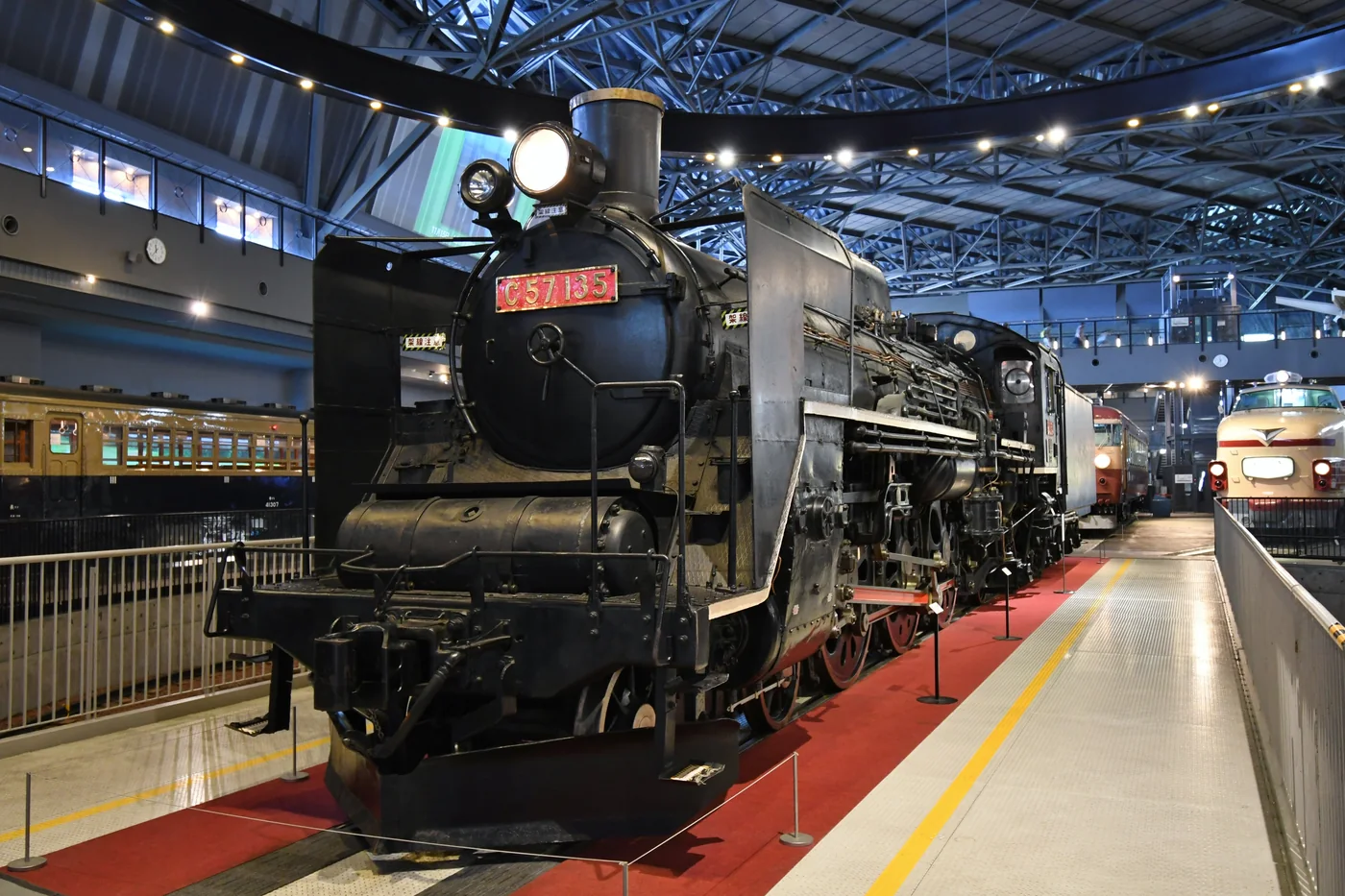
The museum FAQ says visitors can enter or touch some vehicles. Follow the open areas shown at each display entrance. Inside a vehicle open to visitors, look at the proportions of seats, windows and cab. This gives a better sense of scale than rushing to photograph the whole carriage. If your child stays absorbed in one train, drop another area from the half-day plan and keep that time.
At a steam locomotive, find the driving wheels and connecting rods, then link this to the 13:30 driving-wheel demonstration. Shinkansen fans can compare nose shapes before the coupler programme at 14:15. Static exhibits then connect with moving mechanisms, without requiring you to read every technical panel first. Exhibition guides circulate through the museum. Ask them about vehicle construction, and use the information desk for facilities or routes.
Display text is mainly in Japanese. The Railway Museum App provides multilingual exhibit commentary. Choose one or two displays your child likes and use the text to connect with the real object. Translating every panel can interrupt their observation. This guide app serves a different purpose from the Teppaku draw app (てっぱく抽選アプリ). If entering draws, distinguish the two names and find the correct downloads through the official website before travelling.
Saitama City’s 2024 television programme visits the Railway Museum, introducing vehicle displays and train and Shinkansen driving activities. Watch with your child to compare viewing full-size trains with operating them, then choose the day’s focus.
For the Miniature Operating Train, separate driver eligibility from its three seats
The Miniature Operating Train seats three and costs ¥600 per train. The official activity window is 10:30–16:30, with places allocated by app draw. One circuit is about 300 metres and takes around six minutes, with curves, speed limits at points and signals that change with the train ahead. The attraction is controlling a moving train yourself, rather than a fast miniature railway ride.
The driver must be of primary-school age or older; passengers may include preschool children. Two adults and one primary-school child fit within a single train’s three seats, with one person driving and the others riding. A family of more than three needs a different participation arrangement. Agree beforehand who will drive, so that competing requests to operate the train do not change the booked arrangement at the activity point.
An actual circuit outdoors is the clearest difference from the indoor simulators. A primary-school child who likes watching signals and will listen to operating instructions may choose it as the main activity of the day. For a child who dislikes the cold, wants to stay indoors that day or prefers driving on a screen, put the E5 or conventional-line simulators first. Avoid booking a string of slots and expecting everyone to enjoy the same things on arrival.
With an admission-and-activity ticket, plan this part around the printed slot, placing lunch and other displays before or after it. If using the museum app draw, build a basic plan around the vehicle hall and free demonstrations, then adjust when you obtain a slot. Waiting all afternoon for a single unallocated activity uses up time for open viewing. Keep an exhibition area you can visit directly so the day can move on.
E5, conductor, D51 and the driver classroom offer different kinds of operation
The E5 Shinkansen, conductor and D51 simulators each have an official fee of ¥600 and use app draws. The E5 and conductor simulators start at primary-school age; the D51 starts at junior-high-school age. The Train Driver Experience Classroom also costs ¥600 and starts at primary-school age, with an adult required for Japanese primary Years 1–4. Once your child meets the threshold, choose by the job they want to try rather than treating every activity as simply driving a train.
The E5 offers Shinkansen driving at up to 320 km/h. The conductor simulator uses a 209 series train and focuses on how conductors work with drivers to keep trains safe. A child who notices doors, platforms and departure routines may prefer the conductor role to high-speed images. For a cab view and acceleration and braking, choose the E5. Let children watch the official introduction before choosing to reduce the gap between an adult’s choice and their own interests.
The D51 recreates a steam locomotive’s operating environment, including a steam-regulating valve, reverser and brakes. Its instruments respond to operation, and it reproduces the distinctive vibration of a steam locomotive. It suits visitors of junior-high-school age or older with an interest in steam operation. If just one person wants to try it, split up briefly while the others view trains in an agreed area. The whole family need not sacrifice individual interests to do the same activity.
In the Train Driver Experience Classroom, several participants use simplified driving desks with monitors. An instructor teaches instrument reading, pointing and calling, and driving. Compare this option first if you want guided operation, but include the accompanying adult’s time for younger pupils. Official hours are 11:05–16:35 on weekdays and 10:25–16:35 on weekends and public holidays. Attend the individual slot you obtain; the full operating window does not mean you can join at any time.
| Activity | Eligibility | Fee and allocation |
|---|---|---|
| Miniature Operating Train | Driver: primary-school age or older; preschool passengers allowed | ¥600 per train, three seats; app draw |
| E5 / conductor simulator | Primary-school age or older | ¥600 each; app draw |
| D51 simulator | Junior-high-school age or older | ¥600; app draw |
| Train Driver Experience Classroom | Primary-school age or older; adult accompanies Japanese primary Years 1–4 | ¥600; app draw |
| 205 / E235 / 211 / E233 | Follow the on-site instructions | Free; first come, first served |
Four free conventional-line simulators provide an alternative to the draws
The museum’s activity programme lists four conventional-line simulators: 205, E235, 211 and E233. All are free and first come, first served, from 10:30 to 16:30. They offer another driving option if your family does not obtain an E5 slot. Look at the queue and your child’s patience before deciding to wait. The vehicle hall and scheduled demonstrations remain options.
The 205 simulator uses real footage of the inner loop of the Yamanote Line across three large front screens. The E235 connects with Yamanote Line trains your child may have seen in Tokyo. Children who like recognising familiar commuter trains can start by comparing these two. If you ride a similar type that day, look again at its doors, screens and cab shape on the return journey, connecting the museum with your trip.
The 211 introduction focuses on the ATS-P automatic train stop system; the E233 lets visitors try D-ATC digital automatic train control. Primary-school children need not memorise the abbreviations. Ask when to slow down and how to stop at a set position; older children can then ask how the systems help safety. There is no need to try all four. One activity your child likes and is willing to queue for adds something different from the full-size displays.
Station work and free demonstrations: from issuing tickets to closing doors
If your child watches ticket machines and station staff handling tickets, make Work Station another focus. The railway teamwork demonstration at 13:00 is free and needs no reservation. Guides use the ground-floor exhibits to explain how railway jobs work together. See train bodies in the morning, then staff roles around midday, extending the question from how a train moves to how a service departs. This also suits families whose main aim is not a driving simulator.
The Midori no Madoguchi ticket-counter experience takes place at Minami Teppaku Station and covers issuing tickets. It is for primary-school children and older. In the ticket-machine explanation, a guide introduces ticket buying and the machine’s interior. Both are free and use app draws. Listed times are 10:30–11:00 for the counter and 15:30–15:45 for the machine explanation. Compare these slots with paid draw activities. A child interested in ticket-counter work can choose one, then view trains during the rest of the visit. A driving activity is not necessary for an interactive day.
For an indoor film programme, Teppaku Theater is a free 3D theatre with 12 listed screenings a day and reservation-based admission. Films are announced on site, and screenings may stop during events. Look at the film and daily schedule with your child before deciding. Model commentary, the 3D theatre and driving each take a full block of time. Filling the day with seated programmes leaves less time for real trains.
On an early weekend visit, children interested in doors can also look for the KuMoHa 101 door-closing experience from 10:15. The official listing gives Saturdays, Sundays and public holidays, free and without reservations, with a guide explaining operation first. It is close to opening time, so it suits families already inside with children settled. If you need to deal with a pushchair and luggage first, begin with the next display that interests you.
Some children enjoy sounds inside old trains. At 11:00 on Saturdays, the 200 series sound journey recreates on-board announcements and the hometown chimes from the opening of the Joetsu Shinkansen. At 11:00 on Sundays and public holidays, the 0 series programme includes whistles and announcements. The 200 series still runs when a public holiday falls on Saturday. Match these weekday-specific programmes to your travel date and fit one into the morning’s train viewing.
Hear the whistle at midday, then choose a mechanical demonstration
The turntable rotation and whistle demonstration has two listed daily sessions, at 12:00 and 15:00. It is free and needs no reservation, with a guide introducing the vehicle and its stories. Morning arrivals can use noon as a fixed point before lunch. Visitors arriving at midday, or with a booked morning activity, can use 15:00. The whistle may be loud for sound-sensitive children. Explain that it is about to sound and choose a place where your child feels comfortable.
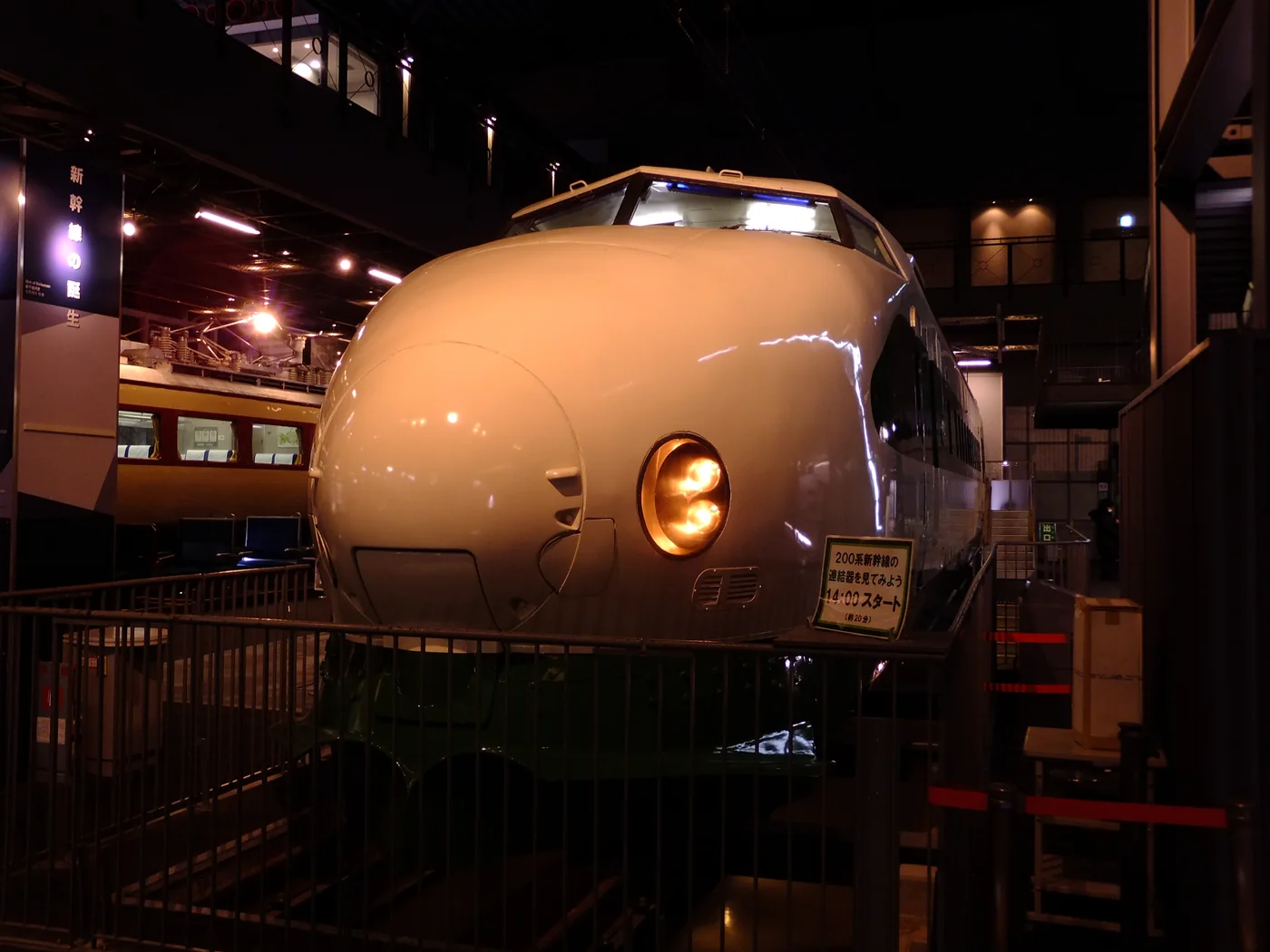
Two afternoon programmes connect well with the real vehicles: the Mallet steam locomotive driving-wheel demonstration from 13:30 to 13:40, and the 200 series Shinkansen coupler explanation from 14:15. Both are free without reservations. The first uses a partly cutaway body to show how steam drives the wheels. The second extends and retracts the coupler, explaining coupling and equipment for snow and cold. Choose according to the train your child spent most time with that morning.
Free admission to each demonstration is no reason to link every one into an unbroken route. After the 13:30 wheels, you might prefer to stay nearby and skip 14:15. If the Shinkansen coupler is your priority, head there at a comfortable pace after lunch. Moving around, toilet visits and finding a seat all take time. One fewer stop between fixed programmes gives you room to finish what you are already looking at.
Model railway commentary runs nine times daily, for about 15 minutes each. Individual times are announced on site. Read the daily list after entering and choose a gap before or after lunch or an activity. Models show trains running across a broad scene; full-size vehicles give children a sense of scale and construction. The two complement each other. If your child is tired, sitting in a rest area is more practical than crossing the museum for another programme.
With preschool children, alternate little Shinkansen rides, viewing and rest
For preschool children, build the visit around Kids Plaza, model railways, the Shinkansen Lounge, the Panorama Deck and full-size vehicles. Their interest may be a wheel, a door or a passing train rather than every explanation adults have planned. Find a rest spot after each stretch. Rest when nap time approaches, then decide whether there is enough energy to return to the displays.
The Mini Hayabusa / Komachi is a ¥200 ride allocated first come, first served, officially from 10:50 to 16:00. Preschool children must ride with an adult. Either Hayabusa or Komachi runs on a given day. It stops for winter from December to February and may also stop in bad weather or extreme heat. For a winter visit, keep that time indoors. In other seasons, look at operations on arrival before adding it, rather than promising a particular train nose in advance.
Keep this ride separate from the ¥600 Miniature Operating Train. The former is a ride on a little Shinkansen. The latter is driven by an eligible participant and seats three per train. Families with young children can compare the latter if an adult also wants to drive. If you simply want the child to enjoy a ride, look at the little Shinkansen first. Choosing the right activity makes both cost and expectations easier to explain.
If two children have very different paces, agree on a precise exhibit area or service point to meet. The person doing an activity takes their own phone and ticket; the person with the younger child keeps water, spare clothes and nappies. Meet again for lunch. This lets the older child complete an age-restricted activity while the younger one follows their usual eating and sleeping pattern, without the whole family waiting in the same queue.
Eat lunch inside, using the designated packed-lunch areas
You may bring a packed lunch. Indoors, you can eat in the third-floor Shinkansen Lounge. Outdoor designated areas include the main building’s rooftop Panorama Deck and benches on the south building’s rooftop Train Terrace. Eating and drinking are prohibited in exhibition rooms. If you have a morning activity or the noon whistle demonstration, place lunch afterwards. Choose the eating area before leaving the displays, avoiding a search and return trip when children are hungry.
Buying an ekiben station lunch box or eating in a restaurant can itself be a main stop. Museum restaurants and shops require an admission ticket, so an afternoon shopping-only visit still incurs admission. Bring suitable food for a selective eater while adults choose museum meals. The family need not spend its rest time repeatedly changing outlets in search of identical meals for everyone.
Re-entry after a short trip outside is possible if requested at the entrance counter when leaving. Requests may be suspended during busy periods. For lunch alone, staying inside usually saves walking. If collecting belongings or going out for another reason, complete arrangements at the counter before leaving and tell companions where to meet. With an afternoon activity booked, leave time for the outward trip and re-entry outside its slot.
You do not have to follow lunch immediately with another hands-on activity. Return to unfinished morning displays if your child wants more trains, or rest quietly before the next programme. Outdoor seats suit pleasant weather; use designated indoor dining areas in rain or heat. Keeping both options in your plan offers more flexibility than insisting on a particular bench.
Deal with pushchairs, feeding, luggage and payment on arrival
There are paid lockers at the entrance, priced by size. Wheelchairs and pushchairs can be used inside, and wheelchairs are available to borrow. Pushchair hire uses the paid Bebical service and requires member registration; ask at the entrance counter. If your child normally naps in their own pushchair, bringing the familiar one can help keep their rest routine. If hiring to carry less, include the registration and fee in your preparation.
Changing tables and feeding spaces are located in Kids Plaza, the north side of Vehicle Station’s floor 1 and the south side of floor 2, and the south building’s floors 1 and 4 (using the museum’s floor numbering), among other places. Baby rooms have formula-preparation equipment. On receiving a floor plan, find the nearest facilities to your next activity. Changing a nappy before a demonstration is easier than leaving at its start time. A nappy machine in front of the 455 Lunch Train on the main building’s ground floor sells M and L sizes and wet wipes.
Transport IC cards such as Suica can pay for activities and parking, except PiTaPa. Lockers do not accept transport IC cards. Credit cards cannot pay for activities, parking or lockers either. Bring a topped-up transport IC card and cash for luggage storage so you can put large items away before arranging activities. Card acceptance for dining and shopping depends on the outlet; View Restaurant does not accept credit cards.
Your phone may hold tickets, draw entries, maps and app exhibit commentary, so start with sufficient charge. Paid ChargeSPOT power-bank rental is available inside and requires its app or a supported mobile payment app. Bringing a power bank avoids a last-minute setup. Follow the museum’s photography rules for personal enjoyment. Some films, temporary exhibitions and shops prohibit photography. Do not use tripods, monopods or selfie sticks, or block walkways with bags.
Free museum Wi-Fi covers the main building’s ground-floor entrance, third-floor Shinkansen Lounge and the whole south building. First use requires an email address or social media details. Each connection lasts 60 minutes, after which you must reconnect. Download apps on a familiar network before travelling, leaving your phone for tickets and daily activities at the museum. If reception is weak in a display area, return to the entrance or a designated area to deal with it, then resume viewing. Draws and guides use separate apps; accompanying adults can divide phone tasks and childcare.
Choose between a half-day train visit and a full day with one main activity
For a half-day train visit, start after opening at 10:00 with part of the vehicle hall. Look at that day’s model railway commentary times, hear the turntable whistle at noon, then finish after lunch according to your child’s energy. Adjust model viewing to the announced times. If you prefer lunch back in Tokyo, leave after the whistle. Once your child finds a train they like, there is no need to move elsewhere just to finish a list.
For a full day, place the activity slot you have obtained first, then choose one free demonstration. A morning activity, lunch and the afternoon 200 series coupler suit a Shinkansen fan. For steam enthusiasts, make the 13:30 driving-wheel demonstration the afternoon focus. With an afternoon activity, see trains and models in the morning and finish lunch early. Both plans leave an unscheduled gap to revisit displays or sit down.
If a draw does not give you a slot, return that time to the free conventional-line simulators, model railways and real trains. Replace suspended outdoor activities with indoor ones. If your child is tired, eat or head back early. These changes keep a workable museum day without a last-minute train journey to another attraction. Rushing from entry to closing does not make the ticket better value.
Normal opening is 10:00–17:00, with last admission at 16:30. The museum closes on Tuesdays and over the New Year period. Compare your date with the official annual opening calendar first. Several activities also finish at 16:30, so late arrivals should choose a short visit. Return by New Shuttle to Omiya, then towards your Tokyo accommodation. Save Kawagoe’s old streets, the Kamakura coast and Mount Takao for another day, ending this one while your child still has some energy.
A few useful answers
How much cheaper are advance tickets to the Railway Museum in Omiya?
As of 28 October 2026, you save ¥100 per person if you buy by the day before your visit. Advance tickets are ¥1,500 for adults, ¥500 for pupils from primary to upper secondary school and ¥200 for pre-school children aged three and over.
Can I book a slot on the miniature train or a paid simulator before we go?
Only Seven Ticket sells admission tickets with a reserved slot for the miniature train or an E5 Shinkansen, D51 or train guard simulator. With a standard ticket, use the museum’s Teppaku Chusen app to enter the draw for a slot once you’re inside.
What school year do children need to be in to drive the miniature train or use a paid simulator?
Children can drive the miniature train from primary school onwards, and younger children can ride as passengers. The E5 Shinkansen and train guard simulators are also open from primary school. The D51 steam locomotive simulator is open from the first year of Japanese lower secondary school.
How do I get to the Railway Museum from JR Omiya station?
Change at JR Omiya station for the New Shuttle and get off at Tetsudo-Hakubutsukan. The museum is about a minute’s walk from the station. With a pushchair, allow extra time to get from the JR platforms to the New Shuttle.
Official information and references
Sources used in this guide.