For a first car-free visit, base yourself in Hirayu; choose Shinhotaka for early ropeway rides, or pick Fukuji, Shin-Hirayu, or Tochio for quiet ryokan soaking. Compare Takayama and Matsumoto buses, ropeway passes, and 2026–27 winter illuminations to plan an effortless overnight trip.
- Region & Focus
- ChubuAccommodation
- Reading Scope
- 15 min read · 9 chapters · 5 Q&As
- Official Verification
- 29 official sources checkedUpdated 22 November 2026
- Key Topics
- Hot springsRyokanItineraries
Chapter Route Map (tap any stop)
- Five hot-spring villages: choose where to get off first
- Walk-up buses from Takayama, advance seats for Matsumoto and Shinjuku
- Structuring a two-day, one-night trip around your day-two exit
- Boarding the Shinhotaka Ropeway and comparing passes
- At Nishihotakaguchi: head straight for the rooftop deck first
- Getting off at Hirayu: budget separate time for the falls and baths
- Fukuji, Shin-Hirayu, and Tochio: one standalone walk in each
- Match your winter overnight to the illumination you want to see
- Dividing days across Kamikochi, Takayama, and Okuhida
- Quick Q&A
If this is your first trip to Okuhida and you are travelling entirely by bus, staying in Hirayu Onsen makes life far easier. Coaches from Takayama, Matsumoto, and Shinjuku all stop at Hirayu Bus Terminal, so you can drop your bags, head straight for a soak, and catch a local bus to the Shinhotaka Ropeway the next morning. Travellers focused on alpine scenery should base themselves near Shinhotaka Onsen Station instead. If your overnight is all about a ryokan kaiseki dinner, open-air bathing, or winter illuminations, Fukuji, Shin-Hirayu, and Tochio each offer compelling reasons to linger. Pick one inn for the night and choose a single extra hot-spring village for the daytime.
Five hot-spring villages: choose where to get off first
Okuhida Onsen-go lies east of central Takayama in Gifu Prefecture and comprises five distinct hot-spring districts: Hirayu, Fukuji, Shin-Hirayu, Tochio, and Shinhotaka. Heading into the mountains from the Nohi Bus Center beside JR Takayama Station, buses reach Hirayu first before continuing through the other four villages to the Shinhotaka Ropeway. Approaches from Matsumoto also funnel through Hirayu as the main transfer hub. Booking sites list the entire valley under Takayama City, so if you plan to dine in Takayama's old town before checking in, check the last evening departure up the mountain—and if your stay includes half-board dinner, verify the final meal check-in time too.
Hirayu and Shin-Hirayu are particularly easy to mix up when booking. Hirayu's stop is signed Hirayu Onsen, while Shin-Hirayu is signed Shin-Hirayu Onsen, roughly 14 minutes further along by local bus. Fukuji has two stops: Fukuji Onsen and Fukuji Onsen-guchi. The former enters the village proper—where you alight for Mukashibanashi no Sato and the morning market—while the latter sits out on the main trunk road. In the same direction, some services loop through Fukuji while others bypass via Ipposui, so if your inn sits inside the village, make sure both your outbound and return timetables align with stop HO40.
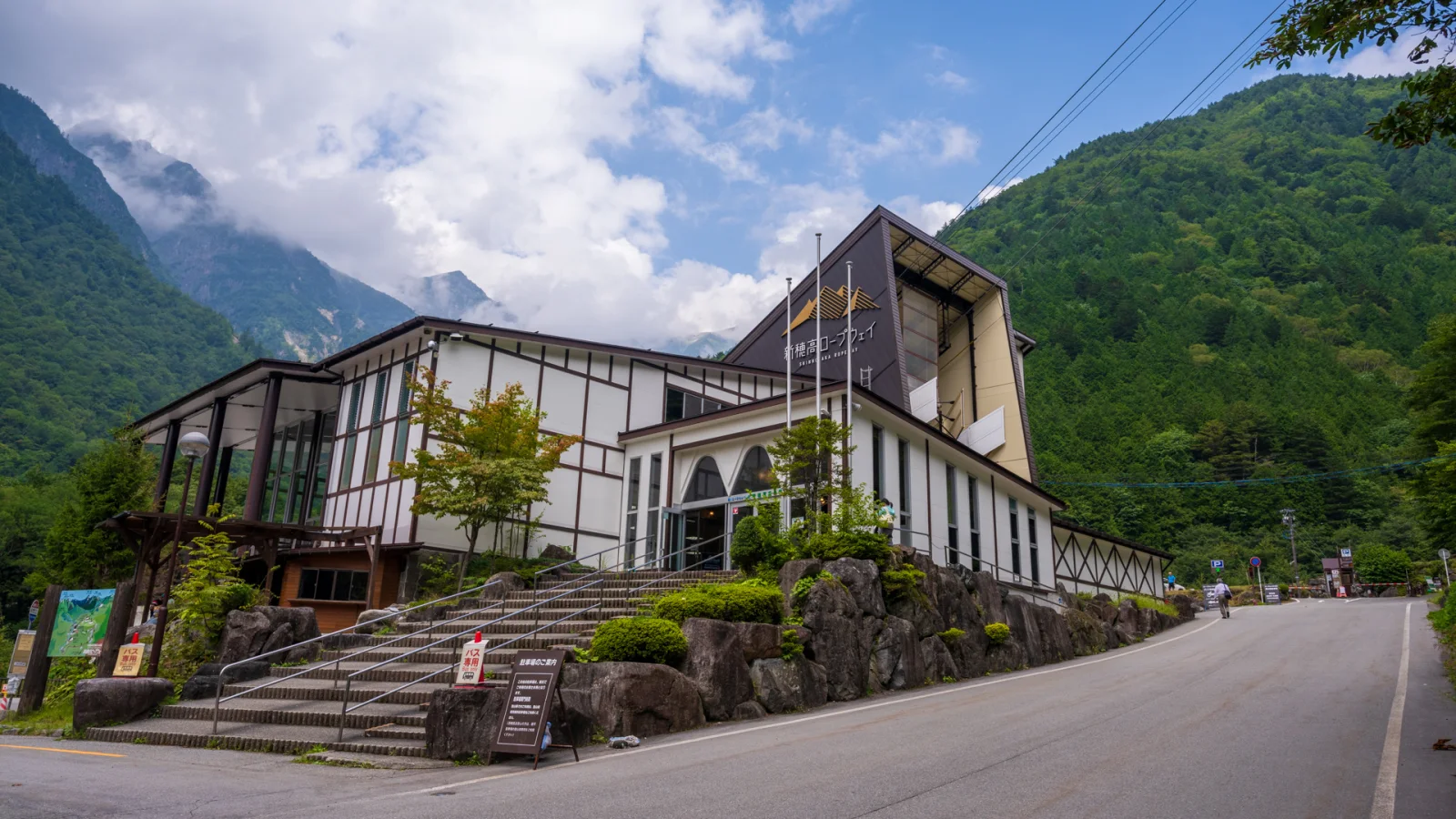
Zoom right in on the map to locate the exact bus stop when picking a Shinhotaka ryokan. Shinhotaka Onsen-guchi, Nakao Kogen-guchi, Shinhotaka Onsen, and Shinhotaka Ropeway are four separate stops. The ropeway sits at the terminus; inns within walking distance of the base station let you catch the earliest gondolas, whereas properties up in Nakao Highland require planning how you will reach the boarding point. If a listing advertises a shuttle, confirm which stops it serves, pickup hours, and whether drop-off is available on check-out morning. Hauling wheeled luggage uphill for ten or fifteen minutes is tough in snow or after dark.
If you want unhurried access to your ryokan's baths over two nights, staying at the same property is usually better value. Spend the first afternoon outdoors if the weather holds, and save the ropeway for the clearest visibility window on day two. Splitting two nights across two villages only makes sense when the rooms and dinners themselves are the point of the trip, or when you want to step outside for a specific evening illumination. Before switching inns mid-trip, arrange luggage storage in advance—early drop-offs and late pickups always depend on the hours your accommodation agrees to.
| Hot-spring district | Best reason to stay overnight | Bus stop and walkability |
|---|---|---|
| Hirayu | First-time car-free trips or next-day connections to Matsumoto, Shinjuku, or seasonal Kamikochi | Hirayu Onsen (HO37); prioritise inns within walking distance of the terminal |
| Fukuji | Quiet village dinners followed by the morning market the next day | Usually Fukuji Onsen (HO40) inside the hamlet; follow your inn's stop instructions |
| Shin-Hirayu | Focusing on ryokan dining and soaking, with winter strolls around Shinsui Park | Shin-Hirayu Onsen (HO48) is the main stop; inns string out along the main road |
| Tochio | Soaking in Kojin no Yu or seeing the Horadani Snow Cherry Blossoms illumination | Tochio Onsen (HO51); check which side of the road your stop serves |
| Shinhotaka | Reaching the ropeway before doors open, or staying on Nakao Highland for snow huts | Match the stop to your inn's address; the ropeway entrance is at terminus HO65 |
For a first car-free visit, base yourself in Hirayu; choose Shinhotaka for early ropeway rides, or pick Fukuji, Shin-Hirayu, or Tochio for quiet ryokan soaking. Compare Takayama and Matsumoto buses, ropeway passes, and 2026–27 winter illuminations to plan an effortless overnight trip.
Walk-up buses from Takayama, advance seats for Matsumoto and Shinjuku
From Takayama, board the Hirayu–Shinhotaka Line at the Takayama Nohi Bus Center right beside JR Takayama Station. On the year-round timetable, an example departure at 10:40 reaches Hirayu at 11:38 and the ropeway terminus at 12:25. Budget around one hour from Takayama to Hirayu and another 40 minutes from Hirayu to the ropeway base. Adult single fares are ¥1,600 from Takayama to Hirayu, ¥2,200 to the ropeway, and ¥910 between Hirayu and the ropeway. No reservation is needed uphill from Takayama or Hirayu; simply buy your ticket at the counter or vending machine at either terminal or the ropeway station. At weekends and during public holidays, arrive early to queue.
One uphill stretch is an exception. Under Nohi Bus rules, passengers boarding between Nakao Yakedake Tozanguchi and Shinhotaka Onsen towards the ropeway must reserve by telephone before 18:00 JST the previous day. If you stay along that stretch, confirm your inn's morning drop-off before locking in a gondola time. Heading back downhill, check the bus destination too. Several departures on the current timetable terminate at Hirayu rather than continuing all the way to Takayama, so verify whether your chosen departure lists an arrival time in Takayama before boarding at the ropeway.
For Matsumoto, check the Limited Express Matsumoto Line jointly operated by Nohi Bus and Alpico; seats are reserved by date in both directions and go on sale one month prior to travel. The scheduled journey between Hirayu and Matsumoto Bus Terminal takes around 90 minutes. If you are staying in Hirayu, book directly to or from Hirayu; if arriving from Matsumoto and leaving for Takayama after check-out, buy separate tickets for Matsumoto–Hirayu and Hirayu–Takayama. Special direct buses run from Shinhotaka to Matsumoto on 29 December 2026 to 3 January 2027; on other winter dates, take a local bus from the ropeway back to Hirayu to change to the limited express. If you plan to head to Matsumoto right after a morning ropeway visit, book an afternoon limited express seat and catch the earlier local bus down.
Travelling straight from Tokyo, take the Shinjuku–Takayama highway bus and alight at Hirayu. Reservations open one month before departure; select Busta Shinjuku as the origin and Hirayu Onsen as the destination. The ride takes roughly four and a half hours and works well if you want to spend your first night in the mountains. If your bus arrives close to dinner service, make the evening meal your priority on day one and save Hirayu Otaki Falls for the next morning. Whenever you have an onward coach booked to Shinjuku or Matsumoto, build in extra margin for walking from your ryokan and potential delays on local buses.
A Nohi Bus service notice issued on 22 November 2026 details detours following a landslide on National Route 158: the Hirayu–Shinhotaka Line is temporarily bypassing the Shioya stop, and Takayama Line services towards Matsumoto are subject to delays. Whenever you are connecting onto a limited express train at either end, check both the bus status page and rail schedules together. Leaving one train's worth of buffer at Takayama or Matsumoto Station is far safer than booking tight back-to-back transfers.
Structuring a two-day, one-night trip around your day-two exit
On a Takayama round trip, catch a morning bus to Hirayu, drop your bags with your ryokan as arranged, and spend the afternoon walking out to Hirayu Otaki Falls and around the village. Day-use bathers can head back to the centre before dinner for the Hirayu Folk Museum area or Hirayu no Mori. Late arrivals should keep things simple in the village streets and head straight into their ryokan bath. Transit, walking, and changing in and out of robes easily eat up the afternoon, so the one thing worth protecting on an overnight trip is making it to dinner on time.
The next morning from Hirayu, one year-round departure leaves at 08:40 and reaches the ropeway base at 09:16. From December to March, the first ropeway car leaves the base at 09:00, making that 08:40 bus a tidy fit for the 09:30 Stage 1 departure. Earlier risers can take the 08:00 bus from Hirayu arriving at 08:45, provided you have agreed an early breakfast time with your inn. If you aim to catch the 12:55 local bus back down from the terminus, check the return timetable first and allow for gondola queues and the walk to the bus bay before deciding whether to eat on the mountain or down in the valley. That 12:55 departure is scheduled into Hirayu at 13:28 and Takayama at 14:31.
If you are exiting towards Matsumoto, stay the night in Hirayu, check out and leave your luggage there in the morning, ride the ropeway, and return to Hirayu to collect your bags for your pre-booked limited express. For example, the 12:55 bus down reaches Hirayu at 13:28, leaving plenty of time to grab luggage and a bite to eat before the 14:55 departure for Matsumoto. Travellers staying in Fukuji who are heading onwards to Matsumoto have two luggage options: take your bags to Hirayu for locker storage in the morning before riding up to the ropeway, or leave them at the ryokan and catch a downhill bus that loops into Fukuji to retrieve them before catching the next bus to Hirayu. Waiting for the loop service and a second bus adds considerable time to the second option.
Anyone heading straight from Takayama to the ropeway before afternoon check-in can use coin lockers inside the Shinhotaka Ropeway station during operating hours. Lockers are also available at Hirayu Bus Terminal and the adjoining Alps Kaido Hirayu. If you are staying in Hirayu and returning there for an onward limited express, leave large suitcases near the terminal to collect during your transfer; if heading straight back to Takayama, store them at Shinhotaka and pick them up on the way down. Bringing big cases onto the ropeway means finding space inside the cabin and paying an overweight luggage fee, so pack a light daypack with warm layers, water, and valuables instead.
If you only have a single day from Takayama, choose one focus: mountain views or hot springs. For the mountains, stay on the bus from Takayama all the way to HO65 and return to Takayama from the same stop. For hot springs, get off at Hirayu and pair a soak with a short stroll through the village before the bus back. Mixed groups with different priorities can travel together to Hirayu, split up, and reconvene at the terminal—anyone riding the ropeway simply works backwards from the return timetable. Meeting for dinner back in Takayama is far easier than waiting for two consecutive local buses between villages with day-trip bags.
When the ropeway is the main reason for your trip, ride up on arrival day if the peaks are clear. Catch the bus straight from Takayama to the ropeway terminus with just a daypack, then drop down to your accommodation towards evening. If low cloud hangs over the valley on both days, having booked a ryokan you genuinely enjoy means you can pivot effortlessly to the Fukuji morning market or Hirayu's day-use baths the next morning and still make your booked departure home.
Boarding the Shinhotaka Ropeway and comparing passes
Stage 1 runs from Shinhotaka Onsen Station to Nabedairakogen Station, where you walk across to Shirakabadaira Station to board Stage 2. The iconic double-decker gondolas operate on Stage 2, climbing to Nishihotakaguchi Station at 2,156 metres. Stage 1 normally departs on the hour and half-hour, while Stage 2 departs at 15 and 45 minutes past the hour; the combined riding time is roughly 25 minutes one way, excluding queues and the transfer walk. Shinhotaka Onsen Station sits at 1,117 metres and Shirakabadaira at around 1,308 metres, with Stage 2 gaining roughly another 850 metres. If you have a pushchair, need step-free access, or want to browse the shops at Shirakabadaira, simply take the following departure rather than rushing. Official guidance notes that wheelchair users can reach Nishihotakaguchi via lifts, ramps, and stairlifts—ask station staff on arrival so they can guide your route.
As checked in November 2026, a standard two-stage return ticket costs ¥3,800 for adults and ¥1,900 for primary-school children, while pre-schoolers ride free when accompanied by an adult; bags over 6 kg require a two-stage return luggage ticket at ¥1,000. From the base station, buy the combined two-stage return. Drivers visiting when the Nabedairakogen car park is open can board Stage 2 directly from Shirakabadaira for ¥3,700 return. In winter, set your satnav to the Shinhotaka Onsen base car park instead: the Nabedairakogen car park beside Shirakabadaira closes for winter, and with only a ¥100 fare difference between the two-stage and Stage-2-only tickets, road conditions and car-park openings dictate where to park.
Nohi Bus sells the Okuhida Marugoto Value Kippu, covering unlimited rides on designated Nohi local bus routes plus one two-stage ropeway round trip; the current edition is valid through 31 March 2027. A two-day pass costs ¥7,700 for adults starting from Takayama and ¥5,400 starting from Hirayu. For a classic overnight from Takayama to Hirayu, ropeway round trip the next day, and return to Takayama, buying single tickets costs ¥1,600 × 2 plus ¥910 × 2 plus ¥3,800, totalling ¥8,820—meaning the Takayama pass saves ¥1,120. If you have already paid separately for a highway coach into Hirayu, compare only the Hirayu–base bus return plus the ropeway (¥5,620 separately), where the Hirayu pass saves ¥220. Onward limited express buses to Matsumoto require a separate ticket.
If the ropeway is optional on a one-night stay, wait until you can see operating status clearly before buying a pass. Passes are non-refundable once activated; if the ropeway is suspended due to weather, the bus operator provides vouchers redeemable at ropeway facilities rather than a cash refund for the fare difference. Two- or three-day validity starts from your first bus ride. Vouchers purchased ahead of time via convenience stores or travel agencies must be exchanged for the actual pass at the designated departure terminal, so factor that counter stop into an early start. Mobile tickets are also offered via Nohi Bus's website.
The operator has announced full two-stage maintenance closures from 24–27 November 2026, during which station shops and restaurants also close. From 5 December, the Shirakabadaira area opens the new Soyoka Footbath and Soyoka Hiroba plaza—ride up to Nishihotakaguchi in clear weather first, then pause for a foot soak on the way back down. Even when both stages are running, summit temperatures are typically 6–10°C colder than at the base. Check the live summit camera and operating status on the official site before setting off; if the peaks are socked in by white fog, enjoying a hot bath near the bus terminal beats waiting at the base station for blue skies that may never arrive.
At Nishihotakaguchi: head straight for the rooftop deck first
The rooftop observation deck at Nishihotakaguchi is called ALPSCAPE. On clear days, the viewing markers help you pick out the sharp pyramid of Mount Yari, the ridgeline of the Hotaka peaks, and Mount Kasagatake opposite. When cloud is drifting in and out, spend your initial minutes on the roof watching how fast it moves before deciding how long to wait. For a closer walk among the conifers, head out to Itadaki no Mori beside the station and choose between the Yari Corridor or Forest Terrace depending on which paths are open. Both viewpoints sit right next to the terminal, so anyone in your group feeling the cold can wait inside the heated lounge.
Allow 45 minutes to an hour at the summit—more if you plan to walk the forest trails, eat, or expect a queue for the descent. Take in the views at the top first, then decide where to pause. If the rooftop wind is biting, warm up inside the terminal or drop down to the lounge and bakery at Shirakabadaira Station. With only a tight window left before your return bus, keep that margin for the gondola transfer and queue rather than squeezing in a hurried lunch at another hot-spring stop. Before boarding Stage 2 downhill, check the final Stage 1 departure time too, as the two last cars leave from different platforms.
Travelling with older relatives or young children, plan to stick to the rooftop deck and indoor spaces. Negotiating stairs, outdoor transfers, and queues at the ropeway stations adds up quickly, so factor everyone's stamina into a half-day plan. Layer up as soon as you step off Stage 2, and pack spare gloves for children or a small towel for footbaths in the same daypack. The mountaineering trailhead towards Mount Nishihotaka sits right next to the Itadaki no Mori boardwalks; casual visitors should stick to signposted station grounds and remain inside the terminal and open decks during heavy snow or trail closures.
Getting off at Hirayu: budget separate time for the falls and baths
Hirayu Otaki plunges 64 metres down a 6-metre-wide cliff face into the valley floor, tucked to the Takayama side of the bus terminal. On the local timetable, Otaki-guchi / Campground-mae (H36) is the closest stop to the walking trail, though some services skip it; once you have dropped bags in Hirayu, you can walk out from town towards the ski slope or ride a bus stopping at H36 one or both ways. In summer, vehicles can drive up to the viewing plaza below the falls, whereas in winter the tourism association notes that access stops around the Ankiya restaurant area, leaving roughly a 30-minute walk each way. Allow extra time on top of that for the return leg, photos, and slower footing in snow.
The waterfall trail and village bathhouses sit in opposite directions. If you arrive with young children, older travellers, or suitcases, drop your bags at the ryokan before deciding whether to tackle the waterfall walk. When winter daylight fades early, visit the Hirayu Folk Museum and footbath park first and leave the falls for bright morning light. The Hirayu Folk Museum preserves thatched gassho-style farmhouses alongside the open-air bath Hirayu no Yu, listed by the Hirayu Onsen Tourism Association as open 06:00–21:00 in summer and 08:00–19:00 in winter for a small honesty-box fee. If you want proper showers to wash your hair and a lounge to relax in afterwards, choose a full-service day-use bathhouse instead.
Right near Hirayu Bus Terminal, Hirayu no Mori taps two distinct spring sources—one visibly milky white, the other crystal clear. Day-use entry to the large indoor and open-air baths is ¥700 for adults and ¥500 for children aged three through primary school Year 6, open 10:00–21:00 with last admission at 20:30. Its private iron-kettle baths operate for day visitors from 12:00–15:00 (last reception 14:15) at ¥3,000 per group for 45 minutes, booked on arrival; turning up around lunchtime gives families the best chance of a slot. Note that Hirayu no Mori is closed for maintenance from 30 November to 11 December 2026, affecting overnight stays, day-use bathing, on-site dining, and its sister restaurant Ankiya—during those dates, use Hirayu Folk Museum for day bathing and dine around the bus terminal or your own ryokan.
Next to the terminal, the Okuhida Visitor Centre introduces alpine flora and fauna while posting current weather and trail conditions, making it a handy stop in rain or between buses. Entry is free from 09:00–17:00, closed Wednesdays (shifting to the next weekday if Wednesday is a national holiday). Alps Kaido Hirayu beside the bus bays houses a souvenir shop and restaurant; winter hours from 16 November 2026 to 16 April 2027 are 09:00–17:00 for the shop and 10:30–15:00 for the restaurant (last order 14:30). From 2 December through the end of March, the restaurant and takeaway counter close on Wednesdays, except on 30 December and 6 January—so if you are changing buses around midday on a winter Wednesday, eat elsewhere or bring a simple lunch from Takayama.
Fukuji, Shin-Hirayu, and Tochio: one standalone walk in each
Stay in Fukuji and you can dedicate the next morning to Mukashibanashi no Sato. Its morning market sets up near the entrance from 06:30–11:00 between 15 April and 14 November, and 08:30–11:00 between 15 November and 14 April, selling Hida dried vegetables, miso, pickles, and local produce. Within the grounds, there is also a small museum of fossils excavated around Fukuji and Ishido no Yu, where you can grill gohei-mochi rice skewers beside an open hearth. On a day trip from Hirayu, pick morning outbound and return buses that stop in Fukuji, browse the market first, and choose one spot inside the grounds with your remaining time so you are not rushing back and forth along the main road against the clock.
People usually choose Shin-Hirayu for a specific ryokan. Properties stretch out along the highway, and daytime strollers can head down to Shinsui Park and Taruma Falls along the Hirayu River. Guests staying nearby can walk to the winter illuminations after dark; if your inn is further out, arrange a pickup in advance and plan evening movements and weekday lunches ahead. For souvenirs, travellers heading onwards to Matsumoto can shop during the Hirayu bus transfer, while Takayama-bound visitors have more choice back in the city. If you have your heart set on Hida beef for dinner, verify whether your room plan includes it or requires an upgrade.
In Tochio, Kojin no Yu sits right beside the Kamada River as an unmanned, gender-separated communal open-air bath with no washing stations or showers—rinse thoroughly using the buckets provided at the tub edge before stepping in. Leave roughly ¥300 in the donation box; standard hours are 08:00–22:00, opening at 12:00 on Mondays, Wednesdays, and Fridays after cleaning. Bring coins and your own towel; parents with young children can easily take turns soaking here. Although the bath stays open until 22:00, bus passengers will still need to leave earlier to catch the last service back to their inn.
In Shinhotaka, Nakazaki Sanso Okuhida no Yu stands close to the Stage 1 ropeway terminal, making it an easy walk for a post-mountain soak and simple meal after braving the summit wind. The tourism association lists hours as 09:00–18:00 (last entry 17:00) with irregular closing days; admission is ¥1,000 for adults and ¥500 for children, increasing to ¥1,200 and ¥600 from December. Buses back to Takayama depart right from the ropeway terminus nearby, so pick your return bus first and decide whether to stay for both lunch and a bath or just one.
Water colour and mineral scent vary noticeably from village to village. The tourism association lists simple thermal, bicarbonate, sulphur, and chloride springs across the valley, so check the published spring analysis of your ryokan or bathhouse before booking. Even within a single district, sources differ. For an easy comparison, pair your ryokan's indoor shower-equipped bath with one riverside open-air tub. Hirayu and Shinhotaka both offer straightforward day-use stops by bus, and if adding a third village feels rushed, save that energy for one more soak after dinner.
The Okuhida Yukemuri Tatsujin bath-hopping pass costs ¥1,200 and grants entry to two or three participating bathhouses; it is sold at the Hirayu and Shinhotaka tourist information centres among other outlets. Before buying one, circle the specific baths you want on the official list and cross-check their day-use hours. If you only plan to soak at your ryokan plus one public bath, paying on the door is simpler; the pass mainly pays off if you are driving and have already mapped out two or three baths.
Match your winter overnight to the illumination you want to see
Winter night events for 2026–27 span all five districts, so if you want to step back out after an evening soak, book your room right beside your chosen venue. Shin-Hirayu, Tochio, and Fukuji all run nightly illuminations from late December 2026 through the end of February 2027. Check the walking route on a booking map and ask your ryokan which exit is easiest after dark; if the distance is far, arrange transport ahead of time rather than assuming you can hop between villages. Bus links that feel effortless by day disappear once the final evening service passes.
The Hirayu Otaki Ice Festival runs from 15–25 February 2027, with illuminations from 19:00–21:00 and snow fireworks listed by organisers around 20:30. Even when staying in Hirayu, allow walking time to and from the waterfall trailhead and book an early dinner slot with your ryokan. Further up the valley, the Shinhotaka Nakao Kamakura Festival takes place from 1–10 February 2027 from 20:00–21:00 in the grounds of Hakusan Shrine on Nakao Highland; official notices stress limited dedicated parking and no shuttle buses, so look for lodging right around Nakao Highland if you want to walk among the snow huts.
If someone in your group feels the cold easily, Fukuji's Aodaru illumination switches on at 17:00 right near the Fukuji Onsen stop, letting you stroll through before heading back inside for dinner; an additional ice-path illumination runs from 4–14 February between 19:30 and 21:00. Shin-Hirayu lights up Taruma Falls and Shinsui Park from 17:00–21:30, while Tochio's Horadani Snow Cherry Blossoms run from 17:00–23:00. In Shin-Hirayu, scout the Shinsui Park path during daylight so the walk out to the frozen falls is easy after nightfall; Tochio's late curfew means even guests on a later dinner seating still have time to catch Horadani.
Give even short winter road journeys generous slack. The ropeway operator notes that snowfall typically occurs from mid-November to early April, so drivers must fit winter tyres and carry cold-weather gear. Bus travellers should prioritise inns within walking distance of a terminal or stop when snow is forecast. Check live bus advisories before heading out at night, carry a torch or use a phone light on unlit paths, and wear grippy winter soles. When eyeing riverside open-air baths, remember the icy steps between the changing room and the water—older travellers worried about slipping may prefer staying at a ryokan with spacious indoor baths.
Dividing days across Kamikochi, Takayama, and Okuhida
Arriving in Hida for the first time from Nagoya or the Hokuriku coast, spend a night in central Takayama first to see Sanmachi, Takayama Jinya, or Hida no Sato, then catch a morning bus up into Okuhida for one night. Check out of your city hotel in the morning so your afternoon up in the mountains belongs entirely to your ryokan and the baths. Shirakawa-go works best as a separate leg from Takayama or another hub with direct buses; if you have an early bus to Shirakawa-go, come back down from Okuhida the previous afternoon and sleep in Takayama so your bags are already near the terminal. For your half-day in town, pair this plan with our walking guide to Takayama's old town and Takayama Jinya.
Kamikochi ties into Okuhida on two strict clocks. First, the Nohi Bus from Hirayu to Kamikochi Bus Terminal takes roughly 30 minutes. Second, the valley keeps a fixed seasonal window: in 2026, buses run until 15 November, after which Kamikochi closes for winter from 16 November 2026 until mid-April 2027, ruling out standard sightseeing visits from Hirayu during those months. On an early morning bus during the open season, either alight at Taisho Pond to walk through to Kappa Bridge or ride straight to the terminal, picking the shorter path if weather or return schedules look tight. Drivers approaching from Takayama must park at Akandana Car Park and switch to authorised shuttle buses or taxis to enter Kamikochi.
If you want to visit both Kamikochi and the Shinhotaka Ropeway, put them on separate mornings. Both routes branch out from Hirayu, so trying to cram them into one day wastes midday hours waiting between buses. On a tight one-night trip, you can leave Takayama early on day one, drop bags in Hirayu, head straight into Kamikochi, and return to your ryokan for the afternoon, then ride the ropeway on day two before continuing to Matsumoto or Takayama. If you arrive after midday on day one, two nights works far better—giving Kamikochi a full middle day and leaving check-out day solely for either the ropeway or a village walk, with extra buffer for full buses over long weekends. In winter, swap the Kamikochi day for a half-day at Shinhotaka and an overnight in the same district to catch snow scenes and illuminations together.
If you are changing hotels each night along a Takayama–Hirayu–Matsumoto traverse, treat Hirayu Bus Terminal as your anchor. Coming in from Matsumoto, aim to reach the terminal around midday for lunch and spend the afternoon exploring Hirayu rather than racing for the last ropeway car. Coming from Takayama with an onward public-transport connection back to Tokyo, put your check-out-day departure time from Hirayu at the very top of your plan and work backwards so there is ample time to collect stored bags. And if this is your first half-board hot-spring stay, read our first-timer's guide to booking a Japanese ryokan alongside your shortlist to compare dinner plans and private bath options.
A few useful answers
For a one-night stay, is Hirayu or Shinhotaka more convenient?
Stay in Hirayu if you need onward connections to Takayama, Matsumoto, Shinjuku, or seasonal buses into Kamikochi. Pick a ryokan within walking distance of Shinhotaka Onsen Station if riding the ropeway as soon as the skies clear is your top priority. Accommodation in the Shinhotaka area is spread out, so check the actual walking distance to the ropeway entrance when booking.
Are Fukuji Onsen and Fukuji Onsen-guchi interchangeable?
To visit the Fukuji Morning Market or Mukashibanashi no Sato, board a bus that stops at HO40 Fukuji Onsen. HO45 Fukuji Onsen-guchi is simply a junction stop on the main highway. If you are staying elsewhere, follow the exact stop name provided by your ryokan for both outbound and return trips.
Do I need to book the bus from Takayama to Shinhotaka in advance?
No reservation is needed on the Nohi Bus Hirayu–Shinhotaka Line when boarding from Takayama or Hirayu. However, passengers boarding between Nakao Yakedake Tozanguchi and Shinhotaka Onsen bound for the ropeway must reserve by phone before 18:00 JST the previous day. Limited express buses to Matsumoto and highway buses to Shinjuku require advance seat reservations, which open one month before the travel date.
Can I see both the Hirayu frozen waterfall and the Nakao snow huts in winter 2026–27?
The two festivals fall on different dates. The Nakao Kamakura Festival runs from 1–10 February 2027, while the Hirayu Otaki Ice Festival takes place from 15–25 February 2027. Evening illuminations in Fukuji, Shin-Hirayu, and Tochio continue through the end of February, so you can easily pair one of those with whichever festival matches your week.
Do I have to ride both stages of the ropeway to board the double-decker gondola?
The double-decker gondolas operate on Stage 2 between Shirakabadaira and Nishihotakaguchi. From the base station, buy the combined two-stage return ticket. If you are driving when the Nabedairakogen car park is open, you can drive straight to the mid-station; when snow closes that car park, park at the base station instead.
Official information and references
Sources used in this guide.
- Okuhida Onsen-go Tourism Association: Five Districts Overview and Spring Types
- Nohi Bus: Takayama–Hirayu–Shinhotaka Line Timetable, Fares, and Stops
- Nohi Bus: Matsumoto Limited Express Timetable, Reservations, and Year-End Direct Services
- Nohi Bus: Hirayu–Shinjuku Highway Bus and Reservations
- Nohi Bus: Service Status and Detour Notices
- Nohi Bus: Okuhida Marugoto Value Kippu Details, Pricing, and Conditions
- Shinhotaka Ropeway: Timetable, Fares, and Luggage Rules
- Shinhotaka Ropeway: Official Live Operations and Weather Status
- Shinhotaka Ropeway: FY2026 Maintenance Closure Schedule
- Shinhotaka Ropeway: New Mid-Station Footbath and Plaza Opening Notice
- Shinhotaka Ropeway: Facility Map, Station Floors, and Timetable (PDF)
- Shinhotaka Ropeway: Accessibility, Temperature Difference, and Winter Driving FAQ
- Okuhida Onsen-go Tourism Association: Hirayu Otaki Falls Information
- Hirayu Onsen Tourism Association: Public Baths and Footbaths
- Hirayu no Mori: Day-Use Bathing and Private Bath Pricing
- Hirayu no Mori: Maintenance Closure Notice
- Gifu Prefecture: Okuhida Visitor Centre Opening Hours and Information
- Mukashibanashi no Sato: Facilities, Fukuji Morning Market, and Bus Stop
- Gifu Prefecture Chubu-Sangaku National Park: Shin-Hirayu and Shinsui Park
- Okuhida Tourism Association: Kojin no Yu Hours and Facilities
- Okuhida Tourism Association: Nakazaki Sanso Day-Use Bathing
- Okuhida Tourism Association: Yumeguri Bath-Hopping Pass
- Okuhida Winter Story 2026–27: Event Dates and Venues
- Nohi Bus: Hirayu–Kamikochi Line and 2026 Operating Season
- Kamikochi Official Website: Winter Closure and Off-Season Entry Notice
- Chubu-Sangaku National Park: Coin Locker Locations and Ropeway Station Hours
- Okuhida Tourism Association: Alps Kaido Hirayu Winter Dining and Shop Hours
- Okuhida Tourism Association: Fukuji Onsen Morning Market Hours
- Kamikochi Official Website: Takayama-Side Park-and-Ride Access (Akandana)