Planning an autumn foliage trip to Nara in 2026? Pair Nara Park's deer and lakeside maples with Tanzan Shrine's thirteen-storey pagoda illuminations and Shoryaku-ji's borrowed-scenery garden. Peak dates, entry fees, last buses, evening return options, and one- and two-day itineraries.
- Region & Focus
- Nara and Yoshino
- Reading Scope
- 21 min read · 11 chapters · 4 Q&As
- Official Verification
- 25 official sources checkedUpdated 22 November 2026
- Key Topics
- SeasonsItinerariesKyoto, Osaka & Kansai
Chapter Route Map (tap any stop)
- When to visit Nara for autumn foliage: choose the area first, then pick your dates
- Half a day in Nara Park: open lawns or the waterside first
- Deer in autumn rut: keep space for photos
- Isuien and Yoshikien Gardens: stepping into quiet greenery beside Todai-ji
- Tanzan Shrine by day: timing your visit for the pagoda
- Tanzan illuminations run until 20:30, but the last bus leaves much earlier
- Shoryaku-ji: start with Fukuju-in's garden, then climb to the Main Hall
- Shoryaku-ji seasonal buses end on 29 November: how to plan the final days
- Nishinokyo for halls and pagodas: walking two temples from one station
- One- and two-day itineraries: start with the scenery you care about most
- Rain, late arrivals or fallen leaves: how to adapt your route
- Quick Q&A
On a first autumn trip to Nara, half a day is enough for Nara Park. Head to Ukigumo-enchi and Kasugano-enchi to photograph deer among the turning trees, then set aside another day for Tanzan Shrine or Shoryaku-ji to see maples framing historic architecture. In 2026, the two mountain sites diverge in schedule: Tanzan Shrine's evening illuminations run until 6 December, and Shoryaku-ji's special autumn viewing ends on the same day, yet Shoryaku-ji's direct shuttle buses finish earlier on 29 November. If you are travelling into December, lock in your transport before choosing which valley to visit.
When to visit Nara for autumn foliage: choose the area first, then pick your dates
If you want to book a hotel early, treat late November as the prime window for central Nara. Nara Prefecture's park guide places peak Japanese maple colour in Nara Park between late November and early December. On 20 November 2026, the Nara City Tourist Association already listed Nara Park, Isuien Garden and Shoryaku-ji in the '50% turned to peak' column. Because that symbol spans everything from half-turned canopies to full peak, it works best for deciding which neighbourhoods to prioritise. If you are travelling specifically for one tree by a pond, check recent on-site photos from official channels; images of the canopy and ground will tell you far more than a single park-wide icon.
A single stroll often shows several stages of autumn at once. Once ginkgo leaves drop, the branches may look sparse while a yellow carpet lingers between the paths and roots. Waterside maples are worth viewing from the opposite bank while sunlight still hits the surface, catching both the foliage and its reflection. For a whole hillside turning together, Shoryaku-ji puts greens, yellows and reds in the same frame. Nara Kotsu lists typical peak viewing at both Shoryaku-ji and Tanzan Shrine from mid-November to early December. When combining Kyoto and Nara, check live leaf reports for each spot and visit whichever is turning first.
If your trip falls in late November, give one morning to Nara Park and another to the direct bus up to Shoryaku-ji. In early December, travellers relying solely on public transport will find daytime connections to Tanzan Shrine easier to piece together; those set on Shoryaku-ji's borrowed-scenery garden should arrange return taxis or book a scheduled sightseeing bus running before 6 December. Leaf progress shapes which mountain appeals most, while bus timetables dictate how many hours you have on site. Separate those two constraints early, and even a late-season trip stays straightforward.
| Area | Autumn highlights | How to get there | Planning trade-offs |
|---|---|---|---|
| Nara Park | Deer, parkland foliage, Ukimido Pavilion and Sagi-ike Pond | Walk from Kintetsu-Nara Station, or take a city bus from JR Nara Station | With half a day, pick one spot in the north and one in the south |
| Isuien and Yoshikien Gardens | Pond views, borrowed scenery and moss gardens | Walk from Kintetsu-Nara Station towards the west side of Todai-ji | Isuien usually closes on Tuesdays; Yoshikien is free |
| Tanzan Shrine | Wooden thirteen-storey pagoda, shrine halls and evening illuminations | Bus from Sakurai Station South Exit, Stop 1 | Arrange your return before staying for the full evening illumination |
| Shoryaku-ji | Fukuju-in borrowed-scenery garden, hillside maples and special display of the principal image | Autumn direct bus from both Nara stations, or taxi | 2026 direct shuttle buses end on 29 November |
| Nishinokyo | Autumn trees framing the halls and pagodas of Yakushi-ji and Toshodai-ji | Kintetsu Railway to Nishinokyo Station | Separate admission at each temple; best as an extra half-day from central Nara |
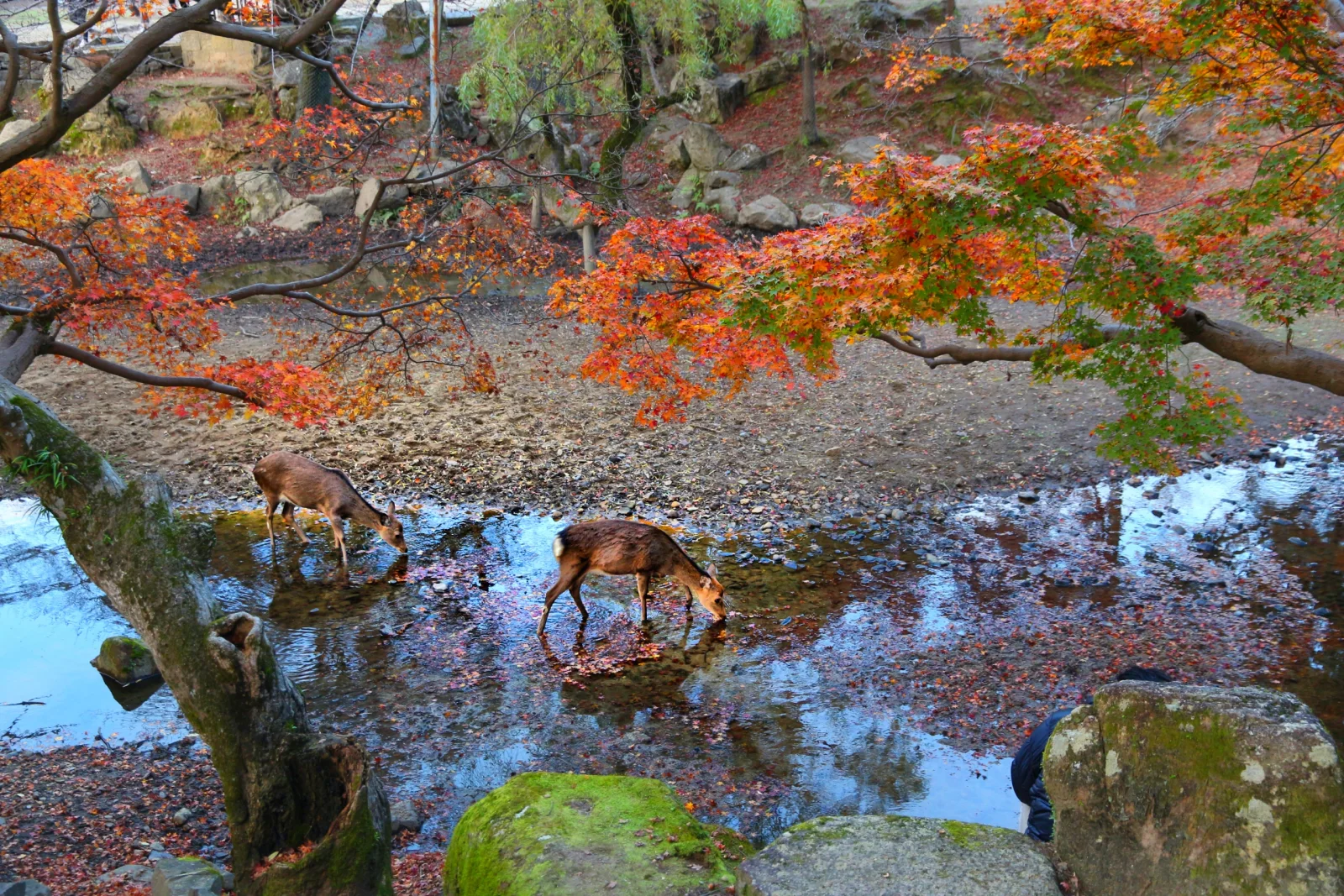
Planning an autumn foliage trip to Nara in 2026? Pair Nara Park's deer and lakeside maples with Tanzan Shrine's thirteen-storey pagoda illuminations and Shoryaku-ji's borrowed-scenery garden. Peak dates, entry fees, last buses, evening return options, and one- and two-day itineraries.
Half a day in Nara Park: open lawns or the waterside first
Walking east along Noborioji from Kintetsu-Nara Station quickly brings you to Noborioji-enchi, the city-facing edge of Nara Park. JR Nara Station sits further from the eastern lawns, so if you want to save your legs for the park, board the outer-loop city circular bus and alight at Todai-ji Daibutsuden / Kasuga-taisha-mae. That stop connects neatly to Todai-ji's Nandaimon Gate and Ukigumo-enchi. If your main stop is Kasuga-taisha Shrine, both Nara stations have buses directly to Kasuga-taisha Honden, letting you save the long approach walk for a gentle downhill return.
For morning deer photos, head to Ukigumo-enchi or Kasugano-enchi just outside Nandaimon Gate. Ukigumo-enchi frames views of Nandaimon and Mount Wakakusa, with room between the trees and grass to pause and watch the deer. Kasugano-enchi feels more open, and along the Yoshiki River you can drop your angle to capture overhanging branches and water together. The two lawns sit side by side, so linger wherever the colour and deer align. For cleaner shots, pick a low-hanging branch first and wait by the path for deer to wander past. Nara Prefecture's park guide notes that deer graze in grassy areas during the day before moving towards their sleeping grounds at dusk—so start on the lawns in the morning and continue naturally to Todai-ji.
If you prefer water reflections first, navigate to Sagi-ike Pond and Ukimido Pavilion. From the bank, the hexagonal pavilion and slender wooden bridge fit neatly into a single frame. On calm days, cross to the far side of the bridge, where shade often makes the reflected foliage sharper than the canopy above. When wind ripples the surface, zoom in on leaves reaching out over the water, or step into Yugayama-enchi south of the pond to view the former villa garden from a different angle. The gentle slopes of Asajigahara-enchi surround Ukimido; families with pushchairs can loop a short stretch around Sagi-ike before rejoining the main paved paths.
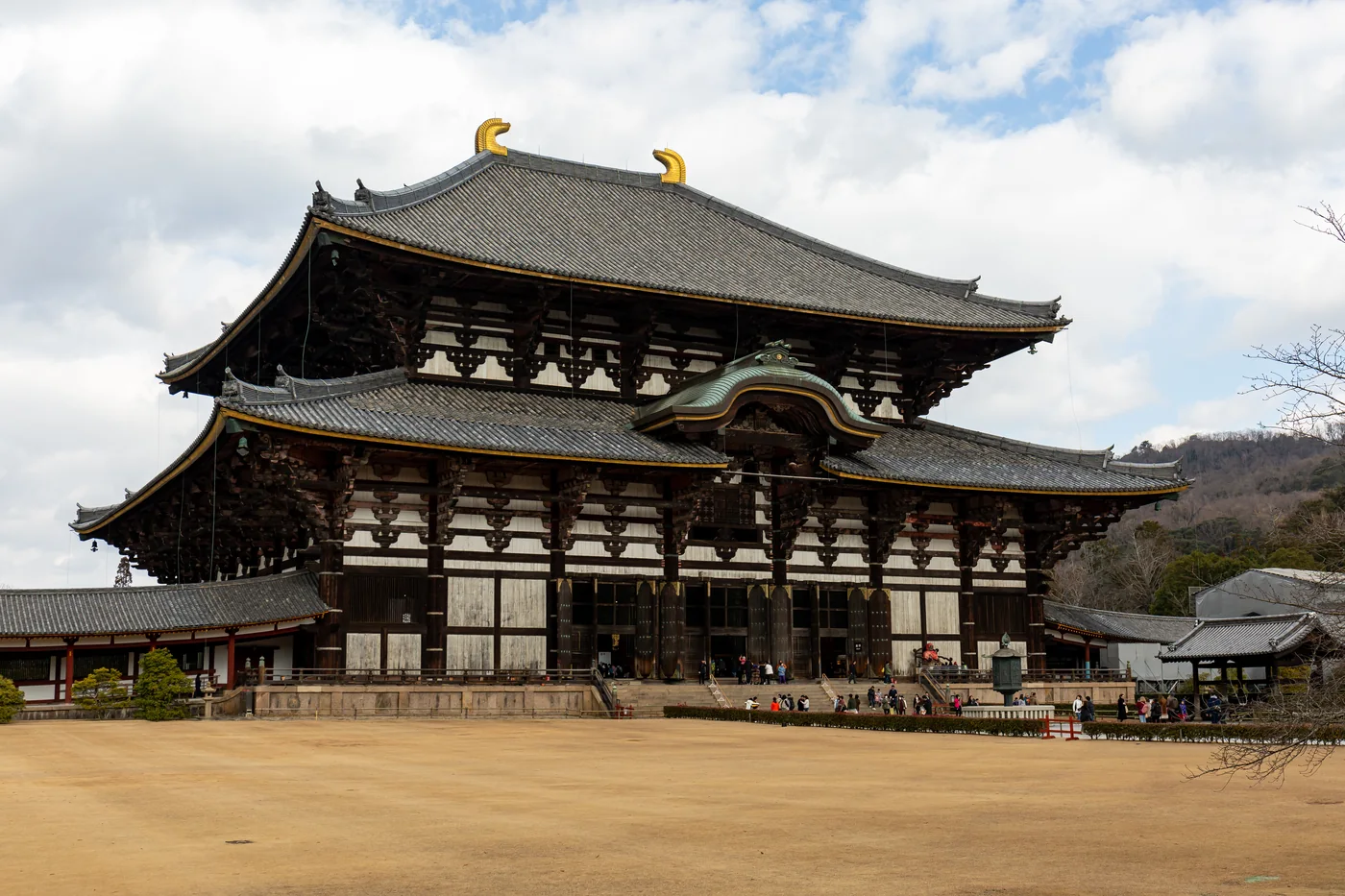
North of Sagi-ike lies the main approach to Kasuga-taisha Shrine, passing Tobihino lawn and stone-lantern-lined paths suited to an unhurried walk. To visit Todai-ji's Great Buddha Hall (Daibutsuden), turn north from Ukimido towards Nandaimon and decide there whether to climb up to Nigatsu-do Hall. From November to March, the Great Buddha Hall opens 8:00–17:00; single-hall admission is ¥800 for junior high school students and above, and ¥400 for primary school children, payable in cash according to Todai-ji's official site. Stepping inside first thing in the morning and picking a lawn afterwards avoids backtracking from deep inside Kasuga-taisha.
Nigatsu-do stands on higher ground east of the Great Buddha Hall, reached by a steady climb and stone steps. Set aside dedicated time if you want elevated views over tiled roofs and autumn trees. With only two or three hours in the morning, choose your top two priorities from the pond, the deer and the Great Buddha Hall, leaving enough margin for lunch or the walk back to the station. Stopping for twenty minutes on one lawn feels very different from pausing for every deer along the route, and the ground you cover changes accordingly.
Deer in autumn rut: keep space for photos
Nara Prefecture's park guide warns that stags enter the rut in autumn and may charge, butt with their antlers, kick or bite. Leave enough room to turn and step away, and tuck away maps, paper bags and plastic packaging before approaching. If deer gather across a narrow path or lawn entrance, wait for them to move on or take a parallel walkway. Keep young children beside an adult and step back together if a deer walks towards you.
Feed deer only official deer crackers (shika senbei). Keep bread, biscuits and food bags out of sight, never hold up a whole stack of crackers to draw a crowd, and do not lure deer across roads. To include both deer and maple branches in an autumn shot, stand back along the path with a medium telephoto lens and wait for a deer to enter the frame. Family portraits work better with space between you: have children face the camera while deer remain further back in the scenery. Visitors with toddlers or anyone uneasy around animals can stick to the outer walkways and still enjoy the lawns and autumn foliage.
Isuien and Yoshikien Gardens: stepping into quiet greenery beside Todai-ji
Isuien's front garden is compact and intimate, anchored by a teahouse and pond. The rear garden opens out: looking east across the water, Todai-ji's Nandaimon Gate and Mount Wakakusa become borrowed scenery within the composition. Allow an hour in autumn to see waterside maples and mountain ridges share the same frame. After viewing the teahouse and front pond, walk through to the rear garden to take in the distant vista before deciding which bank offers the best reflections. Follow the set garden route, noting that some stepping stones across the water have smooth, rounded tops. Isuien advises that paths are not wheelchair-accessible; visitors using a walking stick can ask staff at the entrance which sections are easiest to navigate.
Located in Suimon-cho just west of Todai-ji, Isuien is roughly a 15-minute walk from Kintetsu-Nara Station. It opens 9:30–16:30 (last entry 16:00), with general admission at ¥1,200 including the Neiraku Museum. It usually closes on Tuesdays; if Tuesday is a public holiday, it opens that day and closes on the following weekday instead. If pairing it with Todai-ji on the same day, visit the earlier-opening Great Buddha Hall first and continue to Isuien afterwards—or start at Isuien at 9:30 if morning light in the rear garden is your priority.
Next door, Yoshikien Garden features a pond garden, a moss garden and a camellia garden, with a standalone tea pavilion drawing the eye across the moss. If you want fallen maple leaves resting against bright moss and a low-slung roof, it is far easier to slow down here than along the busy avenues off Noborioji. In autumn, Yoshikien opens 9:00–17:00 (last entry 16:30) and admission is free. On days when Isuien is closed, walk through Yoshikien in the morning before heading back to the Great Buddha Hall. If your schedule also includes Nigatsu-do, one of the two gardens is plenty.
Tanzan Shrine by day: timing your visit for the pagoda
Tanzan Shrine sits in Tonomine in the city of Sakurai. From Stop 1 outside the South Exit of Kintetsu or JR Sakurai Station, buses take about 25 minutes to Tanzan-jinja, followed by a three-minute walk to the shrine. The route passes Shorin-ji, and during heavy autumn traffic buses may terminate early at Tonomine. Bus stop boards show both Tonomine and Tanzan-jinja, so check the exact stop name you boarded at when looking up return times. If a bus drops you at Tonomine, ask the driver where the return stop is and follow local signs uphill. Nara Kotsu charges ¥570 for a single adult fare. The shrine's access page also displays a timetable and fares, though its older table is dated 2023—rely on Nara Kotsu's dedicated autumn page for current times.
Enter through the main gate and climb the stone steps to the shrine complex, taking in the thirteen-storey pagoda and the path towards the Worship Hall first. Originally built for Fujiwara no Kamatari by his eldest son Joe, the current wooden pagoda dates from a 1532 reconstruction. Up close, foreground branches can slice across the stacked eaves, so step back to a wider terrace to see the full silhouette. Around the Worship Hall, follow the outer corridors for shifting angles where vermilion lacquer, cypress-bark roofs and layered wooden eaves meet yellow and crimson leaves.
Daytime general admission runs 8:30–16:30 (last entry 16:00). Following a fee revision in April 2026, entry is ¥700 for adults, ¥300 for primary school children, and free for pre-schoolers. If you arrive late in the afternoon, climb straight to the pagoda first and loop past the Worship Hall back down to the gate. For Santen Inari Shrine higher up on Mount Goharetsu, trail entry closes at 15:00 and the mountain area shuts at 16:00, so slower walkers are better off keeping that climb for an unhurried daytime visit. Older visitors with limited mobility arriving by car can use priority parking near the west entrance; wheelchairs are also available to borrow, and companions should check path conditions at the shrine office.
Allow at least 90 minutes for an afternoon visit from arrival to walking back to the bus stop, or two hours if you plan to enter the halls, see the special exhibition or linger over photos. The 2026 shrine treasures exhibition, 'Kamatari and the Blade: Prayers of the Warrior', runs from 1 November to 20 December. To combine the exhibition with autumn foliage, arrive during daytime hours—the evening illuminations run until 6 December. Once you find a clear vantage point showing all thirteen tiers of eaves, take your time photographing from there rather than climbing up and down the steps chasing your first composition.
Tanzan illuminations run until 20:30, but the last bus leaves much earlier
In 2026, Tanzan Shrine lights up daily from 14 November to 6 December from sunset until 20:30, with last entry at 20:00. If you want to see the pagoda and maples lit after dark, decide how you are leaving before you go up. According to Nara Kotsu's autumn timetable, the last bus from Tanzan-jinja back to Sakurai Station South Exit departs at 17:52. Bus passengers should arrive in the afternoon, catch dusk settling over the valley, and head down early for that departure. To stay until full darkness and see the entire illuminated precinct, drive yourself or pre-book a taxi. The shrine's access page estimates a 15-minute taxi ride from Sakurai Station; arrange pick-up at an obvious landmark near the entrance.
Coming from Nara Park for the 14:00 bus from Sakurai Station South Exit, have lunch near the park edge or in Sakurai itself rather than gambling on the following departure. By Kintetsu Railway, ride from Kintetsu-Nara to Yamato-Saidaiji, change to the Kashihara Line to Yamato-Yagi, and transfer to the Osaka Line for Sakurai. JR trains on the Sakurai Line also run directly from JR Nara Station to the same Sakurai Station. Check train arrival times alongside the South Exit bus departure, as changing from platform to bus stop takes a few minutes. If a delay makes you miss the bus and you still want to see the pagoda that afternoon, taking a taxi from Sakurai is more direct than doubling back to central Nara.
On 14, 15, 21, 22, 23, 28 and 29 November 2026, drivers can park at Grand Village Kurahashi and take a free seven-minute shuttle bus up to the shrine, departing Kurahashi from 9:00 with the final return leaving the shrine side at 16:00. That park-and-ride suits daytime visitors heading down before dark. Those staying for the evening illuminations should use the car parks beside the shrine; even on busy weekdays, check the lots closest to the entrance first. Car park charges are ¥1,000 for standard cars at Car Park 1 (31 October–6 December), ¥500 at Car Parks 2–4 (until 6 December), and ¥1,000 at Car Park 5 (1–30 November). Note your car park number and the downhill path back before night falls.
When moving from lit paths onto stone steps, stow your camera first and stick to illuminated walkways. Damp leaves after rain catch the floodlights well—shoot them from level terraces and leave extra time for wet steps on the way down. If you prefer an evening outing served by city buses instead, central Nara has special night openings on 28 November 2026: Kasuga-taisha opens 17:30–20:00 (last entry 19:45, special fee ¥700), and Kofuku-ji's Eastern Golden Hall (Tokon-do) opens until 21:00 the same evening (last entry 20:45, adults ¥500). Both offer admission on the door. Eating dinner around Sarusawa Pond and strolling up to Kofuku-ji is far easier to time than catching a mountain bus at dusk.
Shoryaku-ji: start with Fukuju-in's garden, then climb to the Main Hall
Shoryaku-ji lies in Bodaisen-cho in south-eastern Nara. Roughly a five-minute walk up from the seasonal bus stop brings you first to Fukuju-in. Its 1681 guest hall, rebuilt in the sukiya-zukuri style, looks out onto garden plantings that screen part of the foreground and guide the eye along the treetops onto the forested hillside. Red maples and still-green foliage share the same hillside view, with the brightest clusters standing out wherever sunlight hits. Give yourself time to sit in front of the garden before moving on, and look at the painted sliding doors inside, which include works by Kano Eino.
In 2026, Shoryaku-ji's autumn special viewing runs from 3 November to 6 December, 9:00–17:00 (last entry 16:30), at ¥800 for adults and ¥300 for primary school children. The principal image, a gilt-bronze seated Yakushi Nyorai with both legs pendant, is displayed in Fukuju-in from 3–12 November before moving to the Main Hall (Hondo) from 13 November to 6 December. Notice the posture and the lotus pedestal beneath the Buddha's feet—unlike typical cross-legged statues, both feet hang downwards. Order your walk around your bus schedule, and check your return departure time before heading up to the Main Hall if you want to see the hidden statue.
Photography is prohibited inside both the Main Hall and Fukuju-in; outdoor photography is allowed, though tripods are banned. Put cameras away through the guest hall and simply spend a few quiet minutes with the borrowed-scenery view before stepping outside. Along the hillside paths, step onto flat, safe ground clear of other visitors when framing rock faces, tree roots and fallen leaves. Families with young children or anyone who tires easily will find plenty around Fukuju-in and the lower approach; climbing to the Main Hall and back requires extra time for the uphill walk, indoor viewing and the return stroll to the bus stop.
Mountain paths slow down quickly in the rain, so shoes with decent tread are far better than smooth soles. If you only have a short window and are focusing on Fukuju-in, eat lunch before boarding the bus or bring water to drink outside before entering. Fukuju-in also sells sake brewed using Shoryaku-ji's traditional Bodaimoto starter—pick up a bottle on your way out from the garden rather than carrying it up the slope to the Main Hall.
Shoryaku-ji seasonal buses end on 29 November: how to plan the final days
In 2026, direct seasonal buses run daily from 14 to 29 November, departing JR Nara Station West Exit Stop 16 and Kintetsu-Nara Station Stop 3. Look for Shoryaku-ji on the Japanese timetable. Nara Kotsu lists a journey time of roughly 32 minutes, with one-way fares of ¥620 for adults and ¥310 for children. Unlimited city bus passes are not valid on this route, so visitors holding a Nara one-day pass must pay the fare separately. Several departures marked in red on the official timetable operate only on weekends and public holidays—confirm the day of the week before copying down a departure time.
On weekdays, the last outbound bus leaves JR Nara Station at 13:00 and stops at Kintetsu-Nara Station at 13:07, with additional weekend and holiday departures at 13:50 and 13:57. The final return bus leaves Shoryaku-ji every day at 15:40. Taking a morning bus gives you comfortable time for both Fukuju-in's garden and the climb to the Main Hall; arriving in the afternoon means factoring in the uphill walk and buffer time back to the stop. If you catch an early bus up and plan a late lunch in Naramachi afterwards, note two candidate return times on your phone when you arrive—catching an earlier bus down frees up your afternoon in town.
From 30 November onwards, Shoryaku-ji continues its special autumn viewing until 6 December without the direct shuttle. The temple's access page estimates a taxi takes about 25 minutes from JR or Kintetsu-Nara Station, or roughly 20 minutes from Tenri Station. Passengers must also pay the autumn mountain entry and parking fee of ¥500 per passenger car, which Shoryaku-ji notes applies to taxis as well. Arrange for your driver to return at a set time—booking the pick-up before you explore makes it much easier to catch dinner or an evening train back to Osaka. Walking in from JR Obie Station takes around 90 minutes uphill to the east, best reserved for hikers planning a proper walk.
Nara Kotsu also operates a scheduled sightseeing bus pairing Shoryaku-ji and Konin-ji on Mondays and Fridays from 2 November to 11 December 2026, including guided commentary and admission fees. If your early December dates fall on a Monday or Friday and you want to see both temples, that fixed tour is a convenient option. Drivers coming from central Nara should head south along Route 169, turn towards the mountains at the Kubonosho-minami junction, and follow temple signs for about 4 km. The temple has around 70 parking spaces, and queues can build during peak foliage—keep the rest of your afternoon flexible with sights that do not require timed entry.
Nishinokyo for halls and pagodas: walking two temples from one station
When pairing a trip with Nara Park, Nishinokyo offers an easy afternoon without mountain bus schedules. From Kintetsu-Nara Station, take a train to Yamato-Saidaiji and change onto the Kashihara Line to Nishinokyo Station. Yakushi-ji sits right beside the station, while Toshodai-ji is roughly a ten-minute walk along the quiet lane connecting the two. To explore both precincts unhurriedly, visit the halls with strict closing times first, take the path between the two temples once, and catch your return train from Nishinokyo Station.
Yakushi-ji's standard admission is ¥1,000 for adults, ¥600 for junior and senior high school students, and ¥200 for primary school children. It opens 9:00–17:00 (last entry 16:30), covering the Golden Hall (Kondo), Great Lecture Hall (Daikodo) and Toin-do Hall. Step back into the open courtyard to appreciate how the pagodas rise against the surrounding autumn trees. Access to the Genjo Sanzoin precinct or the pagoda interiors requires checking the temple's special-opening notices, as buildings, dates and ticket prices vary.
Toshodai-ji opens 8:30–17:00 (last entry 16:30), with admission at ¥1,000 for adults and university students, ¥400 for junior and senior high school students, and ¥200 for primary school children. Take in the colonnade of the Golden Hall first before walking back to the Lecture Hall—a much calmer pace than rushing both temples late in the afternoon. Further back along the path towards Ganjin's tomb, watch for moss and fallen leaves lining the walkway. Even in light drizzle, those close-up textures look vivid, and the walk back to the station through quiet streets is short.
Because both temples close entry at 16:30, anyone arriving at Nishinokyo Station after 15:30 should pick just one and stay until closing. Those wanting to see the Yakushi Triad statues can choose Yakushi-ji next to the station; those drawn to the Tenpyo-period Golden Hall and Ganjin's legacy should walk up to Toshodai-ji. If morning skies are clear and Nara Park is at its best, save Nishinokyo for another day when you can enjoy the stroll right after lunch.
One- and two-day itineraries: start with the scenery you care about most
On a day trip from Osaka or Kyoto, a first-time autumn itinerary naturally links Kintetsu-Nara Station, Ukimido Pavilion and Todai-ji. Once at Todai-ji, climb to Nigatsu-do if time and energy allow, or linger among the trees in Ukigumo-enchi. Return towards Kintetsu-Nara Station for lunch, or follow Sarusawa Pond south into Naramachi for merchant townhouses and Gango-ji. Naramachi is an easy place to sit down over coffee, tea or persimmon-leaf sushi in the afternoon. If you finish the park early, take the train across to Nishinokyo for one temple before heading onwards from Nishinokyo Station.
Trying to fit Nara Park in the morning and Tanzan Shrine's thirteen-storey pagoda in the afternoon means sticking to one side of the park—either Ukimido and Sarusawa Pond, or Ukigumo-enchi and the Great Buddha Hall. Have an early lunch before heading to Sakurai for the 14:00 bus, giving you daylight around the pagoda before general admission closes. Travellers relying on public transport should plan around the daytime return bus and have dinner near Sakurai Station afterwards. Those focused on Tanzan's illuminations should invert the schedule: set off later in the morning, spend late afternoon and dusk on the mountain, and return by car or pre-booked taxi.
Adding Shoryaku-ji works best with an overnight stay in Nara. On day one, arrive at whichever station suits your hotel, drop your bags, walk through Nara Park and Naramachi, and stay in town for dinner. On day two, take a morning shuttle up to Shoryaku-ji while seasonal buses are running, using a late lunch back in central Nara as a buffer. Attempting both Shoryaku-ji and Tanzan Shrine in one day by bus alone requires returning from Shoryaku-ji to central Nara, taking the train to Sakurai and catching the final mountain bus, all while beating two separate last-entry cut-offs. Split those two valleys across separate days, or arrange private transport on day two and work backwards from the earliest closing time.
Your choice of station area makes logistics much simpler. Staying near Kintetsu-Nara puts early-morning walks to Isuien and Nara Park on your doorstep, while JR Nara Station's West Exit is more intuitive for JR arrivals and the Shoryaku-ji seasonal bus. Day-trippers based in Kyoto or Osaka need only a small daypack; anyone transferring with suitcases should drop luggage at their hotel or station lockers before walking Kasuga-taisha's long approach. For hotel areas and walking routes around both stations, see Nara walking routes and accommodation. If you are connecting onwards along Kintetsu lines and comparing rail tickets, check Kintetsu Rail Pass and routes.
Totalling up basic costs also helps clarify your plan. Nara Park's outdoor lawns and Yoshikien Garden are free and easy to link on foot; adding Todai-ji's Great Buddha Hall costs ¥800 for adults. On rainy days, individual visitors can buy a combined Great Buddha Hall and Todai-ji Museum ticket at either ticket desk for ¥1,200 (junior high school students and above) or ¥600 (primary school children). A daytime round trip to Tanzan Shrine from Sakurai Station comes to ¥1,840 per adult for return buses plus shrine entry, while Shoryaku-ji's direct shuttle and special viewing total ¥2,040 per adult from central Nara. Both mountain totals start from the transfer station—if travelling as a family, compare the return taxi quote plus the ¥500 parking fee against multiple bus fares to see where a cab pays off.
Rain, late arrivals or fallen leaves: how to adapt your route
If heavy rain greets you in the morning and your plan was climbing Tanzan Shrine's stone steps, switch to central Nara instead. Both Todai-ji's Great Buddha Hall and the Todai-ji Museum offer indoor shelter; from November to March, the museum opens 9:30–17:00 (last entry 16:30). Note that the Nara National Museum's Nara Buddhist Sculpture Hall closed for renovation on 14 September 2026 and is scheduled to remain closed until spring 2028, though the adjoining Ritual Bronzes Gallery remains open free of charge during that period. Schedule an indoor museum stop for the heaviest downpour, then walk Ukigumo-enchi or drop down to Ukimido once the rain eases.
Arriving near dusk? Start at Sarusawa Pond and wander along the water into Naramachi. Kofuku-ji's five-storey pagoda is currently undergoing conservation and restoration works, so frame pond reflections around lakeside willows, lanterns and passers-by instead. Leave the open Central Golden Hall (Chukon-do) and National Treasure Museum for the following morning, then walk through the park lawns for fallen leaves. If the rain stops while some light remains and sloped paths have dried slightly, Yugayama-enchi south of Sagi-ike is free in autumn and usually opens 9:00–22:00 (last entry 21:30)—eat beforehand or leave time to walk back, as shops are sparse there.
Once peak colour fades and branches thin out, shift your camera towards a quiet garden. In Yoshikien's moss garden, look down at how fallen leaves gather across the green carpet; around Ukimido, stick to firm, level edges of the pond to catch reflected light along the water. If you only have half a day in mid-December and want a little elevation after missing the mountain temples, climb up to Nigatsu-do instead. Pause by the lawns and maples near Nandaimon on your way back down, and head to the west side of the park for dinner before dark.
A few useful answers
When is the best time to see autumn leaves in Nara in 2026?
Japanese maples in Nara Park typically peak between late November and early December. In its 20 November 2026 update, the Nara City Tourist Association already listed Nara Park, Isuien Garden and Shoryaku-ji as '50% turned to peak'.
Can I take a bus back to Sakurai Station after Tanzan Shrine's evening illuminations?
In 2026, illuminations run from sunset until 20:30 (last entry 20:00) from 14 November to 6 December. However, Nara Kotsu's last bus from Tanzan-jinja to Sakurai Station South Exit departs at 17:52. Bus passengers should visit from afternoon into early evening, while those staying until closing need a car or pre-booked taxi.
Are direct buses from Nara stations to Shoryaku-ji still running in December?
In 2026, the direct seasonal shuttle runs only until 29 November, even though special autumn viewing continues until 6 December. In December, take a taxi from Nara or Tenri stations, or check Nara Kotsu's scheduled Monday and Friday sightseeing bus linking Shoryaku-ji and Konin-ji.
With only half a day in Nara, can I see autumn leaves, deer and the Great Buddha?
Yes. Walk from Kintetsu-Nara Station through Ukigumo-enchi and Kasugano-enchi for autumn trees and wild deer, then continue to Todai-ji's Great Buddha Hall. If time permits, add waterside views at Ukimido Pavilion or return via Sarusawa Pond.
Official information and references
Sources used in this guide.
- Nara City Tourist Association: 2026 Nara Autumn Foliage Status
- Nara Prefecture: Nara Park FAQ and Maple Viewing Season
- Nara Prefecture: Park Grounds and Yoshikien Garden Opening Information
- Nara Prefecture: Nara Park Wild Deer Safety Guidelines
- Nara Prefecture: Kasuga-taisha and City Bus Stop Information
- Todai-ji: Opening Hours and Admission Fees
- Isuien Garden: Opening Hours, Admission and Access
- Isuien Garden: Front Garden, Rear Garden and Borrowed Scenery
- Tanzan Shrine: 2026 Autumn Foliage Festival, Illuminations and Treasures Exhibition
- Tanzan Shrine: 2026 Daytime Hours and Revised Admission Fees
- Tanzan Shrine: Wooden Thirteen-Storey Pagoda and Shrine Architecture
- Nara Prefecture Tourism Official Site: 2026 Tanzan Shrine Illuminations and Mountain Entry Cut-off
- Tanzan Shrine: Driving, Car Park Rates and Sakurai Station Bus Access
- Tanzan Shrine: Autumn 2026 Free Park-and-Ride Dates
- Nara Kotsu: Sakurai Station South Exit to Tanzan Shrine Timetable and Fares
- Shoryaku-ji: 2026 Autumn Foliage, Photography Rules and Special Hidden Buddha Viewing
- Shoryaku-ji: Fukuju-in, Borrowed-Scenery Garden and Admission Fees
- Shoryaku-ji: Access and Driving Information
- Nara Kotsu: Shoryaku-ji 2026 Autumn Direct Shuttle and Sightseeing Buses
- Kintetsu Railway: Official Route Map and Station Information
- Yakushi-ji (Nara): Standard Viewing Areas, Fees and Opening Hours
- Toshodai-ji: Viewing Hours and Admission Fees
- Nara City Tourist Association: Autumn Nights in Nara 2026
- Kofuku-ji: Five-Storey Pagoda Conservation and Restoration Notice
- Nara National Museum: Opening Hours and Renovation Visitor Information