Read Kasuga Taisha through its south gate, middle gate, Kasuga-style sanctuaries, twisting corridor and trees. Explore Manyo poems, grains and upright wisteria in the garden, or choose a phase of the 2026 Kitamura Shosai exhibition.
- Region & Focus
- Nara and Yoshino
- Reading Scope
- 30 min read · 16 chapters · 4 Q&As
- Official Verification
- 14 official sources checkedUpdated 22 November 2026
- Key Topics
- ItinerariesSeasonsKyoto, Osaka & Kansai
Chapter Route Map (tap any stop)
- Start with the main shrine, then choose plants or craft
- Distinguish the middle gate from the four sanctuaries behind it
- Kasuga-zukuri: look at the entrance and roof
- The cloisters are not symmetrical: find the three west gates
- Beyond the south gate: Heiden, Buden and the Apple Garden
- Beyond vermilion: the unpainted Naoraiden and plank-built treasury
- Naishiden and the twisting corridor: understand the diagonal connection
- Trees beside roofs: a great cedar, juniper and two kinds of wisteria display
- Lantern cloisters and Fujinami-no-Ya: allow for two kinds of light
- At Manyo Botanical Garden, read a ceramic plaque and then a plant
- Five Grains Village: cultivation and harvest, beyond a rural backdrop
- Winter camellias and spring wisteria call for different ways of looking
- The museum entrance: begin with water and giant drums
- The 2026 Kitamura Shosai exhibition: distinguish originals, reconstructions and new work
- Walk from the first torii for clues to a riding ground and performance spaces
- Use the Honden bus stop for a short route; add just one garden or museum for a fuller visit
- Quick Q&A
At Kasuga Taisha, first distinguish the middle gate from the four main sanctuaries behind it, then decide whether to explore the cloisters. Spend the other part of a half-day with the poem plaques, grains and upright wisteria in Manyo Botanical Garden, or choose the museum’s lacquer exhibition. A themed route makes the architecture, plants and objects easier to understand than collecting every admission ticket.
Start with the main shrine, then choose plants or craft
Kasuga Taisha works well in two parts. Use the main shrine to understand the relationship between gates, cloisters and sanctuaries, then choose Manyo Botanical Garden or the museum. Architecture enthusiasts can linger before the middle gate, by the Oro corridor and where trees pass through a roof. Choose the garden if you enjoy stopping to read plant labels, or the current museum exhibition for lacquer, conservation and craft. These two facilities offer very different subjects. Choosing one usually leaves more time to look than buying admission to both.
The museum is holding Craft Giant, Living National Treasure Kitamura Shosai: Treasures of Maki-e and Mother-of-Pearl Inlay and Kasuga Taisha, with different displays in its first and second phases. The garden has announced a delayed 13:00 opening on 2 November. These dates directly affect the order of a half-day visit. In spring, wisteria can be the garden theme; in winter, choose camellias. Outside flower-focused visits, specimens and Manyo poems remain central to the garden.
With only a short visit, complete general worship and choose one architectural feature to study. Schedule special worship during its admission hours. To include the garden, allow time to walk back from the main shrine, enter and read labels. Arriving at the shrine and beginning worship are different moments. If you walk slowly from the first torii, the approach itself has places worth stopping.
Read Kasuga Taisha through its south gate, middle gate, Kasuga-style sanctuaries, twisting corridor and trees. Explore Manyo poems, grains and upright wisteria in the garden, or choose a phase of the 2026 Kitamura Shosai exhibition.
Distinguish the middle gate from the four sanctuaries behind it
After entering the south gate from the main approach, the vermilion middle gate ahead often draws the eye first. The shrine's cloister guide notes that visitors can mistake it for the main sanctuary. This two-storey gate is about 10 m tall. Its front karahafu curved gable was added in the Meiji period; the Oro corridors extend about 13 m to either side. Recognising this layer first helps you keep gate, corridor and sanctuary separate when looking at photos or site maps.
The main sanctuaries stand behind the middle gate: four similarly sized buildings with adjoining eaves. From the first to the fourth, they enshrine Takemikazuchi-no-Mikoto, Futsunushi-no-Mikoto, Amenokoyane-no-Mikoto and Himegami. Each deity has a sanctuary, while the middle gate and Oro form worship and ceremonial space in front. For a visitor, the layers are useful: first the gate into the cloisters, then the middle gate and its wing-like corridors, and finally the sanctuaries behind.
The Agency for Cultural Affairs' national cultural property database lists the first sanctuary as a National Treasure and dates the surviving building to Bunkyu 3, or 1863. Its explanation also describes how periodic rebuilding has maintained the old style of all four sanctuaries. The Nara-period foundation, the old architectural form and the date of today's timber structures answer different questions. You can appreciate continuity of form alongside later rebuilding without treating every vermilion structure as an original from 768.
Kasuga-zukuri: look at the entrance and roof
The agency describes the main sanctuary as a single-bay Kasuga-style shrine with a cypress-bark roof. Kasuga-zukuri has a gabled roof, an entrance at the gable end and an added front canopy. Unpacking the terms is more useful than memorising a style name: identify the ridge and two roof slopes, then the entrance end, then the shelter in front. Other Kasuga shrines use this form; Nara's four sanctuaries are a starting point for recognising it. Cypress bark covers the roofs. The Japan Tourism Agency's sanctuary explanation connects reroofing with a 20-year cycle, while the shrine describes repairs through its periodic renewal practice. Roofs and painted surfaces need maintenance. Their sheen and neatness do not directly indicate the age of an architectural form. Maintaining the old style requires practical work from each generation.
The worship area in front of the sanctuaries has clear boundaries. The official special-worship description covers the lantern cloisters, worship before the middle gate, the distant-worship point for Ukigumo Peak on Mount Mikasa, and Fujinami-no-Ya. Base your viewing on these open points. Use official diagrams to understand the four sanctuaries, then recognise their positions from the visitor route. Entry to Mount Mikasa is prohibited; the distant-worship point lets visitors pray towards its summit, Ukigumo Peak.
The cloisters are not symmetrical: find the three west gates
From the south gate, the south cloister extends about 21 m east and west before turning north to meet the side cloisters. The east cloister is about 37 m long, with Yogo Gate near its centre. The west is about 57 m, with Keiga, Seijo and Naishi Gates from south to north. The north cloister is about 27 m, joins only the west cloister and ends before reaching behind the sanctuaries. Compare these lengths on the official plan to see why the two sides differ, where they turn and where they stop. The three west gates once served different users. Southern Keiga Gate is associated with Fujiwara entry; its coffered ceiling differs from the other two. Central Seijo Gate was formerly called Sojo Gate and admitted Kofukuji monks. Northern Naishi Gate served female attendants. Similar-looking gates thus have distinct functions. The shrine manages their use today; visitors can read this division through positions and construction along the worship route.
Kofukuji monks once chanted sutras in the Oro, as did monks from Todaiji. Looking at Seijo Gate and the Oro together gives the history of Buddhist and Shinto coexistence two concrete settings. Today the Oro seats shrine priests during main-sanctuary ceremonies. The same structure has had different users across periods, making it worth slowing down here.
Beyond the south gate: Heiden, Buden and the Apple Garden
At about 12 m, the south gate is Kasuga Taisha's largest two-storey gate and the main entrance from the approach into the cloisters. Beyond it stands the combined Heiden and Buden: two eastern bays form the offering hall and three western bays the dance hall. The official guide distinguishes the Heiden by its interior coffered ceiling. It temporarily holds imperial offerings. The Buden hosts court-derived sacred music and, in rain, offerings of kagura or bugaku dance. From the courtyard, begin by recognising the building's different eastern and western functions.
The Apple Garden is a courtyard for ceremonial bugaku and kagura. Its name comes from the apple tree in its south-east corner. The shrine connects the tree's tradition with Emperor Takakura and cites a written record from 1273. First look at the relationship between courtyard and buildings: the open ground accommodates performance, while adjacent halls serve different rituals and weather conditions. Even without a performance, the layout explains why the space is open and deserves more than a quick crossing.
Studying architecture and attending an event require different plans. On an ordinary day, group the south gate, Heiden/Buden and Apple Garden into a short route before deciding on special worship. For festivals, access and worship admission change with rituals. For example, the Kasuga Festival on 13 March is not open to the public, so it cannot be planned as a normal tourist performance. Decide whether you want to read the spaces or choose another event day with published public access.
Beyond vermilion: the unpainted Naoraiden and plank-built treasury
The Naoraiden faces east and measures eight bays north to south and four east to west. Its two eastern bays form the main interior, where the Kasuga Festival's ritual feast is held. From the Heian period onwards, eight-part Lotus Sutra lectures flourished here, giving it the name Hakkoya. Beside vermilion cloisters, its unpainted wood makes an easily recognised material contrast. Important buildings do not all use the same colour treatment. Look at the timber surface and orientation to find a different scale within the vermilion complex.
Beside the sanctuaries, the treasury uses thick planks in a vermilion azekura structure. The shrine explains that treasures including National Treasure armour were kept here into modern times. It now stores sacred objects used to adorn the sanctuaries for the Kasuga Festival, including mirrors, swords, spears, bows and arrows, and is normally sealed. This treasury and the exhibition museum serve different purposes. Read the former through its exterior and storage role; choose current exhibits at the latter. Keeping them separate avoids looking for an exhibition entrance at a sealed building.
Compare Naoraiden and the treasury to see how ritual, assembly and storage occupy different buildings. Unpainted wood, vermilion surfaces, thick planks and larger interiors are meaningful clues. If you only study two extra buildings, these offer clear differences in material and use. Craft enthusiasts can follow the treasury's storage function into the museum to explore how treasures are conserved, studied and displayed.
Naishiden and the twisting corridor: understand the diagonal connection
Naishiden was originally a waiting place for female attendants at the Kasuga Festival. The shrine links early Fujiwara ritual attendants, including saijo and naishi sent from court, with ceremonial service. Naishi visits continued until the middle Muromachi period. During renewal every 20 years, the deities of the main shrine and Wakamiya are transferred here, so it is also called Utsushidono. The names record both former users and continuity of worship during maintenance. The stepped passage linking Naishiden to the Oro is the Nejiro, formerly Tōrō. Its diagonal stairs mean many posts, rafters and beams twist, requiring considerable skill. The shrine also records a tradition attributing it to Hidari Jingoro. Study the actual diagonal connection first, then the legend. Identify which buildings it connects and imagine how the components fit, rather than taking only a photo of a narrow passage.
If timber joints interest you, read Naishiden, Nejiro and the Oro together on the plan. Waiting attendants, temporary relocation of deities and ritual activities need different buildings. Their relative positions shape the connections. The site's asymmetry reflects long-standing arrangements for different uses, beyond the appearance of a floor plan.
Trees beside roofs: a great cedar, juniper and two kinds of wisteria display
The shrine lists the great cedar's circumference at eye level as 8.7 m, height as 25 m and estimated age as 800–1,000 years. The juniper leaning from its base is about 500 years old. Naoraiden's roof even has an opening to accommodate the tree. Rather than focusing only on age, look at how trunks, branches and buildings leave room for one another. The roof treatment makes the shrine's regard for trees visible in a specific detail.
Inside Keiga Gate, the old Sunazuri-no-Fuji wisteria grows on a trellis. The shrine says its flower clusters can exceed 1 m around early May. Its name evokes flowers hanging close to the sandy ground. Distinguish this one celebrated tree in the main shrine from the garden's roughly 200 wisterias of multiple varieties. The former links an old vine, cloisters and worship space; the latter allows comparisons of varieties, flowering times and training methods. They offer different reasons to look.
Another plant stop is the seven-species group east of the treasury, inside Kazenomiya Shrine's enclosure. The shrine lists distylium, mountain cherry, camellia, nandina, elder, wisteria and maple growing together, and explains a belief associated with prayers for children. Read the names and plant relationships rather than treating the group as one extraordinary species. If your companions become interested in trees and their uses, the botanical garden becomes a clear next choice.
Lantern cloisters and Fujinami-no-Ya: allow for two kinds of light
Special worship normally accepts visitors from 09:00 to 16:00 for a ¥700 offering. The official description sets out what this includes: walking the lantern-lined cloisters, worship before the middle gate and at the distant-worship point for Mount Mikasa's Ukigumo Peak, and visiting Fujinami-no-Ya. The general worship area is free and suits a main-shrine visit with a walk along the approach. Add special worship if you want to study the buildings within the cloisters. The museum and garden charge separately.
Regular suspensions of special worship include full days from around 8 to 13 March, 20 December to 7 January and Coming of Age Day. Morning admission is suspended on the 1st, 11th and 21st of each month; Setsubun; 17 and 23 February; 14 and 15 March; the spring equinox; 3 April; the third Friday of May; 5 and 10 May; 7 and 15 August; the autumn equinox; 9 October; 3 and 23 November; and 17 December. On 16 December, the suspension is in the afternoon. Festivals alter admission, and the shrine manages arrangements for additional rituals on the day. At those times, use the general worship area and approach or put a garden or museum visit first.
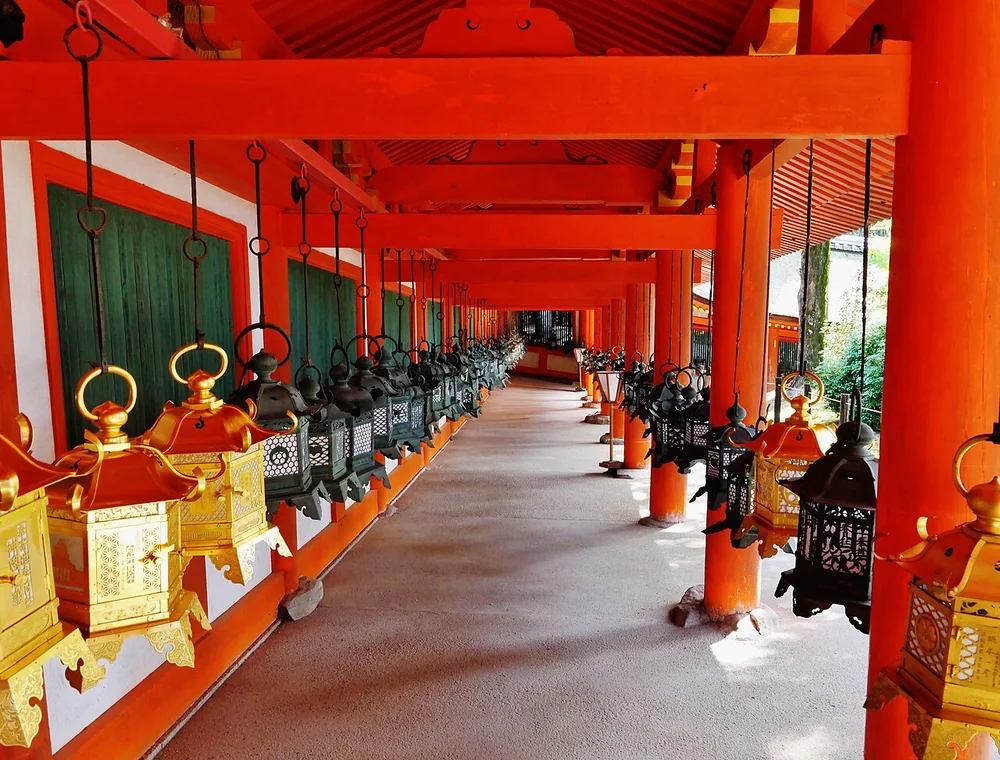
Outdoor stone lanterns and hanging cloister lanterns reward attention to how they line paths and sit beneath eaves. Indoors, Fujinami-no-Ya recreates the atmosphere of the lantern-lighting ceremony. The shrine describes it as a building where priests kept watch before the Edo period, now opened to share the lit-lantern scene. Moving from daylight cloisters indoors shifts the focus from architecture to light. Concentrate your pause on that change.
The actual Kasuga Mantoro lantern ritual takes place at Setsubun and on 14 and 15 August, separately from the everyday indoor recreation. About 3,000 lanterns have been donated to Kasuga Taisha, accumulating since the Heian period and holding religious and historical value. Treat the approach's stone lanterns, cloister hanging lanterns and Fujinami-no-Ya as three scenes, observing their relationship to roads, eaves and interiors. For a trip specifically for the ritual, plan evening time and the journey home using that year's formal announcement.
At Manyo Botanical Garden, read a ceramic plaque and then a plant
Manyo Botanical Garden covers about 3 hectares, divided into the Manyo Garden, Five Grains Village, Camellia Garden and Wisteria Garden. It opened in 1932 around plants associated with the Manyoshu poetry collection. The garden explains that the poems contain about 180 plant names. Because old names differ from modern ones and some have multiple interpretations, it counts about 300 Manyo plants. The difference comes from identifying names. Reading labels fits the garden's purpose better than treating it as a species collection exercise.
The Manyo Garden dates from the opening and still displays specimens of more than 80% of Manyo plants. Beside them are ceramic plaques with representative poems and plant explanations. Pick a plant that interests you. Read its name, see how the poem uses it, then read about its uses. One plant connects words with everyday life. These modest specimens are easy to miss if you only search for abundant flowers.
The garden lists uses including food, medicine, clothing, dyes, building and craft materials. This connects it with the main shrine: how timber becomes architecture, how fibres and dyes enter everyday objects, and how plants become poetic images. Choose a line of interest, such as edible plants and dyes, or correspondences between Manyo and modern names. There is no need to read every sign to complete every variety.
This is a specimen garden, with most plants other than wisteria displayed in small numbers. Agree whether to read a few plants slowly or walk beside the pond and through one area. Either pace works. On the central pond's island stands an old Japanese evergreen oak called Garyu, its trunk lying along the ground. Use it as a landmark, shifting from close-up labels to the wider composition of pond and tree.
Five Grains Village: cultivation and harvest, beyond a rural backdrop
Five Grains Village grows rice, wheat and barley, foxtail millet, broomcorn millet and barnyard millet, rotating ancient rice and other cereals by season. The official guide specifically invites comparison of six-row barley, two-row barley and wheat. For people who usually meet grains on a plate, this restores them to plants. Comparing ears, plant shapes and names is more rewarding than photographing a green field from a distance. Start with one or two foods children recognise.
The same plot looks different while growing, forming ears and after harvest. The official seasonal notice of 19 October 2026 recorded ancient rice due for harvest a few days later, with wild chrysanthemums and namban-giseru at the base of silver grass still visible in Five Grains Village. That autumn record shifts attention from flowers to harvests and low vegetation. Compare it with the actual fields on arrival and observe how harvesting changes the ground.
Namban-giseru is an annual parasitic plant growing on the roots of silver grass, Japanese ginger and sugar cane, among others. The garden identifies it with the Manyo name omoigusa. It provides a useful return to the plaque-reading method: find the plant, then explore the connection between name and poem. Less conspicuous than a large flower, it rewards looking at small details near roots in season with help from the plant labels.
Winter camellias and spring wisteria call for different ways of looking
The Camellia Garden has many varieties, flowering in succession from early to late. The official guide gives December to late March for this sequence. In winter, look for plants with different flowering times and read variety labels. Their sightlines, training and group effect differ from spring wisteria. The garden separately lists the golden camellia around late April. A camellia name does not place every variety in the same winter flowering period.
The Wisteria Garden has about 20 varieties and 200 plants. Its defining feature is upright tree-style training. Ordinary trellises require you to look up; here, flower clusters sit near eye level, facing outwards into sunlight. Compare them with the shrine's trellised Sunazuri-no-Fuji to see two spaces for the same plant theme. One old vine connects with cloister history; multiple upright varieties make flower clusters and colours easy to compare close up. In spring, both offer distinct reasons to stop.
The official wisteria guide gives musk wisteria and Showa-beni as earlier examples, followed in the middle period by Yae Kokuryu and varieties with longer flower clusters. Its variety list also identifies Shiro Noda as late flowering. Distinguishing early, middle and late is more useful than expecting all 20 varieties to bloom on one day. Different dates offer different combinations. With fixed dates, study the varieties flowering that day.
Wisteria generally flowers from about mid-April to early May, with roughly two weeks from the start of early varieties to the end of late ones. Weather shifts flowering dates. The official site notes crowds around the long holiday period and recommends weekdays during the season. First secure garden opening and last-entry times, then connect the shrine visit. If you include other Nara sights that day, make wisteria a main stop so you have more than a hurried circuit after entering.
The museum entrance: begin with water and giant drums
For indoor craft, replace the garden with the museum. The facility introduction calls the ground-floor introductory space Kamigaki, presenting Kasuga's sacred precinct through water and light. Kannabi projects onto a water basin 2.8 m across and 30 cm high, combining drops, ripples and imagery. Kasuga projects precinct scenes onto a grid of steel wires. Water, image and light create a different pace from the objects upstairs.
The ground-floor drum hall lowers the floor around the 6.5 m-high dadaiko drums, allowing close views of their colours and overall form. Such drums are associated with bugaku at the Kasuga Wakamiya Onmatsuri festival. Connecting them with the Buden and Apple Garden reveals the scale of objects needed for performance. The museum also describes a pair of National Treasure dadaiko at the Level 2 entrance as the originals for the ground-floor pair. Follow the display layout to compare the two.
Upstairs, the large gallery hosts the current special exhibition. The small gallery uses low-reflection glass and external lighting to improve views of craft objects and their surface detail. You need not see every item. Comparing an original, a reconstruction or a contemporary work usually gives a clearer sense of the museum than remembering only its nickname, the Heian Shosoin.
The 2026 Kitamura Shosai exhibition: distinguish originals, reconstructions and new work
The tenth-anniversary special exhibition runs in two phases: 3 October–9 November 2026 and 11 November–13 December, closing on 10 November. Admission is ¥1,000 for adults, ¥600 for university and senior-high students, and ¥400 for junior-high and primary pupils. Adult groups of 20 or more pay ¥800 each. Holders of a disability certificate, Nara City Roshun Techo or Nara City Nanamaru Card receive free admission for the holder only when presenting it at the counter on the day. Budget using this exhibition's prices.
Kitamura Shosai spent many years repairing, investigating and reconstructing Kasuga Taisha's old sacred lacquer objects, while also making modern sacred treasures and furnishings. The official exhibition text separates three activities: learning from ancient craft, conserving and reconstructing through research, and applying techniques to new work. Pieces by earlier and later generations of the Kitamura family also appear. Begin by asking which parts are inherited objects and which are the work of modern craftspeople.
Named first-phase exhibits include a replica of the Shosoin five-string rosewood lute with mother-of-pearl inlay, made by Kitamura Shosai and others and held by the Imperial Household Agency's Shosoin Office. Also listed are a floral mother-of-pearl offering tray from Toshodaiji and a floral tortoiseshell-and-mother-of-pearl decorative box from the National Museum of Modern Art, Kyoto. Read replica status or maker first, then the lending institution, to distinguish ancient originals from modern work. The lute is exhibited as a replica; the research and making are themselves the subject.
The second phase includes reconstructions of a gold-ground, mother-of-pearl kenukigata sword and a rosewood, mother-of-pearl ceremonial sword. Both were made by Kitamura Shosai and others, are state-owned and held by the Agency for Cultural Affairs. Also listed are a gold-and-silver heidatsu covered box by Kitamura Shosai from Yakushiji, and a privately owned mother-of-pearl and heidatsu water pitcher by Kitamura Daitsu. If swords or lacquerware are your priority, these phase lists help determine your date. The same exhibition title does not mean identical objects throughout.
The museum also says National Treasure originals among Kasuga Taisha's old sacred objects will be shown alongside reconstructions, encouraging comparison. Read dates and object type on labels before comparing form, surface decoration and materials. This is more specific than judging every piece simply as old or precious. The exhibition explores the relationship between conservation and making. After it ends, plan around the next announced theme.
Walk from the first torii for clues to a riding ground and performance spaces
Start at the first torii if the approach is part of your visit. The official guide dates the surviving gate to a 1634 rebuilding and gives its height as 6.75 m. It marks the junction of Sanjo-dori and the shrine approach, formerly also the boundary between Kasuga Taisha and Kofukuji's old precinct. City streets gradually become the approach, giving the walk a clear beginning. Beyond the torii to the south, Yogo-no-Matsu pine is associated with the Onmatsuri festival's Matsu-no-Shita ceremony and traditions surrounding the pine painted on a noh stage's rear panel.
A straight stretch runs from the first torii to the botanical garden. The official guide identifies it as a riding ground. Madashi Bridge marks the start for horse racing and mounted archery; Madome Bridge near the garden and Ninai-jaya marks its end and a junction of several paths. Read the bridges together to understand why the long straight approach serves more than access. An apparently simple forest path retains the layout of competitions and festivals.
Otabisho is the main site for Wakamiya Onmatsuri, with a central turf stage. The long storehouse to the right was moved from Kofukuji's former Daijoin. Visit these locations by day to build a sense of the space for the year-end festival. Continue towards the main shrine, finding Haraedo Shrine and the reclining-deer purification basin beyond the second torii before reaching the south gate. To stop and read every point, omit the second additional facility and make the approach and main shrine your half-day theme.
The first part shows Kasuga Taisha’s stone-lantern approach and shrine buildings; the later part visits Shin-Yakushiji.
Use the Honden bus stop for a short route; add just one garden or museum for a fuller visit
For a short route, take a bus to Kasuga Taisha Honden, focus on general or special worship and return towards the same stop. For a fuller route, walk east from the first torii along the approach to the main shrine, then double back to the garden or museum before taking a bus to Nara Station. A long reading walk calls for less time in the additional facility. If you want to study the craft exhibition, use the Honden stop both ways and keep the time for the museum.
The garden's main entrance is about three minutes east along the approach from Kasuga Taisha Omotesando bus stop, or three minutes west from Kasuga Taisha Honden stop. The east gate is inside the car park near the Honden stop, but officially opens only in April and May. Use the main gate in autumn and winter; consider the east gate in spring. Normal garden hours are 09:00–16:30, with last entry at 16:00. It closes on Tuesdays from June to March, with exceptions such as public holidays, and opens daily in April and May.
On 2 November 2026, removal of hazardous trees delays garden opening until 13:00. Visit the main shrine first that day, then the garden. For an indoor morning visit, the museum opens at 10:00, closes at 17:00 and ends admission at 16:30. General worship opens earlier than paid facilities, so early arrivals can walk the approach and worship before waiting for the garden or museum. To reduce walking, use the Honden stop and omit the long stretch from the first torii. Follow the day's open paths within the main shrine.
Garden admission is ¥700 for adults and ¥300 for junior-high pupils and younger; adult groups of 20 or more pay ¥600 each, including tax. Eating, drinking, smoking and bringing in or taking away plants or animals are prohibited. This includes removing fallen leaves, acorns and insects. Pets cannot enter; guide, hearing and assistance dogs can. Schedule snacks before entry or after leaving. Children who like collecting leaves or seeds can use photographs or sketches to record shapes and leave specimens in place.
A few useful answers
How can I spend half a day at Kasuga Taisha?
Set off from the First Torii Gate and follow the main approach to the shrine. Then retrace your steps to visit either the Manyo Botanical Garden or the shrine museum. For a shorter walk, take the bus to the Kasuga Taisha Honden stop.
How much does special admission to Kasuga Taisha cost, and what can I see?
Special admission costs ¥700 and is usually available from 9 am to 4 pm. Follow the lantern corridor to the prayer spots in front of the Middle Gate and facing Ukigumo Peak on Mount Mikasa, then see the indoor lanterns at Fujinami-no-ya.
When is the Manyo Botanical Garden at Kasuga Taisha open?
The garden is usually open from 9 am to 4.30 pm, with last admission at 4 pm. It opens every day in April and May. From June to March it closes on Tuesdays, except on public holidays.
When is the wisteria in flower at Kasuga Taisha’s Manyo Botanical Garden?
The wisteria usually flowers from mid-April to early May, depending on the weather. Around 200 plants of some 20 varieties are trained as trees, with the flower clusters hanging at nearly eye level.
Official information and references
Sources used in this guide.
- Inside the main shrine cloisters | Kasuga Taisha
- Nationally Designated Cultural Properties Database
- Kasuga Taisha main sanctuaries | Japan Tourism Agency multilingual tourism resource database
- First torii to the main shrine | Kasuga Taisha
- Garden guide | Kasuga Taisha
- About wisteria | Kasuga Taisha
- Manyo Botanical Garden | Kasuga Taisha
- Kasuga Taisha Museum | Kasuga Taisha
- Tenth-anniversary special exhibition: Craft Giant, Living National Treasure Kitamura Shosai — Maki-e, Mother-of-Pearl Treasures and Kasuga Taisha
- Manyo Botanical Garden opening-time change on Monday 2 November | Kasuga Taisha
- Manyo Botanical Garden flowering report as of 19 October 2026 | Kasuga Taisha
- Basic information | Kasuga Taisha
- JR Central Iza Iza Nara: Kasuga Taisha and Takabatake
- JR Central: Ryohei Suzuki’s Nara walking guide, Enjoying History