Read Kasuga Taisha’s architectural layers from the South Gate and Middle Gate to Kasuga-style main halls, the twisted corridor and trees. Explore Manyoshu poems, grains and tree-form wisteria, or choose works from the two phases of the 2026 Kitamura Shosai exhibition.
- Region & Focus
- Nara and Yoshino
- Reading Scope
- 30 min read · 16 chapters · 4 Q&As
- Official Verification
- 14 official sources checkedUpdated November 22, 2026
- Key Topics
- ItinerariesSeasonsKyoto, Osaka & Kansai
Chapter Route Map (tap any stop)
- Start with the main shrine corridors, then choose plants or crafts
- Distinguish the Middle Gate in front from the four main halls behind
- Read Kasuga-zukuri through the entrance direction and roof
- The corridors are not symmetrical: find the three western gates
- Behind the South Gate: the offering hall, dance hall and Apple Tree Courtyard
- Beyond vermilion: the unpainted Naoraiden and plank-built treasure storehouse
- Naishiden and the twisted corridor: a diagonal connection shaped by use
- Look for trees beside roofs: the great cedar, Chinese juniper and two kinds of wisteria display
- The lantern corridors and Fujinami-no-ya offer two kinds of light
- In the Manyo Botanical Garden, read one ceramic poem plaque and one plant
- Five Grains Village shows cultivation and harvest, beyond a rural backdrop
- Winter camellias and spring wisteria need different ways of looking
- Enter the museum through water and giant dadaiko drums
- The 2026 Kitamura Shosai exhibition: distinguish originals, reconstructions and new work
- Walk from the First Torii for clues to a riding ground and performance stages
- For a short route use the Honden bus stop; for a longer one add only one garden or museum
- Quick Q&A
At Kasuga Taisha, first distinguish the Middle Gate from the four main halls behind it. Then decide whether to study the corridors in detail. Give the other part of a half-day visit to the Manyo Botanical Garden’s poem plaques, grains and tree-form wisteria, or to lacquer art at the museum. A route with one clear theme makes the architecture, plants and objects easier to understand than collecting every admission ticket.
Start with the main shrine corridors, then choose plants or crafts
Divide a visit to Kasuga Taisha into two parts: one explains the relationship between gates, corridors and sanctuaries; the other takes in the Manyo Botanical Garden or museum. Architecture enthusiasts can focus on the Middle Gate, Oro corridor and trees extending through roofs. Choose the garden if you enjoy stopping to read plant labels, or the museum’s current exhibition for lacquerware, restoration and craft. The two facilities differ greatly. Choosing one usually leaves more time to look than buying admission to both.
The museum is holding the special exhibition “A Giant of Craft: Living National Treasure Kitamura Shosai—Treasures of Maki-e and Mother-of-Pearl Inlay and Kasuga Taisha,” with different works in its first and second phases. The garden has also announced a delayed 13:00 opening on November 2. These dates directly affect the order of a half-day visit. In spring, make wisteria the garden theme; in winter, choose camellias. Without a flower-focused plan, specimens and Manyoshu poems remain central to the garden.
With only a short time, complete general worship and choose one architectural detail. Schedule special worship during its reception hours. Adding the garden requires time to walk back from the main shrine, enter and read labels. Arriving at the shrine is different from beginning worship. A slow walk from the First Torii has stopping points of its own.
Read Kasuga Taisha’s architectural layers from the South Gate and Middle Gate to Kasuga-style main halls, the twisted corridor and trees. Explore Manyoshu poems, grains and tree-form wisteria, or choose works from the two phases of the 2026 Kitamura Shosai exhibition.
Distinguish the Middle Gate in front from the four main halls behind
After entering the South Gate from the main approach, the vermilion Middle Gate ahead often draws the eye first. The shrine’s corridor guide specifically notes that visitors can mistake it for the main sanctuary. It is a tower gate about 10 m high. Its front curved karahafu gable was added in the Meiji era. The Oro corridors extend about 13 m on either side. Recognize this layer first so photos and maps do not merge the gate, corridors and sanctuaries into one building.
The actual main sanctuary stands behind the Middle Gate. It consists of four similarly sized halls with adjoining eaves. Halls one to four enshrine Takemikazuchi-no-Mikoto, Futsunushi-no-Mikoto, Amenokoyane-no-Mikoto and Himegami respectively. Each deity has a hall, while the Middle Gate and Oro in front form space for worship and ceremonies. For a visitor, focus on the layers: a gate into the corridors, the Middle Gate with wing-like corridors, then the sanctuaries behind.
The Agency for Cultural Affairs database designates the first hall a National Treasure and dates the existing building to Bunkyu 3, or 1863. Its detailed description also explains that periodic rebuilding has preserved the old style of all four halls. Foundation in the Nara period, an ancient architectural form and the age of today’s timber answer different questions. Understand both continuity of form and later rebuilding instead of treating every vermilion structure as an original from 768.
Read Kasuga-zukuri through the entrance direction and roof
The Agency for Cultural Affairs records the main halls as single-bay Kasuga-zukuri with cypress-bark roofs. The basic form has a gabled roof, an entrance in the gable end and a projecting canopy at the front. Break the name into visible parts: identify the ridge and two roof slopes, locate the entrance end, then look at its shelter. You can find this form at other Kasuga shrines in Japan; Nara’s four halls provide a starting point. Their roofs use cypress bark. The Japan Tourism Agency explanation connects roof renewal with a 20-year cycle, while the shrine describes building repair through its periodic renewal ceremonies. Timber shrines and temples need roof and paint maintenance. Shine and neatness do not directly date the architectural form. Part of reading Kasuga Taisha is seeing the work each generation does to maintain old forms.
The worship area before the main halls has clear boundaries. The official special-worship description covers the lantern corridors, worship before the Middle Gate and at the distant-worship point facing Ukigumo Peak on Mount Mikasa, and Fujinami-no-ya. Plan around these open points. Use the official diagram to understand the four halls, then read their front-to-back relationship from the open route. Mount Mikasa is closed to entry. The distant-worship point lets visitors face Ukigumo Peak.
The corridors are not symmetrical: find the three western gates
The south corridor extends about 21 m in each direction, east and west of the South Gate, then turns north to meet the east and west corridors. The east corridor is about 37 m long, with Yogo Gate near its center. The west corridor is about 57 m, with Keiga, Seijo and Naishi Gates from south to north. The north corridor is about 27 m and joins only the west corridor, ending before it passes behind the main halls. Compare these lengths with the official plan to understand the different east and west outlines and where corridors turn or end. The three western gates once served different users. Keiga Gate to the south was associated with Fujiwara entry; its coffered ceiling differs from the other two. Central Seijo Gate was formerly called Sojo Gate and admitted Kofukuji monks. Northern Naishi Gate was linked to female attendants. Similar-looking gates become distinct through their uses. The shrine manages their present use; visitors can read that history from their positions and construction along the worship route.
The Oro was also a place where Kofukuji monks chanted sutras; Todaiji monks chanted here too. Seijo Gate and the Oro place the history of coexisting Shinto and Buddhist practice in two concrete spaces. Today the Oro seats shrine priests during main-sanctuary ceremonies. The same building has served different people across time, making this a good place to slow down.
Behind the South Gate: the offering hall, dance hall and Apple Tree Courtyard
The South Gate is about 12 m high, the shrine’s largest tower gate and the main entry from the approach into the corridors. The building beyond is divided into the Heiden offering hall in the two eastern bays and the Buden dance hall in the three western bays. The official guide distinguishes the Heiden by its interior coffered ceiling. It temporarily holds imperial offerings. The Buden is used for imperial-court mikagura and for kagura or bugaku offerings in rain. From the courtyard, first note the different functions within one building.
The Apple Tree Courtyard hosts bugaku and kagura during ceremonies. It takes its name from the apple tree in its southeast corner. The shrine links its tradition with Emperor Takakura and cites a written record from 1273. First read the courtyard’s position relative to the buildings: open ground provides performance space, while the halls support different rituals and weather conditions. Even without a performance, this explains the empty space instead of treating it only as somewhere to cross.
Architecture and events make different itineraries. On a normal day, group the South Gate, Heiden/Buden and courtyard into one short route, then decide on special worship. For festivals, access and worship reception change with rituals. Kasuga Matsuri itself on March 13, for example, is not open to the public and cannot be treated as a normal sightseeing performance. Decide whether to read the spaces or visit on another date with published public access.
Beyond vermilion: the unpainted Naoraiden and plank-built treasure storehouse
The Naoraiden faces east and is built of unpainted wood, eight bays north to south and four east to west. The two eastern bays form the central core, where the ritual feast is held during Kasuga Matsuri. From the Heian period onward, Lotus Sutra lectures were popular here, giving it the alternative name Hakkoya. Beside the vermilion corridors it offers an obvious material contrast: important buildings do not all use the same color treatment. Look at the timber surface and orientation to find a different scale within the red complex.
The treasure storehouse beside the main halls is a vermilion azekura structure assembled from thick planks. The shrine explains that treasures including National Treasure armor remained here into modern times. Today it holds sacred mirrors, swords, halberds, bows and arrows used to decorate the main halls for Kasuga Matsuri and is normally sealed. This storehouse and the public museum serve different purposes. Read the former through its exterior and storage function; visit the latter for current exhibits. That distinction prevents looking for an exhibition entrance at a sealed building.
Compare the Naoraiden and storehouse to see how ritual, gathering and storage occupy different structures. Unpainted timber, vermilion coating, thick planks and larger interiors are useful clues. If you want to study only two more buildings, these offer clear contrasts in material and use. Craft enthusiasts can connect the storehouse with the museum to follow how treasures are preserved, researched and displayed.
Naishiden and the twisted corridor: a diagonal connection shaped by use
The Naishiden originally housed female attendants waiting during Kasuga Matsuri. The shrine connects early Fujiwara ritual attendants and naishi sent from the imperial court with this service, which continued until the mid-Muromachi period. During renewal every 20 years, deities from the main shrine and Wakamiya are transferred here, giving it another name, Utsushidono. One name records former users; the other explains how worship continues during maintenance. The stair passage linking the Naishiden and Oro is Nejiro, formerly called Tōrō. Its diagonal stairs require twisted columns, rafters, beams and other members, demanding skilled construction. The shrine also records a tradition attributing it to Hidari Jingoro. Look first at the actual diagonal connection, then place the legend in the context of that difficulty. Understanding which buildings it joins and how the members fit gives more meaning than a photo of a narrow passage alone.
If you like timber joints, read the Naishiden, twisted corridor and Oro together on the plan. Waiting attendants, temporary enshrinement during renewal and ritual space need different buildings. Their relative positions shape the connection. The site’s asymmetry reflects long-term arrangements for different uses as well as its appearance.
Look for trees beside roofs: the great cedar, Chinese juniper and two kinds of wisteria display
The official dimensions for the great cedar before the shrine are an 8.7 m trunk circumference at eye level and a height of 25 m, with an estimated age of 800–1,000 years. The Chinese juniper extending diagonally from its base is about 500 years old. The Naoraiden roof even has an opening for the tree. Instead of starting with age, notice how trunks, branches and buildings make space for each other. The roof detail makes the shrine’s regard for trees visible.
The old Sunazuri-no-Fuji inside Keiga Gate grows on a trellis. The shrine says its flower clusters can exceed 1 m around early May; the name evokes blossoms hanging near the sand. Distinguish this named tree in the main shrine from the roughly 200 wisteria plants of various varieties in the botanical garden. The former combines an old vine, corridors and worship space. The latter enables comparisons of varieties, flowering order and training methods.
Another plant stop is the seven-species joined tree inside the Kazenomiya shrine enclosure east of the storehouse. The shrine lists isu, mountain cherry, camellia, nandina, elder, wisteria and maple growing together, with a belief connected to prayers for children. Compare the names and plant relationships rather than interpreting all the trees as one miraculous species. If companions become interested in trees and everyday uses, that gives a clear reason to add the garden.
The lantern corridors and Fujinami-no-ya offer two kinds of light
Special worship is usually accepted 09:00–16:00, with a ¥700 offering. The official description specifies the route: lantern-lined corridors, worship before the Middle Gate and toward Ukigumo Peak on Mount Mikasa, and Fujinami-no-ya. General worship is free and suits a main-shrine visit with a walk along the approach. Add special worship for a closer look at the layers of buildings inside the corridors. The museum and garden charge separately.
Regular special-worship closure dates include approximately March 8–13, December 20–January 7 and Coming of Age Day, all day. Morning reception stops on the 1st, 11th and 21st of each month; Setsubun; February 17 and 23; March 14 and 15; the spring equinox; April 3; the third Friday in May; May 5 and 10; August 7 and 15; the autumn equinox; October 9; November 3 and 23; and December 17. December 16 has an afternoon closure. Festivals alter reception hours, and the shrine manages access for unscheduled rituals on the day. Use these periods for general worship, the approach or an earlier museum or garden visit.
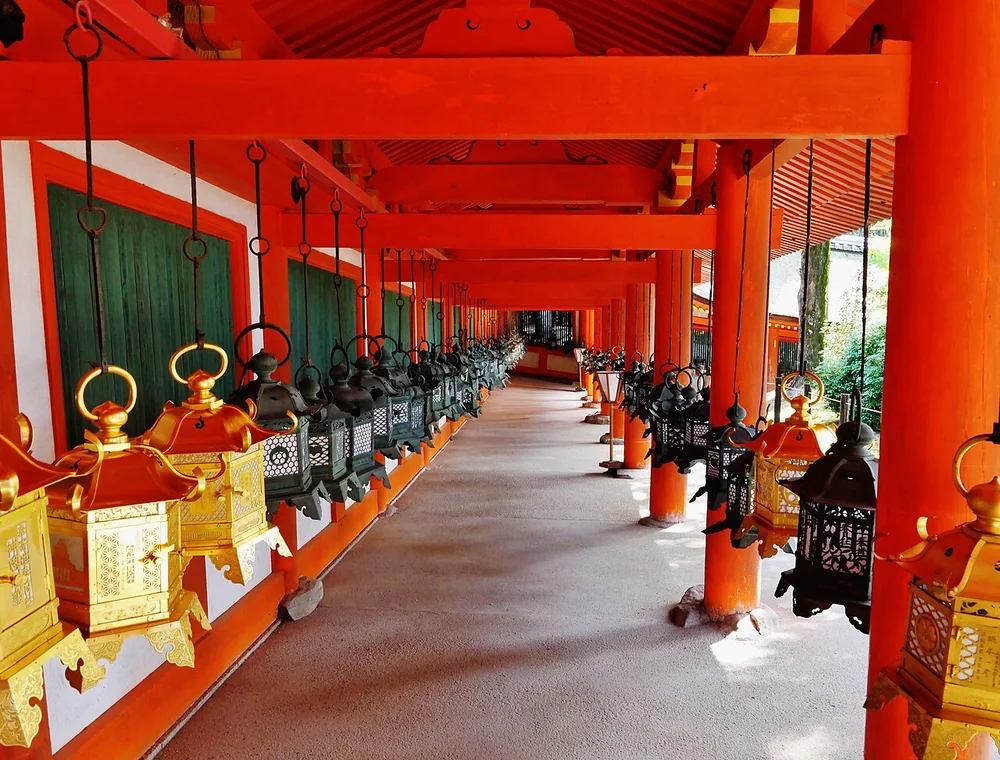
Outside stone lanterns and hanging corridor lanterns show how lanterns line a route and sit beneath eaves. Fujinami-no-ya recreates the atmosphere of the Mantoro lantern lighting indoors. The shrine describes it as a building used by priests on duty before the Edo period, opened to share the illuminated scene. Moving from daylight corridors to the interior shifts attention from architecture to light. Focus your pause on that change.
The actual Kasuga Mantoro rituals take place at Setsubun and on August 14 and 15. Plan them separately from the everyday indoor recreation. About 3,000 donated lanterns have accumulated since the Heian period and carry religious and historical information. Read the approach’s stone lanterns, corridor hanging lanterns and Fujinami-no-ya as three scenes related to paths, eaves and interiors. For a trip specifically for the ritual, use that year’s official announcement to plan the evening and return journey.
In the Manyo Botanical Garden, read one ceramic poem plaque and one plant
The Manyo Botanical Garden covers about 3 hectares, divided into the Manyo Garden, Five Grains Village, Camellia Garden and Wisteria Garden. Opened in 1932, it focuses on plants associated with the Manyoshu poetry anthology. The garden explains that poems contain about 180 plant names, while about 300 plants are treated as Manyo plants because ancient and modern names differ and some old names have several botanical interpretations. The difference comes from identifying names. Reading labels fits the garden’s purpose better than collecting species.
The Manyo Garden dates from the opening and still displays at least 80% of Manyo plants as specimens. Representative poems on ceramic plaques and botanical explanations stand beside plants. Choose a plant, read its name, then see how the poem uses it and read its uses. One plant connects text and daily life. A rush to find flowers in full bloom can miss these less conspicuous specimens.
Listed uses include food, medicine, clothing, dyes, construction and craft materials. This offers questions connecting the garden with the shrine: how wood becomes a building, how fibers and dyes enter daily objects, and how plants become poetic images. Follow your interest, perhaps food and dyes or the match between ancient and modern names. You do not need to read every label to cover all varieties.
The garden is a specimen garden, with most plants other than wisteria shown in small numbers. Agree whether to read a few plants slowly or walk around the pond and one zone. Both work. On the island in the central pond, the old ring-cupped oak Garyu has a trunk lying along the ground. Use it as a landmark, shifting from close-up labels to the wider pond-and-tree view.
Five Grains Village shows cultivation and harvest, beyond a rural backdrop
Five Grains Village grows rice, wheat/barley, foxtail millet, broomcorn millet and barnyard millet, with ancient rice and wheat/barley rotated by season. The official guide specifically offers six-row barley, two-row barley and wheat for comparison. If you normally meet grains only on a plate, this returns food to its growing form. Compare ears, plant shapes and names instead of only photographing green fields. With children, start from one or two familiar foods.
The same field changes through growth, grain formation and harvest. The official flowering report dated October 19, 2026, recorded ancient rice due for harvest within days, alongside wild chrysanthemums and nanban-giseru at the base of silver grass in Five Grains Village. This autumn record shifts attention from flowers to harvest and plants among grasses. Compare it with the actual fields and see how land changes before and after cutting.
Nanban-giseru is an annual that parasitizes roots including silver grass, Japanese ginger and sugarcane. The garden identifies it with the Manyo name omoigusa. It offers a good return to poem plaques: find the actual plant, then read the link between name and poem. Less conspicuous than large flowers, its small root-level details show another way to look at a specimen garden in season.
Winter camellias and spring wisteria need different ways of looking
The Camellia Garden has many varieties flowering in sequence, with the official guide listing December through late March. In winter, look for plants with different flowering times and read variety labels. Their viewing angles, training and group effect differ from spring wisteria. The garden separately lists yellow-flowered camellia around late April. A camellia name does not put every variety in the same winter flowering period.
The Wisteria Garden has about 20 varieties and 200 plants, with tree-form training as its main feature. Conventional trellises make you look up. Here flower clusters appear near eye level, opening outward into sunlight. Compared with the shrine’s trellised Sunazuri vine, the same plant theme creates two spaces: an old vine tied to corridor history, and varied tree-form plants suited to close views of clusters and colors. In spring, both can merit a visit for different reasons.
The official wisteria guide lists musk wisteria and Showa Beni among earlier examples, followed in mid-season by Yae Kokuryu and longer-cluster varieties. Its variety table lists Shiro Noda as late flowering. Divide them into early, middle and late before comparing individual names instead of expecting all 20 varieties at once. Different dates offer different combinations. With fixed dates, study those flowering that day.
Wisteria usually flowers from about mid-April to early May, with roughly two weeks from early varieties starting to late ones finishing. Weather shifts flowering. The site notes heavier crowds around the long holiday period and recommends weekdays. Secure the garden’s opening and last-entry times first, then connect shrine worship. If other Nara sights are on the same day, make wisteria a main stop so entry does not leave time only for a quick circuit.
Enter the museum through water and giant dadaiko drums
For indoor craft, replace the garden with the museum. The facility introduction calls its first-floor introductory space Kamigaki, presenting Kasuga’s sacred realm through water and light. Kannabi projects onto a water basin 2.8 m in diameter and 30 cm high, combining drops, ripples and images. Kasuga projects shrine scenes onto a grid of steel wires. Water, images and light create a different pace from the physical objects upstairs.
The first-floor dadaiko drum hall has a lowered floor for the 6.5 m-high drums so visitors can see their colors and full form up close. These large drums relate to bugaku at Kasuga Wakamiya On-Matsuri. Connect them with the Buden and Apple Tree Courtyard to understand the scale of performance objects. The museum also introduces a National Treasure pair at the second-floor entrance, the prototypes for the pair downstairs. Follow the actual exhibition layout to compare them.
The large second-floor gallery hosts the current special exhibition. The smaller gallery uses low-reflection glass and external lighting to improve views of craft surfaces. Choose an original, a reconstructed replica or a contemporary work to compare. That often explains the museum better than remembering only its nickname, the Shosoin of the Heian period.
The 2026 Kitamura Shosai exhibition: distinguish originals, reconstructions and new work
The 10th-anniversary special exhibition runs in two phases: October 3–November 9 and November 11–December 13, 2026, closing November 10. Admission is ¥1,000 general, ¥600 for university and high-school students and ¥400 for elementary and junior-high students. General groups of 20 or more pay ¥800 each. Holders of a disability certificate, Nara City Roshun pass or Nara City Nanamaru card receive free admission for the holder only by showing it at the desk that day. Use the special-exhibition prices for this visit.
Kitamura Shosai spent many years repairing, researching and reconstructing Kasuga Taisha’s old sacred lacquer objects, as well as making modern sacred treasures and furnishings. The official description separates learning from ancient craft, restoration and reconstruction based on research, and using techniques in new work. Works by earlier and later members of the Kitamura family also appear. Ask which objects were handed down and which parts are modern craftspeople’s work.
Named first-phase exhibits include the replica of the Shosoin five-stringed red-sandalwood biwa with mother-of-pearl inlay, made by Kitamura Shosai and others and held by the Imperial Household Agency’s Shosoin Office. Other works include a floral mother-of-pearl offering tray from Toshodaiji and a floral tortoiseshell-and-mother-of-pearl decorative box from the National Museum of Modern Art, Kyoto. Read “replica” or the maker first, then the collection, to distinguish ancient originals from modern works. The biwa is exhibited as a replica. Its research and manufacture are themselves the subject.
The second phase includes reconstructed replicas of a gold-ground mother-of-pearl kenukigata sword and a red-sandalwood mother-of-pearl ceremonial sword. Both were made by Kitamura Shosai and others, are state-owned and held by the Agency for Cultural Affairs. It also lists Kitamura Shosai’s gold-and-silver heidatsu lidded box from Yakushiji and Kitamura Daitsu’s mother-of-pearl and heidatsu water pitcher from a private collection. If swords or lacquerware are the priority, these phase lists can determine your date. The same exhibition title does not mean the same contents.
The museum also states that original National Treasure sacred objects from Kasuga Taisha are shown with reconstructed replicas, encouraging comparison of their forms. Read dates and object types on labels first, then compare shape, surface decoration and materials. This is more specific than judging only age or rarity. The exhibition focuses on repair and making. After it ends, connect your trip to the next announced theme.
Walk from the First Torii for clues to a riding ground and performance stages
For an approach walk with its own content, start at the First Torii. The official guide dates the existing 6.75 m-high gate to rebuilding in 1634. It stands at the junction of Sanjo-dori and the shrine approach, formerly also the boundary between Kasuga Taisha and Kofukuji grounds. Here the city street gradually becomes the approach, giving the visit a clear beginning. Beyond the gate to the south, the Yogo pine relates to Wakamiya On-Matsuri’s Matsu-no-Shita ceremony and the tradition of a pine on a Noh stage’s rear panel.
The straight stretch from the First Torii to the botanical garden is explained as a riding ground. Madashi Bridge was the starting point for horse racing and mounted archery. Madome Bridge near the garden and Ninai-jaya marked the end and a junction of several paths. Read the bridges together to understand that the long straight route served more than convenient passage. What looks like a simple forest path also preserves uses for competition and ritual.
The Otabisho is the main ritual site for Wakamiya On-Matsuri, with a turf stage in the center. The long storehouse to the right was moved from Kofukuji’s former Daijoin. See these places by day to build a spatial picture for the year-end festival. Continue toward the main shrine, finding Haraedo Shrine and the reclining-deer purification basin after the Second Torii, then the South Gate. To stop and read every point, omit a second garden or museum so the approach and main shrine become the half-day theme.
The first part shows Kasuga Taisha’s stone-lantern approach and shrine buildings. The later part visits Shin-Yakushiji.
For a short route use the Honden bus stop; for a longer one add only one garden or museum
For a short visit, take a bus to Kasuga Taisha Honden, focus on general or special worship, then return toward the same stop. For a longer route, walk east from the First Torii along the approach to the main shrine, double back to the garden or museum, then take a bus to Nara Station. A longer approach walk means a shorter attached-facility visit. For slow viewing at the craft exhibition, use the Honden stop both ways and spend the time inside.
The garden’s main gate is about three minutes east along the approach from Kasuga Taisha Omotesando bus stop, or three minutes west from Kasuga Taisha Honden. The east gate is in the parking lot near the Honden stop, but officially opens only in April and May. Use the main gate in autumn and winter; consider the east gate in spring. Regular garden hours are 09:00–16:30, with last entry at 16:00. It closes Tuesdays from June to March, opening on holidays and similar exceptions. It opens every day in April and May.
On November 2, 2026, removal of dangerous trees delays the garden opening to 13:00. Visit the main shrine first that day, then the garden. For an indoor exhibition in the morning, the museum opens at 10:00 and closes at 17:00, with last admission at 16:30. General worship opens earlier than the paid facilities. Early arrivals can walk the approach and worship before the garden or museum opens. To reduce walking, use Honden bus stop and omit the long walk from the First Torii. Follow that day’s open routes inside the main shrine.
Garden admission including tax is ¥700 for adults, ¥300 for junior-high students and younger, and ¥600 per adult in groups of 20 or more. Eating, drinking, smoking and bringing in or removing plants or animals are prohibited. Fallen leaves, acorns and insects must also stay. Pets are not allowed; guide, hearing and assistance dogs are admitted. Put snacks before or after the visit. Children who like collecting leaves or seeds can photograph or sketch shapes and leave specimens where they are.
A few useful answers
How should I spend half a day at Kasuga Taisha?
Start at the First Torii Gate and follow the main approach to the shrine, then head back to visit either the Manyo Botanical Garden or the shrine museum. For less walking, take the bus to the Kasuga Taisha Honden stop.
How much is special admission at Kasuga Taisha, and what does it include?
Special admission costs ¥700 and is usually available from 9 a.m. to 4 p.m. Walk through the lantern corridor, pray in front of the Middle Gate and at the spot facing Ukigumo Peak on Mount Mikasa, and see the indoor lanterns at Fujinami-no-ya.
What are the opening hours of the Manyo Botanical Garden at Kasuga Taisha?
The garden is usually open from 9 a.m. to 4:30 p.m., with last entry at 4 p.m. It opens daily in April and May and closes on Tuesdays from June through March, except on public holidays.
When does wisteria bloom at Kasuga Taisha’s Manyo Botanical Garden?
Wisteria usually blooms from mid-April to early May, depending on the weather. The garden has around 200 plants of about 20 varieties, trained into tree forms so the flower clusters hang at nearly eye level.
Official information and references
Sources used in this guide.
- Inside the main shrine corridors | Kasuga Taisha
- Database of nationally designated cultural properties
- Kasuga Taisha main halls | Multilingual tourism interpretation database
- From the First Torii to the main shrine | Kasuga Taisha
- Garden guide | Kasuga Taisha
- About wisteria | Kasuga Taisha
- Manyo Botanical Garden | Kasuga Taisha
- Kasuga Taisha Museum | Kasuga Taisha
- 10th-anniversary special exhibition: Kitamura Shosai, giant of craft—maki-e, mother-of-pearl and Kasuga Taisha
- Manyo Botanical Garden: changed hours on Monday, November 2
- Manyo Botanical Garden flowering report as of October 19, 2026
- Basic information | Kasuga Taisha
- JR Central Iza Iza Nara: Kasuga Taisha and Takabatake
- JR Central: Ryohei Suzuki’s Nara walking guide, Enjoying History