For a first visit, choose the Great Buddha Hall and Hokkedo; for sculpture, choose Hokkedo and Kaidando. Follow lotus petals, the octagonal lantern, figure groups, dry lacquer and clay sculpture, with official hillside routes, the autumn–winter 2026 museum exhibition and half-day choices.
- Region & Focus
- Nara and Yoshino
- Reading Scope
- 32 min read · 15 chapters · 5 Q&As
- Official Verification
- 15 official sources checkedUpdated October 26, 2026
- Key Topics
- ItinerariesKyoto, Osaka & Kansai
Chapter Route Map (tap any stop)
- Place the three halls on the map, then choose two
- At the South Gate, look up at how the roof is supported
- Beyond the guardians’ poses, look for evidence of two statues made together
- The Great Buddha Hall’s front reveals a reconstruction made narrower
- When looking at the Great Buddha, shift your gaze to the pedestal once
- The octagonal lantern brings sculpture beyond the giant Buddha back into view
- Hokkedo: the northern main hall and southern worship hall have different ages
- At Hokkedo, recognize the principal image before the surrounding figures
- Why continue to the museum for statues transferred from Hokkedo?
- At Kaidando, look at all four corners instead of one famous face
- Read dry lacquer, clay and metal through their details
- Order a two-hall half-day around the hillside and closing times
- For autumn–winter 2026, substitute the museum’s Pure Land exhibition
- Leave Nigatsudo for architecture and its platform; plan Shunie separately by season
- For an audio guide, plan around rental starting at 10:00
- Quick Q&A
On a first visit to Todaiji, concentrate paid hall visits on the Great Buddha Hall and Hokkedo. The first offers the giant Buddha, lotus petals and a vast rebuilt interior. The second has a group of standing figures and a building whose main sanctuary preserves Nara-period architecture. If you have seen the Great Buddha and now want to study sculpture, choose Hokkedo and Kaidando instead. Leave time to walk and sit between the halls for a half-day with a clear theme. Substitute Nigatsudo or the museum according to energy and the current exhibition.
Place the three halls on the map, then choose two
Todaiji’s three main paid halls occupy different parts of the grounds. On the temple map, the Great Buddha Hall is central, Kaidanin is to the west, and Hokkedo and Nigatsudo are on the eastern hillside. Deciding to enter every hall at the South Gate commits you to movement on both sides. For a sculpture-focused visit, choose Hokkedo and Kaidando at opposite ends and leave the Great Buddha Hall for another time.
For a first visit, the Great Buddha Hall and Hokkedo offer very different ways of looking. Height draws the eye in the Great Buddha Hall; stopping in front reveals the relationship between Buddha and building. Hokkedo centers on standing figures around the principal image. After a giant statue, the dense group naturally directs attention to arms, clothing folds and expressions instead of height alone.
For Tenpyo sculpture, Hokkedo and Kaidando give a tighter focus. Hokkedo has Fukukensaku Kannon, Bonten, Taishakuten, guardian kings and the Four Heavenly Kings in different roles. Kaidando concentrates the eye on four guardians at the altar’s corners. Both halls have Four Heavenly Kings, letting you recognize the same group in different spaces. This choice suits slow looking and a willingness to walk to and from the hillside.
With a wheelchair, or to reduce climbing, pair the Great Buddha Hall with the museum. The temple publishes a western ramp and accessible routes. The museum continues the visit with some statues transferred from Hokkedo. Leave the hillside halls for another day. This pairing keeps the contrast between a giant Buddha and closer sculpture while limiting movement.
For a first visit, choose the Great Buddha Hall and Hokkedo; for sculpture, choose Hokkedo and Kaidando. Follow lotus petals, the octagonal lantern, figure groups, dry lacquer and clay sculpture, with official hillside routes, the autumn–winter 2026 museum exhibition and half-day choices.
At the South Gate, look up at how the roof is supported
The South Gate stands on the main approach before the Great Buddha Hall. The temple introduction identifies it as a Kamakura-period National Treasure, rebuilt by Chogen with Song-dynasty elements in the Daibutsuyo style. The name refers to architecture. Move your gaze from the guardian figures to the center of the gate, then look upward to see the structure behind the term.
The lower level lacks the enclosed ceiling you might expect, exposing tall supports and construction above. The temple records 18 large round columns, each 19.058 m long, extending into the roof. The gate rises 25.46 m from its platform. You need not memorize the decimals on site. Follow one column from the ground upward to feel how timber spans the height. Then look at the two huge standing figures as part of the same spatial arrangement.
Today’s Great Buddha Hall is an Edo-period reconstruction, while the South Gate preserves Kamakura revival architecture. Both are huge, but their dates and structures differ. The South Gate’s frame was raised in 1199, and it was completed with the guardians in 1203. Compare it with Hokkedo’s worship hall, newly built in 1199: Chogen’s revival left both a major entrance and a changed front space for an older hall.
Beyond the guardians’ poses, look for evidence of two statues made together
The gate’s open-mouthed Agyo and closed-mouthed Ungyo guardian kings each stand about 8.4 m high. Start with their mouths, then compare shoulders, waists and feet. Travelers often call all fierce standing figures Nio. At Hokkedo and Kaidando, distinguish these guardian kings from the Four Heavenly Kings to understand how the groups work.
The making of the South Gate statues also deserves a pause. The temple records completion in 69 days in 1203 by sculptors including Unkei and Kaikei. Repairs from 1988 to 1993 found sutras, documents and many ink inscriptions inside. These identified participants beyond the two best-known names, including Jokaku and Tankei. Seeing the huge bodies as a collective project brings you closer to their production than searching for a single genius.
Repair evidence also shows that both statues were made simultaneously, not one after the other. Turn that into a comparison on site: see how similar masses fill the gate’s side spaces through different poses, without assigning symbolism to every muscle. The gate is a passage. Step out of the central flow to pause and see the figures in relation to the columns.
The Great Buddha Hall’s front reveals a reconstruction made narrower
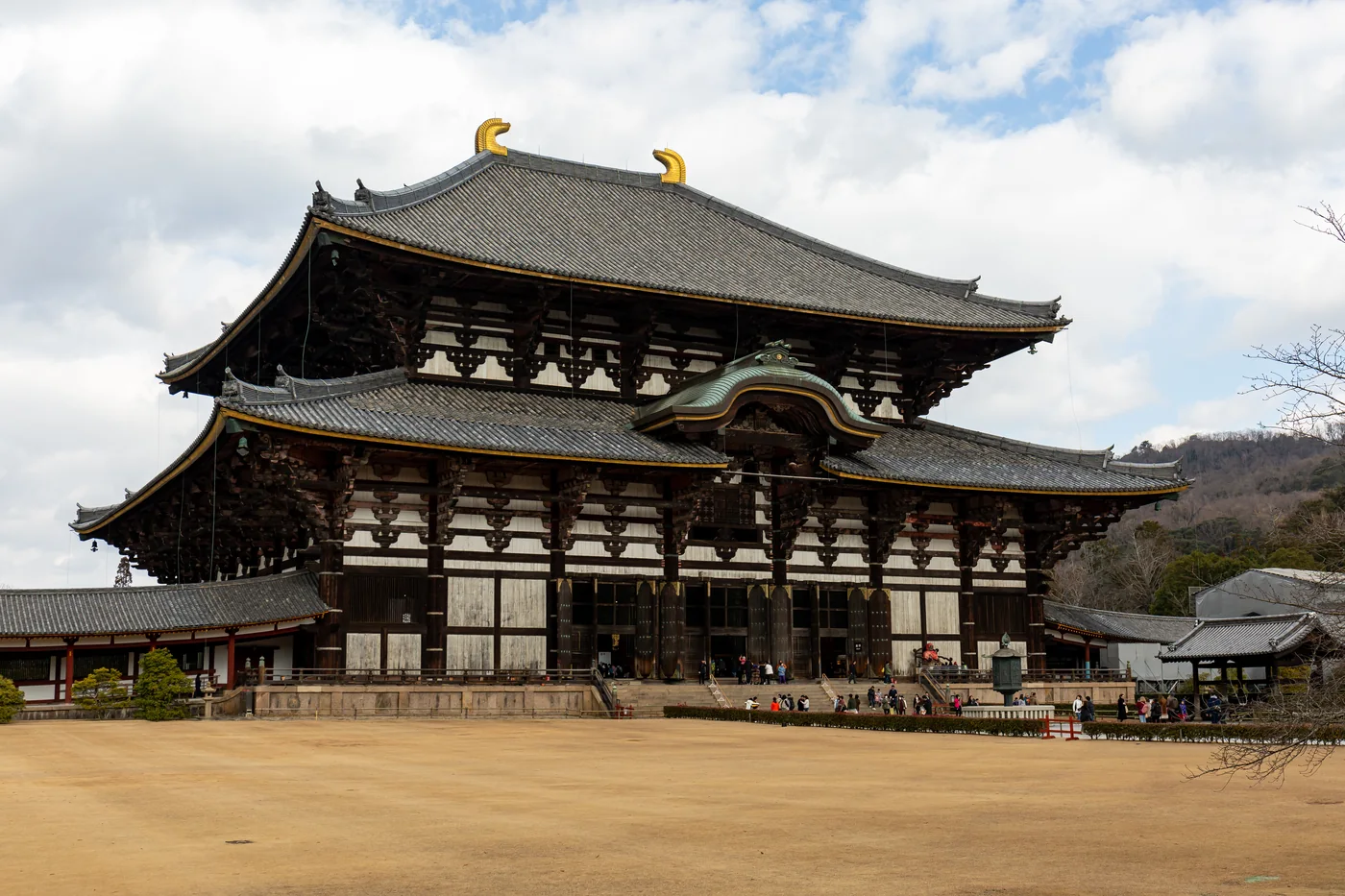
From the front, compare width and roof height. The temple’s Great Buddha Hall introduction records 11 bays, about 88 m across, in the Nara and Kamakura periods. Financial limits reduced the Edo reconstruction to seven bays. Height and depth retained the founding scale, so today’s building is not a proportional reduction of the original.
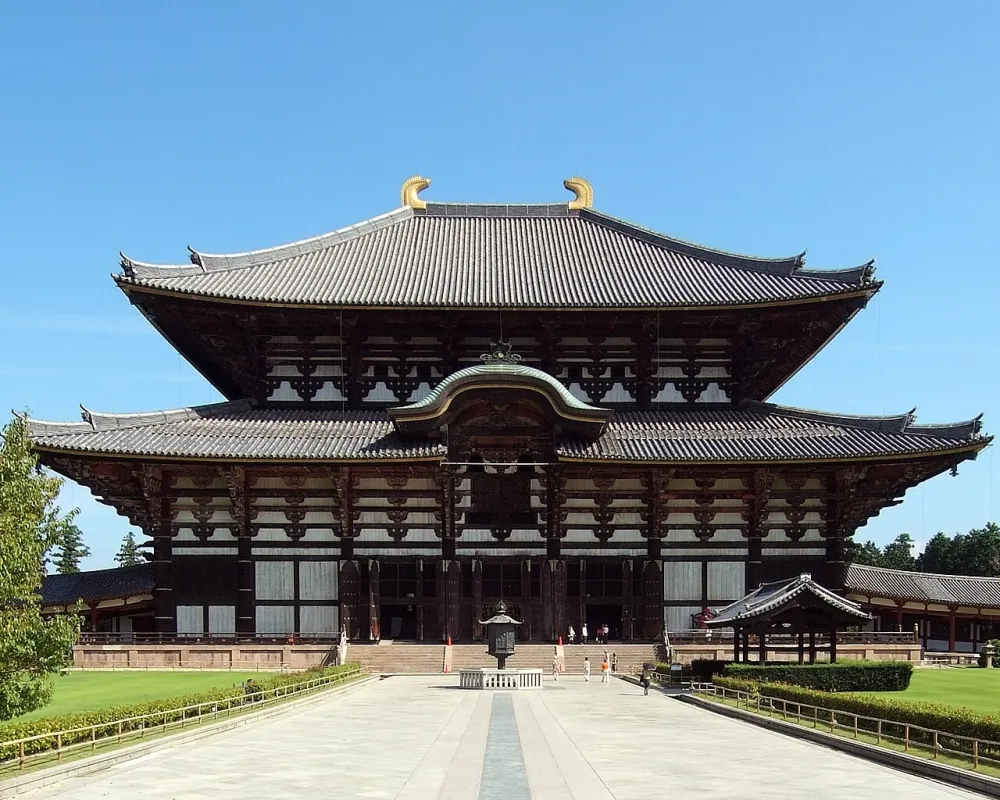
This makes its size more specific: the present hall is 57.012 m east to west, 50.480 m deep and 48.742 m high. Its depth and height remain substantial despite the reduced width. After looking from the front, notice the space behind and beside the Buddha inside to connect the plan with what you feel. A single frontal exterior photo does little to explain the interior depth.
The hall and the Buddha also have different layers of repair. During the Edo period, Kokei led restoration. The Buddha’s eye-opening ceremony took place in 1692, while the hall’s completion ceremony was in 1709. Read the building’s Edo-period label separately from the Buddha’s Nara-period label. The temple preserves a place sustained by successive repairs; the dates refer to different objects.
The South Gate’s Kamakura structure, the Great Buddha Hall’s Edo building, and Hokkedo’s Nara main hall and Kamakura worship hall create a comparison within one walk. Put dates back onto columns, roofs and spaces. A temple labeled Nara-period still contains buildings with dates of their own.
When looking at the Great Buddha, shift your gaze to the pedestal once
The principal image is formally Rushana or Birushana Buddha, Vairocana. The temple explains it as a Buddha illuminating everything with wisdom and compassion. Its height of 14.98 m is a starting point for scale. The relationship with the lotus pedestal also deserves time. See the whole from the front, then follow the worship route and lower your gaze from the face to the petals.
The pedestal petals carry fine engraved images of the Lotus Treasury World. The temple links them to the Avatamsaka Sutra’s view of interdependent existence within Vairocana’s light. The giant body and fine petal lines use very different scales in one work. See the body, then locate the images. This gets closer to the statue’s subject than stopping only at entertaining measurements of nostrils or ears.
Make two pauses: first for the overall proportions, then for pedestal images where the route allows. Do not add light for the fine lines; the temple prohibits flashlights indoors. Look within the available lighting. For deeper interest in the images, continue with the official explanation afterward rather than always searching for the closest position in a crowd.
The spiral hair curls also offer a way to observe form. The temple FAQ explains that the term refers to a spiral shell. The current head was remade in the Edo reconstruction. The often-repeated count of 966 comes from a Nara-period document. Citing 3D measurement research, the temple estimates 492 original positions on the current head, with 483 curls still attached. When counts differ, distinguish the period and whether missing parts are included instead of choosing one number as the answer.
The octagonal lantern brings sculpture beyond the giant Buddha back into view
The octagonal lantern before the Great Buddha Hall is easily treated as foreground in a wide photo, but deserves its own stop. The temple identifies it as a Nara-period National Treasure surviving from the founding. Its parts include the jewel finial, canopy, light chamber, middle platform, shaft and base. Find the central chamber that holds the light, then read the images around its faces instead of seeing one column-shaped object.
The eight faces do not repeat one pattern. Four chamber faces have music-playing bodhisattvas; four door faces have lions running through clouds, backed by openwork diamond grids. The temple points to the bodhisattvas’ soft bodies, the depth between instrument-holding arms and chests, and robes moving in the wind. Identify the figures, then find gaps between arms and torsos to see how metal creates depth.
Visit before or after the hall. After the giant Buddha, the lantern returns your attention to detail. Before entry, it prepares a comparison between two scales of metal sculpture. Sutra text on the shaft explains the merit of offering light. The lantern combines practical use, religious offering and imagery, beyond decoration for the hall.
Hokkedo: the northern main hall and southern worship hall have different ages
On the hillside, Hokkedo is also called Sangatsudo, from the Lotus Sutra rite held in March. It was earlier called Kensakudo after its principal image, Fukukensaku Kannon. The temple introduction identifies it as Todaiji’s oldest building and places its foundation in the Tenpyo era. As at the Great Buddha Hall, distinguish the building from its statues, then recognize that its parts were not all completed in one year.
Hokkedo combines a rear main hall to the north with a front worship hall to the south, originally a twin-hall form. Chogen newly built the present worship hall in 1199, so the two sections span the Nara and Kamakura periods. Read the front and rear from outside, then view the figures inside. The front space for worship and rear space for the principal image have separate histories.
For architecture, first find a position where the front-to-back relationship is visible. Identify south and north, then return to the entrance. Focus on how the spaces join rather than guessing each timber’s date. Both the South Gate and Hokkedo’s worship hall connect to Chogen’s revival: one is a large entrance, the other an intervention in an existing hall. They make a useful same-day comparison.
Hokkedo also relates to Konshozanji, the temple that preceded Todaiji. The temple calls it one of the predecessor’s main buildings and traditionally Japan’s first place for lectures on the Avatamsaka Sutra. This links the Vairocana image with the hillside hall. The central Great Buddha Hall’s Avatamsaka world has an earlier temple and teaching context here. Read the positions of principal image and guardians alongside teaching and worship uses.
At Hokkedo, recognize the principal image before the surrounding figures
Hokkedo centers on Fukukensaku Kannon. The temple’s ten Nara-period National Treasure statues include Shukongojin, normally closed to view. On an ordinary visit, focus on Kannon, Bonten and Taishakuten, the guardian kings and the Four Heavenly Kings. Identify the central body and surrounding guardians’ poses first, then faces and hands. This explains the group more readily than counting every name immediately.
The kensaku in Fukukensaku Kannon means a rope, connected with saving living beings. The Nara City Tourism Association’s sculpture feature describes three eyes and eight arms, a crystal jewel between the joined hands, and a crown set with jade, crystal and other gems. Move your gaze from face to joined hands, then out along the arms. Different gestures extend the body beyond one frontal plane.
Kannon’s gestures and stable body contrast with the guardian kings’ raised hair and angry expressions, making their protective roles easier to identify. The South Gate also has guardian kings, but Hokkedo places them in a larger group. Compare their roles and relationships to surrounding figures rather than only asking which pair looks fiercer.
Bonten, Taishakuten and the Four Heavenly Kings each have positions. If these names are new, do not try to memorize every story on site. Choose one figure beyond the principal image that interests you and compare its pose with one on the other side. At Kaidando, attention can then shift from who the Four Heavenly Kings are to how four figures guard one altar.
Shukongojin stands behind the principal image and offers a separate reason to visit. The temple lists its special opening on December 16. It holds a vajra, has a fierce expression and retains vivid color. For a trip focused on it, plan around that opening. On ordinary days, build the two-hall plan around the regularly displayed group. Photography, sketching and flashlights are prohibited inside. Write down names and impressions after leaving.
Why continue to the museum for statues transferred from Hokkedo?
Old Hokkedo photographs may lead you to look for Nikko and Gakko Bosatsu beside the principal image. The temple says they were moved to Todaiji Museum with Kisshoten and Benzaiten as an earthquake-protection measure. This can change your two-stop choice: pair Hokkedo with the museum to compare the Kannon group and these clay figures, seeing the Great Buddha Hall exterior and octagonal lantern on the way.
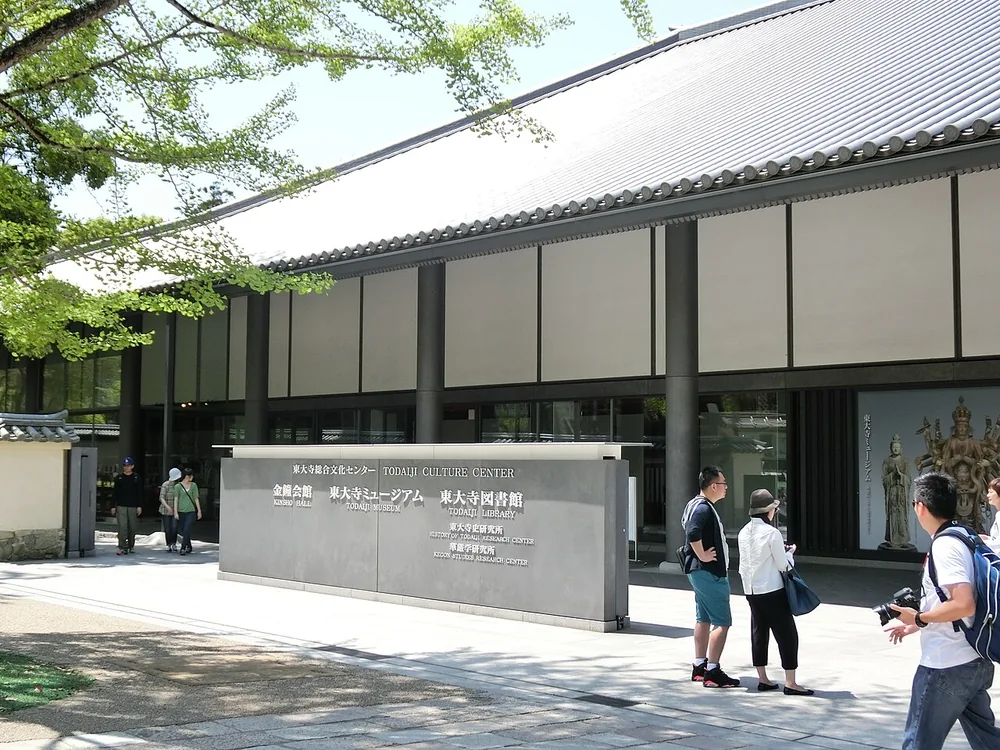
The transfer information needs the current exhibition list too. The temple’s “History and Art of Todaiji” checklist for October 11–December 23, 2026, lists Nikko Bosatsu, Gakko Bosatsu, Benzaiten and Kisshoten, all described as Nara-period painted clay sculpture. During this period, specific works connect Hokkedo with the museum. Carry one question between them: how do detail and surrounding relationships change when a figure leaves its original hall position?
The museum’s second room evokes Hokkedo’s inner sanctuary, and room-level seismic isolation is used in exhibition and storage spaces. These facilities make the reason for the transfer concrete. Think about current arrangements and preservation needs rather than searching old photographs for missing figures.
The tourism association’s Gakko Bosatsu description points to its topknot, full cheeks, narrow eyes and hands joined before the chest. In the museum, study head, face and hands, then recall Hokkedo’s many-armed principal image. Gakko’s gesture gathers movement at the chest, creating a clear contrast with Kannon’s outward-reaching arms.
Todaiji’s official introduction to Todaiji Museum.
At Kaidando, look at all four corners instead of one famous face
Kaidanin lies west of the Great Buddha Hall, opposite Hokkedo. The Kaidando introduction links it to Ganjin’s arrival in 754 to transmit Buddhist precepts. After retired Emperor Shomu and others received ordination before the Great Buddha Hall, the earthen altar was moved here to establish Kaidando. Notice the altar first. The four figures at its corners express protection through position.
The present hall is an Edo reconstruction, while its Four Heavenly Kings are Nara-period National Treasures. Building and statue dates are easy to read within this compact space: a rebuilt hall protects earlier sculpture, and the four figures define the central altar. See the overall arrangement before each statue so Kaidando becomes more than a room holding four masterpieces.
The four are Jikokuten, Zochoten, Komokuten and Tamonten. The temple describes them as protectors of the four directions and this group as representative Tenpyo work. From permitted worship positions, compare faces, body turns and the demons beneath their feet. Each places force differently. Differences in gaze, tension and balance may stay in memory more easily than four Japanese pronunciations.
Komokuten offers a good first identification point. A tourism association introduction using a photograph supplied by Todaiji describes its scroll and brush and sharp gaze into the distance. Recognize the objects, then look at expression and armor. Its force comes from concentration as well as weapons. Return to the other three to compare each face with its body pose, keeping all four in view beyond a single Komokuten close-up.
These Four Heavenly Kings are clay sculptures. A 2009 Tokyo National Research Institute for Cultural Properties report records 3D measurement and X-rays for condition and earthquake-protection research, using a measuring system that did not move the statues. Material and conservation needs add another way to understand their poses and long-term preservation. Photography, sketching and flashlights are also prohibited here. Keep attention on the four corners.
Read dry lacquer, clay and metal through their details
The stops differ in material as well as period. The Great Buddha and octagonal lantern are metal, Hokkedo’s Fukukensaku Kannon is dry lacquer, and Kaidando’s Four Heavenly Kings are clay. Turn these names into questions: where is volume emphasized, and where do fingers, clothing folds and surfaces express force? Compare materials and expression along the same route.
Nara City’s dry-lacquer introduction explains repeated building and shaping with lacquer, hemp cloth and lacquer mixed with wood or polishing powders, unlike wood carving or metal sculpture. At Kannon, use this information to read extended arms, fine decoration and three-dimensional form. Leave internal construction to restoration explanations rather than guessing from the exterior.
At Kaidando, narrow the comparison to faces and hands. All four stand, but their angry expressions differ. Hokkedo has more layers of figures, while Kaidando is more concentrated. If the previous hall required sorting principal image from guardians, this one leaves more time for individual movement. Each hall has its own viewing pace; equal minutes are unnecessary.
Include the octagonal lantern too. Its musical bodhisattvas use metal relief and an open background to separate moving robes and arms in depth. Hokkedo’s principal image extends through many arms, while Kaidando’s four statues enclose an altar. These are three ways of shaping space. Passing the lantern again may raise different questions from your first look.
Order a two-hall half-day around the hillside and closing times
For the first-visit pairing, enter by the South Gate, see the guardians and columns, then visit the Great Buddha Hall and head east to Hokkedo. Add nearby Nigatsudo if energy allows, then return south to leave. Put the main paid halls in the first part and make Nigatsudo optional. This is easier than exploring every outdoor corner before rushing indoors.
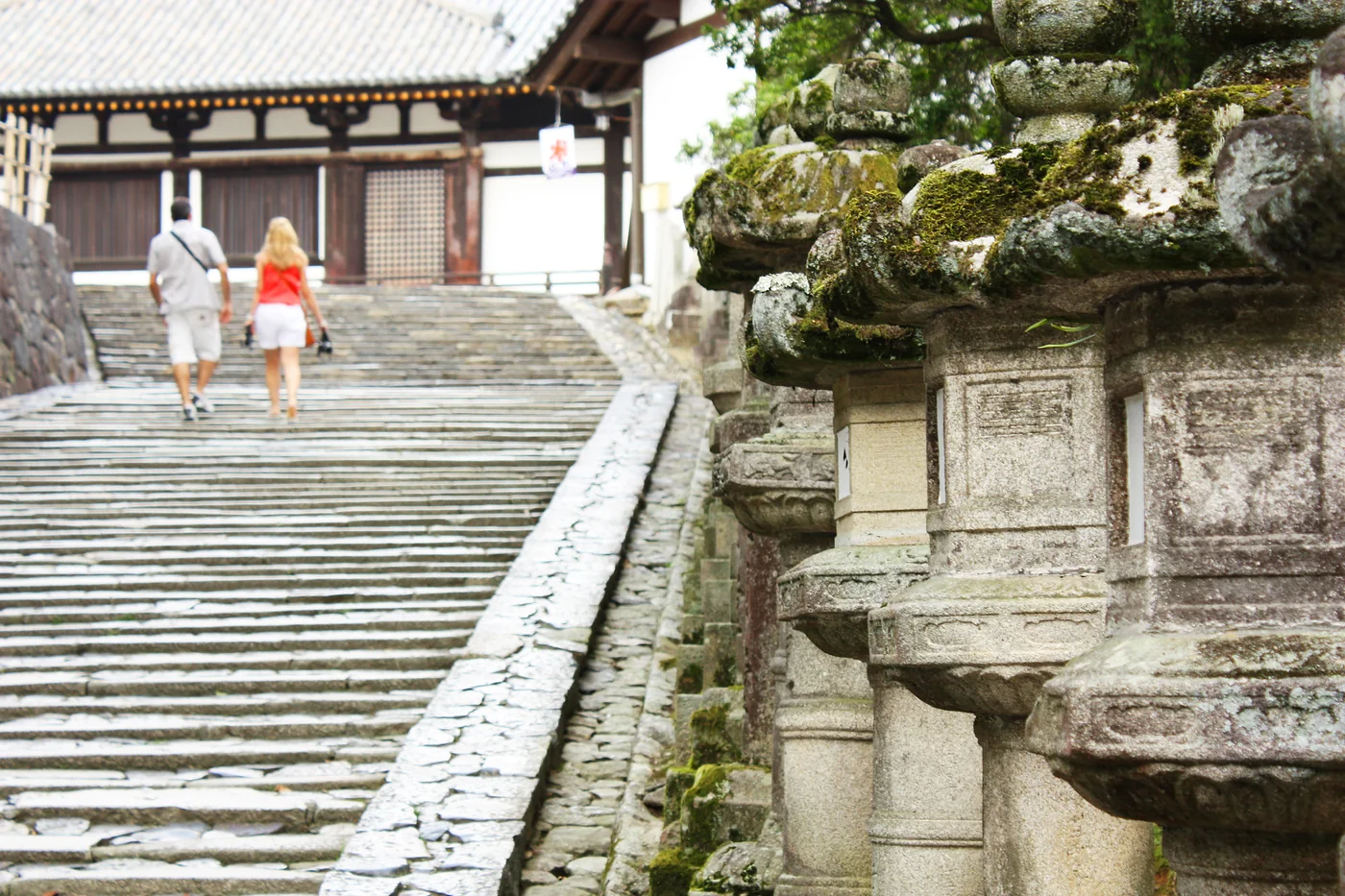
A half-day framework can allow about 90 minutes for the South Gate and Great Buddha Hall area, another 90 for the hillside walk, rest and Hokkedo, and one hour for Nigatsudo and returning south. This four-hour framework includes walking and sitting and suits people who stop for architecture and sculpture. Keep arrival travel, lunch and other park sights outside it so movement does not consume the viewing time.
For Hokkedo and Kaidando, start on the hillside, finish Hokkedo, then return west past the Great Buddha Hall area to Kaidanin. The official map places the halls at opposite ends, not in adjoining galleries. The hall exterior and lantern connect the theme along the way without adding a third admission just because you pass it.
Hokkedo and Kaidando both open 08:30–16:00. The Great Buddha Hall opens 07:30–17:30 from April to October and 08:00–17:00 from November to March. If arriving in the morning for Hokkedo or Kaidando, finish one of these earlier-closing halls first. For an afternoon arrival with two halls planned, omit Nigatsudo and other branches rather than leaving the 16:00 closure until last.
The official accessibility guide allows wheelchairs in the Great Buddha Hall’s corridor and interior, with a ramp to the west, on the left when facing the front. The path toward the square below Nigatsudo has been improved, but the hillside still has level changes. Steps to Nigatsudo itself cannot be avoided by wheelchair. For accessibility, choose the Great Buddha Hall and museum and use the purple route on the official map. Reaching the area below Nigatsudo differs from going up to its platform.
For autumn–winter 2026, substitute the museum’s Pure Land exhibition
Todaiji Museum is holding “Pure Land Belief at Todaiji,” the eighth installment of its 15th-anniversary “Temple of Eight Schools” series, from October 11 to December 23, 2026. Replace a third hall with it for a shift from vast interiors to concentrated object viewing. It also supplies a clear religious theme after the Great Buddha Hall.
The first chapter focuses on Amida belief associated with Chogen. Listed works include both hands of a seated Amida, the seated Goko Shiyui Amida from the Kanjinsho Amidado, a standing Amida from Shunjodo and a seated Amida from Shigatsudo. The South Gate and Hokkedo worship hall introduce Chogen as the leader of rebuilding. The museum adds belief and sculptural forms to that temple world.
The Shunjodo standing Amida is dated 1203, the same year the South Gate guardians were completed. Compare different sculptural tasks within one period: guardians shape an entrance, while Amida relates to Pure Land belief. Their roles, poses and original locations differ. A day’s viewing need not become one list of the most famous National Treasures.
The exhibition also includes sutras, property inventories and temple documents, some shown in different phases. The first phase, October 11–November 16, 2026, includes the Amida Keka materials inventory and the lower scroll of the Newly Compiled Biographies of Rebirth in the Pure Land. Alongside statues, these show how offerings and written records sustained belief. For sculpture alone, focus on chapter one and the transferred Hokkedo figures. Add chapters two and three for documents instead of rushing every object to cover each room.
Photography, sketching and flashlights are prohibited. Individual combination tickets for the Great Buddha Hall and museum cost ¥1,200 for junior-high students and older, or ¥600 for elementary students. They suit a decided museum visit. Hokkedo and Kaidando require separate tickets. If those are your chosen pair, follow their contents instead of buying Great Buddha Hall entry for a package discount.
Leave Nigatsudo for architecture and its platform; plan Shunie separately by season
Beside Hokkedo, Nigatsudo can end a hillside visit. The present building was reconstructed two years after the 1667 fire. The temple explains that its inner and outer sanctuaries and worship hall developed around the needs of Shunie rites. Read the building through use: it serves continuing religious practice, with ritual spaces beyond the platform.
Nigatsudo normally permits worship 24 hours a day. Stay quiet at night. Tripods are prohibited on the platform and around the main hall, and cameras should not be aimed at worshippers on pilgrimage. Finish Hokkedo first for daytime sculpture, then Nigatsudo. If arriving at dusk, visit Nigatsudo and exterior grounds and leave paid halls for another day instead of waiting outside closed doors.
The temple’s Shunie introduction gives the formal name Juichimen Keka Hoyo, with the main rites each March 1–14. Late on March 12, continuing to about 01:30 on the 13th, sacred water for Kannon is drawn from Wakasa Well. Large night torches originally lit the way for the practicing monks. Shunie, Omizutori and Otaimatsu thus refer to related but different parts. For a trip focused on the event, set aside a separate evening following that year’s temple access announcement.
Hokkedo, Kaidando and the museum restrict indoor photography. The Great Buddha Hall allows personal commemorative photos within the worship route, but prohibits posed group photos and tripods and asks that images not be reused for advertising or commercial profit. Distinguish the rules by location. Photograph the exterior in suitable light, then focus on the works indoors.
For an audio guide, plan around rental starting at 10:00
The temple lists an audio guide set with touch pen, earphones and map for ¥500 per person. About 30 minutes of content covers Todaiji’s history, architecture and statues. Languages include Chinese, Japanese adult and child versions, English, Korean, French, German, Spanish, Italian and Vietnamese. If you want to look independently before hearing more, leave this service for the Great Buddha Hall. It adds a spoken way to understand the buildings alongside entrance panels.
Rental is about 15 m beyond the Great Buddha Hall ticket checkpoint, before the Middle Gate. Reception runs 10:00–17:00 from April to October and 10:00–16:30 from November to March; severe weather may suspend rentals. The hall opens earlier. Early visitors can use on-site signs first; if the guide is central to your plan, enter after 10:00. Individuals need no reservation, but groups of ten or more do. The operator is Nihon Joho Factory (NIF). Use the email listed on the temple page for group reservations and questions.
A few useful answers
Which two paid halls should a first-time Todaiji visitor choose?
Choose the Great Buddha Hall and Hokkedo. The former offers the giant Buddha, lotus petals and vast space; Hokkedo offers Tenpyo figure groups and Nara/Kamakura architectural layers. If you have seen the Buddha and are coming for sculpture, choose Hokkedo and Kaidando.
Where are Hokkedo’s Nikko and Gakko Bosatsu now?
The temple says these two, Kisshoten and Benzaiten moved to Todaiji Museum for earthquake protection. The official exhibition checklist for October 11–December 23, 2026, lists all four.
Can you normally see all ten Hokkedo statues?
Of the ten, Shukongojin is a hidden image with a special opening listed for December 16. Base a regular visit on the publicly displayed group, including Fukukensaku Kannon, Bonten, Taishakuten, guardian kings and the Four Heavenly Kings.
Does one ticket cover the Great Buddha Hall and Hokkedo?
The halls charge separately. An individual combination ticket for the Great Buddha Hall and Todaiji Museum costs ¥1,200 for junior-high students and older and ¥600 for elementary students. Hokkedo and Kaidando still require separate tickets.
Which Todaiji route should wheelchair users choose?
Choose the Great Buddha Hall and museum, using the purple route on the temple map. A ramp is on the west side, to the left when facing the Great Buddha Hall. The square below Nigatsudo still has level changes, and steps up to Nigatsudo cannot be avoided by wheelchair.
Official information and references
Sources used in this guide.
- Todaiji | South Gate
- Todaiji | Great Buddha Hall, Vairocana and octagonal lantern
- Todaiji | Hokkedo and its statues
- Todaiji | Kaidanin Kaidando
- Todaiji | Museum and autumn–winter 2026 exhibition
- Todaiji | Exhibition checklist, October 11–December 23, 2026
- Todaiji | Grounds map
- Todaiji | Accessible worship routes
- Todaiji | Opening hours and hall admission
- Todaiji | Frequently asked questions
- Todaiji | Nigatsudo
- Todaiji | Shunie
- Nara City | Dry lacquer
- Tokyo National Research Institute for Cultural Properties | Survey of Kaidando’s clay Four Heavenly Kings
- Nara City Tourism Association | Nara’s thousand-year-old Buddhist statues, information as of August 2025