Kitakyushu's Kawachi Fujien wisteria season usually peaks from late April to early May. Covers timed-entry tickets, taxis and booked shared rides from Yahata Station, the two wisteria tunnels and Mount Sarakura night-view itineraries.
- Region & Focus
- Kitakyushu and Mojiko
- Reading Scope
- 17 min read · 10 chapters · 8 Q&As
- Official Verification
- 16 official sources checkedUpdated 22 November 2026
- Key Topics
- SeasonsBookingRail travel
Chapter Route Map (tap any stop)
- Check the bloom updates before aiming for full tunnels
- Timed-entry tickets and paying the balance at the gate
- Getting there from Hakata or Kokura: where to make the connection
- Shared rides to Kawachi Elementary School and the final uphill walk
- Driving via Okura: parking does not put you at the gate
- Inside the garden: from the wisteria tunnels to the great trellis
- Toilets, water, steep paths and planning your exit
- Pairing with Mount Sarakura night views: check all three return legs
- Day trips from Fukuoka, overnighting in Kokura and adding Mojiko
- Wet weather, sold-out tickets and visiting in autumn
- Quick Q&A
To visit Kawachi Fujien in Kitakyushu for the wisteria, book a timed-entry ticket for a specific date and slot first, then sort out your transport up and down the hill from JR Yahata Station. The garden runs no shuttle bus: without a car, you will need a taxi or a pre-booked Kitakyushu City shared ride to Kawachi Elementary School, followed by a walk to the gate. If you want to see blossoms completely blanket the 110-metre tunnel arch, pencil in late April to early May for Kitakyushu and choose your exact day from the seasonal bloom updates. On a day trip from Hakata, set aside half a day for the garden so you are not rushed; staying a night in Kokura also lets you move the Mount Sarakura night view to a separate evening.
Check the bloom updates before aiming for full tunnels
Kawachi Fujien sits in Yahatahigashi-ku, Kitakyushu, Fukuoka Prefecture, with its entrance along the hillside road near Kawachi Reservoir. Its published spring opening period usually falls between late April and early May. During the first few days of the season, individual trellises may already be flowering before the tunnels fill into a continuous canopy. If you are hoping to photograph blossoms covering the entire arch, treat late April to early May as your target window and pick your date once the garden posts its current bloom updates and individual ticket announcements.
In 2026, a Fukuoka City municipal notice listed the timed-entry ticket period as 18 April to 6 May, and the garden later announced its seasonal closure from 7 May. When planning a spring 2027 visit, check the Kawachi Fujien homepage for individual ticket sales notices. As of 22 November 2026, the garden has stated that coach parking reservation procedures for 2027 are expected to be announced by late January, while spring opening dates and ticket-release dates for individual visitors have not yet been published. Note that the coach notice covers group bus parking only; independent visitors buy timed-entry admission tickets for a specific date and slot.
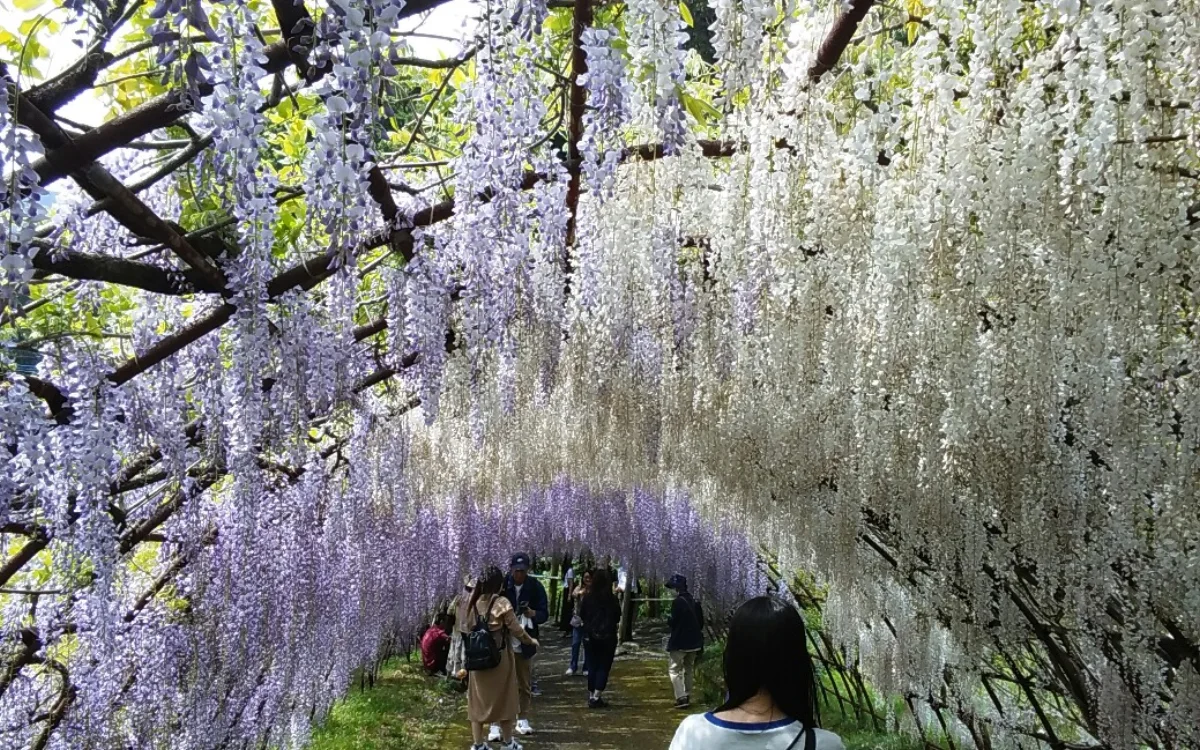
Some travellers buy tickets the moment they spot the word 'blooming'. Yet if your goal is the 110-metre tunnel canopy, photos tell you far more than brief text summaries. Check both the post date and the date the photo was taken, then look for shots framed from the tunnel mouth looking inwards to see whether the racemes overhead and along both sides meet cleanly. Close-up shots of a single blooming cluster show flower colour and petal detail well, but they reveal very little about how dense the full tunnel looks. The garden grows 22 wisteria varieties, so the open trellises and the tunnels can look quite different on the very same day. If you particularly want white wisteria or long-hanging Noda wisteria, search for current-season photos of those specific trellises and compare against what you most want to see.
If you can only spare one half-day for the garden in Kitakyushu, build two interchangeable half-days into your itinerary before booking flights, keeping Kokura Castle or Mojiko as your backup for the other slot. Once tickets go on sale, choose whichever date you can reliably make. Because existing tickets cannot be swapped if the bloom runs late or fades early, you either visit on your booked slot or write the ticket off—flexibility pays off before purchase, not after. Japan's Golden Week holiday also pushes up hotel rates, car hire prices and long-distance rail demand, which can narrow your options. Anyone planning an entire trip around a single full-bloom photograph should factor those costs in early.
Kitakyushu's Kawachi Fujien wisteria season usually peaks from late April to early May. Covers timed-entry tickets, taxis and booked shared rides from Yahata Station, the two wisteria tunnels and Mount Sarakura night-view itineraries.
Timed-entry tickets and paying the balance at the gate
Spring entry to Kawachi Fujien requires a date- and time-specific ticket. According to the 2026 Fukuoka City notice, tickets can be bought online via the link on the garden's website or through ticket kiosks at designated convenience stores in Japan; no tickets are sold at the gate during the reservation period. If you are booking from abroad, start from the seasonal notice on the garden's homepage, check the year shown on the page, and double-check the date and Japan Standard Time (JST) entry slot on your order. If you plan to buy at a Japanese convenience store after arriving, check the current year's participating chains, issue times and remaining availability beforehand. Buying locally at a convenience store works, though leaving it until arrival on a fixed weekend itinerary removes your margin to shift dates.
Taking the garden's published convenience-store ticket system as an example, visitors of junior high school age and above pay ¥600 upfront when booking. If the gate price posted on your visit date is ¥1,100, you pay an extra ¥500 at the entrance; if the day's posted price is ¥1,600, you pay ¥1,000 at the gate. If the posted entry price is ¥600, holders of a pre-paid ¥600 ticket pay nothing further. Listed payment methods at the gate counter include credit cards, selected transit IC cards and PayPay, though withdrawing some Japanese yen cash at the station beforehand makes both the gate top-up and onward local transport smoother. Check your order total, ticketing fees and gate balance separately, as the surcharge at the entrance tracks the bloom-adjusted daily admission rate.
The age rules are easy to miscalculate. The garden counts junior high school students and above as adults, and each paying adult may bring up to two children of elementary school age or younger free of charge. Two parents travelling with two elementary-school children therefore need only two adult tickets. By contrast, a family with a junior high school student must buy an adult ticket for that teenager—even though on the same day the local shared-ride taxi places junior high pupils in its lower child-fare bracket. If one paying adult is accompanying three children of elementary school age or younger, contact the garden before paying to confirm how to ticket the extra child so your group is not held up sorting it out at the gate.
Your booked slot is your arrival window at the garden gate. Standard slots published by the garden start at 08:00 JST and run in two-hour blocks: 08:00–10:00, 10:00–12:00, 12:00–14:00, 14:00–16:00 and 16:00–18:00. Last entry for the final slot is 17:20 before the garden closes at 18:00, and there is no evening illumination of the wisteria. Staying in Kokura with uphill transport pre-arranged makes the 08:00–10:00 slot far more realistic than setting out from Hakata on the morning train. Travellers staying in Hakata, visiting with children or facing two connections usually find 10:00–12:00 much easier around breakfast and the climb up. An early afternoon slot also gives you breathing room for morning trains and lunch, while still getting you back down in daylight.
Once purchased, verify who holds each ticket, the date, the entry slot and how the ticket is issued. Load mobile tickets following the instructions on the booking page, and keep paper tickets separate somewhere easy to reach; if people in your group bought separately, check everyone's timestamps at the station so nobody discovers a ticket for the next slot at the gate. Garden rules allow no self-service cancellations or changes to dates and entry times, and missed slots are non-refundable. The garden's admission page notes one exception for convenience-store tickets: if the garden closes on the day due to severe weather or a natural disaster, those tickets can be used on another day. If heavy rain moves in, check whether the garden has posted a closure notice before writing off your ticket for an indoor plan.
Getting there from Hakata or Kokura: where to make the connection
For the rail leg, search for JR Yahata Station on the JR Kagoshima Main Line (pronounced Yahata rather than Hachiman). From Kokura, take a local or rapid train heading towards Yahata that stops there. From Hakata, compare riding the Kagoshima Main Line all the way to Yahata against taking the Sanyo Shinkansen to Kokura and doubling back on a conventional train to Yahata. Compare both options all the way to your arrival time at Yahata Station: the Shinkansen is quicker between Hakata and Kokura, yet platform transfers, backtracking and picking up a taxi all eat into that margin. If you land at Yahata only to face a long wait for an uphill ride, the minutes saved by an earlier Shinkansen departure simply go into waiting.
Most visitors without a hire car switch to a taxi at Yahata Station. Save the destination name (Kawachi Fujien) and full street address (2-2-48 Kawachi, Yahatahigashi-ku, Kitakyushu) on your phone alongside your outbound time to show your driver; searching simply for 'Kawachi' on a map easily pulls up the reservoir or the local elementary school instead. If you are travelling with elderly companions, require two child seats or have a large wheelchair or other equipment, state the passenger count and equipment dimensions when booking, and ask how close the drop-off point is to the gate. You can enquire about both the uphill and return rides together, agreeing on a safe, permitted pick-up point and confirming with the driver which side of the road to wait on.
With a 10:00–12:00 ticket, for example, factor taxi waiting and boarding time into your arrival plan, aiming for the first half of the window with a buffer for any missed rail connection. Even if traffic moves more slowly than expected, you will still have time to use the toilets by the car park before ticket inspection. When setting a return pick-up time, allow for the walk back to the pick-up spot. If you have an afternoon ride booked, save a screenshot of the pick-up point on your phone and check how long the return walk takes before leaving the trellises. The main tunnel is one-way only, so hurrying back from the far end of the garden does not always let you retrace your exact steps.
Solo travellers footing the entire fare should budget considerably more for taxis than for garden admission. Ask the taxi company beforehand for an estimated return fare between Yahata Station and Kawachi Fujien, and check whether reservation fees or waiting charges apply. Groups of three or four can split the total return estimate per person and weigh it against the shared-ride option. If your hotel offers a shuttle, check its route map carefully, as station-to-hotel transfers and mountain drop-offs are two different things. Kawachi Fujien has no dedicated shuttle bus; any shuttle mentioned in older blog posts is likely the Mount Sarakura cable-car bus, so verify the destination before boarding.
Shared rides to Kawachi Elementary School and the final uphill walk
Travellers who can plan ahead also have access to Kitakyushu City's Odekake Kotsu service covering the Tashiro and Kawachi districts. This is a pre-booked shared ride running along a fixed route; Kitakyushu's official tourism site advises visitors bound for the wisteria garden to alight at Kawachi Elementary School, listed on the timetable as Kawachi Shogakko-mae. At the town end, the service runs from Okura-basutei-mae (in front of Okura Bus Stop), so check the separate bus or taxi link from Yahata Station to Okura first. Keep a note of both stops—Okura-basutei-mae to Kawachi Shogakko-mae—to show drivers or locals when asking the way, as naming the route stops matches this booked service far more reliably than just saying 'Kawachi Fujien'.
City information lists seven departures per direction on weekdays and two per direction on Saturdays, Sundays and Japanese public holidays, with bookings required at least one day in advance. The Daiichi Kotsu reservation and enquiry line is 093-662-2310, staffed weekdays 09:00–16:00 JST. Turning up at the stop on the day without a booking will not work; if you are overseas, ask your accommodation in advance whether they can call on your behalf, and if you are travelling at the weekend or during Golden Week, count backwards to catch the booking desk during weekday hours. Ask about both your outbound and return services in the same call, specifying the boarding stop, drop-off stop, travel date and total number of passengers, and write down the confirmed times and booking status.
The municipal timetable divides services into weekday and weekend/public holiday columns, with the outbound leg listed under Okura to Tashiro and the return under Tashiro to Okura. Whenever your visit falls on a Japanese public holiday, double-check both directions against the holiday column. Before booking, pick a workable return departure first and work backwards to calculate your garden entry slot and walk back down the hill. On the current Kitakyushu City timetable, a weekday departure leaves Okura at 09:15 and reaches Kawachi Shogakko-mae at 09:26, which pairs neatly with a 10:00–12:00 admission ticket and the 12:35 return service back to Okura.
Weekend logistics work very differently. Under the current timetable, the two outbound rides from Okura arrive at Kawachi Shogakko-mae at 10:41 and 11:41, yet the final return service back to Okura passes the stop at 11:10. Once you factor in the walk up to the garden and back, there is barely any time left to enjoy the wisteria. On weekends and public holidays, either use the shared ride uphill and pre-book a taxi for the descent, or take a taxi both ways.
According to the garden's road directions, the final stretch from the turning beside Kawachi Elementary School to the entrance covers roughly 800 metres along a hillside road, so allow for the gradient, post-rain conditions and your group's walking pace. To board at Okura, wait on the park side just west of the Nishitetsu Bus Okura stop, towards the civic centre. For visitors with pushchairs, bulky luggage or companions who need steady support, that 800-metre walk can feel more strenuous than strolling inside the garden, so booking a door-to-door taxi both ways saves considerable effort. The city currently lists a single fare of ¥400 for senior high school students and older and ¥200 for junior high school age and younger, excluding whatever transport you take to reach Okura.
Driving via Okura: parking does not put you at the gate
Approaching from the Fukuoka side, the garden recommends exiting the Kitakyushu Urban Expressway at Otani Junction; from the Yamaguchi side, take Yamaji Junction. Both routes continue via Okura 2-chome towards Kawachi Reservoir. The garden estimates roughly 20 minutes' driving from the motorway exit, covering road time only—you still need extra time to park and walk to the gate. If your satnav suggests a seemingly shorter cut, cross-check it against the Okura route on the garden's access page before following it. Key junctions listed by the garden, Kawachi Reservoir and Kawachi Elementary School all make reliable intermediate waypoints.
The roads around the reservoir wind sharply and narrow in stretches. If you have just arrived in Japan—especially if you are still adjusting to driving on the left or navigating narrow hillside lanes—driving in and out during daylight is much simpler than hunting for the entrance after dark. Have the driver load the satnav and offline maps before setting off while a passenger watches the turnings, paying close attention to the final 800-metre approach past the elementary school. If traffic backs up ahead, leave space and follow instructions from traffic marshals on site. If you are hiring a car with children, confirm beforehand that the vehicle fits all the child seats you need.
The garden provides roughly 200 free parking spaces for private vehicles carrying ticketed visitors. Independent drivers may still be directed to spaces around a 10-minute uphill walk from the entrance. Wear shoes with good grip, as both parts of the car park and paths inside the garden are unsurfaced and turn muddy after rain. Take your water and tickets when you leave the car, visit the car park toilets first, and wait until everyone is ready before walking up to the gate. For the earliest entry slot, the garden asks drivers not to enter the car park until roughly 30 minutes before opening, so plan breakfast in town rather than arriving uphill too early.
The main timing advantage of driving comes when you leave. If someone in your party wants to cut the visit short, rain sets in or you decide to detour to Kokura next, you can simply walk back to the car and go. The trade-off is dealing with spring mountain traffic, parking and car-hire collection and drop-off. For a single return trip just to see Kawachi Fujien before heading back to Hakata the same day, compare hire charges, fuel, expressway tolls and collection time against taking JR trains plus a taxi. If you already have a car shared among four travellers or plan to visit rail-inaccessible spots the following day, using the same hire car usually makes sense. Keep a spare pair of dry shoes and socks somewhere easy to reach inside the car so you do not have to rummage through suitcases after leaving the garden.
Inside the garden: from the wisteria tunnels to the great trellis
The path climbs immediately past the gate. Inside are two wisteria tunnels—roughly 80 metres and 110 metres long—the Wisteria Dome, and a grand trellis covering about 3,300 sq m (1,000 tsubo), planted primarily with long-hanging Noda wisteria. On a first visit, follow the 110-metre main tunnel uphill from the entrance, pause at the dome and great trellis beyond, and then loop back via the 80-metre tunnel or whichever return path is open that day. The garden enforces one-way foot traffic through the main tunnel, so watch for directional signs and ask staff how to loop round if there is a stretch you want to revisit.
The 80-metre tunnel was the first to be built when the garden opened in 1977, while the longer tunnel and the Wisteria Dome came later. Stepping inside the arches, blossoms trail down the curved framework on both sides. Overhead blooms fill the tunnels too, yet at the great trellis the trunks and support posts make it far easier to see how far a single vine can spread; standing by the edge, you can trace the limbs back to the roots feeding an entire curtain of flowers. According to the garden's records, the very first vine planted here was rescued from Kawachi village before it was submerged by the construction of the reservoir. After driving or riding past that reservoir on your way up, the landscape history behind the garden clicks into place.
The garden estimates roughly 30 minutes for one circuit of the wisteria route. In practice, allow 60–90 minutes so you have time to pause for photos and catch your breath on the uphill climb. If you are short on time, check the map at the entrance, walk straight up through the main tunnel to the great trellis and linger under your favourite canopy; if you have longer, work your way through the dome and the second tunnel too. The distinct lengths make the two tunnels easy to tell apart on the map, though seeing which side is blooming most densely still comes down to looking around on the day.
Some visitors queue before opening hoping for an empty shot at the tunnel entrance. The garden asks guests to stick to casual handheld snapshots; if you want to show the tunnel's depth, simply let walkers ahead move further down the frame. Decide whether you want the full arch from the mouth or an inward angle along a particular section once inside. Aiming diagonally upwards fills most of the frame with blossoms while keeping enough space around your feet to keep walking safely. Under the trellises, ask family or friends to stay on the designated paths when framing single-colour flower curtains so nobody steps onto the vine roots trying to dodge other visitors. Tripods, monopods, stepladders and drones are prohibited, as are pre-wedding and commercial shoots.
The main tunnel has a wooden boardwalk that turns particularly slippery in wet weather. Loop your camera strap securely around your wrist or neck and plant both feet firmly before tilting your lens upwards; where side paths are open, angling across towards the great trellis brings out strong contrast between purple and white blooms. To keep children engaged without blocking narrow sections while adults take photos, encourage them to spot unopened buds at the tips of the clusters or locate the dome on the park map. Keep clear of all vine roots—never step on or touch them—and take all rubbish home with you at the exit.
Toilets, water, steep paths and planning your exit
The toilets are located by the car park entrance—there are none inside the garden itself, and re-entry is not permitted once you leave. Make sure children and elderly companions use the toilets before heading up to the gate. There are no restaurants or shops inside, and the garden asks visitors not to bring packed lunches in; although drinks vending machines are on site, picking up bottled water near your hotel or at the station beforehand is easier. Plan lunch back down in Yahata or Kokura if you finish around midday. If anyone in your group needs meals or medication on a strict schedule, either choose a morning slot that lets you finish after breakfast before lunch, or book an afternoon slot after eating.
The garden notes that the route climbs straight from the entrance, featuring steep gradients, unsurfaced ground and slippery stretches. When visiting with elderly companions or slower walkers, checking how much incline and continuous walking they can manage matters far more than the standard circuit estimate. Once you have seen the section you came for, simply follow the signs back towards the exit. For anyone using a wheelchair or pushchair, study the wisteria-zone map first and ask staff at the entrance about the sections you plan to cover; the garden separately marks steep, stepped areas inaccessible to wheelchairs and pushchairs as the autumn foliage route. Because the wisteria and autumn routes follow separate circuits, even the shortest wisteria loop still begins on the entrance slope.
In passing showers when paths remain safe to walk, grippy shoes, a waterproof jacket that keeps your hands free and a pocket-sized lens cloth beat navigating crowds with an umbrella. The garden has previously recorded heavy rain washing mud and debris into the trellis areas, so if officials announce a closure on the morning of your visit, stay down in town and switch to another attraction. If the garden stays open in light drizzle, shorten your loop to the most manageable open paths and pause at the entrance or trellis edges to take photos.
Anyone booked into the 16:00–18:00 slot should lock in return transport before arriving. Leave ample walking time before your pick-up, especially if your hire car is parked further down the road or someone in your party needs to take the downhill path slowly. If your group splits up for photos, agree on a meeting time just inside the exit gate so everyone leaves together. If catching the shared ride, count the 800-metre walk back to Kawachi Elementary School rather than just the stroll from the great trellis to the exit. For dinner back in Hakata, either book a table well after your scheduled arrival back in Fukuoka or eat casually around the station, where plenty of restaurants save you rushing for a tight reservation.
Pairing with Mount Sarakura night views: check all three return legs
To pair Kawachi Fujien with Mount Sarakura, visit the wisteria in the morning or early afternoon and keep dusk free for the summit. Although both sit in Yahatahigashi-ku, their entrances lie along separate mountain roads. Without a car, treat Yahata Station as your hub: take a taxi back down from the garden, have a meal near the station, and then head up to the cable car base station. Alternatively, book a taxi in advance to take you straight from the garden exit to Sarakurayama Cable Car Sanroku (base) Station—handy after an afternoon slot if you want to avoid doubling back. If you need to pick up snacks or give children a break, returning via Yahata Station first is easier.
On Mount Sarakura, you ride the cable car from Sanroku (base) Station to Sanjo (top) Station, then transfer to the slope car up to the summit observatory. The operator estimates roughly 10 minutes' riding time across both legs, excluding queues and waits between departures. Official published return combination tickets cost ¥1,230 for adults and ¥620 for children. In spring, regular operating hours generally run until 22:00 with the last uphill cable car at 21:20, closed on Tuesdays except public holidays. If your wisteria ticket falls on a Tuesday, shift the night view to the previous evening and spend post-garden hours in central Kokura or at an open indoor venue instead. Bear in mind that if fog rolls over the summit, city lights below may stay obscured even when the lifts are running.
The operator runs a free shuttle bus between JR Yahata Station and Mount Sarakura base station, taking about 10 minutes. On the standard April-to-October timetable, the first bus from Yahata Station departs at 17:05 on weekdays and 09:45 on weekends and public holidays, while the final return bus leaves the base station at 22:15. The shuttle follows the cable car's operating days, so if you reach Yahata early on a regular weekday afternoon, you may need to walk or take a taxi up to the base station. Because the shuttle bus has no wheelchair lift, passengers who remain in their wheelchair should book an accessible taxi to the base station and check lift dimensions with the cable-car operator beforehand.
Plan your descent backwards across three connections: downhill from the summit observatory, from the base station back to Yahata Station, and by train from Yahata back to Kokura or Hakata. Timetables list the cable car, slope car and shuttle bus separately. If you stay late at the top, verify that your chosen shuttle still connects cleanly with a practical onward train from Yahata. Crowds gather on weekends and holidays for night photography; if a queue starts forming at the summit, catching one lift earlier gives you a much better cushion for your planned train. On longer trips, putting the night view on the evening you check into Kokura lets you visit the wisteria the next morning and head straight on to your next city.
Day trips from Fukuoka, overnighting in Kokura and adding Mojiko
If you are based in Hakata with a full day spare, look for a 10:00–12:00 or 12:00–14:00 garden ticket first. Take the morning train and uphill transfer, spend a little over an hour among the wisteria, and head back to Yahata or Kokura for lunch. On clear evenings, continue up Mount Sarakura for night views; if you prefer an earlier return, stroll around Kokura Castle in the afternoon and get back to Hakata in time for dinner. Travelling with toddlers, elderly relatives or an evening flight? Make Kawachi Fujien your only fixed booking of the day and decide what else to add once you are off the hill.
Staying overnight in Kokura lets you drop bags near the station on arrival and explore central sights that afternoon. If the forecast allows you up Mount Sarakura that evening, splitting the night view from the wisteria lets you catch an early local train to Yahata the next morning without commuting out from Hakata first. Kokura is also handy for stashing large suitcases at your hotel or in station lockers so you only carry a small daypack up the slopes. Moving on to Hiroshima, Yamaguchi or Hakata afterwards? Pick up your luggage in Kokura before boarding a long-distance train rather than hauling suitcases around the garden. If checking out that morning, ask your hotel how late they store bags so your pick-up time never clashes with transport.
With two days in the area, give Mojiko its own dedicated morning or afternoon. On a two-day plan—Kawachi Fujien on day one, Mojiko on day two—leave heavy bags in Kokura if you are catching a Shinkansen later, ride the Kagoshima Main Line out and back, and focus on the historic station building, waterfront heritage architecture and lunch before returning early for your luggage. Save the Kyushu Railway History Museum or the Kanmon Strait side for a full half-day; squeezing Mojiko into the same morning as the wisteria garden turns two leisurely strolls into a race for trains. For a full walking route covering the museums and waterfront, see our Mojiko Retro and Kanmon Strait guide.
If you are picking lunch on the fly once in Kitakyushu, anchor where you eat to your next stop. Eat around Yahata before heading up to the Mount Sarakura base station for the afternoon, or look for a seated spot with comfortable hours between Kokura Station and the castle if you are moving towards Kokura next. If you emerge late or someone in your party needs food before taking medication, buy something as soon as you reach the bottom of the hill and pick the next available train afterwards. Because hillside transport timings can shift your Kitakyushu schedule, keep any fixed-time bookings back in central Fukuoka for a separate day and leave a clean half-day for the mountain.
Wet weather, sold-out tickets and visiting in autumn
If Kawachi Fujien closes on the day or tickets have sold out while you are already in Kitakyushu, Kokura Castle Keep is an easy indoor fallback. The keep and the neighbouring Kokura Castle Japanese Garden keep their own seasonal hours, so in heavy rain you can buy a keep-only ticket and skip crossing the open garden grounds. To fill more time, the castle precinct offers Kokura Castle alongside the Seicho Matsumoto Memorial Museum and other nearby attractions. Check which venues are open and showing exhibitions of interest before settling on a nearby lunch spot. Staying in the city also skips a mountain transfer, making it far easier to get back to Hakata for dinner.
The Kitakyushu Municipal Museum of Art (Main Building) sits in Nishisayagatani-machi, Tobata-ku. You can reach it from the Yahata area, though it requires another road transfer, so check the Main Building's current exhibitions before setting off. Because the museum's branch gallery near Kokura Castle runs a separate exhibition programme, always include 'Honkan' (Main Building) when looking up the address and listings. Hours generally run 09:30–17:30 (last entry 17:00), closed Mondays or the following day when a Monday falls on a public holiday. If you are still hoping to see wisteria elsewhere, check Kisshoji Temple in Yahatanishi-ku, which has wisteria trellises on its grounds—confirm seasonal bloom updates first and redirect your route there. However, if your heart was set on long tunnels and expansive canopies, pivoting to the art museum or the castle district makes for a far more rewarding rainy-day visit.
In November, the garden reopens for autumn foliage. For 2026, the garden announced planned opening dates of 21 to 29 November, running 09:00–17:00 with last admission at 16:00 and adult entry listed at ¥500. The autumn circuit follows unsurfaced hillside trails with steeper gradients, taking around 30 minutes according to the garden's estimate. Viewing the maple colours higher up towards the ridge requires sturdy footwear and stamina for slopes; if anyone in your group uses a pushchair or wheelchair, lock in your overnight base and flatter autumn walks elsewhere before deciding whether to head into the hills. Notice also that autumn admission closes early at 16:00—when travelling from Hakata, having lunch before heading up the hill is far easier than squeezing in Kokura Castle first and racing the gate.
A few useful answers
When is the best time to see wisteria at Kawachi Fujien?
Target late April to early May first. For tunnels in full bloom, check the garden's current-season photos showing the long tunnel and the great trellis before choosing your date.
Are 2027 Kawachi Fujien tickets on sale yet?
As of 22 November 2026, the garden has not yet announced individual ticket release dates for spring 2027. Only the procedure for 2027 coach parking reservations is expected to be published by late January 2027.
Can I buy spring tickets at the entrance?
No—during the timed-entry season, tickets must be purchased in advance. In 2026, they were sold online via the garden's website link and at ticket kiosks in designated Japanese convenience stores.
Do I have to pay extra on top of a ¥600 advance ticket?
Yes, depending on the day's bloom rate. Under the garden's convenience-store booking rules, if gate admission is posted at ¥1,100 or ¥1,600 on your visit day, you pay the ¥500 or ¥1,000 balance at the entrance.
Is there a direct shuttle bus from Yahata Station to Kawachi Fujien?
No, the garden operates no dedicated shuttle bus. You can take a taxi from JR Yahata Station, or go via Okura to catch the pre-booked Tashiro-Kawachi shared ride to Kawachi Shogakko-mae (Kawachi Elementary School) and walk roughly 800 metres to the gate.
How long does it take to walk around Kawachi Fujien?
The garden estimates about 30 minutes for one loop of the wisteria route, though allowing extra time for photos and rests is sensible. Expect slopes near the gate, one-way foot traffic in the main tunnel and slippery boardwalks in wet weather.
Is Kawachi Fujien lit up at night?
No—spring hours generally finish at 18:00 with no wisteria night illuminations. Visitors holding the final entry slot must enter by 17:20.
Can I visit Mount Sarakura for night views on the same day?
Yes—visit the wisteria garden in the morning or early afternoon, then return to Yahata Station to connect to the cable car base station. Note that the Mount Sarakura cable car is closed on Tuesdays except public holidays, and plan your descent around the cable car, shuttle bus and Yahata train connections.
Official information and references
Sources used in this guide.
- Kawachi Fujien Official Website (Spring Bookings, Access, 2026 Autumn Foliage & 2027 Coach Notices)
- Kawachi Fujien Opening Hours & Admission (Convenience-Store Ticket Top-Ups & Closure Exceptions)
- Kawachi Fujien Park Map, Wisteria Varieties & Visitor Rules
- Kawachi Fujien Official Access Guide (Otani & Yamaji Motorway Junctions)
- Kawachi Fujien Pruning Updates & Heavy Rain Records
- Fukuoka City Municipal Notice (2026 Spring Timed-Entry Dates & Sales Channels)
- Kitakyushu City Tashiro-Kawachi Booked Shared Ride (Services & Fares)
- Kitakyushu City Tashiro-Kawachi Shared Ride Timetable & Okura Stop Map
- Kitakyushu City Kawachi Fujien Spot Page (Shared Ride Alighting Stop)
- JR Kyushu Yahata Station Information & Timetable Portal
- Sarakura Tozan Railway Return Combination Tickets & Boarding Guide
- Sarakura Tozan Railway FAQ (Standard Hours, Tuesday Closures & Accessibility)
- Mount Sarakura Cable Car Free Shuttle Bus Timetable
- Kokura Castle Opening Hours, Single & Combination Ticket Information
- Kitakyushu Municipal Museum of Art Main Building Opening Hours & Exhibitions
- Kitakyushu City Seasonal Flower Viewing Guide (Kawachi Fujien & Kisshoji Temple)