Wisteria season at Kitakyushu's Kawachi Fujien Wisteria Garden typically runs from late April to early May. Plan ahead with timed-entry tickets, taxis or reservation shared transit from JR Yahata Station, the two wisteria tunnels, and a Mount Sarakura night-view pairing.
- Region & Focus
- Kitakyushu and Mojiko
- Reading Scope
- 17 min read · 10 chapters · 8 Q&As
- Official Verification
- 16 official sources checkedUpdated November 22, 2026
- Key Topics
- SeasonsBookingRail travel
Chapter Route Map (tap any stop)
- Check Bloom Photos First to Catch Full Tunnel Coverage
- Timed-Entry Tickets and At-the-Gate Top-Ups
- Getting There from Hakata or Kokura: Where to Connect
- Shared Transit to Kawachi Elementary School and the Final Walk
- Driving via Okura: Parking Does Not Mean You Are at the Gate
- Inside the Garden: Tunnels, the Dome, and the Great Trellis
- Restrooms, Hydration, Steep Paths, and Exit Planning
- Pairing Mount Sarakura's Night View: Check All Three Return Legs
- Day Trips from Hakata, Overnighting in Kokura, and Adding Mojiko
- Weather Swaps, Sold-Out Dates, and Visiting in Autumn
- Quick Q&A
To see the wisteria at Kitakyushu's Kawachi Fujien Wisteria Garden, book a date- and time-specific entry ticket first, then arrange your ride up and down the mountain from JR Yahata Station. The garden runs no shuttle bus: visitors without a car take a taxi or book Kitakyushu's reservation-only shared transit and walk in from Kawachi Elementary School. If you want to catch the blooms covering the 110-meter tunnel arch, pencil in late April through early May for Kitakyushu and watch the seasonal bloom updates. Plan a relaxed half-day for a round trip from Hakata, or stay overnight in Kokura so you can split the Mount Sarakura night view onto a separate evening.
Check Bloom Photos First to Catch Full Tunnel Coverage
Kawachi Fujien Wisteria Garden sits in Yahatahigashi-ku, Kitakyushu, Fukuoka Prefecture, with its entrance along the mountain road near the Kawachi Reservoir. The garden's announced spring season usually falls between late April and early May. During the first few days after opening, some trellises may be flowering while the tunnels have not yet filled into a continuous curtain of blooms. If you want photos of flowers blanketing the entire overhead arch, block out late April through early May as your candidate window and narrow down your exact day using the garden's seasonal bloom updates and individual ticket announcements.
In 2026, Fukuoka City's municipal notice listed timed-entry tickets as running from April 18 through May 6, and the garden announced it would close starting May 7. When planning a spring 2027 visit, check the Kawachi Fujien homepage for the individual ticket sales notice. As of November 22, 2026, the garden had stated that details on 2027 tour-bus parking reservations were expected by late January, while spring opening dates and ticket release dates for individual visitors had not yet been announced. Keep in mind that the tour-bus notice covers parking reservations, whereas independent travelers buy date- and time-specific entry tickets.
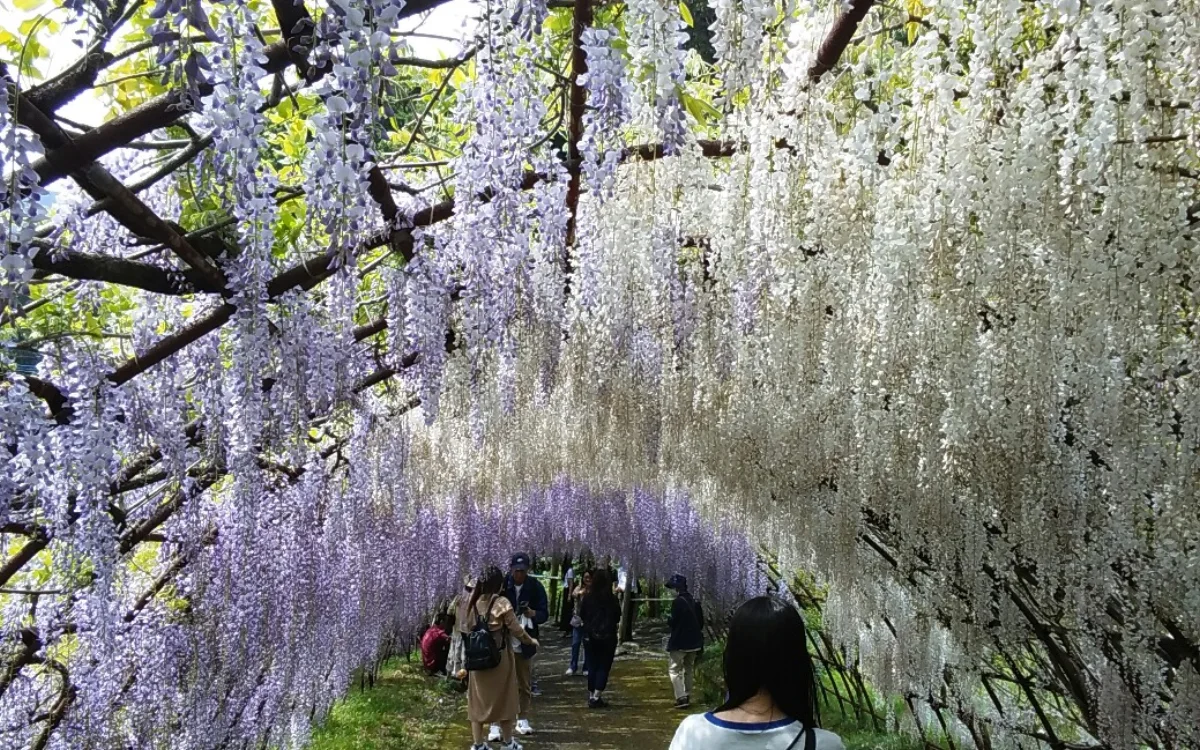
Many travelers buy tickets the moment they see the word "blooming." If your goal is the 110-meter tunnel arch, photos tell you far more than brief text status labels. Check both the post date and the photo capture date, then look for shots framed from the tunnel entrance looking inward to see whether the overhead and side clusters connect smoothly. A tight close-up of a single cluster shows petal color and shape clearly, but tells you little about overall tunnel density. The garden grows 22 wisteria cultivars, so the trellises and tunnels can look quite different on the very same day. If you specifically want white wisteria or long-cluster Noda wisteria (Nodafuji), look for current-season photos of those exact trellises to compare against what you hope to see.
If you only have half a day for the wisteria garden on your Kitakyushu itinerary, hold two flexible half-day slots before booking flights, keeping Kokura Castle or Mojiko in the other slot. Once tickets go on sale, choose the day that best matches your actual arrival schedule. If you buy too early and run into a late bloom or early fade, you either visit on your original ticket or forfeit it—flexibility only helps before you purchase. Keep in mind that Japan's Golden Week holidays also tighten hotel rates, rental cars, and long-distance trains, limiting which dates remain viable. Anyone building an entire trip around one peak-bloom photo needs to factor those added costs in.
Wisteria season at Kitakyushu's Kawachi Fujien Wisteria Garden typically runs from late April to early May. Plan ahead with timed-entry tickets, taxis or reservation shared transit from JR Yahata Station, the two wisteria tunnels, and a Mount Sarakura night-view pairing.
Timed-Entry Tickets and At-the-Gate Top-Ups
Spring admission to Kawachi Fujien requires a date- and time-specific ticket. According to the 2026 Fukuoka City notice, tickets were sold through a booking platform linked from the garden's website as well as at convenience-store kiosks in Japan; no tickets are sold at the gate during the reservation period. International visitors can purchase online via the seasonal announcement on the garden's homepage—confirm the year on the page first, then double-check your date and Japan Standard Time (JST) entry window on the order screen. If you prefer buying at a Japanese convenience store after arriving, check the participating chains, ticketing hours, and live availability for that year. Convenience-store kiosks work fine, though waiting until you land leaves less room to shift dates if your trip is fixed around a busy weekend.
Under the garden's published convenience-store ticket system, visitors of junior high school age and older pay ¥600 upfront when reserving. If the posted admission fee on your visit day is ¥1,100, you pay an additional ¥500 at the gate; if the day's rate is ¥1,600, you pay ¥1,000 at the gate; and if the day's admission is ¥600, your ¥600 voucher covers entry with no extra charge. Accepted payment methods listed for the entrance counter include credit cards, select transit IC cards, and PayPay, though carrying extra Japanese yen cash from the station makes both the gate balance and local rides easier. Review your booking fee, any ticketing fee, and the gate top-up separately—the amount due at entry follows the daily bloom-tier price set by the garden.
Age tiers trip up many families. The garden applies the adult rate to junior high school students and older, and each paying adult may bring up to two elementary-school-age or younger children in free. Two parents with two elementary schoolers need only two adult tickets under this rule. A junior high school student needs an adult ticket at the garden, even though on the same day Kitakyushu's shared local transit puts junior high students and younger in its discounted fare tier. If one paying adult is bringing three elementary-age or younger children, contact the garden before paying to ask how to ticket the third child rather than sorting it out separately at the gate.
Your reserved time slot is your check-in window at the garden gate. Typical posted slots start at 08:00 in two-hour blocks: 08:00–10:00, 10:00–12:00, 12:00–14:00, 14:00–16:00, and 16:00–18:00. Visitors in the final slot must enter by 17:20; the garden closes at 18:00, with no evening wisteria illumination. Guests staying in Kokura with prearranged mountain transport can realistically make the 08:00 slot, whereas travelers coming up from Hakata that morning will find 10:00–12:00 far easier to pair with breakfast and transfers, especially with kids or two connections. An early-afternoon slot also works well if you prefer an unhurried morning train and lunch first while still descending in daylight.
After purchasing, verify who holds each ticket, the date, the time slot, and the pickup method. Load mobile tickets following the vendor's instructions, and keep paper vouchers in an easy-to-reach pocket. If members of a group buy separately, compare timestamps at the station before heading up the mountain so nobody ends up in the next window. Under garden policy, tickets cannot be canceled or changed to another date or time after purchase, and missed entry slots are nonrefundable. The fee page notes an exception for convenience-store tickets if natural disasters or similar events force the garden to close that day, allowing reuse on another day. On rainy mornings, check whether the garden has posted a closure notice before deciding whether to write off the ticket and switch to indoor plans.
Getting There from Hakata or Kokura: Where to Connect
Start by looking up trains to JR Yahata Station on the JR Kagoshima Main Line—note that the Japanese name is read "Yahata," not "Yawata." From Kokura, take a local or rapid conventional train bound for the Yahata direction that stops at Yahata. From Hakata, compare riding the JR Kagoshima Main Line straight to Yahata against taking the Sanyo Shinkansen to Kokura and doubling back on a conventional train to Yahata. Compare both options all the way to your arrival time at Yahata Station: the Shinkansen only speeds up the Hakata-to-Kokura leg, and backtracking plus switching platforms takes time. If your arrival at Yahata leaves you waiting a long time for a ride up the mountain, the minutes saved on the bullet train simply disappear at the taxi stand.
Most visitors without a rental car transfer to a taxi at Yahata Station. Save the Japanese destination name for Kawachi Fujien Wisteria Garden and its full street address (2-2-48 Kawachi, Yahatahigashi-ku, Kitakyushu) in Japanese script on your phone to show the driver, alongside your planned departure time. Searching only "Kawachi" in a map app often drops the pin on Kawachi Reservoir or the elementary school instead. If you are traveling with older adults, need two child seats, or have a large wheelchair or mobility gear, state your headcount and equipment dimensions when booking and ask how close the car can drop you to the gate. When arranging the ride up, ask about booking the return pickup too, agreeing on a safe, permitted loading spot and confirming which side of the road to wait on.
For a 10:00–12:00 entry ticket, build taxi wait time into your pre-entry buffer and aim to arrive in the first half of your window with slack for a missed train connection. Even if mountain traffic runs slow, you will still have time to use the restrooms beside the parking lot before scanning your ticket. When scheduling your return pickup, count the walk back to the pickup point: screenshot the exact pickup spot on your phone and check the walking time before leaving the upper trellises. The main wisteria tunnel is one-way, so rushing back to the gate from deep inside the grounds may not mean retracing the exact path you came in on.
Solo travelers footing the entire taxi fare should expect transport to cost noticeably more than admission. Ask a taxi operator in advance for a round-trip fare estimate between Yahata Station and Kawachi Fujien, and check whether reservation fees or wait-time charges apply. Groups of three or four can split the round-trip taxi estimate per person and compare it against local shared transit. If your hotel offers a shuttle, check its route map—station-to-hotel shuttles do not cover the mountain road to the garden. Kawachi Fujien does not operate a dedicated garden shuttle; older blog posts mentioning a free shuttle are often referring to the Mount Sarakura Cable Car bus, so verify the destination before boarding.
Shared Transit to Kawachi Elementary School and the Final Walk
Travelers planning ahead can also use Odekake Kotsu, Kitakyushu's reservation-only shared local transit serving the Tashiro and Kawachi area along a fixed route. Kitakyushu's official tourism site advises garden visitors to get off at Kawachi Elementary School (listed on the timetable as Kawachi Shogakko-mae). At the Okura end, the stop is Okura Bus Stop-mae (Okura Basu-tei-mae), so check the transit connection from Yahata Station to Okura separately. Keep a quick note of both Japanese stop names—Okura Bus Stop-mae to Kawachi Elementary School—to show the driver when confirming directions; that matches this reservation route far more reliably than just saying the garden's name.
The city schedule lists seven runs each way on weekdays and two runs each way on Saturdays, Sundays, and Japanese national holidays, all requiring reservations by at least the day before. The reservation and inquiry phone number at Daiichi Kotsu is 093-662-2310, staffed weekdays from 09:00 to 16:00 JST. Showing up at the stop on the day without booking will not work. Overseas visitors can ask their accommodation in advance whether staff can call on their behalf; if you plan to ride on a weekend or during Golden Week, count backward to catch that weekday phone window. Ask about both your outbound and return rides in one call, specify the boarding stop, drop-off stop, travel date, and passenger count, and note down the confirmed departure time and reservation status.
The city timetable splits weekday and weekend/holiday columns, with outbound runs listed as Okura toward Tashiro and return runs as Tashiro toward Okura. When switching to the weekend/holiday column, recheck both directions carefully. Before calling to book, pick your return departure first and work backward to determine your entry slot and walk-down buffer. On Kitakyushu's current weekday schedule, for example, the 09:15 departure from Okura reaches Kawachi Elementary School at 09:26, leaving enough time to pair a 10:00–12:00 admission slot with the 12:35 return run back to Okura.
Weekends work differently. On the current schedule, the two morning departures from Okura arrive at Kawachi Elementary School at 10:41 and 11:41, yet the final return run back toward Okura passes the stop at 11:10. Once you walk up the hill from the bus stop, that turnaround leaves virtually no time inside the garden. If you use shared transit uphill on a weekend or holiday, prebook a taxi for the descent—or simply take a taxi both ways.
Per the garden's road directions, the walk from the turn beside Kawachi Elementary School to the entrance is roughly 800 meters along a mountain road, so factor in the incline, wet pavement after rain, and your group's walking pace. To board at Okura, wait on the west side (the park side) of the Nishitetsu Bus "Okura" stop, facing toward the civic center. For travelers with strollers, bulky luggage, or companions who need assistance walking, this stretch can feel harder than touring the garden itself; booking door-to-door taxis saves a substantial uphill trudge. City guidelines currently list one-way shared-transit fares at ¥400 for high school students and older and ¥200 for junior high students and younger, separate from your transit to reach Okura.
Driving via Okura: Parking Does Not Mean You Are at the Gate
Drivers coming from Fukuoka are advised by the garden to exit the Kitakyushu Urban Expressway at Otani IC, while drivers coming from Yamaguchi should use Yamaji IC. Both routes head toward Okura 2-chome and Kawachi Reservoir. The garden estimates about 20 minutes of driving after leaving the expressway, which covers road time only—not parking or walking to the gate. If your car navigation offers what looks like a shortcut, cross-check it against the official Okura route on the garden's access page before turning off; the intersections, Kawachi Reservoir, and Kawachi Elementary School listed there serve as reliable waypoints.
Roads around the reservoir wind sharply and narrow in places. If you just landed in Japan and are driving on the left for the first time, entering and exiting in daylight is far simpler than searching for the gate after dark. Set up navigation and offline maps before departing, have a passenger call out turns, and watch for the final 800-meter stretch past the elementary school. If traffic backs up ahead, leave space and follow traffic attendants' signals. When renting a car with children, confirm the model can accommodate every child safety seat you need.
The garden provides roughly 200 free parking spaces for private vehicles visiting the grounds. Individual drivers may still be directed to a lot about a 10-minute uphill walk from the entrance. Wear grippy shoes: both the lots and parts of the garden have unpaved surfaces that get muddy after rain. Grab your water and tickets when stepping out of the car, use the parking-area restrooms, and gather your group before walking up to the gate. If you hold first-slot tickets, the garden asks drivers not to use the lots earlier than about 30 minutes before opening—eat breakfast in town first instead of waiting uphill.
A rental car's main advantage shows up when it is time to leave. If someone wants to cut the visit short, rain picks up, or you switch your next stop to Kokura, you can walk back to your car and go without waiting on a pickup. The trade-off is handling narrow spring mountain roads, parking, and pickup/return logistics. If the garden is your only non-rail stop and you are returning to Hakata the same day, compare rental, fuel, expressway tolls, and pickup time against JR trains plus a taxi. If you already have a four-person road trip booked or off-rail stops the next day, using that car makes easy sense—just stash a dry pair of shoes and socks within reach in the cabin so you do not have to dig through suitcases afterward.
Inside the Garden: Tunnels, the Dome, and the Great Trellis
The path climbs right from the entrance. Inside, you will find two wisteria tunnels—roughly 80 meters and 110 meters long—a wisteria dome, and a grand trellis spanning about 1,000 tsubo (roughly 3,300 square meters) anchored by long-cluster Noda wisteria. On a first visit, enter through the 110-meter main tunnel leading into the grounds, spend time at the dome and grand trellis on the far side, and follow the day's signage back via the 80-meter tunnel or other open paths. Because the main tunnel is strictly one-way, watch directional signs and ask staff how to loop back if there is a section you want to revisit.
The 80-meter tunnel was completed when the garden opened in 1977; the longer tunnel and wisteria dome were added later. Inside the arches, blossoms wrap down both sides of the curved frame. Under the grand trellis, thick trunks and support posts make it easier to trace how far a single vine spreads—stand near the edge and follow the branches overhead to see where the canopy originates. According to the garden's history, the oldest planted vines were rescued from Kawachi Village before it was submerged to build the reservoir. Driving or riding along the reservoir road right before seeing those vines connects the landscape's past to the garden itself.
The garden estimates about 30 minutes for a basic walk around the wisteria loop. Build in 60 to 90 minutes for yourself to look around, take photos, and pause for breath on the uphill climbs. For a faster circuit, study the map near the entrance, walk the main tunnel to the trellises, linger at your favorite section, and add the dome and second tunnel if time allows. The two tunnels' distinct lengths help orient you on site, though checking which side looks fullest on any given day still comes down to looking around once you arrive.
Some visitors line up before opening hoping for an empty shot at the tunnel mouth. The garden asks guests to stick to casual handheld snapshots; to show tunnel depth in a crowd, keep people walking ahead of you farther down the frame. Decide whether you want the full overhead arch or a tighter slice of the canopy once inside, and angle upward diagonally across the side blooms so flowers fill most of the frame while you keep space below for foot traffic. Under the trellises, keep family and friends on the designated walkways when framing single-color curtains of blossoms rather than stepping onto root zones to dodge people. Tripods, monopods, stepladders, drones, pre-wedding shoots, and commercial photography are prohibited.
The main tunnel has wooden boardwalk planks that turn slick in the rain. Keep your camera strap around your neck and plant both feet firmly before tilting up. When open paths allow, shooting the grand trellis from a side angle helps capture contrast between purple and white clusters. Give kids something to spot—like unopened buds at the bottom tip of a raceme or the dome on the map—so they are less restless waiting in narrow passages. Stay clear of vine roots without stepping on or touching them, and carry all trash out with you at the exit.
Restrooms, Hydration, Steep Paths, and Exit Planning
Restrooms are located at the parking lot entrance—there are no restrooms inside the garden, and reentry is not permitted once you leave. If you are with children or older relatives, stop at the restrooms before passing through the gate. There are no restaurants or shops inside, and the garden asks visitors not to bring boxed lunches inside; although drink vending machines are on site, bringing water from a station or near your hotel is easier. Plan lunch after returning to Yahata or Kokura if you finish around midday. If anyone in your group needs meals or medication on a set schedule, choose a morning entry slot right after breakfast or an afternoon slot after lunch to shorten the gap without food.
The garden notes that the climb starts at the gate, with steep grades, unpaved stretches, and slick surfaces along the paths. With older visitors or slower walkers, gauging what incline and continuous walking distance they can comfortably handle matters more than timing a full loop—once you have seen your top priority section, follow signs back to the exit. If someone uses a wheelchair or stroller, review the wisteria-zone layout first and ask staff which stretches are navigable; the garden marks areas with stairs and steep slopes inaccessible to wheelchairs and strollers as the autumn foliage route. Spring wisteria and autumn leaves follow two separate seasonal routes, though even the shortest wisteria loop includes the slope right at the entrance.
In light rain when trails remain safe to walk, non-slip shoes, a poncho or raincoat that keeps both hands free, and a pocket lens cloth are far more comfortable than weaving an umbrella through crowds. The garden has previously documented mud and debris washing onto trellis paths during heavy downpours; if an official closure is posted on your morning, stay down in town and switch to backup plans. If the garden remains open in light showers, shorten your loop to the most stable open paths and pause at the entrance or trellis edges to shoot.
Visitors entering from 16:00 onward should lock in their return ride early. Leave generous walking buffer before pickup time, especially if your rental car is parked far away or someone needs to descend slowly. If photographers split up inside, agree on a meeting time just inside the exit gate so everyone leaves together. If you are riding shared transit, remember to include the 800-meter walk back to the Kawachi Elementary School stop—not just the stroll from the grand trellis to the gate. For dinner back in Hakata, book a table only after you are safely on the train back, or eat casually around the station where plenty of walk-in options take the pressure off catching a tight reservation.
Pairing Mount Sarakura's Night View: Check All Three Return Legs
Combining Kawachi Fujien with Mount Sarakura works best when you see the wisteria in the morning or early afternoon and save dusk for the summit. Both sit in Yahatahigashi-ku, though on separate mountain roads. Without a car, use JR Yahata Station as your hub: take a taxi back to the station, grab a meal, and head to the cable car base station from there. Alternatively, if you visit the garden in the afternoon and want to skip backtracking through Yahata Station, arrange in advance for your taxi to drop you directly at Sarakurayama Cable Car Sanroku (Base) Station. If you want to pick up snacks in town or give kids a break, routing back through Yahata Station gives you an easier pit stop.
To reach Mount Sarakura's summit, ride the cable car from Sanroku (Base) Station to Sanjo (Upper) Station, then transfer to the slope car up to the summit observatory. The operator estimates both rides together take about 10 minutes, excluding queue or wait times. Official round-trip combo fares are ¥1,230 for adults and ¥620 for children. Spring service generally runs until 22:00, with the final uphill cable car departing at 21:20, and operations close on Tuesdays except national holidays. If your garden ticket falls on a Tuesday, shift the night view to the evening before and spend post-garden hours in central Kokura or an open museum. Note that mountain fog can wipe out the city-light view after dark even when the lifts are running normally.
The operator runs a free shuttle bus between JR Yahata Station and Sarakurayama Sanroku Station, taking about 10 minutes. On the standard April-to-October schedule, the first bus leaves Yahata Station at 17:05 on weekdays and 09:45 on weekends and holidays, with the final bus back from Sanroku Station usually departing at 22:15. The shuttle follows the cable car's operating days; if you arrive at Yahata Station early on a weekday afternoon before 17:05, you will need to walk or take a taxi to the base station. Because the shuttle bus has no wheelchair lift, visitors who remain in a wheelchair should book an accessible taxi to Sanroku Station and check station elevator dimensions with the cable car operator beforehand.
Plan your trip down backward across three legs: summit descent, shuttle back to Yahata Station, and train onward to Kokura or Hakata. The operator posts separate schedules for the cable car/slope car and the shuttle bus. Before staying late on the summit, verify that your target shuttle connects to a practical train out of Yahata, and allow enough cushion to catch it. On busy holiday evenings, if queues start forming for the descent, catching one ride earlier greatly improves your odds of making your intended train. On longer itineraries, put Mount Sarakura on the evening you arrive in Kokura so you can head straight to your next city after visiting the garden the following day.
Day Trips from Hakata, Overnighting in Kokura, and Adding Mojiko
If you are based in Hakata with a full day open, aim for a 10:00–12:00 or 12:00–14:00 garden slot. Ride the morning train to Yahata and head uphill, spend an hour or slightly longer among the wisteria, then descend to Yahata or Kokura for a meal. In clear weather, stay through dusk for Mount Sarakura; if you prefer an earlier return to Hakata, stroll around Kokura Castle in the afternoon and take the train back before dinner. When traveling with toddlers, older relatives, or an evening flight, keep the garden as your sole timed commitment for the day and play any afternoon stops by ear.
For a one-night stay in Kokura, drop bags near the station upon arrival and spend that afternoon around town. If weather allows Mount Sarakura that evening, splitting the night view from the next morning's wisteria visit lets you catch an early local train to Yahata without the long haul from Hakata. Staying in Kokura also lets you leave large suitcases at your hotel or the station and carry only a light daypack up the mountain. If you are continuing to Hiroshima, Yamaguchi, or back to Hakata on day two, pick up your bags in Kokura before boarding your long-distance train rather than dragging luggage along the garden's slopes. If checking out that morning, confirm how late your hotel holds luggage so pickup does not clash with tight train transfers.
Over two days, save Mojiko for its own morning or afternoon. On a two-day plan with Kawachi Fujien on day one and Mojiko on day two—especially if you are catching a Shinkansen later—store large luggage at Kokura Station, ride the JR Kagoshima Main Line back and forth, and focus on the historic station building, waterfront heritage architecture, and lunch before returning early for your bags. If you want to visit the Kyushu Railway History Museum or walk the Kanmon Strait shoreline, give Mojiko a full half-day; cramming it into the same morning as the wisteria garden turns two leisurely strolls into a race for trains. For waterfront walking routes and museum details, see the Mojiko Retro & Kanmon Strait guide.
If you are playing lunch by ear in Kitakyushu, tie your dining neighborhood to your next stop. Heading to Mount Sarakura later? Eat around Yahata before making your way to Sanroku Station. Heading toward Kokura? Look for a sit-down spot between Kokura Station and the castle district that fits your schedule. If you exit late or someone needs medication with food, buy provisions down in town first before checking train departures. Because mountain transport times can shift your schedule around, keep any strict-entry reservations in Fukuoka City on a separate day so this mountain excursion gets the breathing room of a dedicated half-day.
Weather Swaps, Sold-Out Dates, and Visiting in Autumn
If the garden closes for the day or tickets sell out while you are in Kitakyushu, Kokura Castle Keep is an easy indoor pivot. The keep and the Kokura Castle Garden post separate seasonal hours, and in heavy rain you can buy a single keep ticket to skip walking through the outdoor garden. If you want to spend more time in the area, the castle district offers options such as Kokura Castle and the Seicho Matsumoto Memorial Museum. Check which sites are open and showing exhibitions you want to see first, then eat nearby. Staying in town skips the mountain transit altogether, making an early dinner back in Hakata much easier.
The Kitakyushu Municipal Museum of Art Main Building sits in Nishisayagatani-machi, Tobata-ku. You can reach it from the Yahata area, though it requires another road transfer, so check the Main Building's current exhibition before setting out. The annex near Kokura Castle runs its own exhibition schedule—include "Main Building" (Honkan) when searching for the address. Standard museum hours are 09:30–17:30 (last entry 17:00), closed Mondays or the following day when Monday is a public holiday. If you still want to see wisteria blooms elsewhere, look into Kissho-ji Temple in Yahatanishi-ku, which maintains wisteria trellises on its grounds—check its seasonal bloom status and update your route before heading out. If your main goal was the long tunnels and huge canopies, pivoting to the museum or castle district on a rainy day still delivers a full visit.
November brings autumn foliage season. For 2026, the garden announced scheduled opening dates from November 21 to 29, 09:00–17:00 (last entry 16:00), with adult admission listed at ¥500 on its fee page. The autumn route uses unpaved mountain trails with noticeable inclines, taking roughly 30 minutes for the loop per garden estimates. Reaching the higher-elevation foliage near the hilltop requires sturdy shoes and stamina; anyone using a stroller or wheelchair should prioritize accessible city walks near their base before deciding on this climb. Note that autumn last entry closes at 16:00, much earlier than spring. Coming from Hakata, eat lunch before heading up the mountain rather than trying to squeeze in Kokura Castle first and rushing to beat last entry.
A few useful answers
When is the best time to see wisteria at Kawachi Fujien Wisteria Garden?
Start by targeting late April through early May. To catch the tunnels at full cover, check the garden's current-season photos of the long tunnel and grand trellis before booking.
Are 2027 tickets on sale yet for Kawachi Fujien?
As of November 22, 2026, the garden had not yet announced the spring 2027 sale date for individual admission tickets. The notice expected by late January 2027 covers tour-bus parking reservations.
Can you buy spring tickets at the garden entrance?
No. During the timed-entry season, tickets must be purchased in advance. In 2026, tickets were sold through the booking link on the garden's website and at designated convenience-store kiosks in Japan.
Do I have to pay more at the gate on top of the ¥600 ticket?
According to the garden's fee page for convenience-store vouchers, if the posted admission rate on your visit day is ¥1,100 or ¥1,600, you pay the ¥500 or ¥1,000 difference at the entrance.
Is there a direct shuttle bus from JR Yahata Station to Kawachi Fujien?
No, the garden does not operate a shuttle bus. Take a taxi from JR Yahata Station, or connect via Okura to the reservation-only Tashiro-Kawachi Odekake Kotsu shared transit, get off at Kawachi Elementary School, and walk roughly 800 meters uphill to the entrance.
How long does it take to walk through Kawachi Fujien Wisteria Garden?
The garden estimates about 30 minutes for the wisteria loop, though most visitors should allow extra time for photos and breaks. Expect inclines near the entrance and exit, one-way flow in the main tunnel, and slick wooden boardwalks in the rain.
Does Kawachi Fujien have evening light-ups?
No, there is no evening wisteria illumination. Spring hours typically end at 18:00, and final-slot visitors must enter by 17:20.
Can I visit Mount Sarakura for the night view on the same day?
Yes. Visit Kawachi Fujien in the morning or early afternoon, then return to JR Yahata Station to connect to the Mount Sarakura Cable Car base station. Note that the cable car is closed Tuesdays (except national holidays), and check the descent lift, shuttle bus, and onward JR train times together before heading up.
Official information and references
Sources used in this guide.
- Kawachi Fujien Official Website (Spring Reservations, Access, 2026 Autumn Foliage, and 2027 Tour Bus Notice)
- Kawachi Fujien Hours and Admission Fees (Convenience-Store Voucher Gate Top-Ups and Closure Exceptions)
- Kawachi Fujien Garden Map, Wisteria Cultivars, and Entry Rules
- Kawachi Fujien Official Access Guide (Otani and Yamaji Expressway Exits)
- Kawachi Fujien Official Blog (Pruning Logs and Heavy Rain Records)
- City of Fukuoka Municipal Notice (2026 Spring Timed-Entry Dates and Sales Channels)
- City of Kitakyushu Tashiro-Kawachi Reservation Shared Transit (Schedules and Fares)
- City of Kitakyushu Tashiro-Kawachi Shared Transit Timetable and Okura Stop Map
- Kitakyushu City Guide: Kawachi Fujien Wisteria Garden (Shared Transit Stop Details)
- JR Kyushu Yahata Station Information and Timetable Portal
- Sarakura Tozan Railway Round-Trip Fares and Riding Guide
- Sarakura Tozan Railway FAQ (Operating Hours, Tuesday Closures, and Accessibility)
- Mount Sarakura Cable Car Free Shuttle Bus Schedule
- Kokura Castle Hours, Single-Facility Tickets, and Combo Passes
- Kitakyushu Municipal Museum of Art Main Building Hours and Exhibitions
- Kitakyushu City Guide: Seasonal Flower Viewing (Kawachi Fujien and Kissho-ji Temple)