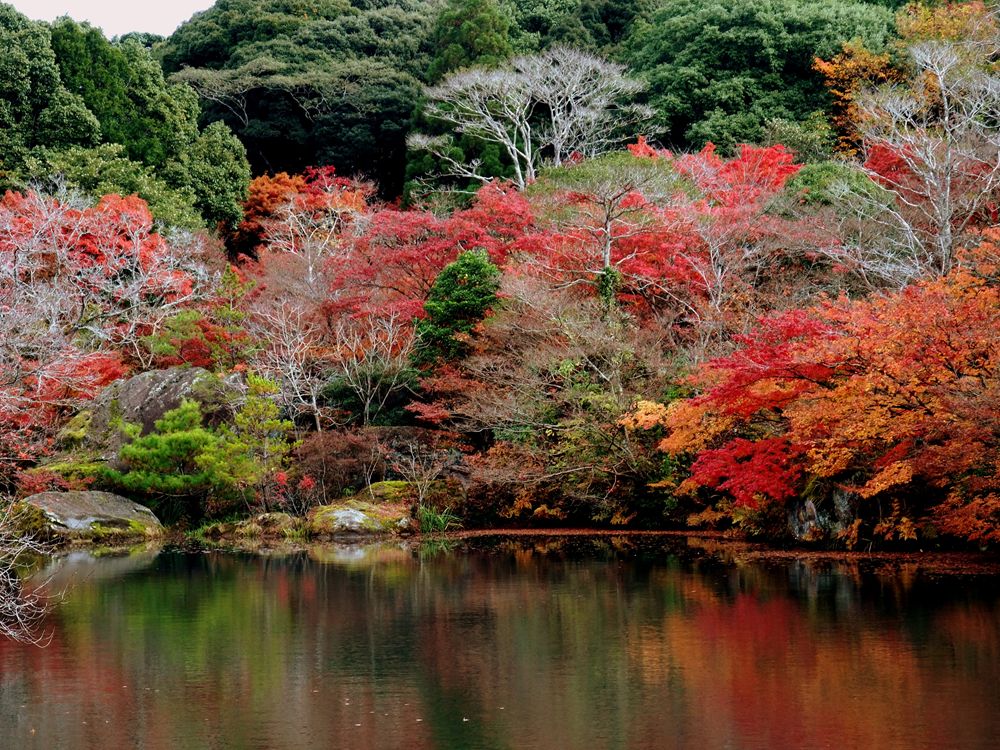
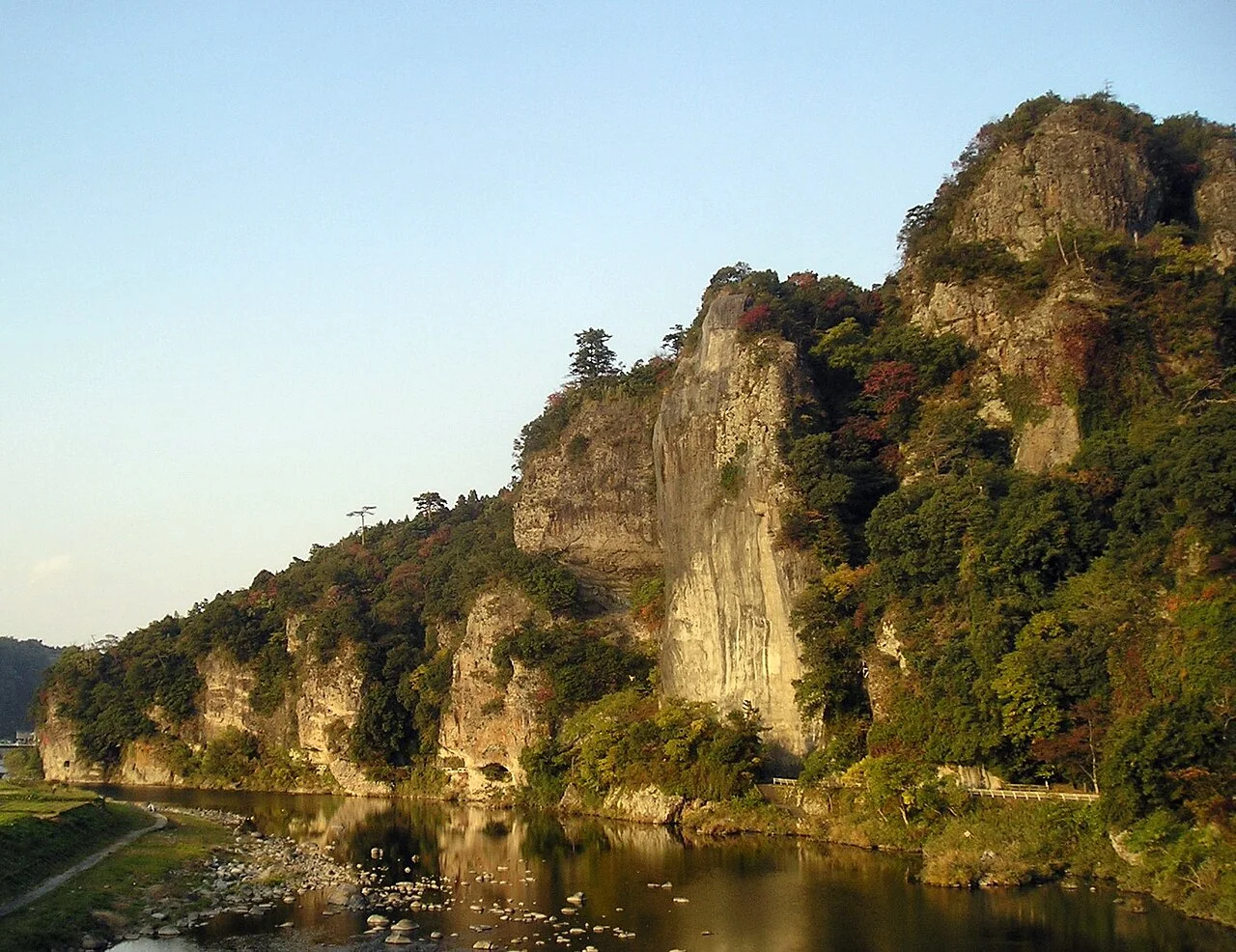
Planning an autumn foliage trip to Fukuoka? Compare timing and transport for Kamado Shrine in Dazaifu, Kuromon Gate at Akizuki Castle Ruins, and Mount Sarakura, with city garden backups, Amagi buses, Yahata shuttles, and one- or two-day itineraries.
- Region & Focus
- Fukuoka
- Reading Scope
- 24 min read · 10 chapters · 4 Q&As
- Official Verification
- 34 official sources checkedUpdated 22 November 2026 at 08:00 GMT+8
- Key Topics
- SeasonsItinerariesKyushu
Chapter Route Map (tap any stop)
- When to Visit Fukuoka for Autumn Leaves: Dazaifu vs Akizuki
- Dazaifu by Day: Tenmangu Shrine First, Then Kamado Shrine
- Kamado Shrine Illuminations Until 21:00 and Return Bus Planning
- Akizuki Castle Ruins: Foliage at Kuromon Gate and Walks Along Suginobaba
- Getting to Akizuki via Ogori or Kiyama and the Amagi Kanko Bus
- Ascending Mount Sarakura from Yahata: Lock In Your Descent Time First
- When to Go Up Mount Sarakura for Autumn Foliage and Night Views
- City Autumn Walks in Fukuoka: Maizuru Park vs Yusentei Park
- One-Day Itineraries: Dedicating a Full Day to Your Top View
- Two-Day Plans and Where to Stay: Balancing Dazaifu, Akizuki, and Kitakyushu
- Quick Q&A
If you only have one day for autumn foliage in Fukuoka, take the train to Dazaifu: visit Dazaifu Tenmangu Shrine by day and head up to Homangu Kamado Shrine for maple leaves. To photograph scarlet foliage framing a dark wooden castle gate, save the morning and lunch for Akizuki in Asakura. Mount Sarakura suits a separate clear evening—ride up while there is still daylight to see the autumn colours along the slopes, then stay for the Kitakyushu night panorama. If you are basing yourself in Fukuoka for two days, put Dazaifu on day one and choose either Akizuki or Mount Sarakura as your day-two anchor, leaving breathing room for buses, lunch, or a quick change of plan.
When to Visit Fukuoka for Autumn Leaves: Dazaifu vs Akizuki
If your travel dates are flexible, aim for late November right in the middle of your trip. Dazaifu City lists the typical peak season at Kamado Shrine as mid-to-late November, while Fukuoka Prefecture tourism records place Kuromon Gate at Akizuki Castle Ruins from late November to early December. Because those two windows overlap in late November, you can book one hotel base and swap the two day trips around depending on the latest leaf reports. In mid-November, check Kamado Shrine first; by early December, prioritise Kuromon Gate in Akizuki, keeping the city gardens for a spare half-day. If your trip crosses into December, pay close attention to both the historical peak window and the date on the most recent foliage photos.
Asakura City's 2025 photo archive shows just how fast conditions turn. Kuromon Gate in Akizuki only began showing noticeable colour on 25 November, reached peak viewing by 28 November, and was already marked as shedding leaves by 5 December. In 2026, Fukuoka Prefecture's 20 November report rated Akizuki at roughly 50% colour; on the very same page, the giant maple at Raizan Sennyoji Temple in Itoshima was already dropping heavily, while the inner garden and main hall grounds were still at peak. Reading a site name on a foliage tracker is not enough—make sure the photo matches the exact row of trees or gate you plan to see.
Japanese foliage reports use three key terms: irozuki-hajime means colour is just starting to turn, migoro indicates peak viewing, and chiri-hajime signals that leaves have begun to fall. If cold rain brings on chiri-hajime, you can still keep the walk if you enjoy photographing fallen maple leaves across wet stone, whereas visitors hoping for a thick canopy over the steps should save that spot for another trip. Travellers spending only two nights in Fukuoka can slot a city garden into their arrival afternoon and keep the full day free to follow the best leaves that week. Mount Sarakura follows a different logic: autumn colour along the cable car line shapes the daytime ride, while visibility from the summit depends entirely on cloud cover.
If you are considering Itoshima, check the condition of the individual trees at Raizan Sennyoji Daihioin Temple before deciding whether to go purely for the giant maple or allow time inside the hall. The interior is open from 09:00 to 16:30, with admission at ¥500 for high school students and adults. From 1 to 30 November, viewing only the outer garden and giant maple requires a ¥200 mountain entry fee, with junior high school students and younger admitted free. Since the temple sits partway up the mountain, it works best in a separate time slot from a coastal drive out of central Fukuoka. Without a car, set your route search destination to Raizan Kannon-mae and check both outbound and return times on Itoshima City's Raizan Line timetable. Some daytime departures operate as demand-responsive shared taxis requiring advance booking, so verify how that slot runs before setting off.
| Spot | Best Time to Go | How to Get There |
|---|---|---|
| Kamado Shrine | Mid-to-late November; aim around sunset on illumination nights | Nishitetsu train to Dazaifu, then Uchiyama Line bus |
| Akizuki Castle Ruins (Kuromon Gate) | Late November to early December; allow morning and lunch | Amagi Railway from Ogori or Kiyama, then Akizuki Line bus |
| Mount Sarakura | Clear evenings with high cloud base and crisp visibility | JR Yahata Station to free shuttle, then cable car and slope car |
| Maizuru Park / Yusentei Park | When you only have half a day in central Fukuoka | Subway to Fukuoka Castle ruins; Nishitetsu bus for Yusentei |
Planning an autumn foliage trip to Fukuoka? Compare timing and transport for Kamado Shrine in Dazaifu, Kuromon Gate at Akizuki Castle Ruins, and Mount Sarakura, with city garden backups, Amagi buses, Yahata shuttles, and one- or two-day itineraries.
Dazaifu by Day: Tenmangu Shrine First, Then Kamado Shrine
From Tenjin, board the Nishitetsu Tenjin Omuta Line at Nishitetsu Fukuoka (Tenjin) Station and change at Nishitetsu Futsukaichi onto the Dazaifu Line; some services run direct, and the Dazaifu Line leg takes around 6 minutes. Look carefully for 'Nishitetsu Futsukaichi' on tickets and route apps, as JR Futsukaichi is a completely separate station. Visitors staying near Hakata Station can take the Tabito bus direct from Hakata Bus Terminal to Dazaifu, which takes roughly 40 minutes to the Tenmangu stop via Fukuoka Airport's international terminal. If you have a fixed morning schedule or want to avoid weekend road traffic, take the subway to Tenjin and switch to the Nishitetsu train.
Stepping out of Dazaifu Station, the Omotesando approach is lined with shops and umegae mochi stalls. To avoid constant stops on the way in, walk straight to the shrine grounds first and save snack shopping for the return leg. Enter through the torii gate, cross the bridge over Shinji-ike Pond, and continue past the Romon Gate to the main sanctuary. Since 19 September 2026, worship from the front of the main sanctuary has resumed, so anyone carrying an older map from the renovation period should follow the current on-site signs. The pond is ideal for reflections and foliage framing, while the area directly in front of the main hall should be kept clear for worshippers and through traffic. If you want unhurried photos, wait until you have crossed the bridge before stopping so others behind you have room.
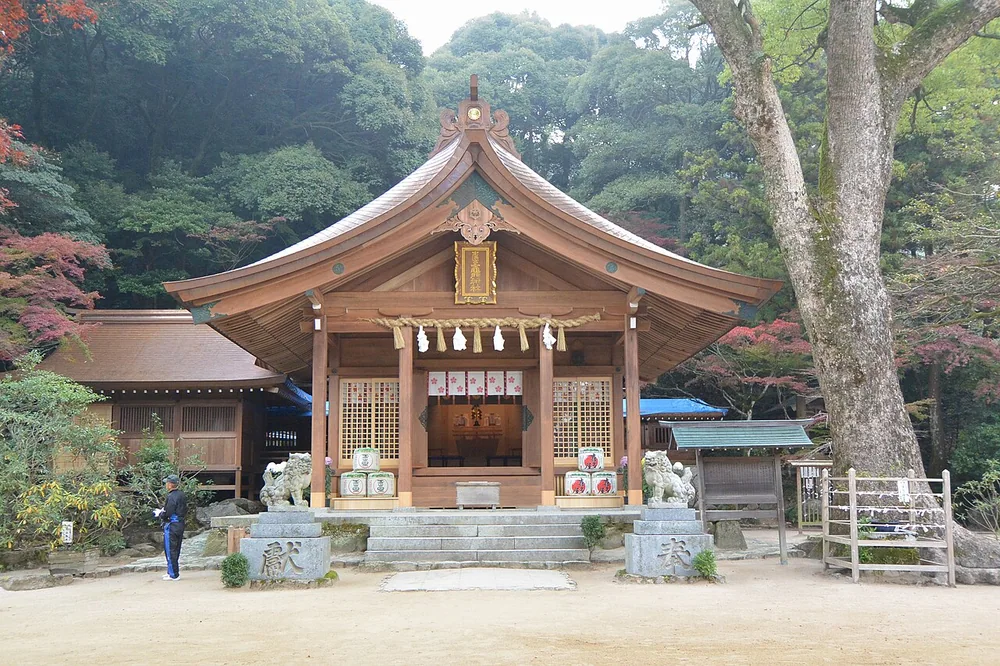
To focus on maple leaves in Dazaifu, ride up to the lower shrine of Homangu Kamado Shrine at the foot of the mountain. Outside Nishitetsu Dazaifu Station, catch the Mahoroba-go community bus bound for Uchiyama in front of the Bank of Fukuoka Dazaifu Branch; if you have already walked to Tenmangu, you can also board at the Miyamae stop outside the 7-Eleven in Sanjo. Ride to the Uchiyama terminus right beside the shrine entrance—the journey takes about 10 minutes and costs ¥100 one way. Walking to the lower shrine takes roughly 30 minutes from Tenmangu or 40 minutes from Dazaifu Station according to official guidance. If you want to walk one way and take the bus the other, do the walk in daylight when the route is easier to follow. For exact stop locations and walking segments, see our Kamado Shrine half-day guide.
Once you pass through the lower shrine's torii gate, pause once to admire the maples flanking the stone steps, then again near the worship hall to look up into the canopy. The elevation rise lets you frame lower branches and upper-terrace trees together from the entrance. If it rained the night before, fold away your umbrella on each flat landing before reaching for your phone rather than shooting while walking up narrow stairs. Families with a buggy who mainly want to see the torii and foliage along the steps can pause briefly at the bottom and take turns walking up; if everyone wants to sit comfortably together looking out over a garden, Yusentei Park in Fukuoka City is a better fit.
If you start in the morning, have lunch along the Tenmangu approach before heading up the mountain. To catch soft dusk light and the moment the illuminations switch on, arrive in Dazaifu later in the morning, pair Tenmangu with the Kyushu National Museum, and then catch the bus to Uchiyama. The museum is normally open from 09:30 to 17:00 (last entry 16:30), and adult general admission for the 4th-floor Cultural Exchange Exhibition alone is ¥700. A covered Rainbow Tunnel connects Tenmangu directly to the museum. On illumination days, decide what time you will leave the museum in advance so you have plenty of margin to walk to Miyamae and catch the bus.
Kamado Shrine Illuminations Until 21:00 and Return Bus Planning
Kamado Shrine's 2026 autumn illumination runs from 21 November to 6 December, daily from sunset until 21:00. The Maple Festival also takes place on 28 and 29 November, with stalls set up in the plaza above the first car park and mini concerts scheduled in the afternoon and evening. If you want both clean photos of the stone steps and live music, walk the upper grounds during the day and head down to the plaza afterwards. Travellers focused purely on illuminated night foliage may prefer to skip the festival weekend and pick another illumination evening.
For evening visits, check the Uchiyama (Kamado Shrine) departures section on Dazaifu City's Mahoroba-go timetable, paying attention to weekday versus weekend and holiday columns. On weekends and public holidays, the last regular bus leaves Uchiyama at 18:30 and reaches Nishitetsu Dazaifu Station at 18:38; to give yourself a buffer, aim for the 17:50 bus down. If you plan to stay for a 19:00 concert or until the lights go out, book a taxi back to the station before heading up. Groups can agree to meet back at the Uchiyama bus stop and wander down from the worship hall at their own pace.
Night foliage photos easily blow out into a flat block of bright red. Take a wide shot including the stone steps or torii before the sky goes completely pitch black, then move in for close-ups of one or two lit branches after dark. Because floodlit leaves overexpose quickly, tap the brightest leaf on your phone screen to focus and pull the exposure slider down slightly to keep vein detail and colour depth. Put your phone away when walking back down to the bus stop so you can watch the stone steps. For hot food, split lunch on the Tenmangu approach from dinner back in central Fukuoka rather than hunting for an open restaurant while waiting for evening transport.
Akizuki Castle Ruins: Foliage at Kuromon Gate and Walks Along Suginobaba
Akizuki lies in Asakura City, Fukuoka Prefecture. Step off the bus at Hakubutsukan-mae, pin Kuromon Gate on your map, walk along Suginobaba towards the castle ruins, and turn onto the Suio Shrine approach to find the dark timber gate. Asakura City notes around 20 maple trees around Kuromon Gate, with their canopy concentrated over the approach so the gate, stone steps, and red leaves sit cleanly in one frame. The famous avenue lining Suginobaba itself is planted with cherry trees for spring. In autumn, use that street for lunch, the museum, or strolling through the old castle town, and save your maple-framed shots for Kuromon Gate.
Kuromon Gate and Nagayamon Gate pair naturally on one loop. Originally the main gate of Akizuki Castle, Kuromon was relocated in 1880 to the approach of Suio Shrine, which honours Akizuki Domain's first lord, Kuroda Nagaoki. Nagayamon Gate, which led to the former inner residence, still stands on its original site within the castle grounds. Seeing both gates on foot makes it clear why almost every classic autumn photo comes from the shrine steps at Kuromon. Hold your camera low to exaggerate the depth of the stone staircase; after your wide shot, wait for a gap at the side and use a medium telephoto lens to isolate leaves against the eaves or gate pillars. If people are praying or passing through, step clear of the stairs before composing.
Since it takes a dedicated bus ride to reach Akizuki, try to leave a short window for Meganebashi Bridge. Completed in 1810, the stone arch bridge was built from local granite by stonemasons brought in from Nagasaki, where the Akizuki Domain had taken turns on guard duty. After returning from Kuromon Gate to Suginobaba, walk down towards the bridge if time allows to get a feel for how the castle ruins connect to the settlement. There is also a Meganebashi bus stop by the bridge, though your return option depends on which services call there. If you want a seated lunch, lock in your return bus time first before choosing a restaurant near the museum or along the main street. Families travelling with children can get off and return from Hakubutsukan-mae and leave the walk to the bridge for another trip.
If light rain moves in, Asakura City Akizuki Museum is a practical indoor stop. Standing on the site of the former domain school Keikokan facing Suginobaba, its entrance lobby and toilets are free to use. The museum opens from 09:30 to 16:30 (last admission 16:00) and usually closes on Mondays, or the next weekday if Monday is a public holiday. During the 2026 autumn special exhibition from 17 October to 13 December, admission is ¥500 for adults and ¥250 for primary and junior high school students, payable in cash only. Note that the museum has special openings scheduled for 24 and 30 November.
Near Meganebashi Bridge, look out for Akizuki honkuzu as a warm local treat. According to the Asakura City Tourism Association, this refined kuzu starch was once presented as tribute to the Kuroda clan and the shogunate. Today you can order hot kuzuyu or translucent kuzukiri noodles; Hirokyu Kuzuhonpo, roughly a 5-minute walk from the Meganebashi bus stop, is a long-standing local maker. If your return bus only stops at Hakubutsukan-mae, allow extra time to walk back up via Suginobaba. Once you have confirmed a bus back to Amagi that picks up at Meganebashi, make the sweet shop your final stop before heading back.
Getting to Akizuki via Ogori or Kiyama and the Amagi Kanko Bus
From Tenjin, ride the Nishitetsu train to Ogori, walk roughly 3 minutes to Amagi Railway's Ogori Station, and take the local train around 20 minutes to Amagi. From Hakata, take the JR Kagoshima Main Line to Kiyama and change to the Amagi Railway for a 28-minute ride to Amagi. Both routes meet at Kantetsu Amagi Station, where you transfer to the Amagi Kanko Bus Akizuki Line bound for Yacho and alight at Hakubutsukan-mae after about 20 minutes. Your start time for the day depends on that Amagi bus departure, so pick the bus slot first and work backwards to Kiyama or Ogori rather than starting from rail timetables alone.
Amagi has two separate railway stations—Amagi Railway and Nishitetsu—and the same bus route serves both Kantetsu Amagi Station and Nishitetsu Amagi Station. Read the column on the timetable matching the station you arrive at, and on the way back pick the stop that connects to your onward train. Asakura City lists 18 return trips on weekdays and 14 on Saturdays, Sundays, and public holidays, with uneven gaps around midday. If you see extra runs labelled 'Dangoan' on the timetable, stick to the regular Yacho service for autumn—the Dangoan extension only operates from July to September.
Using Amagi Kanko Bus's weekend and holiday schedule as an example, departing Kantetsu Amagi Station at 10:22 brings you to Hakubutsukan-mae at 10:41, with a return bus from Hakubutsukan-mae at 13:36 reaching Kantetsu Amagi Station at 13:55. That gives nearly three hours on the ground—enough for Kuromon Gate, lunch, and either Meganebashi Bridge or the museum. If you plan to linger in the galleries and restaurants have queues, grab a quick bite so you do not rush the exhibition. Travellers continuing onwards to Kitakyushu later in the afternoon will find it easier to shorten lunch than to gamble on a tight rail connection.
Drivers should exit the Oita Expressway at Amagi IC and follow Asakura City signs along Route 322 to Akizuki Car Park. The city puts the walk from the car park to Suginobaba at roughly 3 minutes, with traffic marshals deployed on autumn weekends and holidays. Set your satnav to the car park rather than Kuromon Gate itself, as navigating straight to the gate can pull you into narrow pedestrian lanes. Visitors with older relatives can have everyone walk the shorter link straight from the car park and focus on Kuromon Gate and lunch. Since city notices warn of congestion on the roads into Akizuki during peak foliage, early-morning photographers may prefer the bus to avoid queueing for a parking space.
Ascending Mount Sarakura from Yahata: Lock In Your Descent Time First
Mount Sarakura sits in Yahatahigashi Ward, Kitakyushu. When taking the JR Kagoshima Main Line from Hakata, search directly for 'Yahata (Fukuoka)'. Even if you take the Sanyo Shinkansen to Kokura, you still have to backtrack on the Kagoshima Main Line to Yahata, so check total journey times before choosing the Shinkansen for a Mount Sarakura-only trip. Travellers staying in Kokura also use Yahata as their rail hub. Outside Yahata Station, look to the left side of the station roundabout for the orange free shuttle bus run by Mount Sarakura Cable Car, which reaches Sanroku (base) station in about 10 minutes.
From November through March, the first shuttle from Yahata Station runs at 16:45 on weekdays and 09:45 on Saturdays, Sundays, and public holidays; the last shuttle back from Sanroku Station to Yahata Station departs at 20:15. To go up earlier on a weekday for daytime autumn foliage, take a taxi from Yahata Station (about 5 minutes) or walk (about 25 minutes). Walking works best in daylight when landmarks are clear, leaving the shuttle for the return trip after dark. Because the shuttle bus has no wheelchair lift, wheelchair users should arrange suitable transport straight to Sanroku Station. Drivers must also park near the base and buy tickets there, as access roads to the summit are restricted.
The ascent runs in two stages: first a 6-minute cable car ride from Sanroku Station to Sanjo (upper) station, followed by a 3-minute slope car transfer to Tenbodai (observatory) station—about 10 minutes end to end with smooth connections. Because the slope car carries fewer passengers than the cable car, if the first departure fills up before weekend sunset, simply wait at Sanjo Station for the next run. A round-trip combo ticket for both stages costs ¥1,230 for adults (junior high school age and above) and ¥620 for children. Cashless payment is accepted at the Sanroku ticket window, though the operator notes that tickets bought via cashless methods are non-refundable.
There are stairs on the cable car platforms, where staff operate stair lifts for wheelchair users, and the slope car is wheelchair-accessible. Since the stair lifts take extra time to run, the operator advises that you may need to board the following departure. If you want to reach the observatory before sunset, aim one ride earlier than planned. Anyone in your group who struggles with standing in long queues can meet at Sanroku Station, buy tickets first, and wait together. Lifts and accessible toilets are located in the summit observatory annex, making it easy to take a seated break before heading back out for photos.
In winter, the cable car operates from 10:00 to 20:00, with the final ascent at 19:20. Coming down from the observatory, reverse the route: ride the slope car back to Sanjo Station, then transfer to the cable car to Sanroku. If you are aiming for the 20:15 final shuttle back to Yahata, check the timetable beforehand and pick one descent earlier rather than leaving the summit at the very end of service, giving yourself time to walk from the base station to the shuttle stop. That cushion helps if the downhill queue moves slower than expected.
The cable car, slope car, and regular free shuttle do not run on Tuesdays unless it is a public holiday. Kitakyushu City runs a separate Tuesday direct summit bus on select dates in late autumn 2026, including 24 November and 1 December. Advance reservation is required, with a ¥3,000 voucher covering the round-trip ride and observatory access on the same coach, allowing roughly 40 minutes at the summit. City schedules list evening departures from Yahata Station at 17:05 and 19:05. If you want to ride the cable car or linger at the top, plan around an operating cable car day.
When to Go Up Mount Sarakura for Autumn Foliage and Night Views
Mount Sarakura's summit stands 622 metres above sea level. Watch the forested slopes turn colour as the cable car climbs, then look for the cityscape opening out as the slope car nears the top. From the observatory deck, trace the bright arterial roads across Kitakyushu before looking out towards the bay—a panorama the city promotes as its 'ten-billion-dollar night view'. Arrive before sunset to claim a clear vantage point while there is still colour in the sky and watch the city lights come on. If you wait until full darkness to go up, cabin lights reflect on the windows and the autumn slopes disappear from view.
Before setting out, check the summit weather, visibility, and live webcam on the operator's homepage. Even if it is overcast down in the city, you can go ahead with the night view if the summit camera shows clear air; if the feed is socked in with cloud for a prolonged spell, stay in central Fukuoka or Kokura instead. If the cloud lifts shortly before sunset, skip the wait and take a taxi from Yahata Station straight to Sanroku so you have time for both rail stages. Arriving slightly later for night views alone still works well—especially with older travellers, having a hot bowl of soup at the base first is far more comfortable than standing hungry in the summit wind.
The summit is typically around 5°C colder than street level, according to the operator. On mild November afternoons in town it is easy to underdress, so carry a packable insulating layer alongside a windproof jacket. If the wind picks up, wait inside the indoor viewing lounge and step back onto the deck once dusk settles over your chosen angle. The second-floor observatory restaurant operates from 11:00 to 19:00 in winter (last order 18:30); eating early or waiting until you are back down in Yahata or Kokura keeps dinner from clashing with the peak descent queue.
For night shots, find an outdoor spot free of glare and brace your phone against a solid railing fixture rather than balancing it on an exposed ledge. When shooting through glass indoors, press the lens close to the pane and shield it from interior reflections behind you. If part of your group feels the cold, agree on a meeting time so photographers can head onto the open terrace while everyone else stays warm inside. Pairing Mount Sarakura with a hotel night in Kokura leaves only a short local JR hop from Yahata back to Kokura, and sets you up cleanly if you are heading east to Yamaguchi or Hiroshima on the Shinkansen the next morning.
City Autumn Walks in Fukuoka: Maizuru Park vs Yusentei Park
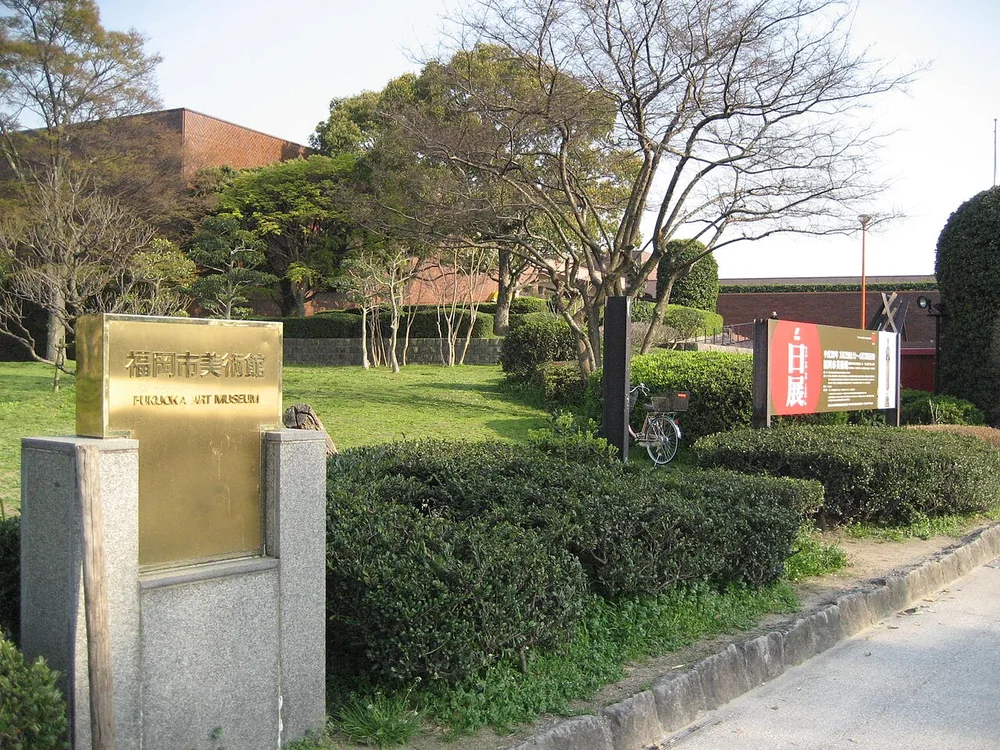
For minimal transit time, stick to Maizuru Park and neighbouring Ohori Park. Maizuru Park encompasses the Fukuoka Castle ruins and sits roughly an 8-minute walk from either Akasaka or Ohori Koen subway stations. Staying in Tenjin, enter the castle grounds from the Akasaka side, continue towards the Ohori Park lakeside or the Fukuoka Art Museum, and catch the subway back from Ohori Koen Station to avoid backtracking. Stone castle walls frame the autumn foliage nicely, and you can climb the steps to the upper terraces for views; if you have a buggy or want flatter paths, head straight along Ohori Park's waterside promenade where benches are plentiful.
To add a formal garden in the same neighbourhood, visit the Ohori Park Japanese Garden at the pond's southern end. Enter via the Kabukimon Gate when walking from the museum, or through the West Gate if coming down along the water from Ohori Terrace. From October to April, the garden opens from 09:00 to 17:00 (last entry 16:45) and closes on Mondays. Admission is ¥250 for adults, ¥120 for visitors aged under 15, and free for children under 6; seniors aged 65 and over enter free with proof of age. If you want to combine the garden with an exhibition, visit the garden first and keep a clear block in the afternoon for the art museum.
Over in Jonan Ward, Yusentei Park offers a quieter alternative. Take a Nishitetsu bus to the Yusentei stop and walk about 5 minutes to the gate. Originally a villa built for Fukuoka Domain lord Kuroda Tsugutaka, its main hall opens straight onto a pond, allowing you to admire the water and shoreline maples under cover before stepping out along the path if rain eases. Opening hours are 09:00 to 17:00, closed on Mondays (or the following day when Monday is a public holiday). Admission is ¥200 for adults, ¥100 for primary and junior high school pupils, and free for preschoolers; matcha served with dry wagashi sweets is listed at ¥700.
If you only have two hours before your next commitment, Maizuru Park slots most easily into a tight schedule. Save Yusentei for a relaxed afternoon when you want to sit quietly beside a pond. On a persistently rainy afternoon, swap that slot for the Fukuoka Art Museum. In November the museum stays open until 17:30 (last entry 17:00) and closes on Mondays. It is roughly a 10-minute walk from exits 3 or 6 of Ohori Koen Station, or reachable on foot from exit 2 of Ropponmatsu Station if you are staying along the Nanakuma Line.
One-Day Itineraries: Dedicating a Full Day to Your Top View
For shrine atmosphere and night illuminations, spend a full day in Dazaifu. Take the morning train from Tenjin to Dazaifu Tenmangu, eat lunch along the approach, and add the Kyushu National Museum if you fancy an indoor gallery. Catch the Uchiyama Line bus from Miyamae or Nishitetsu Dazaifu Station before dusk so you can reach the Kamado Shrine worship hall in daylight, then turn back to photograph the lit stone steps as darkness falls. Take the bus back to Dazaifu Station and ride the Nishitetsu train into central Fukuoka for dinner. If your dates fall outside the illumination window, use the same route to visit Kamado Shrine in the morning, return to Tenmangu for lunch and worship, and finish with evening shopping in Tenjin.
For autumn leaves against historic castle gates, Akizuki comfortably fills a day. Ride a morning bus to Hakubutsukan-mae and head straight to Kuromon Gate, then decide whether your group feels like adding the short climb to Nagayamon Gate. After exploring the museum or walking down to Meganebashi Bridge, catch an early-afternoon bus back to Amagi. You will get back to Fukuoka in plenty of time for dinner without watching the clock for a late Kitakyushu train. Even if leaves have started thinning by the time you arrive, shift your focus to fallen foliage along the gate steps and enjoy the quiet castle town afterwards.
To combine half a day of autumn colour with city lights at night, pair central Fukuoka with Mount Sarakura. Stroll Maizuru Park in the morning, take a JR train from Hakata to Yahata after lunch, and reach Sanroku Station before sunset. On weekdays, use a taxi if you want to leave Yahata earlier than the 16:45 shuttle; at weekends, board an earlier shuttle so you have margin for ticket queues and the two rail transfers. Ride back down once darkness has settled, and dine in Yahata, Kokura, or back in Hakata. If cloud stubbornly covers the summit that day, swap to Ohori Park and the Fukuoka Art Museum and skip the trip to Yahata altogether.
Two-Day Plans and Where to Stay: Balancing Dazaifu, Akizuki, and Kitakyushu
For two days of foliage hunting entirely by train and bus, combine Dazaifu Tenmangu and Kamado Shrine on day one, then go to Akizuki Castle Ruins on day two. Staying both nights in Tenjin lets you depart from Nishitetsu Fukuoka (Tenjin) Station for both Dazaifu and Ogori; basing yourself in Hakata works just as well, taking the JR line via Kiyama and Amagi Railway for Akizuki and either the direct bus or a subway-to-Nishitetsu connection for Dazaifu. Keeping one hotel for both nights avoids hauling luggage onto the Akizuki bus and leaves time for a gentle evening walk before dinner in Hakata on day two.
To pair peak autumn foliage with Mount Sarakura's night panorama over two days, put whichever site has the best leaf colour that week on day one, then travel from Fukuoka to Yahata on day two—you can easily drop bags and have lunch in Kokura around midday before doubling back to Yahata for the afternoon ascent. Whether to switch hotels to Kokura depends on day three: if you are continuing to Mojiko or catching an eastbound Sanyo Shinkansen, sleeping in Kokura saves an unnecessary return to Hakata; if you have an early flight from Fukuoka Airport, keep your Fukuoka hotel and take an earlier descent back through Yahata. If you stay in Kokura without needing to explore downtown, leave your bags at your hotel before heading up the mountain.
Drivers determined to cover all three areas in two days can dedicate day one to Dazaifu, then visit Akizuki on the morning of day two before driving to Yahata after lunch. Before parking in Akizuki, set a firm departure time from the castle town and pick either the museum or Meganebashi Bridge after lunch rather than both. If traffic slows at the junction leaving town or base parking queues build up, treat Mount Sarakura purely as a night-view stop and rely on your morning shots at Kuromon Gate for close-up maple foliage. Trying to cram Akizuki and Mount Sarakura into one day by public transport requires chaining the Akizuki bus, Amagi Railway, JR trains, and the Yahata shuttle—only attempt it if every connection has generous slack and everyone is happy with a quick lunch.
With three days in Fukuoka, save Mount Sarakura for whichever evening has the clearest weather forecast. If a Monday falls in your trip, slot in Tenmangu and Kamado Shrine, moving venues with regular Monday closures—Akizuki Museum, Yusentei Park, and Fukuoka Art Museum—to other days, and double-check public holiday adjustments. Travellers splitting nights between Fukuoka and Kokura can keep their Fukuoka room for the first two days and check bags in Kokura on day three before heading to Yahata, adjusting your evening dinner stop to match whichever direction you ride back down.
A few useful answers
What is the best month to see autumn leaves in Fukuoka?
Start by looking at late November. Kamado Shrine in Dazaifu typically peaks from mid-to-late November, while Akizuki Castle Ruins in Asakura usually peaks from late November to early December. Check the most recent photos for each site to decide which day to do first.
Where are the evening autumn illuminations in Dazaifu?
They take place at the lower shrine of Homangu Kamado Shrine. For 2026, the announced period is 21 November to 6 December, running from sunset until 21:00. Take the Uchiyama-bound bus from Nishitetsu Dazaifu Station or Miyamae, and arrange a taxi in advance if you plan to stay late.
Which bus stop should I get off at for Akizuki by public transport?
From Kantetsu Amagi Station or Nishitetsu Amagi Station, take the Amagi Kanko Bus Akizuki Line bound for Yacho and alight at Hakubutsukan-mae, then walk along Suginobaba to Kuromon Gate on the Suio Shrine approach.
Which transport do I take back down after viewing the night view on Mount Sarakura?
From November to March, the cable car generally operates until 20:00 and the last free shuttle bus from Sanroku Station back to JR Yahata Station usually departs at 20:15. Take the slope car from the observatory back to Sanjo Station, then change to the cable car down.
Official information and references
Sources used in this guide.
- Fukuoka Prefecture Tourism Association | 2026 Autumn Foliage Status and Historical Peak Periods
- Dazaifu Tenmangu Shrine | Access
- Dazaifu Tenmangu Shrine | Precinct Guide
- Dazaifu Tenmangu Shrine | Resumption of Front Worship at the Main Sanctuary
- Dazaifu City | Autumn Foliage at Kamado Shrine and Surrounding Spots
- Homangu Kamado Shrine | Access and Bus Stops
- Dazaifu City | Mahoroba-go Uchiyama Line Timetable
- Homangu Kamado Shrine | 2026 Autumn Leaves Illumination
- Homangu Kamado Shrine | 2026 Maple Festival
- Kyushu National Museum | Visitor FAQs
- Raizan Sennyoji Daihioin Temple | Opening Hours, Mountain Entry and Viewing Fees
- Itoshima City | Raizan Line Bus Timetable
- Asakura City | Autumn Leaves and Access at Kuromon Gate, Akizuki Castle Ruins
- Asakura City | Cultural Property Records for Akizuki Castle Kuromon and Nagayamon Gates
- Asakura City | Cherry Trees of Suginobaba
- Asakura City | Cultural Property Record for Akizuki Meganebashi Bridge
- Asakura City Tourism Association | Hirokyu Kuzuhonpo and Akizuki Honkuzu
- Asakura City Akizuki Museum | Opening Calendar and Admission Fees
- Asakura City | Amagi Kanko Bus Akizuki Line
- Amagi Kanko Bus | Akizuki Line Timetable and Fares
- Sarakura Tozan Railway | Operating Hours
- Sarakura Tozan Railway | Cable Car and Slope Car Fares
- Sarakura Tozan Railway | Cable Car and Observatory Facilities
- Sarakura Tozan Railway | Free Shuttle Bus from Yahata Station
- Sarakura Tozan Railway | Summit Weather and Live Webcam
- Sarakura Tozan Railway | Observatory Restaurant Information
- Kitakyushu City | Mount Sarakura Access and Night Views
- Kitakyushu City | Tuesday Reservation-Only Direct Bus to Mount Sarakura
- Maizuru Park Management | Subway and Bus Access
- Fukuoka City Official Tourist Guide | Maizuru Park, Ohori Park and Museum Locations
- Ohori Park Japanese Garden | Entrances, Opening Hours and Admission
- Fukuoka Art Museum | Access and Opening Hours
- Fukuoka City Official Tourist Guide | Yusentei Opening Hours and Access
- Yusentei Park Management | Admission Fees and Matcha Service