Planning an autumn trip to Yabakei in Oita? Compare Hitome Hakkei, Ao no Domon, and Keisekien with 2026 foliage reports, evening illuminations, weekday bus timetables, and driving or two-day routes from Hakata and Beppu.
- Region & Focus
- Kyushu
- Reading Scope
- 20 min read · 11 chapters · 5 Q&As
- Official Verification
- 28 official sources checkedUpdated 22 November 2026 at 08:00 GMT+8
- Key Topics
- SeasonsItinerariesRail travel
Chapter Route Map (tap any stop)
- Choosing Between Hitome Hakkei, Ao no Domon, and Keisekien
- Start at the Hitome Hakkei Viewpoint, Then Walk the Opposite Bank If Time Allows
- Ao no Domon Is Open on Foot, While Vehicles Use the Outer Bypass
- Weekday Buses to Hitome Hakkei: Changing at Kakisaka
- No Car at the Weekend? Pair Ao no Domon with Keisekien
- Evening Illuminations Run at Keisekien and Hisashi Momiji
- Driving from Fukuoka or Beppu: Pick Your Entry Point by Hotel Base
- Stay Overnight in Nakatsu or Pair Yabakei with Beppu
- Adding Rakan-ji Temple: Allow Time for the Official Mountain Approach
- With a Spare Half-Day, Head to Oku-Yabakei's Riverbed or Cycle the Old Railway
- Practical Planning for Lunch, Rest Stops, and Luggage
- Quick Q&A
For an autumn foliage trip to Yabakei in Oita Prefecture, drivers are best off heading up to Hitome Hakkei in Shin-Yabakei first before dropping down to Ao no Domon in Hon-Yabakei. Travellers using public transport start from JR Nakatsu Station: scheduled buses to Hitome Hakkei run on weekdays only, whereas weekend visitors can pair Ao no Domon with Keisekien instead. Observations from the Nakatsu Yabakei Tourism Association on 19 November 2026 placed both Hitome Hakkei and Keisekien at peak colour, while leaves around the Ao no Domon public car park trailhead were only just starting to turn. Each of the three main areas earns its place for a different reason, so line up your return connection and preferred scenery along the same road before setting off.
Choosing Between Hitome Hakkei, Ao no Domon, and Keisekien
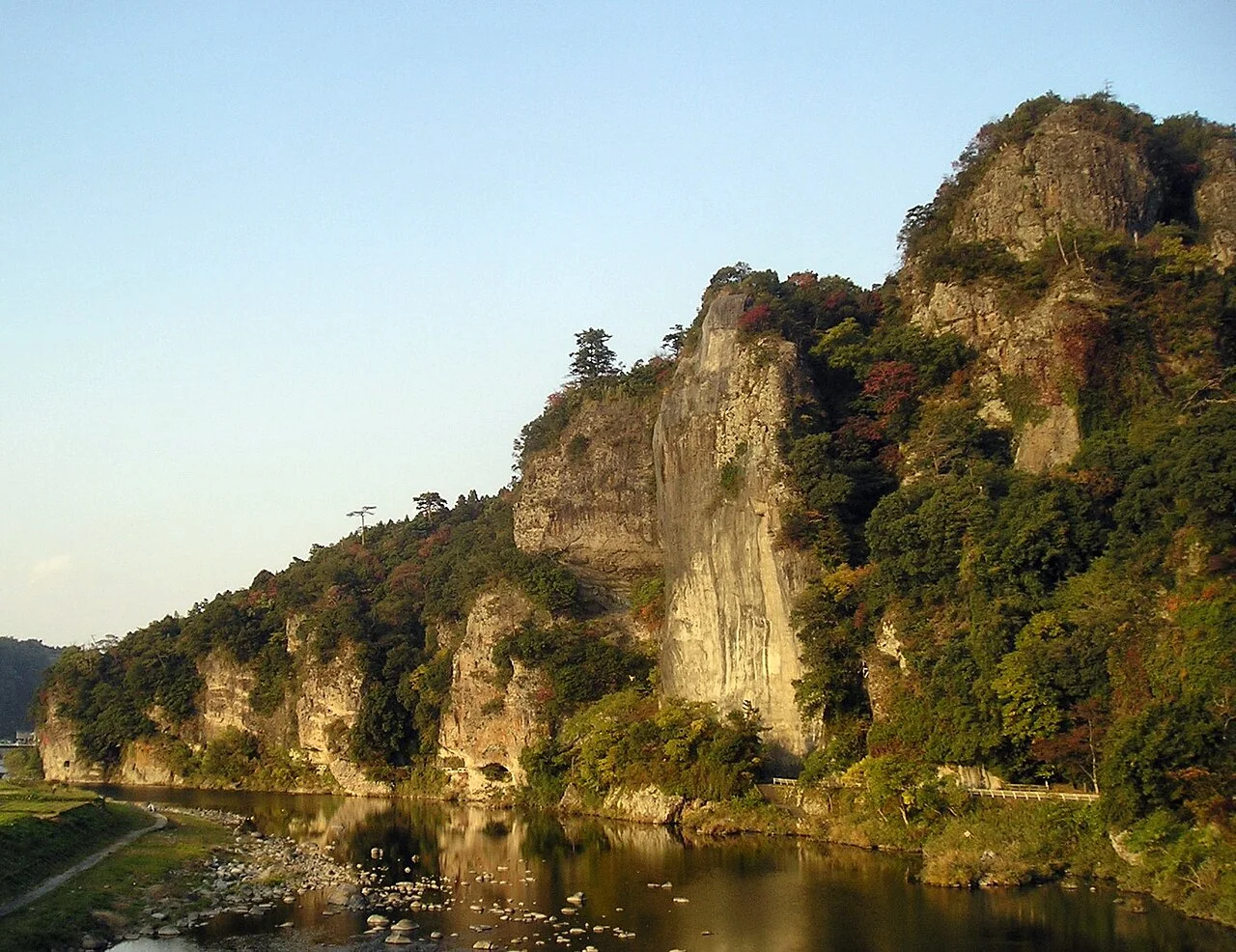
Yabakei lies in northern Oita Prefecture, where the Yamakuni River and its tributaries have cut into an ancient lava plateau to leave rows of crags, sheer cliffs, and narrow valleys. In Hon-Yabakei, Ao no Domon sits right beside the Yamakuni River, with the channel at your feet and the jagged wall of Kyoshuho rising overhead. Further inland along the Yamautsuri River, Shin-Yabakei leads to the Hitome Hakkei viewpoint facing a cluster of neighbouring peaks. Keisekien, next to Yabakei Dam, is a landscaped garden where river boulders, ponds, and maples flank the paths. Entering each specific spot into your satnav makes it far easier to reach the right stretch of valley than simply typing "Yabakei".
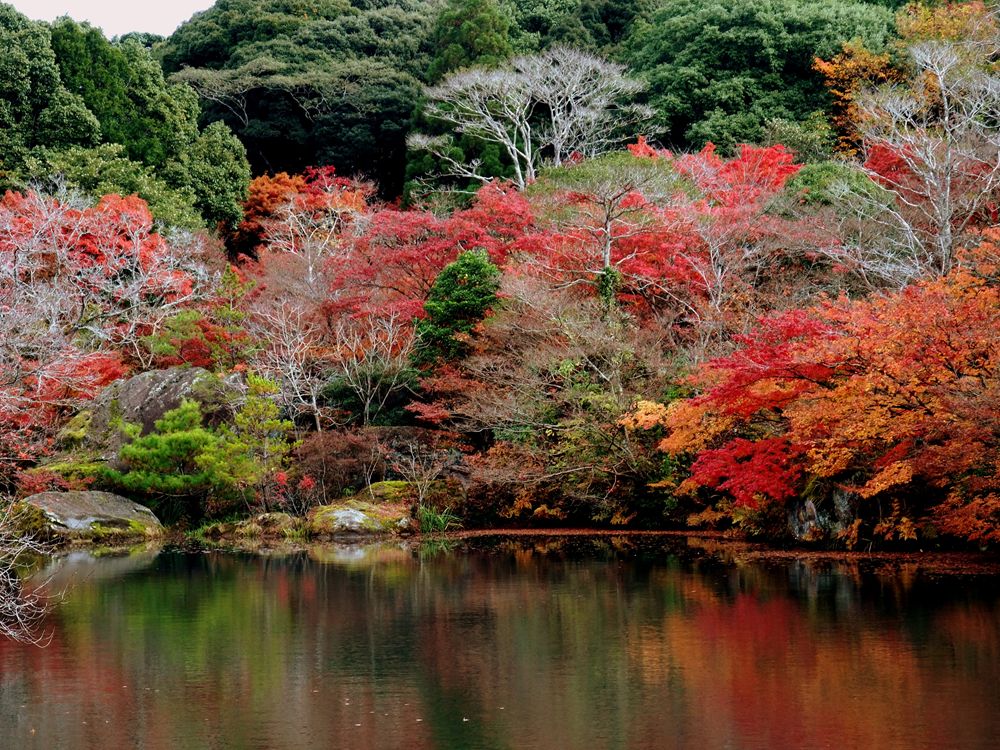
Nakatsu City lists the typical autumn colour season at Hitome Hakkei as mid-November to early December. In 2026, the tourism association issued site-by-site updates: on 19 November, Hitome Hakkei was roughly 70-80% turned and Keisekien around 80%, putting both at peak viewing. On the same date, the trailhead by the Ao no Domon public car park had only begun to turn, while Michi-no-Eki Yaba Topia was already in prime condition. Even on the exact same day along the same highway, foliage colour can vary sharply from one stop to the next.
If you have only one daylight window and want broad slopes of colour backing dramatic rock spires, put Hitome Hakkei first. For an unhurried stroll, or if anyone in your group uses a walking frame or pushchair, start around the teahouse, entrance, and car park at Keisekien and turn back whenever comfortable. Ao no Domon is best saved for full daylight so you can study the tunnel windows, stone bridge, and cliff faces along the river, making it less dependent on peak foliage.
When checking the association's 2026 autumn foliage reports and on-site photos, pay attention to the inspection date on each row. Entries such as Goryo Momiji on 16 November and Sarutobi Senotsubo Gorge on 19 November reflect separate patrols. Upper valley spots can also shed early: near the iron bridge at Sarutobi Senotsubo Gorge, leaves had already fallen by the 19th even as trees below the car park were just beginning to drop. In late November, plan your day around the specific rows you want to see rather than relying on rules of thumb such as "north turns first, south turns later".
| Spot | Observation Date | Foliage Status |
|---|---|---|
| Hitome Hakkei | 19 November | Roughly 70-80%, peak viewing |
| Keisekien | 19 November | Roughly 80%, peak viewing |
| Hisashi Momiji | 16 November | Roughly 40-50% |
| Ao no Domon Public Car Park Trailhead | 19 November | Starting to turn |
| Michi-no-Eki Yaba Topia | 19 November | Peak viewing |
Planning an autumn trip to Yabakei in Oita? Compare Hitome Hakkei, Ao no Domon, and Keisekien with 2026 foliage reports, evening illuminations, weekday bus timetables, and driving or two-day routes from Hakata and Beppu.
Start at the Hitome Hakkei Viewpoint, Then Walk the Opposite Bank If Time Allows
The Shin-Yabakei Public Car Park (Shin-Yabakei Kokyo Chushajo) is the natural starting point for drivers. The city lists 256 standard spaces and 11 coach bays, open 24 hours free of charge with no advance booking. It takes around 5 minutes on foot from the car park to the viewpoint, and accessible toilets are located both at the car park and below the viewing deck. Bus passengers alight at Shin-Yabakei Onsen; check the return bus stop sign first before walking up to the deck.
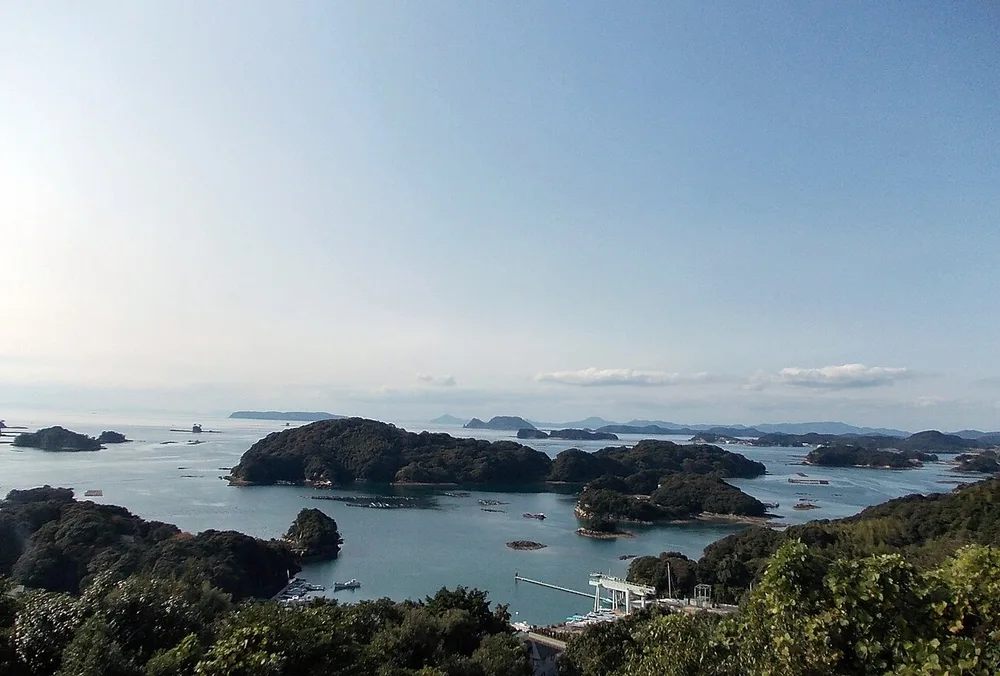
Standing at the railing, you can match the view to the eight named peaks listed by the city: Gunenzan, Tobinosuyama, Shoenzan, Meoto-iwa, Ojikanagao-no-mine, Eboshi-iwa, Sennin-iwa, and Kaiborei all ring this single stretch of valley. On a first look, pick out the twin crags of Meoto-iwa first, then sweep your gaze outward to the left and right. Spending a few minutes reading the rock shapes and relative distances makes it easy to see where crimson clusters sit high on the slopes and yellow leaves gather along the base of the cliffs.
Nakatsu City estimates 30 minutes to 1 hour for a stop at Hitome Hakkei. On a tight schedule, keep that time for parking, the viewpoint, and photographs. If you fancy a longer walk, drop down to the promenade across the river and look back up at the same row of crags from the valley floor. The deck frames the skyline well, whereas the riverside level brings close-up branches and cliff faces into view. If half your group wants to walk further and the rest would rather sit, split up and regroup around the soba noodle shops by the road.
Prefectural Route 28 runs straight past the shops and viewpoint through the gorge, and the overhead canopy easily tempts drivers and walkers to pause. Move onto the viewpoint or a wider footpath before stopping for photos so the road edge stays clear for passing traffic. On damp or overcast days, keep the visit to a quick return trip to the deck, as wet stone and fallen leaves turn slippery; save the riverside path for dry weather. Families with pushchairs or anyone with sore knees should stick to the public path between the car park and the deck first, then gauge whether to tackle the river trail.
Hisashi Momiji is another stop within Shin-Yabakei, about 5 minutes on foot from the same public car park: a roughly 100-metre corridor of maples alongside Prefectural Route 28. Where Hitome Hakkei lays out an entire mountainside, here the branches arch directly above the road shoulder. Families hoping to limit walking can do two short outings from the same parked car, returning in between to grab extra layers or give young children a rest without hunting for another space in a busy scenic zone.
A food-truck gathering beside the viewpoint runs from 30 October to 29 November 2026, advertised from 10:00 to 18:00 around 3222 Oaza Shinyaba, Yabakei-machi, Nakatsu City, subject to cancellation in bad weather. Having lunch here buys extra walking time in Shin-Yabakei. If you are catching an afternoon bus, eat after taking in the viewpoint and check the walk back to the bus stop before sitting down.
Ao no Domon Is Open on Foot, While Vehicles Use the Outer Bypass
Ao no Domon sits directly beneath the cliffs of Kyoshuho. According to Nakatsu City records, the monk Zenkai raised funds and worked with stonemasons using chisels and hammers to carve a 342-metre passage, including 144 metres of tunnel, completing it in 1764. Looking across from the opposite riverbank makes the feat clear: peak after peak crowds the Yamakuni River, leaving only a narrow ribbon of ground between cliff foot and water.
The Hida-Nakashima Line, previously closed by rockfalls, reopened to pedestrians on 1 April 2026, with part of the route following city signage through the hand-carved tunnel on the Sogi side. In September, the city announced that vehicles remain banned following further rockfalls. Drivers should set their satnav to Ao no Domon Public Car Park, follow local marshals to park, leave the car outside, and walk down the steps beside the traffic lights before turning into the hand-carved tunnel as signed. Even if your next stop lies beyond the tunnel's far end, drive round via the outer bypass. Nakatsu City road closure and detour map
Both entry to the tunnel and parking are free. From the public car park, take in the cliff face from the open riverside first, then walk a section of the hand-carved tunnel to see the chisel marks and light windows cut into the rock. Bright daylight pours through the openings facing the river, which can momentarily dazzle your eyes and hide the ground underfoot as you step between shade and sun. Wait until companions move into a wider section before stopping for phone photos so the narrow passageway stays clear for two-way foot traffic. If you want to add the hiking trail up Kyoshuho, treat it as a separate mountain walk after finishing the riverside and tunnel.
Roughly 200 metres beyond the north exit of Ao no Domon stands Yabakei Bridge, known locally as the Oranda Bridge (Dutch Bridge). Measuring 116 metres long, its eight stone arches are easiest to appreciate from the riverbank, while walking onto the deck shows the stonework close up. With children, the bridge makes a natural turnaround point: you get the hand-carved rock windows at the tunnel, then shift straight onto river views and masonry arches without needing a car.
The pedestrian detour through Ao no Domon involves steps. If anyone in your party dislikes dark spaces, uses a wheelchair, or pushes a buggy, focus on the open riverside stretch instead and head to Michi-no-Eki Yaba Topia to see historical exhibits on the tunnel. The same order works well in rain to trim outdoor exposure. If a bus departure is approaching before you reach the stone bridge, stay near the tunnel side by the river and skip the extra walk out and back to the bridgehead.
Weekday Buses to Hitome Hakkei: Changing at Kakisaka
From Hakata or Beppu, take a JR Kyushu Sonic Limited Express to Nakatsu. Direct services from Hakata typically pass through Kokura and reverse direction inside the station, so simply stay on board. In Nakatsu, transfer at Nakatsu Ekimae to a Daiko Hokubu Bus bound for Kakisaka, Morizane Onsen, or Hita, choosing a service listed as stopping at Kakisaka. As the bus heads up the valley, stop names such as Ao no Domon Chushajo and Kakisaka confirm you are travelling in the right direction.
Taking the operator's published timetable as an example, a weekday bus leaves Nakatsu Ekimae at 10:10 and reaches Kakisaka at 10:50. There is a 15-minute connection to the 11:05 Kusu Kanko Bus toward Bungo-Mori, arriving at Shin-Yabakei Onsen at 11:25. Both operators serve Kakisaka; save screenshots of both outward and return timetables before boarding at Nakatsu, including the return direction at Kakisaka. If road delays cause you to miss that first connection, the next bus from Kakisaka to Shin-Yabakei Onsen does not leave until 15:20, leaving far less daylight in the valley.
A sample return on the same timetable leaves Shin-Yabakei Onsen at 15:22 for Kakisaka, arriving at 15:42, where the 16:22 Daiko Hokubu Bus brings you back to Nakatsu Ekimae at 17:02. That gives you roughly 4 hours in Shin-Yabakei — enough for lunch, the viewpoint, and a walk to Hisashi Momiji. Leaving at 15:22 still leaves a later backup connection, though if you want dinner in Nakatsu or need to catch a reserved train seat, avoid relying on the final pairing of the day.
On weekdays, if you would like to visit Ao no Domon first, take the 08:55 bus from Nakatsu Ekimae to arrive at Ao no Domon Chushajo at 09:22. A later bus further up the valley at 10:37 reaches Kakisaka at 10:50 in time for the 11:05 connection to Shin-Yabakei. Those 75 minutes at Ao no Domon give you time for the tunnel windows and riverside; leave Rakan-ji Temple for another trip. Because you are boarding rural buses twice in a row, returning to the stop early is far easier to keep on schedule than trying to squeeze in a sit-down meal, shopping, and sightseeing.
You can also approach Hitome Hakkei from the Kusu side. Take the JR Kyudai Main Line to Bungo-Mori and switch to a Kusu Kanko Bus; on weekdays there is an 08:30 departure from Bungo-Mori reaching Shin-Yabakei Onsen at 08:52. In the afternoon, a direct bus departs Shin-Yabakei at 15:40 and reaches Bungo-Mori at 16:02 for onward JR trains to Yufuin or Hita. The operator lists the main fare between Shin-Yabakei and Bungo-Mori at ¥590. This option works best if you can reach Bungo-Mori early in the morning, or plan to ride just one afternoon leg with enough margin for your Kyudai Main Line transfer.
Scheduled buses to Shin-Yabakei Onsen do not run on Saturdays, Sundays, or Japanese public holidays. Since October 2026, Nakatsu City has also operated an area- and day-specific demand-responsive transport service, with the Yamautsuri and Shin-Yabakei zone running on Mondays and Wednesdays; telephone bookings open one week ahead and close at 16:00 the day before travel. Oita Kotsu's regular sightseeing coach, Keisho Yabakei Meguri, is also suspended. For weekend foliage trips, stick to stops along the Yamakuni River that keep weekend bus service, or arrange a taxi pickup and return time in advance. Oita Kotsu Group bus timetables and fares
| Timing | Outbound Route | Return Planning |
|---|---|---|
| Weekdays | Nakatsu Ekimae to Kakisaka to Shin-Yabakei Onsen | Note both legs separately; pick your return bus from Shin-Yabakei to Kakisaka first |
| Weekends and Public Holidays | Nakatsu Ekimae to Ao no Domon Chushajo, extending to Keisekien via the Chunichi Line | Check the weekend and holiday timetable; return along the valley to Nakatsu for JR trains |
No Car at the Weekend? Pair Ao no Domon with Keisekien
Daiko Hokubu's Chunichi Line continues to serve the Ao no Domon area at weekends. On the weekend and holiday timetable, for example, a bus leaves Nakatsu Ekimae at 09:00 and arrives at Ao no Domon Chushajo at 09:27, with a standard fare listed at ¥650. Return options to Nakatsu include departures at 12:15 (arriving 12:42) or 13:50 (arriving 14:17). Arriving early gives you time to wander from the tunnel to Yabakei Bridge and return to the same stop, leaving the afternoon free for a meal in Nakatsu's castle town.
If you are staying in Hon-Yabakei at the weekend and eating near Ao no Domon, pick up the ¥1,500 Gourmet Route Bus Sightseeing Ticket at the Tourist Information Centre at Nakatsu Station's south exit. It includes round-trip bus travel between Nakatsu and the tunnel area plus a ¥600 meal voucher valid at participating venues such as Domon Patio and Michi-no-Eki Yaba Topia. Boarding and alighting are set at Shimosogi Iriguchi, the Ao no Domon temporary stop, or Nakashima. The ticket is valid for six months from issue, until the end of March 2027 at the latest. Because eligible stops focus on Hon-Yabakei, check the standard fare separately if you continue onward to Keisekien.
To reach Keisekien by bus, the tourism association lists Yabakei Chugakko-mae (Yabakei Junior High School) as the nearest stop, about a 300-metre walk from the garden. At weekends, you can board at the Ao no Domon public car park stop at 12:07 and arrive at Yabakei Chugakko-mae at 12:21 on the city timetable. After exploring Keisekien, catch the 15:21 return bus outside the school to arrive back at Nakatsu Ekimae at 16:02. Check the bus destination carefully at intermediate stops: head toward Kakisaka and Morizane Onsen for Keisekien, and the opposite direction for Nakatsu.
Keisekien easily fills an afternoon on its own. If part of your group wants to stroll the grounds while others prefer tea, agree to meet at the teahouse rather than by the ponds. At weekends, head back to Yabakei Chugakko-mae once you finish the garden: the city's weekend and holiday timetable lists the last bus to Nakatsu Ekimae at 17:01, arriving at 17:42, meaning you must leave before the evening illuminations switch on. If you want to linger after dark, pre-book a taxi willing to collect you at the garden.
Travellers interested in Sengoku or modern Japanese history can set aside half a day for Nakatsu Castle and the Former Residence of Fukuzawa Yukichi. Nakatsu Castle sits around 1.2 km from JR Nakatsu Station, a 15-to-20-minute walk, with the Fukuzawa residence close by — an easy pairing once bus passengers return from the valley and grab a bite to eat. If you plan to dine in the castle town, walk Teramachi-dori before dinner and leave dedicated hours for both historic sites.
Evening Illuminations Run at Keisekien and Hisashi Momiji
Nakatsu City announced that Keisekien and Hisashi Momiji are illuminated daily from 17:00 to 21:00 between 6 November and 6 December 2026, with free admission at both sites. At Hisashi Momiji, the lights line the tree corridor along Prefectural Route 28 near the Shin-Yabakei Tourist Information Centre. The Hitome Hakkei viewpoint itself has no floodlighting, and lighting along the path between the car park and the deck is sparse. To catch both daylight and night foliage in the same area, visit Hitome Hakkei before dusk, rest back at the public car park, and walk over to the lit maple corridor afterwards.
Keisekien was created in 1987 to commemorate the completion of Yabakei Dam, using dam water, boulders, and terraced drops to recreate a mountain stream. During the day, follow the sound of water to trace how the ponds, cascades, and stonework connect. After dark, reflections on the ponds often stand out even more vividly than the branches overhead. To see the transition, arrive in late afternoon, loop the garden once in daylight, and return to the pavilion or familiar pond edges once the lights come on.
Keisekien is also free during the day, with an official suggested visit of around 1 hour; two car parks hold a combined 100 vehicles, with two accessible spaces in front of the teahouse and an accessible toilet inside the teahouse building. There is no need to retrace every flagstone path after nightfall. Slower walkers can pick out a straightforward return route to the car while it is still light and settle at a spot with seating. After rain, stick to level, paved sections beside the pond with clear sightlines to the lit trees.
On 28 November 2026, the Yabakei Autumn Festival takes place in the car park of Yabakei Furusatomura Shunsaikan from 11:00 to 19:00, moving to 29 November in poor weather. Expect game-meat food stalls and kagura performances, which pair easily with evening illuminations at Keisekien. If your priority is quiet photography, drop into the festival around lunchtime and focus on a single illuminated garden after dark. Searching for "Shunsaikan" or "Keisekien" on your map app helps keep the festival venue and the garden distinct.
Driving from Fukuoka or Beppu: Pick Your Entry Point by Hotel Base
Drivers coming from Fukuoka should start at Hon-Yabakei in the north, setting Ao no Domon Public Car Park as the first destination. Leave the Higashi-Kyushu Expressway at Nakatsu IC onto the Nakatsu-Hita Road, exit at Ao no Domon-Rakanji IC, and follow traffic control onto the outer bypass near the tunnel. Walk the riverside first, drive up to Shin-Yabakei before or after lunch, and let the remaining daylight dictate how long you linger at Hitome Hakkei. If you plan to stay for evening illuminations, drop one daytime stop so you are not rushing to find a space at dusk.
Approaching from Yufuin, take the Oita Expressway to Kusu IC and continue into Shin-Yabakei; Oita Prefecture estimates roughly 15 minutes from Kusu IC to Hitome Hakkei. Working from the mountains outward lets you visit Hitome Hakkei and the maple corridor in the morning, continue to Ao no Domon, and still reach Beppu or Fukuoka that night. If you are staying in Beppu for two nights and want extra morning hours in the upper valley, enter via Kusu and return via Hon-Yabakei onto the Higashi-Kyushu Expressway. If Ao no Domon and the temples are your main priority, enter and exit from the Nakatsu side to avoid doubling back through the hills.
For same-day car hire out of Fukuoka, factor in counter queues, pickup, and evening drop-off cut-offs. If you have an evening flight or Shinkansen to catch, limit the day to two main stops and reach Hitome Hakkei — the furthest point — before or right after lunch. For one-way trips starting in Fukuoka and ending in Beppu, select the right drop-off branch when booking and check closing hours before locking in your route. If family members want to check into their Beppu ryokan in time for dinner, make your final stop near Nakatsu for quick access back onto the Higashi-Kyushu Expressway.
If you schedule Hitome Hakkei after lunch on a weekend or holiday, build in extra time to queue for a bay. When traffic backs up outside the Shin-Yabakei Public Car Park, do not park on the shoulder of the prefectural road. If you still have a full afternoon, switch to Keisekien or head down to Hon-Yabakei for lunch, then decide between Hitome Hakkei and the evening illuminations. Adding Rakan-ji Temple requires dedicated time for the uphill walk and entry check, so treat it as a half-day anchor rather than squeezing it in on top.
Driving through Shin-Yabakei after dark brings tight bends along the prefectural road, with pedestrians walking between sights and car parks. On rainy evenings, save Keisekien for the side that gives you the cleanest drive back to your accommodation so you spend less time on unlit mountain roads. Save each stop's Japanese car park label before setting off so offline maps still guide you if mobile signal drops, and ask a front-seat passenger to read detour and parking signs while the driver watches the road and kerbside walkers.
Stay Overnight in Nakatsu or Pair Yabakei with Beppu
Visitors using public transport who want both Hon-Yabakei and Hitome Hakkei can stay one night in Nakatsu. Arrive at Nakatsu Station on the first afternoon to see Ao no Domon, then drop bags near the station and have dinner in town. If the next day is a weekday, catch the scheduled 10:10 bus from Nakatsu Ekimae up to Hitome Hakkei and connect back onto a JR train in the evening. When Day 1 is a Sunday and Day 2 falls on a Japanese public holiday, mountain buses remain suspended, so split the two days between Nakatsu's castle town and the lower river valley, or pre-book a taxi for Hitome Hakkei.
With two days by car, you can separate the evening illuminations from the mountain trails. On Day 1, drive from Fukuoka or Nakatsu through Hon-Yabakei to see the river cliffs, wait for the lights at Keisekien, and sleep in Nakatsu. Next morning, head into Shin-Yabakei and walk the path across from the Hitome Hakkei deck in full daylight. Overcast skies still work well for close-up leaf shots inside the gorge, as soft light on fallen foliage and wet stone is far easier to shoot handheld than waiting for the cliffs to clear. If you arrive early on Day 1 with crisp visibility, swap the two mornings so long-distance viewpoint panoramas get the clearest sky.
If you have booked a hot-spring inn, work backwards from the evening meal seating to see which stops fit. Trying to pack Yufuin and Beppu into the next day leaves driving time in both the morning and afternoon. Travellers hoping to sleep in and soak after breakfast should leave the valley before dark and visit Keisekien by day instead of waiting for the lights. Those staying in Nakatsu with flexible dinner plans can watch the illuminations first and head back to town afterwards. Travellers weighing up the two hot-spring bases can read our guide to accommodation and dining planning in Yufuin and Beppu next.
You can also visit Yabakei for the day by train from Beppu. Ride a Sonic Limited Express that stops at Nakatsu, transfer to a bus toward Ao no Domon, and change back at Nakatsu on the return leg. This works particularly well for families staying in Beppu who would rather not drive in Japan. If your trip is anchored in Yufuin instead, the Kusu and Bungo-Mori side is the timetable to check. Whenever connections fail to line up smoothly, pick a single out-and-back destination rather than forcing the Nippo Main Line, Kyudai Main Line, and rural buses into a tight loop.
Adding Rakan-ji Temple: Allow Time for the Official Mountain Approach
Rakan-ji Temple stands in Atoda in Hon-Yabakei and is easiest to reach by car from Ao no Domon. Rock caves along the cliffside house stone Five Hundred Arhat statues and other Buddhist figures, part of which are designated Important Cultural Properties of Japan. Built directly into the rock face, the statues, caverns, and steep path form a single continuous climb. Visitors drawn to temple architecture should reserve a dedicated daytime block for Rakan-ji and put Hitome Hakkei or the evening illuminations in a separate slot.
On 17 November 2026, the temple announced that uphill access has resumed via the Oi no Saka ridge approach past the natural stone bridge, with the Niomon Gate side used strictly for descent. Register at the reception office for entry clearance: staff assess physical condition, footwear, and clothing before granting access, and the temple closed due to rain on 20 November. Photography is prohibited throughout the precincts. Rather than treating Rakan-ji as a photo stop, plan it for walking and worship and save your camera for the Yamakuni River and stone bridge. Rakan-ji Temple 17 November access notice
For bus passengers, the closest main stop is Nakashima, which the tourism association places roughly 2 km from the temple — and that distance only gets you to the foot of the mountain before the climb begins. Trying to visit Rakan-ji and still catch the 15:22 bus from Shin-Yabakei back to Kakisaka makes for an exhausting rush. Instead, hire a taxi from Nakatsu Station's south exit to Rakan-ji with a pre-arranged pickup time, or pair Ao no Domon on one day with a dedicated morning visit to the temple on another.
If rain cancels the climb or older companions prefer shorter walks, visit the Japan Heritage Centre Yabakei Fubutsukan inside Michi-no-Eki Yaba Topia. Exhibits cover Zenkai's excavation of Ao no Domon, the stone Buddhas of Rakan-ji, and how writers and painters depicted Yabakei. Admission is free and opening hours are 09:00 to 17:00, closed over the New Year period from 29 December to 3 January. The museum operates independently of the roadside station's restaurant, so it remains open on Thursdays.
With a Spare Half-Day, Head to Oku-Yabakei's Riverbed or Cycle the Old Railway
Yabakei's autumn scenery splits neatly across two trips. Heading along National Route 212 toward Yamakuni-machi brings you to Sarutobi Senotsubo Gorge, where swirling water and stones have carved potholes across the riverbed — a completely different perspective from looking down on peaks at Hitome Hakkei. Further downstream lie Mabayakyo Gorge and Nembutsu Bridge. Official updates on 19 November 2026 noted fallen leaves around Nembutsu Bridge in Mabayakyo, with pockets of peak colour remaining along the walking path. If autumn foliage is your priority, give daylight hours to Keisekien and Hitome Hakkei first, then extend here for water-carved rock formations.
To see the Yamakuni River by bike in autumn, ride a section of the Maple Yaba Cycling Road. Nakatsu City lists the full route at around 36 km, including roughly 22 km of dedicated cycleway from Hon-Yabakei to Yamakuni tracing the former Yabakei Railway closed in 1975. Hire a bike at Fusuien in Hon-Yabakei or the Yabakei Cycling Centre near Kakisaka, check rental and return cut-offs first, and ride a manageable out-and-back leg. Riding between the cycling centre and Fusuien takes around 1 hour, and the association also notes one-way drop-off options. If you want to catch a bus back to Nakatsu at the end, agree the drop-off hub when collecting your bike and check return bus times from that stop.
Japan's Agency for Cultural Affairs recognises the shared heritage of Nakatsu City and Kusu Town as the Japan Heritage story "Yabakei Yuran". Beyond mountain views, the tunnel, stone bridges, and landscaped gardens all remain part of a day out here. To understand how people adapted this rugged terrain, view Ao no Domon from the riverside below Kyoshuho and follow up with the maps and history displays inside Yabakei Fubutsukan — plenty for a rewarding half-day. If you have a second daytime window, heading into the deeper gorge to look up at the peaks brings the region's geology into focus.
Practical Planning for Lunch, Rest Stops, and Luggage
Michi-no-Eki Yaba Topia sits near the confluence of the Yamakuni and Atoda rivers with parking, toilets, a restaurant, and Yabakei Fubutsukan. City listings note restaurant service from 11:00 with last orders at 14:00, while the shop and takeaway counter open from 09:00 to 17:00; food and retail outlets close on selected Thursdays. If you spend longer than expected walking at Ao no Domon, check kitchen cut-off times on arrival at Yaba Topia before heading into the museum. Even if the restaurant is shut on a Thursday, the museum keeps its normal hours.
Soba restaurants sit right beside Hitome Hakkei, making it easy to sit down after visiting the viewpoint. If you do not plan to return to Beppu until evening and want to avoid chasing bus schedules or kitchen hours all day, buy rice balls and hot tea in central Nakatsu before heading up the valley. Around Ao no Domon and Keisekien, traffic constantly mixes parked cars, passengers stepping out, and pedestrians crossing, so pause for snacks at proper trailside seating areas and take all litter away with you.
You can leave tasting Nakatsu karaage (fried chicken) until you are back at Nakatsu Station. The tourism association's karaage map lists shops across town offering soy-sauce or salt marinades, both bone-in and boneless. Travellers passing through between cities can use the coin lockers in the Nakatsu Station waiting room; the tourism association lists large lockers at ¥800, medium at ¥700, and small at ¥500, with only four large units available. If your first night is in Nakatsu, drop suitcases at a station-side hotel before catching the bus rather than hauling wheeled bags up and down the steps at Ao no Domon.
A few useful answers
Which parts of Yabakei reached peak autumn colour in 2026?
According to the Nakatsu Yabakei Tourism Association's 19 November report, Hitome Hakkei was roughly 70-80% turned and Keisekien roughly 80%, placing both at peak viewing. On the same day, the trailhead by the Ao no Domon public car park was just beginning to change colour.
Can you reach Hitome Hakkei by public transport at weekends without a car?
Scheduled bus routes to Shin-Yabakei Onsen, the closest stop to Hitome Hakkei, do not run on Saturdays, Sundays, or Japanese public holidays. You can book a taxi in advance, or take a weekend bus from Nakatsu Station to Ao no Domon and continue on to Keisekien.
Can you walk through Ao no Domon at the moment?
Pedestrian access reopened in April 2026, with a detour through part of the hand-carved tunnel on the Sogi side. A September notice kept the road closed to vehicles, so drivers should leave their car in the public car park and walk from there.
Are there evening illuminations at Hitome Hakkei?
The Hitome Hakkei viewpoint itself is not lit up at night. In 2026, the evening illuminations take place at nearby Hisashi Momiji and at Keisekien beside Yabakei Dam, running daily from 17:00 to 21:00 between 6 November and 6 December, free of charge.
How long should first-time drivers allow for a visit?
Hitome Hakkei and Ao no Domon fit comfortably into a single day. The city estimates 30 minutes to 1 hour at Hitome Hakkei, though you should allow extra time after parking and for meals. If you plan to hike up to Rakan-ji Temple as well as see the evening illuminations, staying overnight lets you leave the mountain path for a separate morning.
Official information and references
Sources used in this guide.
- Nakatsu Yabakei Tourism Association | 2026 Autumn Foliage Information
- Nakatsu City | Hitome Hakkei, Viewpoint, and Public Car Park
- Nakatsu City | Hisashi Momiji and the Prefectural Road Maple Corridor
- Nakatsu City | 2026 Evening Illuminations at Keisekien and Hisashi Momiji
- Nakatsu City | Keisekien Gardens, Parking, and Accessible Facilities
- Nakatsu City | History of the Excavation of Ao no Domon
- Nakatsu City | Ao no Domon Pedestrian Reopening and Walking Detour Map
- Nakatsu City | Continued Vehicle Closure and Bypass Map at Ao no Domon
- Nakatsu City | Yabakei Bridge and the Japan Heritage Driving Route
- Oita Kotsu Group | Chunichi Line and Kusu Kanko Bus Timetables and Fares
- Nakatsu Yabakei Tourism Association | Public Transport Route Map and Nearest Bus Stops
- Nakatsu City | October 2026 Yabakei Area Buses and Demand-Responsive Transport
- JR Kyushu | Sonic Limited Express and Direction Reversal at Kokura
- JR Kyushu | Major Stops for Additional Winter Sonic Services from December 2026
- Oita Prefecture Official Tourism Guide | Kusu IC to Hitome Hakkei
- Nakatsu Yabakei Tourism Association | 2026 Shin-Yabakei Autumn Foliage Food Truck Event
- Nakatsu Yabakei Tourism Association | 2026 Yabakei Autumn Festival and Game-Meat Market
- Rakan-ji Temple | November 2026 Mountain Access Route Notice
- Nakatsu City | Rakan-ji Temple Access, Stone Buddhas, and Overview
- Nakatsu City | Yabakei Fubutsukan Opening Hours and Exhibitions
- Nakatsu City | Michi-no-Eki Yaba Topia Restaurant and Shop
- Nakatsu City | Yabakei Cycling Road and Former Railway History
- Agency for Cultural Affairs | Japan Heritage "Yabakei Yuran"
- Nakatsu Yabakei Tourism Association | Nakatsu Castle Town, Bike Hire, Coin Lockers, and Karaage
- Nakatsu City | Eight Stone Arches and History of Yabakei Bridge
- Nakatsu Yabakei Tourism Association | Gourmet Route Bus Sightseeing Ticket, Eligible Stops, and Validity
- Nakatsu City | Ao no Domon Hand-Carved Walking Section and Car Park Steps
- Oita Kotsu | Suspension of Regular Sightseeing Bus Yabakei Route